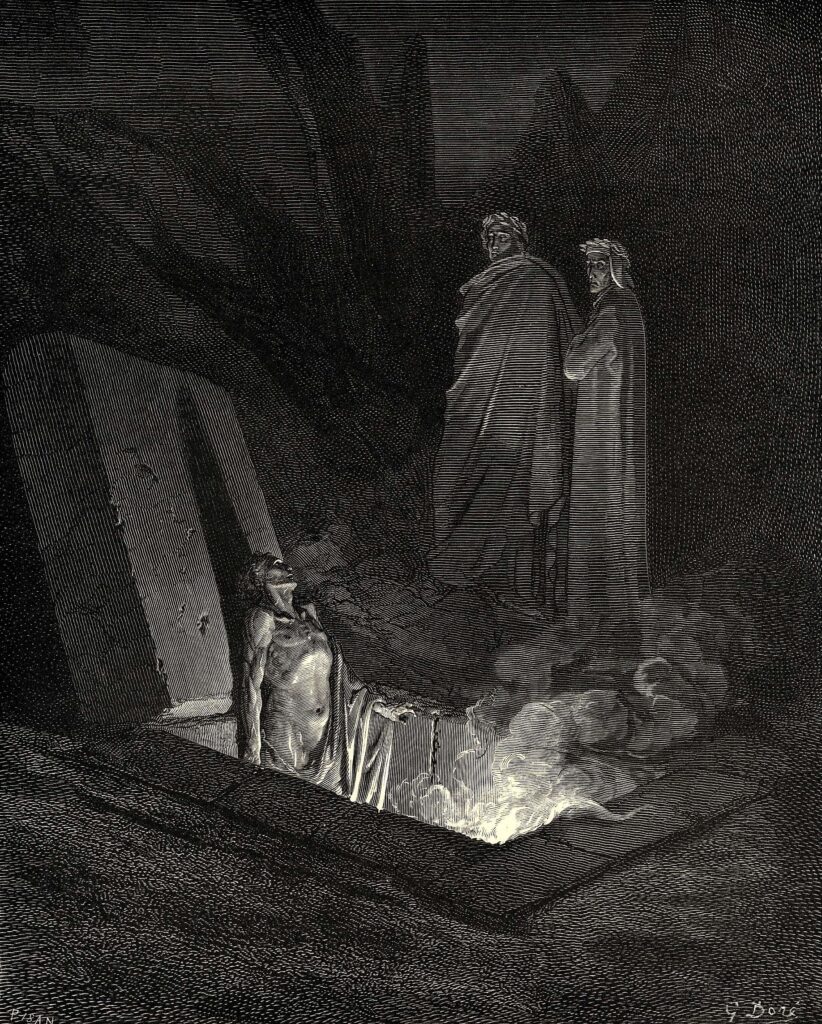
Doré Woodcut, Divine Comedy, credit Wikipedia
Virgiliana
The Cambridge Companion to Virgil (2nd Ed.), edited by Fiachra MacGorain and Charles Martindale, Cambridge University Press: 2019. Pp. i-xvi,1-549, reviewed by Darrell Sutton
Arguably the most illustrious writer of Latin literature, Virgil’s classic, the Aeneid, is central to studies of ancient epic. The popular words arma virumque cano (I sing of arms and the man) resonate in every generation. Many people have been to war but few combatants composed melodies depicting their adventures. Other than Homer, had anyone sung of conflict like Virgil? Homer became Virgil’s model centuries later when he composed his Roman tale of quest and conquest, one filled with Gods who proved to be both baneful and benevolent in their dealings with mankind.
The lifeblood of warriors was poured forth in line after line of the Aeneid. It tells of Rome’s history. Although her legends and myths are rendered in an unfinished account, the Aeneid’s rhythms have been scrutinized countless times by expert and layperson alike. Virgil produced other literary creations. Some writers in the past believe he authored Appendix Vergiliana; some do not (see S. Mcgill’s skeptical but erudite paper (chapter 4) on all the pseudepigrapha).
Virgil was grateful to Augustus for restoring to him his lands. And the Bucolica show his gratitude and his interest in pastoral landscapes. Several poems are dedicated to individuals who were of significance to Virgil. The shepherd’s vocation is extoled; the Muse’s love of woodlands is noted at Ecl.I.2. However, some still believe that his Georgics are the best work that he composed, dealing with various departments of farming. Didactic in style, these four poems shine a light on the technics of organic production in bygone days. Daily chores that relate to crop farming, vine plants, herds and bees are described in technical language. Everywhere some type of symbolism finds expression in the poems. Richard F. Thomas averred that “the Georgics is perhaps the most difficult, certainly the most controversial, poem in Roman Literature…” (Virgil: Georgics, Vol.1, Cambridge Press: 1988; p.16). Continue reading



Home is over Jordan
Colin Jordan and Françoise Dior, credit National Vanguard.org
Home is over Jordan
Failed Führers ; A History of Britain’s Extreme Right, Graham Macklin, Routledge, London & New York, 2020, reviewed by Leslie Jones
Introduction
Failed Führers presents portraits in writing of ‘six principal idealogues and leaders’ from an evolving British Fascist tradition, namely, Arnold Leese (1878-1956), Sir Oswald Mosley (1896-1980), AK Chesterton (1899-1973), Colin Jordan (1923-2009), John Tyndall (1934-2005) and Nick Griffin (1959-). Graham Macklin thereby highlights the pivotal role of key individuals who enabled the far right to adapt to changing historical circumstances. For as Professor Macklin contends, there has been ‘continuity and change within the British fascist tradition’. Both pre and post war British fascists posited the preordained role of the white race and a Jewish conspiracy to engender white racial defilement. Mass immigration from the West Indies (100,000 in 1960 alone) only increased the salience of anti-black racism in neo-fascist ideology. Then in response to mass immigration from the Indian sub-continent, the BNP under Nick Griffin grafted anti-Muslim populism onto a pre-existing racial nationalist ideology.
Compared to a more conventional chronological or thematic historical perspective, Macklin’s ‘collective biographical’ approach or ‘prosopography’ has its downside. The careers and lives of his six key figures overlapped, so there is some repetition of material. Continue reading →
Share this:
Like this: