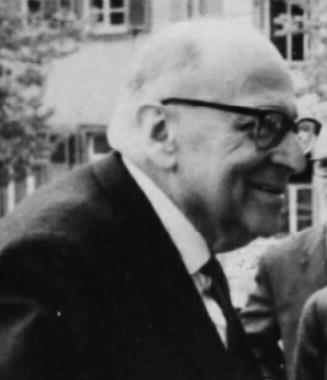
Colour (and culture) clashes

Colour (and culture) clashes

ROBERT HENDERSON reviews a global survey of racial and cultural confrontations

Ethnic Conflicts

Tatu Vanhanen, Ulster Institute for Public Research, 326 pps, £23 hb, £18 pb

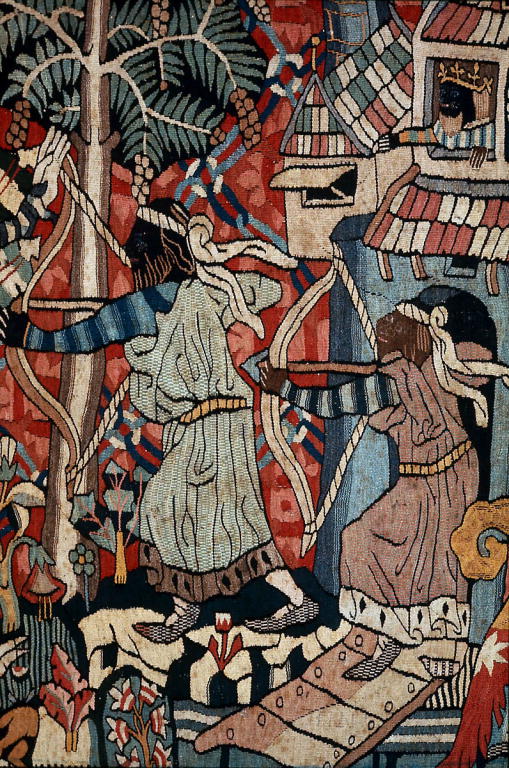
Detail of Wild Men and Moors tapestry CA 1440

This is not a book designed for easy bedtime reading. It is an academic’s work written first and foremost for academics with a fair amount of statistics in it. Having said that, if a prospective reader managed to get to grips with, say, The Bell Curve they should be able to absorb the important messages of Prof Vanhanen’s book and understand how he arrives at them. It is worth making the effort because he deals with the most fundamental sociological aspect of being human: how do we manage the challenges produced by heterogeneous societies?

The Professor’s  first  aim was  to measure the relationship between the ethnic heterogeneity of a society and ethnic conflict. There are considerable difficulties in doing this, not least because what may be thought of as ethnic conflict by one person may be seem by another as conflict based on something else such as class. For example, an ethnic group which is black and poor and rebels against the better off in society who are white (a not uncommon state in Latin America) could be represented as being either ethnically motivated or class motivated. Continue reading

Posted in QR Home | Tagged , , , , , | 1 Comment

Famous last words

Famous last words

PAUL WOOD remembers how past PMs passed

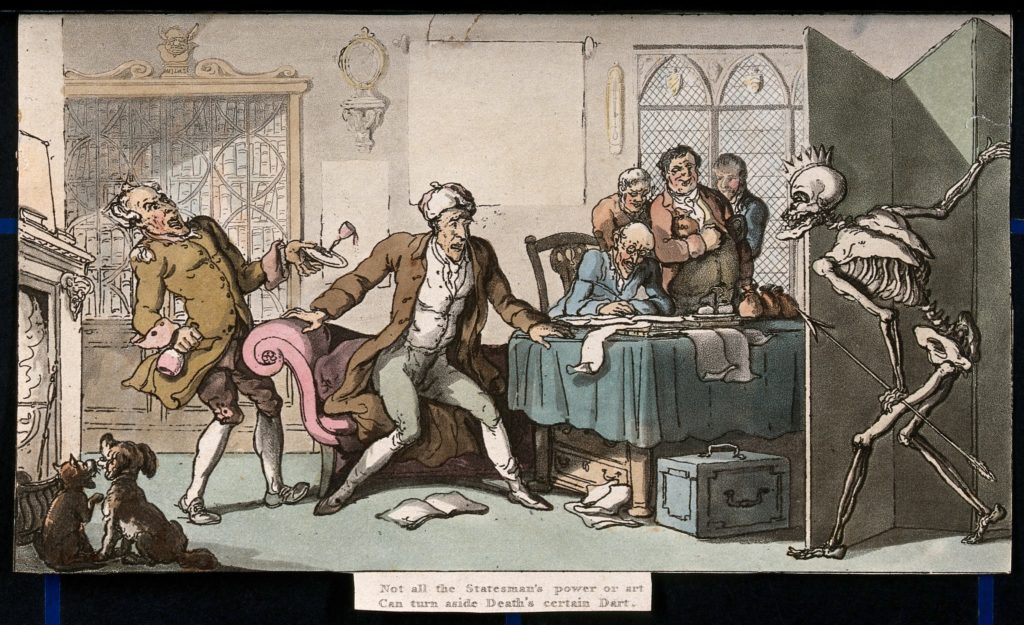
The dance of death: the statesman. Coloured aquatint by T. Rowlandson, 1816.

Margaret Thatcher’s death makes me want to sit upon the ground and tell sad stories of the deaths of Prime Ministers.

The Prime Minister whose death I most often think of is that of Lord Rosebery, for some reason. Most Prime Ministers outlive their eras but few by so much as Gladstone’s successor as Liberal Prime Minister. Lord Rosebery, as he lay dying in 1929, 34 years after he had briefly been Prime Minister, sent his valet to buy a gramophone and one gramophone record. The servants played the Eton Boating Song, over and over again, in the shuttered bedroom, until the earl, forgotten by the world of flappers and moving pictures, was dead.He was only Prime Minister for fifteen months but his life must be judged to have been unusually successful. He once said that he had three aims in life: to win the Derby, to marry an heiress and to become Prime Minister. He achieved all three and won the Derby twice during his brief premiership. I do not know what his last words were and I wonder what were Lady Thatcher’s.

Queen Victoria wanted to do Disraeli the honour of visiting him in his sickbed but he declined the honour with what were said to be his last words:

Why should I see her? She will want to give a message to Albert.

He had fawned on the Queen for years, but now saw no reason to continue in articulo mortis.

Another version of his last words is:

I had rather live but I am not afraid to die

but they sound to me as if written for public consumption. While he lay dying, although he had converted to Anglicanism as a boy, he was heard to murmur a Jewish death prayer.

Sir Henry Campbell-Bannerman’s last words were

This is not the end of me.

George Canning’s last words were:

Spain and Portugal.

William Pitt the Younger’s were

Oh my country! How I leave my country!

Or alternatively:

How I love my country!

His nephew, James Stanhope, who was at his deathbed, is the authority for the latter version and is a better authority than Disraeli, who may have originated the widely believed story that Pitt’s last words were:

I think I could eat one of Bellamy’s pork pies.

Lord Palmerston’s last words are said to have been:

Die, my dear Doctor? That’s the last thing I shall do.

But this, though very well known, is not well sourced.

Lord Derby’s last words convey aristocratic disdain:

Bored to utter extinction.

Chamberlain’s last words also seem to convey the character of the man:

Approaching dissolution brings relief.

He was diagnosed with bowel cancer just after he left office. Had he lived in good health he would have run the home front but he would have remained leader of the Conservative Party and therefore shared power with Churchill.

Shortly before his death, Chamberlain wrote an apologia pro vita sua in a letter to Sir John Simon:

…it was the hope of doing something to improve the conditions of life for the poorer people that brought me at past middle life into politics, and it is some satisfaction to me that I was able to carry out some part of my ambition, even though its permanency may be challenged by the destruction of war. For the rest I regret nothing that I have done & I can see nothing undone that I ought to have done. I am therefore content to accept the fate that has so suddenly overtaken me.

What a terrible hand Chamberlain had to play and how should he have played it?

He was a Unitarian, but he, along with Bonar Law and Clement Attlee, neither of whom believed in God, are the only three twentieth century Prime Ministers to have been buried in Westminster Abbey.

Poor Spencer Perceval’s last words were to the point:

Oh, I have been murdered.

He was a good, able man and would have been a fine Prime Minister had he not been killed. He should win modern day approval for coming from a much more obscure family than Messrs. Cameron, Clegg and Miliband. A book came out last year about the murder. He would probably have held office for as long as, after his assassination, Lord Liverpool did and therefore for longer than Mrs. Thatcher.

Sir Winston Churchill’s last words were:

I’m bored with it all.

On his last birthday, Churchill said to his daughters:

I have achieved much to have achieved nothing at all.

I think this might be the judgement of history.

PAUL WOOD is an English writer living in Bucharest. This article first appeared on his blog  – http://pvewood.blogspot.co.uk


Posted in QR Home | Tagged , , , , , , , , , , , , , , | Leave a comment

Twentieth century sociology – made (mostly) in America

Twentieth century sociology – made (mostly) in America

STODDARD MARTIN traces the American origins of
European social research

Transatlantic History of the Social Sciences: Robber Barons, the Third Reich and the Invention of Empirical Social Research

Christian Fleck (2007), trans. Helen Bleister (2011), London: Bloomsbury Academic, 2011, 256pp., US$65

After World War I, the Rockefeller Foundation (RF) distributed bounty in Europe to develop institutes, projects and seats in universities for study of those social matters gradually separating out into disciplines of psychology, economics, political science, social anthropology and sociology proper. Largesse was dispensed in a spirit of philanthropy typical of the progeny of ‘robber barons’. The Carnegie Foundation joined the RF in this pioneer work; neither was in bed yet with the US government, though both operated in harmony with Wilsonian ideals of a league of nations (which a conservative US Senate rejected) and Hooverian initiatives to feed, re-house and renovate lives of millions on the war-ravaged continent. Since much of the displacement/devastation had been in the centre of that continent and, as the Dawes Plan simultaneously recognized, the core of that centre was Germany (and to a lesser extent Austria), it is where the best efforts were focussed.

Money was spent, perhaps not quite consciously at first, to Americanize Germanic methods. Use of survey, interview and collection of data were introduced to buttress theory; collegial projects to supersede the Word of individual ‘genius’; democratized departments to supplant traditional cults of the magisterial professor. Reduction of Austria to a rump following the collapse of the Hapsburg empire made recruitment of interested academics there easier than in Germany proper – the Weimar Republic had inherited university structures largely intact from its Wilhelmine imperial predecessor. Nonetheless, German sociology, with traditions deriving from Max Weber among others, was soon penetrated by American interests too. Friends were made and scholars financed to travel to American universities, develop new programmes in their own or both. Being ostensibly non-political, initiatives carried on into the first years of Nazi power; then the darkening situation, especially after Anschluss in Austria, shut down and/or transplanted them to the States, where scores of German and particularly Austrian academic friends fled, Jews naturally prominent among them.

Among programmes that grew up coincidental to or in consequence of this process was the Princeton Radio Research Project (a misnomer, as it was run out of Newark and later Columbia Universities). Paul Lazarfeld was its head, its most famous contributor the sociological writer who styled himself Theodore Adorno. These two egotistical, sporadically paranoid émigrés forged an alliance – sometimes misalliance – to bring ‘American empiricism’ and ‘European theory’ together in order to assess the role of the new medium of radio in the lives of its listeners. ‘Who listens, When, How, and What to?’ American sponsors employed brilliant foreigners at half the price of native equivalents; brilliant foreigners penned proposals more and more padded to lure maximum dollars out of their hosts – a habit already formed by some in Europe during the pre-Nazi phase. One commentator would describe Lazarfeld as a “con-artist”; certainly Adorno capriciously pursued his own star, cultivating an old European profile as ‘genius’ to the extent that a credulous New World would allow. Setting these Machiavellian motives aside, what was accomplished?

Theodor Adorno

Quite a bit, it would seem, in analysis of effects and what was likely to cause them. Now familiar techniques were developed: panels of listeners, button-pushers and what we call ‘focus-groups’ to gauge what types of music were likely to lull, stimulate, infuriate or be turned off, or what types of voices would best appeal – the latter spelling an end for the intellectually superior type, the know-all, the stuffed shirt and the grumbler.

Beyond music and its commentators, such diagnostics aided in development of political prognostication – Gallup, Roper and Daniel Bell all worked on the fringes of the programme from time to time. General effects of media began to be predicted with as much acuity as by their contemporary magicker back in Germany, Josef Goebbels. Results could be provoked, Adorno would later remark, “according to the ideal of a skilled manipulation of the masses” with self-evidently “exploitative” or “benevolent” consequence.

The era of mass advertising and mass ‘fads’ was simultaneously growing up, with proliferation of new professions feeding it. The US War Information Office became involved; the RF was eclipsed as premier funder by the American Jewish Congress (AJC). Max Horkheimer became maestro of huge investigations into the nature of the authoritarian personality and typologies of anti-Semitism. Preferring California to New York, he manufactured health excuses to shift the centre of gravity west; Adorno attached himself to his burgeoning équipe, as did from time to time other ‘stars’ such as psychologist Erich Fromm and Marxist/Freudian philosopher Herbert Marcuse. New purpose suffused once supposedly objective research – there emerged a fine sense of The Enemy and of mentalities to be re-formed, if not extirpated, or at least marginalized. Horkheimer saw himself as directing a social research organization analogous to the scientific one developing the atomic bomb at Los Alamos; the shift in world morality it advanced, towards zero toleration of racism and prejudice, would arguably become a more potent force in post-war history.

If the cause was just, many of its promoters were all too human. Christian Fleck’s account of Horkheimer and Co. sometimes recalls the famous quip about academic disputes made by another émigré promoted via Rockefeller largesse: “The reason they are so vicious is because so little is at stake”. But Kissinger’s wit is not in Fleck’s bag of tricks. He plunges us into tables comparing salaries, publication rates, recognition status – measures that today boil down to the number of clicks a name gets on the net. Possibilities for distortion were present then as now. On collective publications, which most projects spawned, the author listed first often became the one it was known by; thus Adorno’s profile was artificially raised. Networking helped, not least among émigrés, especially those associated with the RF or AJC; elements of European prejudice persisted, Germans whether Jewish or not displaying traditional de haut en bas towards Czechs, Romanians or refugees from other ‘less advanced’ cultures. Vienna was top among origins for some, despite or perhaps because of that place’s dramatic decline; among those combating ‘the authoritarian character structure’ or ‘psycho-dynamics of anti-Semitic disease’, it was not hard to spot traits that might have jumped off a page of Elias Canetti’s 1936 novel about the city’s un-sacred monsters, Die Blendung (Auto-da-Fé).

After World War II, many players went back to Europe, either with sponsorship or by choice or both. The RF by now was working in concert with U.S. government agencies, as were Carnegie, Ford and other foundations; occasionally, as Frances Stonor Saunders showed in Who Paid the Piper? (2001), they operated as fronts for schemes directed by the CIA. From initial post-war days of the Control Commission in Berlin, planning and implementation of a new world order progressed. Techniques of the diagnosticians were applied: profiling, acquisition of assets (i.e., competent, loyal friends), re-education. Social sciences, seen as having suffered more than any other individual disciplines under Nazi rule, were ‘rebuilt’, though in Austria they were allowed to slide back into a pre-war condition, Americans apparently believing a self-serving native line that that country had been ‘the first victim’ of Nazi expansion. Proud as some were to have come from Vienna in the first place, few were eager to return to the rump of a heimat, ensconced as they now were on cushy American campuses.

As Germany prospered, its homecomers increased. By the early 1950s Friedrich Pollock, Adorno and Horkheimer himself were back. Frankfurt was chief beneficiary of the reflux; its Institut für Sozialforschung re-arose. Berlin was another: by the Sixties, it boasted the Max-Planck Institut für Bildungsforschung. Women ranked low in these new citadels of social engineering, nor had all the old vices vanished – hyper-reverence for authority, theory and ‘genius’. But data collection was now implanted in the system, modes of analysis imported and refined, tools by which to  bolster a new ‘social market’ economy and order, user-friendly, open to continuous modification, embedded with and within desires and anxieties of a ‘reoriented’ Volk. What ‘robber barons’ had incepted, a new Europe inherited. Since as early as 1913 American per capita GNP was 50% higher than that of developed Europe (by 1950 it was double), it is no surprise that the flow should have been in this direction. However, as Fleck points out, by the end of the 20th century the discrepancy was back to a 1913 level and “other indications going in the same direction”. So what now? What to come?

Libertarians and radicals fret. Thirty or more years ago as the above process proceeded, rhetoric could be heard in the States about the supposed hegemony of the Trilateral Commission, a group set up by David Rockefeller to bring together leaders from the then most powerful nations: the U.S.A., rebuilt Europe and Japan. Disquiet was voiced about how this directorate shaped events, advancing its protégés Carter and Bush at home and equivalents abroad. Who rules the world, it was asked, and to what end? In those days it was defeat of Communism, which succeeded. But afterwards? Some wonder still: who advises our masters? What scientist-geniuses are employed by Metropolis-style bosses to maintain sway over the suggestible mass? How different is their mentality of control from that which devised bread and circuses for denizens of totalitarian states we opposed, how much less eager to root out an enemy within? Doesn’t mentality of control carry bacilli of paranoia in it? Didn’t the sociologists of Fleck’s study flourish in an era that also produced Joe McCarthy?

It was an era sufficiently ‘plastic’ – i.e., opposed to man’s organic nature and freedom – that male babies were customarily mutilated – i.e., circumcised – on hygienic grounds later found to be bogus. Along with their younger sisters, they were fed on powdered formula in preference to breast milk so their mothers could preserve whatever in padded push-ups to rise to a level of desirable womanhood as advertised by iconic Ja(y)nes, Russell and Mansfield. No wonder the 1960s brought revolt in the form of bra-burning, let-it-all-hang-out hippies, descendants of Nietzschean Wandervogel and Kibbo Kift kindred of the European 1920s. But the drive to assess and direct individual activity in the name of social cohesion, order and marketing carried on, made easier finally by mass tracking of credit card transactions, Oyster travel and personal e-mail. It is after all an instinct as old as the king or his spies going in disguise among the people to hear their complaints and deal with them.

Libertarians know that cherished freedoms can only be protected by perpetual vigilance. Our present masters and their social diagnosticians preside over a world in which a perhaps unforeseen consequence has been to generate an echelon of individuals whose principal urge is to evade, slip out of the net, hide away, change locale and/or identity, adopt a low profile – do whatever is necessary to pass under the radar of what for them has come to seem a near universal control industry. Totalitarian China is this new age’s premier success story; yet it must co-exist with a rival phenomenon equally characteristic of the age – the neo-robber barons, oligarchs, tax-haveneers, commodity speculators and their unwitting (perhaps witting?) foot-soldiers: terrorists who shelter in a proliferating list of ‘failed states’. What answers do the messianic data-gatherers and mind-benders have in this situation for we simple bürgers, if any of us honestly still exist?

Dr. STODDARD MARTIN is the author of numerous books on 19th and 20th century thinkers

Posted in QR Home | Tagged , , , , , , , , , , , , , , , , , | 1 Comment

Waving goodbye to Maggie

Waving goodbye to Maggie

PAUL WOOD remembers the remarkable woman who shaped his generation

I felt very old when I read an interview this morning with Margaret Thatcher’s nemesis, Michael Heseltine, and saw that “Tarzan” is now 80. And now, the news that the grand old lady herself, the Great She-Elephant, She Who Must Be Obeyed, Tina (There is No Alternative) has finally died.
Apparently patients in Britain who suffered from amnesia, senility, delirium or schizophrenia, when they were unable to remember the names of their children or spouses nevertheless recognised her name. People dreamt about her as frequently as they dreamt of the Queen or members of the royal family, which British people do very often. She was part of my generation’s collective subconscious, part of the very fibre of our being, whether we liked or loathed her.
I disliked Mrs. Thatcher when she was in power very much, mostly because of unemployment and her economic policies and partly because she was not at all a social conservative. I still think, though I was wrong on a number of things, that Britain’s relative economic decline, compared to other developed economies, was not very significant, though I understand much better now why people at the time thought it was. I suppose if enough people thought it was then perhaps it was, but I am still relaxed about the fact that the English were, before Margaret Thatcher, less concerned about getting on and hard work than the Americans and Japanese.
I still have doubts about privatisation and certainly about using the proceeds for tax cuts, but privatisations worked far better than I expected. So did tax cuts. It was unemployment that cowed and broke the unions, but though this was terribly sad they needed breaking. I see now, but did not then, that tax cuts were needed to reduce state power – unfortunately, that battle seems lost these days. The poll tax was a terrible idea, as I knew it would be before it was even mooted. Rates were the perfect tax, but I drove Essex Man crazy with self-righteous fury  by saying so.
Mrs Thatcher was in many ways a classical liberal, as her so-called “wet” opponents within her party alleged, but she most of all represented what Salisbury called “villa Toryism”. A good thing too in many ways but without always a feel for the working class or the poor, at least up North and in Scotland, though millions of working class people loved her very much.
But overall how much better things were when she was Prime Minister – no devolution; far fewer powers given to the EU (though she agreed to majority voting); 50,000 immigrants entered the UK a year instead of large multiples of that now; hereditary peers; far, far fewer laws and far more freedom, especially freedom of speech. Parliament stayed up till the early hours for key debates and was not merely a rubber stamp for governments; there were about 26 women MPs, which seemed normal, and family-friendly Parliamentary hours had not been introduced. Although things were already very politically correct, a phrase that had not been coined in her day, people smoked in pubs and could do a hundred other things our liberal-authoritarian masters no longer allow.
She was not socially conservative at all – encouraging women not to go to work would have cut male unemployment. My main reason for admiring her now is all the laws she would not have brought in, on press regulation, hate speech, discrimination, unfair dismissal and all the whole caboodle.
In the 1970s, as a young boy, I knew England needed a De Gaulle, but completely failed to see she was our De Gaulle (the difference being her loyalty to America). Her willingness to follow America in almost everything always irked me but she was not the stuff lapdogs are made of. Mr Blair was.
She was right about the Cold War, though I winced at her and Mr. Reagan’s speeches. She was right about the enemy within, but presided over a period when the Left took education and academia further Leftwards than they had every been. She was right about Europe but signed the Single European Act, which gave up the requirements that decisions of the EEC require unanimity. She was right to go to war with Argentina but had she not said she would scrap HMS Endeavour I doubt if the invasion would have happened. (I urged the MP I worked for to ask questions about HMS Endeavour before the war started.)
I thought the Rhodesian settlement a great achievement but the Foreign Office fooled her into thinking Nkomo would win the elections and instead Mugabe did. She was right to want to reduce immigration from the 50,000 a year which made people, she said, feel “swamped” but failed to do so.
The Guardian editorial pays tribute to her but ends on this note:
Her legacy is of public division, private selfishness and a cult of greed, which together shackle far more of the human spirit than they ever set free.
I think socialists had convinced the English for a generation that enterprise and individualism were greedy and selfish, so that when they became enterprising and individualistic they felt gleefully amoral or else guilty, when in fact they were being moral. I remember my shock in about 1989 when, reading the  volume on Chaucer in the old Macmillan’s English Men of Letters series the writer pointed out that in Chaucer’s age as in every age the English were enterprising. I did not want to hear this but the English always were enterprising, rather as we now think of Americans, until the mid-20th century. The 1970s were arguably a more selfish decade than the 1980s, with endless strikes and at one point the dead unburied. Selfishnness, though, you have always with you.
I heard her speak innumerable times. Margaret Thatcher’s greatest defect was her lack of eloquence. She did not have the words to make her ideas seem socially concerned or expansive, when in fact she was a moralist and hers was a moral crusade. As she once said,
Economics is only the method. I want to change people’s souls.
She was the only good looking woman MP in her day and, though I was never attracted to her, most MPS were. I often saw her when I worked in the House of Commons and the House of Lords. She had very good legs and a generous bust. Mitterrand is supposed to have said she had the eyes of Caligula and the mouth of Marilyn Monroe, though, according to the very reliable Charles Moore, Lady Thatcher’s official biographer, what he really said was ‘the voice of Marilyn Monroe and the eyes of Stalin.’
I only met her once, when I was eight, when my father took me to the Houses of Parliament and I got lost looking at coins on display on the walls. She found me, took me to my father and showed us various coins that were not on public display and then the Members’ Terrace. I knew who she was because at eight politics was my passion. She was the shadow Education Minister and soon to take away free school milk.
My father wanted to take me up to see Winston Churchill’s state funeral (I was three) and I shall never forgive my mother for dissuading him. He went alone and I watched it on television which does not count, especially as I do not remember it. The first death of an English Prime Minister I remember is therefore Anthony Eden’s in 1977. I clearly remember that evening, walking home from school, thinking of that forgotten old man, living in Jamaica, his reputation in shreds because of Suez, for whose death Parliament would adjourn for a day. The child is father to the man and I was a born historian. 1977 is a long time ago. Still, Jerry Brown is Governor of California and I was two years below Hugh Laurie at university so I am still young. Young-ish. For how people are rejoicing at her death, click here.
Finally, a footnote. (I love footnote knowledge.) Mrs. Thatcher invited Jimmy Savile to Christmas dinner at Chequers every year. What fun those dinners must have been.
PAUL WOOD is an English writer living in Bucharest. This article first appeared on his blog
Posted in QR Home | Tagged , , , , | Leave a comment

On “Orientalism”

On “Orientalism”

HENRY HOPWOOD-PHILLIPS revisits Edward Said’s famous post-colonial polemic and finds it seriously wanting

In 1963 Dr Abdel-Malik caused shock waves in the field of Oriental Studies when he claimed that it was

‘Europocentric’, paying insufficient attention to the scholars, scholarship, methods, and achievements of the Afro-Asian world; [Orientalists] are obsessed with the past and do not show sufficient interest in the recent history of the ‘Oriental’ peoples

Fifteen years later Edward Said developed the idea that “an accepted grid”, a historical stream of consciousness full of preconceptions and assumptions “filtered” experience of the “Orient into Western consciousness”.

He maintained that Nietzsche’s idea of the will to power applied to Western enquiry and that a narrative and praxis had evolved that affected the structures of knowledge. If Cuvier was correct in asserting that philosophy is “instructing the world in theory”, then Said was right in maintaining that the Orient was “less a place than a topos”; a topos that was essentialist, racialist, patronising, and ideologically motivated.

However, Said’s impressive thesis, so compelling and valid at many levels, seems to be a net spread too thin and wide to constitute a meaningful critique. M. H. Kerr commented

In charging the entire tradition of Oriental Studies with the sins of reductionism and caricature, [Said] commits precisely the same error

a fact that has inspired a whole new literature about Orientalism’s partner in crime: Occidentalism, a subject that in turn is

at least as reductive; its bigotry simply turns the Orientalist view upside down. To diminish an entire society or a civilisation to a mass of soulless, decadent, money-grubbing, rootless, faithless, unfeeling parasites

The thesis, in its attempt to graft a static Western historiography on to the dynamic reality, also encourages the East to set itself up as static too. So, instead of static and backwards, radical Islam prefers to present a reverse of the coin. Islam is static in a good way, it argues: it has a single, perfect, unchanging essence that is morally and spiritually superior.

These are little more than academic quibbles, however. More significantly, Said’s argument just does not fit the history and geography that it claims to unlock. A more honest description of his thesis might be “France, England and Arabia – An Identity Question in the Age of Imperialism”. For geographically, Said excludes all of North Africa west of Egypt, most of Persia, Turkey and Afghanistan – a large part of the Orient. Europe fares little better – Germany, Spain and Italy are ignored for all intents and purposes simply because their historical behaviour does not fit.

Historically-speaking, describing everyone as an Orientalist between Herodotus (484-425 BC) and Postel (AD 1510-81) is at best anachronistic and at worst to fall into the trap of presentism. The Byzantine Empire and its constituent Balkan territories are not accounted for in this simplistic binary formulation. And institutionally, there was little or no homogeneity to Oriental Studies, instead

[it] is mostly a story of individual scholars, often lonely and eccentric men

Said alleges that the very ontological basis of the East and West dyad is arbitrary. He states that

The Orient is [then] corrected, even penalized, for lying outside… [and] is thus orientalized

The reality is less dramatic. The term “Orient” meant the direction from which the sun rose for most of the inhabitants of the Western Mediterranean. D. M. Varisco makes it clear that

The distinction between East and West is in its origins relational, not essential

The Orient’s first Western visitor whose works are still extant was Herodotus, a man from a people who had no name for themselves (only one for those they could not understand) and who adored the Phoenician alphabet, Lydian coinage and Egyptian sculpture.

He admired the Orientals but despised the Thracians and Scythians that lay on the Northern marches, earning the sobriquet “barbarophile”. According to Said, Herodotus conquered the Orient by visiting it and writing about it – in stark contrast to the Persians who espoused a model of international relations that resembled China’s Sinocentric system. Foreigners were dismissed as anarya, non-Aryan, and the spectacle of them conquered and in chains was immortalised in stone at Persepolis.

The Islamic invasions of the seventh century that broke up the Roman Mare Nostra “…move[d] the centre of European culture away from the Mediterranean… towards the North”, as Henri Pirenne had earlier observed. The Christians were attacked by the victorious new faith for believing that God could assume a temporal form; that God could die on a cross; for believing in three gods. The Christians on their part mocked the sensuality of polygamy, Islam’s violence and Mohammed’s failure to perform miracles.

From the reign of Abd al-Malik (r.685-705) when the oppression of Christians in the East commenced, to Erasmus in the early sixteenth century, the West toyed with ideas about itself and Islam but no stable themes emerged. Instead countless balls were juggled. Peter the Venerable’s prologue to Sect of the Saracens told the infidel

I approach you not with arms but with words; not with force but with reason; not in hatred but in love

Aquinas cited Averroes five hundred and three times in his Summa contra Gentiles. The crusades brought both religions into closer contact and resulted in books like William of Tripoli’s Tractatus de Statu Saracenorum (1273) which suggested Muslims weren’t really much further away from salvation than the average Christian, and Ricoldo de Monte Croce’s idea that virtuous Saracens could be used as examples to whip intransigent Christians into line. The most famous epic of Christendom, the Chanson de Roland, commemorates defeat, not victory; makes Charlemagne out to be semi-blasphemous (the war is ‘his’ cause not God’s); and includes the line “Were he [Saracen King Marsilion] but Christian, right knightly he’d appear” thus utterly trivialising his “otherness” to the point of being perceived as a potential paragon of the West had he not held the religious views he had.

Said attacks Dante for being a proto-Orientalist i.e. being complicit, conscious or otherwise, in constructing the prejudicial prism through which all Western scholarship has since been skewed. Yet Dante in spite of his reputation as a canonical “European” did not much care either way about Islam. He thought (erroneously) that Mohammed had been a Christian who had gone astray and certainly did not see him as some ghastly ‘other’. Again, he viewed Saladin, Avicenna and Averroes as virtuous pagans rather than irreconcilable enemies. Miguel Asín Palacios even claimed Dante to be sympathetic (and knowledgeable) enough about Islam to have modelled his celestial journeys on Isra and Miraj (the Islamic night journey texts) and Ibn Arabi’s plan of paradise.

As for the roots of essentialism and otherness, it was Islamic jurists in the early eighth century who formulated the great geopolitical divides of Dar al Harb (realm of war) and Dar al Islam (realm of Islam). It was Islamic governors that enforced gradations of “otherness” from ahl al kitab (people of the book) to the even less fortunate godless Sabaeans, within a framework of dhimmi-tude. If a sense of otherness did not manifest itself on an occidental scale (other than words such as ‘frangi’ – Franks) it was because Muslims were like most other peoples in history:

It was the Muslims who were being normal, the Europeans who were not being normal. Not being interested in other cultures or even despising them is the normal state of mankind.

Meanwhile in the West knowledge of Islam was in decline. R. W. Southern notes that Christendom in the fourteenth century knew less about Islam than it had in the twelfth.

Said makes a point of announcing Orientalism’s ‘formal existence’ with the decision of the Church Council of Vienne (1312); however, its decree was a dead letter. The teaching of Arabic was supposed to be funded by extra ecclesiastical funding but it never happened.

During the Renaissance, European interest in the Orient flagged. This was mainly due to (a) the fact many scholars were coming to realise that Arab-Latin translations of Greek works were of a very poor quality; (b) the disaster of the Fourth Crusade (1204), and (c) the fact pilgrim accounts were becoming anodyne and formulaic. Interest did not peak again until Islam resumed the offensive. In 1453 Constantinople fell, then Belgrade (1521), and Rhodes (1522). The Hungarians lost at Mohacs (1526), Vienna was besieged (1529), Cyprus fell in 1571, Crete in 1669, and Vienna was besieged again in 1683. The sixteenth century was the great age of Islamic Empire: Mughal, Safavid, Mamluk and Ottoman dynasties carved out their realms and Europe shuddered.

If the West as a self-conscious identity (and therefore the Orient a corollary ‘other’) has a father-figure, then Thomas More (and his continental equivalents) with his pleas for peace between Christian princes and solidarity against the Turk (at a time when the printing presses were turning out copies of Sir Thomas Malory’s ode to chivalry, Morte d’Arthur) did more than anybody else to make Europeans realise their distinctiveness and their geopolitical context. However, the Reformation for the most part restricted the West’s attention to itself.

But significantly geopolitical concerns trumped this nascent identity. Said fails to refer to Francis I’s alliance with the Sublime Porte or to Elizabeth I’s request for an alliance with Murad III or to German overtures to the Ottomans in the early twentieth century. These were attempts to deploy the Turks as if they were just another pawn in a great game, a strategy that led directly to the admission of the Ottomans into the Concert of Europe in 1856.

If there is a certain triumphalist strain to European history that presents its past as a seamless story of progress, it had to be invented post hoc. The story of Orientalism between 1500-1700 is an extraordinarily amateur one. It is full of characters such as Guillaume Postel, who believed that speaking Hebrew would return mankind to pre-Babel bliss; men like Edmund Castell, who died a half-blind pauper trying to increase knowledge of the Orient for knowledge’s sake; and orientalists such as André Du Ryer and Antoine Galland, who believed that an international canon of literature could be established and that it would be all the richer for containing The Thousand and One Nights. It was the age in which the Ottoman threat was contained and the New World was won.

Said’s myopic emphasis on British and French perceptions of the Orient blinded him to how the focus of both was actually on each other rather than on the Orient. If anybody was corrupt, despostic and licentious, then France was certainly that Other”.

To the Imperial powers, America, then India and then the Levant were venues of power-struggles rather than targets of conquest in their own right.

During the Enlightenment period, Comte de Boulainvilliers used Mohammed as a stick to bash the Church and Establishment with his Vie de Mahomet. Voltaire praised the prophet as a great, cunning and bold leader; he thought class lines were more conspicuous than civilisational labels. Despotism was removed from the Muslim’s innate baggage and designated as geographically determined according to Montesquieu and a classical category (and therefore universal) according to de Volney. When the leading thinkers of the Age encountered Muslims, Thomas Hope’s (1770-1831) reaction is quite typical:

The Turk, where bigotry interferes not with his better feelings is as charitable as he is confiding

This was the Age in which Napoleon as a sort of ‘textual agent’ is meant to have been led limply by the puppet strings of Western tradition. His project apparently “acquired reality in his mind” from “ideas and myths culled from texts, not empirical reality”, or, more mundanely, he was put under pressure by Marseilles lobbies to secure a market in an age of mercantilism and considered that militarily Cairo was an ideal regional lynchpin from which the French could pivot to Constantinople or Delhi.

Said likes to represent de Sacy as a sort of arch-villain who orchestrated the dark epistemological affair that was destined to end in colonisation but as R. Irwin notes,

For a long time there was no cohesion in the world of the Orientalist. Their first Congress took place in Paris only in 1873… largely the province of enthusiastic amateurs… not systematically refereed. The bulk… consisted of texts, their attempted decipherment or translation. There was little in the way of analysis or synthesis.

Said’s polemic also fails to address the tensions and contests between intellectual factions in the West. If some Westerners had Orientalist agendas (in the pejorative sense), others such as E. W Lane (1801-1876) were genuinely immersed in Oriental societies. If John Dowson’s The History of India as told by its own Historians (1867) received support from the Secretary of State for India, it was also deemed by its critics to have disseminated “not a few inexactitudes” as well as “some false and distorted history”.

What Said labels as Orientalist seems, more accurately, to have been the Western aspiration and attempt to make its knowledge acultural i.e. universal. Behind this universal claim to knowledge, he discerns a universal claim to power: “world history, a euphemism for European history”, he comments.

Yet as historian Sadik al-‘Azm has observed, if all cultures naturally distort others then the Occident “is behaving perfectly naturally and in accordance with the general rule”. D. M. Varisco agrees: “if objectivity is to be defined only as virginity” then knowledge suffers from a form of Midas touch.

Whilst everybody can agree that knowledge is socially constructed, the West seems to have lacked a consistent enough agenda for commentators (including E. Said) to be able to refer meaningfully to a schematisation.

And today, in a world in which radical Islam and Western modernity ostensibly clash, the reality is more opaque. Islamic civilisation as a living entity seems to have disappeared, and Western civilisation seems to have lost its specifically European character. If Orientalism ever had currency, which is doubtful, it has certainly been one of the first casualties of globalisation.

HENRY HOPWOD-PHILLIPS works in publishing

Bibliography

i) Orientalism, E. Said, 1978

ii) Reading Orientalism: Said and the Unsaid, D. M. Varisco, 2007

iii) Contending Visions of the Middle East, Z. Lockman, 2004

iv) Islam in European Thought, A. Hourani, 1991

v) Islam Obscured, D. M. Varisco, 2005

vi) From Babel to Dragomans: Interpreting the Middle East, B. Lewis, 2004

vii) Orientalism Revisited: Art, Land and Voyage, Ed. I. R. Netton, 2013

viii) Lust of Knowing: The Orientalists and their Enemies, R. Irwin, 2006

ix) Occidentalism, I. Buruma & A. Margalit, 2004

x) The Song of Roland, Anon., (Trans. D. L. Sayers), 1957

xi) Islam and the Divine Comedy, M. A. Palacios, 2006

xii) http://www.nytimes.com/books/99/10/03/specials/said-orientalism.html (J. H. Plumb, 1979)

xiii)https://www.amherst.edu/media/view/307584/original/The+Question+of+Orientalism+by+Bernard+Lewis+%7C+The+New+York+Review+of+Books.pdf (B. Lewis, 1982)


Posted in QR Home | Tagged , , , , , , , , , , , , , , , , , , , , , | 1 Comment

The Rise of UKIP and the Right

The Rise of UKIP and the Right

ALASTAIR PAYNTER wonders whether UKIP is now the real conservative party

The assumed certainties of national politics have in recent times begun to look rather less assured. The stolid three party status quo is under increasing pressure from the United Kingdom Independence Party (UKIP), a party which has successfully made the transition in the public’s perception from a single issue organisation to a refreshing alternative for those dissatisfied with the current mainstream choices. The evidence of this shift in public opinion had been present in polls for some time, but it only achieved some concrete affirmation of its existence in a succession of by-elections. In 2012, the party’s respective candidates finished second in Rotherham and Middlesbrough and third in Croydon. The recent Eastleigh by-election witnessed UKIP’s strongest performance to date, with candidate Diane James receiving 11,571 votes, or 27.8% of the vote, coming second behind the Liberal Democrat Mike Thornton’s 13,342 (32%).[i] This latter result is unsettling for the Conservative Party, who previously had looked upon the smaller party with considerable disdain.

In the eyes of many, in UKIP there exists a genuine alternative to the three major parties. Under David Cameron the Conservative Party has undergone a dramatic shift in both emphasis and ideology, to the point where many of the actual Right perceive it to be indistinguishable from the very political forces it is supposed to counter. The Prime Minister’s self-description as the “heir to Blair” hardly invested genuine conservatives with enthusiasm as to the direction the party was taking, yet it seems many still voted Conservative either out of tribal loyalty, or the vain hope that once in power the Tories would revert to their usual selves. Such a reversion has not taken place, and given the complete lack of any policy or initiative which might be called genuinely conservative, many have become convinced that it will never take place.

As a result, the Tory Party has lost an astonishing number of its members. When David Cameron became party leader, membership stood at 250,000. Current estimates place this figure at between 130,000 and 170,000.[ii] Many of these disillusioned Tories have fled to UKIP and leader Nigel Farage has wasted no time welcoming such exiles to his party. The widespread dissatisfaction with politics undoubtedly has a number of reasons. Among these, two perceptions are particularly prominent, both among Conservatives who feel betrayed and among the public at large. The first is that the three major parties are virtually indistinguishable from each other and can only promise a variant of social democracy coloured with their particular hue, be it blue, red or yellow. The second reason is the belief that, as a class, politicians merely represent their own interests and those of the special interest groups to whom the political establishment appears to pander. UKIP’s views on Europe and immigration reflect widespread concerns to which the three major parties hitherto appeared wilfully deaf. For his part, Farage has certainly shown himself to be a man of considerable intelligence and political insight. His prescient and acerbic speeches to the European Parliament and appearances in the media show how far UKIP has come from its earlier days when it was perceived by many, rightly or wrongly, as an eccentric conglomeration of discontents prone to publicity stunts.

Farage’s characterisation of the Conservatives, Labour and the Liberal Democrats as “social democrats” is a rare case of forthright speaking which has been absent from political discourse for some time. Political language has long draped itself in a cloak of dissimulation, as George Orwell evinced with much force in his 1946 essay on “Politics and the English Language.”[iii] In the absence of the clear use of words, civilised order suffers. When their definitions are blurred by constant (and often deliberate) misuse, meaningful debate is smothered in a fog of confusion. In Britain, political appellations are abused on a daily basis. None of the major parties adhere to the philosophies which their names suggest. The Conservatives appear to possess little inclination to actually conserve anything – the few genuine examples of Toryism or even Whiggism among them doubtful as to what exactly there is left which is worthy of conservation anyway.  It has arguably been many years since the Liberals exhibited any genuine concern for individual liberty, while the Labour Party has made an interesting intellectual journey from the self-proclaimed champion of the working class to the voice of the whims and prejudices of the bien-pensant middle class.

To those looking beyond the mere cut and thrust of daily politics, the ascent of UKIP raises interesting questions as to the Right’s direction of travel in the coming years. More specifically, what is UKIP’s place on the Right and is it capable of bringing various different factions into a coherent opposition to the current leftist settlement?  As with any political party, UKIP has its own different factions – there are the traditionalist conservatives and there are those elements which are more classically liberal. UKIP describes itself as a “democratic libertarian” party. As such, it is the largest political party in Britain which could reasonably be described as anti-statist. Its self-described objective is “the minimum necessary government which defends individual freedom, supports those in real need, takes as little of our money as possible and doesn’t interfere in our lives.”[iv] First and foremost among its policies is its most famous cause – Britain’s withdrawal from the European Union. It has certainly developed beyond this, despite the attempts of some in the media to portray it as a ‘single issue’ party, but its primacy in its political concerns remains. This is justified and necessary, since extracting ourselves from the EU is perhaps the most fundamental precondition to any effective movement to shrink the state.  As it stands, the EU has long given up any pretence at being about trade relations and friendly cooperation. The vast monolithic federal structure now spreading out from Brussels deems few matters of too little importance to the scrutinising gaze of its men in grey.

That a broadly anti-statist party has risen in such prominence to be a cause for concern for the three-party establishment can only be seen as a refreshing change to the political landscape. Its objectives are genuine and clearly stated and Farage has demonstrated himself to be a man of purpose, who does seem to speak for a sizeable portion of the electorate. Although it may not go as far in some areas as its various ideological subsets may desire, UKIP does have many very good policies. Despite this, there are certain areas to which UKIP will have to attend if it wishes to establish itself as an effective organ of the Right. The first of these is what seems to be a frequently-stated commitment to democracy. Regarding the means of government, the party website states:

We believe that the government of Britain should be for the people, by the people – all the people, regardless or their creed or colour – of Britain.”[v]

As a force of opposition to the dirigiste EU, which has repeatedly demonstrated a callous and arrogant disregard to the will of the various peoples of Europe when they have expressed opposition to its federalising projects, it is understandable that UKIP default to the popular position of national democracy as the proper form of public administration. The problem with this, is that, beyond the actual cause of withdrawal from the EU, which a strong contingent of the population appear to support, it is difficult to imagine how much of UKIP’s libertarian programme would actually be achievable in the current backdrop of mass democracy. Assuming a situation in which UKIP were elected to office, there would certainly be opportunity to at least scrape away some of the edges of the social democratic state.  To regain any real semblance of the liberty which was once considered normal, a scythe would have to be taken to the mass of wild and excessive state growth which has accumulated during the past century. Achieving this end through democratic means seems nigh to impossible. History appears to demonstrate a correlation between an increase in democracy, and the subsequent increase in the size of the state and decrease in general liberty. It is interesting to note, that those parts of the world today which are comparatively freer, have also demonstrated coolness or opposition to the democratic tendencies prevalent elsewhere.[vi]

For libertarians, the unpleasant truth remains that the majority of the British people support the idea of some form of welfare state, believe government should retain some role in the economy and will not countenance any perceived threat to the National Health Service. Any party promising what it would actually take to significantly reduce the size and scope of state would probably be decimated at any general election. Of course, UKIP’s policy makers are probably aware of this and could simply be trying to garner some substantial public appeal in terms which the majority of people understand. It is certainly difficult to offer any alternative as to how an anti-statist party could succeed in this regard. The party policy statement on healthcare illustrates this implicit contradiction. UKIP clearly commits itself to maintain the principle of the NHS, says its policy is in line with “mainstream thinking” and refers to the principle of treatment being available ‘free at the point of use’ as “non-negotiable”.[vii] Yet there is still something slightly confusing about a party calling itself libertarian committing itself in principle to perhaps the greatest manifestation of institutional socialism that exists in Britain. It could be argued that such a position represents a classic example of those on the modern Right lamenting the loss of liberty, authority, individual responsibility and the utter disintegration of traditional social norms, whilst at the same time compromising with, and attempting to sustain, at least in principle, the very institutions which are in large part responsible.[viii]

What, then, does UKIP’s rise mean for the Right? It is slightly premature for a definitive answer to this question. Electorally, the general election still stands as the preeminent test of political acceptability. While the current trend is encouraging, it remains to be seen whether the near-ubiquitous sense of political disconnection is strong enough to translate itself into votes. Excepting those few honourable members in Parliament who do hold the government to account and occupy a genuine position on the Right, it would seem that UKIP is the only viable option. While some of its stands may depart from its overall description, it is certainly a significant improvement over the status quo. The challenge it faces is to maintain an ideological and intellectual coherence which refuses to compromise with the forces of the Left, but presents itself in a fashion which is amenable to the man on the street.  Despite the essential differences in policy, this is something which they could perhaps learn from their counterparts in the so-called Liberty Movement in the United States, who have continued to fight statism in the political arena, whilst investing much time and energy in sound political education.[ix]

ALASTAIR PAYNTER is a writer and student of politics


[i] BBC News, Eastleigh by-election: Lib Dems hold on despite UKIP surge http://www.bbc.co.uk/news/uk-politics-21625726

[ii] Peter Oborne,  David Cameron is trashing his own party, and its not a pretty sight.  Telegraph Online, February 6th, 2013. http://www.telegraph.co.uk/news/politics/conservative/9852903/David-Cameron-is-trashing-his-own-party-and-its-not-a-pretty-sight.html

[iii] This can be read here: https://www.mtholyoke.edu/acad/intrel/orwell46.htm

[iv] http://ukip.org/page/ukip-history

[v] http://ukip.org/page/ukip-history

[vi] In Europe, Liechtenstein and Monaco are prime examples of freer states. Even though Liechtenstein has elements of direct democracy, the reigning monarch still retains significant executive power.

[vii] http://ukip.org/content/ukip-policies/2843-health-ukip-policy

[viii] See Hans-Hermann Hoppe, “The Intellectual Incoherence of Conservatism” http://mises.org/daily/1766

[ix] By this, I refer to the broad coalition of people who united around the Ron Paul presidential campaign.


Posted in QR Home | Tagged , , , , | Leave a comment

EpiQR – King John Inn, Tollard Royal & Lucknam Park Hotel, Chippenham

The King John Inn, Tollard Royal

The Brasserie, Lucknam Park Hotel, Chippenham

EM MARSHALL-LUCK

The King John Inn is found down twisting, winding, Wiltshire lanes, in the village of Tollard Royal, not far from the Dorset border. The views afforded by the journey are alone worth the trip – on the evening I visited the sun was setting over the Dorset Ridgeway in the distance, bathing the fiercely undulating hills and valleys in a golden light and silhouetting local hillforts.

The King John Inn at Tollard Royal

First impressions of the pub were good; a small group drinking a chilled bottle of white in a sunny, clean, smart little forecourt; the handsome Victorian building (1859) red-brick and ivy-clad. The spacious interior is a combination of the pleasingly rustic and the elegant – slightly quirky, but interestingly so, with modern black and white photographic prints of pastoral pursuits, good solid wooden furniture, quarry tiles, a smart (and notably well-stocked) bar and open fire. The quirkiness was exaggerated by the use of tea towels for napkins.

Our welcome was warm and although we were well looked-after, service was never intrusive or over-bearing; food was served a little too quickly if anything but one suspects that this was in over-eagerness to please, and that visitors who are not known to be journalists would usually be given longer to talk or mull over their wines before courses.

I was impressed by the wine list, and particularly by the excellent selection of house wines. I was also pleased to see English wines features, as well as some interesting ciders; and noted that organic and biodynamic wines are a speciality of the establishment. Taken as a whole, the list offered a superb range of wines to suit all budgets and tastes – the only disappointment was that only three dessert wines were listed. The King John Inn perhaps expects an educated, knowledgeable and discerning clientele, as there were no descriptions of the wines, or even breakdown according to wine types – this means, of course, that those who are not au fait with wines and who are perhaps too shy to ask for a recommendation could well be left floundering. The fact that one suddenly lost the country of origin two thirds of the way down the reds probably wouldn’t help, either!

Although there were a number of old favourites of mine on the list, we nevertheless went for the recommendation: a 2010 Moulin de Gassac Classic from the Languedoc region. With a plummy nose, deep purple colour and tasting of dark berry fruits (blackcurrants, cherry, plums and blackberries) but also offering hints of tar and ash, this was a good recommendation – a full-bodied, hearty red that well complemented the rich flavours of the food.

The menu offers dishes linked to particular villages or counties or regions (I found this a little too elastic – to cite so precise a location as a particular village for the steak, yet the far broader county for the soufflé and lamb didn’t quite convince me) – nevertheless, for those for whom provenance (down to the county at least!) is important, the King John Inn lays anxious minds at rest.

The food itself is immensely flavoursome, well-presented, and supplied in healthy but never excessive portions. My husband’s cured mutton came with an onion and mint raita, the clean, sharp flavours of which cut through the salty, fatty (not in a bad way!) mutton. My pigeon and bacon was wonderfully savoury – the delicate yet gamey pigeon enhanced by the smoky bacon and crunchy croutons.

The mains were not quite as spectacular as the starters – the lamb was just slightly bland in flavour, which is where the accompanying bacon came in, to impart taste. The tartiflette appeared to lack two of its main ingredients and was closer to lyonnaise – but the incorrect appellation is a minor quibble, as it was really rather delicious. My twice-baked Westcombe cheddar soufflé was a little on the dense and mild sides, although the salad was very good.

We tried, for desserts, the hot chocolate (yes, the drink; not an oddly-named pudding), which was rather too sweet for our liking, and which came with so-called “truffles” that were really perfectly adequate homemade chocolates. Far higher marks, however, for the sticky toffee pudding and especially for its exquisite butterscotch sauce (although the ice cream tasted a little on the manufactured side). The meal concluded (as every fine meal should do) with a dessert wine – a glass of Montbazziliac (liquid sunshine) – a fine way to conclude a thoroughly enjoyable, convivial meal – fine food, excellent wines, and more than agreeable atmosphere and surroundings. All that was missing was our Irish Wolfhound and Border Collie – but now we know they are welcome too we’ll be returning with them in tow.

Lucknam Park Hotel

For an entirely different type of eating experience – modern, light and yet still sophisticated, one could not do much better than to visit Lucknam Park Hotel, forty-five miles almost due north of Tollard Royal. A grand and imposing, but unstuffy, Palladian country house hotel dating from 1720 (and retained as a family home until only twenty-five years ago), it is situated six miles north-east of Bath, and thus offers the perfect lunch-break before or after hours whiled away exploring the Roman Baths and Bath Abbey, and enjoying the elegance and other attractions of the city. Set in five hundred acres of parkland and gardens and reached down a mile-long avenue of a drive, the hotel offers all the luxuries one could desire and would expect – equestrian activities, fine dining, formal and informal gardens, the romance of an eighteenth century Dovecote, a spa with an extensive list of treatments, and a relatively new brasserie: I investigated the latter. This is housed in a modern yet tasteful building built in the same honey-coloured stone as the house, with clean lines and large windows allowing the sunlight to fill the spaces; this is connected to the older house by a shady Japanese arboured walkway with rectangular, goldfish-filled pools either side. The brasserie is open for all meals, from breakfast through to full evening meals, although the atmosphere and surroundings seemed perfect for a light lunch – one feels it might be a little too informal for dinner. Meals are offered outside on the terrace when the weather permits, whilst in the colder months an open fire (which was nevertheless burning on the spring day I visited) creates a cosy ambience. The Brasserie is divided into open-plan lounge, bar and restaurant sections: I sat in the restaurant – a spacious, light and smart area in beiges and browns, with vast French windows that overlook, and open out onto, the gardens. The furniture was a little on the functional side and not especially comfortable – another reason, perhaps, to avoid the Brasserie for an evening meal. Staff were attentive and friendly, and a bottle of Gewürztraminer (slightly drier than usual, although with the typical strong mineral elements that one anticipates from a Gewürztraminer) was duly ordered from a good wine list while I enjoyed the superb sourdough bread.

On arrival, one is offered a couple of menus – a set menu and a la carte, the latter with a “healthy corner”, and I was pleased to note that the staff appear relaxed about choosing different courses from the different menus. Aware that the menus had been devised by Michelin-starred chef Hywel Jones, that the ingredients are locally sourced from carefully-chosen suppliers, and that the Brasserie had been awarded an AA rosette, my expectations were high – and, on the whole, were met. I started with the heritage tomato and curd cheese salad from the “healthy” menu, which was pleasantly flavoursome and well-presented; and the curd cheese was so creamy and luxurious that one didn’t feel it was at all “healthy” – the tomatoes of their different hues, all locally grown, also intrigued. This salad was followed by braised lamb with summer vegetables, served in its own little Le Creuset-esque cast iron casserole dish – the meat was meltingly tender, and the sauce was deep and rich. The dessert, a cherry cheesecake, with too sweet a filling and too cardboard-like a base, was the only disappointing part of the meal. I departed, replete, but aware that I hadn’t begun to scratch the surface of the delights that Lucknam Park Hotel offers – next time there is the Michelin starred Park Restaurant in the main hotel to try out…

EM MARSHALL-LUCK is the Quarterly Review’s restaurant critic

The King John Inn, Tollard Royal, Wiltshire, SP5 5PS. 01725 516 207 info@kingjohninn.co.uk

http://www.kingjohninn.co.uk/

Lucknam Park Hotel, Chippenham, Wiltshire, SN14 8AZ. 01225 742777 http://www.lucknampark.co.uk/


Posted in QR Home | Tagged , , , , , | Leave a comment

EpiQR – Aurelia, Cork Street, London W1

Aurelia, Cork Street, London, W1

Em Marshall-Luck


The exterior of the “contemporary Mediterranean” Mayfair restaurant, Aurelia, gives a good indication of the top quality food that awaits one within. The establishment is situated on quiet Cork Street behind the Royal Academy and a first glance reveals a discreet but sophisticated frontage radiating a sense of elegance, exclusivity and understated refinement. The newly refurbished restaurant is named after the Via Aurelia, a road leading from Rome which was constructed by censor Gaius Aurelius Cotta in 241 AD with the aim of facilitating mobilisation of troops and aiding communication with Roman colonies. The route was, over the years, gradually expanded so that eventually it effectively stretched from northern Gaul to Gades (Cadiz), in Spain. The restaurant’s focus is on food offered by these three Mediterranean countries thus once covered by the Via Aurelia.

A step through the door to the just slightly cramped bookings desk finds an altogether different atmosphere to the implication offered by the exterior – more recognisably Italian, perhaps, with its bustling, vibrant air and customers colliding chaotically as they try to squeeze in or out accordingly. Apart from some inviting-looking sofa seats, most tables are cafe-style (with slightly uncomfortable seating, it has to be said) – no origami-style napkins or polished best silver here. The furnishings and decoration my husband and I found a little puzzling – and slightly at odds with the graceful beauty of the food.

Earthy colours predominate, with beige floor tiles, and some walls mud-coloured (and mud-textured), while others are clay-white. Pillars aim to lend a Mediterranean air, yet rather than the Doric, Ionian or even Corinthian pillars that one might expect these are, untraditionally, square, and are liberally decorated with images of maps, photographs of statues, postcard-size reproductions of Leonardo da Vinci drawings and likewise. The pictures on the walls are of a similarly odd assortment – a photograph of the Pantheon that has been heavily Photoshopped to make it look like a model rather than an actual building, and some rather psychedelic pictures I confess I found slightly disturbing. The back of the room sports a smart bar with an excellent and wide section of wines, spirits, fortified wines, aperitifs and digestifs. Always a good mark of an establishment, the lavatories were clean and smart – with marble floors, hand-cream, and nicely tiled walls (I actually preferred the decor in these to the restaurant!). On the other hand, we were mildly perturbed by the popular music playing in the background, expecting and desiring, and certainly in a restaurant of this quality, either classical, light jazz or traditional Italian music. At least it wasn’t too loud.

Although we had arrived at a fairly busy time, the service was nevertheless excellent – food was served at decent intervals; neither rushed, nor forcing the customer to wait overly long periods before being served. The members of staff were all extremely attentive, friendly, knowledgeable, polite and smartly dressed, and we hadn’t been long settled in our seats before we were brought, un-requested and very welcome, a traditional Italian prosecco-based aperitif to sip while we browsed the menu. We visited on a Sunday, when a “brunch” menu is served from midday to 5pm. Perhaps in an attempt to appeal to the largest possible variety of customers, the range is surprisingly wide and makes for a rather odd mixture of offerings (and certainly one that seems to exceed the bounds of the stated Mediterranean cuisine): Sunday roast, full English breakfast, Italian “favourites”, such as lasagne and ravioli, and a further broad choice of meats, fishes and side dishes.

The wine list was good: reasonably extensive and with a pleasing range of wines available by the glass, carafe and half bottle, as well as, of course, full bottles at a healthy variety of prices. The list features predominately Italian wines, with a large number also of French, and also some Spanish, Portuguese and Greek wines, as well as magnums and dessert wines. We ordered a half bottle of 2007 Cruzes Hermitage – Peter Jaboulet Aine (Domine de Thalabert) and were deeply impressed. The intense purple colour and thickness of the wine in the glass promised a substantial and interesting beverage, while the nose gave off appealing aromas of tar, ash, leather and dark bramble fruits, implying, at the same time, quite a high alcoholic hit. These initial impressions were borne out by the taste, this full-bodied wine being dark and rich yet also gloriously smooth and sophisticated. The lingering aftertaste again was redolent of tar, ash and leather. A very fine wine indeed. It was quite noticeable, however, that the wine softened considerably during the meal, and one suspects that it would have been better off having been decanted at the outset.

The decor, music and cafe-feel perhaps led us to underestimate our anticipated food – to say we were pleasantly surprised would be something of an understatement, as the food at Aurelia is quite magnificent. My husband and I shared our starters of Caesar salad and smoked salmon (well, I ate most of them and graciously allowed him a little of both). The lettuce in the Caesar salad was both crunchy yet also quite silky, while the dressing was paradoxically very liberally applied and very rich, creamy and deeply flavoursome, yet wasn’t overpowering – which surprised me: surely such a quantity of so intense a flavour should have drowned out the other elements? With delightfully crunchy and also flavoursome croutons, the salad was full of good contrasts of textures. I have to say that this was, without doubt, the best Caesar I’ve ever had (and I am something of a connoisseur of Caesar salads). The smoked salmon was also presented in generous amount. Beautifully tender and delicately smoked, it was quite superb, and greatly enhanced by the complementing addition of dill.

Our mains arrived after a decent pause. My husband had ordered rib-eye steak of Wagyu steak. Although it was slightly rarer than the requested medium, it was nevertheless rather stunningly flavoursome and perfectly tender, having an excellent “coefficience of elasticity” as my husband so poetically put it. It was accompanied by reasonably good chips and salad.

I had opted for veal Milanese, which was served on the bone in a rather overwhelmingly munificent portion. The meat was succulent and tender, although possibly a little on the fatty side for my taste – although said fat nevertheless added extra flavour. The crunchy breadcrumbs and flakes of sea salt added texture and further taste. The veal was served with a leaf and tomato salad, so I had chosen green beans as a side order – and these were exquisite – wonderfully buttery and perfectly done – crunchy yet without being at all undercooked.

Petit fours followed – biscotti and fruit jellies that we guessed were probably grapefruit. These were beautiful – the taste very natural with a good contrast between the tartness of the fruit and the sweetness of the sugar. Again, the melting middle contrasted well with the crunchiness of the sugar.

At a long table closer to the door, a large Italian family had been celebrating the birthday of a young girl, with all the champagne and noisy, friendly chatter, emotional singing of Happy Birthday and general clamour that one would expect to attend such an event. The celebration culminated in the production of the most incredible creation of a birthday cake in the form of giant house-mushroom (with little windows and door and chimneys and set in an also-edible garden). We had most kindly been given a vast slice of this rich chocolate cake – yet despite this still decided to try a dessert, alighting upon tiramisu as a good end to the meal. It is very difficult to rewrite the history book on tiramisu and make it a success -after all, this dessert hasn’t become a staunch favourite for nothing – and it’s really rather hard to better perfection. But Aurelia succeeded – here, one finds a rewriting of the traditional recipe that really works. The new format presents the dessert as a log, with an outer “wrapping” of spongy biscuit, sprinkled with chocolate and drizzled in chocolate syrup. Next comes a layer of mascarpone cream, and under this, the log core of sponge. The substantial appearance of the (again, generously-portioned) tiramisu is belied by the fact that it is actually amazingly light and easily manageable. The only element I found myself missing in this marvellous dessert were the traditional ingredients of brandy and amaretto – it appeared to be alcohol-free – presumably a necessary measure in a family restaurant!

Perhaps the best accolade that one could possibly give Aurelia was granted when my husband and I found ourselves ready to leave after what seemed to us to be an hour or two, only to look at our watch and find ourselves running late for the next appointment; no fewer than four hours had passed – in a happy, supremely well-fed, flash. 31st January 2013

EM MARSHALL-LUCK is the Quarterly Review’s restaurant critic


Posted in QR Home | Tagged , , | Leave a comment

EpiQR – Sienna, Dorchester

SIENNA

High West Street, Dorchester

EM MARSHALL-LUCK

This is an establishment that is really serious about its food – the finest ingredients, locally sourced wherever possible and absolutely fresh; cooked in a way that shows them off at their very best – non-fussy, uncomplicated, but nevertheless very stylish, and passionately cooked. One has the feeling that all profits from the – very reasonably priced – meals are ploughed back into sourcing the best ingredients, as the appearance of the restaurant somewhat belies the quality of food proffered.

In fact, I’ve passed by the outside of Sienna on a large number of occasions, walking up the hill of Dorchester’s High (West) Street, with its busy traffic, heading for the Keep Military Museum (an excellent place to work up a healthy appetite – along with Dorchester’s other numerous museums, including the fascinating and seemingly Tardis-like County Museum). Every time I’ve stopped; intrigued by the menu but slightly put off by the very plain exterior that is more redolent of a cafe than a fine dining establishment – and one, at that, whose frosted glass does not easily allow one to peer inside.

This just goes to confirm the old saying that one can’t judge a book by its cover, as inside, one will find some of the finest food in Dorset – a very foodie county. The interior also rather suffers from lack of attention. The intimate space sports cafe-like tables; velvety orange benches comprise most of the seating, with just one other table on its own. The toffee-coloured carpet, beige chairs, yellow walls and modern art-y type of paintings complement the general colour scheme of yellow, beige and orange, as does the minimalist wooden bar – yet the wall furniture could complement the decor to a better degree (mid-wood / bronze for the light switches and lights?). The painting is a little uneven on the walls and ceiling, with unclean lines, and is scuffed in places, too, contributing to that slightly run-down look, as does the old heater above the door, and the fact that the paint is flaking away from the frame. Plates lining the walls in the hallway leading to the basic lavatories, however, speak of rosette awards and promise excellent fare.

The greeting is friendly, and service prompt but not at all rushing – one is allowed as much as time as wishes without feeling at all harried (this is good, given the propensity of my husband and mine to spend three or four hours in a restaurant whilst believing that only an hour or two have gone by).  Reasonably inoffensive Pop Jazz plays at a fairly discreet volume – and is duly ignorable (classical music would, of course, be preferable), and there is a no mobile policy, which one must applaud. My final tiny point of criticism, before turning to laud the food, is that the tables are a little close together – which can be irritating if one has people churning out banal inanities on the next table.

We were duly presented with the menu and wine list. Both impressed – the latter in particular, especially given the enticing descriptions of the wines on offer – far fuller and more informative and appealing than one usually finds. Top marks for this. I chose a Kayene Vineyard 2010 Gewürztraminer from the Tamar Valley in Tasmania, not having tried a Tasmanian Gewürztraminer before, and being an aficionado of that particular grape variety. The wine was a pale straw colour, with a nose that combined a heavy hit of lychee with floral overtones. The taste was full of spice and bite, yet with delicate floral and mineral shades. With a dry finish, it presented a perfect balance between body and light freshness, and suited our purposes very well indeed.

The amuse bouches at once set the tone for the rest of the meal – breaded lamb sticks presented slightly fatty but intensely flavoursome lamb in crunchy breadcrumbs, while goats cheese truffles were very dark and smoky in flavour, rich and immensely creamy and silky. These two exquisite morsels were presented alongside a bowl of Marcona almonds, which were immediately whisked away from where my husband could reach them to reside safely on the other side of my menu (I let him have the freshly-baked and distinctive bread instead), and provided much crunching happiness for the next ten minutes or so while we continued to peruse the menus. The lunch menu offers a choice of three starters and mains, and the dinner menu five of each, and there is also a £60 seven course tasting menu (with suggested wines for each course, which can be added on to the equation for a reasonable extra £27 per person). Starters on offer include duck liver parfait, monkfish saltimbocca and fresh Blackacre Farm egg pappardelle with roasted onions, thyme and Fontina cheese; whilst the main courses offer slow-cooked local pork belly, Goosnargh duck, and also imaginative vegetarian options.

My husband opted to start with the new season potato soup with rocket pesto. It is, I imagine, quite difficult to make potato soup taste interesting and, indeed, anything other than bland but Sienna managed extremely well – it certainly tasted very potato-y (in a good and appealing way); the rocket pesto added extra zest, and the soup was garnish with slices of extremely flavoursome potato. I chose chargrilled rump of Jurassic Coast rose veal with white bean casserole, pickled carrots and Arbequina olive oil. The meat was nicely done – slightly pink in the middle, and no sense of actual charcoal anywhere. The accompanying casserole was excellent, with good, tangy, mustardy gravy, and crunchy ribbons of carrot flavoured with tarragon.

For the main course Mr Marshall-Luck went for roast fillet of line-caught West country cod with creamed Savoy cabbage and bacon, salsify and red wine reduction. The fish was delicately flavoured, well-filleted (he found no bones anywhere), and, with a crunchy topping, was served with a delicious sweet parsnip puree, on a tangy cabbage and salty, savoury bacon bed which worked well with the delicate flesh. A good mixture of flavours none of which overpowered the others. I, meanwhile, had been unable to resist the temptation of saddle of wild venison with caramelised quince, chestnuts, potato puree and game jus. This was probably the best venison I have ever tasted – superbly  done, with a dark, gamey, rich taste to the meat, which was beautifully tender and perfectly cooked – neither too pink nor over-done. The potato was rich and creamy, the quince and chestnuts perfectly complement the meat, and I was spared having to steal my husband’s cabbage and bacon by having my own; all in a rich and flavoursome gravy.

While nothing could top my supremely delectable venison, dessert was (unusually) the high point of the meal for my husband. His Yorkshire forced rhubarb frangine tart with orange custard and rhubarb sorbet sported the best pastry he had ever encountered in a restaurant – superbly light and just the right texture, whilst the rhubarb was deemed flavoursome yet delicate – pleasantly tangy without being overbearing. The pieces of rhubarb adorning the edges of the plate were also spot-on – cooked just enough to be firm without being tough or stringy in the slightest. I reverted (atypically) to a female stereotype in giving in to the “Selvatica” chocolate tasting plate: a good (not too sweet) white chocolate panncotta, dark chocolate cookies (fresh and quite chewy), milk chocolate ice-cream (this worked well with a light wafer base, but was just slightly on the bland side for my taste, preferring a much richer, more characterful flavour), and bitter chocolate sponge pudding. The latter was pleasingly bitter whilst remaining surprisingly light. The texture was quite dry (no melting middles here), but not unpleasantly so (although I needed my usual pot of double cream to lend moisture and provide balance to the chocolately essence). It was, however, served just slightly on the cool side.

All in all, it was quite a superb meal – the standards of cooking, freshness of ingredients and presentation remained extremely high throughout, and Sienna well deserves the accolades (which include a Michelin star) it has collected thus far. Talking to chef Russell Brown afterwards, it was evident that the focus on provenance is something that Sienna takes seriously – it is not just a token gesture to appeal to a discerning clientele, but pervades the very ethos and raison d’être of this restaurant. My advice to the passing pedestrian is not to hesitate over a less than inviting exterior but to dive straight in and enjoy the best cooking this historic little town offers (and possibly the best venison anywhere!).

EM MARSHALL-LUCK is the QR’s restaurant critic


Posted in QR Home | Tagged , , , | Leave a comment

Will the “Pussy Riot” sisterhood storm the Sistine Chapel?

Will the “Pussy Riot” sisterhood

storm the Sistine Chapel?

ILANA MERCER wonders if the Catholic Church can resist women priests

NO TO A ‘SUPERPOWER POPE’

Mercifully, the new pope is not the Archbishop of New York, Cardinal Timothy Dolan. Shortly after Cardinal Jorge Mario Bergoglio was elected as the 266th pope, Cardinal Dolan demonstrated why my prayers had been answered. The American had been bypassed.

Out of the papal conclave and into the limelight charged the vainglorious Dolan (who, it has to be said, harboured hopes of becoming pope). He then suctioned himself to the television cameras, American-style. No other cardinal elector granted interviews on emerging from the Sistine Chapel; they were enjoined to secrecy. Not the American cardinals.  According to the Associated Press, these prolix self-promoters held daily press briefings near the Vatican to a room packed with reporters and television crews.

This was vulgarity, not transparency.

Not for nothing was the vow of silence once considered a test of character and spirituality in Christianity and in other faiths. This universal value has been inverted by American pop culture and pop religion. In the US, a deeply private person is considered defective; a blabbermouth who does and says anything on camera is canonized.

Cardinal Dolan - not the first American Pope

Dolan, by CBS’s telling, “broadcasts a weekly radio show”, and “was hardly silent during the cardinals’ self-imposed hush order”. For his vulgar electioneering, the Archbishop of New York was dubbed by Kean University historian Christopher Bellitto, “the Ed Koch of Catholicism”. Having gigged with liberal comedian Stephen Colbert, Dolan’s showman credentials are “better” than Koch’s.

American public life is such that even our pick for pope (Cardinal Timothy Dolan) struts his stuff like a “Jersey Shore” reality star.

The two-day long conclave gave us a glimpse of the sublime. The elevated atmosphere was sustained by the crowds in St. Peter’s Square. Dolan shattered the majesty and solemnity of that event at a press conference where he alone was in attendance. There, Dolan disgorged the obligatory niceties about Pope Francis I. Cardinal Bergoglio was an “inspired choice.” May he persevere for years to come (“Ad Multos Annos“). Then, like most Americans in public life, the man nicknamed “America’s pope”, “a happy warrior” and “the bear-hug bishop”, brought the discussion back to … himself. Out of the blue, Cardinal Dolan announced to the world that his “niece Kelly” had given birth.

How inappropriate.

To the girls at CNN – Anderson Cooper, Wolf Blitzer and their dominatrices – vulgarity equals “charisma”. “Isn’t Dolan wonderful?” they gushed. Despite his pesky attachment to Catholic doctrine – in demeanour, Dolan was clearly everything the dignified and modest Mitt Romney was not.

At CNN, the new Vicar of Christ quickly became the first Latino-American pontiff and was bestowed with the ultimate honorific. Born in Buenos Aires, Argentina, to Italian parents, the cable-news crazies hailed Pope Francis I as their first “non-European pope”.

Let us give thanks that the world was spared the self-promoting sins of a “superpower pope” and his entourage.

THE CATHOLIC CHURCH IS ON THE RACK

That is the meme sounded by all big media covering the conclave. This the brilliant Pope Emeritus Benedict XVI knew all too well.

After “asbestos, tobacco, guns and lead paint, the next jackpot for tort lawyers was … sex”, explained Daniel Lyons of Forbes Magazine. In 2003, Lyons hashed out all there is to say about the $5 billion sexual-abuse shakedown to which the Catholic Church has been subjected. Many of these class-action claims are bogus, backed by the discredited excavation of false memories.

Sexual abuse litigation is big business, a racket facilitated by courts that are conduits to theft. Pope Emeritus Benedict XVI knew that the Church was on the rack; that the victim movement had found a way to bleed the Church dry and rob it of its moral authority. Prescient man that he is, Benedict XVI likely quit because he realized that the Church was no longer a haven from the toxic tides of populism and liberalism, and that he was powerless to halt this momentum.

Although the breakdown of boundaries in society is at the root of the rot around us, the Roman Church will not be permitted to survive in the only way it was intended to function since antiquity: as a hierarchical organization.

As the clamoring demos believe, they are every bit as smart as men like Benedict. The faithful, moreover, no longer see themselves as members of a community of believers, but as members of gay, lesbian, feminist, black, brown and plain angry clans. Unless the Church recognizes and recompenses their brand of identity politics, the masses will bring it down.

Dignified protest - campaigners for women priests

Right on cue – and by baring their breasts, of course – ”ladies” demonstrated at the outskirts of St. Peter’s Basilica why the ordination of women should be out of the question.

In the fullness of time, however, the Pussy Riot sisterhood will storm the Sistine Chapel to ride roughshod over the Church and its wise old men. The question is: How long of a reprieve does the Church of Rome have?

ILANA MERCER (who is not a Catholic) is a celebrated paleolibertarian journalist, and the author of Into the Cannibal’s Pot: Lessons for America from Post-Apartheid South Africa. This column is reproduced with permission from http://IlanaMercer.com


Posted in QR Home | Tagged , , , , , | 1 Comment