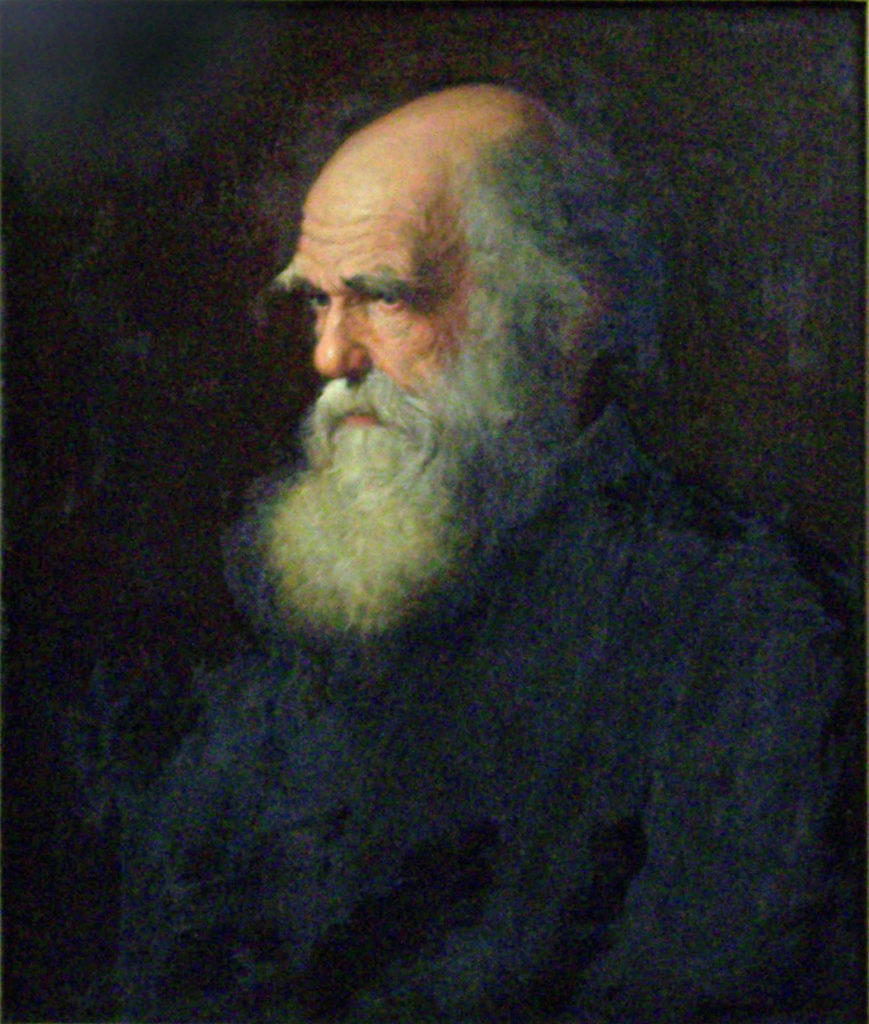
Charles Darwin, painting by Walter William Ouless, 1875
Deconstructing Darwin
Charles Darwin: Victorian Mythmaker by A.N. Wilson, published by John Murray, 2017, £25, hardback, reviewed by Gerry Dorrian
Some of literature’s most unreliable narrators can be found in the field of biography. How appropriate, then, that A.N. Wilson devotes much of Charles Darwin: Victorian Mythmaker to an examination of the naturalist’s self-reconstruction in his autobiography. In doing so, Wilson is endeavouring not only to demonstrate Darwin’s contribution to eugenics in the twentieth century but also arguably to occlude his (Wilson’s) embrace of eugenics at the start of the twenty-first.
As the author observes, Darwin erased from his history the evolutionary theories of his grandfather Erasmus Darwin, his parents, at least one schoolteacher and his fellow officers on the Beagle, whom his disappointed captain (later Admiral) FitzRoy bitterly referred to as “the ladder by which you mounted to a position where your…talent could be thoroughly demonstrated”. He also failed to mention adumbrations of his theory by Edward Blyth and Georges Cuvier, giving the impression that he came up with evolution through inspiration as opposed to osmosis. Continue reading




Cadres for Canadian Renewal
Cadres for Canadian Renewal
Mark Wegierski, on an under-estimated element in politics
Whether one calls them infrastructures or “cadres”, conservatives in Canada today are greatly in need of them. A truly consummate politician is able to utilize the self-interest of disparate groupings to work towards some common goal that only he or she has in mind. This process is exemplified by Pierre Elliott Trudeau, the Liberal Prime Minister of Canada from 1968-1984 (except for nine months in 1979-1980). Trudeau’s ability to turn both French- and English-speaking Canada to his own ends, with both parts of the country thinking they were pursuing their own self-interest, is the mark of an effective political figure.
Indeed, one of the most important elements in politics is the harnessing of the energies of others to consciously or unconsciously, willingly or inadvertently, work for your own goals. Cadres, broadly defined, are a key to history. Certainly, in the Twentieth Century, the exercise of social, political, and cultural power by various “cadres”, whether left-liberal, Leninist, fascist, nationalist, or theocratic (in Iran, for example) has had an enormous impact. Continue reading →
Share this:
Like this: