Bitter and Twisted


Dimitri Platanias as Rigoletto

Bitter and Twisted

Rigoletto, opera in three acts, music by Giuseppe Verdi, libretto by Francesco Maria Piave, after Victor Hugo’s Le Roi s’amuse, director David McVicar, orchestra conducted by Alexander Joel, Royal Opera, 14th December 2017, reviewed by LESLIE JONES

Giuseppe Verdi, like several other composers, passionately admired Shakespeare. As Susan Rutherford notes in the official programme (‘Attempting New Things’), in 1849, he drew up a list of plays that he thought could be made into operas. It included King Lear, Hamlet, The Tempest but also Victor Hugo’s verse drama Le Roi s’amuse. In the event, only the last idea came to fruition.

For Verdi, Rigoletto was his finest work. He regarded Hugo’s characterisation of Triboulet, the prototype of Rigoletto, as “one of the greatest creations that the theatre in any country or period could boast”. As in ancient Greek tragedy, Rigoletto is the play thing of the gods and by virtue of his character defects, instrumental in his own undoing. For as he himself acknowledges, there are divergent sides to his personality. Once at home, the cynical, world weary court jester gives way to the doting, over-protective father (of Gilda, played here by the technically gifted soprano Sofia Fomina). He considers the “vile, cursed race of courtiers” responsible for his moral failings and for his goading of Count Monterone, which elicits the latter’s fateful curse. Continue reading

Posted in Cultural Matters, QR Home | Tagged , , , , | Leave a comment

In House

Cliveden 

In House

The English Country House: from the Archives of Country Life, Rizzoli, 2017, ISBN 978-0-8478-3057-2, £50, reviewed by Angela-Ellis Jones

‘The English country house is an extraordinary phenomenon that lies at the very heart of England’s history and cultural life’. So begins a magnificent tome which showcases  sixty-two houses which have featured in Country Life since the 1980s, when it started printing photographs in colour. The architectural styles span seven centuries, from the mediaeval Stokesay Castle to the newly built, Lutyens-inspired Corfe Farm. Many are still private homes, often inhabited by descendants of the families that built them. The houses show a wide geographical spread – almost all counties boast at least one entry in the book. The variety of England’s vernacular architecture is a testament to the remarkable diversity of its geology. Continue reading

Posted in Book Reviews, QR Home | Tagged , , | Leave a comment

Rattle and Hun

Wassily Kandinsky, Romantic Landscape

Rattle and Hun

Sir Simon Rattle, Berlin Philharmonic, Staatsoper, Unter Den Linden, Berlin, December 2017: Stravinsky, Petrushka, Rachmaninov, Symphony No. 3 in A minor. Staatskapelle Berlin, conducted by François-Xavier Roth, Konzerthauss, Berlin. Reviewed by TONY COOPER

Sergei Rachmaninov wrote his Third Symphony in 1936, whilst living in Switzerland where he had a home located just outside of Hertenstein, near Lake Lucerne. Named Villa Senar, it was the composer’s summer residence for most of the 1930s. He died in 1943, after emigrating to the United States and, apparently, wishing to be buried at Senar. But the Second World War thwarted his wishes.

Rachmaninov’s three symphonies reflect different phases in his creative development. The First (written in 1895) conjures up a stormy combination of contemporary trends in Russian symphonic music, whilst the Second (1907) reflects the opulence of the music of Tchaikovsky. The Third Symphony, first heard in Britain in November 1937 with the London Philharmonic under Sir Thomas Beecham, saw the light of day a year earlier with Leopold Stokowski and the Philadelphia Orchestra. Critical opinion was divided. Public opinion proved negative but the composer remained convinced of its worth. Continue reading

Posted in Cultural Matters, QR Home | Tagged , , , , , , | Leave a comment

M.L. West, Cementing a Legacy

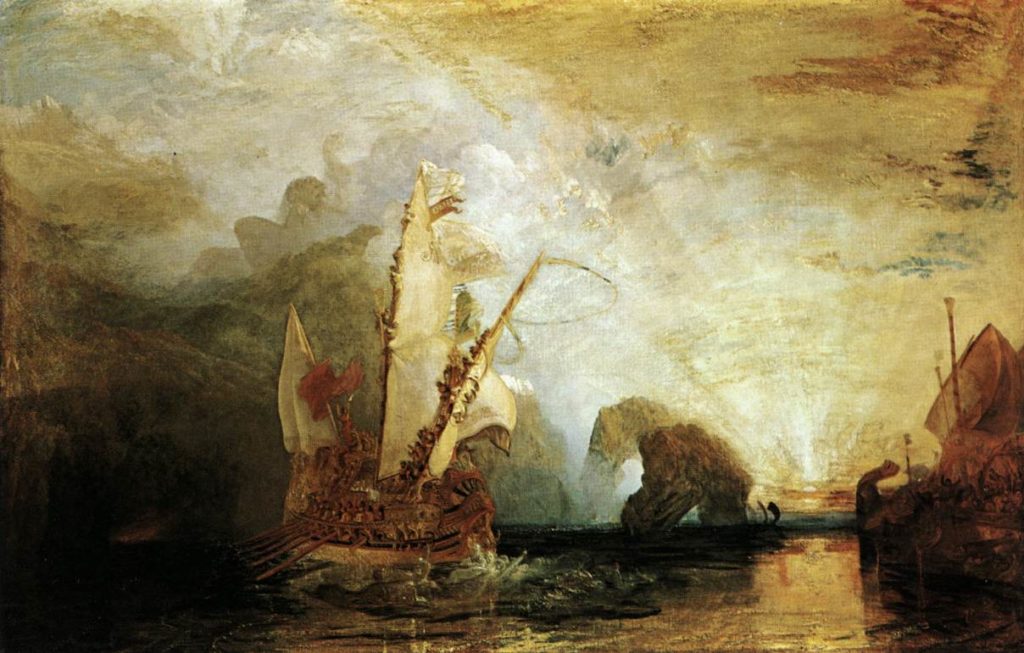
J M W Turner, Ulysses Deriding Polyphemus

M.L.West, Cementing a Legacy

M.L. West, ed., Homerus Odyssea, Berlin/Boston, Walter de Gruyter, 2017, Pp. LXII, 519

One hundred and fifty years ago, German academics were strides ahead of their non-Teutonic, classicist peers. Since then, a text-critical revolution has occurred: a select few men and women adapted and improved German classical implements for the betterment of classical studies as a whole. The distribution of good judgment in the editing of ancient Greek and Latin texts has now has been equalized, and to good effect

This edition of “Homer’s” Odyssey supersedes P. von der Mühll, Homeri Odyssea (Teubner, 1984), and is the culmination of five decades of academic study of Greek epic by West. The critical text exhibits all the scientific principles set forth in previous editions of Greek texts edited by him. Scholarly debts are repaid by him to several competent scholars (XXV). By June of 2015 the book was in effect finished (XXVI). Dr. Stephanie West, a distinguished classicist in her own right, tells readers that M.L. West (1937-2015), her husband, died before he could put the finishing touches to the final pages (XXVI). So the task fell to her. She is to be commended for her efforts. Continue reading

Posted in Book Reviews, QR Home | Tagged , , | 1 Comment

ENDNOTES, 6th December 2017

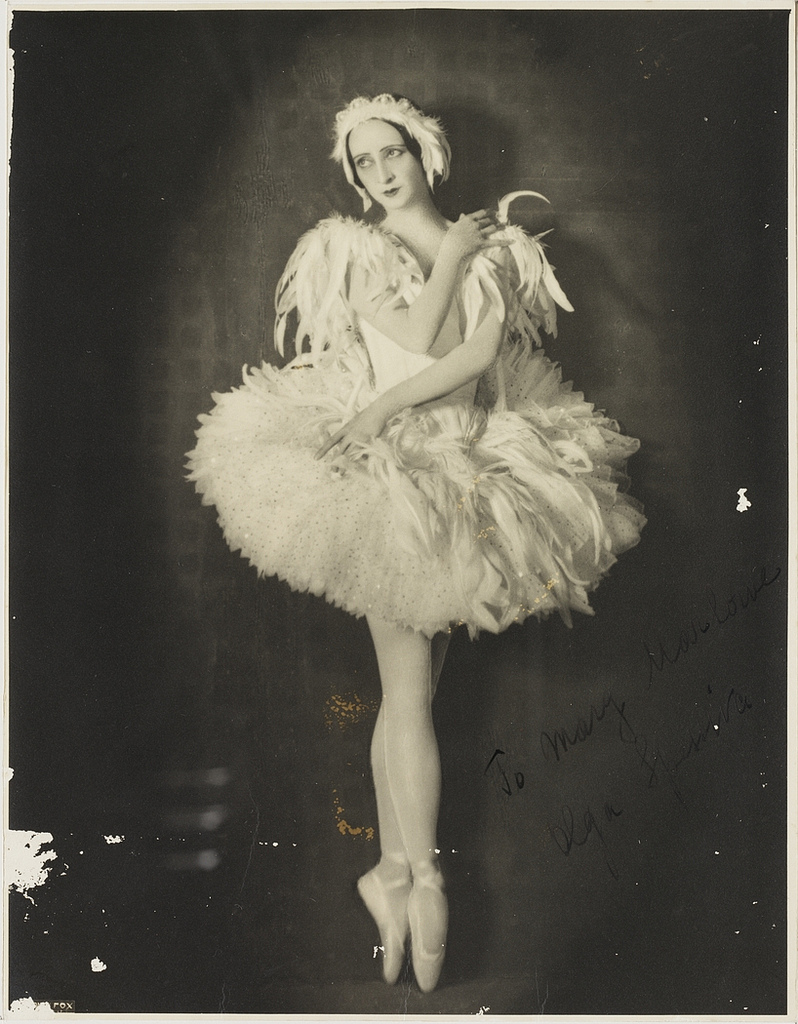
Olga Spessiva in Swan Lake costume, 1934, photographer Sydney Fox Studio

ENDNOTES, 6th December 2017

In this edition: Ronald Corp conducts Parry, Elgar & Vaughan Williams; A Wind in the Willows fantasy, narrated by Simon Callow; Tchaikovsky’s Nutcracker from Bergen, reviewed by STUART MILLSON. Echoes of Mozart, reviewed by LESLIE JONES

The Quarterly Review caught up with conductor and composer Ronald Corp just a few days before his end-of-year concert with the London Chorus and New London Orchestra. Busily rehearsing at London’s Cadogan Hall – especially the large-scale and seldom-performed Vaughan Williams’ Hodie (1953-54) – we asked the maestro about his latest championing of rare English music: “I am delighted to be performing this late work by Vaughan Williams, his 16-part Christmas choral-orchestral piece, because it’s very much a symposium – his own symposium – of his lifetime of composition. Hodie (‘Today’ – [Christ is born]) contains many ideas and themes – some of them pastoral, some reminiscent of The Pilgrim’s Progress, some from the symphonies. There are wonderful sections for the three soloists, a tenor, soprano, baritone [Mark Wilde, Julien Van Mellaerts and Augusta Hebbert] with the choir – and children’s choir – evoking the mysteries of the Christmas story.” Continue reading

Posted in ENDNOTES:Music, QR Home | Tagged , , , , , , , , , | 2 Comments

Oakeshott’s World View, Part 3

Michael Oakeshott

Oakeshott’s World View, Part 3

Noel O’Sullivan (ed), The Place of Michael Oakeshott in Contemporary Western and Non-western Thought, Imprint Academic, 2017; £19.95; pbk; 197 pages, reviewed in three parts by ALLAN POND

[This collection includes some of the papers given at the 2015 conference of the Michael Oakeshott Association held at Hull University plus some papers not presented to the conference but on the same theme of the conference which also lends its title to the book.]

Whence Oakeshott’s growing appeal? Clearly he speaks ‘to our condition’. Yet there are many thinkers who don’t speak ‘to our condition’ (such as Filmer, Bossuet, Albert the Great) who are studied and whose writings are still available to us, the first two at least in modern paperback editions; and there are writers who try to speak to us but do so in such technical or obscure language that they have little broad appeal. Continue reading

Posted in Book Reviews, Current Affairs and Comment, QR Home | Tagged , , , , | 12 Comments

Mad Days in Münster

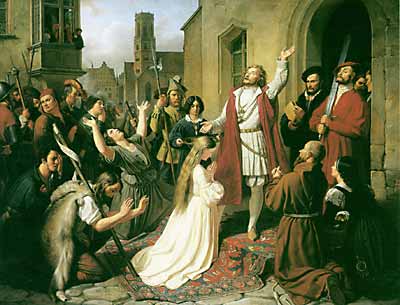
Jan van Leiden tauft ein Mädchen

Mad Days in Münster

Le prophète, Grand Opera in 5 acts composed by Giacomo Meyerbeer, Deutsche Oper, Berlin, November 26th, 2017, directed by Olivier Py, conducted by Enrique Mazzola, reviewed by TONY COOPER

Le prophète forms part of a project that has seen new productions at Deutsche Oper Berlin of Les Huguenots (2012) and Vasco da Gama (L’Africaine) (2015) while a concertante version of Meyerbeer’s opéra comique, Dinorah, formally entitled Le pardon de Ploërmel, was staged in 2014.

It charts the rise and fall of the rebellious Protestant Anabaptists who tried to establish a communal sectarian government in the Westphalian city of Münster during the Reformation. The city, in fact, came under their direct rule from February 1534 – when the city-hall was seized and Bernhard Knipperdolling installed as mayor – until its fall in June 1535. It was Melchior Hoffman who initiated adult baptism in Strasbourg in 1530, and his line of eschatological Anabaptism helped lay the foundations for the dramatic events in Münster, one of the bloodiest chapters in the history of the Reformation.

Meyerbeer’s opera Le prophète captured this slice of history convincingly and was  frequently performed on the world’s leading opera stages. But, sadly, it fell completely out of favour in the early part of the 20th century and only slowly recovered its status with revivals at Zürich Opera in 1962 and Deutsche Oper Berlin in 1966 (both featuring Sandra Warfield and James McCracken in the leading roles). A revival at The Met in 1977 starred Marilyn Horne as Fidès. Vienna State Opera also brought it to the stage in 1998 in a production directed by Hans Neuenfels with Plácido Domingo and Agnes Baltsa. Happily, over the past few years, Le prophète is finding its feet once more in European houses. Continue reading

Posted in Cultural Matters, QR Home | Tagged , , , , | 1 Comment

Deconstructing Darwin

Charles Darwin, painting by Walter William Ouless, 1875

 Deconstructing Darwin

Charles Darwin: Victorian Mythmaker by A.N. Wilson, published by John Murray, 2017, £25, hardback, reviewed by Gerry Dorrian

Some of literature’s most unreliable narrators can be found in the field of biography. How appropriate, then, that A.N. Wilson devotes much of Charles Darwin: Victorian Mythmaker to an examination of the naturalist’s self-reconstruction in his autobiography. In doing so, Wilson is endeavouring not only to demonstrate Darwin’s contribution to eugenics in the twentieth century but also arguably to occlude his (Wilson’s) embrace of eugenics at the start of the twenty-first.

As the author observes, Darwin erased from his history the evolutionary theories of his grandfather Erasmus Darwin, his parents, at least one schoolteacher and his fellow officers on the Beagle, whom his disappointed captain (later Admiral) FitzRoy bitterly referred to as “the ladder by which you mounted to a position where your…talent could be thoroughly demonstrated”. He also failed to mention adumbrations of his theory by Edward Blyth and Georges Cuvier, giving the impression that he came up with evolution through inspiration as opposed to osmosis. Continue reading

Posted in Book Reviews, QR Home | Tagged , , , , | 3 Comments

The Body Dandiacal

The Body Dandiacal

The Dandy at Dusk: Taste and Melancholy in the Twentieth Century, 2017, Philip Mann, Head of Zeus, £25, reviewed by STODDARD MARTIN

For one who grew up by the sea and sequoias of California in the 1960s, there is no more perfect condition than to amble in solitude in a warm, dappled wood. This is an instinctive creed. To be barefoot or nude wearing nothing but beads was a style of the soi-disant New Age. It travelled cross-country to Woodstock, not far from where Emerson tread, Thoreau and Whitman notionally alongside. Over the ocean, a renaissance of Wandervögel and Kibbo Kift kindred flourished, donning old tapestries and furs and boa-like scarves – anything begged, borrowed or fallen from the curtain-rails – during the inevitable tragedy that winter becomes for children of a forest of Arden.

Nature, in short, was our milieu, the body the ultimate dress. Pasolini, clothing his dramatis personae in gaudy costume in Decameron or Canterbury Tales, revelled in disclosing the vanity, nay absurdity, of such sumptuousness by repeated uncoverings of youthful flesh. Clothes are a substitute, or necessity. Having lost simian hair, we need protection from the elements. So evolved ‘fashion’, with its inevitable preferences. Because it is a creation, artifice if not art, we have generated theories about it. Like cookery or the lore of perfume, it is a sensual craft liable to be dismissed as frivolous or delectated with ardour and prescriptive rules by dedicated connoisseurs. Continue reading

Posted in Book Reviews, QR Home | Tagged , , , , | Leave a comment

Vox Populi, Vox Dei

Eva Perón, ca. 1943

Vox Populi, Vox Dei

From Fascism to Populism in History, Federico Finchelstein, University of California Press, 2017, 328 pp, h.b., reviewed by LESLIE JONES

In his Prison Notebooks, Antonio Gramsci refers to the sentimental connection (connessione sentimentale) that exists between the intelligentsia and the people. But not today, as Federico Finchelstein unwittingly makes clear.

“Why beholdest thou the mote that is in your brother’s eye, but considerest not the beam that is in thine own eye”? (St Matthew, 7:3). During both the British EU referendum campaign and the American Presidential election, many commentators gave up being objective. Both results were generally unexpected (and unwelcomed), a testament to left-liberal wishful thinking but also to the underestimation of nationalism. Indicatively, in this context, “defeated” French Presidential candidate Marine Le Pen won 11 million votes in 2017, more than twice the number of her father in 2002. And Donald Trump, likewise, won almost 63 million votes in 2016. Continue reading

Posted in Book Reviews, QR Home | Tagged , , , , , , , | 1 Comment