ENDNOTES – Machinations in Mantua

ENDNOTES – Machinations in Mantua

Rigoletto, Giuseppe Verdi, ENO, 15th February 2014, evening performance: directed by Christopher Alden, orchestra conducted by Graeme Jenkins

Leslie Jones imbibes an intoxicating concoction at English National Opera

Verdi and his librettist Francesco Maria Piave originally set Rigoletto in the court of the decadent French King Francis 1, in accordance with Victor Hugo’s tale Le roi s’amuse. But the Austrian censor (or Director General for Public Order, to give him his proper title) strongly objected to any such depiction of monarchical rule. So the action had to be shifted to the 16th century court of the Duke of Mantua, another notorious womaniser.

Now, in director Christopher Alden’s new production (or newish, given that it was briefly performed in 2000 at Chicago’s Lyric Opera but subsequently deemed ‘unrevivable’), the action has been transposed yet again, this time to a Victorian gentleman’s club in the ‘modern Babylon’, replete with candelabra, flunkeys, hooray Henrys, leather armchairs, newspapers, rich carpets and other apposite paraphernalia.

Alden, an ardent exponent of ‘relevance’ and contemporary resonance in opera, is evidently taking a swipe at a somewhat easy target here, to wit, bourgeois sexual hypocrisy and the oppression of women – Sigmund Freud meets John Stuart Mill.

Enrico Caruso as the Duke of Mantua

Thus, Rigoletto (the personage) encourages the Duke’s philandering and thereby draws down on himself the curse (la maledizione) upon which the action pivots. But he also exhibits a type of ‘whore and Madonna complex’, placing his daughter on a pedestal and trying, however ineffectually, to protect her purity (symbolised here by Gilda’s invariably white attire), virtually imprisoning her.

The three leads, namely baritone Quinn Kelsey as Rigoletto, tenor Barry Banks as the Duke and soprano Anna Christy as Gilda, have received high praise for their vocal performances ditto the rest of the cast. This reviewer, however, begs respectfully to differ. For one thing, the chorus at times sounds distinctly reminiscent of Gilbert and Sullivan. But the problem is arguably more serious and systemic than this. Something ineffable in Verdi, it seems, has been lost in translation. Just as most theatre lovers would patently prefer to have Shakespeare’s greatest speeches declaimed in his mother tongue rather than, say, in French (although French translations of all his foremost tragedies are readily available) so most genuine opera lovers, given the choice, would doubtless prefer to hear Verdi’s quartet Bella figlia dell’amore or the aria La Donna è mobile sung in Italian rather than in English. By virtue of the vagaries of language, Wagner, in contrast to Verdi or Puccini, seems to lose much less in translation, at least judging from ENO’s recent, triumphant production of Parsifal.

Singing aside, the various liberties that director Christopher Alden has taken with Piave and Verdi’s original conception have engendered some deservedly critical commentary. Writing in the Daily Express, William Hartston referred scathingly to the setting of a gentleman’s club, in which all the action (including an orgy, a hanging and the kidnapping of women) takes place. “The only thing wrong with this [he opined] is that it is nonsense. The opera is not set in a gentleman’s club: its various scenes take place in a palace in Mantua, in Rigoletto’s humble dwelling and in the assassin Sparafucile’s windswept shack”. And what precisely would be the function, anyway, of a court jester in a gentleman’s club?

Mikhail Shuisky as Rigoletto

Immediately after the climactic moment when Rigoletto, bent on revenge, realises that by dint of the curse, he has not brought about the death of the Duke but that of his own beloved daughter, the curtain is drawn and the onstage lighting is simultaneously extinguished. We were reminded of the final, memorable scene of the HBO drama series The Sopranos, another Freudian take on sexual double standards and misogyny, in which the demise of priapic patriarch Tony Soprano is suggested by a sudden ominous silence (preceded by audible gunshots in one version) and a totally blank screen.

©

Leslie Jones, posted on 19th February 2014

Leslie Jones is Deputy editor of Quarterly Review


Posted in QR Home | Tagged , , , , , | Leave a comment

PERSPECTIVE – Long Walk to Freedom

Long Walk to Freedom

Dir: Justin Chadwick, Cert 12A, 146 min

ROBERT HENDERSON watches the much-hyped Mandela biopic

There are two films currently on release with a very high PC approbation quotient: 12 Years a Slave and Mandela: A Long Walk to Freedom. The latter is a better film simply as a film, both because it had a male lead who imposes himself on the film and because it possesses something resembling a plot rather than a repetitive series of scenes of brutality and contempt being inflicted by whites on blacks. But being superior to 12 Years a Slave does not make it a good film, let alone a great one, and this Mandela biopic has serious flaws.

There are two ways to watch a biopic: simply as a drama without worrying about its verisimilitude, or to judge it as one would a documentary. This film fails on both counts. As a drama, it is too fragmented and lacking in action to maintain  tension.  It is also handicapped because it is difficult to view it as simply a drama when the person and events for which they are noted are so recent. Inevitably, it will be seen as a de facto documentary, but it fails to deserve that name because it is profoundly dishonest in its reporting of the facts. More on that later.

The film starts  with two considerable dramatic disadvantages: the very long period which it covers – even Mandela’s adulthood in the period covered by the film stretches over  more than 50 years – made the film inescapably but unduly episodic and the 27 years he spent in prison was a setting where there is limited scope to show Mandela doing very much. The large cast also works against character development, other than that of Mandela. Even the depiction of Winnie Mandela is distinctly one-dimensional. There is also the problem of representing her as an irresistible beauty. She was not that even when young, and the use of the considerably better looking Naomi Harris to represent her is a form of dishonesty because a good looking actress exhorting violence will have a much less toxic effect than a rather plain woman doing so.

Idris Elba as Mandela gives a strong performance judged simply as a character, but because of the inevitable documentary element his appearance does present problems.  Because everyone knows what Mandela looked like and sounded like, it is difficult to shed the image of the real Mandela in the mind’s eye while watching Elba who  has no real facial similarity to the young Mandela, a fact made ever more obvious as their looks diverged with Mandela’s ageing in the film. By the time the real Mandela emerged from prison and was before the world’s cameras, his face had developed a curious ‘Chinese’ look and been drained of its robustness. All that was done, and perhaps all that could be done to age Elba, was to give him greying hair.

Then there was a question of physique and vitality. Elba is a powerfully built man and although Mandela was no seven-stone weakling as a young man, he was still substantially shorter (6’0” against Elba’s 6’3”) and much less heavily muscled than Elba. That did  not matter so much in the scenes of Mandela’s youth, but it became ever more problematical as Mandela aged. By the time the scenes of  Mandela’s release arrived  Elba was still a hulking figure, whereas the real Mandela at that age had become a rather physically frail figure.

The final problem of impersonation was that Elba caught Mandela’s voice as we know it from his time after his release quite well, but that did mean he was using  the voice of Mandela as an old man throughout the film. (I did try to find a recording of Mandela  pre-imprisonment but was unable to do so.)

But the main black mark against the film is that it is wilfully and widely dishonest. This turns it into nothing more than a propaganda vehicle. The serious dishonesty consists of acts of omission. These are:

Mandela’s Marxism and membership of the South African Communist Party (SACP) is  not mentioned, nor is the heavy influence of Communists within the ANC.

The brutal behaviour of the ANC members to both those, both within and without the party,  who fell out of favour with the ANC leadership,  either as the result of personal quarrels or because they were judged to be disloyal. Even a pro-ANC account admits there were considerable abuses (see 6.3.3.2 onwards in particular). This behaviour went unremarked.

Winnie Mandela’s glorying in the murder by torture that is ‘necklacing’ is barely given a glance, with Mandela making a single reference to it in a scene with Winnie in which he simply says the necklacing must stop. There is precious little attention given to the practice in general. There is one fleeting scene of someone being chased, caught, having a tyre placed over his head, the tyre being soaked with petrol and set alight.  The scene lasts a few seconds. There is no explanation of why the person is being murdered, who the person was and who was doing the killing. It was tokenism of the most extreme sort.

Winnie Mandela also had a nice line in personal intimidation and violence up to and including murder. She ran a bunch of thugs known as the Mandela Football team and was convicted of  assault and kidnapping in 1991 after the death of ANC youth activist, Stompie Seipei Moeketsi.  The sentence was six years in prison initially but this was reduced to two years suspended on appeal. There was no reference in the film  to either Stompie or her conviction. As for the Mandela Football Team, there was a  sentence or two in a scene when Mandela said the violence must stop – the same scene as the single reference to necklacing by Mandela – but nothing else.  Mandela’s failure to condemn her behaviour for so long was represented as an understandable weakness of the heart rather than any indication of serious fault in Mandela.

The film runs to Mandela’s election to the Presidency in 1994. By that time he had shown a rather worrying fondness for unpleasant dictators such as Fidel Castro and Gaddafi. Such behaviour went unremarked.

Far too little is made of Mandela’s womanising and the failure  of his first marriage to Evelyn Mase because of that and his placing of the ANC cause above his family. There are a few rows, and one scene of what might be called domestic violence by Mandela, although that could be interpreted as self-defence, but the overall impression is that somehow the break-up was Mase’s fault, at least in part. Nothing was said about the fact that Mandela left Mase to bring up three young children with precious little if any financial support from Mandela before he went into prison or the ANC after he was imprisoned.

Is this film worth seeing? Certainly not on its own terms, for it is  not only dishonest but rather pedestrian. Political animals may wish to see it to prime themselves on the extent that the politically correct myth has overturned reality in the case of Mandela and how readily the mainstream film reviewers have bought into it.

ROBERT HENDERSON is the Quarterly Review film critic

Posted in QR Home | Tagged , , , , , , , , | Leave a comment

Warming shots

James Delingpole

Warming shots

Watermelons: How Environmentalists are Killing the Planet, Destroying the Economy and Stealing Your Children’s Future

James Delingpole, London Biteback Publishing, 2012, pb., 312pp

EDWARD DUTTON reviews a fiery broadside against Greenery

The title Watermelons grabs the reader’s interest. They are green on the outside but red on the inside. This, argues Delingpole, characterizes the entire Man-made Global Warming (MMGW) movement ranging from hippie activists all the way up to the most senior climate scientists, including a one-time president of the Royal Society itself. All levels of the movement are heavily influenced by what Delingpole terms many times a kind of replacement (and anti-human) apocalyptic ‘religion.’ Arguing this is nothing new, but what is is Delingpole’s detailed dissection of this religion as part of a popular book.

Delingpole was the Telegraph journalist blogger who broke the 2009 Climategate Scandal. Leaked emails by senior climate scientists at the University of East Anglia demonstrated, argues Delingpole, that climate scientists were manipulating their data to achieve the desired panic-inducing results. He presents a persuasive case for accepting that these climate scientists are ideologically motivated and are essentially part of the Frankfurt School’s growing dominance of some areas of academia, an analysis that it is excellent to increasingly find in non-academic books. For these scientists, discovering the truth is less important than persuading the populace of a certain perspective in order to achieve a better – a socialist – society. Continue reading

Posted in QR Home | Tagged , , , , | Leave a comment

Right royal retribution

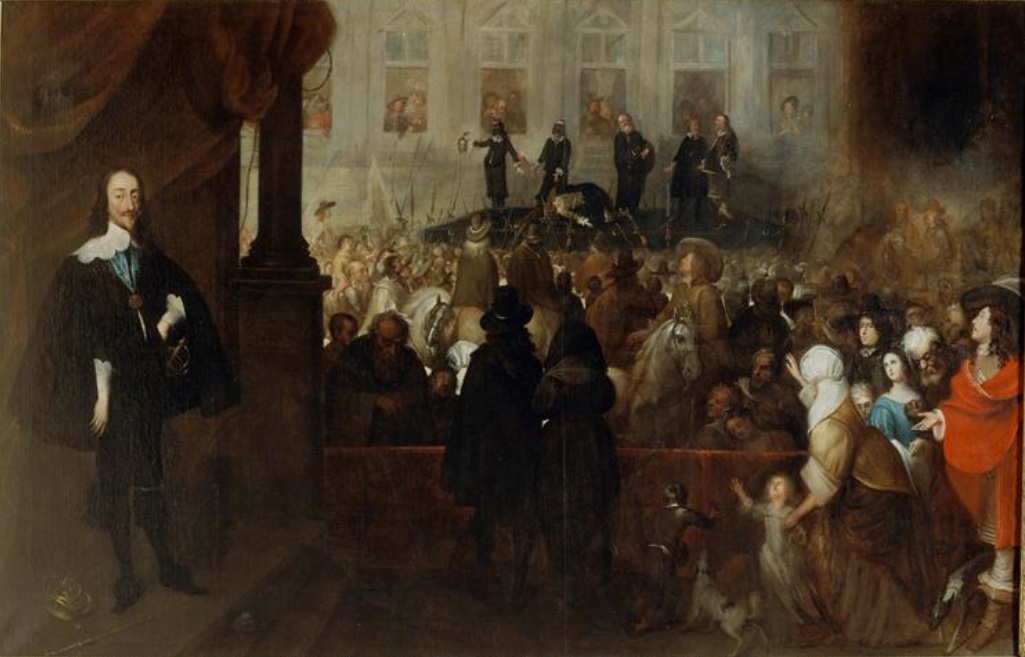
The Execution of Charles I, Gonzales Coques

Right royal retribution

The King’s Revenge: Charles II and the Greatest Manhunt in British History

Don Jordan and Michael Walsh, London: Abacus Books, 2013, 383pp, pb.

EDWARD DUTTON finds he is hooked on an obscure but fascinating chapter in English history

Everybody knows the story of the English Civil War and how it culminated in the Roundhead forces beheading Charles I and 11 years of Puritan rule, much of it with Oliver Cromwell as a military dictator, before Charles II was ′restored′ to the throne. What is far less well known is the lives of the 59 regicides who signed Charles I′s death warrant and others involved in his trial and execution, the power struggles that took place between Cromwell′s death in 1658 and the collapse of the republican regime two years later, and the brutal lengths that Charles II and Parliament went to in order to scapegoat people from the republican regime, track them down and kill them.

Don Jordan and Michael Walsh have correctly identified this period as woefully under-explored in popular history writing and – soaked as it is in intrigue, espionage and blood – as having all the makings of a fascinating historical thriller. In The King’s Revenge they certainly manage to do a period in which the public screamed for ′justice′ precisely this. This book brings to life the extraordinary characters in the bloody drama that was mid-seventeenth century England.

Jordan and Walsh have a particular style which may not be to the taste of all academic historians but which certainly helps to engage the interested layman. To give the book a thriller quality, they begin by focusing on a single king-killer, Edmund Ludlow, who is hiding out in Switzerland during the Restoration purge and fearing assassination. He is a frequent character in the rest of the book, we get to know him particularly well, and we must wait to the end to discover if he survives. This isn′t a particularly new technique but it helps to keep the reader hooked.

What is new is the wealth of historical detail presented about the Commonwealth and Protectorate periods and the Restoration purge of the regicides. Charles I did everything he could to ensure he would be remembered as a ′martyr king′, and not long after his execution a book called The King’s Image, possibly penned by Charles I himself, was published persuasively arguing this. An insurgent campaign to destabilize the new regime also began swiftly. Isaac Dorislaus, a Dutch lawyer who was one of the king′s judges, was sent to the Hague as ambassador in 1649 and promptly assassinated by royalist exiles. In 1650, Anthony Ascham was posted to Madrid and assassinated by royalist exiles there.

Drawing upon and quoting from a myriad of contemporary sources (such as Pepys) Jordan and Walsh guide us through the constant royalist attempts to destabilize the republican regime, the collapse of the Commonwealth (under precisely this pressure), the introduction of military rule, and, most interesting of all, and the power struggles in the wake of the resignation of Cromwell′s hapless son Richard. The leaders of Parliament and the leaders of the army struggled for power in this period before George Monck led the army from Scotland, invaded England, invited Charles II back and then began to purge all of his old republican friends. He did, however, protect Sir Arthur Haselrig, who, in the wake of Richard Cromwell′s resignation was, in effect, the de jure ruler of England. The authors do a great service to history by unearthing people like Haselerig from obscurity as well as many other colorful characters, such as John Cook, the prosecuting lawyer against Charles II, and William Prynne, the radical writer, mutilated for his writings against the crown, who ended one of Charles II′s most fervent supporters.

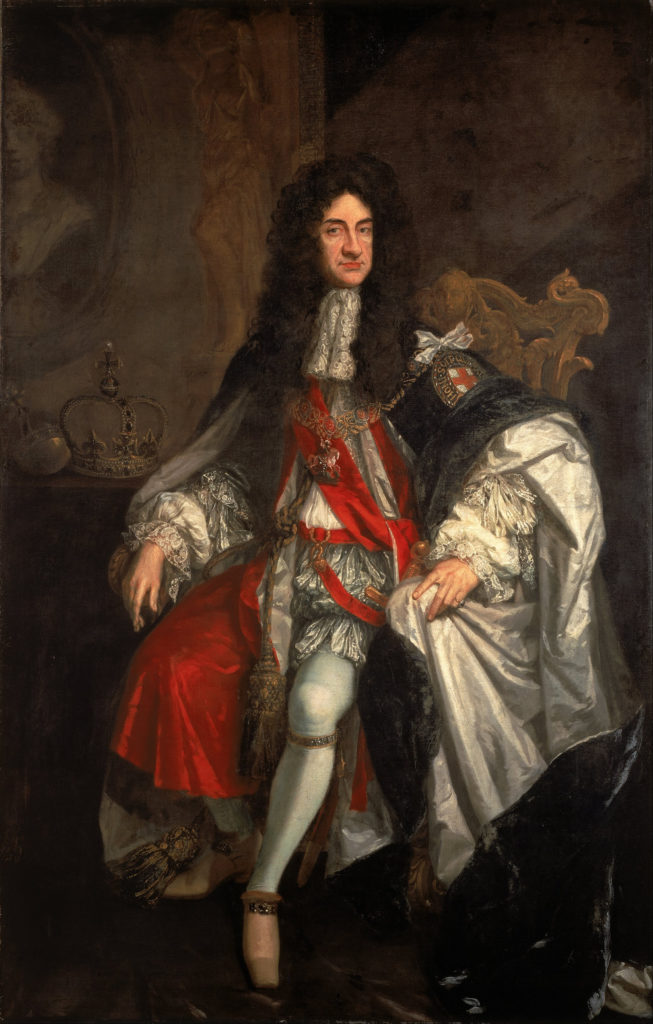
Charles II, Godfrey Kneller

Upon the collapse of the Parliamentary regime, the authors take us through the incredible bloodlust and hypocrisy as notable supporters of the republican regime try to flee the country, parliament becomes desperate to find scapegoats for the killing of the king and continuously lengthens the death list, and many formerly ardent republicans – including those who sit as judges over the regicides – bend over backwards to prove what loyal supporters of Charles II they are. It is a deeply uncomfortable read. We witness a period in which a fanatical government rides roughshod over the law and natural justice, using the execution of Charles I as a means not of punishing those most responsible or most critical of monarchy (John Milton, the arch-critic, gets off!) but simply as an excuse to purge all opposition. A few braver souls, such as John Cook, do not run away and, of course, pay a very heavy price. Even those who do escape are not safe. Search parties are sent to the United States and all around Europe, and in many cases those on the death list are assassinated years after they fled England.

But our feelings of revulsion at Charles II′s ′unfair′ revenge are perhaps, in part, because this book is not entirely fair. It paints Charles II′s regime as an unjust and thoroughly unpleasant one but rather glosses over the kind of regime it replaced, and the fact that most of those in charge of it were extremist Christian fundamentalists (even by the standards of the day) who, like the Restoration government, abused the law of the land, purged inconvenient enemies, and were in many ways extremely similar to the regime that replaced them. The authors give us an epilogue in which they describe 1649 as

…the real Glorious Revolution …the rule of law was confirmed, wider social freedoms than ever before granted, censorship lifted and relative freedom of worship assured…the regicides were men of principle who stood for many of the liberties which today we take for granted.

This glowing summary rather forgets the fact that Cromwell′s government persecuted Catholics with unheard of severity, tried and killed a king by retrogressively changing the law, purged Parliament of possible opponents, banned numerous practices that had been part of the social fabric of England for centuries (such as saints′ feasts), shut down theatres (hence the need to rebuild the Globe), had boys whipped for playing for football, regulated dress excruciatingly and banned makeup (instituting a religious police to roam the streets and scrub makeup off ladies, like something from Saudi Arabia), banned Christmas celebrations (including feasting), and eventually introduced military rule. The authors do not look at this in detail, which they should because it is significant to the support for the Restoration. In addition, the evidence presented by the authors gives the lie to the assertion that the ″regicides were men of principle″. Some were – others squirmed to save their lives.

But though the book does show evidence of bias at points, it is undoubtedly an extremely well-written and engaging history of a period about which little is generally known. The King’s Revenge is superbly detailed, meticulously sourced and well worth reading.

Dr. EDWARD DUTTON′s latest book, Religion and Intelligence, is soon to be published by the Ulster Institute for Social Research


Posted in QR Home | Tagged , , , , , , , , , , | Leave a comment

Dimocracy

Dimocracy

Democracy and Political Ignorance – Why Smaller Government is Smarter

Ilya Somin, Stanford University Press, 2013, 280pp

ROBERT HENDERSON is unimpressed by an earnest screed against uninformed politics

Does the ignorance of voters matter in a system of representative democracy? Somin, a professor of law at George Mason University School of Law, thinks it has very serious consequences because it leads voters to make ‘wrong’ decisions. His book is primarily concerned with the effects and implications of voter ignorance on the American political system, but has implications for any political system, democratic or otherwise.

Political ignorance can certainly be found in abundance in both the United States and Britain. Listen to a vox pop or phone-in on a political subject and the ignorance of the general public can be startling when it comes to the detail of  politics, not least because educated respondents are frequently as much at sea with political subjects as the uneducated. Somin cites a large number of prime examples of crass political ignorance amongst Americans. For example, two 2006  polls respectively found that only 42% of Americans could name the three branches of the federal government – the executive (President), legislature (Congress) and judiciary (Supreme Court) – and only 28% could name two or more of the five rights guaranteed by the first amendment (p.19). As for specific policies, a good example is a 2010 survey which showed that 67% of the population did not know that the economy had grown the previous year, despite the economy being judged as one of the most important policy areas by Americans (p.21).

This may be dismaying at first glance, but in practice it is irrelevant how limited is the detailed political knowledge of an electorate. This is because no individual, however diligent, erudite, insightful and intelligent, could be seriously knowledgeable about all but a very small proportion of  the problems and policies arising in a  minimalist state constructed on the Hayek model, let alone the vast ocean of policy areas which are covered in the modern industrial state. That would apply even if political power was devolved. Indeed, in a devolved situation (and Somin is strongly in favour of devolved power) the position could be even worse, because there could be more to know and understand, with multiple jurisdictions to vote for on important issues.

Does this mean that representative democracy should be done away with? Not a bit of it. Even though he is worried about democratic outcomes based on ignorance and sceptical about the chances of improving political knowledge amongst  voters, Somin in the end comes down in favour of it:

Despite political ignorance, democracy retains many advantages over rival systems of government. (p.199)

Indeed it does. Whether electors can make considered decisions on all matters or even the vast majority of issues  is not really the point of representative democratic politics. What matters is the fact that such a political system can best restrain the naturally abusive tendencies of elites and provide by far the best legal mechanisms for the formal and peaceful transition of power, something which makes coups and civil war much less probable.

Voters can meaningfully answer the big political questions. They can oppose mass immigration. They can say whether they want their country to go to war. They can approve or disapprove of their country’s legal system. They can say whether they feel more comfortable with a welfare state or no welfare state. They can make a meaningful choice on whether they wish their country to be part of a supranational bloc, such as the EU. They can decide what punishment should be meted out to criminals. They can say yea or nay to whether essential industries should be in public hands. Electors can also make purely rational decisions (for example, those made simply on arithmetical grounds) on competition for resources; for example, it is perfectly rational to oppose immigration on the grounds that it increases competition for housing, education, jobs and welfare.

The fact that voters’ answers to such questions, if they were ever allowed to vote on them in referenda, would  generally run contrary to the wishes of elites in countries such as the USA and Britain and are routinely thwarted by those elites, tells us that the real reason voters are denied the chance to directly make decisions about policy is not that they are incapable of doing so on many major issues,  but rather that the opinions of voters are opposed to those with power, wealth and influence.

A major problem with Somin’s approach to his subject is that he wants politics to be a science, to have an objective reality like physics. When I was a history and politics undergraduate, I had  to take a compulsory course entitled Modern Political Analysis. This involved flow charts, graphs and formulae which purported to elevate the  study of politics to the level of a science. Politics students were solemnly expected to take seriously, say, a flow chart which started with a box marked electorate, had boxes marked with words such as election and  government, before ending with a box marked democratic outcome. Democracy and Political Ignorance is cut from the same misdirected intellectual cloth, nothing like so crudely but still in a manner which assumes that the democratic process can be reduced to quantifiable data. He even has a few formulae such as this example:

Assume that UV equals utility of voting, CV equals the cost of voting and D equals the expected difference in welfare per person if the voter’s preferred candidate defeats her opponent. Let us further assume that this is a presidential election in a nation with three hundred people, that the voter’s ballot has only a one in one hundred chance of being decisive, and that the voter values the welfare of his fellow citizens an average of a thousand time less than his own…thus we get the following equation D(300 million/1000)/ (100 million) – CV = Uv (p.67)

That is the general error of the book, to imagine that human behaviour can be reduced to a miscellany of objective fact which can be used to determine how people should (or even would of necessity) behave if only they were in full possession of these facts. This matters greatly because the vast majority of political decisions have no objective truth or falsity. The particular mistake Somin makes is to imagine that there is such a thing as perfect information which leads to objectively right answers to political questions.

Somin adds bias to this error, for he makes it clear that he is on the politically correct wing of politics. Everyone who is interested in politics has a bias and that is fair enough if the bias is both acknowledged and opinions are not put forward as objective facts. Somin does not do this. Rather in the way that people claim they are in favour of free expression and then allow censorship of  things they disapprove of, so the author wants a distinction between good and bad values, viz:

This book does not provide a defence of any particular vision of political morality. But unless we adopt the view that all values are equally good – including those of racists and Nazis [note that he does not include Marxists who have been responsible for even more deaths than the Nazis] –  we must admit that good political knowledge might sometimes be put in the service of “bad” values. (p.55)

Tellingly, he also feels that some political knowledge can be damaging:

Why might political knowledge exacerbate the harm caused by an electorate with bad values? Consider an electoral majority that is highly racist and wants to inflict as much harm as possible on  a despised racial minority. If such racist voters become more knowledgeable about the effects of government policies, they might force elected officials to implement policies that increase the minority group’s suffering. (p.54)

That might seem a reasonable position at first glance, but what would constitute ‘racism’? After all, governments of all colours routinely favour one group over another,  whether the group be defined by race, ethnicity or class. Trying to objectively define what was racist behaviour by a government would in practice would be impossible because inevitably judgments would be highly subjective.

Political correctness also colours Somin’s judgements in important ways. For example, he claims  that the  mistreatment of blacks in post-slavery America was in part built on the belief of whites that blacks were prone to excessive criminality and every black man was just waiting to rape white women. But whether post-slavery white America did genuinely fear black criminality is not necessarily the real issue. Human beings will use justifications for likes and dislikes which are not the real reasons for their choices, when they feel either that they simply do not like something without having any clear idea why, or are afraid for legal and social reasons that their motivation for holding a view would be unacceptable or even dangerous for them if expressed. Whites in the old slave-owning states may have used any number of rationalisations for segregation, while their actual motivation was that they did not see blacks as their equals or, more fundamentally, simply as different, as not part of the national American “tribe”. There is also the fundamental difficulty of how any objectively true information could exist in some instances. It is not irrational to have a fear that an enslaved group once set free might wreck physical revenge on the group which had held them enslaved. That being so, it is difficult to see how American whites who believed that could have their fears assuaged by more knowledge. In the nature of things there could be no such knowledge available to decide the question of whether freed slaves and their descendants would be violently criminal.

Interestingly, Somin does not address the fact that it is not just a lack of interest or education which stops people becoming politically knowledgeable, but also lack of innate qualities such as intelligence, intellectual inclination and  extroversion. Perhaps that is because his politics debar him from believing that people will or will not do or be something because that is the way they are born. That would fit into his mindset. IQ is particularly important because the lower the IQ the less ability to handle abstractions or complex data. This is not a trivial matter, because at least ten percent of the population of Western states have IQs of 80 or lower. That is the level which most psychologists working in the field of IQ believe that a person begins to struggle to live an independent life in an advanced modern society.

Somin is much taken with the concepts of rational ignorance and rational irrationality. Rational ignorance is the idea that voters do not devote time to educating themselves about political issues because they make a rational decision that their votes will count for next to nothing. I sincerely doubt whether anyone actually makes a decision to remain ignorant on that basis, although they may use it as an excuse for being politically ignorant.

But even if voters did make a considered decision to remain ignorant it would not self-evidently be a rational decision. To begin with there are many electoral circumstances where a vote is important. That is true where the electorate is small or a seat is marginal. Under the first past the post system used in Britain there are a considerable number of seats where the main party candidates are near enough in their support to make voting a far from redundant business. But even where there is no main party candidate who appeals to an elector, or one of the main party candidates is odds on certain to win, there is still a point in voting. To begin with, if turnout is persistently low it could be used  by those with power to argue for a restricted franchise or even no franchise at all. Then there is the overall vote a party gets. If, for example, a party or presidential candidate gets elected with less of the popular vote than their main opponent their mandate is weakened. If all else fails, a vote for a candidate of a minor party such as UKIP in Britain, the  minor presidential candidate in the USA, or a spoiled ballot sends a public message about the state of elector dissatisfaction with the mainstream parties. Somin is not entirely blind to such objections, but mysteriously and annoyingly they appear to carry little weight with him.

Rational irrationality is the brainchild of the economist Bryan Caplan. The idea is that voters not only have incentives to remain ignorant but also incentives to “engage in highly biased evaluation of  the information they do have” (p.13). The tempting response to this is a sarcastic “Who would have thought it?” Pursuing the idea of rational irrationality, Somin likens those who are seriously committed to supporting political parties to fans of sports teams who support their team blindly,  generally give weight to information which boosts their team and disregard that which does not. The rewards for doing so are emotional. This of course is not irrational behaviour because it is natural for human beings to indulge their “tribal” instincts and defend their position and that of their group. Where rational ignorance and rational irrationality come together, they are to Somin’s mind the most toxic political democratic cocktail, one which could only be overcome or at least ameliorated if those pesky voters would just become “correctly” informed.

What are Somin’s solutions to reduce what he sees as the harm of voter ignorance? It is to lessen the amount which government does (with much of the slack being taken up by private enterprise) and bring as much as possible of politics to the local or regional level, viz:

Despite political ignorance, democracy retains many advantage over rival systems of government. Nonetheless, political ignorance will probably continue to be a serious weakness of democratic government. We are unlikely to eliminate that weakness completely. [Another example of the blindingly obvious] . But we can reduce its dangers by limiting and decentralising the role of government in society (p.199)

There are real  problems with both of these policies. In a large industrialised society, government of necessity has to do a considerable amount, whether that is at the local or national level. There have to be good communications for people, goods and information. A universal school system is unlikely to exist if it is not in large part funded by the taxpayer. Defence and the maintenance of law and order cannot reasonably be left to private initiatives. Foreign policy, especially for a super-power such as the USA, has wide-reaching ramifications for domestic policy and is frequently very complex to master.

As for decentralisation of politics, the more local the decision making the smaller the pool of political talent available. This may well result in poorer decisions being made, especially where the policy is complex. It is also true that if the number of political bodies which can raise and spend taxes increases, the opportunities for corruption  increase, and this generally means more corruption. As for what should be devolved, that would be a real can of worms. For example, it is difficult to imagine Somin thinking that federal action to enforce politically correct behaviour throughout America would be damaging, or that he would readily tolerate a local jurisdiction which, for example, refused to apply equal rights laws.

Overall, Somin is gloomy about the likelihood of political knowledge increasing. He glumly points to the fact that despite rising IQ scores, educational standards and the great ease of access to information because of the internet, there has been little increase in political knowledge during that time (p.199) or of rationality (in his terms).

Perhaps most damaging  for Somin’s desire for greater political knowledge is research (which he cites)  that suggests that the more knowledgeable voters are “…more biased in their evaluation of  new evidence than those with less prior information”( p.80).  If this is true – and it is very plausible because the more data someone has, the greater the material from which  to construct arguments – then the whole idea of a better educated electorate producing superior outcomes falls completely to pieces.

Where does all this leave us? Somin has expended a great deal of effort on creating vast complications for a subject which is essentially simple. The matter can be reduced to its essentials by simply pointing out the following –

  1. That no person, even if they are a full time politician and have the requisite intellect, can master more than a small part of the political range of the modern political state
  2. That even if the scope of politics was massively reduced by, say, half, the problem of inevitable political ignorance would exist because there would still be a great deal left
  3. That for most political issues there is no objectively right answer, and
  4. That much of the population, even if they had a serious interest in politics, would not have the education and intelligence to understand much of what goes on.

There is an important book to be written about voter ignorance within a democracy. Sadly, this is not it. However, the book is worth reading as a first-rate example of the attempts of those working in what are mistakenly called the “social sciences” to pretend that these subjects  are bona fide sciences just like physics and chemistry, and a very revealing look into the modern liberal mind.

ROBERT HENDERSON blogs at www.livinginamadhouse.com


Posted in QR Home | Tagged , , , | 1 Comment

Germany, in the eye of the beholder

Germany, in the eye of the beholder

Christopher Webster van Tonder, Erich Retzlaff volksfotograf, with contributions by Rolf Sachsse & Wolfgang Brückle, School of Art Press, 2013

Erich Retzlaff Volksfotograf, an exhibition of photographs from the School of Art Collection, Aberystwyth, by Christopher Webster van Tonder. At the German Historical Institute London until 21 March 2014

Leslie Jones contemplates some striking but unsettling images

As Christopher Webster van Tonder acknowledges (Erich Retzlaff volksfotograf), anyone working in the arts in Nazi Germany had little choice but to embrace Nazi ideology. Photographers were expected “to promote photography in a racial sense” and to support “national customs and traditions” (Klaus Honnef et al, quoted page 54). However, the photographer Erich Retzlaff (1899-1993) evidently found these requirements easy to comply with. An ardent nationalist, he had fought on the Western Front in the First World War. He joined the NSDAP in 1932 (party member number 1014457). Even after 1945 he remained an unrepentant anti-Semite.

Van Tonder, Lecturer in Fine Art at the University of Aberystwyth, considers Retzlaff’s work of the 1930’s and 1940’s “a visual metaphor of an idealised and exclusively Germanic utopia” (page 10). His output was informed by the concept of the Volksgemeinschaft (people’s community) and he specialised in depicting racial types. The idea of the Volksgemeinschaft appealed to many Germans because it potentially embraced any person of supposedly ‘German stock’ regardless of social standing, although the denial of rights to homosexuals and communists provided noteworthy exceptions.

Retzlaff was born in Reinfeld in Schleswig-Holstein. His family background was affluent middle class and Protestant. He was badly wounded in the Great War and after the war he eventually became a supplies buyer for a factory in Hamburg. Earning an excellent salary he moved in artistic circles and took up photography in the first instance as a hobby. In 1928 he opened a small photographic studio in Düsseldorf. Some of his early commissions were industrial photographs for the public relations magazines of steel and mining companies. Wolfgang Brückle points out that Retzlaff’s artistic breakthrough came with his collection of anonymous portraits entitled Das Antlitz des Alters [Face of Old Age] published in 1930. This volume received critical acclaim both at home and abroad.

As Dr van Tonder observed at the opening of the German Historical Institute’s exhibition, the salient characteristic of many of the portraits exhibited therein is that the photographer considered them not just as individuals but also as racial types. Titles like Friese [Frisian] (1940), Jungbauer aus Mecklenburg [Young Farmer from Mecklenburg] (1940) and Jungbauer aus Westfalen [Young Farmer from Westphalia] (1940) are indicative in this context.

In his many depictions of peasants, notably in the collection Die von der Scholle [Those who till the Earth] (1931), Retzlaff emphasised the putative link between racial type and geographical location. These are people rooted in “blood and soil”. Indeed, in his introduction to this work Hans Friedrich Blunck characterised the models therein as “standard bearers of authentic existence in an alienated world” (Brückle, page 25).

The introduction of Agfacolor Neu in 1936 enabled photographers to readily process their own films and allowed Retzlaff to make racial characters even more prominent. The blond, blue-eyed, “idealised Germanic type” became a recurring motif in his work.

In 1933, Retzlaff was commissioned to take photographs of high-ranking Nazis (alte Kämpfer or old fighters) for Wegbereiter und Vorkämpfer für das neue Deutschland [Pioneers and Champions of the New Germany] (1933). He duly produced portraits of Hess, Himmler, Streicher and Strasser (Gregor) amongst others. Van Tonder is surely right that Retzlaff’s current obscurity is largely attributable to the ideological character of his output before 1945. He was apparently someone quite impossible to forgive, to wit, “a photographer for the Reich” (page 13).

©

Leslie Jones, February 2014

Dr Leslie Jones is Deputy editor of Quarterly Review


Posted in QR Home | Tagged , , , , | Leave a comment

ENDNOTES – Chamber cornucopia

ENDNOTES

CHAMBER CORNUCOPIA

Brodsky Quartet at Kings Place  *  Overtures galore from Victorian and Edwardian Britain  *  Delius from Norway  *  Schubert and Hummel from Finchcocks

Classical Music Editor STUART MILLSON savours a varied musical menu

Kings Place, the newest concert-hall in London, welcomed a capacity audience on Wednesday 15th January for a performance by the world-renowned Brodsky Quartet – Daniel Rowland and Ian Belton, violins; Jacqueline Thomas, cello, and Paul Cassidy, viola – four of the finest chamber musicians now at work in this country. The Quartet is named after the violinist Adolf Brodsky, to whom Tchaikovsky dedicated his Violin Concerto, and judging by their immaculate, profound sensitivity – as much as to one another’s playing as to the audience which came to hear them – they are the modern custodians of a great musical heritage.

For chamber music in London, you naturally think of the gracious old Wigmore Hall in W1, Cadogan Hall near Sloane Square, St. John’s, Smith Square, or the Purcell Room on the South Bank. Kings Place, a thoroughly modern venue, seems to combine elements of all four: the magnificent, shiny woodwork which clads its well-designed interior making for what must be the perfect acoustic for chamber music. And yet there is nothing small about this hall: somehow, there is a great sense of space – enough room for a quartet and for a chamber choir and ensemble in a Bach cantata. The Brodsky Quartet performed as part of the Kings Place “Chamber Classics Unwrapped” series, music chosen from the many nominations and favourite pieces of concertgoers; and it is a tribute to the visionary approach of the hall’s Chief Executive, Peter Millican, that popularity and audience choice has produced, not safe, “everyday” classics, but a challenging, unusual and exciting repertoire.

The first work – a gentle invitation from a much earlier age – was Purcell’s Fantasia of 1680, a Dowland-like melancholic meditation, pristine and beautifully articulated by the masterful Quartet. Here was an arcadian English landscape, or perhaps an evening of music played in a country household of the time – with candles and shadows, and people absorbed in their own thoughts. Twentieth-century and exactly contemporary music followed: Henning Kraggerud’s Preghiera (2012) – Middle-Eastern influences mixing with the baroque – and then the wildness, twists and tension (with stark, sinister pizzicato) of Bela Bartok’s five-movement String Quartet No.4 of 1928. Despite his febrile imagination, with themes seething as in an inescapable nightmare, Bartok always seems to find room for ideas that are almost pastoral or nocturnal – think, for example, of the unusual moments of wistful nostalgia, ghostly quiet, or folk-melodies in the epic Concerto for Orchestra. Such moments of semi-reassurance can be found in this extraordinary quartet. The concert concluded with another five-movement masterpiece: the String Quartet No. 15 in A minor, Op. 132 by Ludwig van Beethoven. In Beethoven, Bach, Mozart – the listener finds the building blocks of music; the compass points from which all the others take their bearings. Beethoven’s works are pieces of endless invention, vivacity and passion, and then with almost religious moments of heavenly peace – all conveying an inner authority and sonority. Nowhere does this depth and noble heart manifest itself than in his late quartets.

For those who have never really cared for chamber music, I say this: think again. Go to Kings Place, and hear performers communicate with an audience – bringing what is often perceived as a sombre, sparse, intellectual experience into radiant life. But a very different experience awaits you in the form of two CDs, from the Chandos and Somm labels – Overtures from the British Isles (Chandos) and British Opera Overtures from the Victorian era, conducted by the great opera conductor, Richard Bonynge. Somm’s Victorian overtures are a delightful journey through a part of the romantic era long forgotten: how many people know of composer, Julius Benedict and the 1862 opera, The Lily of Kilarney, or John Barnett’s The Mountain Sylph, which dates from 1834? And then we discover William Vincent Wallace, with his Amber Witch, followed by the overture, She Stoops to Conquer by George Macfarren, a one-time principal of the Royal Academy of Music. Recorded at Urmston Grammar, Manchester (a perfect acoustic for these rousing and colourful works), the specially-created Victorian Opera Orchestra is probably about the same size as a conventional, provincial opera-house ensemble, but sounds rich and full-sized on this disc, with good percussion and brass. Somm’s CD booklet is also delightful, the company using reproductions of theatre programmes and theatrical posters from the mid-19th-century – items from Richard Bonynge’s own archive.

Apparition on the Streckleberg - Philip Burne-Jones. Illustration to an 1895 edition of The Amber Witch

The Overtures from the British Isles from Chandos are also given an ear-catching, memorable, clear recording (the venue, BBC Hoddinott Hall, Cardiff); the BBC’s National Orchestra of Wales under Rumon Gamba getting into the spirit of works which come from the late-19th/early-20th-century English musical renascence. The programme begins with another forgotten name, Frederic Austin, his Sea Venturers, an eleven-minute score of action and orchestral flamboyance dating from 1935. Sullivan’s Macbeth overture of 1888 is probably the most familiar piece on the CD, but Samuel Coleridge-Taylor’s Overture to The Song of Hiawatha and Balfour Gardiner’s Overture to a Comedy (1906, revised 1911) have, in places, that poetic Englishness of spirit which you might feel in an overgrown rose garden of a country house, or at a village festivity. However, a jaunty north-of-the-border flavour will make you tap your hand or foot along in time to the 1897 Overture, The Little Minister (J.M. Barrie) by that thoroughly Buchanesque-sounding Sir Alexander Campbell Mackenzie. They certainly don’t make composers like this any more.

Chandos also brings us the music of Frederick Delius, played by the Bergen Philharmonic Orchestra under the baton of that well-loved champion of British music, Sir Andrew Davis. Sir Andrew’s name is synonymous with that of the BBC Symphony Orchestra, but it is good to see him at the helm of a continental ensemble – and promoting the music of our country abroad. Except that it is sometimes difficult to think of Delius as a truly English figure. Bradford-born, but of Germanic descent, Delius was very much an international figure, his youth spent in Florida and in the artistic milieu of Paris, and also in the mountains and by the fjords of Norway. For the pantheistic, Nietzschean, free-spirited Delius, the fresh air of the high hills and the sun breaking through the clouds at the end of a stormy day represented for the composer the very essence and momentum of life; and this latest Norwegian collection certainly celebrates the spirit of the Scandinavian Delius. Among the works presented by Davis and his Bergen players are: Paa Vidderne – which translates as ‘In the Mountains’ (1889-91, revised 1892); Songs from the Norwegian (the song, The Princess, almost Mahlerian in its world-weary, twilight tone and atmosphere), and the incidental music to the Gunnar Heiberg play, Folkeraadet (1897) – ‘The People’s Parliament’. Better known is On Hearing the First Cuckoo in Spring, dating from 1912, which receives a beautiful performance. People tend to think of this as a quintessentially English work. Not so: its roots are in Norwegian folk-song.

Finally, we return to chamber music, to a recording made not at Kings Place, but at The Finchcocks Musical Museum, at Goudhurst in the Weald of Kent. The works are Schubert’s Quintet, Op. post. 114, D 667 ‘Die Forelle’ – (The Trout – dated 1819) – and the Op. 87 Quintet of 1802 by Johann Nepomuk Hummel. Both are substantial scores, the Schubert longer in duration than the Hummel, and are performed by The Music Collection, leader, Simon Standage – a much-respected name in the world of classical and baroque violin-playing. The recording (Chandos on wonderful form again) is pleasing for being set down, not in the laser-sharp clarity of a recording studio, but in the acoustic of Finchcocks – the recorded sound suggesting music being played in a drawing room, or in a wood-panelled house. The “authenticity” and music-at-home feel of the production brings us back to the world of Purcell’s Fantasia; to a small circle of people playing and listening – as if the composers were there in person. Such is the fascination and detail, and connection with the performers, offered by the closeness of chamber performance.


Posted in QR Home | Tagged , , , , , , , , , , , , , , , , , , | Leave a comment

EpiQR – Mango Lounge, Windsor

…with Em Marshall-Luck

Mango Lounge

Windsor

Due to the fact that I have travelled in India and tasted “real” Indian food, I tend to avoid Indian restaurants in Great Britain, which generally bear a similar relationship to their mother cuisine as Becks does to real ale. My inability to tolerate very hot spicy flavours further inhibits my frequenting such establishments. Yet Mango Lounge promised, with high plaudits received for Ashwani Kumar (hailing from Himachal Pradesh and the Head Chef at the restaurant since its inception in 2007) and for the food consultant Mridula Baljekar (an Indian food writer and author), proper Indian cooking, and had me intrigued.

The exterior (prominently situated opposite the castle in Windsor) is smart, with the name clearly picked out in sophisticated lettering on a black facade. Peering in at the well-spaced tables in a large, marble-floored room, walls bold in dark red, grey and olive brown and a modern look established through the contemporary prints and coloured vases that fill the niches, you wouldn’t necessarily guess it was an Indian establishment. Tables are properly dressed with starched white linen, smart, modern cutlery and candles, and, in fact, the only give-away is the large statue of a dancing Shiva, the head of a Buddha and the popular Indian music playing gently in the background. But, then, this is not your typical Indian curry house.

We were warmly greeted and shown at once to our table by waiters with impeccable manners; throughout the meal the Indian waiters were all thoroughly professional – friendly and attentive without being pushy, and immensely polite – as one would expect (if only service was always this good!).

Menus were brought – these at once spoke volumes about how this is not any ordinary Indian restaurant but something quite special. Although some of the meal choices would be familiar to the visitor, all dishes featured receive either fascinating and unusual embellishments or, at least, mouth-watering, detailed and extremely enthusiastic (in true Indian fashion) descriptions (these, one imagines, would be very useful also to those not acquainted with Indian cuisine). There is an excellent, wide choice of meats (including roe, rabbit and duck alongside the more typical chicken and lamb), fish (monk fish, crab, lobster and scallops), and good, inventive vegetarian options for both starters and main courses, as well as side dishes, rice and breads. The menu commences with a list of the health-giving properties of the various spices employed, which is a lovely touch. Furthermore, Mango Lounge states that they use no GM ingredients and no artificial colours, flavourings or preservatives (how different from many other Indians one may be able to tell of, with their luminous-coloured sauces!). It is a further and unexpected bonus that the dishes are all reasonably priced – quite high prices could probably be charged for food that has been prepared with this level of care, time and attention, and for the quality of ingredients presented here.

The wine list is, comparatively, quite modest, with about four options for each of light, medium and full-bodied white and red wines, as well as some sparkling, roses, beers and cocktails; yet despite not being particularly extensive it nevertheless covers a good range of wine, with a wide price range and a reasonably good cover of countries. A number of tempting wines feature on this small but impressive list, and I chose The Yard Shiraz from Larry Cherubino’s Acacia Vineyard in Franland River in Western Australia. A dark ruby colour, this has a rich, fruity and deep nose of blackcurrants and ash. The very full and up-front taste is smooth, black and rich, with tar and ash, tobacco and tamarind. It lingers and mellows from quite a fierce (yet not unpleasant) first bite to something more rounded and gentler, with a hint of liquorice also tempering what could otherwise head towards harshness.

Appetisers were soon placed before us – interesting and (pleasantly) unusual potato cakes on cocktail sticks, and popodums with various taste-bud-tingling dips – a very far cry from the sticky, glutinous dips one might be accustomed to find in British Indian restaurants.

Starters swiftly followed suit: we had opted for smoked lamb chops and duck spring rolls. The lamb chops were served bubbling and sizzling violently in a cast iron dish placed on a shaped wooden board. The wonderfully flavoured meat was marinated in yoghurt, ginger, cumin, garam marsala and star anise, and placed on a bed of onions. Beautifully tender, despite being boldly flavoured with these spices, it was not too hot or spicy, just nicely smoky. The duck spring rolls were also very good indeed; spiced with chilli and lemongrass; accompanied by an appropriate soy and honey sauce, and with a good depth of texture – enveloped, as the duck was, by an extremely light filo pastry with enough crunchiness to complement the texture of the meat.

We were encouraged to try a few of the other starters on offer as well (not that we needed much persuasion). King tiger prawns marinated in lemon juice, ginger, garlic and anise, coated with rice flakes and deep fried were not as ‘fishily’ flavoured as one might expect; indeed, if blindfolded, one would be hard-pressed to ‘name the food’.  The enclosing rice added a pleasing layer of crunchiness – again, a good depth of textures and contrasts. The chicken tikka (infused with pickling spices of mustard oil, garlic, ginger and chilli) and the tikka haryali – slightly milder with mint, coriander, green chilli, spinach, ginger, yoghurt and spices – were also something of eye-openers in their freshness and vibrancy.

I failed to resist the temptation of rose chicken korma for my main and was pleased to have done so, despite it perhaps not being the most adventurous of choices. Unlike many a chicken korma, this is actually flavoured traditionally with dried rose petals, which add an extra sweetness and a delicate floral flavour. Yet I admit to having found the meat itself just slightly on the bland side – it did rather need the rich and creamy sauce, with its tantalising additional elegance from the inclusion of saffron, to deliver the full requisite flavour. The pulav rice was also just slightly lacking in flavour, although it had a very good texture, with crunchy crispy onions and cumin seeds, which made it an especially good accompaniment for the korma.

My husband opted for the chef’s signature dish: lamb shanks with a masala fig sauce, simmered in an onion-based sauce with yogurt, Kashmiri chilli, garam masala and figs. He pronounced this superb (and my stolen mouthfuls confirmed this), with just the meat itself, without taking the sauce into account, being incredibly sweet and succulent, yet with enough natural saltiness  to balances the sweetness. It was pleasantly lean (especially given that lamb shanks tend to be on the fatty side), and was cooked and served on the bone, which further enhanced the flavour.  The sauce was smooth and spicy, with a good kick, yet which refrained from in any sense overpowering the meat itself.

A spiced potato and cauliflower side was recommended to accompany the lamb and, despite the fact that he is not usually particularly keen on this type of vegetable dish, Mr Marshall-Luck found it wonderfully (and surprisingly) mild and light, and an excellent complement for the lamb. It was just a little too dense for the korma (and the flavour tended to overpower the delicacy of this chicken dish) – not at all a criticism of the potato and cauliflower side; just the nature of the flavours of the different choices.

Although we were by now immensely full, we decreed it our duty to try the desserts.  I once again failed to resist an old lure and went for the chocolate choice – in this case warm chocolate mousse with cardamom – a rich and dark sweet that was almost more fondant than mousse. My husband, meanwhile, tried the mango kulfi. He wasn’t sure about it at first, but it very quickly grew on him.  Made with condensed milk, it was sweet without being cloying and was substantial enough to register without being in the least heavy. The texture he declared odd but intriguing, combining flakes of ice with a more spongy consistency than one would expect. I fully agreed with him that it was very moreish indeed – and very “Indian” in the best sense possible. We finished with excellent coffee and mint tea – a perfect conclusion to what had been a really rather superb meal.

It was a credit to the food that the restaurant was completely full by 7.30p.m. on a mid-week evening – and I personally found the mixture of westerners and Indians a good sign. It was also very encouraging to see well-behaved children sitting with their parents and enjoying the food. We certainly departed happy and replete – perhaps too replete, actually, with my husband finding it impossible to button up his jacket at the end of the meal and being forced to commit the sartorial crime of walking back to the car with an unbuttoned, single-breasted jacket flapping around in the breeze…

Em Marshall-Luck


Posted in QR Home | Tagged , , , | Leave a comment

Journey into Guilt – Detour (1945)

DETOUR, Ann Savage, Tom Neal, 1945

Journey into guilt

Detour (1945)

The term film noir is loose and sometimes controversial, but for many people Detour could encapsulate the genre. It is American, it is shot in black-and-white, it is a thriller, and it focuses on a semi-criminal to criminal demimonde that is the obverse of American optimism – a seedy stratum of sweaty, unshaven men and over made-up shrews, slouching scruffily on wrong-side-of-town corners, downing too much bourbon, cohabiting in grotty dives, hating and fearing all authority, lying and scheming, preying on all others and being preyed on in their turn.

Films noir – the Italian critic Nino Frank is supposed to have coined the term in 1946, the year after Detour was made – cast a wholly unsentimental light on human nature, precisely opposed to the resolute cheeriness of Capra or, later, Disney. In this vivid but unappetizing universe, even the forces of ‘good’ are compromised, and the very places in which this yeast bubbles and swirls feel inimical – looming, low-lit blocks, dark docksides, wind-whipped boulevards, used car lots, nightclubs where the doormen pack Gats, big houses raised on dirty money.

When they first arrived in Europe, immediately after the war, these films were instantly popular, the prostrate continent looking for celluloid escape from privations, and maybe even taking a kind of comfort in the notion that America was somehow only semi-civilized, and that life there could be just as terrible and tenuous as in Europe. Audiences devoured the graphic violence, the fast-moving storylines, the relative sexual freedom, the atmospheric photography, and the vigorous language – so vigorous and to-the-point, in fact, that even saying please or thank you usually seems like too much trouble. Folk-memories of these films even now underlie European imaginings of America.

Detour was so deftly directed by Edgar G. Ulmer that the casual viewer would probably not guess that it was made in a hurry (1) and at minimal expense (2). There are certain errors of continuity, but few will spot these, or notice that the two leads, Tom Neal and Ann Savage, were only modestly endowed with talent – as one critic described them, “a man who can only pout and a woman who can only sneer”. There were many such films, and some of them featured Neal and Savage, but Detour is regarded as so definitive of its B-movie kind that it was granted preservation in the United States National Film Registry in 1992, and regularly attracts clichés like “cult” and “iconic”.

The film is based on the eponymous 1939 novel by Martin M. Goldsmith, who also wrote the screenplay. Tom Neal plays Al Roberts (3), a hard-boiled (to utilize another noir-ish cliché) nightclub pianist who hitchhikes from New York to join his singer girlfriend Sue (Claudia Drake) in California (4). He is given a lift by Charles Haskell (Edmund MacDonald). While Al is taking his turn driving, Haskell takes pills, and falls into a stupor. When Al cannot wake him, he pulls in and opens the passenger-side door. Haskell topples out and hits his head on the ground, which kills him. The panicky Al assumes – a classic film noir trope – that the police will frame him for the murder, so rather than simply reporting the mishap he decides to assume Haskell’s identity until he can get to Los Angeles and resume his own. He swops clothes and takes Haskell’s effects, including the car. He discovers that the apparently open-handed and frank-countenanced dead man had been in fact a kind of con-man – “a chiseller”, to use Al’s term. But we might already have guessed this by the fact that Haskell’s forearms were deeply scored by recent savage scratches from a female hitcher’s fingernails.

On the way, he gives a lift to a woman hitcher, Vera (Ann Savage), and his terrible run of luck continues when it transpires that it was she whom Haskell had tried to molest. (She had overtaken Al on the road, while he was dining.) She assumes that Al murdered Haskell and stole the car. This reinforces Al’s determination not to go to the police, but more importantly it also gives Vera a blackmailing hold over him, which she uses unscrupulously. From then on, he is almost totally under her control. The exchanges between them fizz with distrust and aggression hazed by cigarettes, and she starts to despise him when he rejects her sexual overtures. Her sharp face with its thickly pancaked make-up is like a mask, frozen in contempt for the pouting patsy by her side, and for a whole world that can and should be put upon. She relished the role because it gave the female lead a rare opportunity to dominate the story.

They eventually agree to sell the car, split the proceeds, then part company – but even as they are finalizing terms with the car dealer, Vera spots a news item saying that Haskell’s wealthy father is dying and wants to find his son, whom he had not seen in fifteen years. They withdraw the car from sale, and Vera argues angrily with Al, trying to inveigle him into assuming the role of the errant son and so get control of the dying man’s fortune. Al refuses, and they argue more and more bitterly. Then in an even unluckier mishap, Al inadvertently strangles the drunken Vera, and now finds himself in the position of having been the only other person present at two highly suspicious deaths.

He feels there is simply no way he could ever hope to explain or exculpate himself, so forsakes his plan of going to Sue and goes hopelessly back to the road, a stubbled, hag-ridden wanderer almost longing for the police to pick him up, which they obligingly do, immediately before THE END flashes up on the screen.

In reality, Ann Savage’s life was un-noirishly respectable, after a rather rackety start as a wartime pin-up and then in Detour and about twenty other films. After the 1950s, she more or less ceased acting, except for odd appearances on TV, and worked instead for various film producers. She was devastated when her husband died, and lived unobtrusively in Los Angeles, helping to run a small tool company, working as a clerk, flying planes as a hobby, and good-naturedly turning up to film conventions where Detour was to be featured. She also became deeply involved in campaigns to preserve Hollywood history. In 2007, the year before she died, she was cleverly cast as Guy Maddin’s mother in the acclaimed My Winnipeg.

Tom Neal, by contrast, lived a more suitably seedy life, despite holding a law degree from Harvard. He was a noted amateur boxer, and this stood him in good stead during a violent altercation with the actor Franchot Tone, a rival for the affections of the capricious actress Barbara Payton, at that time a beauty and a rising star who had worked with the likes of Gregory Peck. Neal inflicted on the easily outclassed Tone serious concussion, a broken cheekbone and a broken nose. Tone and Payton then married, and Neal found he was effectively blackballed from Hollywood, and had to work as a gardener to support himself. Seven weeks later, Tone and Payton’s marriage broke down, and she returned to Neal, with whom she remained for four years, before leaving him and spiralling down to an early death by way of alcoholism, passing dud cheques, public drunkenness, and prostitution. (The protesting-too-much title of her 1963 memoirs, I Am Not Ashamed, might almost have been the title for a noir production.)

Neal remarried and had a son – who would make his sole foray into the film business with a 1992 remake of Detour, which no-one has troubled to put onto a DVD. His wife died, and he married again in 1961. He cannot have been an easy man to live with, because four years later, he killed his wife with a bullet to the back of her head, and was charged with murder. He was lucky to be convicted only of manslaughter, and he was sentenced for ten years. After six years, he was released in December 1971, and died eight months afterwards, at just 59. As with his on-screen character, one gets an impression of ineffable meaninglessness.

Detour is a film with no likeable people, and no winners, where life is utterly random and pointless. The last lines in the novel read

Dramatics, buddy? No, sir. No dramatics. God or Fate or some mysterious force can put the finger on you or on me for no good reason at all.

In the film, these harrowing reflections are evoked by an unutterably desolate image of Al, standing in heavy rain at midnight, as the realization of his helplessness hits, and America stretches out all around him, a vast blackness of guilt. Rarely can a country have seemed so huge and cruel, or a film character so small and contemptible.

DEREK TURNER is the editor of the Quarterly Review

NOTES

  1. Between four and twenty-eight days of filming, depending on whom you consult
  2. Again, a matter of debate amongst film historians, with romantics insisting on a meagre $20,000, and others on a more realistic-sounding (but still far from lavish) $100,000
  3. The character is named Alexander Roth in the novel
  4. Sue has a much larger part in the novel, to the extent of being co-narrator


Posted in QR Home | Tagged , , , , , , | Leave a comment

ENDNOTES

ENDNOTES

Manon, Jules Massenet; Royal Opera House, Covent Garden, 14 January 2014

As Christopher Anthony Meade has aptly but inelegantly observed, in opera we get the most beautiful music “allied with the greatest drivel ever to escape from the twisted mind of the librettist”. Meade was referring to the deficiencies of plot line and characterisation of Verdi’s Rigoletto. The story is so far-fetched in his judgement “as to make Bobby Ewing emerging from the shower in Dallas” (and thereby rendering the whole of the previous season of the soap opera nugatory) seem “positively normal”.

But Meade could equally have been referring to Manon by Jules Massenet (libretto by Henri Meilhac and Philippe Gille). The plot is based on the novel cum cautionary tale L’Histoire du Chevalier des Grieux et de Manon Lescaut by the Abbé Prévost, and it borders at times on the preposterous. Yet there are also exquisite musical moments, most notably Des Grieux’s aria “Ah! fuyez douce image”(Act 3, scene 2, set in the vestry of the seminary of Saint-Sulpice). Like Puccini, who produced an even darker version of Manon, Massenet knew how to wring the maximum degree of emotion from the conflict between love and duty, whether duty to family or to vocation.

Massenet’s Manon is unadulterated melodrama throughout. In Act I the tragedy is set in motion when the Chevalier des Grieux, a seventeen-year old student of philosophy destined for the church, encounters the beautiful Manon Lescaut at a coach inn in Amiens. She is being sent to a convent because, in the intriguing words of Prévost, “her penchant for pleasure was already apparent”. Des Grieux, who has hitherto supposedly shown no interest in women or even thought about the difference between the sexes, becomes on seeing Manon “enflammé tout d’un coup jusqu’au transport”. The line “Marquis’s son unused to wine” (Brideshead Revisited) springs immediately to mind.

On ‘In Tune’ (Radio 3), Sean Rafferty suggested that because Manon opts in due course for riches, excitement and luxury with De Brétigny rather than love and relative poverty with Des Grieux, the dictates of bourgeois hypocrisy demanded that she pay the ultimate price. She expires in Des Grieux’s arms in Le Havre en route to a penal colony in America. Puccini, in contrast, set his final scene of Manon Lescaut in the desert of Louisiana to which our “heroine” has been deported.

In the first interval of Manon, I bumped into A N Wilson in the Paul Hamlyn room that so uncannily resembles an opera set. With some trepidation, I broached the issue of Frank Ellis’s highly critical review (evisceration) of his (Wilson’s) biography of Hitler (see QR, July 17th 2013). I suddenly realised that my interlocutor was not A N Wilson at all but his literary lookalike or doppelganger. In the words of Edgar Allan Poe (William Wilson), “I grew perfectly sober in an instant”.

©

Leslie Jones, January 2014

Dr Leslie Jones is Deputy Editor of Quarterly Review


Posted in QR Home | Tagged , , , , | Leave a comment