A Farewell to Patriarchy

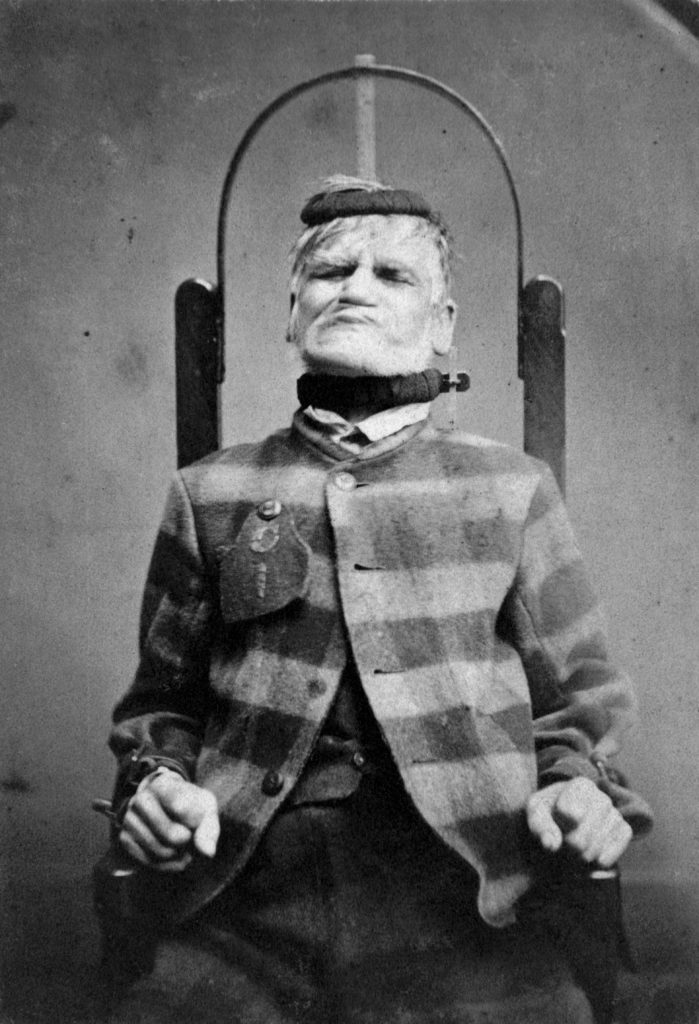
Man in restraint chair; by H. Clarke; 1869
Credit: Wellcome Library, London. Wellcome Images

A Farewell to Patriarchy

Women vs Feminism: Why We All Need Liberating from the Gender Wars, Joanna Williams, 2017, Emerald Publishing, 318pp., paperback, £14.99, reviewed by Ed Dutton

The sexual harassment scandal surrounding the film maker Harvey Weinstein has placed women’s rights squarely in the spotlight. The ‘Me too’ campaign, which has been spread across social media, seems to imply that women need ‘feminism’ more than ever. They are, at best, victims of testosterone-fuelled micro-aggressions: being stared at, leered at, objectified – in a way that would never happen if they were men. The feminist fight for equality will never be won until precisely these kinds of sexist behaviours are banished to the past.

However, in Women vs Feminism, education lecturer Joanna Williams insists, au contraire, that ‘There’s never been a better time to be a woman’ and that today’s feminism has nothing to do with achieving quality, because a calm analysis of the statistics indicates that it has already been pretty much achieved. Modern day feminism, Williams argues, is a totalitarian ideology, through which its proponents aim to achieve power. Continue reading

Posted in Current Affairs and Comment, QR Home | Tagged , , | 1 Comment

Welcome to Canada

Robert Dziekanski, CBC

Welcome to Canada

Mark Wegierski considers a Canadian cause célèbre

Ten years ago, on October 14, 2007, Robert Dziekanski, a forty-year-old Polish immigrant to Canada, met his death at Vancouver Airport. Having arrived at the airport, he waited in the airport’s enclosed baggage area. His mother was in another part of the airport, and was erroneously told that he hadn’t arrived, and she then left the airport. After waiting for over ten hours, Robert understandably became angry, and started to make a ruckus. The over-zealous RCMP airport police rushed in and Tasered him a number of times, resulting in his death from a heart attack. One is struck by how pointless his death was.

This tragic death of Robert Dziekanski, which is still sometimes discussed in the Canadian media, leads the author to certain uneasy thoughts about the place and future of the Polish-Canadian community in Canada, as well as about allegedly “compassionate” Canada. Continue reading

Posted in Current Affairs and Comment, QR Home | Tagged , , , , | 2 Comments

Rape Seed

I Vespri Siciliani, painting by Domenico Morelli

Rape Seed

Les Vêpres Siciliennes; Grand Opera in five acts, music composed by Giuseppe Verdi, libretto by Eugène Scribe & Charles Duveyrier, sung in French with English surtitles, directed by Stefan Herheim, conducted by Maurizio Benini, Royal Opera, 12th October 2017, reviewed by LESLIE JONES

Les Vêpres Siciliennes, Verdi’s first new commission for the Paris Opéra, was premiered on 13th June 1855. Given its French audience, it had a somewhat provocative theme, to wit, “Sicilian nationalist fervour in the face of French oppression” (Sarah Hibberd, ‘The Creation of Les Vêpres siciliennes’, official programme). Indeed, the French occupying forces in Sicily are depicted throughout as drunkards and libertines who treat the local women as the victor’s spoils. In this, the first revival of Stefan Herheim’s 2013 Royal Opera production, the French Governor Guy de Montfort (baritone Michael Volle) sets the tone by raping a Sicilian woman (on stage). In due course, she will give birth to his illegitimate son Henri (tenor Bryan Hymel) enabling Verdi to address the putative conflict between loyalty to father and loyalty to fatherland. Continue reading

Posted in Cultural Matters, QR Home | Tagged , , , | Leave a comment

Canadian Conflict, a War Game Perspective

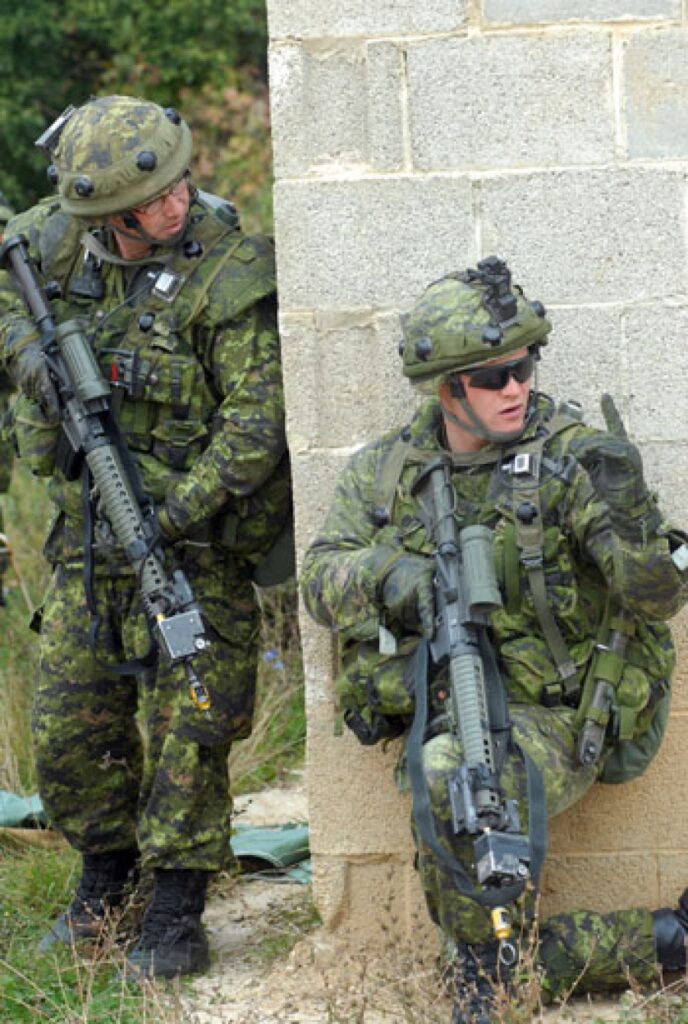
Canadian soldiers train at Hohenfels, Seth Robson/S&S

Canadian Conflict, a War Game Perspective

Mark Wegierski considers Canadian Civil War, first published
40 years ago

Canadian ‘Civil War’: Separatism vs. Federalism in Modern Canada was a board wargame published in 1977 by Simulations Publications, Inc. (SPI), then the premiere gaming company. On the game’s cover-sheet, it is called “A Political Simulation Game”, and it is said that “the time is: 15 November 1976.” This is a game with mostly political, rather than military conflict, played on an abstract map, where the four different factions struggle with each other. These are the Federalists (Red counters); the Provincial Moderates (Orange counters); the Provincial Autonomists (Green counters); and the Separatists (Blue counters). The color of the Provincial Moderate counters is not meant to suggest the Orange Order. There is a three-player variant for the game (called “The Quiet Revolution”, without the Separatist Player); but the game works best in the four-player version. It does not work as a two-player or solitaire game.

The game components include the distinctive SPI plastic game box and cover-sheet; a 28-page rulebook; a sheet of 400 die-cut, half-inch counters, printed on both sides; a 17” x 22” abstract map; 56 “Political Opportunity” Cards (including Event cards, Election cards, and Crisis cards); four player-aid sheets; and a small six-sided die. The highly abstract map (or “Game Display”) is meant to model conflicts of power structures in Canada, without being a geographic map of Canada. The counters represent various constituencies, pressure-groups, provincial influence markers, and counters for the premiers of the provinces, and the Prime Minister. Each of the factions (colors) represented replicates the same set of counters, so the country-wide conflict can be properly represented. There are also 84 counters representing Canada’s land army, including the militia. They are only used in an “end-game” situation, when a “National Emergency” may be called. The military counters are printed red on the front, and blue on the back (with the same numerical values) – representing their allegiance to either the Federalist or Separatist cause. The Canadian military units are the only strictly military component of the game. Continue reading

Posted in Current Affairs and Comment, QR Home | Tagged , , , | 1 Comment

Catalonia, on the Brink

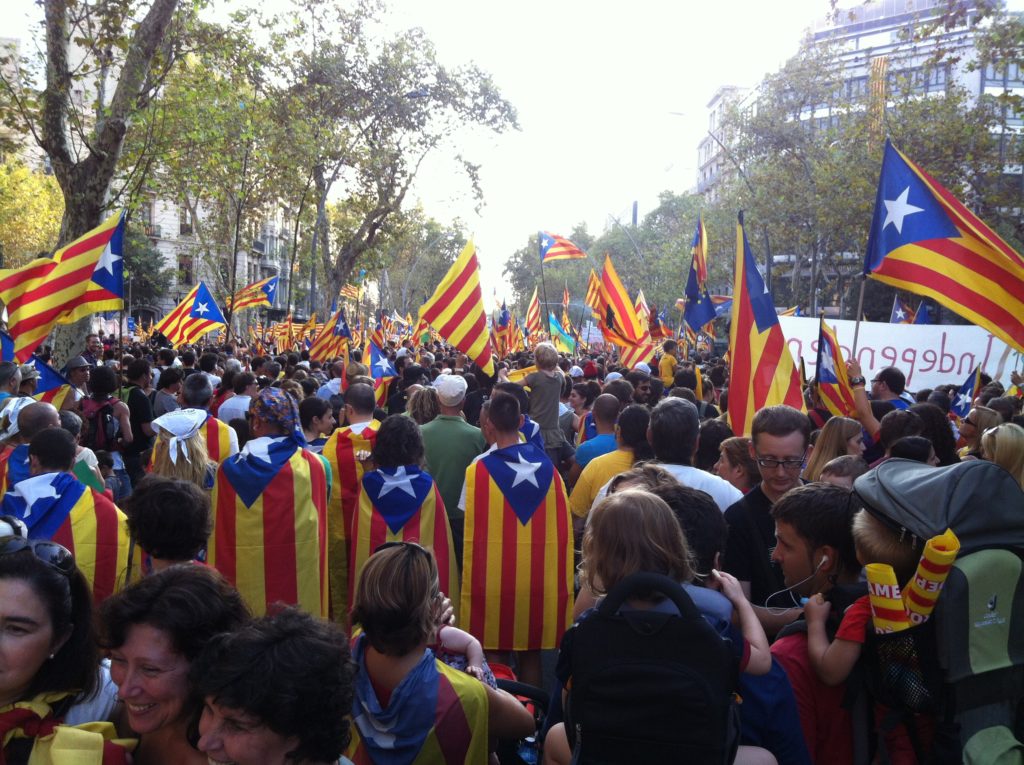
Catalan Independence Protest

Catalonia, on the Brink

Gerry Dorrian considers the roots of the current crisis

Political geography tends to fracture across historical fault lines. In 2015, the University of Oxford’s DNA map of Britain revealed the continuing existence of the millennium-old Landsker Line separating English and Welsh-speaking people in Pembrokeshire, as well as the sharp division between genetic groups in Devon and Cornwall running down the border between the two counties, again 1,000 years old.1

Writ large, the best-known example was the Iron Curtain, which sundered Germany roughly down the line dividing in medieval times western lands where peasants could own property (for a time) from lands where they could not,2 and continued down the Roman Empire’s easternmost stable border, inherited later by Charlemagne,3 which also divided the realms of Latin and Cyrillic text, and the division between western and Orthodox Christianity.4 From the late eighteenth century onwards, Yugoslavists envisaged their supranational Slavic state straddling this line:5 it didn’t end well. Continue reading

Posted in Current Affairs and Comment, QR Home | Tagged , , , | 9 Comments

Epistle to the Romans, part 1

Salvador Dali, Crucifixion (Corpus Hypercubus)

Epistle to the Romans, part 1

A new translation by Darrell Sutton of Paul’s timeless text

Introduction

October 31, 1517 was a fateful day in early-modern German history. For it was on that date that Martin Luther (1483-1546) published his Ninety-five Theses on the Power of Indulgences. In honor of the 500th year anniversary of the German Protestant Reformation, and to mark subsequent transformational events that occurred at that time among Roman Catholics, a new translation of seminal chapters 1-5 in the Latin Vulgate text of Romans, is proffered to readers. Paul’s epistle to the Romans is a key component-text of western civilization: the bulk of eastern Europe was untouched by these reforms. Romans became the main theological treatise for Christians of the later Renaissance era and of the Post-Reformation period, the interpretation of which instigated divisions between leaders, brought about schisms in nation-states and ignited strife in families. Adherents of a form of Erasmian reform Catholicism shunned the more militant views espoused in the Counter-Reformation. They forged ahead in another direction: Chrysostom’s (AD349-407) homilies on the text of Romans were more agreeable to them than the construal of Augustine (AD354-430). The internecine debates over Romans’ subject matter paved the way for so much of the harm and the good that was done in the name of religion. Continue reading

Posted in Cultural Matters, QR Home | Tagged , , , | 2 Comments

ENDNOTES, 7th October 2017

Norman Tower Front, Malling Abbey

ENDNOTES, 7th October 2017

Frank Bridge Cello Sonata etc. at Music@Malling, reviewed by STUART MILLSON

‘Music is always important but even more so in difficult times. It brings people together to share what is good and enduring and underscores what we value.’ So writes Alan Gibbins, Chairman of Music@Malling held in the Kent town of West Malling and now in its seventh year. An event that is very much at the heart of the community (with many educational and outreach events to its credit), the Festival attracts Britain’s brightest performers in a repertoire that embraces Bach, Kodaly, Reger, Nielsen and many English composers.

The mediaeval Pilsdon Barn, situated behind a traditionally Kentish rag stone wall in the grounds of St. Mary’s Abbey, is becoming a well-known venue for classical music. For their concert on the 30th September, Chamber Domaine (Thomas Kemp, violin; Adrian Bradbury, cello; Sophia Rahman, piano) presented a number of works from the year 1917. Beginning with Frank Bridge’s deeply-felt and autumnal Cello Sonata, the ensemble also performed the lyrical Piano Trio No. 2 by John Ireland, a short piano waltz by Stravinsky, and the Chaconne Op. 31 by Carl Nielsen. Continue reading

Posted in ENDNOTES:Music, QR Home | Tagged , , , | 2 Comments

Slave Morality

Slave Morality

Aida, opera in four acts by Giuseppe Verdi, libretto by Antonio Ghislanzoni, conducted by Keri-Lynn Wilson, directed by Phelim McDermott, ENO, 28th September 2017, in collaboration with the theatre company Improbable, reviewed by LESLIE JONES

Interviewed by the writer Adrian Mourby for the official programme, Phelim McDermott, director of this new production of Aida, acknowledged that the period setting therein is “a slight mash up. It’s not ancient and it’s not modern” (see ‘Mining of the Emotions’). And, he should have added, it’s confusing and it’s heteroclite. For we have soldiers in modern battle gear, brandishing automatic weapons; Radamès, decked out in a distinctly Ruritanian dress uniform, replete with gold braid; and (in Act 11, scene 2) modern, flag draped coffins containing the bodies of recently killed Egyptian soldiers, accompanied by framed photographs, evocative of burial scenes in modern day Israel. The costumes of the Egyptian priests brought to mind the head ware and the sombre suits of Ulster’s Orange Order. But we also have slave girls, and an alluring high priestess (Eleanor Dennis) dressed in what presumably is Ancient Egyptian attire. The costumes created for Aida, for the Women’s Chorus and for the pharaoh’s daughter Amneris (mezzo-soprano, Michelle De Young) were decidedly unflattering. Continue reading

Posted in Cultural Matters, QR Home | Tagged , , , , , , | Leave a comment

English, Old and New

Beowulf

English, Old and New

DARRELL SUTTON celebrates the scholarship of Medievalist, Fred C. Robinson (Sep 23, 1930-May 5, 2016), Douglas Tracy Smith Professor Emeritus of English at Yale

HWÆT;

is that the English of old,
Yet spoken in modern times?
It is the language of times long ago,
prefacing Beowulf’s lines.
Those days are gone,
their times are past; but Chaucer’s Tales
yet sail the ages with its ship’s mast
Intact.
In fact, the English we know and love
From Shakespeare to Slang:
Says, “Et Tu, Brute?” or “naw lil bro,’ you cain’t hang!”
Holding the Bible captive, and
Cradling European lore.
Our English tongues
are ever gluttonous: yes,
forever craving more.
Decades before, when times were dark;
Mitchell and Robinson then
hailed a new day. So
Old English textbooks got a new start,
And OE shan’t see shades of The Grave,
for English will never lay dead
in The Tomb of Beowulf.

Darrell Sutton is rector of the Tabernacle in Red Cloud, Nebraska, a small village in the Great Plains. He also teaches Semitic languages and edits an academic bulletin entitled ‘The DS Commentary on Books’

Posted in Poetry, QR Home | Tagged , , | 1 Comment

Today on Radio 4…

Today on Radio 4…

Stuart Millson briefly forsakes the Third Programme and tunes in to a day of left-leaning bias on BBC Radio 4

Famous for programmes which have become “national treasures” such as The Archers, Desert Island Discs, Any Questions, Today and PM, BBC Radio 4 is conventionally seen as an influence for civilised, open debate, intellectual curiosity and the sort of listening which readers of broadsheet newspapers would regard as their cherished, familiar choice of network.

The BBC in general has long been criticised for left-leaning bias – by Tory backbenchers in rabble-rousing conference speeches and by media-bias vigilantes, who are often able to compare the number of broadcast hours given to (for example) “Remainers”, Labour spokespeople or the heads of “progressive” charities, as opposed to Vote Leave supporters, Christian fundamentalists or climate-change sceptics. However, despite the BBC’s duty to provide impartial political coverage, and Radio 4’s pride in its own editorial integrity, a day’s listening to the network – despite the quality of its programmes – shows how our national broadcaster now reflects the in-built cultural and political prejudices of its leading personnel; confirming, not necessarily a party-political bias, but a predisposition to a liberal-left view of the world which – in this age of resurgent “Corbynism” – could easily be taken for a broadcasters’ version of political activism. Continue reading

Posted in Current Affairs and Comment, QR Home | Tagged , , , | 29 Comments