Demonising Whites

Ilana Mercer

Demonising Whites

by Ilana Mercer

Melinda Gates, a silly woman with an enormously wealthy husband, has decided to reinvent herself as a venture capitalist with a difference.

With her husband’s billions, Mrs. Gates announced her intention to venture into funding start-up companies that are likely to fail.

In an interview with Fortune Magazine, Gates “bashed ‘white guys,’” and vowed to favor women and people of color in her investment choices.

Using pigment and gender as criteria in allocating her abundant resources is hardly a prudent investment strategy.

But Mrs. Gates can afford to lose money. Her husband is Bill Gates, a lily-white billionaire (with lots of liver spots).

From the vertiginous heights of ignorance, Mrs. Bill Gates has scolded the venture-capital industry:

“Enough with your love for ‘the white guy in a hoodie’” (whatever that means). Continue reading

Posted in Current Affairs and Comment, QR Home | Tagged , , , | 2 Comments

ENDNOTES, June 2018

Paul Nash, Wittenham Clumps

ENDNOTES, June 2018

In this edition: a world première at the English Music Festival; preview of the 2018 Welsh Proms.

For those of us driving from the South East, via Wokingham and Henley, the road to Dorchester-on-Thames (home of the English Music Festival) takes in some of England’s most beautiful scenery – a route which, in late May, is garlanded in white by roadside Queen Anne lace and the full canopy of green on the stately tree-lined road out of Henley. The town’s bridge marks the border with Oxfordshire, and from then on, a rolling landscape – with hints of an ancient past (Iron Age hill-forts, Saxon churches) – unfolds. Wallingford, with its associations of King Alfred, soon comes into view; and a few miles on, the famous Wittenham Clumps – a wooded ridge (memorialised by the 20th century artist, Paul Nash) looks down upon Dorchester, whose ancient Abbey is the main concert venue for the English Music Festival.

The visitor is, therefore, immediately put into the right frame of mind for a weekend of Vaughan Williams, Holst, Bliss, Elgar and Peter Warlock. But for the Festival’s founder, Em Marshall-Luck, English music does not begin and end with these famous names: instead, the equivalent of an archaeological dig has been initiated, one which has brought to light lost or rare masterpieces; and a host of composers – such as Sir George Dyson, Sterndale Bennett, Ethel Smyth, Arwel Hughes, Ivor Gurney – who have suffered years of neglect in our country’s concert programmes. Continue reading

Posted in Cultural Matters, QR Home | Tagged , , , , , , , | 1 Comment

Marriage Matters

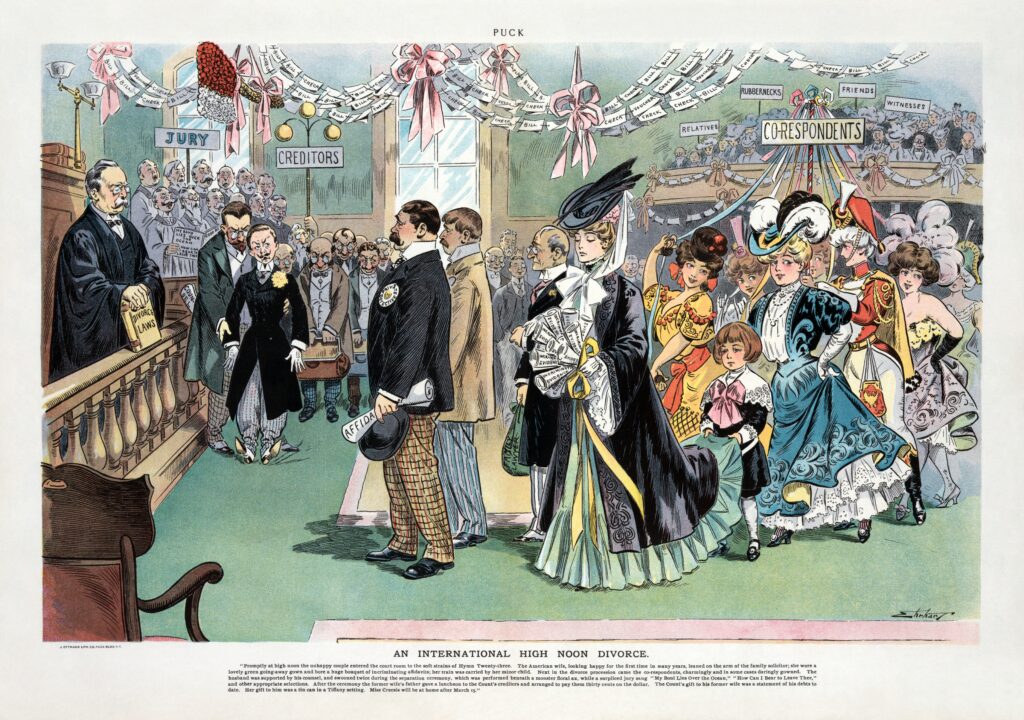
Samuel D Erhart, An International High Noon Divorce

Marriage Matters

by Bill Hartley

Periodically the question of divorce reform features in the media. The last serious attempt to bring about change was by John Major’s government which apparently ignored what students of constitutional law are taught: that no minority administration should ever attempt to legislate on a moral issue. Admittedly Major’s government wasn’t quite in a minority but his majority following the 1992 general election was only 21 and the government should have first calculated how many Roman Catholic MPs there were in the Parliamentary Conservative Party; the sort of people likely to have viewed it as a moral issue. Anyway it was all rendered academic because Major lost the 1997 general election. Tony Blair’s government was smart enough to sidestep a moral issue. As a consequence, the Matrimonial Causes Act (1973) remains the law on divorce in this country.

Critics of the existing law (and Major’s government based its intentions on this) insist that divorce shouldn’t be ‘fault based’. They are presumably in favour of a petitioner being able to approach the county court and see the marriage dissolved without any evidential checks being left in place. Of course there are the financial and child care arrangements and doubtless a court would wish to be satisfied that these had been established. Overall the desired approach would be to reduce divorce to an administrative process lightly overseen by the courts whose task would be to record that the marriage had been dissolved. However, just because the current law has been in operation for 47 years doesn’t necessarily mean it is bad law. The Law of Property Act for example, a far more complex piece of legislation, continues to regulate the sale of houses and no-one is crying out for it to be reformed simply because it is nearly a hundred years old and society has changed. Continue reading

Posted in Current Affairs and Comment, QR Home | Tagged , | Leave a comment

White Lines

The Grave of Wilhelm Fliess, Cemetery Dahlem, Berlin

White Lines

Freud, the Making of an Illusion, Frederick Crews, Henry Holt and Co., New York, 2017, pp 746, HB, US 40$, reviewed by LESLIE JONES

Frederick Crews is Professor Emeritus of English at the University of California. Once an acolyte, he now competes with Jeffrey Masson and Michel Onfray for the coveted title “King of the Freud debunkers” (see “Sigmund Freud, from myth to counter myth”, QR, Autumn 2010).

In Freud, the Making of an Illusion, extensive use is made of the Brautbriefe, the engagement letters of Freud and Martha Bernays, written between 1882 and 1886. Hitherto, some of these letters were unavailable or only available in redacted form. Three of the five planned volumes of this revealing and unexpurgated correspondence have already appeared. Crews contends that they will revolutionize Freud scholarship. The attempts by Freud’s disciples and relatives (especially his daughter Anna) to censor the compromising material therein, including alleged breaches of medical ethics, is a major theme of this book.

The eldest child of Jacob and Amalie Freud, Sigmund was born in Freiberg, Moravia, in 1856. It was here that his father’s wholesale wool business went belly up. He never worked again. In 1860, the family re-located to a Leopoldstadt, a poor, predominantly Jewish quarter of Vienna. Crews maintains that this background of economic insecurity and poverty imbued Sigmund with an insatiable ambition for material success and social advancement. He had five younger sisters and a younger brother (another boy Julius died in early childhood). The family’s hopes rested on the “goldener Sigi”. His uncle Josef’s imprisonment for forging rubles, in 1865, doubtless reinforced his sense of being an outsider. Referring to Freud’s stellar, subsequent career as anatomist, paediatric-neurologist, research scientist, family doctor and scientific author, Crews remarks, “None of those achievements and honours… would slake his appetite for greatness or earn him more than temporary peace of mind” (page 12). Continue reading

Posted in Book Reviews, Cultural Matters, QR Home | Tagged , , , , , , | 2 Comments

Pickled in Formaldehyde

Alan Dershowitz, 2009

Pickled in Formaldehyde

ILANA MERCER dissects the liberal brain

“There are no more civil libertarians left,” warned celebrated attorney Alan Dershowitz.

The topic was the left. The location was Tucker Carlson’s TV studio, May 30.

Dershowitz, a life-long liberal and civil-libertarian, has refused “to allow partisan politics to pre-empt his views on the Constitution,” in general, and in the matter of Grand Inquisitor Robert Mueller and his tribunal, in particular.

Conversely, the  American Civil Liberties Union has supported the FBI’s manifestly unconstitutional raid on Michael Cohen’s offices, even asserting that the seizing of client-attorney privileged files from the Trump attorney was kosher.

“… all indications thus far are that the search was conducted pursuant to the rule of law,” crowed the ACLU, in “stunning rebuke to the basic concepts behind the [organization’s] mission.”

To ACLU silence—and in contravention of that quaint thing called the Fourth Amendment—Mueller had previously taken possession of tens of thousands of emails exchanged among President Donald Trump’s transition team. Continue reading

Posted in Current Affairs and Comment, QR Home | Tagged , , , , | Leave a comment

Shakespeare’s Sister

Shakespeare’s Sister

IN BYRON’S WAKE: The Turbulent Lives of Lord Byron’s Wife and Daughter: Annabella Milbanke & Ada Lovelace, Miranda Seymour, Simon & Schuster, 2018, £25, reviewed by STODDARD MARTIN

What is it about Bryon that provokes such fascination? His self-possession, his wit, his self-destructive daring? Certainly the women touched by him lived duller lives once he had vanished. Miranda Seymour’s new book testifies to this, coming to life when the lame poet arrives on stage and ebbing towards inanition in what she aptly calls his ‘wake’ – except of course when questions surrounding his character or career would resurface, as they often did. It is a bold stroke for a woman of our generation to grant key focus to a man in what is essentially a gallery of miniatures of his women and issue. But Miranda Seymour is confident enough of her powers as person and scholar not to let her portraits be disfigured by partisanship for gender.

She writes as a frank, un-shockable, intelligent female rather than as a feminist. The Byron saga, told so frequently by men, is reviewed through her eyes to show its protagonist’s frailties, rumbling the mask of machismo his type tends to wear, if in this case more flamboyantly than most. Seymour neither mocks nor resents him, though at one point she chastises a previous woman writer for ‘excessive devotion to the man and his work’[1]. Byron in her hands is less hero than wayward young man, a correction that in some moods the mercurial poet might have welcomed. Byron the legend becomes Byron the crossed husband and then, once offstage and spun via memory of his estranged wife and child, a legend again, though not quite of the style favoured by Pushkin or Hugo or Verdi, more related to some monstre sacre of an English public schoolgirl’s reflections – Byron house-brokenly situated in a feminized order of rank. Continue reading

Posted in Book Reviews, QR Home | Tagged , , , | Leave a comment

Glock is Great

Glock 30

Glock is Great

BY ILANA MERCER

The tele-experts assert that to do what he did—kill 10 and maim 13, at Santa Fe High School, in Texas—Dimitrios Pagourtzis had to be insane.

Likewise, Nikolas Cruz—killer of 17 in Parkland, Florida—and many shooters before him: all were victims of mental disorder. Or, so say the experts.

The structure of argument coming from conservative and progressive corners is pretty much the same:

Conservatives blame mental health.

Progressives blame the National Rifle Association.

Both factions see the locus of responsibility for these murder sprees as beyond the the individual and of what were once formative and corrective institutions: the church, for example. Continue reading

Posted in Current Affairs and Comment, QR Home | Tagged , , , | 2 Comments

Imagination – it’s an Illusion

Archbishop of Canterbury

Imagination – it’s an Illusion

Reimagining Britain: Foundations for Hope, Justin Welby, Bloomsbury Continuum, 2018, 300pp. Hardback, £16.99., reviewed by EDWARD DUTTON

The Rev. Dr Malcolm Johnson, Rector of St Botolph’s, Aldgate, once remarked, ‘I see the Church of England as an elderly maiden aunt. Most of the time you’d like to strangle her, but she comes into her own at Christmas and Easter and she’s there when you want her’ (quoted Caroline Chartres, 2007, Why I Am Still Anglican, Bloomsbury, p.104). Dr Johnson’s metaphor piquantly summarises the feelings that many English people have (or used to have) about the Anglican Church: she’s eccentric, unworldly, embarrassed about sex . . . but, deep down, she’s loving, reliable, and she holds the English family together at times of crisis. She reaches back, beyond living memory, into English history – perhaps her fiancé was killed at the Somme – into rituals our ancestors did, something vaguely eternal and ineffable. Somehow, with her, all will be well in the end.

It is, therefore, fascinating to a read a book by an Archbishop of Canterbury, the incumbent the Most Rev. Justin Welby, which reflects the way in which a very different model has taken over the Church of England. The elderly maiden aunt is, alas, a bit too old-fashioned for the new head of the clan, because he – like so many in senior clerical positions – is essentially a Multiculturalist in a mitre. The ideology of Multiculturalism traces its ideological roots to Marxism, wherein ‘the revolution is eternal’ and History unfolds according to the Hegelian Dialectic. There is always a ‘Spirit of the Age’. Whereas the elderly maiden aunt represented something eternal and unchanging, Mr Welby embodies this chaotic Zeitgeist.   Continue reading

Posted in Book Reviews, Current Affairs and Comment, QR Home | Tagged , , , | 5 Comments

Two Tribes, Part 2

The Dance to the Music of Time, Poussin c. 1640, credit Wikipedia

Two Tribes, Part 2

By Mark Wegierski

Many of Canada’s problems derive from the fact that the country consists of “two nations warring in the bosom of a single state”, to quote from Lord Durham’s famous Report of 1840. The “two nations” are, of course, English-speaking and French-speaking Canada. Oft times, English-speaking Canada tried to pretend that Québec simply did not exist; then it moved, probably too late, into a stance of extreme accommodation; and finally, when English-speaking Canada became ideologically liberal, it moved to oppose Québec in the name of so-called universal rights, and in view of Québec’s “illiberalism”.

In an attempt to have Québec accede to the new Canadian Constitution, Prime Minister Brian Mulroney negotiated the Meech Lake Accord in 1987. A strange kind of fury seized English Canada, in opposition to the legal recognition of Québec as “a distinct society”, albeit an obvious historical and social reality but a blow to absolute individual rights, as well as to the notion that so-called “group rights” are normally afforded only to visible minorities (a term of official usage), as well as to Aboriginal peoples in Canada. The Accord failed in 1990, when it was rejected by the recalcitrant legislatures of two smaller English-Canadian provinces. Continue reading

Posted in Current Affairs and Comment, QR Home | Tagged , , , , , | 1 Comment

All Greek to Me

Pallas (Athena) with the Parthenon

All Greek to Me

Exhibition, Rodin and the art of ancient Greece, The British Museum, 26th April to 29th July 2018; Rodin and the art of ancient Greece, a publication that accompanies the exhibition, reviewed by LESLIE JONES

“…we possess intellectual and moral faculties [for whose] origin we can only find an adequate cause in the unseen universe of Spirit”, Alfred Russel Wallace, Darwinism

In Auguste Rodin’s bizarre marble and plaster bust entitled Pallas (Athena) with the Parthenon (1896), the goddess of wisdom and truth has given birth to the Athenian temple  – from her head. The two figures, one falling, in Lamentation on the Acropolis, sometimes known as The Death of Athens (1902?), also bespeak Rodin’s neo-Hellenism. They have collapsed onto a rock that supposedly represents the Acropolis. For “In Rodin’s day, the Parthenon represented the summit of intellectual and artistic achievement….” (quotation from Rodin and the art of ancient Greece). But not only in his day.

Rodin’s interest in the Parthenon sculptures pre-dated his first visit to the British Museum in 1881. Before 1870, he executed a superb series of sketches from casts and engravings in the Louvre. His study of Youths preparing for the cavalcade, from the North Frieze, is particularly fine. So too are the sketches of horses and men with a chariot (Parthenon North Frieze, before 1870), and of men driving cattle. Continue reading

Posted in Cultural Matters, QR Home | Tagged , , , | Leave a comment