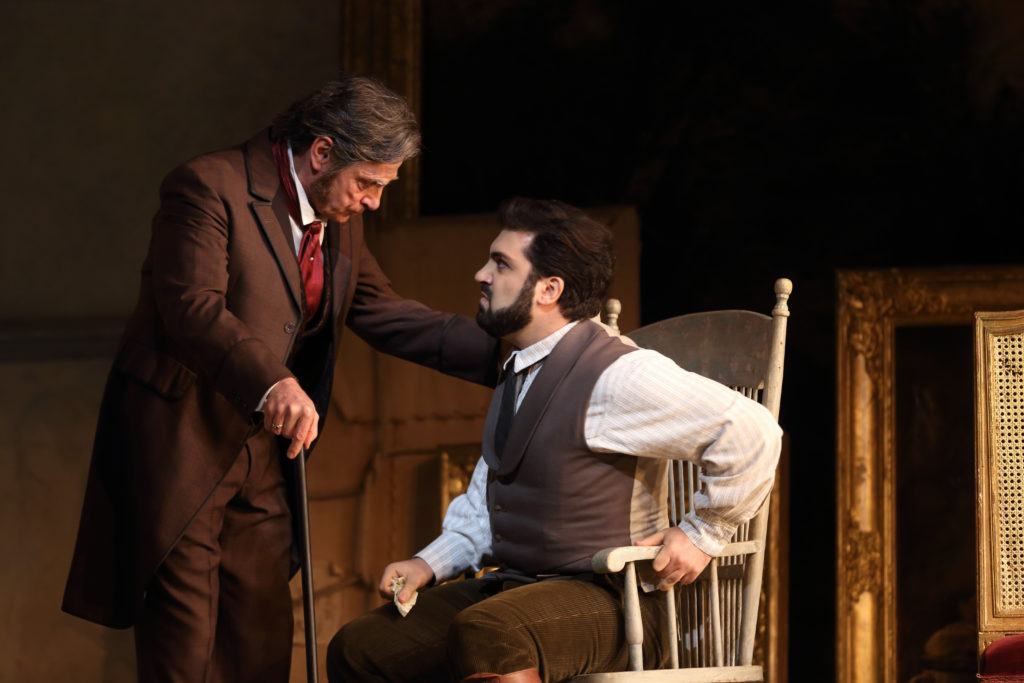
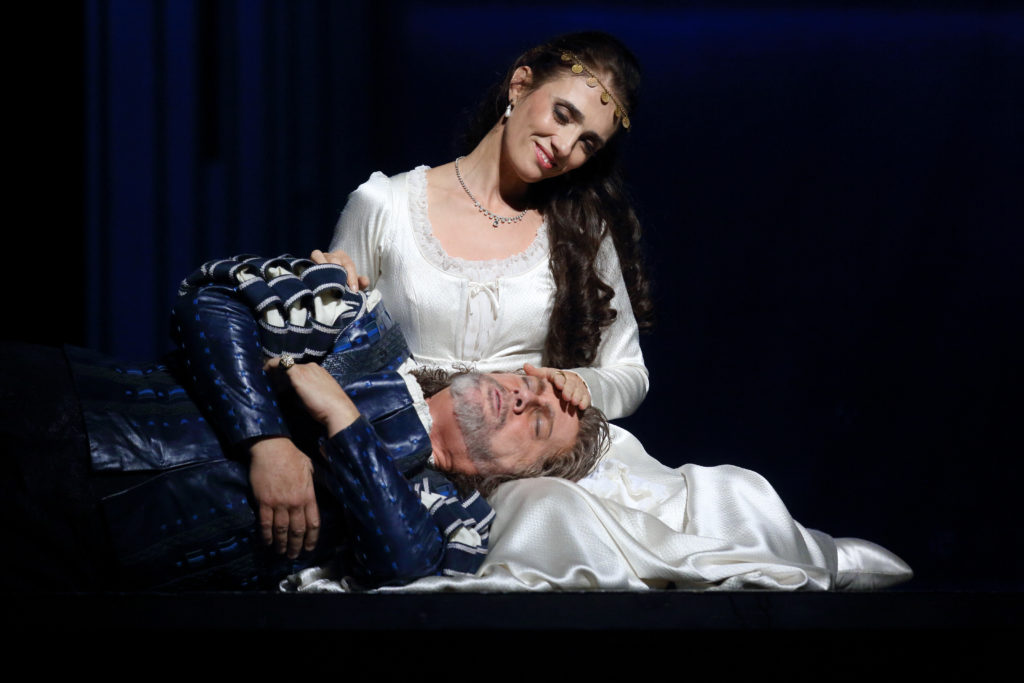
Simon Keenlyside as Giorgio Germont and Liparit Avetisyan as Alfredo Germont, photo by Catherine Ashmore
Fathers & Sons, review of La Traviata
La Traviata, opera in three acts, music by Giuseppe Verdi, libretto by Francesco Maria Piave, conducted by Daniel Oren, directed by Richard Eyre, a further revival of the 1994 production, Royal Opera, 17th December 2019, reviewed by Leslie Jones
Aristotle, in the Nichomachean Ethics, distinguishes between hedonism, living for pleasure, and eudaemonism, living in accordance with wisdom and virtue. Witness Violetta (played by soprano Hrachuhi Bassenz), conflicted and torn. In Sempre libera degg’i, she advocates a life of pleasure. But in the opening scene of La Traviata, something of a bacchanalian affair, she tells Alfredo that she has never loved or been loved but that she fantasised about an ideal lover. Alfredo, in his aria Un di, felice, eterea, acknowledges that love, the “heartbeat of the universe”, entails both pleasure and pain. Violetta is evidently ambivalent about emotional dependence.
La Traviata is replete with the crowd pleasing arias and duets characteristic of bel canto. Warwick Thompson refers to the “cruel coloratura demands of [the aria] Sempre libera” (‘Why is champagne not mentioned‘, Official Programme). But after an understandably nervous start, Ms Bassenz warmed up and her vocal pyrotechnics were rewarded by a prolonged ovation at the end of Act 1. Liparit Avetisyan, as Alfredo, graciously accepted being upstaged. Continue reading



A Behemoth in the Bedroom?
Prince Andrew and Princess Eugenie
A Behemoth in the Bedroom?
David Ashton does sex, lies and videotape
The controversy over “randy” Prince Andrew, reputedly the Queen’s favourite son, and “pervy” financier Jeffrey Epstein [1], might be clarified in more detail by interviewing their long-term “sassy” mutual acquaintance Ghislaine Maxwell [2], reputedly the favourite child of “dodgy” tycoon Robert Maxwell. An international espionage asset, the “Bouncing Czech” was larger than life – and also in death, when senior dignitaries in Jerusalem eulogised his colossal – if partly undisclosed – services [3].
Mr Epstein was accused of recording sexual acts by politicians and celebrities among his guests, possibly for subsequent entertainment and/or profitable “compromise” [4]. Ms Maxwell is “also under investigation for allegedly procuring girls for Epstein [but] denies all wrongdoing” [5]. At this time of writing, her whereabouts are unknown, although it is claimed that she is planning a televised rebuttal with a US network [6].
A further question is whether any intelligence agency would have an interest in such events, or even some involvement. Surveillance of important friends and foes by security services is hardly unknown, Russian “honeypot entrapments” being especially notorious [7]. Continue reading →
Share this:
Like this: