
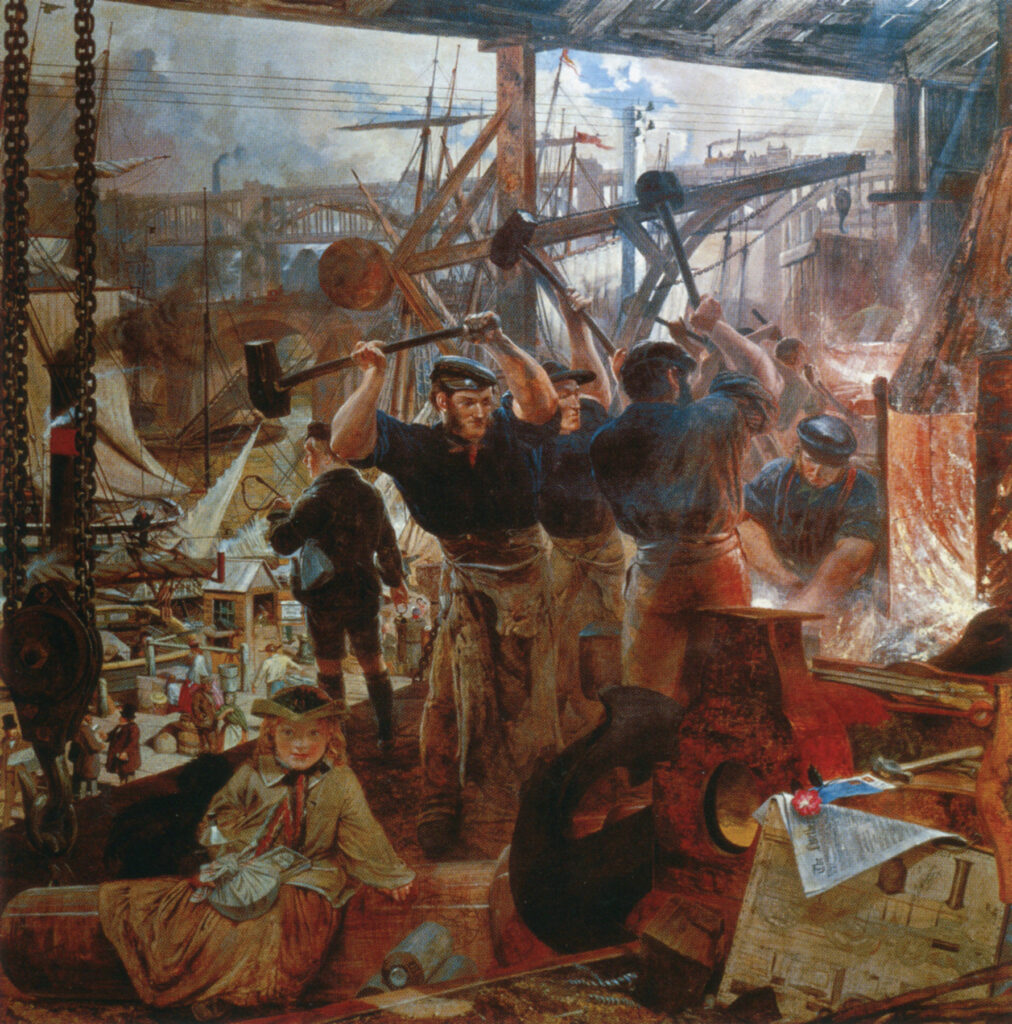
William Bell Scott, Iron and Coal
Fake History, from the EU
William Hartley has iron in the soul
In 1999, recognising there was no single event which shaped the European landscape greater than the Industrial Revolution, Britain, Belgium, Germany and the Netherlands applied for EU funding to draw up a master plan. What flowed from this became known as the ‘Duisberg Declaration’. The aim was to create interest in the common European heritage of industrialisation. This became known as the European Route of Industrial Heritage. In terms of leisure and tourism it wasn’t a bad idea. After all, shouldn’t citizens of Europe learn about what shaped the modern world? This being an EU funded project, however, a problem arose through an overarching requirement to achieve commonality. Rather reluctantly, the ERIH only hints at where the industrial revolution originated before crossing to the continent. Evidently no nation was to be given a leading role.
There were various social, environmental and geological reasons why the industrial revolution began in Britain. The early start thesis has been well covered by economic historians and as we know that for Britain it meant both benefits and burdens. The ERIH moves quickly on from that awkward point of origin question, giving the impression that the industrial revolution was breaking out everywhere. Certainly, what followed in Europe was important. Yet much of what is to be found on the Route is nineteenth or even twentieth century in origin. The fact is that the building blocks of the Industrial Revolution originated in eighteenth century Britain. Continue reading







Woke – Curse of the Thinking Classes
Morgan Russell, Cosmic Synchrony
Woke – Curse of the Thinking Classes
Ilana Mercer on the enemy within
They’re unwilling to defend true dissidents, but Beltway lite libertarians and Con Inkers are forever genuflecting to privileged legacy journalists, who can afford to voluntarily leave their rich gigs in “protest” at cancel culture. The Right hasn’t shut up about the New Yorker’s Andrew Sullivan, who is far less banal than the New York Times’ Bari Weiss. Both belong to the “nothing new, more of the same” neoconservative tradition. Her resignation antics are a storm in a C-cup; his “defiant” departure is the fussy equivalent (just for gay men).
For a more meaningful scandal, to the Right at least, consider the farce of a Conservative news and opinion organization, founded by a dragon slayer of a broadcaster, which has published lacerating pieces condemning America’s foremost hate group, yet has proceeded to purge writers, in compliance with the demands of said shakedown hate group. American conservatism capitulating to America-haters? Negotiating with terrorists? Hypocrisy? Yes, yes, and yes. Supine is the natural position of the Establishment Republican, Con Inker, neoconservative, whatever his latest opportunistic, political permutation may be.
The news site is the Daily Caller. The hate group is the Southern Poverty Law Center (SPLC). The ransom demands issue from the illiterati of the SPLC, who regularly publish lists of—and hit pieces against—untouchable dissidents. They then proceed against us with all the vigor of a “a money grabbing slander machine,” to quote John Stossel, a veteran investigative journalist who has exposed this corrupt syndicate that lives off destroying people. For his part, economist Thomas DiLorenzo has skillfully pried apart the revenue-rich, “racial racketeering” of the Southern Poverty Law Center, showing it to be nothing more than a “hate group hedge fund.” Continue reading →
Share this:
Like this: