The riddle of the sands

The riddle of the sands

LESLIE JONES pays tribute to a pioneering Egyptologist

In The Archaeology of Race, Debbie Challis, Audience Development Officer at the Petrie Museum, deploys the usual hackneyed criticisms of eugenics and psychometrics. Race, accordingly, “is not a biological but a social construction” (page 3); Galton’s thinking has a “Nazi taint” (page xiii); his studies of Jewish anthropometrics helped lay the foundations for the Holocaust* (pages 147 and 148); and IQ testers “ignore[s] the way in which such tests are predicated around assumptions about peoples’ background and prior knowledge” (page 53). Dr Challis’s opening chapter, an excursus on the notorious anatomist Robert Knox, author of Races of Men, is of questionable relevance. For the gullible reader, however, it may serve to undermine the reputations of Galton and Petrie through guilt by association.

The Archaeology of Race brings to mind a recent debate on the putative influence of Egypt on the development of ancient Greek and thence of Western civilisation. In Black Athena, it may be recalled that Martin Bernal debunked what he termed the “Aryan Model” of ancient history as elaborated by allegedly racist classical scholars. Professor Bernal accused the latter of downplaying not just the influence of Egypt (an “African” civilisation) but also that of the Mesopotamian and Levantine civilisations. In Bernal’s estimation, for the proponents of this model the ancient Greeks had to be Aryans. And the idea that Egyptians (an African people) or Jews or Phoenicians or Arabs could have influenced the development of Western culture was simply unacceptable.

As Kathyrn A. Bard has observed in Black Athena Revisited, the title Black Athena was chosen to suggest that the roots of Greek and therefore of Western civilisation were in “a black African civilisation in Egypt”. Bernal, in other words, is an exponent of Afro-centrist ancient history, albeit a methodologically superior one. On this particular issue, Dr Challis deserves some credit. Although she too insists that Egypt was “an African civilisation” (whatever that means), she at least challenges recent claims that Tiye and Nefertiti were “powerful black queens” (page 165). But like Bernal, she considers such claims an understandable reaction to the prevalent “racism in scholarship and archaeology over the last 200 years” (page 164) and exemplified in her judgement by the racial preconceptions of both Galton and Petrie.

The distinguished Egyptologist and archaeologist William Matthew Flinders Petrie (1853-1942), as Dr Challis reminds us, was profoundly influenced by the racial typology elaborated by his friend and supporter Francis Galton. Race for both men had played a pivotal role in history. In “Migrations”, the Huxley Lecture of 1906, Petrie comments that “Races are exterminated and wholesale changes are going on now in a lifetime which might have occupied a thousand years in past ages”, an observation reminiscent of remarks made by Galton in Inquiries into Human Faculty.

According to Petrie, during the successive civilisations of Ancient Egypt art flourished but then declined. He inferred that as powerful races came in they reinvigorated civilisation but were then subject to race mixing and deterioration. In The Revolutions of Civilisation, he concluded that this is why civilisation is an intermittent phenomenon.

Petrie maintained that the Palaeolithic race that occupied Egypt was “a steatopygous and hairy Bushman”. The latter was then displaced in prehistoric times by a European (Caucasian) type race with long brown wavy hair, either Syrians or Libyans. But the dynastic, history-making race, probably from the Red Sea, was Semitic and distinguished by a quite different facial profile and a “massive” head. For Petrie, the emergence of this new race was marked by an outburst of art work of the highest quality. He claimed that another powerful race of invaders from Syria subsequently engendered the XII Dynasty civilisation.

Like Galton, Petrie clearly believed that certain populations, notably the ancient Greeks, were innately superior. Or as Dr Challis, summarising Petrie’s position puts it, “Different races are all human but so different from each other to be almost like separate species…” (page181). Yet she fails to substantiate her repeated assertion, as on page 52, that both men “judged social considerations and nurture in forming an individual as irrelevant”.

Petrie used anthropomorphic criteria to identify the successive racial types in Egypt. This involved carefully measuring the cephalic index of ancient crania. Indeed, as the author informs us, the craniometer that Petrie used in Egypt and in Palestine is currently held by the Department of Statistical Sciences at University College London. During his visit to Egypt in 1886/1887, Professor Petrie also took photographs of the main racial types as depicted on various ancient monuments (subsequently published under the rubric Racial Photographs from the Ancient Egyptian Pictures and Sculptures). Dr Challis, an assiduous postmodernist, characterises this procedure as “reading race in the face” (page 86). In addition, Petrie obtained squeezes, from which he subsequently made plaster casts of heads. But note in this context that he also used cultural criteria to differentiate the successive ethnic types, notably burial customs, styles of pottery, the use of pictorial hieroglyphs and of minute ethnographic distinctions etc.

What distinguishes a science from an ideology? Petrie at first thought that pottery etc that he excavated in cemeteries in Naqada in 1894-5 belonged to a “New Race” that had migrated into Egypt between 2180 and 2040 BC and vanquished the local population. But science is self-correcting. He eventually conceded that this material was much older (pre-dynastic). Racial prepossessions notwithstanding, Professor Petrie was prepared to “put the observation of archaeological evidence above his own theories”, as the author acknowledges. For this alone he deserves lasting credit.

*The Germans, however, had developed their own Rassenkunde or racial anthropology, as the author points out herself on pages 118-119

The Archaeology of Race: the Eugenic Ideas of Francis Galton and Flinders Petrie

Debbie Challis, Bloomsbury, London, 2013, pp 272

Leslie Jones is deputy editor of the Quarterly Review


Posted in QR Home | Tagged , , , , , , , | 1 Comment

Goodnight, Vienna…

Goodnight, Vienna…

STODDARD MARTIN reads a redolent dramatized account of an Austrian family’s 20th century tribulations

Edmund de Waal had a succès d’estime a few years back with his family memoir The Hare with the Amber Eyes. His Ephrussi forbears, a grand European Jewish clan, produced among other exquisites a model for the protagonist of the overture volume of Proust’s epoch-making À la recherche du temps perdu. Fine manners and taste allied to great wealth characterized a type and an ethos summoned up with gentle, if perhaps not quite unintentionally polemical, nostalgia. The Palais Ephrussi had stood prominent among similar piles along the top-drawer Ringstrasse in pre-war Vienna. That the street was known as “Zionstrasse” among less privileged types was in retrospect a harbinger of catastrophe, as de Waal notes in his preface to The Exiles Return. Yet in the heyday of the Ephrussi and kind such insults were nobly ignored; and as late as the Anschluss in 1938, de Waal’s great-grandparents hung on, only to be rescued by an efficient daughter who had begun her own exile to the West fifteen years earlier as Rockefeller Foundation fellow in economics at Columbia University.

Elisabeth von Ephrussi became ‘de Waal’ upon marrying a Dutchman. Although trained as an economist, she had from an early age wanted to be a literary writer. She penned poems in her husband’s language, two novels in her native German and three in adopted English. Following her time in America, she lived in Paris, where she wrote for Le Figaro, and later in London, where she reviewed French novels for The TLS. A true cosmopolitan, she could recite swathes of Faust and of Rilke, her favourite poet, with whom she had corresponded. She owned an original copy of James Joyce’s Ulysses, published by Shakespeare and Company, and may even have read much of it – her grandson tells us its pages are cut up to 563. Above all, however, her master was Proust; and in The Exiles Return, a novel left unpublished at her death, we see a version of his milieu, if not style, filtered heavily through the anaesthetic of ‘the American century’ and transferred from belle époque Paris to a post-war Vienna, whose sombre atmosphere will forever be branded on the Anglo psyche by the Carol Reed/ Alexander Korda/ Orson Welles film of Graham Greene’s The Third Man.

As evocation of what once had been and would become of that city in the last days of Four Power occupation, de Waal’s novel penetrates further than the Greene spy scenario cared to. Because she had lived to adulthood amid its glories now flattened, she feels the place as insider as well as outsider, as victim as well as new dominator. Her exiles returning provide a three-way split of her psyche: a scientist/academic who fled with his wife to America, where she flourished but he felt alien; a Greco-Viennese magnate who also fled to America and flourished but now seeks to thrive again in a milieu where his people strode like colossi before calamity struck; the daughter of another noble émigré to America who has grown up in a plasticized suburb where she could never feel quite at home, thus is sent off to ‘find herself’ among relations of the surviving Austrian aristocracy. Action takes place for these three respectively in Third Man-ish mean streets and an un-renovated university laboratory; in art and antique shops and a rebuilt, if somewhat hidden, palace; in a down-at-heel country estate and a noble townhouse now turned into flats. The impact of American upon Old World values is pervasive, yet shallow; resistance of the latter to the former is deftly depicted; the mix of the two in a new order emergent is painted with subtle brushstrokes.

Gore Vidal once entitled a book Pink Triangle & Yellow Star to underline common interest between gays and Jews in the aftermath of persecution by Blackshirts. He relocated to Europe to ply a congenial lifestyle among the decadent aristos of, in his case, Italy. This very New York-ish new old alliance – gay, Jew and ancien régime – is a matrix into which de Waal places her personae, interweaving their destinies as they ply expatriate lives in a new (for them) old world. The scientist leaves his wife making a fortune in Manhattan as corsetière to the nouveau riche (she despises them with a verve resembling Leona Helmsley’s decades on) to find only begrudging welcome from the native academics at his old institute; he is restored to his former position, without recognition of his achievements in exile, solely as a result of imposed policy and finds contentment only via the affection of an aristocrat who, dispossessed, has buried herself in research and, being too grand to think in terms of rivalry, recognizes his genius without fear of being overshadowed by it. Her brother is a beautiful scamp who, penniless, becomes bisexual bait for the rich; he is taken up by de Waal’s second persona, the Greek collector, who wishes to create a salon for what remains of or can be made into a beau monde in the half-dead city. De Waal’s third and most intimate persona, the American girl sent to find herself in ancestral Austria, falls under the spell of the scamp and becomes pregnant by him. He refuses to marry her, being after wealth only; but she is offered salvation by engagement to the Greek, whose covert motive for taking her on is to increase his attraction via her beauty and pedigree and to exercize further power over the lothario-scamp, who turns out to be not only bait for his developing salon but also the object of his own rarefied erotic interest.

In this imbroglio, ethnic, class and sexual prejudices all play significant roles. There is something pot-boilerish to the ending: one senses a whiff of Hollywood – say, James M. Cain (Mildred Pierce comes to mind) – affecting the otherwise ambient scent of one of Louise de Vilmorin’s housebroken-ly Proustian efforts. That said (and one wonders if it may be an explanation for why the book was not published in the author’s lifetime), the ending does have portent. Not all is as it should be in this new-world-upon-old paradise. The gay-Jewish-aristo alliance is a ‘golden bowl’ with significant fissures, even cracks; and it is fortunate for the principals that American authorities are still in charge of their district, if only just. Along with carefully vetted police and under supervision of a mysteriously omniscient priest, they are able to cover up a tragedy which might lead to scandal, even reactionary sanctions, were the native authorities back in control, as they imminently will be.

Elements in The Exiles Return are strikingly of the 1950s and might alarm monitors of political correctness in our day. Homosexual intrigue as the cause of a naïve young woman’s demise is one. Depiction of the plutocratic Greek as all-manipulating is another: it could be seen as an anti-Semitic caricature had he been cast as a Jew, as he easily and possibly more credibly could have been. But Elisabeth de Waal was clearly driven by desire for recherche of her own Proustian province as much as of this new old world at large, and the picture she paints of post-war Vienna’s apparatchiks and ideologues, only partly de-nazified natives and nostalgists, is sketchy in comparison to her detailing of her own kind. Thus we must not rush to hail the book chiefly as the historical portrait it appears to be at first glance. As that, it is atmospheric, intriguing, suggestive and rich; but as novel of personality and development it has more insistent pull and intrinsic truth. This may be the chief reason that Edmund de Waal, with his family agenda, persuaded Persephone Books to release it for the first time. It is a credit to both that they have done so, and in an inexpensive, highly attractive edition.

Dr. STODDARD MARTIN is the author of numerous books on 19th and 20th century thought

The Exiles Return

Elisabeth de Waal, with a new Preface by Edmund de Waal. Persephone Books, 2013. £12


Posted in QR Home | Tagged , , , , , , | Leave a comment

Welcome to Britain (perhaps)

Welcome to Britain (perhaps)

SONYA JAY PORTER explores some anomalies of immigration into the UK

British housewives defend their homes from German troops in the 1942 propaganda film Went the Day Well?

Last summer, the Coalition brought into effect new immigration laws which are creating yet more difficulties for British nationals who want to marry citizens from countries outside the European Union and to bring them to the UK.

But these difficulties do not apply to citizens of other EU countries. This is because they are considered to be exercising their European Economic Area (EEA) rights, which are e determined by their living and working in one EEA member state and are therefore entitled to bring their non-EEA born spouse, partner or close relatives to join them when the move to another EEA country, such as Britain. This is a Rights Entitlement enshrined in the European Convention on Human Rights and therefore should supersede domestic laws.

In other words, the Coalition actively discriminates against its own nationals by imposing restrictions on UK citizens before they are allowed to bring a non-EU spouse – or other family members – into the country, which do not apply to EU citizens.

It was in July 2012 that the government introduced changes of the immigration laws (1). Amongst others were:

  • Imposing a new minimum income threshold of £18,600 pa for sponsoring a proposed spouse or partner or proposed civil partner of non-European Economic Area (EEA) nationality, with a higher threshold for any children also sponsored   – £22,400 for one child and an additional £2,400 for each further child;
  • Extending the minimum probationary period for settlement for non-EEA spouses and partners from two years to five years, to test the genuineness of the relationship;
  • Allowing adult and elderly dependants to settle in the UK only where they can demonstrate that, as a result of age, illness or disability, they require a level of long-term personal care.

Speaking on the Andrew Marr Show in July 2012, Home Secretary Theresa May said:

We think it is right that someone wanting to bring a spouse or partner into the UK, should be able to support them financially and should not be bring in them in on the basis that they’re reliant on the state.

But these laws can be illogical and the Family Immigration Alliance (2) has received many distressing reports from UK citizens affected by these new laws.

One UK national married her husband, an American citizen, in the States and they have now been married for three years. But in spite of the fact that she owns her own property with a mortgage and pays her own bills, her American husband is unable to join her because she does not earn the stipulated £18,600 pa. This is proving a strain not only on their relationship but also on her children who regard the husband as their father.

The Brazilian husband of a British citizen was caught out by the sudden change of the immigration laws last summer. The couple married in 2009 and moved to the UK where the husband was granted an indefinite leave visa. For family reasons the husband felt the need to return to Brazil in 2011 and the couple decided to settle in that country, at least for a while. Naturally, they thought that if necessary, he would be able to apply for the indefinite leave visa again if they had to return to Britain, as in fact they did in September 2012. Unfortunately by that time, and with little publicity, the new immigration laws had been put into effect and because his wife did not at that time earn the £18,600 pa necessary the husband was now unable to get the visa. However, since November 2012 she has been in a permanent position which pays £35,000 pa, well above what is required by the government, but in spite of this, the couple still have to wait until November this year before the husband can request the necessary visa and so must remain apart until then. As his wife says,

I find it ridiculous – I am a British citizen asking for my husband to join me in the UK. He has an inheritance which would pay the deposit on a house for us and I am now working, with a decent salary.

Should the government consider the husband a burden on the state, she adds

He is not entitled to benefits anyway and during the two years he lived here before he was always working and also paid taxes and National Insurance.

There also seems to be another ‘one rule for UK citizens and one rule for others’. Another British wife asks “£18,600 – is that the price the Government puts on a family life?” Because she does not earn the necessary annual salary, her foreign-born husband is also unable to obtain a settlement spouse visa to live with her and their young baby in the UK. She even appealed in court but was chillingly told that her rights to a family life were not being interfered with as she could take her son and go to live with her husband abroad. This is not a judgement even handed down to undesirables the government wants to deport!

Unmarried partners can also be badly affected by these new laws even if one of them has one parent born in another EU country. A student who is half English and half Italian, met and fell in love with a Nepalese national in 2012 and while living together was supported by him as she continued to study both in Britain and in Italy. Recently, their application to extend his visa as unmarried partners was refused on the grounds of their not having lived together the for five year period of time now stipulated which was originally two years. As she says, if he has to leave the country what will happen to them? Why is the government forcing them apart?

The new immigration laws are also splitting families apart in other ways. In November 2012 during the BBC TV programme The World Tonight, Beth McLeod featured the story of Nadya, a 64 year old widow who recently retired from her job as a doctor in Russia and had been helping to look after her baby twin granddaughters in Edinburgh. Her daughter Yana and British son-in-law John had hoped that would be able to live with them and as Nadya said, “Everybody I care about is here in the UK”. But under the new immigration laws, she would not be able to live permanently in Britain unless she needed long-term personal care and even if she met those criteria, Yana and John would need to demonstrate that they could not afford nursing care for her in Russia, while showing that they have enough funds to provide maintenance and accommodation for her in the UK. “It’s particularly cruel”, said Yana during the interview, “that my mother isn’t allowed to be with us unless she’s too ill to enjoy it”.

And yet, In France for instance, one of the main countries in the European Union, family members who were born outside of the EU, EEA and Switzerland are able to move freely within the country as long as they –

  • Carry a short-stay visa for France or a residence permit from another EEA country or Switzerland;
  • Carry valid identification;
  • Have documentation supporting their connection to the European national

And such family members can include extended family, dependent grandparents and children who are dependants or under twenty-one. They should then be able to acquire a residence permit as follows:

  • Temporary residence permit — usually valid for up to one year;
  • Skills and talents residence card – valid for three years and also renewable;
  • Resident card – valid for ten years and conditionally renewable on a permanent basis;
  • Retired residence permit – valid for ten years and renewable. (3)

It is therefore not surprising that British nationals are now moving to other EEA countries so that they can effect their EEA Treaty rights for they can then, under a further European Court Ruling known as Surinder Singh, exercise these Treaty rights in their own country.

But why do British citizens need to go to such inconvenience? Why has the Coalition made it easier for citizens from other EU countries to bring their non-EU born spouse, partner and close relatives into the UK, than for British citizens to do the same? Agreed the Coalition has to reduce the number of immigrants into this country, but why the discrepancies between the immigration laws in Britain, France and the other EU states – isn’t free movement of peoples within the European Union one of the basic planks of the Union? Why are these new laws by the government so loaded against the British people?

SONYA JAY PORTER is a Surrey-based freelance writer

NOTES

(1) http://www.ukba.homeoffice.gov.uk/sitecontent/newsarticles/2012/june/13-family-migration

(2) http://familyimmigrationalliance.wordpress.com

(3) http://www.frenchlaw.com/Immigration_Visas.htm.


Posted in QR Home | Tagged , , , | 1 Comment

EpiQR – Brompton Bar & Grill, London SW3 and Boqueria, London SW2

with EM MARSHALL-LUCK

Brompton Bar & Grill

243 Brompton Road, London SW3

The Brompton Bar & Grill is conveniently placed for the attractions of the museums, Royal Albert Hall, Royal Geographical Society and parks of Kensington, almost directly opposite Brompton Oratory, and suitable either for a swift but filling meal, or a more relaxed evening. The establishment has a traditional ‘grill’ style set-out and atmosphere, with light oak-stained hardwood floors; a shop-window frontage and quirky antique prints and cartoons. The angled down-lighters and colour-scheme of browns and greys impart a slightly industrial air, which contrasted with the white linen and candles on the small tables and bench seating. The toilets were disappointingly basic and we at once found the music intrusive, with a heavy bass and overall volume too high. The reasonably enjoyable 1930s big band soon switched to bad covers of 1960s “crooning” numbers, indeterminate world music and a rather strange track that was trying very hard to be a mixture of 1970s experimental synthesisers and Quintette du Hot Club de France. The occasional traditional French song was more welcome as were the Grappelli numbers – alas the music then reverted to more heavy beats. The overall effect was one of indeterminacy; an inability on the restaurant’s part to ascertain the type of music that corresponded with their perceived image and desired clientele, and thus a hedging-the-bets approach of trying a little bit of everything in the hope that something at least might appeal to the present patrons.

We were seated at a table by the window – an agreeably private table (although draughty when anyone entered by the adjacent door, albeit be-curtained), and the menus and wine list appeared expeditiously. Bread was also soon placed on the table – an excellent sourdough-type baguette which promised a fine meal to come. The menu was good, with a set menu, or a range  of salads, pasta dishes, substantial fish and meat plates and vegetable and salad side orders; and the wine (and cocktail) list was impressive, too, with a good range of wines and prices, from £16 through to the very finest wines at several hundred pounds. I was pleased to see that a fair number of wines were available by the carafe, as well by bottle and glass.

We decided to try the house red, a 2011 vin de France: Le Bosq, and found it reasonable for its price, with a pleasingly spicy nose and a mouth full of red berry fruits (predominantly red currants) – although it was too acidic and light for my personal taste, preferring my beverages rich, dark and full-bodied.

The service at BB&G is professional, friendly and attentive, although food arrived a little too quickly course on course, not allowing enough time for conversation and digestion. Plates were also cleared away a little too rapidly – we would, for instance, have preferred the main course dishes not to have been leapt upon and borne off the second the cutlery hit the plates for the last time, and I was still nibbling happily at my bread when it was whisked off. That aside, however, the waiters were watchful, with eyes easily caught, very polite, and gratifyingly decently turned-out.

I started with smoked salmon – beautifully tender and well-flavoured; served with toast and lemon, while my husband went for the ham hock terrine. Accompanied by gherkins, mustard and toast, this was enjoyably meaty with good large chunks of ham. It was, perhaps, just slightly on the oily side, but certainly not gelatinous.

The main courses were not as good as the starters (as seems so often to be the case!) – although my husband’s rib-eye steak was wonderfully very flavoursome and with a well-seasoned taste, its texture was oddly dry. My roast Barbary duck breast was surprisingly chewy and tough, the fact of its being thickly cut and rather pink in the middle yet very well done on the outside enhancing the rather leathery tendency. The French fries (accompanying the steak) were fine, and the creamed potatoes were delicious and very more-ish; yet the green beans disappointed. They were rather over-done and slightly wilted as a result and, furthermore, had been flavoured with lemon juice (which a decent green bean just doesn’t need – it’s such a superb, flavoursome vegetable when fresh that showing it some boiling water and lathering on butter is all that should be required).

For desserts I attempted the rich and thick dark chocolate mousse with homemade honeycomb – a little too sweet for my liking; whilst my husband tried the vanilla crème brulee, with which he was reasonably well pleased, and which brought the meal to a satisfactory close. On the whole, a good dining experience, with the excellent starters and the professionalism of the staff being the high-points of the evening.

Boqueria

192 Acre Lane, Brixton, London SW2

Brixton’s Boqueria has already established itself as a fashionable place to eat, especially amongst young professionals, by the look of the crowd we encountered when visiting. At first, the exterior immediately presents itself as rather industrial-looking. One enters along the corridor of a bar having, again, an industrial air, with metal, bare wooden floorboards, and greyish walls. The restaurant area is slightly minimalist in feel and, once more, the industrial aspects also makes its presence felt, with bare floorboards, wooden chairs (not desperately comfortable), long mushroom-grey (Waitrose essential mushroom, if we’re pushed) padded benches, rustic wooden tables, black paper napkins and no tablecloths. Above the bench seating hangs a series of colourful photos of food markets. A long table dominates, in the middle of the room, and there are a number of separate tables along the back wall by the radiator – a good place to be on a March evening with temperatures of near zero outside – it felt like the first time I had been warm for weeks!

The music suits the young, trendy clientele – reasonably loud pop music which we, regrettably, found intrusive and aggravating, but which no doubt is usually appreciated by patrons. Continuing the “functional” theme, placemats double as menus. These have a contemporary look; sans serif fonts are used throughout, and the black ink occasionally lapses into red and yellow – one is uncertain whether this is a reference to the Spanish flag or whether the ink cartridge is running low! The menu, though clearly laid out, offers no advice, such as to the size of the dishes or how many it is recommended that one should order.  The wine list is likewise printed on paper rather than card and, disappointingly, bears no descriptions of the wines. There is, nevertheless, a good selection of cavas and sherries, and about a dozen bottles of red and white wine, of which 3 each are available by the glass, as well as two roses. All wines on offer are Spanish, and there is also a good selection of beers and sangria. We chose the Castillo Perelada Brut Rose. Very pink in colour, this had delicate bubbles, a light nose of strawberries, and a dry taste with a lingering strawberry finish. Quite crisp and acidic, it worked well, cutting through the richness and creaminess of the following dishes.

Tapas come in a particular order, with a new plate reaching the table as soon as one is half way through the previous, so that there is always a fresh dish to tuck into as soon as the current one has been demolished. Bread and marinated olives were brought first – quite tangy, the latter had a very nice balance of flavours; their not being pitted was actually beneficial from the point of view of flavour, whilst the fact that the flesh didn’t overly cling to the stone also meant that the non-pitted-ness was not a problem. The bread was freshly baked and was so light that my husband did not feel the lack of butter or olive oil (I did!). Furthermore, he proclaimed it nicely textured with a firm but not tough crust, and a pleasantly springy crumb.

Eager to obtain a representative view of the food on offer, we chose rather a large number of dishes (well, that was our excuse, anyway!). The meal started very impressively indeed, although the impression we gained during the course to it was that the cold dishes that might normally be considered starters were actually the best dishes on offer, and that the more meaty plates disappointed in comparison.

The pork loin with which our meal commenced was absolutely superb. Very chewy in texture, it was nevertheless packed full of flavour – slightly smoked but not intrusively so, and very “piggy” if one will excuse the expression (let us just say that there could be no doubt as to what unfortunate member of livestock the dish was derived). The fact that it was quite lean indicated that the flavour came straight from the meat, rather than relying on the fat to impart this. A sheep’s cheese was served at the same time, along with jellied quince and sultanas. The cheese had a characteristically nutty flavour; rich and creamy, tangy and salty, it worked spectacularly well when eaten with the pork loin.

The goats cheese was also superb and for me – a goats cheese connoisseur as I immodestly deem myself – probably the highlight of the meal. Rich and tangy, it was baked so that the middle remained crumbly whilst the outside had melted into a glorious goo. It was served with crunchy raisin toast, red berry fruit jam and with caramelised onions that tasted more like solidified honey. Absolutely exquisite, this onion accompaniment complimented the deep flavour of the cheese impeccably, and such was the perfection of the whole effect of this dish that it was almost a “die happy” moment.

After this small slice of heaven, the croquettes rather brought us back down to earth with a bump. Comparatively tasteless, with a chewy exterior that did not seem to bear much resemblance to any breadcrumbs that I have known, the filling was neither particularly flavoursome nor particularly generous, with the result that they were rather flaccid and one found not enough filling for the “skin”. The tortilla, likewise, underperformed in our critical eyes. It was a little on the undercooked side for me, falling apart too easily and with the egg a little too raw and sloppy. The omelette was very thick so presumably had been oven baked rather than fried and then grilled on top. However, it came with a rich and creamy tomato and red pepper sauce that can be commended.

We struck gold again with the chorizo in cider – quite a salty and spicy dish, but that worked well in contrast to the previous dishes, and full of flavour and good textures.

We moved on then to dishes that might be considered “mains” – firstly lamb chops with potatoes cooked with garlic and white wine. The meat was a little dry and chewy and slightly colourless and bland; whilst the potatoes tasted almost slightly burnt and were rather al dente (to my discomfort!). There was, indeed, a little hint of garlic but the white wine didn’t really make itself known. We noted, also, that there were only two rather meagre chops – and at £7.90 that’s pretty steep for not much meat.

The Iberian pork with boletus mushroom sauce presented rather greasy meat, served on bread, with an intensely rich and sweet sauce that was more reminiscent  of the thickest, richest balsamic vinegar rather than mushroom (but was no worse for that!); whilst the pantixo of Iberian beef with Pedro Ximanez was similar in concept – if more successful. Tender beef, liberally condimented with flakes of sea salt is served on a sourdough bun – the resultant combination of flavours and textures, along with the unctuous Pedro Ximanez, is quite intriguing. The albondigas – usually my favourite tapas – were the nadir of the meal – they were so finely minced and had too strong a flavour.

We finished the meal (already groaning) with a selection of desserts (tempted as I was to order the goats cheese dish again!) – an excellent, very intensely flavoured, light, dry, crumbly almond cake with crunchy nuts; a very rich and smooth (if slightly gelatinous) cheesecake with a good buttery biscuit base and sweet and fruity raspberry marmalade; a firm but not unyielding crème caramel with a sponge base studded with pistachio nuts (which could have been rather more melting); and a triple chocolate tart. This, again, had a pleasantly buttery biscuit base whilst the chocolate itself (in three stripes) was immensely smooth and not too sweet (it could so easily have been overly cloying).  A surprisingly sophisticated (in the non-Shakespearian sense) dessert and a splendid conclusion to the meal.

With our desserts we tried some of the superb sherries on offer. My husband was rather taken with the tawny orange Manzanilla, with its nose of burnt toffee and caramel and very dry taste. I tried – as I have long wished to do – the Pedro Ximenez, which defied my expectations. It was dark, almost black in colour with a nose that spoke of the essence of raisin. In the mouth the sherry was immensely thick and syrupy (gloopy, almost), whilst the actual flavour itself wasn’t as intense as the smell would indicate. The predominate flavour is of malt (rather like drinking a malt loaf), and although it is very dark, the foretaste is sharper than expected. The lingering aftertaste is strongly cloying.

The sherry which most appealed to me was the Alfonso – another burnt toffee nose for a drink of a rich maroon hue (inasmuch as we could make out in the subdued lighting), a raisiny taste with hints of tar and ash and coffee, and a surprisingly dry finish. Really rather delicious.

The waiters and waitresses at La Boqueria constantly perambulate the circuit of tables so one is assured of catching someone if desired. They are quick to take away empty plates and top up wines regularly but get the hint on being requested not to do so (my husband was driving), whereupon they hold back. The service is, as well as being prompt, friendly – the chaps especially.

Boqueria is clearly an extremely popular establishment – even on a rainy and freezing cold Tuesday evening it was soon completely packed; by 8p.m. there was not a single spare table. The downside of this of course is that it gets quite noisy, with everyone needing to bellow at the tops of their voices in order to be heard by their dining companions. It is, furthermore, not particularly inexpensive, despite receiving the accolade (in Time Out) of being one of the “best new cheap eats”. Given that the right number of dishes is around six, and that most average £6 but rise up to a whopping £17.50 for the most expensive tapas, a dining bill with drinks would not be a negligible expense.

I would love to return (for that goats cheese and pork loin in particular!), but would be a little more wary of the meat dishes; on the whole, however, some fascinating and flavoursome dishes and drinks, in an exciting and vibrant atmosphere.

EM MARSHALL-LUCK is the QR‘s restaurant critic


Posted in QR Home | Tagged , , , | Leave a comment

ENDNOTES: Sir Hubert Parry and Season Songs

ENDNOTES

Sir Hubert Parry and Season Songs

STUART MILLSON

Elgar is usually credited as the progenitor of the English musical renascence, and it is certainly the case that his Enigma Variations and The Dream of Gerontius placed our music on a new international trajectory. The symphonies, violin concerto, and further Biblical choral works which followed conveyed a grandeur and an inspiration matched by few, if any, of his contemporaries. But if the compositions featured on a new Chandos CD are a measure of this country’s place in the world, then we must regard the output of Sir Charles Hubert Hastings Parry (1848-1918) as a major source of the artistic greatness which flowered at the end of the 19th-century.

Using the excellent new facilities of Cardiff’s Hoddinott Hall, the Chandos sound engineers have created yet another CD masterpiece; a treasury of choral-orchestral music by Parry, with the BBC National Orchestra and Chorus of Wales, under the baton of the great Estonian maestro, Neeme Jarvi. (See our review, published last month, on the music of Svendsen: this, too, was conducted by Jarvi.) In days gone by, Parry’s music would only ever have been conducted by quintessentially English artists, such as Sir Adrian Boult, and it is both suprising and encouraging to see Sir Hubert (the composer of Jerusalem, which features on this record) tackled by today’s European conductors. English music is English, but it is also international, capable of speaking to anyone who appreciates the solemnity and romanticism at its heart, whether they are residents of Bournemouth, or the Baltic states.

One of the most vigorous items in the new collection is the 1897 Magnificat, written for the Three Choirs Festival, and a work which pays tribute to J.S. Bach – not as a replica of Bach, but in the spirit of the 18th-century master, transferred and translated into the English choral tradition. With the markings, Allegro molto – Animato – and the BBC Welsh chorus in fine form (accompanied by Amanda Roocroft, a very well-projected, resonant and sharp soprano voice), Parry’s Magnificat is uplifting, and seems almost unable to contain itself, a suggestion perhaps of the composer’s own physical delight in breezy outdoor activities, such as yachting.

Four years prior to the Magnificat, Parry set a funeral ode, The Glories of our Blood and State, which Jeremy Dibble’s brilliantly-researched programme notes tell us was based upon words by James Shirley (1596-1666), The Contention of Ajax and Ulysses. Elgar, they say, was the British Brahms, and in the opening pages of Gerontius, he may even have been the British Wagner. Yet Parry may also be seen as the Anglo heir to those continental giants, especially in this thoughtful, autumnal piece.

The purely orchestral suite, The Birds of Aristophanes, allows us to appreciate what a truly fine ensemble we have in the BBC National Orchestra of Wales; whose players respond to the time-honoured tone of turn-of-the-century Britishness in the final March. The latter piece would be a wonderful “final furlong” piece at The Last Night of the Proms, noble yet slightly understated, and just right to prepare us for Elgar’s Pomp and Circumstance March No. 1. (The March was actually played at the wedding of the Duke and Duchess of Cambridge in 2011, as HRH the Prince of Wales – a great Parry enthusiast – reminds us in the foreword to the CD booklet.)

Finally, praise must go to the emotionally-charged recordings of England (written in 1918, and a setting of John of Gaunt’s famous speech in Richard ll) and Jerusalem, which appears on this disc in its original form. Usually, audiences tend to hear Elgar’s orchestration of this great hymn, with its thrilling, spine-tingling, swirling strings, giving the impression of soaring and floating above the world. However, Parry’s original (what one might call a “dark-wood” orchestration, with few frills) is executed in such a way as to repeat that uplifting and airborne emotion! Amanda Roocroft sings the first stanza, her voice bringing to mind such resounding singers of 40 years ago, Elizabeth Bainbridge and Dame Norma Procter; and then, Neeme Jarvi cues the full chorus for the conclusion, allowing a wall of brass to make its plangent final statement.

Without a doubt, this is a recording that is destined to become a classic. Chandos and its artists bring Sir Hubert Parry to life, and we must be grateful for this restoration of unknown and familiar masterpieces.

And rare works, this time, song-cycles, are to be found on the recently-issued disc from EM Records (the recording arm of The English Music Festival, founder, Mrs. Em Marshall-Luck). Another Parry (no relation) has given this recording its title: Season Songs. Ben Parry (b. 1965) sets the words of Cecil Lay (1885-1956) and, interestingly, the singer is accompanied, not by a pianist, but by a marimba player. The choice of this instrument works particularly well in the final song of the set, Spring… “There’s a cow in the field, that the daisies adorn/The cow is enraptured from tail-tip to horn/And lambs in the meadows are glad they were born.” Alive with spring and modern rhythms, Ben Parry’s interpretation of the beginning of the year should be listened to on a bright morning in April: music to feel alive to! Yet the composer also has moments of contemplation, loneliness in fact, and in September, creates a tone, or sound-world, that is a little like the music of Benjamin Britten…

The spider writes the robin’s song,

He writes it with a silver line;

The swallows see the soft refrain

And weave it in the air again.

The photograph on the CD booklet is very probably of the coast at or near Aldeburgh, Suffolk, a shingle beach with fishing boats, and so it is only right that Britten is represented on the disc. His Winter Words, op.52, of 1953 (recorded here at the Snape Maltings) set the poems of Thomas Hardy, my favourite being the Wagtail and Baby – Britten excelling at depictions of birds. The voice of Richard Edgar-Wilson, tenor, is very enjoyable to listen to, and he seems to be a true heir to Peter Pears, who made this area of the repertoire his own.

A recording to savour: a production of high quality, with a seriousness and high artistry to match.

Stuart Millson is the QR‘s Music Editor

Parry: Jerusalem, The Birds of Aristophanes, England, The Glories of Our Blood and State, Te Deum, Magnificat. Amanda Roocroft, soprano; BBC National Orchestra and Chorus of Wales, conducted by Neeme Jarvi. CHAN 10740

Season Songs, works by Britten, John Parry, Ben Parry and Andrew Leach. Richard Edgar-Wilson, tenor; Eugene Asti and Andrew Leach, pianists; Sam Wilson, marimba. EMR CD014

Posted in QR Home | Tagged , , , , , , | Leave a comment

Middle Earth v. Duniverse

Middle Earth v. Duniverse – the different worlds of Tolkien and Herbert

Frank Herbert

MARK WEGIERSKI compares and contrasts two of the 20th century’s most successful fantasy writers

J. R. R. Tolkien (1892-1973) and Frank Herbert (1920-1986) wrote works that are among the greatest achievements of the literature of the fantastic, or speculative fiction, and have had a major influence on popular culture. In this article, I will be focusing on Tolkien’s The Hobbit (1937) and The Lord of the Rings trilogy (originally published in three volumes in 1954-55), and Herbert’s original Dune novel, published in 1965.

Lord of the Rings is generally agreed to be the archetypal work of ‘high fantasy’, and Dune among the greatest science fiction novels ever written – although it has been suggested that Dune is intermediary between fantasy and science fiction. Certainly, some of Dune’s tropes (such as the old woman coming to test the young hero at the beginning, and the feudal nature of the social structures in the book) could easily fit into fantasy. The technology is also a strange mixture of the archaic and the highly advanced – people fight knife-duels, but travel in spaceships across the galaxy.

Richard Hughes wrote of The Lord of the Rings:

Something which has scarcely been attempted on this scale since Spenser’s Faerie Queene, so one can’t praise the book by comparisons – there’s nothing to compare it with. What can I say then?… For width of imagination it almost beggars parallel, and it is nearly as remarkable for its vividness and the narrative skill which carries the reader on, enthralled, for page after page.

Among the critics of J. R. R. Tolkien have been radical feminists like Germaine Greer, and the iconoclastic author Michael Moorcock, especially in his essay “Epic Pooh” (originally published in 1978). Moorcock says that Tolkien and similar fantasy authors evoke an infantile typology similar to the Winnie the Pooh stories of A. A. Milne. There have also been accusations of implicit racism and sexism.

Tolkien wrote in 1943:

My political opinions lean more and more to Anarchy (philosophically understood, meaning abolition of control, not whiskered men with bombs) – or to ‘unconstitutional’ Monarchy.

Before the Second World War, Tolkien forcefully rejected the publication of a German edition of The Hobbit when the German publishing house inquired about his Aryan ancestry. He also wrote in a 1941 letter to his son, Michael:

You have to understand the good in things, to detect the real evil… I suppose I know better than most what is the truth about this ‘Nordic’ nonsense. Anyway, I have in this war a burning private grudge… against that ruddy little ignoramus Adolf Hitler… Ruining, perverting, misapplying, and making for ever accursed, that noble northern spirit, a supreme contribution to Europe, which I have ever loved, and tried to present it its true light. Nowhere, incidentally, was it nobler than in England, nor more early sanctified and Christianized.

Arthur C. Clarke said of Dune,

Unique…in the depth of its characterization and the extraordinary detail it creates. I know of nothing comparable to it except The Lord of the Rings.

Robert A. Heinlein called it “powerful, convincing, and most ingenious”. But the feminist author Kathy Gower has criticized Dune for minimizing the role of women, while Samuel R. Delany has criticized it for its portrayal of homosexuality.

Tolkien’s works are often collectively called “the Middle-Earth legendarium” or the “Arda mythos”. Frank Herbert’s creation is commonly called “the “Duniverse”. Both books are largely driven by invented terms and languages. The invention of language is a vital element of what Tolkien called the “subcreation” of a world, and both Tolkien and Herbert placed an enormous amount of effort into the construction of specific vocabularies. Nearly all of the special words appear in the ongoing flow of the text, without being italicized. These languages are not created ex nihilo, but are based on real languages. Tolkien’s best known invented language, Elvish – which comes in two varieties, Quenya and Sindarin – were based largely on a combination of Latin, Old Norse, Old Anglo-Saxon, Celtic, and Finnish elements, to name just the main influences. The relation of Elvish to his Middle-Earth setting is like that of Latin to modern European cultures – increasingly confined to the most highly-educated, but still resonant and powerful. The vocabularies used in Dune were based on at least three years of intensive study of Arabic, Persian, and Middle Eastern cultures generally, combined with other linguistic and cultural influences (such as Ancient Greek, South Asian, East Asian, and Slavic).

The books’ respective stances towards religion are very different. Tolkien was in real life a devout Roman Catholic. It was his intent to minimize the presence of fictive religions in Lord of the Rings, relying on the general spirit of the work to convey a somewhat Catholic-traditionalist sensibility. The trilogy ostensibly takes place in the remote past of our own Earth. Hence historical Christianity is not present in it. Herbert, who tended towards agnosticism, refers to “realworld” religions in Dune, although most of these have become transmogrified over millennia into new, hybridized, syncretic beliefs. He uses such terms, for example, as “the Orange Catholic Bible”; “Zensunni” and “bindu”. The predominant “realworld” context for his posited religions (especially in regard to the desert-like planet of Dune itself) is Islam.

The authors’ approaches to issues of good and evil also diverge. Tolkien portrays hordes of monstrous, evil creatures on the march against the forces of good. This clearly does not correspond to any “realworld” situation – perhaps Tolkien’s point is that human beings in themselves have a choice to become either more like the demonic orcs or the angelic elves. Tolkien also offers a typology of resistance to evil that does not explicitly invoke revealed religion – but at the same time valorizes such virtues as heroism, loyalty, friendship, and modest romantic love, making these virtues attractive to those who have fallen away from revealed religion.

Middle Earth

By contrast, in the Duniverse there are no malevolent aliens, just better and worse human beings. While the chief character, Paul Atreides, is shown as almost instinctually being able to distinguish between good and evil, he is also a conquering leader willing to apply force with little hesitation. One is reminded of Nietzsche’s stated ideal – “Caesar with the soul of Christ”, or possibly the founder of Islam. Herbert had a certain sense of ambiguity in regard to the depicted triumph of Paul Atreides –

I am showing you the superhero syndrome and your own participation in it.

In 1979, he said:

The bottom line of the Dune trilogy is: beware of heroes. Much better [to] rely on your own judgment, and your own mistakes.

Possibly among the most important of Herbert’s concepts is “the Butlerian Jihad” – a war against robots and computer technology that occurs some 10,000 years before the events of the novel. This posited smashing-up of machine technology is one of the reasons that the setting depicted in Dune seems neo-traditional.

Tolkien’s vision could be termed pre-modern, hearkening back to the idealized Middle Ages of Christendom, to a world – as he put it – of “less noise and more green”. He was deeply shaped by Edwardian Britain, and that society was to be sorely tested by the Great War, in which Tolkien fought bravely. The original inspiration for his hobbits was said to be the British “Tommies” living in the trenches (“holes in the ground”) of the Great War – who so often rose to great levels of heroism. This elevation of hobbits qua ‘ordinary people’ rising to extraordinary heights is one of the main themes of Lord of the Rings. Tolkien also had a profound appreciation for hereditary monarchy and aristocracy. His Elves were clearly ‘natural’ aristocrats, beings of high excellence and superb accomplishment.

Another ingredient of Tolkien’s vision was a sense of tragedy, probably partly derived from his being a Catholic living in England. Part of the Roman Catholic experience in the British Isles was identified with a yearning for the restoration of the Stuart dynasty.  For Roman Catholics and some Scots, the British Isles were seen as being under the occupation of a hostile, usurping dynasty (the Hanoverians). The romantic resonance behind the historical desire for a Stuart restoration may play a part in an over-arching theme of kingship in Lord of the Rings (the third volume significantly entitled The Return of the King).

The fact that the Elves are increasingly harried and diminished throughout the unfolding of the legendarium may be a reflection of his sense that Roman Catholicism was increasingly attenuated in the British Isles. By this reading, Cromwell can be seen as a possible inspiration for the figure of the Dark Lord, Sauron – or even a precursor to Hitler or Stalin. In the nineteenth and early twentieth centuries, there was often a tension between wanting simultaneously to be a ‘good Englishman’ and a ‘good Roman Catholic’.  It is possible that one of the origins of the Arda mythos was an attempt to resolve this tension.

Herbert’s cosmos, on the other hand, can be termed post-modern – a setting that, after millennia of future history, has left today’s world far behind. Herbert is more ‘modern’, more willing to look at religion in an anthropological way, and approaches ecological issues through a more systematic, scientific lens. Among the germs of Dune was a long study that Herbert had been working on about sand dunes on the coast of California. The dedication of the novel reads:

To the people whose labours go beyond ideas into the realm of ‘real materials’ – to the dry-land ecologists, wherever they may be, in whatever time they work, this effort at prediction is dedicated in humility and admiration.

He is also far more willing than Tolkien to look at civilizations and cultures other than the European. One of the central tropes of Dune is the all-important “spice” that is the basis of interstellar space travel in the Duniverse. The sole source of this spice is Dune itself, also called Arrakis, populated by the warlike Fremen. One can easily transpose the reliance on spice to our reliance on oil – much of which is of course located in the Middle East. Dune can be seen as a treatise on how a widely-spread human civilization can have an excessive reliance on a single resource – and how the local inhabitants of a single area are able to seize control of this resource from hostile, occupying forces. (The Dune sequence is very popular in the Middle East.)

Both Tolkien and Herbert had precursors. Britain was of course the locus for Beowulf and the Arthurian legends. Tolkien had read George Macdonald’s and William Morris’s fantasy novels. Another influence was the epic poem “The Ballad of the White Horse” (1911) by G. K. Chesterton (1874-1936) portraying an idealized King Alfred. Much of Tolkien’s creativity was shaped by interactions with the “Inklings” group, notably C. S. Lewis (1898-1963), whose children’s fantasy series, The Chronicles of Narnia, appeared in seven volumes between 1950-1956, beginning with The Lion, the Witch, and the Wardrobe.

Herbert could have been to some extent inspired by Isaac Asimov’s (1920-1992) Foundation Trilogy (originally published 1951-1953), and previous “space opera” attempts to meld archaic and advanced technology with feudal structures. A good example of the latter is The Rebel of Valkyr (1950), by Alfred Coppel (1921-2004) – an influential novella which has been characterized as “horses in the starship hold”. Paul Atreides’ story is also somewhat similar to the exploits of Lawrence of Arabia, which have had an enormous impact on the Western imagination, both through Lawrence’s own writings and the superb 1962 film. There were also numerous late-nineteenth century stories where an exiled and disgraced European adventurer led Asian or African natives in a victorious war against their oppressors (who were either even greater savages, or supported by a rival imperial power) and thus regained recognition in his home country. (A possible criticism of Herbert’s approach is that it veers towards what Edward Said dismissed as “Orientalism”.)

While Tolkien’s writings enjoyed modest success in Britain, it was in America where they gained a truly mass audience, starting in the 1960s, and mushrooming exponentially. Ironically, Tolkien became one of the favorite writers of the ‘hippie’ movement. Generously for a traditionalist, he admitted that there were elements of the Sixties he found highly congenial. In the 1970s, Tolkienian fantasy became the mainspring of fantasy role-playing games, typified by Dungeons and Dragons (released in 1974). Tolkien had sometimes expressed trepidation that his writing would become the basis for something like a cult.

Since his father’s death, Tolkien’s son Christopher has published virtually everything his father ever wrote. These various papers and notes were so voluminous that there was no need to write new fiction based on the mythos, to keep what became a mega-franchise in the public eye. The first rendering of Tolkien on U.S. television was the 1977 animated version of The Hobbit. In 1978, Ralph Bakshi’s animated film, The Lord of the Rings (Part One) was released. (The studio left off the “Part One” suffix, greatly confusing viewers.) Owing partly to an outcry by fundamentalist Christians about ‘adult’ animations on which Bakshi had worked, he was not allowed to finish this endeavour.

In 1980, there appeared an animated version of The Return of the King, based on the third volume of The Lord of the Rings trilogy, by the same team who had brought out the 1977 Hobbit. The two television efforts were not well-received. But in the years 2001 to 2003 The Lord of the Rings appeared in a trilogy format magnificently rendered by director Peter Jackson, acclaimed as some of the greatest films ever made. The movies have also been made available on DVD at extended length in DVD formats. Given the years in which they were released, the movies were often seen as expressing support for resolute American and Western opposition to the challenge from radical Islamists.

Andrea Lewis was highly critical of the series in “Lord of the Rings vs. Matrix: Patriarchy vs. the Rainbow Coalition” (Pacific News Service, 5 January 2004), accusing it of being “Eurocentric” and of advocating a “Return to Patriarchy”. In his response of 19 February 2004 (posted on VDare.com), Sam Francis made clear his understanding of  what was at stake in the  battle over the imaginative visions of entertainment mega-franchises:

The fact is that Lord of the Rings is an important, beautiful and entirely healthy movie, more or less faithfully based on an important, beautiful and entirely healthy book, which itself draws from some of the deepest springs of Western culture – the myths and folklore of Northern Europe – and tells an important, beautiful and entirely healthy story that white Western men need to hear.

In 1977, Simulations Publications Inc. (SPI)  brought out the very colorful board wargame War of the Ring, with two smaller games, Sauron (about the battle at the end of Tolkien’s Second Age), and Gondor: The Siege of Minas Tirith (from the trilogy). In 1983, Iron Crown Enterprises (ICE) brought out the boardgame, The Fellowship of the Ring, then in 1984, the first volume of its Middle-Earth Role Playing (MERP) system, which became probably the second-most-popular role-playing game (after Dungeons and Dragons). ICE produced supplements and elegantly rendered stand-alone maps until 1999, when Tolkien Enterprises unceremoniously yanked its franchise rights; the company went bankrupt the following year.

Herbert published five sequel novels to Dune before his death in 1986. His son Brian, with the help of Kevin J. Anderson (better known as the author of the novels in the Star Wars franchise) has in recent decades been producing books of fiction based on the Duniverse, some based on Herbert’s fragmentary notes. Brian’s efforts have met with a very mixed reception. In 1984, a lavishly budgeted film based on Dune, directed by David Lynch, was released. It was not the best of all possible renditions, introducing many deviations from the book. For example, in the book Baron Harkonnen is a “Mephistophelean” figure, but he is rendered as a hideous horror-flick monster in the film. In December 2000, there appeared a new rendering of Dune, as a six-hour television mini-series on the U.S. Sci-Fi Channel. This seemed like a more graceful adaptation of the book, and the various East European actors playing in the movie (alongside mostly British actors) gave it a nice touch (available on DVD in a “Director’s Cut”). Nevertheless, some have argued that some of the costuming was better in Lynch’s version – notably the dress of the Bene Gesserit (the all-female religious order).

What are the main differences between the visions of Tolkien and Herbert? Tolkien seemed to look backward in a defence of an Old England, whereas Herbert boldly looked to a future consisting of what has been characterized as “feudal values plus high technology”. (This latter phrase stems from 1985, when the left-wing science fiction writer Judith Merril complained that most science fiction was characterized by such a typology.)

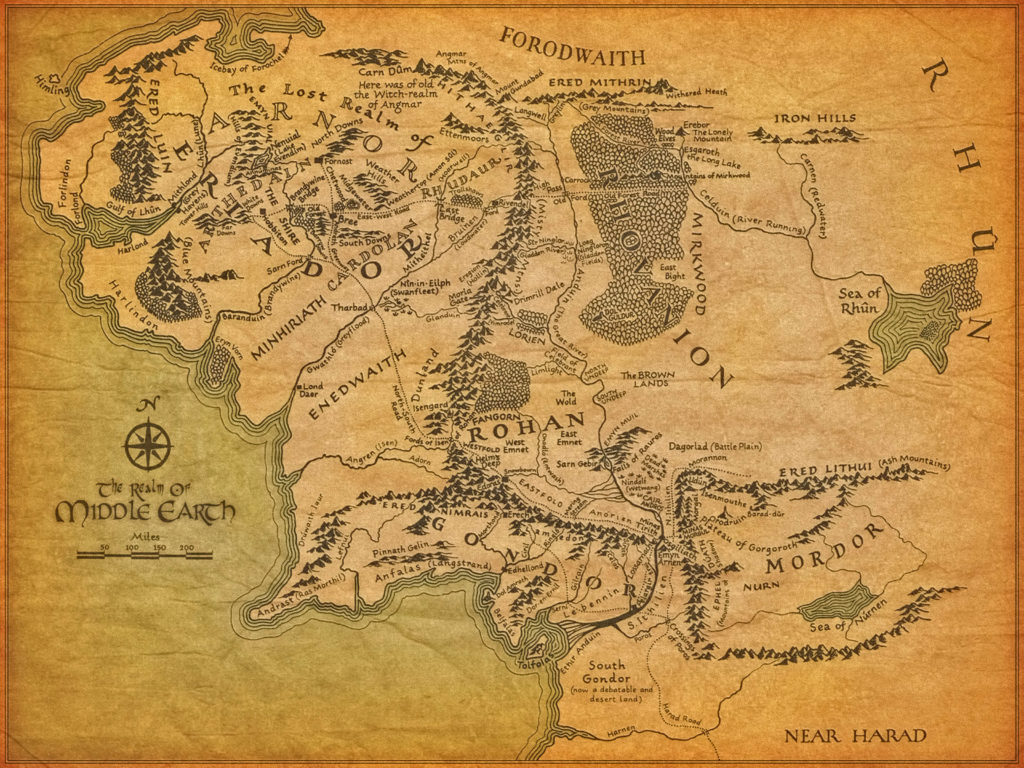
Tolkien’s writing remained entirely rooted in the context of his British and European roots. For example, the political geography of Middle Earth is like that of historical Europe; the forces of freedom are centered in the west, while invasions come from the south and the east. What has been called Herbert’s “anthropological” outlook gave him the opportunity to step outside the West and entertain Islamic and Eastern outlooks.

While Tolkien’s work can certainly inspire ecological and cultural resistance to the negative aspects of late modernity, Herbert’s work is more akin to prophecy, suggesting ways in which traditional mores might be able to persist even in technically advanced societies.

MARK WEGIERSKI is a Toronto-based writer, who specializes in science-fiction and fantasy

This paper is partly based on a presentation to the 20th Annual Conference of the Polish Association for the Study of English (PASE) held in Torun, Poland, at Nicolaus Copernicus University, 12-14 May 2011

Posted in QR Home | Tagged , , , , | 2 Comments

George Bellows – Modern American Life

George Bellows – Modern American Life

Royal Academy, until 9th June 2013

DEREK TURNER

George Bellows (1882-1925) is among the best-known of modern American artists, who made an extraordinarily varied contribution to America’s culture and self-image in the space of just 42 years.

Born in Ohio, he almost became a professional baseball player, but instead moved to New York in 1904 to pursue a career as a commercial illustrator. He early made a name for his impassioned and uncompromising portrayals of the seamier side of NY life, and became part of the jocularly entitled “Ashcan School” – whom over-refined critics nicknamed “the Apostles of Ugliness”.

Stag at Sharkey's

His celebrated boxing images combine both impressionist and expressionist techniques – savagely side-lit, Futurism-influenced, the central protagonists grappling like blind but furious machines of war watched hungrily by sweaty and saturnine crowds with crudely rendered yet highly expressive faces. The most famous of these images is Stag at Sharkey’s, described by Joyce Carol Oates as

a Dionysian frenzy of faceless bodies hurtling together in virtual midair.

Bellows himself claimed

I don’t know anything about boxing. I’m just painting two men trying to kill each other.

Outside such shebeens, joints and dives, he wandered the streets endlessly around where he lived, and painted the poor engrossed in hard lives – longshoremen waiting for work beside ships like cliffs against a backdrop of sunlit skyscrapers, construction workers delving by frozen day and braziered night the huge crater that would one day be Penn Station, tugboats chugging up the choppy East River, naked children diving into the Hudson, feral dogs rooting for food, frantically busy intersections where tall cops try vainly to instill an idea of order on a chaos of carts, charabancs, pantechnicons, elevated trains and dashing pedestrians of all classes. There are also crepuscular pen-and-ink treatments of disturbing scenes, like “The Law is too Slow”, which shows a man being lynched, “The Benediction” in which a parson pontificates to an audience of slumped and hopeless black convicts, and the self-explanatory “Electrocution”. He also produced classically-informed portraits of street characters – urchins and ne’er do wells who would never normally have been depicted by any artist.

The contrasts between these tenement lives, and those of the rising rich who were raising skyscrapers and promenading in Central Park, impelled him – understandably enough – to work for a socialist newspaper called The Masses. But he was never active in politics, and would throw himself with equal assiduity into portraying parasol-ed picnickers and middle class jaunts into the countryside. He especially liked wintry scenes, which are well represented in this exhibition, and the opportunities whites and blues offered for contrasts with the butterfly-brilliant dresses of women, as seen in works like Easter Snow. The cumulative effect is an intoxicating evocation of the vitality, innovation and self-confidence of the city of his time, the cultural and financial capital of a burgeoning behemoth.

An Island in the Sea

His focus shifted somewhat after 1911, when he began to visit the Maine coast, and produced seascapes that swell with power, even when, as with An Island in the Sea, the subject is simple almost to the point of abstraction – a deeply dark and treeless lump of rock off a bare promontory, the ensemble sent shimmering into life by a limitless, silvered segment of North Atlantic.

Having initially opposed American involvement in World War One, by 1918 he was producing suitably horrifying illustrations of real or alleged German atrocities in Belgium – these strongly influenced by Goya’s Peninsular War images of just over a century earlier. Bellows’ harrowing tableaux of martyred Belgian civilians being slaughtered by jowly, walrus-mustachioed, Pickelhaube-sporting demi-beasts undoubtedly helped to shape the climate of opinion which ended in the departure of the Doughboys to die in one of the old continent’s most pointless wars.

In the last seven years of his abridged existence, he devoted himself mostly to what in less skilled hands might have been schmaltzy subjects – family, friends, neighbours, horses, scenery – but even these often have disturbing qualities, like 1924‘s The Picnic. The painting is set in a breathlessly still, high summer Catskills landscape of hills and lake, and contains some domestic details – a cloth spread on the ground, a man fishing, a young girl with a skipping rope. Two sunlit hills are reflected almost too perfectly in a lake that is more like glass than water. But dwarfing these tame and lovely hillocks, the lake and the human interlopers, there rise all the way to the horizon much higher hills unlit by sun, a blue and mysterious massif without trace of humans, surmounted by a vast sky promising storms. In the right foreground, a family friend lies so helplessly prostrate with sleep that he could be a corpse.

Other paintings on show – like Fisherman’s Family and The White Horse – likewise possess surreal and hallucinogenic qualities which make us regret that he died so soon. But he was unclassifiable to the end, and was simultaneously turning out cleaner-line, commercial illustration-inspired artworks, as well as sombre studies like Elinor, Joan and Anna. The exhibition leaflet quotes Sherwood Anderson, who said Bellows’ late works

…keep telling you things. They are telling you that Mr. George Bellows died too young. They are telling you that he was after something, that he was always after it.

Bellows may never have quite caught up with whatever it was he was pursuing, but he left behind an unforgettable slice of Americana.


Posted in QR Home | Tagged , , , , , , | Leave a comment

One and three-quarter cheers for Mrs. T.

One and three-quarter cheers for Mrs. T.

ALLAN POND surveys a mixed legacy

Mrs Thatcher now rests in peace, the crowds have dispersed and the rent-a-mob have furled up their banners and put away their stink bombs for another occasion. So perhaps now is the time to attempt some reflection on what virtually all can agree on – whatever else they thought about her – the transformative effect that she had on our country.

But how transformative was she? Few doubt her single mindedness but many would say that she was fortunate in her enemies: Heath, General Galtieri, Foot, Kinnock and Scargill. In the case of Scargill she faced an empty vessel who, though he made much noise, did more to damage his own side than his purported enemy, the Conservative government.

Also throughout most of her time in office she faced a divided opposition – not simply the internecine warfare within the Labour Party and the Bennites’ unfounded idea that what most people in the country actually wanted was even more state control and direction of their lives rather than less; but also the split on the centre left between the Labour Party and the breakaway SDP, giving the Conservatives a clear run against a divided ‘progressive’ vote.

All this is undoubtedly true and had she faced more canny opponents she might have been in greater difficulties. Had the Argentinians not invaded the Falklands she might well not have won her second election. Had Scargill had a ballot of the miners and won it, the outcome might not have been different but it would have been a far closer thing run thing. But these things didn’t happen and Mrs Thatcher made an opportunity out of the various crises she faced – and as Machiavelli counselled his Prince, she ensured the spin of the wheel of fortune favoured her and not her enemies.

She was transformative in a sense wider than particular policies, though many of these have proved in hindsight far reaching in their effects. The 1980s was a time of great change; in many ways it had a similar feel to the 1960s, especially coming after the rather dull and drear 1970s. There was a cultural excitement and a feeling of get up and go about those times. Of course the technological changes, the mobile phones, computers and so on, would have happened anyway, and so would the wider underlying transformations within the economies of most advanced Western societies. But what Mrs Thatcher helped to do was to push that forward. She created space for these wider changes to work their way through the body politic. She encouraged and fostered the desire for change, even if in many ways she actually really was a rather traditionally minded daughter of the provincial bourgeoisie.

And on foreign policy she really was hugely change-making and largely right all the way down the line. On the USSR she was prescient, far ahead of almost anyone else including initially the American State Department, in seeing in Gorbachev a distinctively new kind of Russian leader from the old guard apparatchiks who genuinely wished to reform the sclerotic Soviet system. On South Africa too, she was right to support and give quiet encouragement to the reformers in the South African Nationalist Party who wanted to dismantle apartheid peacefully rather than those advocating a violent overthrow of the system which in reality would simply have resulted not in black majority rule but a bloodbath from which a far more authoritarian white supremacist regime would probably have emerged.

And of course she did the right thing in sending a task force to retake the Falkland Islands despite the opposition of many in the foreign and diplomatic services who did not think a military solution would be successful. She did this not from any inkling of any possible economic benefit the Falkland Islands might have –  although we now know that there are rich oil deposits there that wasn’t and couldn’t have been known at the time – but simply from the belief that it was imperative that any attack on British territory, however far away, by another country must be resisted.

She was even, I think, at least three quarters right over Northern Ireland.  Some have seen her agreeing to the involvement of the Irish Republic in the discussions over a peaceful settlement to the ‘troubles’ as a betrayal of the Ulster Protestant majority, creating the situation that now exists of dual power. But I believe that what she was trying to do was to strengthen the constitutional nationalists as opposed to the terrorist nationalists by involving the Irish government. It was Blair who let in Sinn Féin. She might have miscalculated the direction that the peace process would eventually take but her position was thoroughly consistent, similar to her stance in South Africa – to support those who wanted peaceful negotiation and a moderate solution rather than violent conflict.

And finally, despite an early enthusiasm for all things ‘Europe’ in the middle 1970s – she was one of the most vocal supporters of the ‘Yes’ campaign in the 1975 referendum on whether the United Kingdom should become members of the EEC – she was right to oppose the advancing Euroslavian superstate since she saw it as a threat not just to our national sovereignty but as much if not more to our deepest traditions of democracy – that those who wield power over us should be accountable to us and can be removed by us.

Even her poll tax, though one of her most unpopular policies, did have some logic to it, even if it was not the best way of dealing with the problem she had identified of profligate and wasteful elements within local government. It was not just a few ‘loony left’ elected councillors who were causing problems but an entrenched officer corps, some of whom were supporters of the authoritarian left, others merely jobsworths solely interested in protecting their own feather-bedded niches in local government, who were doing their utmost to undermine Conservative policies not just in big cities such as Liverpool, Manchester or Newcastle but even in some more obviously Tory towns. Mrs Thatcher felt that if people had to pay directly for some of the profligate as well as propagandistic policies (eg., “nuclear free zones”!) that these local councils were espousing they would soon grow tired of it all and throw them out.

Unfortunately the policy was not really a solution to this, not least since if it was officers rather than elected politicians often making the running in pushing lunatic policies they could continue to get away with this even when there were Conservative councillors in the majority in the council chamber (as often was the case). Secondly, the cure was as bad if not worse than the disease and simply contributed to attenuation of local government and a decline in interest in what went on in the council chambe – as well as giving an undeserved cachet to some of the left who could pose as put-upon friends of local democracy. A local income tax, or maybe a locally administered sales tax, would have been a better solution and would  have given both real financial clout to local authorities as well as real veto powers to voters. The genuine reform of local government remains unfinished business that hopefully a radical conservative government after 2015 can complete.

Let us also not forget that Mrs Thatcher was one of the first political leaders to spot the importance of the environment, as far back as 1988 in a keynote speech on climate issues to the United Nations arguing that far from being freeholders, our species were merely life tenants with a full repairing lease on the planet.

So far then so good. But why grudge her two cheers let along three? Mainly, I think, because whatever her own intentions might have been there was an imbalance in the economic approach of her governments. There was far too much emphasis on the service industries, especially financial services, and not enough on manufacturing things. Much of this emphasis it is true was down to Nigel Lawson rather than Mrs Thatcher, but she appointed him and did not express any reservations about the sort of casino capitalism that he appeared to advocate uncritically.


Britain's lost manufacturing tradition

Of course many of the traditional heavy industries, such as shipbuilding, were already declining when Mrs Thatcher came to power, but there was a tendency to simply accept that, instead of trying to think creatively about ways in which other forms of manufacturing, at the higher end technology sectors, could have been fostered. Instead, there was far too much emphasis placed on trying to make Britain a low tax haven for foreign investors and businesses at the cost of our own indigenous industries and people.

Some of the privatisations were perfectly reasonable, such as telecoms or airways. Others though, such as railways and the utilities, were far more questionable, though to be fair these latter happened not under her watch but under her successors. Nevertheless the climate for these changes had already been set by Mrs Thatcher. Whole swathes of industry were consigned to the scrap heap and large parts of other sectors were left open to foreign carpetbaggers, often Arabic or Russian, to plunder. This has been especially true of the energy sector, where foreign investors get very rich at the same time as many British pensioners face a choice between eating or heating their sparse rooms.

It is sometimes said that the current government, or at least the Conservative half of it, is desperate to be seen as the heir to Thatcher. In fact, in the area of industrial policy it is doing the opposite and endeavouring to reverse the mistakes of the Thatcher/Lawson era by its emphasis on rebalancing the economy by rebuilding the manufacturing base. If anybody continued the mistakes of economic Thatcherism and could be said to be her true heirs on this score, it was New Labour and in particular Gordon Brown with his disastrous spend-now-pay-later approach to the economy. Mrs Thatcher, even at her most laissez faire, would never have contemplated the figure fiddling of PFI, passing on our present consumption as enormous future debts to our children and grand-children. Her Methodist morality of frugality and financial probity would have baulked at such blatant dishonesty and chicanery.

I am sure that she would have regarded the “loadsamoney” antics of some of those who seemed to revel in the new financial freedoms with distaste. But there was undoubtedly a sense in which the whole ‘lunch is for wimps’ mentality that seemed to dominate the new economic order was an inevitable accompaniment to an emphasis on freeing up the market through thrusting entrepreneurship. To argue that the market should have no fetters and that commerce values should be valued above all others is as alien to the traditional conservative surely as much as to the old style socialist. There was much that was good about the economic transformations of that era, including at least for a while a genuine widening of the share-owning base and a more extensive distribution of property ownership. However, we are perhaps less dazzled by the glitz and razzmatazz of ‘big bangs’ and financial wizardry, not least when it results in HBOS, Fred the Shred, and bankers living the cosseted life courtesy of the taxpayer. At least Mrs Thatcher accepted that capitalism was about loss as much as profit. She would have found it a strange reversal of everything she believed in to see profits stay with the bankers in bonuses while the losses are born by the public via state subsidy, which she loathed with all her might.

So the balance sheet is mixed. We should also add to the plus side, though it may seem small, the almost universally reported fact about her that she did untold small private kindnesses to staff along the way. Whatever the forbidding nature of her iron public image, she could in private, it is well attested, be kind, considerate and caring to those who worked for her, even the lowliest, even if she did sometimes bully her colleagues round the cabinet table. That compares very favourably with many other figures in public life who might like to appear caring and compassionate but are arrogant and short-tempered with their staff and those in lower positions.

It was often said of Mrs Thatcher that she came across as a stern nanny, and this was perhaps why she had such an appeal!  I think maybe the better analogy is with a strict but caring nurse.  Mrs Thatcher imposed on us all a collective enema, painful but necessary in the long run.

ALLAN POND is a former member of the Green Party, and writes from Northumberland


Posted in QR Home | Tagged , , , , | Leave a comment

Colour (and culture) clashes

Colour (and culture) clashes

ROBERT HENDERSON reviews a global survey of racial and cultural confrontations

Ethnic Conflicts

Tatu Vanhanen, Ulster Institute for Public Research, 326 pps, £23 hb, £18 pb

Detail of Wild Men and Moors tapestry CA 1440

This is not a book designed for easy bedtime reading. It is an academic’s work written first and foremost for academics with a fair amount of statistics in it. Having said that, if a prospective reader managed to get to grips with, say, The Bell Curve they should be able to absorb the important messages of Prof Vanhanen’s book and understand how he arrives at them. It is worth making the effort because he deals with the most fundamental sociological aspect of being human: how do we manage the challenges produced by heterogeneous societies?

The Professor’s  first  aim was  to measure the relationship between the ethnic heterogeneity of a society and ethnic conflict. There are considerable difficulties in doing this, not least because what may be thought of as ethnic conflict by one person may be seem by another as conflict based on something else such as class. For example, an ethnic group which is black and poor and rebels against the better off in society who are white (a not uncommon state in Latin America) could be represented as being either ethnically motivated or class motivated. Continue reading

Posted in QR Home | Tagged , , , , , | 1 Comment

Famous last words

Famous last words

PAUL WOOD remembers how past PMs passed

The dance of death: the statesman. Coloured aquatint by T. Rowlandson, 1816.

Margaret Thatcher’s death makes me want to sit upon the ground and tell sad stories of the deaths of Prime Ministers.

The Prime Minister whose death I most often think of is that of Lord Rosebery, for some reason. Most Prime Ministers outlive their eras but few by so much as Gladstone’s successor as Liberal Prime Minister. Lord Rosebery, as he lay dying in 1929, 34 years after he had briefly been Prime Minister, sent his valet to buy a gramophone and one gramophone record. The servants played the Eton Boating Song, over and over again, in the shuttered bedroom, until the earl, forgotten by the world of flappers and moving pictures, was dead.He was only Prime Minister for fifteen months but his life must be judged to have been unusually successful. He once said that he had three aims in life: to win the Derby, to marry an heiress and to become Prime Minister. He achieved all three and won the Derby twice during his brief premiership. I do not know what his last words were and I wonder what were Lady Thatcher’s.

Queen Victoria wanted to do Disraeli the honour of visiting him in his sickbed but he declined the honour with what were said to be his last words:

Why should I see her? She will want to give a message to Albert.

He had fawned on the Queen for years, but now saw no reason to continue in articulo mortis.

Another version of his last words is:

I had rather live but I am not afraid to die

but they sound to me as if written for public consumption. While he lay dying, although he had converted to Anglicanism as a boy, he was heard to murmur a Jewish death prayer.

Sir Henry Campbell-Bannerman’s last words were

This is not the end of me.

George Canning’s last words were:

Spain and Portugal.

William Pitt the Younger’s were

Oh my country! How I leave my country!

Or alternatively:

How I love my country!

His nephew, James Stanhope, who was at his deathbed, is the authority for the latter version and is a better authority than Disraeli, who may have originated the widely believed story that Pitt’s last words were:

I think I could eat one of Bellamy’s pork pies.

Lord Palmerston’s last words are said to have been:

Die, my dear Doctor? That’s the last thing I shall do.

But this, though very well known, is not well sourced.

Lord Derby’s last words convey aristocratic disdain:

Bored to utter extinction.

Chamberlain’s last words also seem to convey the character of the man:

Approaching dissolution brings relief.

He was diagnosed with bowel cancer just after he left office. Had he lived in good health he would have run the home front but he would have remained leader of the Conservative Party and therefore shared power with Churchill.

Shortly before his death, Chamberlain wrote an apologia pro vita sua in a letter to Sir John Simon:

…it was the hope of doing something to improve the conditions of life for the poorer people that brought me at past middle life into politics, and it is some satisfaction to me that I was able to carry out some part of my ambition, even though its permanency may be challenged by the destruction of war. For the rest I regret nothing that I have done & I can see nothing undone that I ought to have done. I am therefore content to accept the fate that has so suddenly overtaken me.

What a terrible hand Chamberlain had to play and how should he have played it?

He was a Unitarian, but he, along with Bonar Law and Clement Attlee, neither of whom believed in God, are the only three twentieth century Prime Ministers to have been buried in Westminster Abbey.

Poor Spencer Perceval’s last words were to the point:

Oh, I have been murdered.

He was a good, able man and would have been a fine Prime Minister had he not been killed. He should win modern day approval for coming from a much more obscure family than Messrs. Cameron, Clegg and Miliband. A book came out last year about the murder. He would probably have held office for as long as, after his assassination, Lord Liverpool did and therefore for longer than Mrs. Thatcher.

Sir Winston Churchill’s last words were:

I’m bored with it all.

On his last birthday, Churchill said to his daughters:

I have achieved much to have achieved nothing at all.

I think this might be the judgement of history.

PAUL WOOD is an English writer living in Bucharest. This article first appeared on his blog  – http://pvewood.blogspot.co.uk


Posted in QR Home | Tagged , , , , , , , , , , , , , , | Leave a comment