Fee-fi-fo-fem, I smell the blood of a racist ILANA MERCER

Fee-fi-fo-fem, I smell the blood of

a racist

ILANA MERCER denounces a denouncer

“You’re a racist.” “No, you’re a bigger racist.” “No way; you hang with the Hoppe, Rockwell and Ron Paul crowd of libertarians; they’re ‘known’ racists, so you’re racist.” The tiff is between defenders of the anti-establishment libertarians, aforementioned, and an establishment libertarian, or a “regimist,” as Mr. Rockwell likes to say.

The “regimist” in question is Cathy Reisenwitz, a sally-come-lately libertarian, whom Justin Raimondo, a life-long, creedal libertarian, has “smoked out” for libelling Paul, Murray Rothbard, Lew Rockwell and Hans-Hermann Hoppe as racists.

Mercifully, Reisenwitz, the S. E. Cupp of libertarianism (light and fluffy), is not on a mission to rearrange the income curve. But like any member of the egalitarian project, she vapourizes about the obligation to vanquish so-called endemic, structural and institutionalized inequalities in America. Thus her expedition to sniff out “homophobes,” “sexists,” “xenophobes” and “racists.”

So what on earth is going on here? Why have serious libertarians succumbed to a tit-for-tat spat? Are libertarians as dazed and confused as Republicans? The latter have certainly dignified the rival gang’s Stalinist show trial tactics, with more holier-than-thou racial one-upmanship: “Democrats are the real racists; Republicans are the party of Lincoln, the liberator of blacks. We’re against abortion and welfare because we love blacks. … Blah, blah, blah.”

Reisenwitz adduced no documentary evidence to support her claims. However, what will Mr. Raimondo do if, in a fit of pique, Reisenwitz retracts the apology she’s issued and ferrets out unkosher quotes attributed to the men maligned? Res ipsa loquitur. Intelligent men (and a few women) invariably give voice to reality. Consider, for instance, tracts from Murray Rothbard’s splendid December 1994 essay about The Bell Curve. These are bound to send Cathy into one of her fee-fi-fo-fem frenzies. Therein Rothbard writes:

Until literally mid-October 1994, it was shameful and taboo for anyone to talk publicly or write about, home truths which everyone, and I mean everyone, knew in their hearts and in private: that is, almost self-evident truths about race, intelligence, and heritability. What used to be widespread shared public knowledge about race and ethnicity among writers, publicists, and scholars, was suddenly driven out of the public square by Communist anthropologist Franz Boas and his associates in the 1930s, and it has been taboo ever since. Essentially, I mean the almost self-evident fact that individuals, ethnic groups, and races differ among themselves in intelligence and in many other traits, and that intelligence, as well as less controversial traits of temperament, are in large part hereditary. ..

Egad! (Or OMG in Millennial speak.)

Clearly, libertarians should not partake in a dance adopted by the political establishment to cow contrarians into submission. By going on the defensive – allowing themselves to be drawn into these exchanges – libertarians are, inadvertently, conceding that speech should be policed for propriety, and that those who violate standards set by the PC set are somehow defective on those grounds alone, and deserve to be purged from “polite” company.

Incidentally, I had hoped that my article Libertarian Feminists Make a Move on Von Mises, which deconstructs the poor quality of Cathy Whatshername’s arguments, would have convinced libertarians to marginalize a mental midget. Alas, libertarians have generally opted to conflate public prominence with intellectual importance, ponderously responding to the woman on the grounds that she’s … famous.

That someone has a penchant for publicity, takes a good “selfie” and gets herself on “Stossel” is not proof of intellectual gravitas. No matter how energetically Reisenwitz is promoted as the new face of libertarianism, and no matter how skillfully she suctions face to camera – she’ll likely never muster an opinion or an analysis that is not hackneyed. To adapt a saying by a smart wag, Cathy Reisenwitz might be said to belong to the history of publicity rather than to history.

Junge Freiheit, a German weekly committed to combating the thought polizei on The Continent, interviewed this writer. One of the questions posed was, “Have you been accused of racism because of your book, Into the Cannibal’s Pot? What would you answer?”

The reply, taken almost verbatim from Into the Cannibal’s Pot (pp. 41-42), ought to help in fending off bloodhounds scenting their prey:

My answer to those who’d fault me for daring to make broad statements about aggregate group characteristics, vis-à-vis crime, for instance, would be as follows: generalizations, provided they are substantiated by hard evidence, not hunches, are not incorrect. Science relies on the ability to generalize to the larger population observations drawn from a representative sample. People make prudent decisions in their daily lives based on probabilities and generalities. That one chooses not to live in a particular crime-riddled county or country in no way implies that one considers all individual residents there to be criminals, only that a sensible determination has been made, based on statistically significant data, as to where scarce and precious resources – one’s life and property – are best invested.

Before rushing headlong into the dark entrails of Reisenwitz’s world, consider something the inimitable Hans Hoppe told me, after we had both been marked with the “racist” Mark of Cain:

If you are not called a racist, then it seems to me you are in intellectual trouble and it is high-time to reconsider your own thinking.

ILANA MERCER is a paleolibertarian writer, based in the United States. She pens WND’s longest-standing, exclusive paleolibertarian column, “Return to Reason” and is a fellow at the Jerusalem Institute for Market Studies, an award-winning, independent, non-profit, free-market economic policy think tank. She is also a Quarterly Review Contributing Editor. Ilana’s latest book is Into the Cannibal’s Pot: Lessons For America From Post-Apartheid South Africa. Her website is www.IlanaMercer.com.She blogs at www.BarelyaBlog.com


Posted in QR Home | Tagged , , , , , , , , | Leave a comment

ENDNOTES – Tosca by Numbers LESLIE JONES


Maria Callas as Tosca

ENDNOTES – Tosca by Numbers

Tosca by Giacomo Puccini, Royal Opera House, 13th May 2014, production by Jonathan Kent: the Orchestra of the Royal Opera House conducted by Oleg Caetani, with Oksana Dyka as Floria Tosca, Roberto Alagna as Mario Cavaradossi and Marco Vratogna as Baron Scarpia

Leslie Jones reviews Giacomo Puccini’s timeless masterpiece

Richard Burton confides in his diaries that he loathed acting because he found it boring. “I have one disease that is incurable…” he remarks, “I am easily bored. I am excited by the idea of something but its execution bores me”. On one occasion, to relieve the tedium, he played Hamlet as a homosexual. On another, he began “To be or not to be” in German. And on yet another he inserted lines by Christopher Marlowe into Shakespeare’s text. The audience did not mind but the rest of the cast were reportedly incensed (see The Richard Burton Diaries, edited by Chris Williams).

Tenor Roberto Alagna’s performance of Mario Cavaradossi reminded me at times of Burton’s behaviour. He is obviously a prodigiously gifted singer and was greatly admired by Luciano Pavarotti, no less. But sometimes he only goes through the motions. Ukrainian soprano Oksana Dyka, un peu embonpoint in a rather old fashioned costume, is likewise a technically very accomplished artist. But her portrayal of Floria Tosca was singularly devoid of feeling or pathos. She clearly is not Callas.

The half-hearted response of the audience to the famous arias, notably “Recondita armonia” and Vissi d’arte, spoke volumes in this context. The late Franco Corelli, in

Franco Corelli

contrast, once received an ovation that lasted for five whole minutes for his rendition of Recondita armonia! Of the principal roles, only baritone Marco Vratogna as the evil Baron Scarpia made any real impression. He captured something of the sadistic and manipulative character of the perverted Chief of Police. It will be interesting to see what Bryn Terfel makes of this complex and demanding role when he takes over from Vratogna.

Credit also should be given to the Revival Director Andrew Sinclair for highlighting the strikingly subversive and iconoclastic qualities of the libretto, based on the play La Tosca by Victorien Sardou, as when Tosca lays out (stages) the body of the hated Scarpia between candles in a pseudo-religious ceremony. The resulting tableau brings to mind the unique “signature” or modus operandi of certain serial murderers. Then, again, there is the memorable and sacrilegious scene set in the church of Sant Andrea della Valle, when Scarpia contemplates ravishing Tosca, just as a religious service commences in a riot of colour and candle light. Little wonder that many of this opera’s early critics, used to more anodyne fare, balked, lamenting what one of them called an “atmosphere tinged with blood that pervades and overwhelms everything” (see Alexandra Wilson’s enlightening programme note, entitled “Praise and Hostility”). Torture, blackmail, betrayal, execution, assassination and suicide follow in rapid succession.

On a somewhat lighter note, my companion on this occasion, an ardent opera buff, assured me that at Covent Garden, some of the best seats in the house are in the amphitheatre, where we found ourselves. Sound, she explained, rather like the price of opera seats, always rises. I was not entirely persuaded. Your critic has been banished to the gods. Expect to see him shortly in the even more vertiginous upper slips, humming An Alpine Symphony.

Tosca was the first opera that I ever attended, in a full-blooded performance in Holland Park auditorium many years ago. With its exquisite leitmotifs and it’s “ruthlessly taut drama” (Gregory Dart, programme note, “Cruel Bounty”), it made an indelible impression. Perhaps understandably, I retain an abiding and sentimental affection for this master-work, a symbol latterly of one’s lost youth. It surely deserved much better than this.

Giacomo Puccini

Leslie Jones May 2014

©

Leslie Jones is Deputy Editor of QR


Posted in QR Home | Tagged , , , , , | Leave a comment

ENDNOTES – A sad pavan for these distracted times STUART MILLSON

Thomas Tomkins Copyright City of London Corporation / Supplied by The Public Catalogue Foundation

ENDNOTES

A sad pavan for these distracted times

STUART MILLSON remembers two overlooked English Civil War composers

The period of the English Civil War was a time of profound anxiety for the country. The breakdown of authority and civil order was accompanied by an emotional, even psychological anguish: premonitions of mortal disaster, visions of giant fish in the Thames, rumours of witches and familiars, and the rise of the self-appointed witchfinders and other puritan fanatics. Cannon fire and muskets in city streets, English fields running red with blood, and churches wrecked by those who saw music, or a statue, as evidence of Satan: these were truly distracted times.

Yet despite living in a wasteland of war and religious psychosis, England still seemed capable of producing magnificent music, and we must never forget that some 250 years before the famous “English musical renascence” of Parry, Elgar and Vaughan Williams, our country had composers of the calibre of Thomas Tomkins and William Lawes. Both Royalists, Tomkins and Lawes succeeded in producing a body of work which stands, to my mind, as some of the finest music ever to have come from these islands. Purcell, of course, is credited as the greatest composer of the 17th century. But Tomkins and Lawes are names which deserve to be seen alongside the great composer of funeral odes, The Fairy Queen and King Arthur.

Thomas Tomkins was born in Pembrokeshire in 1572, in the tiny cathedral city of St. Davids. He followed his father’s calling into the world of church music, Mr. Tomkins senior holding the position of Master of the Choristers, and vicar-choral. But the family migrated to Gloucester, and by the mid-1590s, the young Thomas had gravitated to the role of instructor of the choristers at Worcester Cathedral. He was to become an important member of the Chapel Royal (appointed organist in 1621 – Orlando Gibbons was the senior organist); and was responsible for the musical planning for the coronation of King Charles I. In his declining years, Tomkins lived with his son, Nathaniel, who was to continue the family’s musical name. The tide of war may have temporarily suppressed the English voice in music, but it can be said with certainty that it was Tomkins’s example and dedication (and indeed, that of his son) which ensured the survival and revival of the radiant spirit of our anthems and choral services.

The nobility of the music which he produced sings across the centuries; its Englishness and church setting, indissoluble and inter-linked elements of its character. It is tempting to think of Tomkins, whose times seem now so remote and ancient, as a harbinger of the spirit which led to the emergence of Edward Elgar: a link across time and space to the churches and cathedrals of Gloucester, Worcester and Hereford of the 1890s and 1900s. How curious that English music should find its parent-stem in this region marked out by the River Severn and the Malvern Hills. The mysteries of the English church tradition find full realisation in Tomkins’ Great and Marvellous are thy works, with such lines:

“Lord God almighty;

just and true are they ways, thou king of saints,

Who shall not fear thee, O Lord,

and glorify thy name?”

The line… and glorify thy name… is repeated, the repetition acting as an affirmation and an echo; a perfect piece for a church service, and a most important treasure in Musica Deo Sacra, the great Tomkins collection, published after his death. Yet this man, whose life was ruled by the church calendar, can also be seen as a composer capable of capturing the tumult of his era; fulfilling a role that only became officially understood or “appointed” in modern times. Just as Elgar commemorated the passing of a king, and an age, in his great Second Symphony of 1911 (the slow movement, a magnificent lamentation for the passing of Edward Vll, but also, perhaps, a clairvoyant mourning for the England that would sink into the mud of Flanders and the Somme), so, too, was Tomkins a musician who reflected wider national feelings. His three-minute A Sad Pavan for these distracted times tells of England’s misery, as Charles l awaited execution in the bitter winter of the New Year, 1649. The manuscript of this work (and one can only imagine the pain with which the composer inscribed his feelings onto paper) dates from the February of that year.

Tomkins, like so many of our native composers, was also inspired by a vision of bucolic life. In a recording from just over 40 years ago by the Purcell Consort of Voices conducted by Grayston Burgess, Early Music enthusiasts found this quintessential composer of church anthems bidding farewell to urban life and rejoicing in a scene in which “winter is going and trees are springing”: Adieu, ye city-prisoning towers – a spirited part of an old English compendium (alongside the sporting country lads and country nymphs as seen or imagined by Michael East, Thomas Campion and Giles Farnaby!) And in his last years, Tomkins did in fact forsake the life of the town: abandoning the environs of Worcester Cathedral (his home and belongings badly damaged during the siege of the city) for the village of Martin Hussingtree, not far from Droitwich Spa, where he died in 1656.

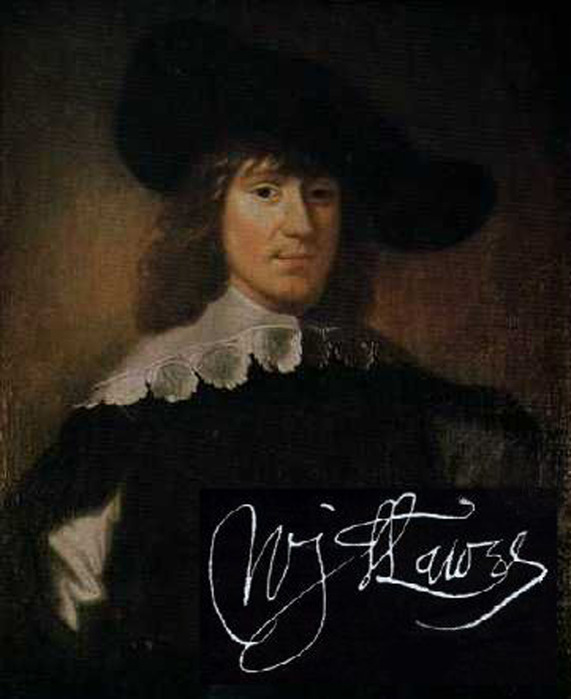
William Lawes

His fellow Royalist composer, the young and brilliantly gifted William Lawes (Henry Lawes’ younger brother) met his end in 1645 in combat during the siege of Chester. His loss at the age of just 43 affected King Charles very deeply… Hearing of the death of his dear servant, William Lawes, he had a particular mourning for him when dead, whom he loved when living, and commonly called the Father of Musick.” He was undoubtedly a man of action and resolution, sacrificing himself to a noble cause, yet not a professional soldier: …betrayed by his own adventureness.” (Thomas Fuller)

A pupil of John Coprario, Lawes was a prolific composer of fantasias and consort music, mainly for viols and theorbos, and his music survived him in manuscript form. A talented player of the bass viol, he was interested in the music of Monteverdi, and in 1635 became a “musician in ordinary for the lute and voices” at the court of Charles l. Denis Arnold, writing in The New Oxford Companion to Music says of Lawes:

He also wrote some attractive verse anthems and a considerable amount of music for masques, some of which shows a strong sense of large-scale organization of the kind which Purcell was to explore in his theatre music.

With clear, beautiful lines, and a great ear for atmosphere and even special effects (such as the Ecco in the Royal Consort in D Minor for two theorbos), the music of William Lawes might have become one of the great presences in our artistic life. His situation in our musical history can almost be compared to that of the composer George Butterworth, killed in the First World War, and Walter Leigh, killed in action in the Second: who can predict what these remarkable men might have achieved had they survived. Fortunately, the works of this craftsman survive, and alongside the choral glories of Tomkins tell us a story quite at odds with the notion that England (until Parry or Elgar) was the “land without music”.

STUART MILLSON is Classical Music Editor of the Quarterly Review

Posted in QR Home | Tagged , , , , | 1 Comment

Class inaction EDWARD DUTTON

Class inaction

EDWARD DUTTON finds that societies tend towards social immobility

The Son Also Rises: Surnames and the History of Social Mobility

Gregory Clark, Princeton University Press, 2014, hb.,   366pp

In his ground-breaking 2007 book A Farewell to Alms, Gregory Clark, Davis economist at the University of California, marshalled a large body of data on historical breeding patterns. He fearlessly presented his controversial conclusion: until the Industrial Revolution, Europe was undergoing eugenic fertility. If England was divided into the richer 50% and poorer 50% then the richer group had around double the number of surviving children than did the poorer group. As intelligence (and personality factors, such as Conscientiousness) is significantly positively associated with socio-economic status and is strongly genetic (80% for intelligence), Clark argued that the Industrial Revolution happened when it did because England reached a tipping point of high intelligence and was politically stable. Since the Industrial Revolution, this pattern of fertility has actually gone into reverse.

With The Son Also Rises, Clark is in the difficult situation of attempting to improve on a brilliant book. I’m not sure he succeeds in that regard, but The Son Also Rises is certainly highly original and a fascinating read. Clark attempts to trace social mobility over time in assorted countries, including England, the USA, Sweden, Japan, Korea, China, and India. He achieves this by focusing on surnames and, in particular, unusual ones. In general, Clark argues, social mobility is assumed to be relatively high because the correlation between, for example, a father’s education level and his son’s is relatively low. However, the problem with this is that ‘education’ – or, for that matter, occupational status, or income – are only partial measures of social status. People can make trade-offs between these measures. They might have a higher income than their father but a lower occupational status. Continue reading

Posted in QR Home | Tagged , , , , , , , | Leave a comment

The elephant in the Pistorius courtroom ILANA MERCER

Oscar Pistorius

The elephant in the Pistorius courtroom

ILANA MERCER interviews Afrikaner campaigner Dan Roodt

Philosopher Dan Roodt, Ph.D., is a noted Afrikaner activist, author, literary critic and director of PRAAG. He is the author of the polemical essay, The Scourge of the ANC. I spoke to Dr. Roodt about two recent show trials: that of blade-runner Oscar Pistorius and that of the owner of the Los Angeles Clippers, Donald Sterling.

ILANA MERCER: There’s an elephant in the courtroom in which Oscar Pistorius is being tried for the murder of girlfriend Reeva Steenkamp. It is the unidirectional, black-on-black and black-on-white violent crime in South Africa. The fear of being butchered was likely behind the blade runner’s irrational, irresponsible actions. I had hoped that Pistorius would speak up. For all his privilege, Pistorius knows the rapacity and invincibility of the criminal class in his country. Like every other Afrikaner, he knew in his gut what infiltrating gangs would do to a legless Boer. The world is praising the proceedings in that court. However, “making sport of a caged animal that has confessed” is how a South African reader described this courtroom Colosseum. What do you think?

DAN ROODT: I largely agree with that. One of the columnists on our site described the trial as “a canned hunt and a legal travesty.” Most people watching it probably do not know that only eight percent of murder cases in South Africa result in a conviction, so killers have a 92 percent chance of literally getting away with murder! South Africa is both the murder and especially the rape capital of the world. Usually the statistics are massaged in such a way that only murder proper, called “first-degree murder” in the United States, is included in the absolute number of murders. But if one also counts other homicides with a lesser culpability, we are the world champions, even above India’s 43,000 homicides. But, of course, India has over one billion people, whereas we have just over 50 million. Even for first-degree murder, we have more of those per year (16,000) than the U.S. (14,000) which has six times our population.

Regarding the court procedures, Pistorius is spending a lot of money on his legal team and the state is using an experienced Afrikaner prosecutor, Gerrie Nel. However, there has been large-scale affirmative action applied to the appointment of judges, so that many of them lack the knowledge of the law and the experience to do their job properly. In many cases, black offenders, especially, get off very lightly and in practice do not serve more than ten years for first-degree murder.

The government is also applying pressure on lawyers to apply affirmative action in their own ranks as most of the top-level senior lawyers or advocates, as we call them, are still white. They are preferred by the big-spending corporate clients in civil cases, especially. A lawyer friend of mine recently told me of one tedious corporate court case in Pretoria that has lasted ten years and consumed $5 million in legal fees, also swallowing up her whole life. Ironically, even the president, Jacob Zuma—who has had more than 500 charges of corruption against him and was also accused of rape in December 2005—used white Afrikaner lawyers to get him off, using their technical knowledge of the law and court procedures.

There is also rampant corruption in the criminal justice system, with policemen and petty court officials being bribed to make documents and evidence disappear, so the kind of televised court-room soap opera of the Pistorius trial is not at all representative of the vicissitudes of the average trial.

Unlike in the U.S., South Africa does not collect crime statistics broken down by race anymore, but we know that the vast majority of prison inmates serving time for violent crime are black. White offenders—which include white-collar crimes like fraud or insider trading—only constitute 1.8 percent of the prison population, while whites make up under 10 percent of the total population. A recent reliable survey showed that whites are disproportionately victims of house robberies, constituting about 50 percent of the victims, while the perpetrators are almost invariably black.

The image of South African blacks disseminated by the global media is of a population of kind-hearted, forgiving people like Mandela, whereas the reality demonstrates something entirely different. There is something inexplicably sadistic about murders and assaults by black perpetrators on their white victims in South Africa, which often include lengthy and dehumanizing torture sessions, mutilation of bodies, sexual violence, and so on. Often the victims are children, including toddlers and babies. Every week we read about farm murders in the press where the victims are normally elderly white farmers, regularly ambushed on a Sunday morning when they return from church attendance.

MERCER: The South African Constitution, naturally, sanctions the prosecution of individuals based on the things they say. Conversely, Americans are supposed to enjoy a constitutional right to speak freely. The freedom gap is, however, narrowing. The establishment—politicians, journalists, jurists, educators and academics; “conservatives” as much as liberals—trip over one another in a collectivist, concerted effort to ruin an “offender.” The latest individual to be crucified for committing America’s original sin—harbouring impure racial thoughts—is Donald Sterling. You’ve written that, while “few people in the U.S. have had any direct experience of racism, they nevertheless discern racism in other people’s body language, in their use of euphemisms or in being patronized by others.” Explain how this “Metaphysical Racism” now works as an “engine of history.”

ROODT: Unfortunately, ever since the 1960s, South Africa has been influenced by America in a very bad way. Instead of looking to the U.S. for lessons in self-reliance, the right to self-defence, or how to finance start-up tech companies, we have simply imported your liberal, pathological political correctness. That includes the sensitivity around language and terms with a racial connotation. I cannot begin to tell you how many words there are in South Africa to describe people of various races including, of course, pejorative terms. I seem to recall that my generation was very sensitive to using some of those words and there was a famous case in 1978 when the old government’s censors banned a satirical novel entitled Magersfontein o Magersfontein! for containing a piece of dialogue in which the word “kaffir” was used in an ironic way. This is our equivalent to what you call the “N-word” in the U.S. In print these days, most people here also refer to the “K-word,” as there is just such a taboo against using it. However, if you go to any school playground or university campus in South Africa, young whites are using it as a way of rebelling against the system. How long this will last, I do not know, because the government and mainstream, politically correct society are clamping down on it and even giving people suspended prison sentences for a first offense after being found guilty of using the “K-word.”

So in South Africa you can torture an elderly white lady and maybe get away with it, but you will be prosecuted for speechcrime for using racial epithets. I would not be surprised if all telephone conversations will be monitored, NSA-style, at some point in the future to ensnare those who use so-called racist language.

When it comes to “metaphysical racism,” that is at a far more subtle level. Someone who first alerted me to this was the documentary filmmaker Craig Bodeker from Denver, Colorado, with his piece A Conversation About Race. Many people in the film say that “racism is everywhere,” surrounding us like sin or some invisible element. Also in A Conversation About Race, I learned that some American blacks think that a compliment from a white could be a sign of racism. So either an insult or a compliment could be construed as racism.

In South Africa, some of the liberal commentators such as Steven Friedman claim that blacks were damaged by apartheid and therefore cannot be expected to perform at the same level as whites. In the U.S., this claim is made about slavery; that the insidious effects of slavery are still present, which would explain the academic achievement gap, but also differences in wealth and income. Colonialism also comes into it, as far as other African countries are concerned. The fact that Africa has remained underdeveloped for so long is almost always blamed on colonialism, notwithstanding that it was colonialism that had introduced Africa to the wheel and to writing, not to forget science and technology!

Whereas about a decade ago, the British magazine The Economist had described Africa as “the hopeless continent,” it now sees Africa as a fast-growing continent, not very different from countries like China, Hong Kong or South Korea. Even Goldman Sachs thinks that Africa will soon be a developed continent competing on an even keel with Europe, North America or Asia.

The flipside of the new optimism about Africa, including South Africa, is that every failure or missed growth target is somehow backwardly rationalized in terms of racism, colonialism and apartheid. In short, “metaphysical racism.” So even when it comes to technology, the economy and education, there is always a cloud of racism somewhere that the developed world has to address by offering aid money or some form of expiatory confession from Western leaders.

I always wonder: If Africa is now standing on its own two feet and growing so fast, why do so many countries still need development aid? Why do South African blacks still need affirmative action, including racial quotas in sport?

ILANA MERCER is a paleolibertarian writer, based in the United States. She pens WND’s longest-standing, exclusive paleolibertarian column, “Return to Reason” and is a fellow at the Jerusalem Institute for Market Studies, an award-winning, independent, non-profit, free-market economic policy think tank. Ilana’s latest book is Into the Cannibal’s Pot: Lessons For America From Post-Apartheid South Africa. Her website is www.IlanaMercer.com.She blogs at www.BarelyaBlog.com


Posted in QR Home | Tagged , , , , , , , , , | Leave a comment

The ridiculous racial merry-go-round ILANA MERCER

The ridiculous racial merry-go-round

ILANA MERCER observes an American recreational activity in full flow

What were CNN and MSNBC doing while Russia Today was broadcasting an interview with Ehud Barack about the breakdown of “peace talks” between Israelis and Palestinians, Fox News was covering a breakthrough in DNA research, and BBC News was keeping viewers abreast of event in Syria and Ukraine?

The conga-lines of cretins at the two networks were fulminating over a racially charged private conversation between one Donald Sterling, owner of the Los Angeles Clippers, and his mistress du jour.

On the positive side, the Sterling vignette distracted CNN fleetingly from a non-stop, no-news vigil for the missing Malaysian Airline. “Breaking News: Malaysia Airlines Flight 370 is still missing” has provided perfect cover for a “news” operation that has refused to cover the many failures and scandals of Barack Hussein Obama’s presidency.

I listened to the recordings of Sterling’s comments. (What option did I have?) I heard an odious old man nagging an equally off-putting woman. She is asked to refrain from publicly flaunting her relationships with black athletes. “Cavort all you wish behind my back,” Sterling seemed to be saying, “but don’t embarrass me in public.”

From abroad, another repugnant character refused to rise above the fray and stick to the issues on his teleprompter. Never uttered by the president were sobering, uniting words such as, “In the US, we don’t hound people for the things they say, anywhere.” Instead, broadcasting from Malaysia (whose majority population has been known to launch perennial pogroms on their One Percenters), Obama demonstrated the extent to which he follows petty racial politicking in this country, and the lengths to which he’ll go to perpetuate the mythical meme of a racist America.

Puled the President:

When ignorant folks want to advertise their ignorance, you don’t really have to do anything, you just let them talk. That’s what happened here…  Sterling’s alleged comments are an example of how the United States continues to wrestle with the legacy of race and slavery and segregation.

Like CNN, MSNBC had hardly reported on a conflict that has roiled the country – Cliven Bundy’s “mutiny against the federal government.” The operatives there rectified the failure right away when Bundy made his racial blunder. From paying scant attention to the conflagration between farmers and federal forces, MSNBC switched to a blow-by-blow account of Bundy’s speech infraction. “Nevada Rancher Cliven Bundy Doesn’t Apologize, Repeats Racist Remarks,” “Bundy’s Blunder,” blared the headlines.

Needless to say, the same pattern of heightening emotion, manufacturing buzz, and distracting the easily distracted from reality and reason coloured CNN’s belated reporting in Farmer Bundy v. the Feds. Thus did anchor Brook Baldwin entertain commentator Paul Begala for a segment aimed not at informing CNN viewers about land seizures across the country and excessive use of federal force; but so as to strategically deploy Bundy’s alleged racism against Republicans, some of whom had concerned themselves with the aforementioned transgressions. (In fairness to Begala and Brook, neither is working with much.)

When it comes to the original sin – harbouring impure racial thoughts – members of the chattering class, “conservatives” as much as liberals, trip over one another to express their disgust. So it was with the comments of the inconsequential, ill-mannered Sterling.

Another dominant paradigm over which right and left converge in agreement is the Marxist Labour Theory of Value. How dare Sterling claim to have supported, fed, clothed and housed the NBA athletes on his team. What a plantation mentality! But unless one is down with Karl Marx, Sterling is correct. Marx’s “demonstrably false” Labour Theory of Value disregards the infusion of seed capital necessary to launch and sustain an enterprise, privileging the role of labour in the production process.

No sooner had Sterling opened his mouth to speak rudely than legions of sinewy sportsmen were parading their pain on camera, shedding tears and telling of psyches shattered and hearts broken. Hey, unlike Abe Foxman, director of the Anti-Defamation League, I didn’t cry when Mel Gibson maligned Jews. Ditto Kanye West, upon whom the ADL has alighted for his riffs about us Jews. So long as they have no power over my life, why do I care what idiots say? Direct your ire, rather, not at Citizen Sterling, but at the flourishing political class, whose overweening, hateful ways shatter actual lives daily.

It was not long before another CNN simpleton, Fredricka Whitfield, was soliciting legal advice on how to dispossess the thought-criminal of his property: the NBA Team. Warned Dallas Mavericks owner Mark Cuban:

… regardless of your background, regardless of the history they have, if we’re taking something somebody said in their home and we’re trying to turn it into something that leads to you being forced to divest property in any way, shape or form, that’s not the United States of America. I don’t want to be part of that.

Let us hope that no legal remedy is pulled out of the proverbial hat to silence or rob Sterling and similar offenders. For then, we are China, only less industrious.

Rest assured, however, that the racial merry-go-round is made-in-America. Round and round will Americans be compelled to ride on a mindless, manufactured, racial carousel. For this is about sustaining the thing Afrikaner philosopher Dan Roodt has dubbed “metaphysical racism.”

Although

few people in the US have had any direct experience of racism, they nevertheless discern racism in other people’s body language, in their use of euphemisms or in being patronized by others

explains Roodt. The US is “married to metaphysical racism forever.” Perceived racism can be “public, private, postmodern, subliminal, imagined, symbolic,” anything, so long as it survives in some form or another, for without it, the edifice of an industry built upon grievance and excuse-making is destined to collapse. “Like sin,” says Roodt, “metaphysical racism is insurmountable.” It “is the real motor of history.”

ILANA MERCER is a paleolibertarian writer, based in the United States. She pens WND’s longest-standing, exclusive paleolibertarian column, “Return to Reason” and is a fellow at the Jerusalem Institute for Market Studies, an award-winning, independent, non-profit, free-market economic policy think tank. Ilana’s latest book is Into the Cannibal’s Pot: Lessons For America From Post-Apartheid South Africa. Her website is www.IlanaMercer.com.She blogs at www.BarelyaBlog.com


Posted in QR Home | Tagged , , , , , | Leave a comment

A Northern Light for Europe’s darkest hour STODDARD MARTIN


Raoul and his paternal grandfather

A Northern Light for Europe’s Darkest Hour

STODDARD MARTIN enjoys a new biography of one of the most admirable – if enigmatic – figures of World War Two

THE HERO OF BUDAPEST: The Triumph and Tragedy of Raoul Wallenberg

Bengt Jangfeldt, translated by Harry D. Watson and the author. I. B. Tauris, 2014

Sweden is a country whose participation in the trauma of modern European history is of long-standing. Lutheran from early on, it played a significant role in the Thirty Years’ War, that catastrophe in which – as Schiller’s Wallenstein demonstrates – heroics did not always follow the script. Later in the 17th century Sweden began to wrest spoils from a declining Polish-Lithuanian empire, as did its quondam opponent Peter the Great. Not long into the next century, the Nordic land’s Drang nach Suden was ended by Charles XII overreaching and the valour of Ukrainian Cossacks, which Byron glamorized in Mazeppa. Sweden’s receding influence in east central Europe was hastened by the advent of other ‘Greats’ – Catherine in Russia, Frederick in Prussia – and by the start of the 20th century it was hardly even primus among Scandinavian pares, having lost both Finland and Norway during a long 19th century of diplomatic manoeuvre set off by Napoleonic upheavals.

Its ancient dynasty was deposed in the same phase that saw the downfall of the French ancien régime, but it retains a monarchy to this day in consequence of having invited one of Bonaparte’s maréchals to become heir apparent shortly before the collapse of his empire. The irony is not atypical. Cleverness, coolness and compromise allowed Bernadotte and his heirs to survive Metternich-ean reaction; similar characteristics marked 20th century Swedish governments’ tergiversations as Europe descended towards its darkest hour. During the interval, great banking and trading families had grown up to be powers in the austere land, not least the Wallenbergs, whose influence over politics, diplomacy, social and cultural life was second to none. Raoul Wallenberg, the ‘hero of Budapest’, was a scion of this clan. His legend belongs to the genre of what may befall young men of privilege if they are so lucky or so rash as to offer themselves up in service as saviours.

Raoul’s initial expectations in life were perhaps less great than is generally assumed. His father, for whom he was named, died of a rare cancer at age 25 shortly before he was born. Raoul Jr was raised under supervision of his paternal grandfather, a naval officer, diplomat and entrepreneur who took no direct role in running the family bank but by dint of first-born status expected his son and eventually grandson to take it on. Scions of a younger brother’s branch, being tracked for the bank from an early age, had a head start on their cousin – Raoul’s grandpa, fearing the lure of social life for a rich boy in Stockholm, preferred him to get his education in the outer world. Periods in Germany and France were followed by university in America, at Ann Arbor in Michigan, not the Ivy League – grandpa feared that similar lures lurked on the more social and élite East Coast. From this regimen Raoul gained fluency in four languages (he learned some Russian too), a sense of self-sufficiency, ease of relating with all sorts of people and a penchant for fun. Hitchhiking became his favourite mode of travel; despite being mugged once on a midwestern road, he kept to it.

He studied to be an architect and once back in Europe in 1938 expressed admiration for the ‘genius’ of Albert Speer, ‘which reflected a striving for “bigness” [that] has long been suppressed in Europe’[i]. He was proud to a point of hubris of a drop of Jewish blood in his veins – ‘A person like me, who is both a Wallenberg and half-Jewish, can never be defeated’[ii] – though he was in fact only 1/16th Jewish, on his mother’s side. Despite this, he seems to have taken little note of Kristallnacht or its portent for a people he would later be engaged to save. In common with many in the international élite of the day, other Wallenbergs appear to have had a touch of social anti-Semitism about them, which may occasionally have been directed at the ‘outsider’ in the cousinage. In any case, none rushed to welcome Raoul into management of the bank; so with characteristic chutzpah he threw himself into trade and teamed up eventually with Kálmán Lauer, a Hungarian Jew who emigrated to Sweden in 1939 yet wished to continue to deal in livestock and foodstuffs with his native country and other regions of what was or soon to be a Nazi-dominated continent. Given his languages, connections and charm, Raoul seemed a perfect young operative to cultivate.

The Hungarian connection attracted the attention of others who by 1944 needed a paladin to rescue what they could of that nation’s 800,000 Jews. The relatively mild fascism of Admiral Horthy, who had ruled the county since the crushing of Béla Kun’s communist régime of 1919, was in process of being supplanted by German occupation and the fanatically anti-Semitic native Arrow Cross party. A War Refugee Board was set up by President Roosevelt at the behest of Treasury Secretary Henry Morgenthau and funded partly by wealthy American Jews; the OSS man in Stockholm knocked heads together with Lauer, the chief rabbi, and ‘righteous gentiles’ to find a man to front an operation. Despite a well-publicized speech by the king against the activity against Jews throughout Europe, the Swedish foreign office was not uniformly eager to associate itself with a project that could be construed as less than wholly neutral. Even so, once a Wallenberg had been recruited, it agreed to give him cover as one of its civil servants on an official humanitarian mission.

Hitler with Horthy

Thus began a six-month descent into an inferno – the final machinations and collapse of fascism, with all the terror, starvation, rape and pillage it entailed, followed by even more shocking rampages on arrival of the Red Army in frigid January 1945. Wallenberg’s mission between early summer of ’44 and this end-game was to round up Jews in Budapest who could be shown to have a link to Sweden, thus saving them from transport to labour camps and the death to come for their fellows in the countryside. Exploiting a non-combatant status shared with the Vatican, Switzerland and Spain, he used bribery, fiction, fraud, back channels to the Arrow Cross, cat-and-mouse games with Eichmann, promises of postwar protection for ‘good Germans’, indulgence of Himmler’s offers of ‘blood for goods’, pliability of the SS man-on-the-ground Kurt Becher and playing off actors against one another[iii]. He was a Wallenberg and many Germans saw Sweden as their best hope for facilitating a separate peace with the Western allies, or at least leniency from them as they faced annihilation from the East. Horthy had supported Hitler mainly out of fear of Bolshevism and loathing for the post-WWI Treaty of Trianon, which had reduced Hungary to a rump, and Wallenberg was not above playing to these emotions in order to hide chattels and stockpile food for his ghettoized protégés. In his months in Hungary, he also architected a plan for the country’s renewal after the war – a scenario in which, it is fair to assume, his experience as a trader with Lauer and his link to a leading international capitalist family played their roles: i.e., it would be far-fetched to suppose that he envisaged a Marxist satellite state, let alone return to anything like the revolutionary Leninism that had flamed up briefly under Béla Kun.

Arrow Cross

We can never know. The plan went with Wallenberg when he ‘crossed the line’, evidently to treat with the Soviets as they entered a city that their mortars were turning to rubble. From his bunker in the vault of a bank as well as other no longer safe Swedish houses, he collected and packed into his car’s petrol tank currency, jewels, gold – booty from Jews he had been sheltering, which otherwise might have vanished in the chaos. The Russians proved to be captors, not saviours. The car was stopped; treasure and documents vanished; Wallenberg was held without charge by the counterespionage unit SMERSH. He found himself shortly in the notorious Lubyanka prison in Moscow, to be interrogated on suspicion of being a German collaborator, a trafficker in stolen goods, a Western spy with a conspiratorial agenda against the USSR and/or all of the above. His protests of diplomatic status proved of no avail and claims of working only to save a threatened people evoked derision from some in the increasingly anti-Semitic Stalinist milieu. Did he infuriate his jailers by self-confidence and an air of superiority which, it is said, had sometimes cowed their equivalents of the Arrow Cross and even SS? Was he beaten? tortured? injured? disfigured? From the time of his disappearance until his supposed death by heart attack, aged 34, in March 1947, nothing is clear. This was a time of the miasma of gulags and closing of an ‘Iron Curtain’.

Raoul Wallenberg

Other forces at work, or not so, were also opaque. Such is the conclusion of Bengt Jangfeldt in his formidable account of the affair, a narrative thick with detail of the Budapest inferno but never bogged down in pursuit of the many threads as to who Wallenberg truly was[iv] and what occurred between his last sighting and reports of his demise. Jangfeldt portrays an exceptional adventurer fully capable of being a double-dealer if needed, even ‘triple thinker’ to use Edmund Wilson’s term[v]; this makes it quite easy to understand how his captors might have viewed him as playing for personal gain or an enemy spy. But Jangfeldt also wonders about the role of official Sweden, eager for trade deals in Stalin’s new east central Europe and under a socialist administration of its own. Why didn’t it push harder for information about this illustrious son? And why, to raise Jangfeldt’s most barbed final question, didn’t influential members of the Wallenberg family do more?

One answer might go like this. Great families, like great corporate entities of all kinds – political, commercial, covert – have their essential economy. Individual members grow up to slot into roles or not as case may be, for better or worse: the flourishing or at least survival of the group depends on it. There is inevitable ruthlessness in this process, if not always conscious. Raoul Wallenberg, like Byron, could not have been an organization man in an establishment mould – the absence of father and eccentric tutelage by grandfather destined him for a more romantic agenda, even if romance was part of what that tutelage was meant to discourage. In the end Raoul (his name is said to derive from a character in Dumas[vi]) had to behave like some latter-day Sydney Carton, a Christ-hero amid scenes of ghastly upheaval. His cousins safe in Stockholm running the bank were perhaps not discontent that they did not have to share desk-space or boardroom with a flamboyant rival, and lifted only a few fingers to find out what had happened to him. The Swedish F.O. did likewise, even while others – in Hungary, the U.S. and Israel – busied themselves in raising a new young man of privilege into status of a latter-day Don Carlo reaching down to help les misérables, a Byron breathing his last to combat tyranny. Glorious apotheosis! Yet what comfort for a body rotting away and probably finally poisoned in some noisome space out of Darkness at Noon?

This is often the real end of daredevil service. And while the bravery of Raoul Wallenberg is beyond question, the legend surrounding him may be misleading, in this respect: whatever he did, whatever he achieved, whatever heroism he displayed – even his martyrdom, if it was that – involved the efforts and interests, good and bad, of countless others operating on the same ground at the time; and much of what he accomplished may have come to pass via them anyway. He was no doubt exceptional – certainly few appear to have given up such comfort as his pedigree promised. But the sacrifice was rich in incentives: he had at his command vast resources and was invested with an extraordinary type of insurgent-official authority. The mission was heady. He took it, presumably in full knowledge of the risks, for that reason. It would be disingenuous to suppose that there was not an element of vanity in his motives, possibly even competitive (familial) pride. Dreamers on heroism of the future be warned: read his life as a cautionary tale as well as an incitement to go get recruited.

Dr. STODDARD MARTIN is a publisher, and the author of numerous books on nineteenth and twentieth century culture and history


[i] In a letter to an American friend, quoted by Jangfeldt, 144.

[ii] A statement Wallenberg made to a friend during his military service in 1930, quoted Ibid., 146.

[iii] I wrote about contingent matters in an essay about Rudolf Kastner in Quarterly Review Winter 2009-10.

[iv] One aspect in which Jangfeldt’s account is too sketchy is Wallenberg’s private life. Girlfriends are mentioned but the nature of relationships with them is not made clear. The impression is that Raoul was a ‘young man in a hurry’ with too much to accomplish to have time for more than dalliance and, after all, his grandfather had consistently warned him off falling into the clutches of women unless and until he was ready to marry. Perhaps a postwar Raoul Wallenberg might have found a wife and become a paterfamilias in traditional mode, but for all one can tell a playboy nature might have led him in quite other directions.

[v] Wilson’s term became a title of a book of essays which appeared some years after his classic on the genesis of modern socialism and communism To the Finland Station (1940).

[vi] The son of Athos in The Three Musketeers. Jangfeldt takes the idea from Wallenberg’s half-sister, 4.


Posted in QR Home | Tagged , , , , , , | Leave a comment

Why the land belongs to Bundy ILANA MERCER

Why the land belongs to Bundy

ILANA MERCER roots for old school American libertarianism

A writer for The Atlantic has faulted Nevada rancher Cliven Bundy, who is in mutiny against the federal government, for his interpretation of states’ rights. No wonder. The progressive magazine’s scribe views states’ rights much as the Beltway-based lite libertarian would – he thinks that the division of powers between state governments and the federal government has left the states in charge of pot, poker and porn. The proper expression of “genuine states’ rights,” opines The Atlantic, is passing “permissive laws on divorce, gambling, and prostitution…abortion and same-sex marriage.”

I guess cleaving to a somewhat frivolous notion of states’ rights is better than framing a conflict that has roiled the country as no more than a local skirmish.

Farmer Bundy is no lifestyle libertarian; he’s a hardcore libertarian – a libertarian who rejects federal authority over state land and does not recognize the federal government. Bundy faced down the goons from the federal Bureau of Land Management. They had come to steal his livestock, in lieu of back taxes the BLM claims the rancher owes it since 1993, which was when Bundy stopped paying grazing fees.

The Bundys of Bunkerville, Nevada, had homesteaded the disputed land, southwest of Mesquite, in 1877. Bundy’s forefathers had lived off the land well before the Bureau of Land Grabs came into being. The feds subsequently passed laws usurping Bundy’s naturalright to graze his cattle. The elderly rancher offered the following rejoinder:

I have raised cattle on that land, which is public land for the people of Clark County, all my life. Why I raise cattle there and why I can raise cattle there is because I have preemptive rights

among them the right to forage.

Both sides side with the state, and against natural law

“Everybody else is paying their grazing fees,” intoned Democratic strategist Donna Brazil. “He should pay his fees as well.” With some variation, that’s the standard line from both political factions. However, from the fact that “everybody else” is paying the mafia for fear of being kneecapped – it doesn’t necessarily follow that “everybody” should fork over shakedown fees.

For their part, conservatives have not disputed the state’s case; they’ve merely argued an excessive use of force by the federal government. Fox News’ Britt Hume cringed when questioned about Bundy, whose disobedience he vehemently denounced. The feds have the law on their side, pondered anchor Megyn Kelly. How could they have gone so wrong while being so “right”? So too was the libertarian-leaning Tucker Carlson adamant that the Bundys didn’t have a legal leg to stand on. The woefully misguided Mr. Carlson purported to alert dissenters to “the essence of private property” and the principles that “undergird conservatism.” “This land does not belong to [the Bundys],” he asserted. Let Bundy buy his own.

Lectured Bill O’Reilly: “The government has a right to put a lien on Bundy’s property.” Correction: government has the power to put a lien on Bundy’s property. Whether it has the right to so do is far from established.

And therein lies the problem: the government has a monopoly over making and enforcing law— it decides what is legal and what isn’t. Thus it behooves thinking people to question the monopolist and his laws. After all, cautioned the great Southern constitutional scholar James McClellan, “What is legally just, may not be what is naturally just.” “Statutory man-made law” is not necessarily just law.

Naturally, and without knowing it, Bundy speaks the language of natural law. His case against the federal occupier, moreover, cannot stand or be understood without reference to a free man’s natural, unassailable right to own himself and that which sustains his life, free of unprovoked aggression.

No such thing as ‘government grass’

Unlike the positive law, which is state-created; natural law in not enacted. Rather, it is a higher law – a system of ethics – knowable through reason, revelation and experience. “By natural law,” propounded McClellan in Liberty, Order, And Justice,

…we mean those principles which are inherent in man’s nature as a rational, moral, and social being, and which cannot be casually ignored.

Tamara Holder, another Democrat, grasps the natural law not at all. “Can I go into your house and steal stuff; can I trespass onto your land?” she hollered at Sean Hannity. Holder, of course, was implying that the disputed land belonged to the state and was as good as the government’s house.

In siding with the heroic homesteader against the BLM, Mr. Hannity’s heart is in the right place. He and Fox News colleague Greta Van Susteren probably staved off a Waco-style massacre, in Bunkerville. When the militarized BLM, SWAT teams and all, trained sights on the Bundy family and their supporters; the two turned the cameras on the aggressors, who then retreated.

In the course of butting against buttheads like Holder, however, Mr. Hannity has refused to engage his head. (The anchor, moreover, is performing no public service when he gives this and other prototypical TV tarts a platform from which to spread ignorance.)  Ms. Holder:  the government doesn’t have a house. There is no such thing as “government grass”! Not in natural law. Government cannot morally claim to own “public property,” explain Linda and Morris Tannehill, in The Market For Liberty.

Government doesn’t produce anything. Whatever it has, it has as a result of expropriation. It is no more correct to call the expropriated wealth in government’s possession property than it is to say that a thief rightfully owns the loot he has stolen.

Then there is the matter of logic. “The public” is an abstraction. In logic, an abstraction cannot possess property. To borrow from libertarian political philosopher Murray Rothbard, “There is no existing entity called ‘society’ – there are only interacting individuals.” To say that “society” should own property in common is essentially to say that “government bureaucrats” should own property, in our case, at the expense of the dispossessed homesteader.

Lockean homesteading

Nowhere in the course of this piss-poor debate about the vanishing private-property rights of Cliven Bundy has John Locke’s thinking on the homesteading of property been mentioned. According to the Stanford Encyclopedia of Philosophy, “John Locke (1632–1704) is among the most influential political philosophers of the modern period,” whose “treatment of property is generally thought to be among his most important contributions in political thought.” Locke’s philosophy of natural rights informed the Founding Fathers’ ideas about the natural rights to “life, liberty, and estate.” Locke’s natural-rights doctrine found expression in the Declaration of Independence – the preamble, in particular – and in the thought of Thomas Jefferson.

Property, argued Locke, in Two Treatises of Government, begins in “the taking of any part of what is common, and removing it out of the state of Nature.” When life-sustaining resources are in their natural state,

…there must of necessity be a means to appropriate them some way or other before they can be of any use, or at all beneficial, to any particular men…And the taking of this or that part does not depend on the express consent of [mankind].

Thus,

The fruit or venison which nourishes the wild Indian, who knows no enclosure, and is still a tenant in common, must be his, and so his—i.e., a part of him, that another can no longer have any right to it before it can do him any good for the support of his life

contended Locke. And,

the grass my horse has bit, the turfs my servant has cut, and the ore I have digged in any place, where I have a right to them in common with others, become my property without the assignation or consent of anybody. (Chapter 5: “Of Property”)

At the very least, Cliven Bundy possesses indisputable prescriptive rights to the land. A form of homesteading, prescriptive rights come about through protracted use of an unused tract of land.

19th century farm gate from upstate New York

Whether arrived at through reason or revelation, natural law is the highest law known to man. It is anchored in the very existential nature of man and is therefore a priori just. To go by the once-proud Western tradition of natural law – it originated with the ancient Hebrews and Greeks – the government most certainly does not own the Clark County land that sustains rancher Bundy’s livestock, and, by extension, his life.

ILANA MERCER is a paleolibertarian writer, based in the United States. She pens WND’s longest-standing, exclusive paleolibertarian column, “Return to Reason” and is a fellow at the Jerusalem Institute for Market Studies, an award-winning, independent, non-profit, free-market economic policy think tank. Ilana’s latest book is Into the Cannibal’s Pot: Lessons For America From Post-Apartheid South Africa. Her website is www.IlanaMercer.com.She blogs at www.BarelyaBlog.com

Posted in QR Home | Tagged , , , , , | Leave a comment

Four poems LIAM GUILAR

POETRY

Edited by M. W. Davis

Four poems by LIAM GUILAR

The earliest-known representation of St. George in England - a twelfth century stone in Conisborough, Yorkshire


Dedication?

Were we born for an age of cathedrals,

for the arrogant upward reach of certainty;

the overarching columns, neck wrecking,

sweeping the gaze from priest to heaven,

when prayer went straight to God, riding

incense and the polyphonic chant;

an age of miracles and heroes? Quests

we could devote our lives to, where

betterment and sacrifice were the rewards?

The long apprenticeship, the strict self-discipline:

hard earned knowledge shaping wisdom.

Did we learn our histories too well? Foundations

of misogyny were stained by the heretic’s pyre.

The workmen lived in poverty while

majestic buildings mocked their hovels.

We know the Pardoner inside the Close

was selling chicken bones as bits of John the Baptist

and the hellfire preacher, one hand up his cassock,

damned all to hell for any carnal joy

until there was no possibility of living after birth.

When our grandfathers blindly followed

white-gloved men through fields in France,

the survivors learnt the costs of certainty.

We grew up in an age of tenements. As I

fragments and we invites too many disagreements,

in damp bed sitters certainty was bollixed

by the automatic qualifying doubt

our educations taught. The snigger of derision

and the inevitable,  How pretentious can you get?

Distrusting awe, denying the generous impulse,

the democratic urge makes it unseemly

to reach beyond what we’d been told we wanted

and instant art, like instant coffee,

instant love and instant disappointment,

is instantly available and cheap at half the price.


Presentment of Englishry

Mumchancing it, while the question takes a hike

past dark satanic mills and pleasant (enclosed) pastures

where we do tug a forelock as m’lady rides to hounds.

Us folks below the stairs do know our place,

stunned in the underground while bombs fall overhead.


We stood our ground at Ethendun, Stamford Bridge and Senlac hill

then bartered, buggered, battered, ground into the soil

from Agincourt to Waterloo we fell in well-drilled rows

in Somme slime screaming, there is a corner of some foreign

field that is forever foreign. Smashed, scorched and sunk

for Drake to Jellicoe. Hatred handed down amongst the people

we defeated, and we reviled by those we did the fighting for.


Prosperity rode misery to market, past sullen tenements,

street maggot urchins breeding in the gutters while

the gin-sunk stench of slack-jawed women at the gallows

slumping towards oblivion, transported, (not to joy) their men folk

beaten dogs, looking anywhere but up. By what grounds English?

West Midlands, I. Not mercenary, prat, a Mercian! Of Penda’s folk.

Gehyrest þu? (1)

1. Are you English?  A ‘Presentment of Englishry’ in the 11th century was the offering of proof that a slain person was an Englishman, in order to escape the fine levied upon hundred or township for the murder of a ‘Frenchman’ or ‘Norman’. Gehyrest u? meant ‘Do you hear and understand?’ and/or ‘Are you listening?’


Robert Dudley and Elizabeth the First performing as you And me in the ruins of Kenilworth Castle


The architecture of devotion, gutted now,

stands testament to his obsession

made concrete in these ruined walls.

Weeds grow abundantly in third floor windows

where Dudley stood, imagining

she’d turn from watching fireworks

reflected on the artificial lake,

whisper his name and lead him

to the ornate bed; a promise in the shadows.


The Golden Boy, all England’s darling;

maids, mothers, rich and poor

grew moist anticipating his desire

but he went tilting for the one he couldn’t have,

the one who’d test how far he’d go,

to prove it wasn’t far enough.


Slight castle walls that stood a nine months siege.

Convert a fortress to a palace to seduce her.

Let there be festival! Bring on the actors

the dancers and musicians

as puppets in his passion play.


She said no, and laughed

and danced and drank then left,

still saying no.


Shut up the windows and consign the bed

to mildew in a shuttered room.

In the theatre of his early morning

she rises, pale as a drowned corpse,

resurrecting his affection.


The Golden Boy, now old, no longer England’s darling,

turns from the woman sleeping by his side,

steps back into those rooms he wrecked and stands

once more beside the window. She says no.

But arguments he’s since rehearsed

(his lovely girl, untouched by time

stripped of regalia, reaching up to him,

pale, perfumed, eyes wide in the shadows)

turn him towards her body double,

who never knows how often she’s betrayed.


Trivial pursuits

(For Pete, on the anniversary of the ‘Falklands Conflict’.)


Answer: Friday 2nd April 1982!

Ruffling cellophane fragrance

buckets bouquets florist and the cost sir

an essay I wished I’d finished yesterday

stock footage of a strike jet rolling over

sagging lines of rocket vapor

towards a tank exploding in a desert.

No, that was later, that was ‘The Gulf’:

this was flowers for her twenty-first.

You were infatuated. Now I can’t recall her face.

Fit young men around a table,

kayakers, cavers, mountaineers,

plans for that summer shelved

pending diplomatic gestures

someone else will tell us where to die.


The radio broadcast the emergency debate.

Essay wouldn’t write itself.

Bad metaphors reveal poor intellects

default to rhetoric.

Mr. Normal on the bus: I’d nuke the bastards.

Until yesterday he thought the islands were off Scotland.


Sasha’s flat in Moscow, eating excellent piroshki

Years later, watching tanks clank south to Chechnya.

Answer: Russians in Afghanistan. Two Gulf Wars,

NATO Actions.’War on Terror’! We worry for our son.


If the armada sails [You forgot Belfast.]

for islands no one finds without an atlas and the index

do we enlist? Fine for the professionals, they love this stuff

but you and me, mate, we’re just rotting bodies in a ditch

or drowned and sunk so someone can declare how hard the battle was.


Must have been a radio in the florist.

Good for business in the long run.

I‘m not so sure they call them strike jets.

Answer: Smart bombs!

Inverted commas won’t suffice for that raped adjective:

just repeat: al-‘Amiriyya children’s shelter.

Men died for sheep. Now there’s a headline.

Answer: Weapons of Mass Destruction!

Babies Ripped From Incubators.

Question: If we’re so smart

Why do dickheads run the world?


LIAM GUILAR lives in Australia where he teaches English. He studied Medieval Literature first as an undergraduate at Birmingham University and then as a post graduate at the University of Queensland in Australia. He spent several decades searching for wild rivers in remote parts of the world. He has had four collections of poems published; the most recent Rough Spun to Close Weave, is published by Ginninderra press http://www.ginninderrapress.com.au/poetry.html He runs a blog at http://ladygodivaandme.blogspot.com.au and in 2013 was the proud winner of the Australian Bad Joyce Award: http://www.johnbutleryeatsseminar.com/home/bad_joyce_essay


Posted in QR Home | Tagged , , , , , , | Leave a comment

The week of whining wimmin

The week of whining wimmin

ILANA MERCER is irritated by a self-obsessed sorority

The logic is as simple as it is foolproof. An “air-tight free-market argument, according to WND:

If women with the same skills as men were getting only 78 cents for every dollar a man earns, men as a group would have long-since priced themselves out of the market. That entrepreneurs don’t ditch men en masse for women suggests that different abilities and experience are at work, rather than a conspiracy to suppress women.

The logic is not, however, female-proof.

It’s been the week of the weaker sex: filled with baseless whining. The Week of the Wimmin culminated with Facebook billionaire Sheryl Sandberg grumbling to Fox News millionaire Megyn Kelly: “I think it’s good that the President took some steps on equal pay, but it’s not enough.”

About women’s work, Sandberg holds humdrum feminist views. She learned the hard way, having dared, at first, to share the aggregate reality she had encountered in the workplace: Men were wont to be as driven as demons. Women needed to be driven. For that observation, the Pussy Riot Sisterhood threatened to sandbag Sandberg. Facebook’s chief operating officer quickly corrected course. Ms. Sandberg started mouthing the only acceptable meme: saddle “society” and the “patriarchy” for any and all female failures and preferences.

As her politically pleasing, mainstream opinion currently has it, society and the patriarchy have conditioned women to be nurturing and to apologize for any male-like, go-getter ambitions they harbor. While men will attribute their success to their own core skills, women “attribute their success to luck and help from other people,” carps Sandberg. The girls are too nice. They don’t take credit for their greatness. They don’t raise their hand enough. They don’t “Lean In” – the trite title of Sandberg’s serialized book. Yes, there’s a follow up for advanced nudniks.

While she should seldom be taken seriously, House Minority Leader Nancy Pelosi was perfectly serious when she too, in 2012, inveighed against the same debunked myth of “income disparity between men and women” that Democrat Sandberg is perpetuating. For their part, Republicans will seldom deploy economic logic to dispel distaff America’s claims of disadvantage. To counter Pelosi, Republicans called on a teletart who is front-and-centre on GOP TV because in possession of what TV takes: big hair, big boobs and Chiclets for teeth – a pretty package that more than compensates for a lack of cerebral agility or originality. (Yes, why is it that nobody dares to comment on the overwhelming, overweening dominance the fair sex has in the anchor’s chair? The reader doesn’t need me to spell out the profit-generating advantages women hold in visual media.)

Although this column did not name her at the time, one Michelle Fields, I believe, “pioneered” the tit-for-tat, rudderless case the Republicans excel at making on wage parity. Incapable of argument, Fields thus condemned Pelosi – not for her bogus theory of pay inequality, but for her hypocrisy. Pelosi, it was revealed, had been silent about Democratic senators who were paying women staffers less than male staffers.

The lesson is equally applicable to the recent revelation that women working in the “executive mansion” are also getting paid less, on average, than their male counterparts. As this column advised in 2012 (well before Chuckie Krauthammer cottoned on), the T & A Republican TV contingent ought to have responded as follows:

We’re glad that Barack Obama has finally understood that the length of time a woman has been in the workplace, her age, experience, education; whether she has put her career on hold to marry and mother – all factor into the wage equation. Good for you, Mr. President, for showing in practice that you comprehend that women are more likely than men to have had an interrupted career trajectory and to opt for part-time and lower-paying professions – education instead of engineering, for example.

Now, Mr. President, please put down your pay-parity executive order and step away from that pen, slowly.

ILANA MERCER is a paleolibertarian writer, based in the United States. She pens WND’s longest-standing, exclusive paleolibertarian column, “Return to Reason” and is a fellow at the Jerusalem Institute for Market Studies, an award-winning, independent, non-profit, free-market economic policy think tank. Ilana’s latest book is Into the Cannibal’s Pot: Lessons For America From Post-Apartheid South Africa. Her website is www.IlanaMercer.com. She blogs at www.BarelyaBlog.com


Posted in QR Home | Tagged , , , , | Leave a comment