Die ägyptische Helena

Helen by Gustave Moreau

Helen, by Gustave Moreau

Die ägyptische Helena

Die ägyptische Helena, Richard Strauss, Deutsche Oper Berlin, April 2016. Director Marco Arturo Marelli, Das Orchester der Deutschen Oper Berlin conducted by Andrew Litton. Reviewed by Tony Cooper

Following on from Strauss’ well-loved operas, Salomé and Elektra, Deutsche Oper continued their five-day mini-Strauss fest offering a rarity with Die ägyptische Helena (The Egyptian Helena), a two-act opera set to a German libretto by Hugo von Hofmannsthal who, for inspiration, sourced material from Euripides and Stesichorus.

Strauss wrote the title-role for the celebrated Czech-born soprano Maria Jeritza but creating quite a stir at the time, the Dresden management refused to pay the large fee she demanded and, therefore, cast Elisabeth Rethberg instead as Helena of Troy. Continue reading

Posted in Cultural Matters, QR Home | Tagged , , | Leave a comment

Die Liebe der Danae

1904_Richard_Strauss

Die Liebe der Danae

Die Liebe der Danae, Richard Strauss, Deutsche Oper Berlin, April 2016. Director Kirsten Harms, Das Orchester der Deutschen Oper Berlin conducted by Sebastian Weigle. Reviewed by Tony Cooper

German soprano, Manuela Uhl – who delivered a fine performance as Elektra’s sister, Chrysothemis, in Elektra – found herself back at Deutsche Oper within a couple of days to take on the demanding title-role of Die Liebe der Danae, the penultimate work in Strauss’ output of 15 operas which received its première at the Salzburg Festival in August 1952.

Arrangements were actually made for it to be staged in 1944 but following the July plot to assassinate Hitler, Joseph Goebbels closed all theatres within the Third Reich resulting in the opera not being allowed a public staging. He did permit a single dress rehearsal in Salzburg conducted by Clemens Krauss performed in the company of Strauss and an invited audience.

During the rehearsal Strauss walked down to the orchestral rail in order to listen closely to the beautiful final interlude in the last act which contains the opera’s finest music. Contemporary accounts tell that Strauss raised his hands in a gesture of gratitude and spoke to the orchestra in a voice choked with tears: ‘Perhaps we shall meet again in a better world.’ He was unable to say any more. Silent and deeply moved, everyone present remained still as he left the auditorium.

Set to a German libretto by Joseph Gregor, the opera – which could be considered a morality play in which true love triumphs over lust for material wealth – is based on Hugo von Hofmannsthal’s Danae – The Marriage of Convenience written in 1920.

Hugo von Hofmannsthal

Hugo von Hofmannsthal

Sadly, it is not often performed nowadays. One reason seems to be the complexities of its stage directions but Kirsten Harms didn’t seem to encounter any such problems in this respect. She delivered a remarkable production using very few props but still made good use of Deutsche Oper’s large stage mainly with the movement of the opera’s extremely forceful 78-strong chorus who gave the bankrupt king, Pollux, a run for his money (no pun intended!) in the opening scene as outraged citizens wanting to know where he has squandered all the wealth of his kingdom. Following the second act they were treated to their own curtain-call and, deservedly, lapped up every second!

Bizarrely, one of the main props was a grand piano hoisted to the rafters and left hanging upside down for the rest of the opera. Was it meant to represent Pollux’ throne? If so, was the upturned piano meant to represent Pollux in complete disarray and being made to dance to a new tune while giving way to the new order? And in act II, Danae’s recollection of a dream being showered with golden rain was also confusing portrayed with reams of sheet music raining down upon her.

The central character of Danae is a taxing role and Manuela Uhl put in a brilliant and assertive performance. She harbours the right kind of voice for Strauss: strong, bright and forceful one minute, tender, lyrical and sonorous the next. She was suitably attired, too, looking regal in a ravishing gold-lamé dress with a long train which, surprisingly, didn’t hinder her stage movement.

Baritone Mark Delavan (Jupiter) and Belgian tenor Thomas Blondelle (Mercury) fitted their parts admirably well while American tenor, Raymond Very, Midas, who first appears in disguise as Chrysopher, the donkey-driver whose identity gets confusingly entwined with Jupiter, added a touch of humour to the overall proceedings while British tenor, Andrew Dickinson delivered an entertaining performance as king Pollux.

But distraught Pollux is relying on his daughter, Danae, to save the day. She dreams of a wealthy husband in terms of that shower of golden rain and royal envoys return with news that Midas, who can turn all things into gold, is coming to woo her.

The scene when Danae receives the stranger – confusingly, Midas in disguise as his own messenger – was beautifully portrayed. They seemed drawn to each other but slightly distant, too. As they proceed to the harbour to welcome the supposed king Midas, Jupiter sneaks into his place in pursuit of another female conquest and greets Danae instead.

As Jupiter prepares for his marriage to her he fears being found out by his wife Juno so he forces Midas to deputise for him at the ceremony. More confusion! But when Danae and Midas embrace, she’s turned into a golden statue (a magical moment!) and Jupiter claims her as his divine bride. Magic was everywhere in this production and it reappeared when Danae calls out to the mortal Midas for help. He duly obliges and she’s instantly returned to life. As the lovers disappear into the darkness, Jupiter throws his weight around conjuring up a storm and igniting a few explosives for good measure cursing Danae to a poverty-stricken life.

The opera, especially in the last act, has strong Wagnerian overtones. Strauss evidently equated the role of Jupiter with that of Wotan and we see him old and washed up and disillusioned with life in his last tête-à-tête with Danae who seems to harbour the same sadness and melancholy that confronted Brünnhilde at the end of Götterdämmerung.

In the end, Jupiter pays off Pollux’s creditors and realising that Danae’s far more than a passing amorous fancy he makes one last desperate attempt to win her back. But to no avail and as she gives him a hair-clasp, her last golden possession, he accepts his loss with a moving farewell. Danae then admits that it was her love for Midas rather than his golden cloak that really won her heart.

There was some fine singing from four queens – Semele (Nicole Haslett), Europa (Martina Welschenbach), Alkmene (Rebecca Jo loeb) and Leda (Katharina Peetz) – who could have jumped out of Das Rheingold especially when frolicking and teasing Jupiter to distraction on a satin-covered bed. And let’s not forget the four kings either: Paul Kaufmann, Clemens Bieber, Thomas Lehman and Alexei Botnarcluc. Their contribution was invaluable.

Overall, an excellent production and one sincerely hopes that it is kept in Deutsche Oper’s repertoire for the foreseeable future. It is worth a trip to Berlin just to see it.

Midas Bathing by Bartelemo Manfredi

Midas Bathing by Bartelemo Manfredi

Tony Cooper has been working across the field of publishing and the arts for a number of years writing mainly for Archant newspaper group based in his home city of Norwich. Nowadays, he focuses more on opera and classical music and he greatly admires the works of Richard Strauss and Wagner

Posted in Cultural Matters, QR Home | Tagged , , , | Leave a comment

High Priestess of Paleolibertarianism

Ilana Mercer

Ilana Mercer

High Priestess of Paleolibertarianism

Ilana Mercer gets personal

The reader should know that I cringe as I write this first-person account.

Why the disclaimer?

Opinion differs about how often to use the first person pronoun in various genres of writing. Certainly its overuse in opinion writing is a cardinal sin. To get a sense of how bad someone’s writing is count the number of times he deploys the Imperial “I” on the page.

Abuse “I” when the passive-form alternative is too clumsy. Or, when the writer has earned the right to, because of her relevance to the story. The second is my excuse here.

Righting two wrongs I must. Continue reading

Posted in Current Affairs and Comment, QR Home | Tagged , , , , | 2 Comments

Elektra, Richard Strauss

 Elektra

Elektra, Richard Strauss

Elektra, Richard Strauss, Deutsche Oper Berlin, April 2016. Director Kirsten Harms (revival director: Claudia Gotta), Das Orchester der Deutschen Oper Berlin conducted by Donald Runnicles. Reviewed by Tony Cooper

A thrilling and adventurous piece of composing, Strauss’ one-act opera Elektra – staged as part of a five-day festival devoted to Richard Strauss by Deutsche Oper – was the first of the composer’s collaborations with the librettist, Hugo von Hofmannsthal.

A work well known for its abrasive music and flights into atonality, it is a difficult and musically complex piece and the role of Elektra (Agamemnon’s avenging daughter) requires a singer with grit, determination and stamina.

Not only is it a physically-demanding role it is an emotionally-charged one and Evelyn Herlitzius delivered a performance of a lifetime. Continue reading

Posted in Cultural Matters, QR Home | Tagged , , , , , | Leave a comment

ENDNOTES, 17th April 2016

Peter Maxwell Davies

Peter Maxwell Davies

ENDNOTES, 17th April 2016

In this edition: Farewell to Sir Peter Maxwell Davies * Coastal sketches by Kurt Atterberg * Piano Quintet by David Matthews * English clarinet concertos.

Known in the 1960s for an uncompromising modernist style (fellow composer and BBC administrator, Robert Simpson, described his work as a crushed-out version of Schoenberg), Peter Maxwell Davies, who died last month at the age of 81, nevertheless emerged as the pre-eminent composer of his generation – a generation (born 1934) that included Alexander Goehr and Harrison Birtwistle, fellow radicals from their days at the Royal Northern (formerly, Royal Manchester) College of Music. I first encountered Maxwell Davies’s music at a concert at Dartington College, Devon in 1983 – a performance of a somewhat violent and disturbing score, Eight Songs for a Mad King, concerning the derangement of George lll. At the time, the composer was Director of the Dartington Summer School, and education was a constant theme of his life; but he was perhaps best known for his association with the Orkney Islands where he made his home, and for the many (more tonal) works which he produced there – including the famous An Orkney Wedding with Sunrise, a whisky-fuelled village festivity, ending with a bagpiper heralding the rising sunshine of morning. Lullaby for Lucy, a touching piece for unaccompanied choir celebrating the birth of a child – the first for decades – in a lonely district of Orkney, set a distinctly pastoral, local tone, as did his elegy for piano, Farewell to Stromness – originally written for an anti-nuclear cabaret in the early 1980s.

My next major encounter in a concert hall with the music of the now knighted Sir Peter Maxwell Davies (Master of the Queen’s Musick) was at a Promenade Concert, given in the presence of Her Majesty, and which consisted of a work written for her in collaboration with the Poet Laureate, Sir Andrew Motion – A Little Birthday Music. “Max” as he was known had made the ideological journey from Republican to Monarchist, mellowing with age, and seeing our Royal heritage as a force for continuity and stability. A passionate believer in the arts and civilisation, he detested the philistine political class – denouncing in a BBC Radio 3 interview “the wretched Bush and Blair” (he stated that neither would remotely understand, or even listen to, such a work as a string quartet which he had written in a state of anguish against the Iraq war); Sir Peter was an artist of many sides, but always with an integrity and a enduring love of his adopted home’s landscape. Farewell to Stromness, and to Maxwell Davies…

Evoking landscape of a similar wild beauty, the Swedish symphonist, Kurt Atterberg (1887-1974) was perhaps his country’s answer to Carl Nielsen. New from Chandos Records is his Symphony No. 3, Op. 10 of 1914-16, subtitled ‘Vastkustbilder’ (West Coast Pictures) – with three movements, Summer Haze, Storm, and Summer Night. This is enchanting, atmosphere-laden music, decidedly late-romantic in tone, and yet giving away little about the times in which it was written – except for the storm movement, which must surely carry with it the conflagration then engulfing the European lands to Sweden’s far south-west. The first movement, though, resembles (to my mind) the slow movement of Nielsen’s Third Symphony: a languid, serene vision – simplicity, the sound of sea and waves in the distance, or the soft touch of a breeze as you turn your face to the rays of the sun. This opening section to the work grows in intensity, with horn calls and the rumbling of timpani, but this moment seems unresolved, and it all subsides again into the dreamy ether – with a celestial touch, possibly suggesting sunlight on water.

Kurt Atterberg

Kurt Atterberg

The final movement of the symphony has an optimistic, triumphant character, enabling the muscular, finely-balanced tone and impressive brass of the Gothenburg Symphony Orchestra to be savoured to the full. The Estonian maestro, Neeme Jarvi, brings great authority and commitment to this exciting music, which like many of the overlooked composers in the Chandos catalogue, deserves much greater exposure in our often “play-safe” concert halls. As ever, Chandos gives the CD-buyer great value for money, with a finely-presented product and excellent programme notes (by Stig Jacobsson) – who informs us that Atterberg was not exactly praised by his fellow countrymen, despite finding many champions from abroad, including the great British-international conductor of those days, Albert Coates.

Swedish coast

The month of April sees the commemoration of Shakespeare’s birthday and the feast of St. George, so Endnotes will add to this Anglocentrism by including two new discs of English music: the Piano Quintet by the contemporary British composer, David Matthews (recorded on the Somm label), and a collection of clarinet concertos (again from Chandos) performed by soloist, Michael Collins and the BBC Symphony Orchestra. Now in his 70s, David Matthews is an interesting figure in our artistic life, being the brother of composer, Colin Matthews, famous for his (to some, controversial) “completion” of Holst’s The Planets with a new movement depicting Pluto, and for their joint work, with Deryck Cooke, on the completion of Mahler’s Tenth Symphony. I know that David Matthews is fond of energetic country walks, having bumped into him on a walk across marshland near Walberswick, Suffolk – and surprising the composer for having recognised him at all! There is a definite feel of English landscape in his work – both Vaughan Williams and Tippett are influences – but in the Piano Quintet, sunlit foreign vistas open up, as the composer explains in Somm’s informative CD booklet:

“The finale grew out of a walking holiday in Italy in the spring of 2004 during which, on Easter Sunday morning, I heard the bells of a convent near the town of Montefalco. They appear at the centre of the movement as I notated them, and the rest of the thematic material is derived from them. The giocoso mood, apparent throughout, leads to an unbuttoned exuberance in the coda.”

For their performance of David Matthews’s Op. 92, the Villiers String Quartet, with pianist Martin Cousin, play with a care, study, sincerity and feeling that honours this English composer – bringing to his work, exactly the same commitment they give to the Piano Quintet, Op. 57 by the great Shostakovich – the other work on this CD.

Finally, Britten’s Clarinet Concerto – a relatively early work (completed for this performance by Colin Matthews) – is given a breathtakingly-good performance by Michael Collins, who appears as both conductor and soloist with the BBC SO. Britten made a start on a work for clarinet and orchestra in 1941-42, just prior to his wartime homecoming from the United States. Intended for Benny Goodman, and very much a work of the new world and the 20th-century, the lean, strident, startling and impetuous writing also contains moments of shadow and melancholy – with short menacing timpani strokes, and then – like light on the Suffolk coast – a gentle brush of the harp. Britten’s other hallmark, the fanfare-like brass (though sounding more like a warning of dangerous waters, or uncertain times to come) adds to the spine-tingling feel of this very enjoyable, restored work.

Gerald Finzi by Angus McBean

Gerald Finzi, by Angus McBean

In complete contrast, Gerald Finzi’s Five Bagatelles – from about the same period as the Britten – appear on the CD in orchestral form, in the manner of a concerto. Their theme seems to be one of nostalgia, with many memorable tunes, and in the third movement, entitled ‘Carol’ (Andantino semplice), Finzi locates, as he does in the second movement of the cello concerto, a deep vein of tender sentiment mixed with nobility and longing. The strings of the BBC Symphony Orchestra match the mood perfectly – with a lightness, a chamber-like sound – suffusing the recording studio, and giving additional pathos to the gorgeous tone of Michael Collins’s clarinet playing.

The Welsh composer, William Mathias, and the Hindemith disciple, Arnold Cooke, are also featured in the Chandos clarinet collection: both works providing engaging listening, and demonstrate the quality and craftsmanship of our native composers.

NB: A new Norfolk March by David Matthews will be performed on Friday 27th May at the English Music Festival. The catalogue numbers for the CDs mentioned in this review are: Atterberg, CHAN 10894; David Matthews/Shostakovich – SOMMCD0157; British clarinet concertos, CHAN 10891

STUART MILLSON is the Classical Music Editor of The Quarterly Review


Posted in ENDNOTES:Music, QR Home | Tagged , , , , | Leave a comment

Salome, Richard Strauss

Salome with the Head of John, Sebastiano del Piombo

Salome with the Head of John, Sebastiano del Piombo

Salome, Richard Strauss

Salome, Richard Strauss, Deutsche Oper Berlin, April 2016. Director Claus Guth (revival director: William Robertson), Das Orchester der Deutschen Oper Berlin conducted by Alain Altinoglu. Reviewed by Tony Cooper

First performed at the Hofoper, Dresden, in 1905, Richard Strauss’ one-act opera Salomé was part of Deutsche Oper’s mini-Strauss fest (five operas in the same amount of days) which has been a highly successful venture with capacity houses.

Set to a German libretto based on Hedwig Lachmann’s translation of the play Salomé by Oscar Wilde, the opera was famous (at the time of its première, infamous) for the erotically-charged ‘Dance of the Seven Veils’ but in this production eroticism was nowhere to be seen.

This would have pleased the original Salomé, Marie Wittich, an outstanding singer who worked at the Dresden Royal Opera for a quarter of a century. Continue reading

Posted in Cultural Matters, QR Home | Tagged , , , , | 1 Comment

Forth on the Godly Seas

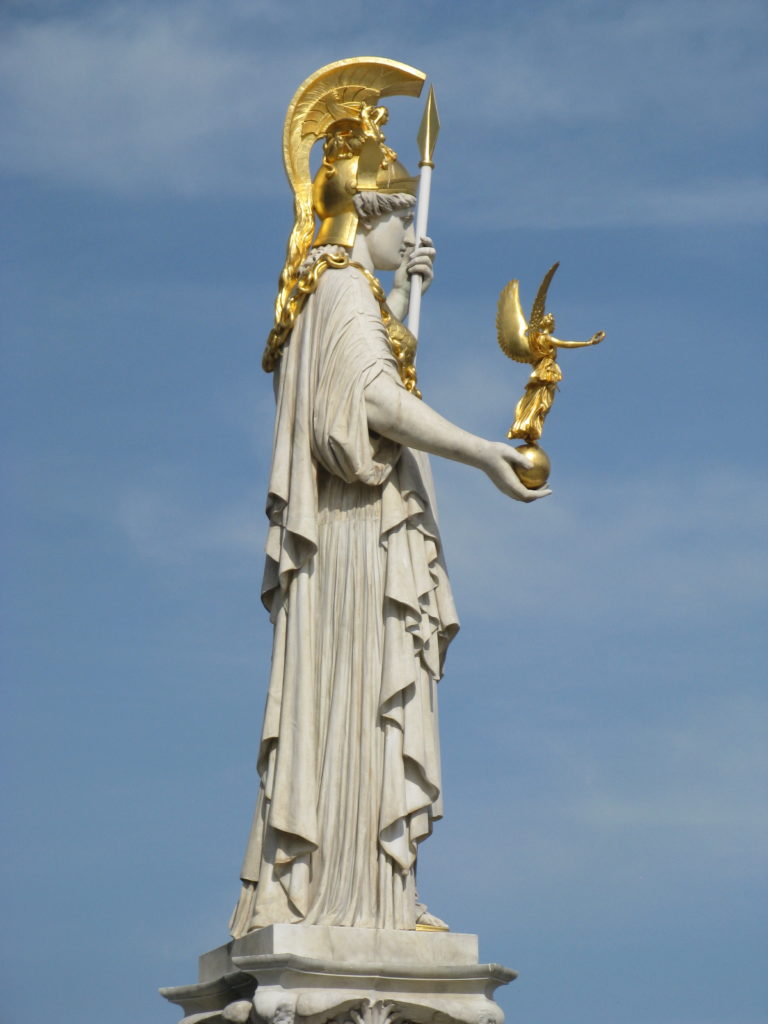
Pallas Athena

Forth on the Godly Seas

Darrell Sutton considers new translations of timeless texts

Barry Powell, Homer: The Odyssey (Oxford U. Press, 2014), xxv, pp 459
Peter Green, The Iliad: A New Translation (U. of California Press, 2015), xvi, pp 592

Since the moment that Aristotle penned his Homeric Questions and defended Homer from his detractors there have been supporters and opponents of various Homeric views. Of all extant Greek writers in antiquity Homer certainly stands apart. The two main poems attributed to him, the Iliad and the Odyssey, served as models for later Greek and Roman writers. Homer’s biography cannot be soundly reconstructed; but his poetic texts are rich in historical detail, and the nuances in each phrase elicit varied sentiment and strong emotion. It is no wonder that cinematic productions draw vast crowds.

The adage that ‘hindsight is 20/20’ is not entirely accurate. Continue reading

Posted in Book Reviews, Poetry, QR Home | Tagged , , , , , , | 1 Comment

Wines for Spring 2016

The chalky, dry soil of this vineyard in Languedoc, France is ideal for cultivating grapes.

The chalky, dry soil of this vineyard in Languedoc, France is ideal for cultivating grapes.

Wines for Spring 2016

This season’s drinking has yielded two excellent wines to accompany a roast on slightly special occasions; a rather exciting red at the lower end of the mid-range, and cheap but very quaffable reds and whites.

My top pick for value has to be that outstanding mid-range red, Monastier Cabernet Sauvignon 2014 IGP Pays D’Oc, which uses grapes from the Languedoc region of France, with its limestone and clay-rich soil. Continue reading

Posted in QR Home, Tippler | Tagged | Leave a comment

The Bell Inn, Lyndhurst

The Bell Inn

The Bell Inn

The Bell Inn, Lyndhurst

The Bell Inn is to be found in pretty, popular Lyndhurst in the New Forest, with its bustling shops and restaurants; an extremely suitable establishment for a lunch or dinner after a day exploring the paths, woodlands and meadows of the New Forest and admiring its flora and bold and abundant fauna. We were fascinated to discover that the inn has been in the same family for over 250 years, Continue reading

Posted in EpiQR, QR Home | Tagged , , | Leave a comment

Trump vs. the Banana Republicans

Mount_Rushmore_Sunrise

Trump vs. the Banana Republicans

Ilana Mercer draws a distinction

There’s a difference between (small r) republican principles and the Republican Party’s rules of procedure. But National Review neoconservative Jonah Goldberg doesn’t see it.

Or, maybe Goldberg is using America’s founding, governing principles to piggyback the Republican Party’s oft revised and rigged rules to respectability.

Conservatives who harbor the quaint expectation that voters, not party operatives, would choose the nominee stand accused by Goldberg Continue reading

Posted in Current Affairs and Comment, QR Home | Tagged , , , , | 1 Comment