Paul and Jeremy

William Beveridge

Lord William Beveridge

Paul and Jeremy

Bill Hartley enters darkest England

These days British television is full of what are called ‘Reality’ shows. One such programme is Can’t Pay? We’ll Take it Away. A new series has just started. The programme follows the adventures of some High Court enforcement agents – that’s Bailiffs to you and me. Their job is to evict or recover debts and given the endless repeats out in the wilderness of daytime television, the producers have got themselves a winner.

The way it works is that if a claimant is dissatisfied with the rate of progress through the County Court then they may escalate to the High Court, meaning that the process is quicker and the bailiffs arrive without warning.

Veteran watchers of the show will be as familiar with the excuses as the bailiffs themselves. Defendants may claim to know nothing about the matter, or that vital paperwork is with their solicitors. None of this makes an impression on the bailiffs who refuse to be deflected from their aim of either recovering a debt or evicting a tenant. Continue reading

Posted in Cultural Matters, Current Affairs and Comment, QR Home | Tagged , , | Leave a comment

If America becomes South Africa

Ilana Mercer with Oscar Wood

Ilana Mercer, with Oscar Wood

If America becomes South Africa

Ilana Mercer predicts the downfall of democracy

If African-Americans didn’t get out and vote for Hillary Clinton, they would be dissing him and his legacy. So warned President Barack Obama, in a speech at the Black Caucus Foundation in Washington DC, on September 17.

The woman whose election promises portend a war on whites, Walmart and the wealthy has nothing to fear. Obama’s political cant notwithstanding, there isn’t much chance blacks will side overwhelmingly with Hillary’s rival.

Like never before, the 2016 election has been characterized by “a muscular mobilization of a race-based community, coercive control of territory and appeals by powerful charismatic leaders.” Continue reading

Posted in Current Affairs and Comment, QR Home | Tagged , , , | Leave a comment

Let the States Roar, by Stephen MacLean

Calvin Coolidge

Calvin Coolidge

Let the States Roar, by Stephen MacLean 

The significance of States’ Rights for fiscal probity

Notice is given from its ‘Constitutional Affairs’ department that ‘The New York Sun . . opposes a balanced budget amendment.’

The justification cannot be that The Sun favours deficit spending, for the broadsheet prides itself as a tribune for limited government, fiscal probity, and sound money — grounded on the Gold Standard.

An awareness of the speed of unforeseen circumstances is one likely scenario for the editorial stance: allowing for contingency language written into a balanced budget amendment to take into account war or domestic necessity requiring its temporary suspension, The Sun may reason that even such foresight would frustrate government efficacy. Continue reading

Posted in Current Affairs and Comment, QR Home | Tagged , , , , | Leave a comment

ENDNOTES, 13th September 2016

Elgar, Bicycle Statue by Oliver Dixon

Elgar, Bicycle Statue by Oliver Dixon

ENDNOTES, 13th September 2016

In this edition: historic Elgar recordings from Somm, “Our revels now are ended” – contemporary work by Jonathan Dove that concluded the 2016 Proms season

Somm Records continues to offer the slightly unusual and often unexpected classical repertoire, and you might say that a new disc featuring Elgar’s Cello Concerto somewhat contradicts that policy. However, when the Elgar in question is taken from recordings made in the late-1920s and early-1930s by the composer himself, Somm’s choice of music becomes clearer. Set out across four CDs (with a detailed and fascinating booklet on the whole enterprise by musicologist and audio engineer, Lani Spahr), the performances – some of which include various “takes” and test pressings made by the original recording company – are a model of digital remastering and restoration. Another remarkable find from the archive is a private HMV Record made by cellist, Beatrice Harrison, of the third movement – accompanied at the piano by a member of the Royal Family, HRH Princess Victoria. The Cello Concerto is not, however, the only work to appear: the two completed symphonies, and the 1932 Menuhin performance of the Violin Concerto, also provide a window into Elgar’s sound-world, and into the performance styles of the time (often with a quick tempo – with little sign of the slowed-down grandeur we find in some Elgar concerts today). Continue reading

Posted in ENDNOTES:Music, QR Home | Tagged , , | Leave a comment

Cosmetology in Poland

Lautrec, Woman at her Toilette, 1889

Lautrec, Woman at her Toilette, 1889

Cosmetology in Poland

Mark Wegierski reminisces about a happier time in East-Central Europe

Poland is a country where the fashion sense and interest in cosmetology of many women is perhaps the third-highest in Europe (after France and Italy). Already during the later Communist era, it was said that women in Poland’s large cities would adopt the fashions of Paris a few days after their appearance in the West. Also, many Polish women tend to visit their “kosmetyczka” (cosmetician) at the beauty salon or aesthetics center with a frequency somewhat greater than that seen in Anglo-American societies.

I gained some knowledge of this whole scene through my female relative – herself a tall, lithe, brown eyed brunette who might have appeared to some observers as a former model – who had been working in the cosmetological profession for over twenty years. Unlike in Anglo-American societies, there are extensive programs of study at the university level in cosmetology in Poland. My relative, having the appropriate university training and decades of experience, rather lamented the fact that standards in the profession appear to be dropping, with some cosmetological study programs lasting a mere three months.

I recall that on Sunday, September 21, 2003, during my visit to Poland, I travelled with her to Warsaw, in her compact but elegant Peugeot 206, to attend a large trade show for cosmetologists. It was a sunny and rather warm day. I had been staying at Ciechocinek, which is a spa and resort town of about 14,000 permanent residents. It is known for its unique titration towers – large wooden structures with thick layers of bramble, through which water from nearby salt springs is filtered into the air, producing a healthy microclimate, approximating that of sea air. Ciechocinek lies about 200 kilometers northwest of the capital.

We drove into Warsaw along the Wislostrada (Vistula Highway) which lies to the east of the main city of Warsaw, along the Vistula River. We found the trade center with some difficulty, and there were literally hundreds of cars parked on the sides of the road as we drove up toward the huge building. We found a parking spot in the vast underground garage, despite the bustle of the place.

The trade center had probably been built only a few years ago. Warsaw is clearly the most prosperous city in Poland, with a huge building boom. While this is great for Warsaw itself, there are still the much poorer regions and smaller towns of Poland, especially in the southeast of the country, that are hoping for some relief from their often grinding poverty and unemployment. The official unemployment rate in the country as a whole had been around twenty percent for several years in the 1990s and early 2000s.

We finally rushed up into the trade center venue, a vast hall jam-packed with exhibitors and huge crowds. My companion complained that admission to the trade show should have been more selective (i.e., only for recognized professionals). As it was, anyone who paid 15 zlotys was allowed inside, resulting in a virtual mob scene.

The cosmetology-related products, devices, and furniture on display were of an enormous variety, and the prices for some of the items were out of this world, e.g., several thousand Euros for a professional salon bed. I gained some insight into how expensive getting effectively set up in this profession could be.

My “chauffeuse” insisted on viewing virtually every exhibit in the trade show, but after an exhaustive and exhausting run-through, which included picking up various brochures and pamphlets, we stepped out of the door. We thought of eating at the local cafeteria in the trade center building, but the crowds there were massive, too.

Slipping out of the “madhouse”, we drove in light Sunday traffic to Three Crosses’ Square (Plac Trzech Krzyzy) which is in the Downtown-South part of Warsaw, where there was a fine restaurant with which she was familiar.

Walking to the restaurant, called Modulor Café Bar, one noted the bright whiteness of the freshly restored church at the center of the square; the ponderous-looking, cavernous modern hotel (the Warsaw Sheraton, I believe); as well as the trendy student hang-out, Szpilki Szparki Szpulki (Needles, eyes, threads).

Modular Cafe

Modular Cafe

Eating at the Modulor restaurant at about six o’clock in the evening, it was mostly empty, but I imagine that it is jumping later in the evening, as it caters to a trendy clientele. There is a large bar alongside part of the right wall of the restaurant, the tables are of imitation marble, and there are various framed caricatures of persons active in the Warsaw arts scene – some of them probably from earlier decades  – on the walls.

The food – such as roast strips of chicken on a bed of lettuce – was excellent, with the added bonus that you could order things like real milkshakes (i.e., something frothy that can be sipped rather than slurped).

Except in major and medium sized cities, and a few smaller centers, very high-quality restaurants in Poland are not that easy to find, presumably because the cooking at home is usually so good, and it has been estimated that the average Polish person eats only 1 in 30 meals at a restaurant (although this may have begun to change to more out-of-home dining in more recent years).

Having rested up, we returned to our car, to begin our over three-hour trip back to Ciechocinek.

Unfortunately, a large, prosperous middle-class has not yet arisen in Poland, and it is that class of women that would probably give the largest support to cosmetology. Indeed, in the aftermath of Communism, a small number of people have become very rich, while wide swathes of the population have been pauperized. Ironically, some people look back with comparative fondness at the so-called “golden years” of the Gierek era of the 1970s, when small luxuries appeared to be within greater reach of the average pocketbook.

Mark Wegierski is a Toronto-based writer and historical researcher. He was born in Toronto of Polish immigrant parents

Posted in Cultural Matters, QR Home | Tagged , , , , | Leave a comment

Kill Bill, volume 2, by Ilana Mercer

Image.toutlecine.com

Image.toutlecine.com

Kill Bill, volume 2,
by Ilana Mercer

Hillary – first she rubbishes* the country, then she expectorates all over it

How does evidence against something, become evidence for that very same something?

Plain evidence against the good health of Hillary Clinton has become, with the aid of the malfunctioning media, evidence for her stamina. “She has the constitution of a boar,” said a defender on Fox News, following Mrs. Clinton’s very public collapse at the 2016, 9/11 memorial.

“She powered through it all,” parroted the rest.

“Pneumonia blows over like the flu” was the consensus on MSNBC, as they collected affidavit after affidavit from their reporters to swear to how humid, crowded and uncomfortable it was for Hillary on that fateful, New York day.

“Probably nothing,” said that no-good neurologist Sanjay Gupta, at CNN, mere hours before the news of Clinton’s pneumonia broke.

How does a display of faltering health from Hillary become a reason to doubt the stamina of a man, Donald Trump, who’s like The Incredible Hulk?

Like magic, Trump materializes at multiple events a day, hops from Mexico to Louisiana, and seems to be having fun while at it. “Give me more,” his whole countenance seems to scream.

Then there’s the sexism angle (where, in the YouTube video that accompanies this short text, the writer is forced to reach for some Dutch courage). How is it that we hold a female presidential candidate with pneumonia to a different standard than a male presidential candidate without pneumonia?

Now there’s a no-brainer.

How do we pivot from a real problem, the reality of Hillary’s ill health, to hailing her strength: Hillary is obsessively private—chastely so—rather than suspiciously ill? In this context, Trump, naturally, is said to be deceptive rather than manifestly robust and revved-up with energy.

How does a display of deplorability by Hillary Clinton—lumping in her highness’s “basket of deplorables” millions of Trump supporters in fly-over-country—become a ruse to put VP candidate Mike Pence on the Rack and extract a confession from this mild-mannered man about the deplorability of a third, unrelated party, David Duke?

And how is the deplorable Hillary’s list of thought crimes, imputed to Trump supporters, stand as evidence of anything other than a form of totalitarianism?

And the American media-pundit complex dares to talk about Russian authoritarianism?

Finally, first she scoffs at the country, then she coughs all over it. So tell me this: does Hillary Clinton’s dangerous decision to cough her way around the country—rather than come clean about her infectious disease and quarantine herself—show that, at the very least, Hillary’s decision making is profoundly flawed?

Over and out.

*Editorial note : we have an analogous problem here in the UK with the vindictive remainers. As James Anthony Froude once memorably observed, only a “miserable caitiff” cannot love his own country

Subscribe to Ilana’s new YouTube channel. This shy, retiring writer/thinker promises to get better at it

ILANA Mercer is the author of “The Trump Revolution: The Donald’s Creative Destruction Deconstructed” (June, 2016), and “Into The Cannibal’s Pot: Lessons for America From Post-Apartheid South Africa” (2011). She has been writing a popular, weekly, paleolibertarian column—begun in Canada—since 1999. Her father was a distinguished rabbi. Ilana’s online homes are www.IlanaMercer.com & www.BarelyABlog.com. Follow her on https://twitter.com/IlanaMercer

Posted in Current Affairs and Comment, QR Home | Tagged , , | 1 Comment

Yorebridge House Hotel, Bainbridge

yorebridge-house

Yorebridge House Hotel, Bainbridge

What an incentive to be a school Head Master in Bainbridge in the 1850s – being placed in a house of such size and beauty as Yorebridge House: for, prior to its current incarnation as a luxury hotel and previous one of Head Office of the Yorkshire Dales National Park, this imposing stone house belonged to the Headmaster of the local school – which stands opposite in the courtyard, a fraction of the size!

One approaches the House along paths and through doorways lined by pillar candles blazing away in glass canisters – we were immensely impressed by the fact that these were real candles, lending a welcome glow lighting the way to the house, rather than fake candles or just lights. This gave an initial impression of warmth, as well as an exciting feeling of something special, almost magical, grandly impressive and yet intimate and thrilling at the same time. Continue reading

Posted in EpiQR, QR Home | Tagged , , , | Leave a comment

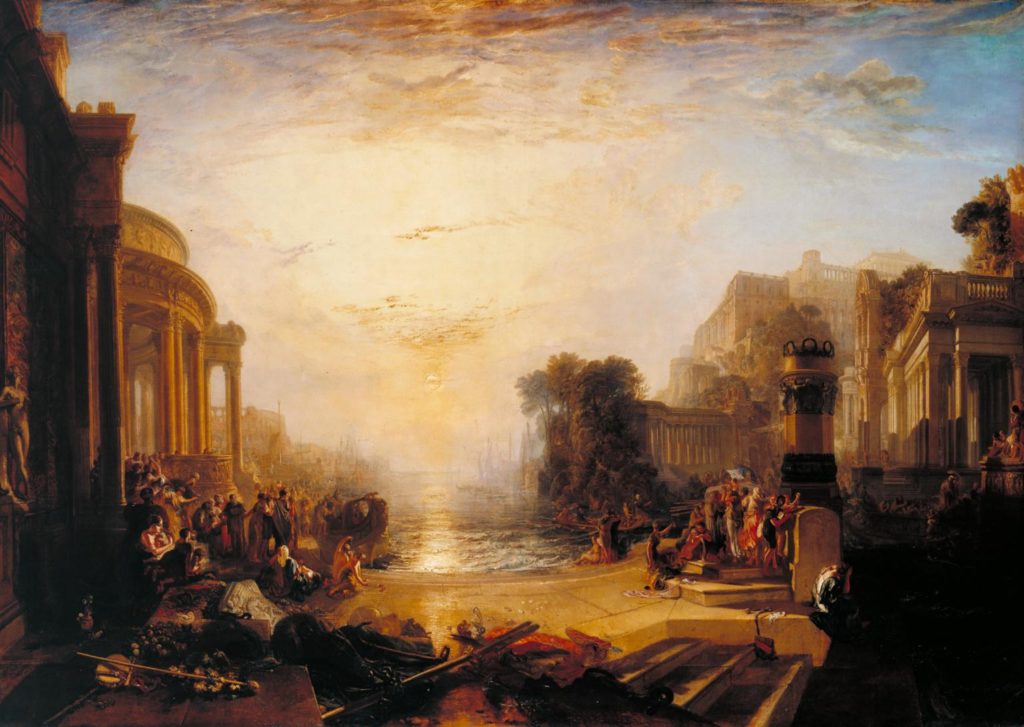
The Fall of Rome and Decline of the West

JMW Turner, The Decline of the Carthaginian Empire

The Fall of Rome and Decline of the West

On the fifteenth anniversary of 9/11, Mark Wegierski reports

It seems doubtful that America can ever re-capture the spirit of that patriotic surge that occurred in the wake of the September 11th attacks. Arguably, all that patriotic energy was misdirected and wasted by the George W. Bush administration, in its pursuit of a misbegotten invasion of Saddam Hussein’s Iraq.

Comparing the Fall of Rome to the situation of the West today, while it has some merit, is also a somewhat inaccurate analogy. In the absence of any technological advantage, the conflict between Rome and the barbarians was almost entirely a physical and moral struggle, between a decadent and enfeebled Empire, and more vital, healthy, prolific tribes. In comparing Rome to the West today, what is striking is the noticeable lack of any ideologies of self-hatred among the Romans (although some like historian Edward Gibbon have argued that Christianity fulfilled that role) as well as of any unusually pronounced hatred of Rome by the barbarians. Continue reading

Posted in Current Affairs and Comment, QR Home | Tagged , , , , , | Leave a comment

Kill Bill Volume One, by Ilana Mercer

From Kill Bill Volume One by Quentin Tarantino

From Kill Bill Volume One, by Quentin Tarantino

Kill Bill Volume One, by Ilana Mercer

Or, it takes a village (idiot) to vote for Hillary

If you strapped Bill Clinton to a polygraph (or to some lie detector that can’t be fooled by the Clintons)—I suspect that, he too, might confess to a preference for Vladimir Putin over Barack Obama.

Mr. Clinton had been appropriately scathing, in 2008, about Obama’s mythical status in the media. A “fairy tale,” he called the current president.

However, his wife and her supporters on The Hill and in media have ruled that any remotely realistic utterance about the Russian president—such as that he’s a strong leader who’s popular with his people and acts in their interests—puts you outside the camp of the saints.

Mrs. Clinton is making it a habit to tell Americans what to say and how to think if they want to qualify as … Americans. Continue reading

Posted in Current Affairs and Comment, QR Home | Tagged , , , , | Leave a comment

ENDNOTES, 4th September 2016

prom-64_cr_bbc-chris-christodoulou_1

ENDNOTES, 4th September 2016

The Proms: Sir Simon Rattle and the Berlin Philharmonic, performing Boulez and Mahler

Each year at the Proms, certain performances stand out and provide the landmarks of the season. Last year, the Sibelius cycle embodied the 2015 Proms for many of us, and I still remember the overwhelming impact that Bruckner’s Fourth Symphony and Bartok’s Concerto for Orchestra made in 1981, in the hands of Sir Georg Solti and the Chicago Symphony. On Friday 2nd September, another legendary partnership took to the platform at the Royal Albert Hall – the Berlin Philharmonic Orchestra, under the baton of their first-ever British chief conductor, Sir Simon Rattle (a conductor whose dazzling career began in the early-1980s with an apprenticeship role with the BBC Scottish Symphony Orchestra, followed by years of dedication and achievement in Birmingham with the CBSO).

A packed Royal Albert Hall and a heartfelt welcome from the Proms audience demonstrated the affection and respect in which Sir Simon is held, but of course, the prospect of hearing the Berlin Philharmonic – the ensemble of Furtwängler and Karajan, and perhaps the greatest orchestra in the world – also contributed to the excitement. The Berliners performed two works: the short, beguiling Éclat written in 1965 by Pierre Boulez (for this, a chamber-sized ensemble of just 15 players was required) and then the main work of the evening, the massive full-orchestral dreamscape and phantasmagoria that is the Symphony No. 7 (1904-5) by Gustav Mahler.

Éclat typifies the music of Boulez: a musical language in which there is no trace of the tunes and recognisable structures of classicism, romanticism and even early modernism, but which – even in its pure abstraction – manages to convey a brilliant craftsmanship of sound; with piano (which begins the work) percussion and woodwind piercing the air, as if in some odd dream in which notes of music appear and disappear, like fleeting, disjointed memories. The definition of the word éclat (from the New French Dictionary) is as wide-ranging as the piece itself – “a sudden bursting… a crash, clap, peal” – or better still – “sudden uproar, shiver, brightness, glare, glitter”. The Proms programme note (expertly written by Paul Griffiths) also refers to the poet Stéphane Mallarmé, who wrote of the “pure éclat” of a swan breaking free of ice on a lake – Mallarmé being one of the poets who inspired Boulez.

Sixty years before Boulez was forging his new musical language, Gustav Mahler emerged as the re-creator of symphonic form: his ardent post-Wagnerian and Brucknerian romanticism, shaped and tinged by a mixture of nature-sounds, legends, poems and the ghosts of children; a heady cocktail of psychological disturbances, yet towered over by immense landscapes in which unsettling thoughts appear. Such is the soundscape of his extraordinary five-movement Seventh Symphony. A languid, but tense opening – a moment inspired by the sight and feel of the movement of oars on a lake in Carinthia – gives the symphony its slow-breathing launch, the composer then considering numerous, sometimes fleeting ideas, which give rise to dizzy, unresolved passages, and to climaxes that end abruptly in nothingness. And yet, in all of this circuitous exploration, a purpose gradually emerges – a great striding as if the whole orchestra is over-heating, to an astonishing, blazing ending – music made to perfection for the effulgent brass instruments of the Berlin Philharmonic. In this first movement of massive steps and peaks, the air suddenly clears to give way to chamber-like sections of music: precursors, almost, of the abstractions and éclats of Boulez; as beautifully-etched sounds, describing ice or crystal, or a distant horn or trumpet call – or hollow clang of cow-bell, hang delicately in the air – making us see vast distances and feel the heady sensation of high altitudes. Sir Simon Rattle shaped these transcendental interludes with profound sensitivity: the tension in the air was palpable – it was as if the thin sheet of sound could snap at any point.

The Seventh Symphony is probably best known for its unusual central section: three Nachtmusik movements, each one offering a miniature symphonic story in itself – from the commanding and sinister horn-calls of the shadow-filled first (the second movement of the whole symphony), to the shaking dances of death, and fiddler and mandolin-accompanied reflections of the remaining pair. Interestingly enough, it was this part of the work which Mahler first completed: inspiration for the opening eluding him, until that chance visit to Krumpendorf, Carinthia, led to the successful shaping of the great Langsam (Adagio).

Finally, the great Rondo that takes the symphony to its ringing, chiming resolution – and here the orchestra and conductor drew on great reserves of energy. Find the power they certainly did: from the martial-sounding timpani “fanfare” with horns roaring, to the one other great, affirmative brass chorale – about halfway through the movement. My preferred version on disc of Mahler 7 comes from the Vienna Philharmonic Orchestra and Lorin Maazel – a reading of absolute cogency and mastery, captured by CBS Records. This latter performance is characterised by a Teutonic heaviness of sound, weighed down with strong, almost lugubrious feeling. But in their Albert Hall performance, the Berliners and Rattle discovered a silkier side to the score: smooth and delicate strings, with many of the heavier passages gaining from a quicker tempo – mercury and velvet, almost, appearing in the playing.

This was a landmark Prom, a memorable visit by a great orchestral partnership, and a symphony from Mahler that embraced all of human emotion.


STUART MILLSON is the Classical Music Editor of The Quarterly Review

Posted in Cultural Matters, ENDNOTES:Music, QR Home | Tagged , , , , | Leave a comment