
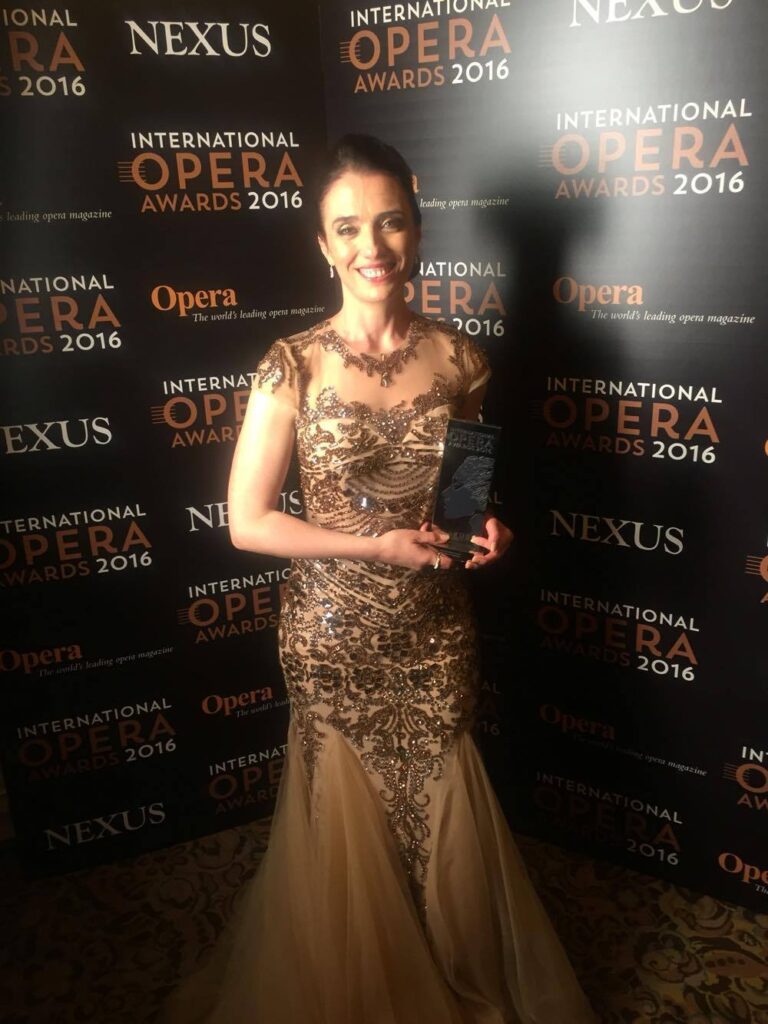
Ermonela Jaho, credit Wikipedia
ENDNOTES, December 2020
In this edition: opera arias sung by Ermonela Jaho, Art of the Mandolin, choral music from Keble College, Oxford and Clifton Cathedral. Reviewed by STUART MILLSON
We bid farewell to 2020, the year of Coronavirus in which our opera houses and concert-halls have been closed – with four CDs to inspire us over whatever can be salvaged of the yuletide season. We begin, as the curtain rises across the great opera houses of Europe, with Albanian-born soprano, Ermonela Jaho, paying tribute to a fine singer of a bygone age, Rosina Storchio – star of many Puccini and Mascagni productions. Ms Jaho is accompanied by the Orquestra de la Communitat Valenciana conducted by Andrea Battistoni, who is only in his 20s, but who already has a production of La bohème to his credit.
Despite it being a studio recording, there is a real sense of public drama to the proceedings: soloist and orchestra playing as if they are before a vast concourse – with Ms Jaho building an overwhelming tide of drama and anticipation, even though we are hearing just the famous “snippets” and arias from great operas. The album is launched with the ever-spine-tingling ‘Un bel di, vedremo’ from Madama Butterfly – “One fine day, we will see arising a strand of smoke over the far horizon of the sea… And then the ship appears… Do you see it? He’s arrived…” The anticipation that Butterfly’s husband, Pinkerton, will arrive – surely? – is brilliantly conveyed here. Verdi, Mascagni, Leoncavallo, Massenet – all feature on the bill, as well as names not quite so feted, but who deserve more distinction, and certainly receive performances of great commitment here – Boito, Giordano and Catalini. The Opera Rara label deserves acclaim for this recording. Continue reading







Is Israel Racist? Part 1
Marc Chagall, credit Wikimedia Commons
Is Israel Racist? Part 1
Ilana Mercer gives chapter and verse
Some months ago, a gentleman who pens anti-Semitic tracts approached me for an interview. I agreed. Being a naïve methodological individualist, I never generalize about individuals. That my interlocutor writes crude anti-Semitic boilerplate did not mean I would not give him a chance to reveal himself as someone other than a crude anti-Semite. After I had already answered his written questions in full, however, he bailed.
Here, then, is my reply to one of many loaded and leading questions I was asked and had answered in good faith. A leading question is one that suggests an answer. Since I am Jewish, I was considered a priori guilty. Of what? Well, you know: “nudge nudge, wink wink, say no more,” as goes the Monty Python skit. In his case, the fact that I married gentiles twice was not enough to clear me from charges of “Jewish supremacy.” I was pelted with uncouth, inappropriate, bias-confirming questions such as, “Do you think that marrying a non-Jew was a mistake and you should only marry another Jew?”
One of the less flighty questions was, “Do you believe Israel is a racist state?” I’ve been deconstructing the concept of racism in my latest columns, analytically showing that, at worst, racism is a worldview, a state of mind—often spoken or written, and entirely the prerogative of a free people, just so long as no corporeal aggression is committed. Continue reading →
Share this:
Like this: