Rotherham and the collateral damage of complacency

Rotherham and the collateral damage of complacency

At the time of writing, the media are regaling us with the story of three foster siblings who were removed from their placement family by Rotherham Council because the fosterers belonged to the United Kingdom Independence Party (UKIP). This made the fosterers ipso facto “racists”, according to at least one social worker – and this single perception was allowed to outweigh all others in the childcare consideration. The fosterers are experienced and have always fulfilled their roles in an exemplary fashion, so the decision was clearly made on purely political grounds. This is literally a sinister development, and not just for UKIP members, or children in need of fostering. With its combination of anonymous denunciations, blatant bias, ideological sclerosis, mendacious management-speak, and petty nastiness disguised as compassion, the whole sad saga inevitably evokes Nineteen Eighty-Four.

The decision to remove the children (who have now been split up) was greeted with outrage by the rightwing media, as might have been expected, but even Ed Miliband has called for an enquiry – although it is possible that his evinced concern is merely part of his party’s strategy of recapturing the white working class vote. The children’s removal, even if it is reversed (unlikely) and even if there are apologies and resignations from the council (as there should be), encapsulates the corruptness of some on the Left, who have run large chunks of the country as a virtual one-party state for decades, and whose personnel and prejudices predominate in social services and many other parts of the body politic.

Rotherham is a prime example of a permanent Labour regime where erstwhile liberal and communitarian impulses have been overwhelmed by ideological cowardice, administrative complacency and accreted abuses. It should be remembered that the same council was recently told “to get a grip” on another racially charged scandal it has long covered up – the systematic “grooming” by some Asian males of local white girls. Rotherham is in many ways a latter-day rotten borough – the electorate may be larger than that of the 19th century rotten boroughs, but it is no less taken for granted. And the old rotten boroughs would at least occasionally throw up an MP of genius, whereas Rotherham has to date offered posterity only the outgoing Denis McShane, who long combined irrational pro-Europeanism and voluble “anti-racism” with quiet embezzlement. Sad Rotherham, with its relict medieval bridge chapel and surrounding industrial dereliction, has been abused as much by Labour ideologues as by the Thatcherite ideologues who condemned the town to hopelessness and welfare dependency.

There will be an election in Rotherham shortly, and obviously one cannot tell what will happen, but the likelihood is that UKIP (and indirectly maybe the battered BNP) will score highly as a consequence of this happily-timed story.  UKIP’s exasperated views on Europe, immigration and political correctness are shared by a large proportion of the British electorate, including many who perversely vote for Labour, the party which has done all it could to give everyone more of all these things. Nevertheless, tribal habits die hard and Labour will almost certainly retain the seat.

Assuming it does, the chances are that normal ideological service will resume, after the sacrifice of one or two symbolic paper-shufflers, like Joyce Thacker, present head of children’s services. McShane’s chutzpah in blaming the BNP rather than his own behaviour for his fall from grace is characteristic of the arrogance of some on the Left. Likewise, Labour apparatchiks educated into a certain way of seeing the world will find it difficult or impossible to change their outlook, and will blame individuals’ failings rather than the system they staff or the philosophy they follow. Almost equally bad examples of incompetent klepto-complacency can be found in yet other places across the UK – other South Yorkshire locales like the notorious Doncaster, many places in West Yorkshire, Lancashire, the North East, inner-city London, inner city Glasgow – places where old industries, old traditions, old communities, old identities are being ripped up and remade, and career politicians prosper by abandoning old friends and riding each incoming wave.

Nevertheless, for the first time, political correctness is being seriously challenged in strongholds where it has long reigned supreme. It can be likened to the doctrine of some established church whose unforgiving orthodoxy is enforced by a battery of laws and all the weight of social opprobrium – yet which cannot resist the slow but steady onset of reality. Political correctness is doomed in the long term because it runs contrary to the facts. It has always been the most expensive of illusions, and it is one we can simply no longer afford. But for now it can still lash out in spite and cause collateral damage – in this case three unlucky infants who have already been through the mill and are now condemned to more. Derek Turner, 29th November 2012


Free Google Ad cialis drugs no rx
Posted in QR Home | Tagged , , , , , | Leave a comment

China’s new American outpost – photo-essay by James Whitlow Delano

EDITOR’S NOTE As part of its programme of global expansion, China has established a foothold in the South American county of Suriname (formerly Dutch Guiana). A substantial proportion of the country’s population is now of Chinese nationality, and there are major implications for the country’s economy, social stability and rainforest environment – and of course the wider region. The award-winning photojournalist James Whitlow Delano has recently visited the country and produced the following report. Please follow the links below to view the multimedia footage (divided into three parts) and visit the photo gallery. We are privileged to feature this enlightening, powerful (and beautiful) photo-essay documenting the plight of a small and little-known country, and some of the human stories behind China’s great geopolitical game. DT

China’s new American outpost

Photo-essay by JAMES WHITLOW DELANO

I have been documenting China for almost 18 years now. So when I was in Suriname last July, I was surprised to see large numbers of Chinese nationals working on large infrastructure  projects that hinted at preparations for resource exploitation and the discount retail sector dominated by migrant-Chinese entrepreneurs. In a nation of a half million people, Suriname is particularly vulnerable to neo-colonial dominance. The Chinese embassy has put the number of Chinese migrants at 40,000, nearly 10% of the population. Aside from Brazilians, whose giant nation borders the country, there were no significant numbers of any foreign nationality; no large contingents of Russians, Argentinians, Venezuelans, British, Japanese, Nigerians; only Chinese.

I found through confidential US Embassy communications leaked by WikiLeaks that the US government had clearly taken notice of this activity and I knew then that, through my own instincts and observations, and through reading the leaked communications, that this was a story that needed to be told. So I returned a month or so ago to Suriname to produce this story with the help of funding by the Pulitzer Center on Crisis Reporting.

Please watch the three parts of the multimedia footage in sequence:

Part I

WikiLeaks, Chinese Soft Power & a Small Amazonian Country. (Part I short version)/ Strategic Foreign Aid & Investment. A from James Whitlow Delano on Vimeo.

Part II

WikiLeaks, Chinese Soft Power & a Small Amazonian Country. (Part II short version)/ Chinese Citizen Entrepreneurship. A from James Whitlow Delano on Vimeo.

Part III

WikiLeaks, Chinese Soft Power & a Small Amazonian Country. (Part III short version)/ A Gulf in Perception. A from James Whitlow Delano on Vimeo.

You can view the photo-gallery as a slideshow here: (Flash player needed)

WikiLeaks, Chinese Soft Power & A Small Amazonian Country – Images by James Whitlow Delano

http://jameswhitlowdelano.photoshelter.com/gallery/WikiLeaks-Chinese-Soft-Power-A-Small-Amazonian-Country/G00009slUBKglqZs/

I hope this provides greater insight into an often overlooked part of the world that soon may become important, and would welcome comments.

JAMES WHITLOW DELANO is an author and award-winning photojournalist based in Tokyo. His website is http://www.jameswhitlowdelano.com/. This essay was funded by the Pulitzer Center on Crisis Reporting


Free Google Ad cialis drugs no rx
Posted in QR Home | Tagged , , , , , | Leave a comment

Tory revolutionaries: the unconservative foreign policy of the Conservative Party – guest article by Alastair Paynter

Tory revolutionaries:

the unconservative foreign policy of the Conservative Party

Guest article by ALASTAIR PAYNTER

The reaction to the ongoing development of the so-called “Arab Spring” has demonstrated with abundant clarity that the Conservative-led coalition’s foreign policy is anything but conservative. In fact, the guiding philosophy behind its Middle Eastern policy appears to be the exact opposite of that to which conservatives used to hold. That it would be such was evident from the start. The 2010 Manifesto, chummily titled, An Invitation to Join the Government of Britain, boldly stated that Conservative Party policy was “based on a belief in freedom, human rights and democracy” and a belief in “humanitarian intervention when it is practical and necessary” (1).

David Cameron recently reiterated this position during a visit to the region. Visiting a Syrian refugee camp in Jordan, he hailed forthcoming talks with Syrian rebel leaders as

“…an opportunity for Britain, for America, for Saudi Arabia, Jordan and like-minded allies to come together and try to help shape the opposition, outside Syria and inside Syria, and try to help them achieve their goal, which is our goal of a Syria without Assad.” (2)

Central to Britain’s pursuit of regional stability in the Middle East is support for the various rebellions against autocratic regimes throughout the area. In addition to committing British forces to the international effort to topple Libyan dictator Muammar Gaddafi, the British government has repeatedly sided with the revolutionaries across the Middle East. First it was Egypt. Then it was Syria, although the once constant relay of media coverage of Assad’s latest atrocities has dimmed, perhaps due to Sino-Russian recalcitrance to commit to international ‘peacekeeping’ efforts and the fact that Syrian government forces have proved difficult to unseat.

Nevertheless, the official tone that is discernible in the speeches of David Cameron and Foreign Secretary William Hague is that the United Kingdom and the international community must continue to provide support for the burgeoning democracies of the region. In other words, Britain remains as in tune to Washington’s interventionist policy as the previous government was when George W. Bush was President.

On an ideological level, the level of continuity in policy in both Britain and the United States demonstrates how liberal interventionism and neoconservatism are just two sides to the same coin. Both ideologies presuppose that contemporary Western concepts of freedom and democracy are universal ideals and that it is the duty of the West to transpose them to less fortunate, benighted areas of the world. Now, it was entirely expected that Blair’s government should pursue such a revolutionary policy, given its domestic penchant for removing as much of the vestiges of tradition and the old order from public life that it could, all in the name of modernization. However, that a government led by self-described “Conservatives” should follow suit indicates the complete loss of principle which has occurred at the heart of British conservatism. A conservative foreign policy should consistently pursue the national interest, not act as a social service for other peoples thousands of miles away at the expense of our own. In early 2011, Mr Cameron attempted to distance himself from the neoconservative approach to installing democracy via military force, arguing instead for a “liberal conservatism” which supposedly supports the full range of institutions necessary for a viable democracy (3). In reality, that there was a significant difference between the two positions was questionable, as was the degree to which he really did have an aversion to military force, given that the RAF bombing campaign over Libya began about a month later.

An earlier "Emperor of the East" - Napoleon visiting plague victims in Jaffa, 11th March 1799 (as depicted by A. J. Gros)

Current Middle Eastern policy is fixated around the promotion of freedom, democracy, equality and human rights. In his speech to the United Nations in September, the Prime Minister reaffirmed his commitment to his “liberal Conservative” foreign policy vision by stating, “We in the United Nations must step up our efforts to support the people of these countries as they build their own democratic future” (4). Leaving aside the assumption that the peoples of the countries in question were and are seeking to embrace freedom and democracy, the attempt to usher in Western-style government in places with no actual history of such must be considered futile.

Philosophically, conservatism owes much to the thought of Edmund Burke. While his political place was amongst the Old Whigs, much of his anti-revolutionary thought found its way into the intellectual arsenal of the Tories, who were anxious about the spread of Jacobinism into Britain following the French Revolution. While the British government is not exactly reenacting the violent extremes of the Jacobins, the guiding vision of their Middle East policy does reveal some interesting parallels. Perhaps most notable in this global crusade for democracy is the sense that freedom and democracy are the necessary foundations of a new political order in the region. Such a concept would have been anathema to conservatives two hundred years ago who agreed with Burke that the replacement of settled bodies of law and custom with constructs that were based on abstractions was dangerous. Genuine social and cultural change occurs organically. It cannot be imposed top-down without disastrous results. The degree to which the government, and other Western powers, have offered Syrian rebels their full support, short of actually intervening militarily, seems to parallel the way some Whigs, to Burke’s abject horror, latched on to the French Revolution in its early stages as a positive development, believing the revolutionaries actually wanted a British-style constitutional monarchy rather than simply being bloodthirsty secular zealots desirous of rank power.

Regardless of Cameron’s stated opposition to the neoconservative model of democratization (which differs only in means rather than premises and objectives from his own “liberal Conservative” one), the fact remains that Britain and France under Sarkozy acted in full concert with Washington’s mission of regime replacement. In this regard, they have acted as handmaidens to what Claes G. Ryn has referred to as the “new Jacobinism” (5). The Western powers today have collectively acted as the vehicles by which the abstract ideals of democracy and freedom are to be exported to the rest of the world.

The fact that we have a Conservative-led government willingly exporting the ideals of the French Revolution to the Middle East indicates the extent to which the politics of the Right has taken a rather expansive detour throughout the Twilight Zone. Of course, most genuine conservatives and classical liberals alike already knew this. It is time for a complete re-evaluation of what the Conservative Party considers foreign policy. Unfortunately, such a reversion to traditional conservative principles is not likely in the short term, given that the Prime Minister’s self-description as the “heir to Blair”. It is time for less Blair and more Burke.

ALASTAIR PAYNTER is a Masters graduate in History. He writes about the intersection between current affairs and the ideas and events of the past

NOTES

1. “A liberal Conservative foreign policy” from Conservative Party Manifesto, 2010 p.109

2. Telegraph Online, “David Cameron vows to work with Barack Obama over Syria”, 7 November 2012

3. Telegraph Online, “Democracy is route to peace in Middle East, says David Cameron”, 21 February 2011

4. BBC News, “David Cameron urges UN to step up Syria efforts”, 27 September 2012

http://www.bbc.co.uk/news/uk-politics-19724829

5. Claes G. Ryn “A Jacobin in Chief”, American Conservative, 11 April 2005

http://www.theamericanconservative.com/articles/a-jacobin-in-chief/


Free Google Ad cialis drugs no rx
Posted in QR Home | Tagged , , , , | Leave a comment

“Venator” – Time for a cleverer conservatism

Time for a cleverer conservatism

This past week has seen the election of two of the most significant individuals in world affairs. In the US, the American electorate has once again opted to flood the White House with the forces of political correctness, secularism and permissiveness, although perhaps without fully understanding what they were doing as they flocked once more to the banner of “Change”. The Crown Nominations Commission came up with a distinctly less known quantity. Justin Welby’s nomination to the See of Canterbury was greeted with cautious optimism by many orthodox Anglicans at home and abroad, including myself, right up until the moment he chose to open his mouth.

We traditionalists are forever accused of being obsessed with gays but, without wanting to sound petulant, he brought it up. We all knew Bishop Welby supported women bishops but to expect anything else from the next Archbishop of Canterbury was fanciful. Where it was still all to play for was in the defence of the Christian understanding of marriage, and in Justin Welby it seemed we had someone on our side. And yet in his first speech as nominee there he was pledging rethinks to the (God help us) “LGBT community”. One wondered if it was a condition for getting the job.

In the US the defeated Republicans picked over the carcass of the Romney campaign. As far as I could tell from their flagship magazines, the neocons who had so strongly backed Romney felt that their policies were correct but the candidates were all wrong, while the Buchananites bemoaned the dreadful neocon policies and pointed out (correctly) that they had predicted this defeat all along. What no one could ignore were the ominous racial voting patterns now plaguing American politics. Successive governments had permitted mass immigration, neoconservative doctrine had at times encouraged it, and now there was no denying it – the demographics of the US had changed forever, and with it voting patterns. Hispanic and African-Americans were instinctively, tribally Democrat, and they were growing in number. The Republicans, it would seem, have a choice – change or die.

So what to do? Marco Rubio has already been anointed by some as the next Republican Presidential nominee. There has been talk of an end to the historic opposition to illegal immigrant amnesties. It is apparently time to stop debating immigration in “cultural terms” and start considering only the economic benefits. As a Briton it is interesting watching someone else’s country, or at least one of its major political parties, busily engaged in “heaping up its own funeral pyre”.

In the Church of England we have seen catastrophic declines in church attendance, for which chronic separation from the modern world was the diagnosis. The cure? Modernisation – engagement with the real world, with issues of social justice and environmentalism. Gender equality was the first priority appended to the 39 Articles, and that battle is almost won. Climate change, fair trade, anti-globalism (of the capitalist variety, never the political) and even immigration became the stuff of sermons up and down the country, as the liberal middle class nodded approvingly, albeit with a slightly smug smirk. Now the church once again looks inwards, this time seeking a battle on the grounds of sexual preference. And again, as the forces of liberalism progress through the Synod, the modernizing powers-that-be look on with approval.

But the liberal, modernizing powers-that-be don’t go to church. Nor do the militant homosexuals. Nor the radical feminists. They never did, and they never will. Those who do go to church want clarity, and leadership, and the Gospel, and they are finding it easier to find in Pope Benedict’s Catholic Church, or in the free Evangelical churches, than in the modernized Church of England. Even those newly seeking truth and faith in this modern world of ours are not dawn to this newly modern church. It might only be anecdotal, but stories of white British converts to Islam abound, and New Age paganism certainly continues to grow.

So I’m sure Bishop Welby’s prayerful rethink will be greeted with muted approval by the LGBT community, and by their fans in the liberal press. But it isn’t going to fill any pews because the gays are not going to start coming to church. And that same liberal press might well greet the Republican Party’s repudiation of immigration controls with enthusiasm. But it won’t get them elected because the Hispanics aren’t going to start voting Republican and nor are their friends.

These policies of trying to love your opponent into supporting you might feel good when the Guardian or the New York Times smile warmly at your efforts, but in the long run are nothing short of suicide. Because these additional immigrants you’ve decided to allow in are going to vote Democrat. And if all lifestyle choices are deemed equally valid then staying in bed on a Sunday morning is just as virtuous as going to church.

So conservatism around the world is undergoing a stumble, a shaking of confidence. None of this, however, is justification for a cop out. There is a pernicious trend emerging among elements of the traditional right, an attitude that sticks a middle finger up to the world and cries “damn you all”, and this won’t do either. If the result in the USA shows us anything, it is how close the Right is to oblivion. Withdraw from the democratic process and we cede the battlefield to the opposition, and they will consolidate fast. Some advocate this total abstention from politics, but there are other ways of withdrawing from the process – some damn all politicians or abuse their opponents, while others exclude themselves through self-indulgent political incorrectness. Yes, it is important to speak the truth, but provocative statements for the sake of controversy get us nowhere except barred from the discussion. It is impossible to influence events if you are not even invited to the table, and too many people seem intent on upsetting those who, for better or for worse, are dishing out the invitations.

We must keep traditional conservatism coherent and mainstream precisely so we can keep the engines of conservatism, institutions such as our established Church and our conservative political parties, out of the hands of the modernizers who would so surely drive them to destruction. The modernizers believe we are dinosaurs that hold back their efforts to formulate a more welcoming conservatism, one they genuinely believe will win them parishioners and presidencies.  This fight is too important to value our ideological purity above political savvy; our opponents will play the political game and we must too. There may be some hollow satisfaction in being right but, in this time and in this battle, it’s more important that we win.

Venator, 15th November 2012


Free Google Ad cialis drugs no rx
Posted in QR Home | Tagged , , , , | Leave a comment

The new do-nothing economics – guest article by Larry Eubank

Disinvestment and the do-nothing economists

Guest article by LARRY EUBANK

During the Wall Street Crash of 1929 and the subsequent Great Depression, nobody knew with any certainty what was wrong or what to do about the economy, so the ruling idea became “Do something, do anything!” Many government agencies were accordingly created – the Civilian Conservation Corps, National Recovery Administration, Works Progress Administration, and others. These alleviated some of the worst suffering, but nothing really solved the problem until military production began to be cranked up for World War II.

In stark contrast, today’s pundits are just as adamant that we should “No matter what, do nothing”. Their idée fixe is that government should never adopt any policies whatsoever, least of all tariffs, designed to encourage domestic production. In particular, no actions should be taken to correct what some people see as the problem of outsourcing – the hollowing-out of our manufacturing base by the transferring of production to other, cheaper countries. Even in the state the US economy is in now, the prevailing, orthodox prescription is not so much laissez faire as laissez faire rien – let us do nothing, don’t meddle in the economy. Unfortunately, such an approach effectively means that we will continue to run headlong over the cliff.

An economic debacle cannot be far away unless drastic measures are taken, but commentators are adamantly opposed to doing anything. They vehemently denounce everyone who asserts that off-shoring is a serious problem, and that we need to eliminate some of the incentives that prompt companies to move production abroad. The least of the epithets applied to such persons is ‘protectionist’– self-evidently a bad thing to be. Perhaps ‘sacrificialist’ should be used as an epithet for the anti-protectionist faction – indicating their willingness  to sacrifice our national interests, manufacturing capacity, jobs, and prosperity rather than to act in our own ‘selfish’ interests. Continue reading

Posted in QR Home | Tagged , , , , , | Leave a comment

From landscape to land-skip – Derek Turner on wind power

From landscape to land-skip –

The high price of windpower

My latest article for the Daily Mail, on wind turbines, can be viewed here:

http://www.dailymail.co.uk/debate/article-2222852/From-landscape-land-skip-The-Lincolnshire-Marsh-lies-completely-Big-Energy-s-mercy.html

Derek Turner, 25th October 2012

Free Google Ad cialis drugs no rx
Posted in QR Home | Tagged , , , , , , , | Leave a comment

Sir Jimmy Savile, psychopath – guest article by Paul Wood

Jimmy Savile

Sir Jimmy Savile, psychopath

Guest article by PAUL WOOD

I think Jimmy Savile’s rapes were less about desire than the desire for power, and the psychopath’s eternal desire to spoil and break things, which is the way he proves his power – especially to spoil innocence.

Jimmy Savile was a very big British television star even when I was at primary school and then very famous for raising money for charity. He was a talentless, boring TV presenter and physically repellent too, but he was famous for being famous, a synthetic fame manufactured by the BBC, who therefore are in a sense to blame for his crimes, since BBC employees had heard the stories. The English never took him to their heart, as they have taken such odd or unrighteous people as Barbara Windsor, Elizabeth Hurley or Stephen Fry, but he became rich, was knighted by the Queen and by the Pope, and he got Cardinal Hume to put him up for the Athenaeum. (He bought a suit to wear there.) Margaret Thatcher invited him for Christmas dinner year after year (imagine what fun those dinners must have been). He gave advice to the Prince of Wales on his marital problems. I always disliked him, without thinking about it, and now, it turns out, so did almost everyone else.

The allegations of his interfering with girls in their early teens for years are heart-rending and pretty clearly true, alas. What is chilling is how institutions like the BBC, hospitals and the police seem to have protected him. There are also rumours floating around that he was a necrophiliac who was given admittance to hospital morgues. He died in November and was buried, after a three day celebration of his life and a funeral in the Catholic cathedral at Leeds, in a golden coffin encased in concrete, “so that the grave couldn’t and wouldn’t be opened again”. He clearly knew full well that people would desecrate his grave. One feels that somewhere he is laughing about all this.

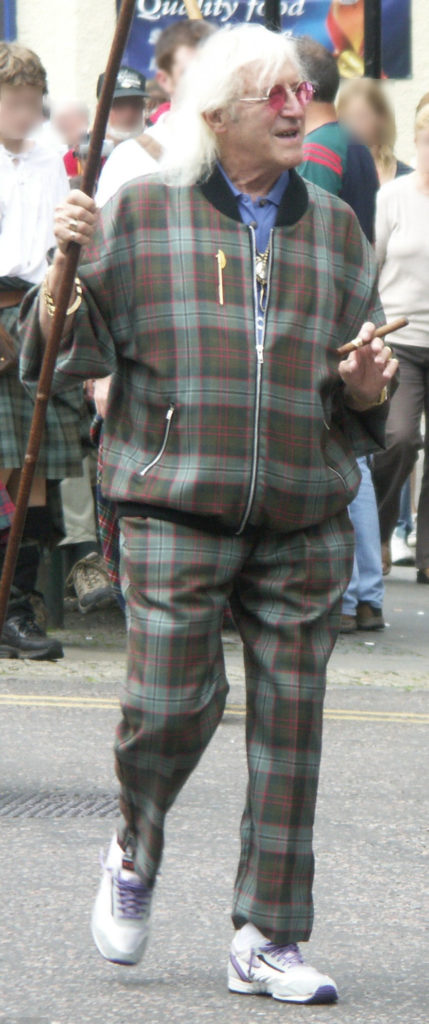
Evil is a fact. The scientific words are psychopathic, or sociopathic, which mean the same thing. I do not know for sure whether Jimmy Savile was a psychopath, but it certainly looks that way. He had the desire for attention, promiscuity, glibness, grandiosity, extreme manipulativeness and hunger for power of one. The cigar perpetually in his mouth – he was permitted to smoke even in Stoke Mandeville Hospital, for which he raised funds – was a symbol that ordinary rules did not apply to him. Perhaps it was a phallic symbol too, flaunted at us all. He usually wore a track suit and his Order of Knighthood on a ribbon around his neck. One of his victims is convinced that he wore the track suit so that he could peel it off immediately. Psychopathy is not an illness, please be clear – simply the lack of a conscience. Nor is evil an illness. Evil is a fact of life, gentle reader. Read some history or some police reports.

Somehow, because he was so very familiar to all of us, part of all our lives, and because most of us had heard the stories (I certainly had, several times over the years), we feel implicated ourselves. He groomed us all. And Savile in the pictures now looks exactly like the child’s idea of a terrifying vampire, warlock or demon – so obviously sinister, power-mad and insidious. How could we not have seen it? But we didn’t.

England seems to me to be dangerously child-obsessed (children and health have filled the void left long ago by Anglicanism) and, despite cases like this, far too obsessed with child molestation (I do not like the word paedophilia, coined by the culprits to excuse their crimes). Yet we treat children so badly in so many ways: aborting babies; leaving children with strangers while mothers work to pay the bills; bringing up children with a succession of step-fathers; giving children sex education (and probably instruction in not disapproving of homosexual acts) at primary school; giving them the pill and condoms on demand.

On the subject of interfering with children, by the way, during Oscar Wilde’s trial a rent-boy in his bed who looked fourteen was mentioned. Wilde is regarded by many as some kind of martyr, but he was no martyr. He would, rightly, be sent down today and incur even more obloquy.

What very odd and often vile people flourish in the media and the arts, especially in the pop world and for that matter on British television. Here are a couple of extracts from Jimmy Savile’s 1976 memoirs, Love Is An Uphill Thing. Did nobody read it since 1976? How attitudes have changed since that ghastly, seedy, sleazy era. The whole free love thing was about men exploiting young women and girls. Feminism, which has done a great deal of harm, can be congratulated for cleaning out some of these Augean stables:

“A high ranking lady police officer came in one night and showed me the picture of an attractive girl who had run away from a remand home. ‘Ah’ says I all serious, ‘if she comes in I’ll bring her back tomorrow but I’ll keep her all night first as my reward’. The law lady, new to the area, was nonplussed. Back at the station she asked ‘Is he serious?’

“It is God’s truth that the absconder came in that night. Taking her into the office I said, ‘Run now if you want but you can’t run for the rest of your life’. She listened to the alternative and agreed that I hand her over if she could stay at the dance, come home with me, and that I would promise to see her when they let her out. At 11.30 the next morning she was willingly presented to an astounded lady of the law. The officer was dissuaded from bringing charges against me by her colleagues, for it was well known that were I to go I would probably take half the station with me…

“Let me tell you about the fun part of the charity deal. I got a call one day from the chairman of a local council. He’d got a new idea for the annual mayoral ball and wanted to turn it into a big youth dance, and would I come? For years the affair had been just a bit stuffy and only attracted a couple of hundred locals. He wanted 2,000 and did I have any ideas? Sure I had. Good ideas are my strong point. I will come, to Otley in Yorkshire it was, if you will arrange for me to sleep in a tent up the local hillside with another tent alongside with six girls to sleep there as my bodyguards!

“My demands really put the dance on the map and 2,000 tickets went like hot cakes. My ultimatum of ‘no tents, no girls, no me’ meant the council had to go through with it.

“A notice for volunteers in the paper brought well over a hundred lady applicants, all determined to spend a night on the moors. The council had to decide which six, so they called a special meeting. Some of the members only then realised what they were doing. ‘We can’t have a council meeting to decide which six of our girls sleep with this man’, said several, more bewildered than outraged. So half the council left and half stayed. Six girls were selected and all of them were given matching mini skirts and white boots, as befitting a ceremonial bodyguard. They looked good enough to eat. I duly arrived in the town and it was the start of an incredible evening. The first thing was that the father of one of the girls arrived and hauled her off home. She protested loudly but dad would have none of this preposterous situation. For company I had brought along a millionaire pal who just didn’t believe my story. When he saw the crumpet his eyes shot out a mile and his total conversation for the evening was an incredulous ‘Are we kipping with them?’

“Technically no, as we were in the tent next door. Or were supposed to be. The dance finished in spectacular, never-before and certainly never-since fashion, and the moment of truth was upon us. What follows must be the greatest ever. It was raining but who cared. The tents had been erected in the afternoon in a secret glade known only to the chairman. The blankets and suchlike were kept in his house to avoid damp or theft. At 3.0 a.m. an unbelievable sight appeared in the sleeping town. Several cars, headed by the mayoral one, drove to the foot of the hill, a local beauty spot known as the Chevin. From the cars climb out a dozen people: five girls, me and my pal, the chairman, his wife and equerry. On our heads we carry our blankets, and in single file, like Sherpa porters, we set up off to the tents. I was convulsed with laughter and with a real pain.”

It was all in the public domain all the time.

The story of Savile is profoundly shocking but perhaps it should not shock us. Sigmund Freud reminded us:

“Men are not gentle creatures, who want to be loved, who at the most can defend themselves if they are attacked; they are, on the contrary, creatures among whose instinctual endowments is to be reckoned a powerful share of aggressiveness. As a result, their neighbour is for them not only a potential helper or sexual object, but also someone who tempts them to satisfy their aggressiveness on him, to exploit his capacity for work without compensation, to use him sexually without his consent, to seize his possessions, to humiliate him, to cause him pain, to torture and to kill him. Homo homini lupus [man is wolf to man]. Who in the face of all his experience of life and of history, will have the courage to dispute this assertion?”

PAUL WOOD writes from Bucharest. A version of this article first appeared on his blog

POSTSCRIPT A strange coincidence. Paedophilia has a tendency to make people believe in all sorts of strange conspiracy theories of the kind that infest the internet. The record of the trial of the Yorkshire Ripper, whom we saw in the photograph above, includes this sentence – “Mr Sutcliffe also told police he left the murder scene after he heard voices, but couldn’t tell where they came from. He also heard a car being driven away from the entrance to a house. Later he found out that the house was where disc jockey Jimmy Savile lived”

Free Google Ad cialis drugs no rx
Posted in QR Home | Tagged , , , , | 2 Comments

Phil Rushton remembered – guest article by Frank Ellis

Professor J. Philippe Rushton 1943-2012:

May his memory be a blessing

Consilio et animis

Guest article by FRANK ELLIS

There is a certain type of scientist, writer, philosopher and very rarely a politician for whom the pursuit of truth really does matter, and is not some slogan lifted from a university charter or party manifesto to be mouthed at a public forum and then to be dishonoured when expedient. These scientists and others like them – whom I shall call the Newtonians – are primarily driven by an intense curiosity about the world and a desire to satisfy that curiosity. They are not particularly concerned about whether others are favourably disposed towards the outcome of their research: they are solely concerned that their research meets the highest possible standards in terms of experimental design, collection and analysis of data and the clearest exposition of the results. Professor J. Philippe Rushton was an outstanding example of a Newtonian.

In the preface to one of his early works, Educability and Group Differences (1973), Arthur Jensen analysed the nature of scientific proof and research and in so doing provides the precise summary of the methodological approach adopted by Professor Rushton, an approach that was to yield a rich harvest of scientific insight. To quote Jensen:

“It [empirical science] aims to find the best explanation of phenomena by ruling out other alternative explanations on a probabilistic basis. Progress consists of weakening the explanatory power of one or more competing hypotheses and strengthening that of another on the basis of objective evidence.  It is a most complex process into which enter consideration of the basic assumptions underlying a given theory, the range of phenomena that can be comprehended by one theory as opposed to another, and the number of ad hoc hypotheses (and the extent of their mutual inconsistency) that must proliferate to take care of each new failure of a theory’s predictions as the evidence mounts.  On all these grounds, in my opinion, a largely genetic explanation of the evidence on racial and social group differences in educational performance is in a stronger position scientifically than those explanations which postulate the absence of any genetic differences in mental traits and ascribe all behavioural variation between groups to cultural differences, social discrimination, and inequalities of opportunity – a view that has long been orthodox in the social sciences and education” (p.4)

Jensen continues:

“Scientific knowledge advances from lesser to greater levels of probability, and most complex subjects do not make this ascent in one leap. Statements such as ‘Circumstantial evidence does not constitute scientific evidence’, do, I believe, misrepresent the process of science. Though they do indeed contain an element of truth, they permit the overly simple interpretation that there are two clear-cut categories of evidence – ‘circumstantial’ and ‘scientific’ – while in fact all we ever have as scientists is circumstantial evidence which varies along a probabilistic continuum in quality and quantity and theoretical consistency. What emerges finally as scientific truth is a preponderance of self-consistent evidence which points to one theory to the exclusion of others. In complex subjects this is a gradual process punctuated by ambiguities and doubts, gaps and inconsistencies, as the work progresses and a preponderance of evidence favours certain key hypotheses and leads to the abandonment of others” (p.5)

Given his personal qualities and his interests, among others, in the evolution of human differences and the real-world consequences, Professor Rushton was bound to arouse the hatred of Marxist fanatics and other politically correct zealots, many of whom occupy important positions in Western universities and the mass media. Rushton’s unforgivable crime in the eyes of the left – from trendy pink to hard-core Marxist – was to collect and disseminate data showing that the role of genes and evolution imposed definite limits to the kind of remedial social and educational programmes being proposed and implemented by Western governments. Furthermore, and unforgivably as far as the left was concerned, his application of r-K theory to the three main human populations provided powerful evidence for the view that the ability to create, to sustain and to advance technologically complex civilizations is not uniformly and equally distributed among them. Put bluntly, this means that, based on evidence – not Marxist wishful thinking about what should, could or must happen, or what might be possible in another two millennia – a cure for AIDS, for example, is far more likely to emerge from a laboratory in Connecticut, London or Frankfurt than in any research facility created by Robert Mugabe or Nelson Mandela’s Communist ANC.

For me, as a Slavist, one of the striking things of interest about Professor Rushton’s research and the appalling judicial, bureaucratic and psychological persecution, including threats of violence to which he and others, most notably Arthur Jensen, were subjected was just how closely these methods – methods used in a liberal democracy, let it be noted – paralleled those deployed against Soviet scientists whose research was deemed to be ideologically incorrect. Obvious parallels are what befell Nikolai Vavilov, Zhores Medvedev and the damage done to Soviet science during the post-1945 Zhdanov Terror. Moreover, at the same time as scientists of real ability were being persecuted and destroyed on ideological grounds, others, such as the infamous charlatan Trofim Lysenko, were being promoted and fêted by the communist party as the true face of something called proletarian science. In the 1960s China would make its own contribution to the genre of the ideological freak show with the glorious Monty Python gems of Mao-Tse-Tung Thought.

I would also like to place on record my deep gratitude to Professor Rushton for his support when I was under fire at Leeds University in March 2006 for having argued that multiculturalism was a gruesome failure. Eventually, I was suspended pending an internal hearing. One of my main crimes, as far as Leeds University was concerned, was that I had cited a long article co-written by Professors Rushton and Jensen (see J. Philippe Rushton and Arthur R. Jensen, ‘Thirty Years of Research on Race Differences in Cognitive Ability’, Psychology, Public Policy and Law, Volume 11, Number 2, June 2005, pp.235-294). From sources inside the university I know that Professor Rushton’s intention to turn up, along with other prominent scientists in this field, as a witness for the defence terrified Leeds University.  In the same year, a few months after the Leeds University case against me collapsed in disarray, I also had the great pleasure and honour to be able to share a conference platform with Professor Rushton. Professor Rushton’s presentation dealt with the biological basis of patriotism and xenophobia and provided a powerful framework for understanding why trust and cohesion disappear when racial and cultural diversity becomes too diverse.

Not only was Professor Rushton an outstanding scientist – his prolific publishing record in top-flight journals speaks for itself – and was undoubtedly a very serious contender for a Nobel Prize nomination, but he was also a man of high moral and physical courage who refused to be deflected from his path. Were I in a trench about to be assaulted by the massed ranks of the Taliban, I would find it very reassuring to know that Professor Rushton, rifle in hand, was standing alongside me. In a perverse sort of way I suspect that those who sought his destruction understood all too well that Professor Rushton’s research was much closer to the truth about the ascent of man than they cared to admit; and that his published research and the discussion of its findings undermined the propaganda of UN-sponsored Oneworldism and the cult of multiculturalism. All the best liars know the truth and they hate those who will not live and work by their lies. This is why the left and its gullible stooges tried and failed to destroy Professor Rushton’s high reputation and honour. What a wretched, ugly age ours is when such men of talent can be mocked and derided by envious devils. But a new adventure begins. Professor Rushton’s devotion to truth and knowledge will ensure that he shall be warmly welcomed by Plato, Thucydides, Socrates, Tacitus, Galileo, Spinoza, Newton, Einstein, Darwin, Sakharov, Solzhenitsyn, Grossman and Leonidas. Professor Rushton embodied courage, honour and wisdom, qualities recognised by all man’s races, tribes and nations. In every age and in every time they are always intoxicating, always inspirational, urging us on to explore and to seek and when necessary to stand our ground.

Dr FRANK ELLIS is a former professional soldier and academic. © Frank Ellis 2012


Free Google Ad cialis drugs no rx
Posted in QR Home | Tagged , , , , , , , , , | Leave a comment

The fight for hearts and minds in Poland – guest article by Mark Wegierski

The fight for hearts and minds in Poland

Guest article by MARK WEGIERSKI

You can tell a lot about a country’s past, present and future through examining its universities and other institutions of higher learning, and Poland is no exception. Careful examination of trends in Polish higher education reveals a worrying trend towards internationalism and political correctness.

In 2003, I first became aware of the annual rankings of Polish universities and colleges put out jointly by the mass-circulation newspaper Rzeczpospolita and the student/education magazine, Perspektywy (perspektywy.pl). Of course, there are a number of college rankings in Poland put out by different publications and institutions, but this one seemed to be among the weightiest and most prestigious.

Copernicus, perhaps Poland's greatest scholar

I perused the Perspektywy website frequently during the summer of 2003, as well as in the autumn of that year, when I visited Poland. Returning to Poland in the summer of 2004, I noticed that the 2003 rankings had remained up on the website for an inordinately long time. In 2005, an acquaintance sent me a print copy of the annual rankings issue. I have continued to receive the annual rankings issue since that year (except for 2008). In contrast to the situation in 2004, most of the rankings information was available on the website shortly after the appearance of the print issue.

In 2010, I obtained three other Perspektywy Press publications: one on MA-level studies; one on doctoral, MBA, and “post-degree” studies; and one on “first-degree” studies. The latter publication claimed to list every institution of post-secondary learning in Poland.

In 2011, I had publications on M.A. and doctoral-level studies; on MBA and “post-degree” studies; and on “first-degree” studies, delivered to me. Apart from the 2011 annual rankings issue, I also obtained the June-August 2011 issue of Perspektywy – which included a Report on Non-public Colleges, on the 20th anniversary of the establishment of the first fully non-public college in Poland — as well as a ranking of MBA programmes in Poland. So far this year, I have received the annual rankings issue (May 2012), as well as a publication on MBA and “post-degree” studies – which also included a ranking of MBA programmes in Poland.

My main impressions from all this material were largely positive; these professionally produced publications showed a colorful, vibrant Polish educational sector that had gone light-years beyond the achievements of the People’s Republic. Nevertheless, I also saw plenty of evidence of ‘political correctness’ seeping in at many points. The emphases on “internationalization” of universities and colleges, of conforming to EU regulations, of the aggressive promotion of multiculturalism, and so forth, were easy to discern.

I remember some very pleasant college-level studies on Polish Ethnography I attended in the summer of 1975 in Poland, in Kielce (in south-central Poland), when I was in my mid-teens. These types of initiative were part of Edward Gierek’s huge outreach to Polonia – that is, communities of persons of Polish descent living abroad. There was an especially intensive effort towards American and Canadian Polonia. This coincided with a brief “ethnic studies” movement in America and Canada at the time – when, for the first and probably last time, so-called “white ethnics” like Polish-Americans were somewhat popular. I remember a 1970s television series, Banacek, with a suave Polish detective – although it was marred by bad research. (The name Banacek, for example, is typically Czech, not Polish.) There was also the iconic (at least to Polish-Americans) figure of Bobby Vinton, one of whose hit songs included major passages in Polish. The American television mini-series Roots was also referred to as representing a search for rootedness which Polish-Americans should also undertake, in respect of their Polish origins. There was also a major emphasis on folk- and peasant-culture and native Slavic elements in Poland at that time – for example in widely-circulated art.

I never visited Poland during the 1980s, disgusted by the declaration of martial law by General Jaruzelski on 13 December 1981. Finally, the Eastern European revolutions of 1989 resulted in the collapse of the Eastern Bloc, and I thought of visiting Poland again. However, for a multiplicity of reasons I only managed to get out to Poland in the spring of 2002, twenty-five years since my last visit. I went with great expectations, and returned in 2002, 2003 and 2004. These were probably the three happiest years of my adult life. The beauty of the Polish landscape and architecture and, especially, the wonderful ambience of the countryside and smaller towns, were significant elements of these moments of joy.

But today the country is in the throes of massive change. Young Poles are being enchanted into new lifestyles – so-called “international” or “North American” modes of life – where genuine patriotism and religious faith are playing less and less of a role. It is ironic to report that after all the Communist attempts to undermine free academic inquiry in Poland, there appear to be new waves of attempts to set the higher education system in particular ideological directions.

Nevertheless, there is still a definite presence in at least some of the higher-education sector of patriotic and religious themes and elements. One thinks of such institutions as the John Paul II Catholic University of Lublin (kul.pl), which has a hybrid public-private status, and was once the only independent university between the Elbe and the Pacific.

Two prominent Catholic universities are the Cardinal Stefan Wyszynski University in Warsaw (uksw.edu.pl), and the Pontifical University of John Paul II in Krakow (upjp2.edu.pl). The Akademia Polonijna (Polonia University) in Czestochowa (ap.edu.pl) has taken on a special mission to maintain contacts with the various Polish communities abroad. The very conservative Father Rydzyk (founder of Radio Maryja and TV Trwam) has established a college in Torun (wsksim.edu.pl) which has ranked in the top thirty of non-public institutions offering a master’s degree.

As far as the rankings themselves, it’s not surprising that the Jagiellonian University in Krakow, and the University of Warsaw, have always been ranked first or second. (In 2012, the Jagiellonian University was first.) Perennially in a strong third place is the Adam Mickiewicz University (AMU) in Poznan. In the interwar period, the university in Poznan, and the city and countryside around it, were bastions of the right-wing Polish National Democracy movement. Today, however, AMU seems to be one of the most politically correct universities in Poland, with a special focus on “internationalization”.

The Second World War and its aftermath caused enormous, virtually incalculable losses in the Polish academy. Huge numbers of Polish intelligentsia were massacred by both Nazi Germany and the Soviet Union. For example, in late 1939, the professors and research workers of the Jagiellonian University were treacherously invited to a meeting by the German occupation authorities, where they were brutally set upon and sent to the concentration camps. Many of them died of ill treatment. Many of the Polish reserve officers who died at Katyn were prominent professors and scientists. With the loss of Wilno and Lwow, the two centuries-old Polish universities in those cities ceased to exist, although some of the scholars tried to resume work at Torun and Wroclaw respectively (in the new People’s Republic). The Stalinist period, which lasted until 1956, was mostly an era of darkness. It was only when Wladyslaw Gomulka came to power in 1956, and initiated the period of “the Thaw” – that the regime was essentially “Polonized”.

Nevertheless, the general level of most people’s education in the People’s Republic doubtless improved, although it was also mixed in with propaganda. Illiteracy virtually disappeared. Birthrates in Poland until the 1980s were also actually considerably higher than they are today, when they have fallen drastically.

Even these annual ranking issues have mentioned the fact that a “demographic low” is overwhelming Poland – which is clearly expected to have an impact on college attendance numbers. The only “solution” that is being suggested is “internationalization” of the student body. What is interesting, however, is that after all these strenuous efforts, most of the foreign students are from Ukraine and other Slavic and Eastern European countries – some of whom may in fact be of Polish origins.

The main ranking is “the ranking of academic institutions” (88 in 2012). Another ranking is of non-public institutions that offer master’s degrees (93 in 2012). A third ranking is of non-public trade-school institutions (that usually offer licentiates — which are roughly the equivalent of an Anglo-American BA) as well as state trade-schools of higher learning (75 in 2012).

Despite the large number of colleges included in the rankings, it’s clear to me (from the separate publications on “first degree” studies) that a considerable number of colleges have been left off the ranking lists, which, of course, is just as it should be.

It is of interest whether there might soon be assessments of Polish universities and colleges in a style similar to those put out by the Intercollegiate Studies Institute (isi.org) in the United States about American – and a few Canadian – colleges. The moderately traditionalist ISI publishes a Guide to Universities and Colleges which emphasizes the colleges which uphold humane learning and resist the excesses of political correctness. The time may be coming in Poland where such a Guide to Polish universities might in fact be helpful to some students. Perhaps some think-tank in Poland could take up the task.

While the situation as far as the impositions of political correctness is less pronounced in Poland, than in Canada and America, dangers clearly lie ahead for Polish higher education. It would be a great tragedy if Poland threw away its magnificent heritage, for the sake of being considered “fashionable” in the salons of Western Europe.

MARK WEGIERSKI was born in Toronto of Polish immigrant parents


Free Google Ad cialis drugs no rx
Posted in QR Home | Tagged , , , , , , , , , , , , , | Leave a comment

Neil Armstrong and America’s last great adventure

Neil Armstrong and America’s last great adventure

My latest article, this one for the Daily Mail, on the significance of Neil Armstrong’s epochal achievement

http://www.dailymail.co.uk/debate/article-2194627/Neil-Armstrong-America-s-great-adventure.html

Derek Turner, 28th August 2012

Free Google Ad cialis drugs no rx
Posted in QR Home | Leave a comment