EpiQR – Summer Lodge Hotel and Restaurant, Evershot

EpiQR

Epicurean expeditions

… with Em Marshall-Luck

Exterior1-1

Summer Lodge Hotel and Restaurant

Evershot

There are few establishments that I have regretting leaving as much as Summer Lodge Hotel and Restaurant, an unassuming and cosy gem tucked away in rural Dorset, which combines a relaxed atmosphere with charming surroundings and the finest of foods.

The hotel is set in Evershot (a traditional village which has the blessing of having been able to cling on to all its amenities including pub, school, church and post office), and is approached by a short drive lined with flowering hydrangeas. The cream buildings that form the hotel, with climbers trained up the walls, have quite a homely feel about them – the fact that they are slightly less than pristine adds an appeal. The initial welcome is very warm, and the reception area itself is more informal and inviting than polished and swanky, most likely better suiting a hotel that has such a laid-back air. We were taken to our room – actually a house at the edge of the gardens with sitting area, filled mainly in our case by a cot (there was also a baby gate at the top of the staircase so this is clearly a child-friendly house); small bedroom; double bedroom; and bathroom. The bathroom was probably the largest room and provided quite a stark contrast to the other rooms. All modern, pristine and smart, with huge monsoon shower, free-standing bath, modern beige-coloured tiling and mirrors everywhere (including on the slopes of the ceiling), the bathroom was let down only by the linoleum fake-tiled floor and the exposed pipework under the sinks. The other rooms on the other hand are not sleek, swish and modern, but old-fashioned, homely and just very slightly worn – a fraying carpet here; an obvious stain there. Fabric wallpaper in either a traditional tweedy green, as in the small sitting area, or dark red, in the bedrooms, lends a further (not unwelcome) antiquated atmosphere. The furniture is dark wood antiques – including a large desk in the bedroom and plenty of drawer and wardrobe space, although the room itself is quite small and there is otherwise not a great deal of space. All that one would expect from a top quality hotel is also present – iron and ironing board, safe, dressing gown, slippers and rather lovely aromatic toiletries (and, unfortunately, televisions – one in the bedroom and one in the sitting area). The overall sensation of being stationed in this house is definitely of being cloistered, but with a slightly exciting sense of a cosy isolation – as if in a treehouse padded with comfortable cushions and duvets far away from any other being.

The dining room also has a rather old-fashioned, refined feel – smart but comfortable and familiar, with its fabric floral and bird-themed wallpaper in beige, red and pinks; pink and red patterned carpet; red chair coverings over dark wood chairs; and ribbons forming a cross on the white tablecloths. The floral theme is continued above one with paintings of individual flowers pasted onto the white ceiling. Giant terracotta horses are mounted on the low wall dividing the two sections of the dining room, and the tables are dressed with silver ornamental pheasants as well as plates bearing a pheasant and the hotel name. There are old paintings of cockerels on one wall; botanical line drawings of fish and fungi on others. Large windows look out over the gently landscaped gardens, carefully tended to provide bursts of colour, and with rather appealing hammocks and swinging benches. Mirrors also abound (rather tarnished), and lighting is provided by wall-mounted pairs of lights with dark red shades set on bronze moulded lozenges. The service is polished – formal and attentive. We were pleased and touched by the great and friendly care provided with regard to young master Tristan, who was carefully buckled in to the high chair by the French waiter and then surrounded by cushions for comfort. The menus were provided and explanations of them offered at the same time.

SL_Restaurant_039_S

There are four different menus that one can choose between – the “surprise”, where one is surprised by six mystery courses; the tasting menu of six courses (accompanied by selected wines if one desires); the à la carte and the set menus. The set menu provides good value, with a choice of one of four dishes per course, while the à la carte offers a choice of around six dishes per course – including a fair amount of fish and seafood as well as a vegetarian option. My starter came from the set menu; the rest of our choices from the à la carte, although we were severely tempted by the tasting menu.

Amuse-bouches appeared shortly – roasted tomato and goats cheese soup, which was rich and creamy if not particularly intensely flavoured; rather moreish cheese straws, hummous on toast, and a delicious feta and pea concoction on a spoon. These were nicely presented, and offered a very pleasant range of different textures and flavours: pleasing. A second amuse-bouche, following soon after and comprising a flavoursome salmon mousse accompanied by celeriac, was a very pleasant surprise.

There was a good choice of bread rolls – granary, onion, goats’ cheese and olive – all fresh, and with two types of butter.

Wines were being chosen for us from the extremely extensive and highly impressive wine list; proper red wine glasses were brought, and we were offered a 2012 Bouchard Finlayson “Galpin Peak” Pinot Noir from the Western Cape, South Africa. It was cherry-coloured and boasted a nose which spoke of a maturity that it had not gained in physical years. Dark notes predominated – ash and oak and a little tar. The taste was also impressive – an initial burst of red and dark berry fruits including red currant and cherry, followed by a lingering aftertaste of the more mineral elements, including ash, tar and leather. The wine was rich and smooth, its taste also indicating the maturity initially gauged by the nose. Quite heavy-bodied for a pinot noir, it was altogether a pleasant, rounded and enjoyable wine.

I then commenced with a ham hock terrine, which was appropriately meaty and full-flavoured – its innate saltiness tempered by the accompanying apricot. My husband’s slow cooked beef rib was exquisite – melting and immensely flavoursome, with a marbling of succulent fat. It was served with fluffy potato balls and a pesto sauce, both of which complemented the beef well.

Main courses were equally good – my Dorset lamb loin was very tender and with a full and characterful taste. It was served with a minced vegetable accompaniment of cabbage, carrot and bacon – although the bacon didn’t add the extra kick I was hoping for. The second lamb element of the dish was a mini shepherd’s pie. With a base of wonderfully intense, melting braised lamb shoulder and a deep and thick topping of immensely creamy potato, this was a dish that worked superbly well; and although the individual items on the plate didn’t look particularly generously-portioned, the whole left one more than replete. Mr Marshall-Luck’s duck was served medium and the tender and rich breast slices shared the plate with crunchy spring rolls and mange tout, with a slightly Chinese-inspired sauce.

A pre-dessert followed the main courses – a crème brulée with very silky, creamy texture, with wineberries. This was a pleasingly different and unusual way to cleanse the palate – a far more delicious and appealing option than the traditional sorbet!

I had felt that the dessert choices were slightly limited in range, and there was nothing particularly intense or chocolate-orientated (the available options were mostly fruity – soufflés and cakes and suchlike) so I opted for the cheese board instead. And, gosh, I was pleased I did so, as I thereby encountered probably the best cheese board I have ever experienced outside of top London restaurants: a choice of 27 cheeses, 26 of which come from south west England, and only the Stilton from outside that area (very impressive). I chose a selection of five goats’ cheeses ranging in flavour from lemony and peppery, through intensely-flavoured and crumbly to grey and gooey. They were served with a traditional choice of accompaniments, from grapes and celery (de-stringed for convenience) through to walnuts and biscuits. So satisfying were these cheeses that I even managed to forgo a dessert wine from their superb list!

Although my husband rather regretted not joining me in the cheese board when he saw the gloriously extensive selection being wheeled over, he nevertheless pronounced his strawberries and cream very good: fresh and an appropriately light ending to a very satisfying meal.

Very good leaf tea and decent filter coffee of a good strength and rather moreish petit fours were taken back to our room, as we had already over-stayed by well over an hour the cut-off time by which children need to have absented themselves from the restaurant. (It should be noted that the staff were very good about this and we never once felt that there was any pressure upon us to leave – probably helped by the fact that Tristan, though then only all of five months, is already used to restaurants and behaves as perfectly as a young gentleman should.)

Breakfast is served in the dining room again, but spills out into the conservatory and even to the wrought-iron tables outside in the garden, surrounded by roses. Two minor slips were made by the staff, firstly by failing to bring hot water to warm up Tristan’s bottle when requested and secondly by omitting the mushrooms with my husband’s sausage, bacon and eggs – yet these were only tiny blemishes in an otherwise gratifying breakfast. A buffet offers a choice of cereals, smoked salmon, fruit salads, fresh juices (including a rather lovely pressed local apple juice), and meats and cheeses (including a spectacular air-dried ham), whilst the menu then presents hot choices, from the traditional English, through smoked fish and Eggs Benedict to sweet options such as pancakes, waffles and even peanut butter and jam French toast with crème fraiche. The food itself was very good – my scrambled eggs were light, fluffy and properly cooked; the bacon was wonderfully flavoursome (one was offered a choice of back or streaky), and the roasted tomatoes were also worthy of particular mention.

Breakfast was followed, by me, for a trip to the spa, while my husband and Tristan enjoyed the verdant gardens. The spa is housed in a glasshouse in the substantial vegetable garden, with its main feature an almost irresistibly inviting swimming pool – elegant and sunny and a deep blue. The spa is on boutique-y side (rather small yet intimate) and staff are friendly and professional, although the treatments rooms feel more clinical than cosy. I tried a hot stone massage which left me feeling deeply relaxed and unknotted.

We were enjoying ourselves so much that we failed to drag ourselves away at the appointed time and just happened to have to stay on for lunch – a leisurely affair taken outside surrounded by flowers. We commenced by admiring the tremendously impressive bar list (with literally hundreds of spirits from all over the world – from Japan through to the Czech Republic, with particularly extensive single malt and cognac lists) in the elegant drawing room , with its duck egg blue theme, large portraits and mirrors, comfortable and slightly faded armchairs and settees and open fireplace. Then we moved outside into the late summer sun for a substantial ham sandwich, and an excellent goats’ cheese salad along with delicious chips and a pint of local cider for me. It was the perfect conclusion to one of the most relaxing stays I’ve had the good fortune to experience for many a year.

Em Marshall-Luck

Posted in QR Home | Tagged , | Leave a comment

Elmore’s Farm

abandoned-farm-building-rural-decay

Elmore’s Farm

By Luke Torrisi

 The dogs’ chorus draws me to the night sky,

I look up to see the crushed quartz underfoot

Mirrored in the clear black. A ring of onlookers

From the heavens, like an ancient audience.

They surround this earthen altar,

Faintly verdant, streaked with rust,

In the blue light of Mani.

Stepping out from the void, as if disturbed,

Are the gnarled joints and split limbs

Of the oldest residents. Wind sculpt effigies.

What backs have they seen broken?

How many men have they measured?

Whose remains do they shade from the merciless

Beat of Sunna’s drum?

Quiet, now so quiet. And in the still crisp air,

I ask myself – did I hear a calling?

Was that a voice whispered from the earth itself?

I stoop to pick up a glinting shard – the tittering earth-crunch

Incessant. My every move – even a pivot – announced.

Sharp yet smooth – catching the slightest of light

It’s small but ancient curves amuse my thumb.

Words not hushed but echoed,

Strong, indeed determined to be heard

Reverberating through the ages, refuse to leave me.

Is my place in this sliver of vastness? Should my hands

Loosen the crumbling bronze? Splinters, spurs, stings-

Not even housemaid’s taunts out here. The rain furrowed

Driveway carries my eye to its craters.

A barely standing shed of discarded wood sighs.

A breeze, a rusted clang. Winged specks are cast like grain.

Will the dendrite watchers of the land oversee my passing?

The cluttered silhouettes of lives past hang from the distant

Roof of an unwalled lean-to, too precious to discard.

Dented iron, pitted brown metal, flaky ash-grey handles.

Dangling remnants – the inheritance I leave?

The dry-wind brushed fences of picket and wire,

Encompass the testing paddocks. A tough bronze skin

That only gives way to wilful heaving of diesel coughing iron.

What mercy will Freyr grant to any channel hewn

Into this parched firmament so divided from the sky’s tears?

The children’s window, tapped by the fluttering flecks.

I feel them sleeping.

In the common good of this soil I shall sow their strength.

In the bright solar spirit of tomorrow these fields,

Shall receive new life, as new life from old springs in me.

To acquiesce is not to lose one’s self, to fail one’s being,

It is to become, to return to one’s essence.

In this ochre and dusty green I have found my polis

A citizen returned from his Odyssey.

The dogs snap me back to the present moment.

Are the sirens calling me to the rocks once more?

Roused from my reverie, the dark shades of doubt

Whisk about me. Loki’s bag of tricks,

Once loosed an enchanting promise of perfection,

So many dance intoxicated to its tune – perhaps me?

My fate lies now in this ghost-soaked land.


Luke Torrisi is a legal practitioner and the host of Carpe Diem, Sydney’s only explicitly Traditionalist radio programme

Posted in QR Home | Tagged , | Leave a comment

Before the deluge

Nicholas II en famille

Nicholas II en famille

Before the deluge

Stuart Millson enjoys a capital account of a world order on the brink

1913: The World before the Great War, Charles Emmerson,

Vintage Books, 2013, paperback, 528 pages, ISBN 978-0-099-57578-8, £9.99

“At Easter 1913 Tsar Nicholas ll gave his wife Alexandra a remarkable present: a golden Fabergé egg. Its exterior was sumptuously decorated with golden double-headed eagles, imperial crowns and eighteen exquisite miniature portraits of the Tsars and Tsarinas of the Romanov dynasty stretching back to Nicholas’ distant forebear Tsar Michael, who had become Russia’s leader exactly 300 years previously. But the egg’s true masterwork was on the inside. There, a globe of blued steel showed the frontiers of Muscovy in 1613, and those of the Russian Empire in 1913… For now, the double-headed eagle could be seen from the Baltic to the Pacific, from the Black Sea to Central Asia, from the borders of China to those of Prussia.”

So begins the chapter entitled: St. Petersburg, Eastern Colossus – just one part of the four great sections devoted to the capitals and cities of the world (and world empires) as they were on the eve of the Great War, in Charles Emmerson’s masterly study, 1913. Although the general unrest in the Balkans prompted thoughtful editorials in The Times and The Economist (the latter certainly believed that its readers had much to look forward to for the year 1914), it is not entirely clear – even, with superpower rivalry between the British and German navies – that the world believed it would soon be at war. The Tsar, with his Fabergé egg and ancient crown, clearly had no premonition of the horror that would await him in 1917; in Germany, the Kaiser and his subjects looked forward to opera galas, openings of technical exhibitions and parades of mediaeval guilds – although in Vienna, where (as one writer observed) “it was forever Sunday”, concern was expressed at the curious number of suicides – over 1,300 in 1912 – an indication perhaps of some sort of spiritual, psychological malaise.

Much discussed by reviewers, and food for thought on many book programmes (the author was even a guest for the week on BBC Radio 3’s Essential Classics), Emmerson’s immensely stimulating, flowing, readable, deeply-instructive portrait of a world on the brink of catastrophe is certainly one of the best of British publishers’ World War One offerings. He is clearly a man of wide interests, and broad tastes (with an excellent knowledge of classical music) often looking beyond what we might consider the purely “academic”. A graduate in Modern History from Oxford University, and now, Senior Research Fellow at Chatham House (the Royal Institute for International Affairs), Charles Emmerson writes as much for “everyman” as for the serious student.

Occasionally, history books and their writers can seem very fixed upon one idea, explaining and charting the course of events, and how things came to be, or could have been averted. For example, Robert K. Massie’s epic Dreadnought – the story of the making of Prussia, and the eventual maritime rivalry between Wilhelmine Germany and the England of Edward Vll and George V – is a lucid explanation of the road to war; a revelation of all the works of the Bismarcks, Tirpitzes, foreign ministries, inner cabals and military strategists who were the architects of what came to pass in 1914 – a brilliant work, and central to one’s understanding of it all.

And yet a clear sense of the colour, thoughts, and day-to-day essence of those times still eludes us to some extent – until now, with the publication of Emmerson’s vivid bringing-to-life of the people and boulevards of Paris; the industries, mass-markets, consumer goods of Berlin and Detroit; the imperial “heart-of-the-world” – the London of H.G. Wells’s Tono-Bungay (the city connected to her dominions of Melbourne and Winnipeg); and also, the surprising riches and wealth of Buenos Aires, very Anglo in those days.

The story of the emerging importance of Washington D.C. (world capital and American political centre, just 50 years on from its Civil War) is also told – yet we are also brought to an understanding of New York (its art-loving leading citizens felt that the “rough edges” of the country needed to be rounded off), with a stop on the West Coast at Los Angeles (a thirst for water and hunger for wealth), and the old New World of Mexico City. But what of the world’s other spheres of influences and races? The author takes us across the Pacific Ocean to Tokyo (the modernising, Westernising Japanese authorities determined, even since 1880, to rebuild their capital as “a grand city of ceremonial avenues”); but then turning his attention to the cities of ancient eras – Jerusalem, Constantinople, Tehran and Peking – the last Emperor locked inside the Forbidden City, whilst Yuan Shikai – half-President, half-Habsburg emperor – was driven through Peking by car. Usually, in our minds, the pre-First World War period is concentrated on happenings in London, Paris, Berlin, St. Peterburg: with Emmerson, you are given a truly global, and local view.

There is also an intriguing ending to the book, a touch of The Time Machine, perhaps…

“ ‘What will be the standing of the British Empire in AD 2013?’, asked the Evening Standard of its London readers in 1913. Certainly, it answered, it would not be an empire held together by force; rather it would be most probably a collection of ‘allied autonomous states under a common head. The Standard speculated that Canada would have a population of 100,000,000 and the federal capital of the Anglo-Saxon Federation would be along the Canadian border with the United States. India might be a self-governing entity by 2013 – but probably not. Britain itself might have become an agricultural country again, its home population having peaked in 1950.’ ”

What was interesting about this prediction of things to come was the absence of any mention of war or global conflict. Even a vaguely diminished Britain (in the mind of the Standard’s writer) would still have a presence in world affairs – the world itself resembling an Anglo-minded order, with countries benevolently encouraged toward a measure of independence. What might provoke some first-class counter-factual history and soul-searching is a projection of a Britain that lost the First World War – George V the unseated monarch, rather than Russia’s Nicholas or Germany’s Wilhelm; England as a type of Weimar Republic (although, of course, such a term would never have existed if Germany had won). But Emmerson deals in facts and reality, and rarely would you find a book so rich in evoking the life of the world, 100 or so years ago.

Stuart Millson is the classical music critic of QR

Posted in QR Home | Tagged , , , , | 4 Comments

The Savonarola of Suburbia

Owen Jones, Labour Party Conference 2016

The Savonarola of Suburbia

Henry Hopwood-Phillips debunks new leftism

Owen Jones, The Establishment: And How They Get Away With It, Allen Lane, London, 2014, pp 368, £16.99

If you’ve heard of him its possible that is you’ve been blocked by him on twitter. Famous for his intolerance of ‘trolling’ (a Stalinist term for criticism) and looking at thirty like a sandblasted baby, in The Establishment, he offers his thoughts on those who rule us. His definition of the puppet-masters is non-existent, however. Indeed, it’s not who they are that is fixed, it’s a reciprocal system: people buy into it so that it buys into them.

The first warning signals go off when Jones notes that anybody to the right of Lenin that challenges the system (so everybody then) are not radicals at all but agents of the establishment, basically feeding and reinforcing false-consciousness (blaming immigrants etc.), a convenient concept historically used by Marxists to deny the real working people, as opposed to the abstract liberator class, any respect whatsoever. And one that Jones must apply to the British people as a whole if he is not to deny research later included in the book, which demonstrates that the British electorate is, for the most part, more socially conservative and economically interventionist than its light-touch socially liberal elite.

As the argument develops, it becomes clear that Jones, despite his quibbles about democracy, identifies far more with the latter than the former. He plays the outcast well but his protestations, like many an emperor assuming the purple, ring hollow. One only has to read the list of names in the acknowledgements (David Blanchflower, Mehdi Hasan, Eric Hobsbawm and Geoffrey Robertson just to give a few) to realise this is not a man who has to worry about ‘earning a crust’. If Jones is not a major component of the establishment, he is certainly a part of it in much the same way Her Majesty’s Opposition is a part of the governance of the realm.

The reality is of course that Jones knows that whistle-blowing within the circus of power is a monetisable role, and one that is, more importantly, not incompatible with being a member – in fact it gives him a patina of rebelliousness – a shroud the establishment loves to cover itself in, like a dog dressed in fox poo, to cover its real scent.

The real question that haunts The Establishment is whether the author actually knows he is producing agitprop or not. Jones went to Oxford and yet he has set up an intellectual playing field so tilted that a mountain goat would dismiss it as impassable. And it’s not as if the tricks employed are either new or clever. Instead, Jones’ criticisms of capitalism display the simplistic and monolithic tendencies he would doubtless abhor anywhere else. One of his favourite techniques is to characterise pro-capitalists as idiots with interests and no principles but then, when it suits him to admit to their ideals, to cast them as ‘true believers, zealots even.’ Likewise, his definition of reactionary hinges on ‘the aim to turn the clock back’ – a risky line of attack for a Marxist. He insists on calling libertarian think tanks ‘outriders’ with a view to making them sound like prejudiced cowboy salesmen. And he knows the BBC is a right-wing mouthpiece because people like Chris Patten work there (which is a little like arguing Peter Mandelson’s company, Global Counsel, must be a communist cell because it has him in it).

Perhaps the most interesting part of the book is the section Jones devotes to the Madsen Pirie mission and how free markets offered answers at a time that the postwar economic consensus had stalled. It is a shame that, again, the language used makes the movement sound like an evil counter-reformation to Jones’ utopia. It is clearly to Jones and his ilk what the Frankfurt School theory is to the right: an expedient explanation as to how the heretics got into the citadel.

There are many valid questions that could have been asked from Jones’ starting-points. He had the opportunity to shine his torch down some of the darkest folds of the Western mind. He could have, for instance, investigated whether capitalism in its advanced stages is compatible with democracy or on a less abstract level, looked into the psychology of the elites. Instead, however, we get a jumble of chapters, with not enough distance or analysis to be considered history but too much of both to be reckoned journalism. Each topic, from policing to media, feels like a hook on which to hang a range of grievances on that lazily imply conspiracy.

The result is a rather sulky, immature text that sags with references to the ‘Murdoch-owned The Times’ – a formulation he repeats throughout like a toddler in love with his own revelation. Any sense of outrage that I felt could have been kindled (as a writer I have many reasons to dislike capitalism, not least my bank balance) is repeatedly dulled by a grasp of the facts that leaves one mistrustful. Readers will be stunned to hear for instance that ‘ideologically conservatives have no doubts about capitalism.’ Red Tories, Ruskinites, Chesterton types, fascists and Roger Scruton would beg to differ.

The real tragedy is that Jones does have a justifiable target. Both the elite and the society it brings about often lack a democratic mandate but this is a phenomenon better covered in Peter Oborne’s The Triumph of the Political Class (2008). Capitalism, too, in the West at least, has become distorted to the point that it barely serves its own narrow ends but again this is a problem better addressed by Daniel Pinto in Capital Wars (2014).

In going for the bigger picture, Jones has fallen between many stools. But worse than this, his glaring omission of the left’s marriage of convenience with capitalism in breaking western society’s norms makes for a lopsided read. Although capitalism and leftism are correctly perceived as historically opposed, both share an interest in eroding Western values. The former because institutions such as child rearing wives, education systems geared to antiquated subjects etc. bore opportunity costs; the latter because it believed that these institutions were oppressive and patriarchal. The result has been that the establishment consensus on truth lies where Foucault (indebted to Nietzsche) left it – essentially as a mere justification of power. For the author to have overlooked this, the most important element in the ideology of the new establishment, is unconscionable.

Henry Hopwood-Phillips works in publishing


Posted in QR Home | Tagged , , , , | Leave a comment

All the President’s Women

Omar J Gonzalez

Omar J Gonzalez

All the President’s Women

Ilana Mercer eviscerates the ladies in the House

The pols and the pundits are cut up about a breach or two in the White House’s formidably protected perimeter. The People should not be. Working for government ought to be one of the most dangerous jobs ever. Thomas Jefferson, a real prince among men, traveled on horseback and wore plain clothes. Not only was he unguarded, his house in Washington was open to all-comers. Never again will a Jefferson occupy the People’s House. But occupational hazard might just get us a better class of parasite.

In any event, the latest security breach at the White House – there have been many under departing Secret Service Director Julia Pierson – saw 42-year-old Omar J. Gonzalez rush across the lawn and into the first family’s residence, where the trespasser was “confronted by a female Secret Service agent, whom he [naturally] overpowered.” No wonder Pierson and the press have circled the wagons. The same lady officer, or another with a similar skill set, had also failed to lock the front door. Disarmed, too, was an alarm meant to alert officers to intruders.

GI Jane

GI Jane

All in all, officers on-duty stood down and an off-duty officer manned up. The canine unit, sick of eating Michelle Obama’s carrots, was busy digging for bones. Gonzalez could have bounded up the stairs to the first family’s living quarters had the off-duty officer not tackled him. He must be male. Were he a woman, or something in-between, he’d be up for a medal of honor.

It’s always good to see gender set-asides and affirmative action – in particular, the delusion that women are just as qualified as men to be soldiers, security guards, firefighters and cops – hurt those who inflict it on non-believers. An A grade for Pierson, like other ciphers in skirts (or pantsuits) promoted by this administration, she is something else – but nothing like stumblebum Marie Harf, the sibilant spokeswoman at the State Department. Watching Miley Cyrus’ hootchy hoopla is less offensive than enduring a press conference with Ms. Harf, where reasonably intelligent, veteran newsmen attempt to engage this schoolmarmish, tart young woman in reasoned repartee.

Marie Harf is intellectually inconsequential, to put it kindly. Only the other day, she claimed, most memorably – and from the safety of her perch – that the outsourcing, in Benghazi, of the safety of American diplomats to the enemy, a local Muslim militia, is justified because it is part of the protocol. The militia hired to protect the compound was late to the scene, possibly complicit in the carnage.

Another exhibit is Lois Lerner. She “is toxic,” conceded Politico, before segueing into a puff piece about this allegedly corrupt kleptocrat. The central conceit of the Politico exposé, “Lerner Breaks Silence,” is that she’s a “complicated figure.” The characterization doesn’t jibe with the main character’s actions and demeanor. Lerner is, in fact, consistently one-dimensional. An example: The Treasury Inspector General determined that Lerner’s IRS division used “inappropriate criteria … to identify tax-exempt applications for review,” and that certain organizations applying for tax-exempt status, singled out for their “policy positions,” were harassed for “significant amounts of information.” Translated from bureaucratese, Lerner used a vast, oppressive apparatus – the Internal Revenue Service – to hound right-leaning non-profit making organisations, threaten their mission and menace their donors.

In particular, this bloodhound instructed her elite Unit (Determinations U) to BOLO (Be On the Look Out) for tea-party or 9/12 patriots. The GI made his recommendations. Lerner fobbed him off. The Office of Audit grumbled that it does not believe the “alternative corrective action” proposed by the Lerner division “fully addresses” the problems: “We do not consider the concerns in this report to be resolved.” Befitting the flat, uncomplicated personality that she is, Lerner showed no commitment to correct her agency’s ways. Post resignation, lippy Lerner remains unrepentant. “I am not sorry for anything I did,” she declared breezily to Politico.

Signally unsuccessful as head of the General Services Administration was Martha Johnson. (Like IRS top officials, she too was in-and-out of the White House.) On YouTube, taxpayers watched Johnson’s jolly bureaucrats having a whale of a time at their expense. Chins, butts and guts wiggling obscenely, the grotesque GSA training conferees stayed in lavish spa resort casinos, as detailed in a damning Office-of-Inspector-General report.

In selecting resorts in which to party, our corpulent public servants conducted “dry runs” and “scouting trips” to destinations like the Ritz-Carlton. Underwritten by taxpayers too were assorted team-building exercises, a bicycle-building project, for one. The OIG lists corrupt contracting practices, a miscellany of employee misconduct, including excessive and impermissible expenditure on luxury suites at Nevada’s M Resort; on 1,000 sushi rolls at $7.00 apiece; and on “$6,325 on commemorative coins ‘rewarding’ all conference participants.”

These are but some of the president’s women – and not even the heavy hitters. Barack Obama’s liberal utopians, Susan Rice, Hillary Clinton and Samantha Power, lied the country into bombing and killing Libyan soldiers who had done nothing to the U.S.

ILANA MERCER is a paleolibertarian writer based in the United States. She pens WND’s longest-standing column, “Return to Reason” and is a Fellow at the Jerusalem Institute for Market Studies. She is a Quarterly Review Contributing Editor. Ilana’s latest book is Into the Cannibal’s Pot: Lessons for America from Post-Apartheid South Africa. Her website is www.IlanaMercer.com. She blogs at www.barelyablog.com

Posted in QR Home | Tagged , , , , , | Leave a comment

Conquest by other means

Derek Turner

Derek Turner

Conquest by other means

Robert Henderson lauds Derek Turner’s latest novel

Sea Changes, Derek Turner, Washington Summit Publishers, Washington, ISBN 978-1-59368-002-2, 2nd edition, 2014

The time is somewhere around the present: the place is England. Thirty-seven bodies wash-up on the North-East coast of England. Some have gunshot wounds. All are would-be illegal immigrants. There is one survivor from the group: Ibrahim, an Iraqi. This is the cue for the politically correct mob to go into action, with everything from the-borders-are-racist campaigners to those who pounce on the evidence of gunshot wounds to suggest that some of the illegal immigrants were murdered by the locals.

The novel has two strands. One is of the survivor Ibrahim. He has had the misfortune to spend all his life in uncertain circumstances, living under the Iraq of Saddam Hussein, both before and after the first Gulf War, then through the perpetual chaos following the defeat of Saddam. We follow him on his tortuous journey from Basra to England, during which we gradually learn more of his story, a history which includes working as an enforcer for a notorious Basra gangster. He moves from Basra in Iraq to Syria, across Turkey, then by boat to Greece where he is interned in a centre of asylum seekers before escaping and travelling across Europe then paying to be smuggled across the North Sea to England.

Once in England he finds that being an illegal immigrant is not all that he had hoped for. This is partly his own fault because he fabricates a story which falsely paints him as someone who resisted Saddam and who suffered for it, a lie which is discovered and which takes the gloss off him as a political weapon to be wielded, but he is also disappointed to find that the promised land does not live up to his expectations. The result is Ibrahim’s withdrawal into the cultural cocoon created by other Iraqis in Britain.

The second strand to the novel is the English response to the bodies on a beach. In the surreal world that is modern England the would-be illegal immigrants are considered not as intruders but at best as people who at best have been murdered by the immigration policies of the government which have forced them to take this route to enter England and at worst as innocent victims slaughtered by the unreconstructed English who inhabit non-Metropolitan England.

The pc fox is set running by a late middle-aged farmer by the name of Dan Gowt who lives in the area where the bodies wash up, in the fictional village of Crisby. He is interviewed on television and expresses views which would have passed without remark when he was young, but which are now considered not merely insensitive but positively racist, remarks such as, “The fact is they shouldn’t have been trying to get into England in the first place. It’s a crime that is. It’s just common sense …”

His words make Gowt a media hate figure. He writes a letter to a newspaper explaining his position and seeks a lawyer to sue for libel on his behalf but all to no avail. His explanations to reporters are twisted out of recognition, his letter is not published and his attempt to find a lawyer results in refusal on the grounds that representing him would taint the firm in question.

Gowt finds that many of the people he knows now shun him. His wife and daughter are treated as guilty by association and his windows are smashed by “antiracist” protestors when he goes outside to tackle them with a shotgun. After the last event he calls the police who not only show little interest in investigating the crime, but tell him that he has brought this on himself and his family. The police go as far as to say that he is lucky he has not been investigated for race hatred and hint that he may still be. They also suggest that his licence for his shotgun may be revoked because he had intended to threaten people with it.

Being labelled as a racist affects Gowt’s wife Hatty and his daughter Clarrie. His wife is simply bewildered; his daughter is patronisingly tolerant as she condemns what her father has said whilst blaming his ideas about immigrants on his age. The shocking thing about all this is the fact that Gowt has not been racist in any meaningful sense. All he has done is object to foreigners settling in his country in large numbers and effectively colonising parts of it.

Turner parades a large cast of characters. This could have lead to confusion but to his credit the author keeps control of them by repeatedly providing snapshots of their intervention in the affair. We may not get to know them intimately but we do not need to because it is their symbolic roles in the tragedy that is modern England which is important.

There are the politicians varying from fearful, driven sheep to true believers in the One World creed: the journalists and commentators who perpetuate the received wisdom and last but not least the multifarious interest groups and individuals who represent immigrant interests: the Black Muslim Mecca Morrow, Wayne Smith of the Christian Democrat Reachout, Atrocities against Civilians Scum, the Rural Racism Task Force, Ben Klein, founder of National Anti-Fascist Foundation (NAFF), Dylan Ekinutu-Jones of the Forum for Racial and Ethnic Equality (FREE), Carole Hassan from the Muslim Alliance and the Guatamalean Action Group. Readers will be able to readily spot their counterparts in real life.

The political parties are also thinly disguised versions of those that exist: the Christian Democrats, the Workers Party and the Fair Play Alliance. All are shown not merely as dishonest but either fanatical or cowardly. There is also a party, the National Union, which plays the indispensable role of a Far Right bogeyman. The party has a single MP who is ostentatiously ostracised by all the other MPs who eventually vote to expel him from the Commons.

Then there are more substantial characters such as Albert Norman, columnist of the Sentinel. Norman is a licensed jester, a man of 70 and a relic of an earlier, less tightly controlled era. He serves a useful purpose for the liberal left establishment because they can point to him and say that all voices are being heard. Norman’s tragedy is that he is ultimately irrelevant because the people who agree with him, the ordinary people of England, are powerless.

Norman is the one character who detects the truth about Ibrahim, as well as resolutely refusing to climb on the English-locals-must-have-killed-immigrants bandwagon. His columns are popular but his youngish editor Doug is getting twitchy about their political direction. He asks Norman to tone down his material because he wants to move the Sentinel to a new location in the press marketplace. Norman resists but eventually gives in and re-writes a piece about Ibrahim. Norman’s readers feel cheated by his new blandness and Norman soon realises that his day is done and retires. Opposed to Norman on the media front is John Leyden of The Examiner. Leyden thinks no further than the next self-promoting headline, regardless of the harm he inflicts on others. Just think of the more obnoxious type of Guardian journalist and you get the picture.

Overall Turner paints a picture of an England which has been defeated, at least for the moment. The multi-cultural propaganda has not been completely successful, however, so that part of the population of England has remained regrettably backward in the eyes of the liberal establishment. But even the part which has not been fully conditioned understands the danger of being identified as racist and either keeps mum, or engages in grovelling apologies when the anti-racist hounds start to run. The claustrophobia created by what has become a totalitarian ideology is nicely caught.

There is a degree of exaggeration for the sake of narrative sharpness in the depiction of the limp calamity of the people of England in thrall to a one-dimensional ideology, but sadly the book is an all too plausible representation of what England is now. This is a country in which people can be imprisoned for expressing anger about mass immigration, where a single inappropriate remark can result in the loss of a job, and where the mainstream media go into Witchfinder-General mode when someone does not slavishly endorse the shibboleth of equality.

Those who have read Jean Raspail’s Camp of the Saints will notice some general similarities of structure as well as intent in Sea Changes. There is no harm in that. Indeed, I found Sea Changes a rather better vehicle for warning about the dangers of mass immigration, because it is far less hysterical and blessedly bereft of the intellectual and cultural pretensions of Raspail’s book.

Sea Changes might almost be treated as a documentary of what has gone wrong with English society. Whatever the future brings it will stand as a primer on a particular and decidedly peculiar period of English life. It is worth reading both as a novel and for the important message that it contains.

Robert Henderson is the Quarterly Review’s film critic. Derek Turner is the former editor of QR

Posted in QR Home | Tagged , , | Leave a comment

Reflections on a broken world

The Katyn Massacre 1940

Reflections on a Broken World

Michael Davis evaluates poet Leo Yankevich’s new collection

Leo Yankevich, Tikkun Olam and Other Poems, 2nd ed. San Francisco, Counter-Currents, 2012.

Tikkun Olam, according to the blurb on the rear cover, is ‘the most important collection to date’ by Leo Yankevich, who is apparently ‘among the greatest living poets in the English-speaking world’. Insofar as a critic should be concerned with blurbs, this is poising the collection for scrutiny: that Mr Yankevich is to be ranked with Paul Muldoon and Geoffrey Hill is somewhat doubtful.

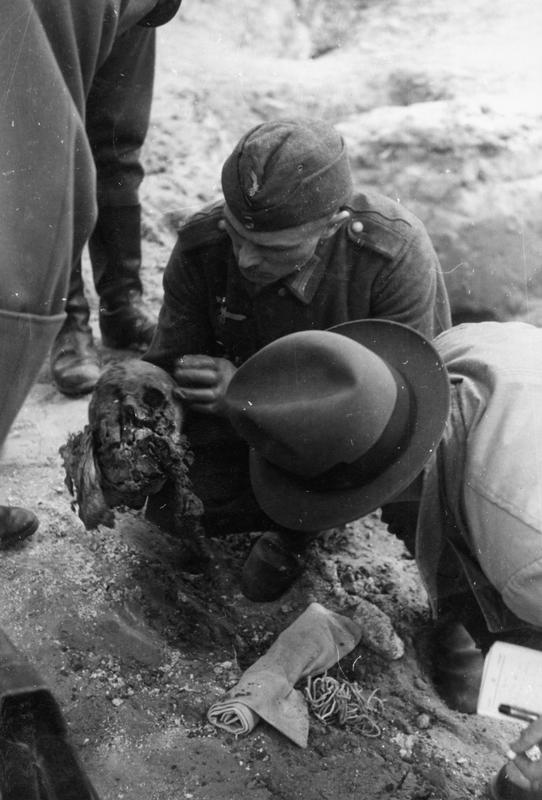
What may well strike the reader of Tikkun Olam more than any single poem is the book’s cover: an Orthodox cross planted in a pile of skulls, set in stark black and white – the slim volume evidently ‘gives [a] voice’ to the innumerable martyrs of Communism. We readily recall Siegfried Sassoon’s ‘On Passing the New Menin Gate’: ‘And here with pride/ “Their name liveth for ever”, the Gateway claims./ Was ever an immolation so belied/ as these intolerably nameless names?’ Whether one poet – one man – can ‘give voice’ to so many dead is perhaps a vain proposition. Anyway, the real question (one would hope) is not how effective Tikkun Olam is as an anti-communist propaganda piece, but rather, what is the quality of Yankevich’s verse?

The one incontestably sublime poem in the collection is ‘Butugychag’ (p.47), written about a Soviet labour camp in Kolyma. It epitomises Yankevich’s gift for understatement. Approaching the abandoned Commandant’s house, he writes,

… we behold the spacious balcony,
the broken panes of the enormous window,
and the sun-bleached, rain-worn wood of the stair,
built for the little man from the Ukraine
who liked to sing in Russian and in Yiddish
because, we are told, he enjoyed the view there

The view is probably of the tin mine, where 380,000 prisoners died over the course of ten years. But even when unaware of those details, we know this was certainly an evil place, and the poet’s casual, rather attractive description of the old house adds to the horror of the scene. Yankevich’s mastery of the language is unquestioned in such shocking, blasé ruminations on Soviet brutality.

But at other times, his method of understating falls disappointingly flat. For instance, the ‘Sarajevo Sonnet’ (p.43) runs,

…in someone’s rib cage,
in a sunlit temple without a steeple,
two tiny beetles in the place of people,
(their love too pure to ever turn into rage,
too tried and true to ever fail or falter), …

I’m more struck by the fact that Yankevich goes out of his way to say that the temple lacks a steeple. A Jewish or Pagan temple doesn’t, in my mind, typically bear a steeple, which causes some dissonance with the poetic imagination. One hazards to guess Yankevich used ‘temple’ instead of the more acceptable ‘church’ or ‘cathedral’ to accommodate his metrical scheme of eleven syllables per line, but that shouldn’t excuse the forced image. On the other hand, if some primitive Slavic religion used steeples in their temple architecture, I don’t think it is reasonable for a poet to expect his reader to be aware of the fact. Likewise, the idea of beetles having an intimate love affair is underdeveloped. If Yankevich hopes for a Romantic-Kafkaesque blend of metaphors, two lines won’t suffice to this end. At least in this instance, it can’t be said that less is more.

The most interesting piece in the book is ‘Lorca’s Death’ (p.14). Franco’s army executed Lorca for being a communist, a homosexual, or both – though it is now generally believed that he wasn’t affiliated with the Popular Front at all. If I am not mistaken, Yankevich is drawing attention here to some of the more ambiguous ‘martyrs of communism’. The Spanish Civil War was provoked partly because the radical vanguard leading the Spanish Republic aligned itself with the Soviet Union, much to the distress of conservative and moderately leftist Spaniards. It’s a fascinating idea for a poem, and certainly the closest Yankevich comes to ‘speaking for’ the victims of Stalinism. And, of course, we have a fine example of understatement: after surveying the graves of dead nuns and altar boys, the poet’s companion says (of Lorca): ‘For this we fired two shots/ into the faggot’s rear’. The poet seems to suggest that the circumstances of the War drove Spain’s greatest artist to a tragically inconsequential death. There is a compassion and conflict in the poem that marks it as a fine example of wartime elegy.

ca. 1937, Spain — A group of Republican soldiers talk to journalists during the Spanish Civil War, including the American novelist Ernest Hemingway (seen with his back to the camera), who served as a war correspondant. — Image by © Hulton-Deutsch Collection/CORBIS

We shouldn’t neglect the poems on events Yankevich experienced first-hand. Much of the collection, unfortunately, repeats many of the clichés about the hardships endured by prisoners, victims, and combatants in 20th century war – History Channel details given with a beatified tone. For instance, ‘Veteran’s Hospital’ (p.27):

Some nights are never-ending hells
for these old veterans in our care.
We do not hand out pills, but shells,
as out of battlefields they stare…

Most of that has been done before, and done better by the poets who lived through the experience. But that lived experience works to Yankevich’s advantage when we move closer to the 21st century. There’s a brilliant, fresh verse titled ‘Spreading Democracy: Serbia 1999’ (p.65). The closing stanzas run,

…he cannot tell
which was whose face.
High over hell,
his stealth’s black wings
still mock the night,
and fallen things
in morning light

And in ‘On the Lynching of Saddam Hussein’ (p.74),

You died with tubes in your mouth,
gasping for one more breath of air,
your fragile fist clenched in fear
before almighty Allah
No mercenary’s noose was placed
around your neck, as round Saddam’s.
You did not chasten craven tormentors
falling through the gallows

The task of writing about modern warfare is a daunting one for every new generation of poets. The psychological repercussions of war in 1999 are quite different from those in 1914, when the great revolution in war poetry began. If Yankevich is indeed among the great poets of our age, this is precisely why. He does this job admirably.

Michael Davis is Poetry Editor of Quarterly Review

Posted in QR Home | Tagged , , , , | 1 Comment

ENDNOTES, October 2014

Valerie Tyron

Valerie Tryon

ENDNOTES, October 2014

In this edition: Rachmaninov, Dohnányi and Strauss from Somm Records * Summer music from Judith Bailey * Sacred choral music from St. John’s College, Cambridge

Although Endnotes has avoided “Discs of the month” and other sales-like descriptions, I feel that the latest recording to arrive from Somm Records deserves some sort of special recognition. Pianist, Valerie Tryon (now aged 80, but as a child, one of the youngest students ever to be admitted to the Royal Academy of Music) appears on a CD devoted to three significant, but less frequently performed works: the Piano Concerto No. 1 (1890-1, revised 1917) by Rachmaninov; Richard Strauss’s Burleske for Piano and Orchestra (1890); and the dramatic, melodious, inventive and thoroughly enjoyable Variations on a Nursery Song (1914) by Hungarian composer, Ernst von Dohnányi (1897-1960).

Accompanied by the Royal Philharmonic Orchestra, conducted by Jac van Steen (a Dutch maestro often seen at the Proms, particularly with the BBC National Orchestra of Wales), Valerie Tryon gives a performance of dramatic drive and colour that is never-too-hard, and of romantic, delicate, mood-matching virtuosity that is never-too-overstated. Her tone, her approach to every note, and her clear feeling for this array of late-romantic music seems to be complemented in every way by an RPO sound which seems to “grow” from and around her: the orchestra exuding a warm, euphonious, poised and elegant tone – a weight and a sense of distance and echo, but with clear, sharp brass, and splendid percussion contributions, including a pleasing swish to cymbal clashes, blending into the effortless orchestral wash of colour.

We are familiar, perhaps over-familiar, with Rachmaninov’s Second Piano Concerto, although I much prefer the longer, more thoughtful, more saga-like Third. Rarely does the First Concerto enjoy an outing, and perhaps it is the slightly less “fluent” or sure-footed – less gradually-unfolding nature of the work that accounts for this. The opening, for example, is abrupt, and the piece never quite seems to settle – as is witnessed by the jumpy and nervous, but nevertheless bold announcement of the final movement theme. And yet there are exciting passages and great moments for a great soloist, such as Valerie Tryon, to seize upon: dynamic and attention-grabbing sequences, with all the intensity, passion and also “Russian gloom” that informs all of Rachmaninov’s works.

Rachmaninov's hands

Rachmaninov’s hands

The Richard Strauss Burleske is also played well, but I must confess to not liking the work as much as anything else on the disc. As Richard Strauss goes, this 20-minute piece does not seem to be particularly characteristic of the composer (we think of his blood-curdling Salome, or the opulent, rich, more 20th-century symphonic writing): in fact, the Burleske could almost be by Liszt, whose inspiration and example were never far away from the younger Strauss. But for sheer individual quality and wit, it is the Dohnányi that crowns Valerie Tryon’s Somm collection: the composer’s Introduzione, statement-of-theme and then eleven variations on the nursery rhyme tune, which we all know and recognise as “Twinkle, twinkle, little star”. At first, the Maestoso opening – as grand as anything in serious, romantic music – makes us believe that we are in the company of a thundering old-school Wagnerian, fond of portentous gestures. And then, a drum stroke (which shakes you), and cymbal clash that crashes out of your speakers and slices into your ears, leads into the soft-in-heart, nostalgic old nursery tune. This moment, with its huge and unexpected contrast… I defy you not to smile! From then on, an absorbing and intriguing virtuoso development and flight of imagination by Dohnányi takes the tune into all manner of allegro or waltz-like manifestations, which recall the styles of other composers. Listen especially to the third variation – marked L’istesso tempo – and you will hear a theme which brings to mind Brahms’s Second Piano Concerto, a charming, beautiful and memorable part. Recorded at the Henry Wood Hall in the July of last year (Recording Producer, Siva Oke, and Engineer, Tony Wass), Somm deserves absolutely full marks for an inspired production.

The Cornish-born composer and former Royal Academy of Music student, Judith Bailey (b. 1941), is undoubtedly one of contemporary music’s lesser-known voices. But I believe that this might well change, as a result of a brand-new CD from EM Records, the recording arm of the English Music Festival. Entitled ‘Havas’ (a native old-Cornish term for a period of summer), the disc allows us to sample a number of landscape scenes, with powerful, historical and mystical associations – Lanyon Quoit (a Neolithic site), The Merry Maidens (a stone circle in the Cornish countryside), and an area of coastal water – Gwavas – said to have healing powers. The orchestral writing is compelling and attractive – and something of the spirit of Bax’s Tintagel finds its way into the score, although I was also reminded of the music of William Alwyn and of his composer-wife, Doreen Carwithen. Judith Bailey’s 17-minute-long Concerto for Orchestra also appears, alongside a sequence of four works by George Lloyd (1913-98) – a fellow Cornish composer, who has long been viewed as a standard-bearer (or a symbol) of the neglected post-war romantic tradition; that time when Stockhausen and the Second Viennese School almost completely eclipsed all those who tried to maintain tonality and British romanticism.

Gull Rock, Cornwall

Gull Rock, Cornwall

The orchestra used for the recording is the very fine Bath Philharmonia (an ensemble quite new to me) who play in firm, full-bloom, professional style, in Lloyd’s Prelude to Act 1 of The Serf, In Memoriam, Le Pont du Gard (a symphonic impression of the ancient French aqueduct), and the nostalgic, HMS Trinidad March (a tribute to the composer’s old shipmates from World War ll – a work that certainly evokes a sense of past endeavours and the recalling of those times by old comrades). Jason Thornton, who has led the orchestra at many venues throughout the West and South-West of England, conducts the performance.

Finally, Chandos scales the heights of the English choral and organ-music tradition, with twelve works by Thomas Tomkins (1572-1656) – organist and choirmaster of Worcester Cathedral, whose life there, and world of music, faced destruction when Cromwell’s forces occupied the city during the Civil War, and (as Jeremy Summerly’s booklet note observes) “ripped the organ out of the cathedral”. A convinced Royalist, Tomkins clearly saw a connection between the kingdom of God, and the kingdom to which he gave his emotional and political allegiance. A Jubilate (for ten-part choir with organ), a Te Deum (for the same forces) and Magnificat (five-part choir) demonstrate the exceptional vocal training and tradition of the Choir of St. John’s College, Cambridge (Director of Music, Andrew Nethsingha). The anthem, When David heard that Absalom was Slain, conveys a profound sense of mourning, as does the introspective organ piece, A Sad Pavan for These Distracted Times – a lonely lament for the imperilled kingdom, dismantled state and demise of a King. The Editor will forgive me, and I hope, indulge me – if I tell readers that this edition of Endnotes was written on the day of the Scottish referendum.

Stuart Millson is the classical music critic of Quarterly Review

Posted in QR Home | Tagged , , , , , , | Leave a comment

Dinesh D’Souza’s American Error

Mount Carmel Fire

Dinesh D’Souza’s American Error

by Ilana Mercer

There are certainly good things about Dinesh D’Souza’s film America: Imagine a World Without Her, as sharp-eyed critics like Jack Kerwick have observed. But those don’t matter much for this reason: the central question asked and answered by the film maker is premised on an epic error of logic.

But first, in honor of Bad Eagle a friend and a great American, it is imperative to counter D’Souza’s claim about the fate of the Amerindians at the hands of the U.S. government. The late Bad Eagle, aka David Yeagley, was the namesake and great-great-grandson of Comanche leader Bad Eagle.

According to D’Souza, Native Americans were decimated not by genocide or ethnocide, but by diseases brought from Europe by the white man. Not entirely true. In his magisterial History of the American People, historian Paul Johnson, generally a supporter of America, details the “destruction of the Indians” by Andrew Jackson. Continue reading

Posted in QR Home | Tagged , , , , | Leave a comment

Dworkin’s Dangerous Idea

Dworkin on After Dark, 1988

Dworkin’s Dangerous Idea

Steve Moxon deconstructs identity politics

‘Identity politics’ (manifested most obviously as political correctness) is predicated on the realisation that the workers are never going to bring about a Marxist revolution. That Marxist theory did not work in practice was already apparent by the late 1920s in the absence of any European imitation of the Russian Revolution. The cognitive-dissonance that this produced for the Marxist intelligentsia grew over time obliging further ratcheting up of the ideology, which more and more relied on asserting internal consistency to the exclusion of contact with reality. Neither the falsity of the ideology nor gullibility for believing it was admitted but instead face was saved by blaming others. The fall guys here were those perceived to have let the side down: to wit, the workers.

As is well documented, the initial attempts to explain the failure by the proletariat to act according to Marx’s predictions were made by academics working in the late 1920s onwards in Frankfurt and then New York. They devised an aetiology in terms of Freud’s notion of repression, then in vogue, which remained central to all forms of neo-Marxism, including the ‘post-structuralists’ and not least Foucault. Taking firm hold across academia, this theory trickled down via the graduate professions to society at large.

The central theory was a development of the anti-family rhetoric of nineteenth century socialists further radicalised by Marx and particularly Engels, to conceptualise the family not as the evolutionary phenomenon that it clearly is but as an aberration resulting, it was imagined, from capitalism somehow repressing the workers, to the extent that supposedly they become psychologically dysfunctional. Marxism was thus supplemented by a theory of culturally based personal relations, with the aim of eliminating what were seen as the mere roles of mother/father, so that, it was envisaged, all distinction between masculinity and femininity would eventually disappear, taking with it the ‘patriarchy’ supposedly the foundation of capitalism. As the head of the family, the man (husband/father) was held to be the incarnation of oppression from which the woman (wife/mother) needed to be liberated. So it was that the workers, formerly considered the agents of change and the group destined to be liberated, were replaced in Marxian imagination by women, heralding the feminist Marxism we see today. A related notion, false consciousness, is that the populace is brainwashed by capitalists. These notions of repression and false consciousness constituted a complete volte-face: a transition from eulogising to blaming the workers but without holding the workers directly culpable.

Here, then, we have the core of what became identity politics, though it was not known as such until the early 1970s; before which there was no multiplicity of ‘identities’ labelled as disadvantaged/oppressed. As with any fervent ideology, a hallmark of the political-Left is interpreting anything and everything in its own terms. The decisive development was the co-option by neo-Marxist theory of a movement with which it originally had no connection at all: the USA Civil Rights Movement, in the wake of King’s assassination in 1968. The large-scale rioting in 1965 and 1966 that preceded its co-option looked like the promised Marxist revolution and was just the practical application the theory sought. Moreover, the protagonists (black Americans) were eminently separable from the now despised workers per se; presentable as a new group from outside of the former fray of boss versus worker.

This accident of history served to add black to woman as the new oppressed without any intellectual shift: it was made on a gut level; implicit rather than explicit cognition. The worker in effect was retrospectively stereotyped as both man and white. With the inverse of this stereotype of white being not just black American but black – that is, ethnic-minority generically; then so it was that the new agents of social change were extended from women to also include all ethnic minorities. This notwithstanding the fact that many ethnic groups are far from disadvantaged, let alone oppressed – some (e.g. Chinese, Indian) actually out-performing whites in all key measures.

Given the template of this successful co-option, then the next big cause was ripe: the 1969 gay Stonewall riots, again prompting in effect a retrospective stereotyping of the worker by contrast as heterosexual. Just as black American was broadened generically to ethnic minority, so gay was broadened to homosexual – to also include lesbians, despite the fact that unlike male homosexuals, lesbians have only been persecuted in rare historical instances, notably by the Nazis.

In the bringing together of all these disparate strands of sex, race and sexual orientation, there was a restoration of the yearned-for lost sense of universalism of the political-Left ethos, now made possible by demonising the workers. From then on, anyone belonging to a group according to any of the inversions of one or more of the now supposed hallmarks of the worker as male/white/heterosexual was deemed automatically to belong to the newly identified agents of social change, and deserving of unquestioned protection.

The ensuing gravy train spawned further extensions, again in effect by inverting the worker stereotype: the disabled and the elderly, trans-sexuals, and even the obese – but on such dubious grounds as to reveal further the incoherent basis of identity politics other than as a protracted agitation against the workers. For the disabled and the elderly do not experience discrimination: they simply have a hard life that no form of intervention can reverse or significantly ameliorate. The only sense that can be made of their inclusion within identity politics is that they are non-workers. The obese constitute another obviously unjustifiable category within ‘identity politics’, in that being fat is not fixed and irreversible, hardly constituting an inescapable condition. Fat studies arose as a subsidiary of women’s studies. And trans-sexuals, albeit rare and although biologically speaking the term is a misnomer, were duly included in order to challenge the male-female dichotomy.

The several abstracted faux groups, in entering political centre stage displaced class, because with the workers now considered collectively persona non grata, then being working class was no longer recognised as a disadvantage.

In the absence of any external validity to identity politics, a novel intellectual underpinning was needed, which was supplied by postmodernism. An attempt to obscure the sophistry of identity politics, at root postmodernism deems any and every criticism of identity politics inadmissible. With any text held to have no significant surface (ostensible) meaning, the actual meaning supposedly is situated in local context. This is the identity politics contention that given that everything concerns power relations then all depends on someone’s vantage point in respect of these relations. This group narrative is considered to be trapped in the sub-text, rendering it decipherable only through the special technique of deconstruction.

The obviously fatal flaw in this reasoning is that the texts of the postmodernists are uniquely deemed to be legitimately understood according to their surface meaning. The irony is that if postmodernist principles were applied to postmodernism itself, then the theory would become apparent as being entirely based in the very principles of power relations it purports to reveal.

Given that Marxian ideological belief has always been in terms of a power struggle between one bloc and another within society – formerly the bourgeoisie versus the proletariat – such that the powerless are destined to overthrow the powerful; then it was not a large adjustment to re-envision the underlying dynamic of society as conflict between a more abstract but still supposedly dominant group of men as the group with power, against the group without it. And just as in classical Marxist theory, a powerless group somehow is set to eventually displace a powerful group. This fallacious and otiose prophecy is evidently the key imperative driving today’s identity politics.

STEVE MOXON is an independent researcher and social scientist, with a particular interest in sex differences. He is the author of The Woman Racket

See his website at stevemoxon.co.uk 

Posted in QR Home | Tagged , , , , , , | Leave a comment