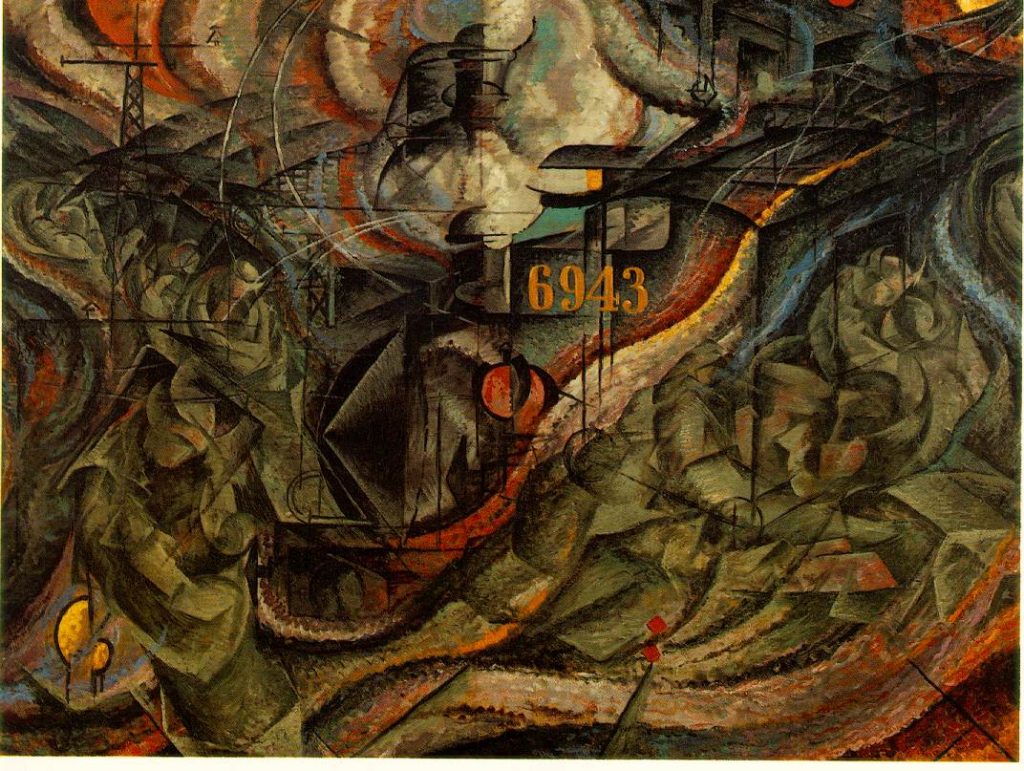
Umberto Boccioni, States of Mind, The Farewell
The Dilemma of Hypermodernity, part one
Mark Wegierski espies an escape route for humanity
An earlier, academic version of this essay has appeared in “This World: Religion and Public Life” (Culture and Consumption) no. 31 (2000) (New Brunswick, USA and London, UK: Transaction Publishers), pp. 29-45. This is the 15th anniversary of the appearance of the academic version of the essay – which had also appeared in various, different, non-academic iterations in the 1990s, including in Polish translation.
One of the most significant, yet often cursorily examined phenomena of modern society is the increasing pace of technological change. The amount of theoretical scientific knowledge (that is, in the “hard” sciences) is growing exponentially, as is the number of devices etc that are being produced, as a result of the growth and practical application of such scientific theory. Ultimately, these technological processes are fuelled by the market-economies of (primarily) North America, Western Europe, and now, the Pacific Rim countries. Yet amongst all this frenzied growth and creative entrepreneurship, to what ultimate end is all this unbridled expansion is taking us?
Social theorists such as George Parkin Grant, David Ehrenfeld, Christopher Lasch, and Jacques Ellul — inspired by figures like Simone Weil and Martin Heidegger — have described an emergent “vicious cycle”, where all the problems caused by modern technology can only be solved by the application of further technologies — which engender newer, greater problems, for which new technological solutions have to be found — and so on. It seems impossible to think that this process can go on forever — at some point, the crises engendered by technology (a total saturation of the environment with pollutants of various sorts, for example), will confront humanity. And the suggestion that recombinant DNA technology could be used to “adjust” humans to live in heavily polluted or radiated environments is simply nightmarish. Our world is one in which genes of mice are spliced with those of carrots, mice with genetically human blood coursing through their bodies. Biotechnology companies develop new, unique life forms, such as the aforementioned mice, over which they then exercise exclusive proprietary control. Recently, there was the story that scientists in Britain had developed transgenic pigs, whose organs are to be used in humans. There were also reports in the media that a research laboratory in Basel, Switzerland, had produced genetically altered flies with fly eye structures in 14 different places in their bodies, where they never naturally occur. These various tendencies evidently represent only the beginning of the infinite manipulation of human and physical nature through technology, against which — along with other thinkers — Aldous Huxley warned, in his finely crafted dystopia Brave New World.
Apart from the so-called purely physical effects, e.g., toxic waste dumps, poisoned air, skin cancer from ozone depletion, shrinking forests and green spaces, as well as dwindling or extinct natural species — which are bad enough in themselves and now obvious to almost everyone — there are also the enormous social effects and costs of total technologization, for example, massive overpopulation, especially in often overburdened urban areas — which are enfolding more quickly than the ultimate dangers of pollution and biological manipulation.
The trend through all of history has certainly been towards increasing urbanization and technologization in urban areas, but in premodern societies, there were definite natural checks on such growth. The contemporary problem of excessive urban growth affects all parts of the Earth — the Western world, the ex-Eastern bloc, East Asia, and the vast South of the planet. What, for example, can be done today to prevent BosNYWash (Boston – New York – Washington) from swallowing up the entire North-Eastern seaboard of the United States? What is to prevent Mexico City from having a population of 30 million in ten years or so? The traditional society — like all societies of the South of the planet — continues to be dislocated by overpopulation arising from cheap, band-aid infusions of Western technology — resulting in greater misery, disease, starvation, political corruption, and environmental degradation for virtually everyone afterwards. The faster the growth rates of the American and world-economies, the more enticing the images Western advertising firms offer the desperate poor in the South and ex-Eastern Bloc, and the greater the needs of the transnational corporations (TNC’s) for cheap labour pools, the faster such behemoth-cities will grow, in every part of the world. (Only East Asia shows some evidence of being able to cope with burgeoning urban populations — as typified by the authoritarian but very environment-conscious Singapore.) In terms of human social existence, the contemporary urban environment virtually always turns out to be one where, as in New York, the social bonds and ties of “small-town” family, community, and country are largely lost, to be replaced by the “razor’s-edge” excitement of the big city.
In their hey-day from around the 1880’s to the late 1960’s, America’s big cities — New York, Chicago, Boston, Detroit, etc., had evolved a unique, fairly liveable, many cornered community structure that somehow dealt, however imperfectly, with the problems of living in these urban agglomerations. This system was partially described in Jane Jacobs’ The Death and Life of Great American Cities. Prominent in these structures were civic politicians and “ward-heelers”; the big factory-owners; leading small businessmen; the municipal police; the Catholic Church, which represented large numbers of non-Protestant white ethnics; the virile, heavy-industry, blue-collar labour unions; the editors and reporters of the big independent papers of the city; as well as traditionally-situated organized-crime groups and youth-gangs, both exceedingly mild in their social consequences by today’s standards. This kind of urban milieu can be seen in any number of movies (especially older movies) set in this period.
However, in the following decades, as the commodity, advertising, and “instant gratification” culture increased its grip on society, there came an explosion and expansion of various vicious groups, for example, greedy developers, ruthless advertisers, the parvenu rich, drug-pushers, etc., that refused to play within the rules of the big-city, resulting in the near-complete breakdown of the urban social consensus, and the turning of large sections of downtown American cities into hell-zones. Although the city vs. country distinction has existed throughout much of history, nowhere has it been thrown into such sharp relief as in America.
There are in fact two, distinct America’s: the big cities — dynamic, pulsating, heterogenous, and cosmopolitan; and the heartland — simple, quiet, and home-spun. There is, however, a serious imbalance of power, ideology, and resource-consumption between the urban centres and the rural periphery, which parallels, it could be argued, the relations between the Western world and the South of the planet, as described in node-periphery theory. The big cities siphon off the people and resources of the heartland to create an environment which, while certainly exciting, is brazen in its artificiality — gleaming corporate skyscrapers, condo-towers, and ugly housing complexes rising out of the detritus created by the death of old neighbourhoods and old town-centres — possibly the last places of civilized life in the modern city (from the Latin civis, suggesting the public-spirited “citizen”) — which had continued to exist in the context of the older big-city structure.
And then there are the suburbs, neither city nor country — the developers’ creation, “Ye Olde Victorian Homes” — thrown together at impossible densities, produced with all the care and craftsmanship of an assembly-line, and centred on those vital modern institutions — the shopping-mall and the public high school — though one sometimes wonders which of these performs the greater “educative” function. In the suburbs, one finds neither the “cutting-edge” excitement of the inner-city, nor any real sense of community and country values. Indeed, the suburbs continually devour the real countryside, forming a sterile “inter-zone” between the various urban conglomerations.
And what now increasingly emerges is the West Edmonton Mall scenario — which is today the world’s largest mall — human beings living in huge, totally manipulated environments, cut off from earth and sky and sea and wind. Life in such an environment would eventually come to resemble the existence portrayed in such movies as Logan’s Run or Outland — meaningless, monotonous work relieved only by perverse, polymorphous ecstasy. In fact, as the efficiency of control techniques increased, one could reward workers with less and less, until they literally became happily mindless drudges, as Jacques Ellul warns.
Through the instrumentalities of the technological media, and a co-opted heterogenous lumpenproletariat — which is always ready to be deployed against the legitimate claims of the heartland — an extraordinarily narrow, socially liberal, economically capitalist, hyper-urban elite dominates North American society. The social liberalism of this elite is nothing more than a justification for ever greater hypertrophic consumption for the entire population; as well as for bringing into existence innumerable pseudo-countercultural “tribes” based almost exclusively on expensive commodity fetishes (as described by Guillaume Faye in La Nouvelle Société de Consommation).
The webs of urban-and-technology-based domination, control, and influence by media reach deep into the heartland — creating through various technological means and simulacra, a whole “other” dimension, an electronic environment, which has never hitherto existed in humanity’s history. Along with the commodity-structure they support, the media constitute the major part of the interlocking grid of what French social theorist Jean Baudrillard terms North American “hyperreality”.
The media, far from being liberating, hyper-centralize power — for those who have access to them — hence the absurd income-figures of persons who, in earlier societies, might well have been petty street-hawkers or street-singers. The electronic and other media dominate the sociophysical environment to an extent never before achievable or imaginable. As Aldous Huxley wrote, “one thousand repetitions make one truth”. And one picture (i.e., riveting visual image) is worth a thousand words!
The media do not use “inefficient” coercive methods but rather all-pervasive normative control of virtually all societal vocabularies and imageries. In Nineteen Eighty-Four, Orwell had asserted that “Newspeak is Ingsoc, and Ingsoc is Newspeak”, i.e., that the key to capturing people’s minds was to monopolize the various “languages” current in society. The apparatus of torture and repression drawn in the book was ultimately secondary. Aldous Huxley’s society — to which our own world seems somewhat closer than to Orwell’s vision — can therefore be seen as a “refined” version of Orwell’s police state.
Understanding the nature of semantic and symbolic control allows one to see North American society as both generally non-coercive and normatively totalitarian. The mass media and its complementary mass marketing, mass education, and state therapeutic systems construct the sociophysical environment in which we all live, and the societal norms most of us accept.
What does the promised land of hyperurban North America really amount to? At the upper-most levels of Manhattan, or in its cavernous underground play-pens, corporate controllers, cynical media figures, “successful businessmen” (i.e. drug pushers), highly placed government apparatchiks, and decadent pseudo dissidents, pseudo artists, and pseudo intellectuals commingle freely, indulging in their variegated pleasures — bought at the expense of exploiting and corrupting the heartland, and the decencies of the human heart. The scene is similar in L.A. and its environs, Chicago, San Francisco, Washington D.C., Atlanta, Miami, Detroit…with minor local variations and colour.
All in all, this is reminiscent of the world portrayed in such ambiguous or culturally challenging films as Paddy Chayefsky’s Network (where the desperate prophet-figure, after a brave fight, concludes, “we’re all androids now”); Wall Street (“greed is good!!”); Tim Burton’s new Batman epics; Ridley Scott’s Blade Runner; Verhoeven’s RoboCop; Terry Gilliam’s Brazil; Robert Longo’s Johnny Mnemonic (based on William Gibson’s short story); Judge Dredd; or the Max Headroom TV series — most of which depict the so-called “air-conditioned nightmare” of the “near-future”. (Max Headroom was set “twenty minutes into the future”.) This “gritty future” — distinct in some ways from the supersanitized Brave New World environment — is also explored in Anthony Burgess’ A Clockwork Orange (filmed by Stanley Kubrick), and in the entire “cyberpunk” subgenre of science-fiction. There already exists — among other phenomena — a rock music movement often called by that name; as well as other such extremal movements (which amount to being entire styles-of-life), like thrash-metal and gangsta-rap, promoting hyperviolence and hyperdecadence.
These various contemporary artefacts (as well as the burgeoning genre of “the lonely, wounded hero”, best typified by Andrew Lloyd Webber’s operatic interpretation of The Phantom of the Opera, as well as the Beauty and the Beast TV series) suggest that meaningful resistance to the current system — whether in strong words or deeds — must initially come from embattled lonely men and women of heroic stature, championing and joining together with all others who are brutally marginalized by the current power-realities. Many of the truly intelligent and decent people in North America wander about half-dazed and half-broken, not even conscious of what is plaguing them and the society as a whole.
And, if generational rebellion truly is inevitable, let it flow in a natural and socially-meaningful direction: towards a rejection of the whole system of media-oligarchy with all its sterility and machine like conditioning processes.
Although rock-music is undeniably one of the primary means for the socialization of youth into contemporary society, it maintains in places strong Romantic and idealistic themes, however distorted they might be. To properly evoke these themes, through careful lyrical and melodic analysis, in a socially meaningful way, would be a quick point of entry into the very centre of current media-generated “youth-culture”. Another possibly hopeful music genre is the rising “New Country”.
Yet, ultimately, the only worthwhile attitude to contemporary North American culture, which “air-conditions hell and kills the soul” — for anyone claiming the barest shred of thought, reflection, or decency — must be cutting, biting, searing, consistent criticism. Surely, there can be no cause more heroic and idealistic than to fight against a corrupt and socially destructive oligarchy; to discover real meaning and worth in one’s own life; and to strive to recreate and then participate fully in a real social, communal, and spiritual life, “heart speaking to heart”. This deeply felt, determined, serious minded criticism might even be seen as the only genuine art or poetry — in the highest meaning of those terms — possible in our age. Arguably, everything else is mannerism, kitsch, commodity, or genre piece, meaningful only in so far as it echoes the serious critique of “the contemporary order of things”.
In the face of a completely manipulated environment, it appears that most of us are left with, as our final defence and ultimate touchstone, only our subterranean underground impulses, our primeval unconscious, which remains virtually inviolate — if we can even believe in something like it in this day and age. This disjunction between something that can be felt as our primeval eros, which is virtually the same as when we emerged from the caves, and our radically altered technological world, probably explains why there are so many people today who superficially accept contemporary norms, yet are genuinely unhappy. Ever deepening unhappiness in the midst of sybaritic luxury, or rather, more often than not, engendered by that purposeless luxury, will remain a part of the human condition in contemporary society until the real genetic manipulation, à la Brave New World, begins.
And there is much to criticize today. The “last men” now in charge (so well described by Nietzsche), who preside over this imploding kingdom, are a feckless oligarchy — they rail against vigilantism, but are unable to maintain safe streets; they claim they are opposed to violence, but supersaturate society with slasher-flicks, shock-horror movies, thrash-metal, and so forth, particularly aimed at the young.
These oligarchs are clearly incapable of giving genuine leadership and direction to the society they are parasitical upon. They cannot even use the justification of being a successful elite, of assuring unity and cohesion for their society — or even a minimum of safety for their citizens. They can evangelize the East to their way of thinking; exploit the South of the planet economically (and invade it militarily, too); dislocate and destroy traditional societies; and rape the environment with relish, at home and abroad, but they lack the creative political energy to form something lasting and worthwhile, which can be passed on to the common history of humanity. It must be understood that the big cities of North America today — completely divorced from the countryside — are really the centres or “capitals” of an emerging, transnational global culture which some term “PlanetTeen” — a borderless, planet wide, socioeconomic system, dominated by North American pop-culture, consumerism, and all pervasive technological saturation.
Mark Wegierski is a Toronto-based writer and historical researcher. He was born in Toronto of Polish immigrant parents
Like this:
Like Loading...





Homespun Conservatism
Homespun Conservatism
Allan Pond assesses a thought provoking thesis
Peter King, Keeping Things Close: Essays on the Conservative Disposition (Arktos, 2015; ISBN 978-1-910524-42-8; pp.95 )
The author of this slim volume of essays is described on the back cover as an ‘anti-radical’ and he is certainly a member of that rare species, the conservative social theorist in higher education. (He is reader in Social Thought at De Montfort University, Leicester). A couple of years ago he wrote a book called Reaction: Against the Modern World which put in a good word for reactionaries. But feeling perhaps that that was too strident he has now produced a work that advocates an altogether more homespun conservatism, to use his own expression, which he takes to mean not one that is unsophisticated, crude, mundane or lacking in polish so much as one that starts and finishes close to home. To express the obligatory declaration of interest in reviewing, Peter King and I are ‘friends’ on Facebook although we have never met in person and we both have posted on the wall of the ‘Traditionalist Conservative’ Facebook discussion group from time to time. I find his ‘take’ on conservatism hugely congenial and any criticisms I make here of this book are merely ones of emphasis rather than fundamental dissent.
In these discrete essays, albeit linked by a strong common theme throughout, he channels the thoughts of two leading conservative thinkers, Michael Oakeshott and Roger Scruton. From Oakeshott he adopts the idea that conservatism is a disposition, a relaxed and tolerant yet also sceptical approach to life, rather than a check-list of ideological principles or detailed policy prescriptions. He takes from Scruton the idea that conservatism is about love of home and being comfortable with the everyday and the familiar. This book advocates a small c conservatism that completely eschews doctrinal argument. Indeed not only does he argue that his form of conservatism is not, properly speaking, particularly political at all (p.viii) he actually lambastes the current Conservative Party for celebrating aspiration and change for changes sake thus falling in with the contemporary zeitgeist. (p.83)
King adopts what might at first glance seem to be a rather risky strategy which is to accept those epithets thrown at conservatives by their opponents, that they are complacent, unadventurous, stick in the muds and so forth as a valid description of the nature of the conservative disposition. His argument is that most of us live quiet and ordinary lives not of desperation but of contentment and that is what makes us conservative. We are creatures of regular habits and known routines and above all we need to protect that feeling that we belong somewhere and know our place.
This is of course often the picture that radicals will have in their heads about conservatives, whether small or big c, that they are insanely wedded to hierarchy and immobility. But King provides a considerably richer picture of this sense of ‘knowing’ ones’ place, where knowing is actually a feeling of contentment rather than frustration and satisfaction not striving. Being in, or knowing, one’s place is to be located, bounded, contained within a network of significant others, both people and particular places, shared memories and common loyalties. Knowing our place is to feel comfortable. The author contrasts this sense of being ‘in place’ with what we feel when we are ‘out of place’. Of course we are always in some place but when we feel out of place we feel embarrassed or insecure, perhaps threatened, certainly not at ease. Above all it is where we are not accepted and therefore it is not home. For those genuinely homeless, who cannot find acceptance anywhere, they are never secure because never properly located and rooted.
Our sense of place is not inevitably fixed to a single spot. King uses the example of rambling where the purpose is not necessarily to get to a particular place at the end of the walk, though undoubtedly we will baring unforeseen events, but to enjoy the activity of walking and taking in the scenery itself. He describes how he likes to take his camera with him on walks and take pictures often of the same places but at different times and seasons. So in a sense the same place can also become different places, as different aspects, perspectives, are highlighted; “I do this because I continue to see new things; or rather, I see the same things in new ways”. (p.6) What matters about a place is not merely its location but more its meaning for us, or what he calls (following the Swiss architect Peter Zumthor) its atmosphere. That is how we ‘lock on’ to a place, by recalling the associations it has for us and the feelings it evokes in us when we remember it or recall it when looking at a picture of it. Through those evocations we both locate ourselves and others we share those memories of atmosphere with. Snatches of music can have of course a similar effect, and as Proust memorably noted, smells. King notes that Zumthor describes this pull of atmosphere attractively as a ‘seduction’; it pulls us into and back in time to the place or person, and like sexual attraction this is not a rational so much as an intuitive or visceral feeling. It need not depend on any one physical attribute. A place does not have to be particularly beautiful or noteworthy to have this effect on us. What is far more important is the sense of familiarity, its continuity even in difference that the place has for us. This is what makes a place, or a person or activity, ‘feel right’. It is unique, irreplaceable. Another place might look ‘just the same’ but it does not ‘feel right’. It is this distinctive feeling that makes it ‘home’ for us, a place we can always return to and know it from the inside.
Another way of saying that we feel at home is to say that we have put down roots. This is often however regarded as something of a limitation, a restriction of movement and therefore of personal freedom. It’s something we do when we have done roaming. But again King flips over this clichéd trope and argues that in fact freedom is fixity, anchorage in a secure foundation. He contrasts the conservative idea of the root with the once fashionable post-structuralist idea of the rhizome, popularised by the radical anti-psychiatrists Deleuze and Guattari in their two books Anti-Oedipus and A Thousand Plateaus. Unlike the root which was about fixity and therefore represented authority and hierarchy, they counter posed the notion of the rhizome (which actually also means a root but never mind) which represents fluidity, lack of a structure, no central authority, an automatically self-generating and spontaneous order rather than a pattern imposed from a centre. This idea appealed to the playful, post-modernist mood of the 1980s when it first appeared and was appropriated by a number of different political as well as academic viewpoints ranging from anarchism to cultural geography.
But as King rightly notes, the idea that a tree or its root represents some kind of hierarchy and lack of difference is nonsense. Every tree is distinct with its own particular set of roots that fit it to the soil in which it is rooted. To be rooted is not to be the same, not to be undifferentiated or under the sway of a ‘central automaton’ whatever that is, but is to be a distinct and particular individual. No two trees are exactly the same.
But this discussion of roots leads onto the no less interesting notion of ‘ruts’. He concedes that conservatives will be happy to be stuck in a rut. But again he employs this idea in a much more fecund way. After all a road began as a rut; a track gradually worn bare and widened over time by long usage by many travellers. We can follow a rut without having to clear our own fresh path, and it helps avoid the bogs on either side. Leaving the direct physical metaphor aside, King argues that the idea of a rut, the familiarity of a settled and repeated routine, enables all of us to concentrate on more important things without thinking of where we are putting our feet. To follow a well-trodden route, a rut, gets us there considerably quicker because we do not have to forge a fresh track, i.e. adopt an entirely new and unfamiliar way of doing things. It also gives us a useful way of resisting unnecessary change.
Farmers of course know the value of the rutted track and while writing this I was reminded of a passage in Adrian Bell’s The Budding Morrow, his account of a year farming in Suffolk during the second world war. “Well, why stick to the ruts ? For two good reasons. One is that last autumn I carefully ploughed the field we pass through to reach the kale, and I could not bring myself to mar those crested winter furrows…Two, that nothing would have been spared but my personal mud-bath, for that fresh earth would have clogged up the wheels, whereas the water in the ruts keeps them clean. In farming with horse and cart the motto is not ‘get out of the rut’ but ‘get into a rut and stay in it’”. (The Budding Morrow, Bodley Head, 1946, p.13)
King argues that what most of us actually wish for is not variety and endless change but blandness and banality, but again he gives to these seemingly negative words a positive connotation. To be banal is less to be trite or shallow than to be merely ordinary and unexceptional; indeed to be in a common place. Actually, to be banal is a highly appropriate conservative expression since it was originally a feudal term meaning that the use of the lord’s mill was compulsory for all his tenants (banal mill) from whence we derive the expression common to all. To be banal therefore is to share in a common inheritance. And to be bland is less to be boring than to be balanced and not over excited or carried away by passing fads or fashions or idees fixe. He adopts the expression and the wider argument from Francoise Jullien’s 2004 book In Praise of Blandness: Proceeding from Chinese Thought and Aesthetics in which Jullien argues that blandness derives from the Chinese concept of shi which he translates as detachment. To be bland is to be able to hold a variety of different emotions or attitudes in balance; to be essentially a harmonious or rounded person. To be bland is, he argues, to be like a sponge, soaking up influences from our environment and assimilating them through the strength and regularity of our habits.
Indeed so keen is the author to insist on this aspect that he italicises what he describes as the most important fact of how we live; “we live in the banality of the ordinary”. (p.37) This is a salutary thing to insist on since so many seem to regard the world as a puzzle that needs to be deciphered and these people are quite often not only deluded but positively dangerous. The obvious example is the follower of Marx who uses dialectics as a sort of magical incantation. But the allure of superior gnostic insight appeals across the political spectrum, where a cabal or a cell are identified as the manipulators of the scene, the hidden hands that make the world go round. Indeed the idea that there is some hidden reality beneath the appearances, that some secret fingers must be pulling our strings, is merely the dystopian version of that utopian dream that wants to remake the world as perfect.
To be ordinary is inevitably to be limited but as Peter King observes, we are constantly preached at to be always striving for more, to be high achievers, to aspire to be better. We seek a limitless and ever expanding cornucopia or as he puts it and the key idea that animates our contemporary culture appears to be ‘boundlessness’. (p.75) Instead he advocates the Greek idea of ataraxia which means being happy with what we have got, knowing our limits and the limits of a good life, being content with enough. This is the old Stoic teaching which is at the core of any small c conservatism worth the name.
The penultimate essay, appropriately titled ‘Enough’, is to me the most appealing in the book and one that not only small c conservatives, but adherents of all political doctrines across the spectrum should inwardly digest. The argument is not exactly new. In some ways those who see themselves as ‘greens’ are temperamentally closest to taking seriously this viewpoint but green politics in its radicalism denies its caution. But somewhere we have to find an alternative to the politics of limitless desire, not least because as Burke reminded us, men of intemperate minds cannot be free. King’s own solution is to suggest that we are best focusing on our own backyards rather than trying to change the whole world.
Is he right? This is clearly a herbivore’s conservatism rather than a carnivore’s. It is gentle and ruminative and is a refreshing change from a lot of other conservative writings. For where is the paean to free markets? Where is the denunciation of cultural Marxists and other assorted pests undermining the fabric of our civilization? Where is the longing for moral certainty and the condemnation of those who are deviant? Where is the patriotic banging of drums and cymbals, the waving of flags, the insistence on national loyalty above all else, a nation one and indivisible? Where is the crude anti Americanism?
In my view there is far too much of this excitable lumpen conservatism around and King’s refusal to indulge in it is refreshing. Nevertheless I do have a few reservations about his case. First I wonder if it true that conservatism appeals only to those who live comfortable and uneventful lives, or the complacent as he himself puts it. Does this not imply that conservatism is fine if you are comfortable but definitely not for those whose lives are characterised by threat or upheaval? Maybe it is the latter who need conservatism more. None of us relish chaos, but those of us with resources can weather it better than those without. And indeed I wonder whether it is correct, as he claims, that “life for most of us most of the time is not a struggle…Most of us find that we can just get on and do much of what we want…Life is not always, or even often, difficult.” (p37) We are indeed fortunate to live in a country where this is certainly true for most if us. But even here not all of us can be quite as equanimous as he seems to be and this is certainly not true for many in other parts of the world. I think conservatism must be about more than appealing to the comfortable. On occasions it might also have to afflict the comfortable.
My other reservation concerns his whole notion of conservatism as disposition. This has an impeccable pedigree I know and in one sense it is obviously true in so far as we can quite properly talk of people having ‘conservative’ tastes in, say, clothes or music or art and architecture. But I feel uncomfortable with the idea that conservatism is somehow a general view of the world, a whole way of life, rather than merely a view about the public realm; just as I feel uncomfortable, because it is a related confusion, when he supports the argument made by Pierre Hadot that philosophy is a way of life rather than an academic pursuit. I believe that conservatism is not metaphysical, a view of the world in general, but political, a view about what arrangements work best in politics. So conservatism is a public doctrine rather than a private passion. Small c conservatism is less about possessing certain habits or tastes (hating rap, preferring plainchant) than about having certain views about politics and its limits.
The danger of seeing conservatism or indeed any other doctrine concerning res publica as a way of life is that it moves quickly on to saying that the personal is political and the political is personal thus denying any notion of a limited politics and in this regard conservatives and liberals can unite and make common cause. What in fact is distinctive about small c conservatism is not that it is a total view of life but rather that it is a limited view of politics. Conservatism appeals, I would suggest, precisely because of the limited nature of its ambitions to remake the world. Nevertheless it is a political doctrine not merely a preference for comfortable shoes or home fires. But these are mere caveats and overall I regard this as an important and engaging statement of the conservative position.
Solid Blue
Allan Pond if a former member of the Green Party and writes from Northumberland
Share this:
Like this: