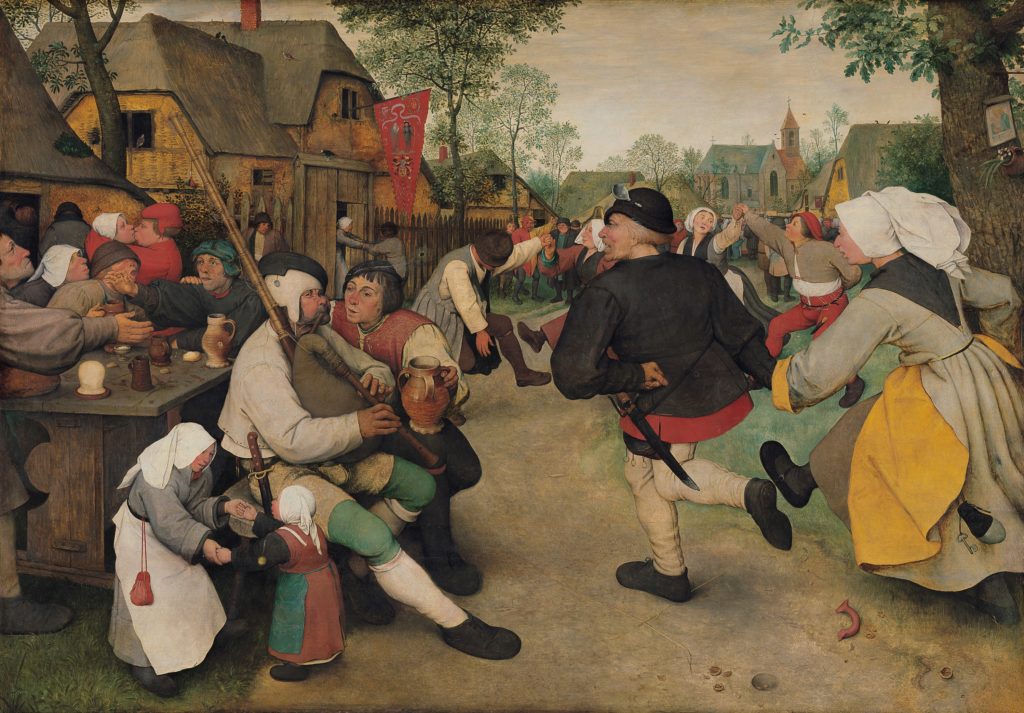
Peter Bruegel the Elder, the Peasant Dance
Gay Marriage – and then what?
Duke Maskell fears the worst
“ … as long as our words retain the power of distinguishing things … ”
Ian Robinson, The Survival of English, p. 151
… Now, there is a thought: that they might not, that Alzheimer’s might infect not just a person but a language. In 1973 Robinson could say, as if beyond contradiction, “That is why there cannot be homosexual marriage”. Well, a fat lot he knew. That may have been beyond contradiction in 1973, in 2016 what is beyond contradiction is that denying homosexuals the right to marry is like denying blacks the right to a seat on the bus or women a seat in the bar. ‘Marriage’, in law, has changed its meaning, and along with it a host of related words are changing theirs: ‘husband’ and ‘wife’, ‘man’ and ‘woman’, ‘male’ and ‘female’, ‘mother’ and ‘father’, ‘parent’ and ‘child’, ‘son’ and ‘daughter’, ‘family’, ‘sex’, ‘consummation’, ‘adultery’, and who knows what. To me (and, I expect, Robinson) what this bundle of changes means is that some of the most important words in the language are losing, or have lost, the power to distinguish some of the most important things in our lives. To others they mean, of course, just the opposite, that words are acquiring new powers to distinguish things by ceasing to distinguish them falsely.
‘Marriage’ and the words associated with it are changing their meaning through—how else?—the operation upon them of other words. Among the progressive (and, nowadays, what public figure dare not be among them?), the words ‘rights’, ‘equality’, ‘discrimination’, ‘choice’ (with help from a few more like ‘partner’, ‘orientation’, ‘gender’, ‘lifestyle’, ‘non-judgemental’) carry everything before them. They’re a rock-fall, a glacier, a rise in sea-level, obliterating landmarks and remodelling the landscape. They make everything new. And their most astounding achievement—like something out of science fiction—is to re-make the meaning of marriage.
Male and female created he them . . . . Now, who, fifty, thirty, twenty years ago would have thought that the connection between that text and our understanding of marriage could be broken? (Not Robinson, obviously.) It is something that requires a revolution, not only in law but in sentiment. But it now looks more or less inevitable that, sooner or later, homosexual couples will be thought marriageable not just by the state but by all of us, just as married as any heterosexual couple with children and grandchildren and a widely extended family. People with the same colour of hair or shape of nose can marry, why not people with the same sexual organs? It’s just fair, isn’t it? Marriage will cease to have one meaning and come to have another. It is, perhaps, (see later) just evolution at work.
But why do homosexuals want to marry? Why are they not satisfied with civil partnerships granting them the same legal and economic benefits? What is it about marriage they think they are missing out on? It must, presumably, be something to do with the meaning Christianity has given it. Christianity gives marriage a character over and above the contractual; and it is this extra-legal benefit (if benefit it be) that homosexuals feel themselves unjustly denied. For Roman Catholics marriage is a sacrament and for Anglicans a rite with—as we might say—something of the sacramental about it.
Perhaps not many, even amongst those married in church, even Catholics, really, any longer feel marriage to be a sacrament or mystery signifying the mystical union between Christ and his Church but, probably, not many either, even amongst those most indifferent or hostile to religion, really live as if marriage were just a useful sexual and economic arrangement, as binding as, but no more binding than, any other legally binding partnership. What divorcing couple think of their severance as no different from the dissolving of a business partnership? Of no different an order of seriousness? Which don’t think of it as a failure, their failure, and find it, to one degree or another, a source of shame? Remnants of the sacramental or mysterious seem still, widely, to cling to it, remnants but still real. The meaning of marriage in England today—even when not explicitly that given it by Christianity—is still derived from it. What meaning has any civil marriage service, for hetero- or homosexual, except what it borrows, consciously or unconsciously, from (what I’d like to call, as a sort of Anglican fellow-traveller) the marriage service: “Dearly beloved, we are gathered together here . . . ”?
Marriage may not be to many of us a sacrament but the Prayer Book’s “Solemnization of Matrimony” does remain, even today, not merely intelligible but (it seems to me, an ordinarily worldly and unbelieving man) entirely convincing. It does, as it says, solemnize marriage, even for, or especially for, those who might enter into it unadvisedly, lightly, or wantonly. It doesn’t just call marriage “an honourable estate”, it makes it so; and what is that if not a sort of everyday miracle?
The value it discovers in marriage and which homosexuals claim a right to, the value over and above the enumerable costs and benefits—sexual, economic, legal—shines out from the very first words of the service: marriage as something that makes those who witness it not a mere sum of individuals but, whether strangers to one another or not, a little community, “gathered together here”—a little community constituted as such by the purpose for which it has gathered—one which, even more astonishingly, makes it right for the presiding minister to address its members, whom he may never have set eyes on before and never will again, as “Dearly beloved … ”. Now, if marriage is something that can make that intelligible and right … well, no wonder homosexuals aren’t satisfied with civil partnerships, even when contractually and legally identical. They can see, evidently, something over and above the countable benefits and utilities, an invisible value they don’t want to be denied.
And aren’t they right to? Isn’t there something about marriage that resists being deconstructed and demystified, seen as a merely useful arrangement: the familiar mystery of the way people—whether or not they consciously attribute a value to it over and above its usefulness—do commonly live together as if it did indeed have such a value, even those for whom it proves a far from happy arrangement? It is all around us, as a familiar element of our social life: marriages, happy and unhappy alike, lived as if possessing a value over and above what can be accounted for by weighing costs against benefits. What could be a commoner mystery than why he remains married to her or she to him? What does either of them see in the other, especially now the children have gone? We think it of our neighbours while they think it of us. It isn’t a matter of what people make explicit, even to themselves, but of the way, over long periods of time, they practically submit to the sharing of one another’s lives. The value is there. It inheres, visibly, in the practical living just as much as in the words of the marriage service.
So no wonder homosexuals claim that they have the right to marry, and believe the State has the power to grant, or deny them that right, jut as it might grant or deny them the right to sexual relations, the vote or equal pay. They want their partnerships to have the same meaning, be accorded the same value, the same dignity, respect, esteem as those of the other ‘orientation’. It is understandable. And it is equally understandable that the State (those temporarily in charge of it), which has such power and can do so much, should think it has the power to do this too.
But, as with other things, making abortion a medical intervention, say, or giving a university education to half the population, there are impediments in the way, not mere practical ones like the garnering enough votes or voting enough money but impediments of sense.
If the value homosexuals find in marriage and want for themselves derives from Christian marriage, then only part of that value lies in what Canon Law calls, “the good of the spouses” which marriage makes possible, what the Prayer Book, more expansively, calls, “the mutual society, help, and comfort that the one ought to have of the other, both in prosperity and adversity.” Such a good might come (or not) as readily from a civil partnership as from marriage. The good of the spouses made possible by marriage, great good though it be, is hardly the thing that distinguishes it. The good the spouses do one another, however honourable in itself, is hardly the thing that makes marriage the honourable estate it is. That, plainly, is the connection (to put it no more emphatically) between marriage and the procreation and upbringing of children, described by Canon Law as,
a partnership of the whole of life and which is ordered by its nature to the good of the spouses and the procreation and education of offspring
and by the Prayer Book, with even more emphasis on procreation, as,
First, It was ordained for the procreation of children, to be brought up in the fear and nurture of the Lord
As The Conciliar Anglican website puts it, “The main and abiding purpose of marriage is to create family. … A man and a woman who are not related by blood, who have no familial obligations to each other, are made one flesh through marriage, and thereby a new family is established, with a bond stronger than a blood bond, stronger even than the bond of a parent to a child since ‘for this cause shall a man leave his father and mother, and shall be joined unto his wife’ (quoted in the sermon, but coming from Genesis 2:24).” It is a partnership of the whole of life: sexual gratification, procreation and care of one another and of children—and it is from its being this that marriage gets its meaning. Not individuals giving satisfaction to other individuals, however lovingly, loyally and self-sacrificingly, but families giving rise to families and (by doing so in accordance with the “Table of Kindred and Affinity”) without disturbing any family that is already in existence. And it is this that makes marriage not a merely private arrangement between individuals but the great public fact it is, rightly attracting the attention, for good or ill, of the state.
Now, whatever other virtues a homosexual union might aspire to, this one it can’t.[1] And while, for the moment, it is this one that gives marriage its meaning—while, at least, this meaning remains vivid in our memories—it makes a puzzle to say that homosexuals have a right to be married and that the state has the power to give effect to this right. Saying that homosexuals have a right to marry is quite different from saying that someone has a right to sexual relations or a vote or equal pay. The state can, of course, give marriage licences to whomever it likes upon whatever conditions it likes but it is not at all similarly free to give the meaning of marriage to whatever it likes—no more than it is to make 2 and 2 equal 5 or ‘glory’ mean ‘a nice knockdown argument’. The value or meaning found in marriage that homosexuals want for their own partnerships isn’t in the gift of the state as the licence is. A majority vote in a quinquennial parliament can decide what makes someone eligible to have a marriage licence but, except in that legal sense, it can no more decide what does and does not count as a marriage than what does and does not count as an element or a poem. These are matters (thankfully) out of its reach. Here, it’s not Parliament but the Church, tradition and vulgar prejudice that have authority.
For those, like our present legislators, in the van of progress, homosexual marriage does, of course, already have the value the state attributes to it (they did the attributing):
No matter who you are and who you love, we are all equal. Marriage is about love and commitment, and it should no longer be denied to people just because they are gay. (Clegg)
Marriage reflects the value we place on long-term, loving relationships, whoever you love. (Miliband).
All couples who enter a lifelong commitment together should be able to call it marriage. (Miller)
Couples who love each other should be able to get married regardless of their gender and sexuality and we should enjoy that and we should celebrate that. (Cooper)
The state’s job is to recognise the commitment between a couple to spend the rest of their lives together and not to judge who that couple are. (Grayling)
All we’re really saying is “should sexuality be a bar to making a lifelong commitment to another person?” (Bottomley)
How much nicer they have made marriage: no longer the bed you make, then lie on; now the bed of roses (without any thorns). Whereas it used to set definite and onerous conditions beforehand and entail definite and onerous obligations afterwards, it is from now on for all, no matter who you are or whomever you love, and requires of you nothing more definite than ‘commitment’ (that who-knows-what? which everyone with something to sell has plenty of, including politicians themselves[2]). It’s commitment as something so good in itself that, according to Mr Cameron, it’s one of the things to get married for: “marriage is a great institution, it helps people to commit … it helps people to say that they’re going to care and love for another person.”
The Daily Telegraph published a letter supporting homosexual marriage from Osborne, Hague and May (5.2.13) that had (its niceness aside) only one argument to advance but what a knock-down argument it was: … The time is right. Civil partnerships for homosexuals had been “a great step forward” but stopping there wasn’t “any longer acceptable”, marriage had “evolved over time”, “attitudes had changed”, a “substantial majority … now favour” it, “support has increased”, it is “the right time”. To which Maria Miller, Minister for Women and Equalities, added “marriage will continue to evolve.” Chris Grayling agreed: same-sex marriage is merely the “sensible next step” in the evolution of social attitudes. Our legislators looked in the petri dish of time and found there a distinct, new idea of marriage, an idea whose time has come: marriage as an institution that is evolving, like the species.
So we can look forward to a succession of sensible next steps which will take us we can’t be sure quite where—except, of course, forward, always forward—to somewhere that we know will open up this great old institution to great new partnerships. We can’t at the moment say what these partnerships will be. They may involve—who knows?—more partners than two, or twenty-two, and more species than one. Who can say? Perhaps they will involve—why not?—what we presently (in our only partially evolved state) think of as incest or paedophilia or bestiality or bigamy or—why not?—open and avowed celibacy, sekkusu shinai shokogun, as the Japanese say. This last (see later) is the most likely. What we can know is that, in opening up the old institution, these new partnerships will strengthen it. Why not, if, like Cameron, you can say, “Frankly, I am a marriage man. I am a great supporter of marriage. I want to promote marriage, defend marriage, encourage marriage.” Why, if you are such a marriage man—and marriage is something in the process of evolving—shouldn’t promoting and encouraging it for homosexual couples be just a sensible step towards promoting and encouraging it for … well … who can say? What might marriage might evolve into? (You don’t think evolution, for this particular species, came to a stop, in The House or out, at about 7.15 pm on Wednesday, the 6th of February 2013, do you?) This is how evolution works, like the ways of God, mysteriously.
Except that, in this case, it works even more mysteriously than usual because it permits the more and the less evolved varieties of the same species to exist side by side. For, as Maria Miller, Minister for Women and Equalities and spokesperson for the Government as a whole, says:
The bill is about choice. It is about giving those who want to get married the opportunity to do so, while protecting the rights of those who don’t agree.
So, now, we can choose our idea of marriage! Power to us! Opportunity for the one is balanced by protection for the other. We protect the primitive Christian idea of marriage as a union between a man and woman whose essential purpose includes the procreation and upbringing of children and at the same time opportunize the new more evolved idea of marriage as … love and relationships and commitment, without distinctions or conditions. What could be fairer?
Except that this compromise is very unlikely to stick. The Government can’t guarantee that the legality of its compromise won’t be challenged in the courts, including the European Court of Human Rights, and it can’t guarantee what the result of such a challenge would be. Mrs Miller’s own remarks in Parliament show how uncertain it is. Although she says, “teachers, particularly in faith schools, will be able to continue to describe their belief that marriage is between a man and a woman”, she also says that this must be done “while acknowledging and acting within the new legislative position which enables same-sex couples to get married” and without expressing “personal beliefs … in a way that exploits pupils’ vulnerability or involves discriminating against them.” So … watch your step.[3]
For the moment, in the eyes of the state and for the state’s purposes, marriage has evolved to the point where two men or two women may marry as well as a man and a woman; and it has done so as something fitter for an environment in which equality and non-discrimination are supreme social goods. Except that … there’s still a bit more evolving to do. For the two kinds of marriage aren’t, yet, still quite equal, on account of a puzzle our legislators couldn’t solve: What is the equivalent for two women or two men of the act of consummation between a man and a woman, which can give birth to a new life? Finding themselves unable to say, sensibly they didn’t. Maria Miller tried to pass this off as a triumph of reasoning: “I can be clear when it comes to issues of adultery and consummation, these are issues that relate to heterosexual marriage, they won’t apply to same-sex marriage.”
Unfortunately for equality—which is supposed to be the whole point of the new law—what this means is that heterosexuals are currently able to get an annulment for want of consummation or a divorce for adultery but homosexuals are not and that, although one heterosexual can divorce another on the grounds of adultery committed with a member of the opposite sex he can’t divorce for adultery committed with someone of the same sex.
Fortunately, there is an easy way out of this confusion—something else for Maria Miller or her successor to be clear about: abolishing consummation and adultery as legal concepts altogether—and thus, in law, making homosexual and heterosexual marriage perfectly equal by the clever device of dissociating sex from marriage.
Once marriage is decoupled from sex and becomes nothing more than a public expression of commitment, aren’t all sorts of couples, and more than couples, going to demand its benefits and to claim they are discriminated against if they don’t get them? There must be lots of people in life-long and loving relationship—brothers and sisters, parents and children, as ‘committed’ to one another as any married couple, hetero or homo—who might well want to claim for themselves the benefits of marriage. And, if marriage has, legally, nothing to do with sex, what happens to the legal prohibition against marriage within families? Why shouldn’t I, now, be free to marry my sister or my wife’s son’s daughter or, come to that, my sister’s daughter’s husband?
For the present, the only gender and sexuality being newly enjoyed and celebrated by Yvette Cooper is the homosexual. But it can’t, surely, be the only gender and sexuality waiting to come out.[4] Yvette may have more to enjoy and celebrate than she knows. Perhaps, in the fullness of time, when social attitudes are more evolved than they are just now, we will be able to choose between not a mere two or three varieties of marriage but umpteen or untold varieties. For, I am a marriage man. I am a great supporter of marriage. I want to promote marriage, defend marriage, encourage marriage and strengthen not weaken the institution. And the more people who can marry, the stronger marriage is, isn’t it?
Yes, marriage customs differ in different places and at different times. And, looked at from the viewpoint not of husbands or wives but of anthropologists, our own customs, whether including homosexual marriage or not, are, if not exactly arbitrary, then contingent. They have been as they have been, but not from necessity and because they couldn’t have been otherwise; they might very well have been, as elsewhere, quite otherwise. But what follows from this? That we should practise a sort of radical scepticism, in which we find nothing to affirm and nothing to deny and—because we find no particular form of marriage universal and necessary—make ourselves conformable to any at all? Acknowledging that marriage customs differ or that our own have changed only helps us know what course to follow if we say that, having failed to draw a line there or there, we must in consistency forever cease to think of drawing lines anywhere.
This does seem to be implicit in the Osborne-Hague-May view that marriage customs are evolving and their only justification is their timeliness but not even Osborne-Hague-May can actually be satisfied with this view of things. It too obviously does leave the door open to cross-species marriage or adult-child marriage or in-the-family marriage or any form of marriage whatsoever; and they would no doubt be as opposed to many of these ‘marriages’ as others are to same-sex marriage. We are all obliged to practise, and perhaps to defend, some particular custom, which is no less contingent than any other. But what ground will Osborne-Hague-May find by which to justify their opposition to some further extension of the marriage law which they happen to find repugnant or absurd? Where and how is our search for justifications, and the scepticism it expresses, to end?
Wittgenstein’s answer seems to have been it just does: “justification comes to an end”; the “groundlessness of our believing”; “At the foundation of well-founded belief lies belief that is not well-founded”; and
Giving grounds … justifying the evidence comes to an end;—but the end is not certain propositions striking us immediately as true, i.e. it is not a kind of seeing on our part; it is our acting which lies at the bottom of the language-game.[5]
If we oppose ‘homosexual marriage’ (even by putting it in inverted commas), we do so in order to preserve the institution and the understanding of marriage as we have known it, not just in our own lives but in our history and the best part of our history, our literature. We do so not for reasons but in defence of a practice and the way of life it is part of.
That practice may seem to have been left behind by time and evolution but (encouragingly) evolution does make mistakes. There are such things as evolutionary dead ends, resulting from traits that are advantageous in the short term but not in the long. And it may well be—who knows?—that New Marriage proves to be one. For I can’t quite believe in a lasting victory for the gender-assigning, homosexual-marrying party. The consummation- and adultery-free commitment it celebrates is too obviously shallow and frivolous.
That respectable product of our ‘elite’ schools and universities may, for the moment have its hands on the handles of political power and it may be authorised in its use of them by a bundle of currently prominent locutions and sentiments but the pull of the forces ranged against it, even now, should not be underestimated. There’s not only 2000 years of Christianity to be escaped and all that art of which Tolstoy’s Anna Karenina, Mozart’s The Marriage of Figaro and Eyck’s Arnolfini portrait can stand as the examples but (what may prove even more obstinate) the coarse, low-life voices of the uneducated and ineducable, of the chavs, plebs and proles, still talking, underground, of ‘queers’ and ‘poofters’ and ‘dykes’ and turning the progressive snidely against itself in remarks like “That is so gay.”
If the homosexual-marrying party were finally to triumph it could only be when the entire Western literature of sexual love and marriage between men and women had become as unintelligible as pederasty in Ancient Greece, and when Modern Toss and Viz had become unintelligible along with it, equally objects of anthropological study and without a living audience. Until that happens, even the most liberal-minded will find it hard to break, quite, the last mental connection between marriage and procreation, to overcome that last obstacle to seeing homosexual marriage as marriage simply, without qualification.
And, for the moment, while the plebs, and the petit bourgeois too, retain their prejudices, and Christian marriage services and the Western literature of love their intelligibility, it isn’t quite so easy for any of us to treat homosexual marriage as marriage simply and without qualification. We can but it takes a bit of an effort. The young, for instance, as laid-back, cool and tolerant as they are about these things, nevertheless, seem to me, in being so, not quite sincere. They say ‘gay’ routinely (without any very obvious signs of choking), but they say it, all the same a bit deliberately. Their easygoingness seems a bit willed, a bit too self-consciously correct. And, as a friend once wrote, in a quite different connection, “correctness does not preclude sincerity but we can usefully say that it raises problems for it.”
However laid-back the heterosexual young are about homosexuality in general, or in their friends, if, when they become parents, they learn that a child of their own is ‘gay’, they will at the same time learn that it is something else to them than a life-style choice and mere indifferent preference for putting certain bits and pieces of one’s own body in one place rather than another in someone else’s. They will learn to grieve over it, to grieve for all the life the homosexual is shut out from: the different life of the other (not-for-nothing called ‘opposite’) sex and the children and the grandchildren that may come from union with it. And the greater their love, the deeper their grief. ‘Gay!’ ‘Gay?’ What’s gay about it? What is it, when seen clearly and without self-deception, but deeply sad? And all the sadder when its sadness goes unrecognised. ‘Queer’ may be cruel but there’s more truth in it than ever there is in ‘gay’. What ‘homosexual’ means to the parent in us, even the most determinedly politically correct, and even when we are parents only in our imaginations, is not-marriageable, an affliction. It means, at this point, now, the end of the family-creating family line, a dead-end, finis.
[1] Unless, perhaps, adoption came to have the place in homosexual unions that procreation has in heterosexual. And, even then, the ‘families’ that resulted would hardly be families in the ordinary sense. Think of all the common terms for family relations that couldn’t be used of them. They really would be nuclear—a nucleus with nothing orbiting round it. Unless the children were heterosexual, such families would be dead ends without the power of extension. None of Yeats’s “dying generations” in them.
[2] ‘Commit’ is a word that permits one to say such things as “I am committed at this moment,” as Steve McClaren said, of his reported “100% commitment” to Derby County FC (Look North news, 6.5.15). As soon as the moment was over he joined Newcastle FC. Similarly, Chris Coleman, the Wales coach, was “totally committed” to his Wales job even though his negotiations for a new contract had already broken down and ones with Swansea and Aston Villa had already (reportedly) started up.
[3] Magistrates already have to watch theirs. If you are a magistrate and think it better that a child be adopted by a man and a woman than two men or two women, then say so publicly and find yourself a Person of Interest to the Judicial Conduct Investigations Office and sacked by the Lord Chancellor and the Lord Chief Justice for misconduct so serious that it brings the magistracy into disrepute. The magistracy brought into disrepute by a magistrate saying what, until just a few years ago, the whole world has always taken to be self-evident, what the whole world outside the West still takes as self-evident. What an idea of misconduct and the disreputable! What Third World village is as parochial as Westminster and its environs?
[4] The paedophile pressure groups PIE has been out and gone back in again but is hardly likely to stay in forever. When polyamourous activist Dr Redfern Jon Barrett asked Natalie Bennett, the Green Party leader, what her party would do to make the union of trios and groups legally equal to that of couples, she replied, “We have led the way on many issues related to the liberalisation of legal status in adult consenting relationships, and we are open to further conversation and consultation.” And, although the idea of cross-species marriage is presently unthinkable, a New York state supreme court judge did recently grant, for a few hours, a writ of habeas corpus on behalf of two chimpanzees held by Stony Brook University; so perhaps even that will find its advocates in time and, when it does, some future trio of Osbornes, Hagues and Mays will be on hand to find that its time has come.
[5] By “language-game” he means the exchanges in which we ask for reasons, give grounds, accept justifications and so on. It is not, ultimately, that our acting rests on grounds but that the “game” in which we give grounds rests upon our acting, a whole form of life which is itself groundless, which is the condition of our having any grounds to give at all and which sets a limit to the grounds we can reasonably ask for. Quotations from On Certainty, Blackwell, 1969, pp. 92, 166, 253, 204
DUKE MASKELL is the joint author of The New Idea of a University (2002)
Like this:
Like Loading...


The Benighted Remains of the Day
The Benighted Remains of the Day
Ilana Mercer notes that it takes brains to understand liberty
During the Bretton Woods Conference, in 1944, Lord Halifax is said to have “whispered to Lord Keynes: ‘It’s true: they have the money bags but we have all the brains.’” By “they,” Halifax meant the Americans.
His frustration with the American mind—often prosaic and anti-intellectual—during the critical Bretton-Woods negotiations seems as valid today. As odious as Britain’s elites are, boy, are they cleverer than ours. Take the impromptu interview, on June 28, which Richard Quest, CNN’s imported British broadcast journalist, conducted with Nigel Farage, leader of the UK Independence Party.
Farage had emerged exhilarated from the coven that is the European Parliament, where he had shared some home truths with the ponces leeching off Britain.
Other than to mouth formulaically about “small government, big military, balanced budgets and the penny plan”—America’s chattering class and ruling elites seem incapable of expressing the principles undergirding freedom. And members of this political Idiocracy dissolve into a puddle if their cue cards disappear.
Farage, however, spoke to some difficult ideas with ease, and without notes.
The act of secession, the quests for sovereignty, decentralization and regional autonomy from a second tier of tyrants—the first being the national, British government—involve comprehending complicated ideas.
About this, Milton Friedman forewarned in the introduction to F.A. Hayek’s “The Road to Serfdom.” Whereas “the argument for collectivism is simple if false; it is an immediate emotional argument.” “The argument for individualism” and freedom, on the other hand, “is subtle and sophisticated; it is an indirect rational argument.”
Put differently: it’s difficult for dummies to understand liberty, let alone defend it, a problem the scintillating, cerebral Mr. Farage doesn’t have.
“You as a political project are in denial,” he told the grumbling laggards in the EU chamber. The EU had, “by stealth by deception, and without ever telling the truth to the British and European people, imposed political union upon them.”
Heckling Eurocrats were reminded by Farage that when, in 2005, the people of the Netherlands and France said adieu to an enforced political union—the Eurocrats had “ignored them and brought in the Lisbon Treaty through the backdoor.”
Indeed, the last refuge of a Brussels scoundrel is the bureaucracy. When voters scuttled the EU Constitution in that referenda, the rogues being upbraided by Farage simply dissolved one illegitimate political structure and constituted another.
“What the little people did,” continued Farage; “what the ordinary people did, what the people who’ve been oppressed have done is to reject the multinationals, reject the merchant banks, reject Big Politics, and demand their country back, their fishing waters back, their borders back. We want to be an independent self-governing nation.”
A series of similar watersheds would follow, predicted Farage.
Fleetingly, at least, Farage’s fluency with the ideas of freedom took effect. The blank faces flanking UKIP’s leader looked somewhat animated. Fewer jeered; some even clapped and cheered as Farage went on to submit that no stalling would be tolerated. The will of the British people would be heeded forthwith. Called for was “a grown-up and sensible attitude” toward executing popular—in this case, naturally licit—wishes.
Mr. Farage was not done, going on to impress upon EU parliamentarians—none of whom had “held a proper job” in their lives, “or worked in business or worked in trade, or indeed ever created a job in [their] lives”—that unlike a coerced political union, trade in goods was mutually beneficial and voluntary and would continue.
Here the booing resumed.
If, in sensing an opportunity to exert unauthorized political power, this unelected mob intended to reject trade between Europe and England, reinstate tariffs and quotas—Mr. Farage was pleased to inform them the consequences to Europe would be worse.
No doubt: as statist and regulated as the once great merchant and maritime nation of Britain has become—Europe under the Brussels machinery is practically paralyzed.
Few in the US media appreciate that language that effectively conveys clear ideas has got to be strong. Weasel words won’t do. Thus Ashley Banfield was flabbergasted by Farage’s verbal whips. CNN’s verbose host was appalled, you guessed, at the “tone” taken by Farage in his pointed remarks to the EU.
Days prior, two lunatic American women, dressed in matching Mao-like tunics, had stormed a stage together, where they had a petit mal fit over Donald Trump. Yet the two—Hillary Clinton and “Pocahontas,” aka Senator Elizabeth Warren of Massachusetts—made reporters like Banfield giddy with Girl Power.
Never was Warren depicted as angry or out-of-control. Instead, she was a “towering” liberal Democrat, who delivered not ad hominem but “energy, folksy appeal and a populist roar …”
By contrast, Quest, Banfield’s British-born colleague, was able to settle down to a blind panic by the time he conducted his exhilarating interview with Mr. Farage.
No longer in a post-Brexit frothy, Quest even accepted Farage’s forceful instruction to “stop this nonsense about the markets. The pound has been in a bear market since July 2014. Fact!” Jittery markets had begun to self-correct, the Dow was bouncing back.
Unlike their hysterical colleagues in the US, British liberal journalists have even begun to pull back slightly in embarrassment. Were they really going to persist in lamenting losses suffered by global puppet-master George Soros and the financial sector, all just to take aim at the Little People? In so doing, was not the Left showing it loved the lumpenproletariat only as long as they got with The Left’s program?
Moreover, Quest’s professional counterparts in Britain (indubitably the smarter cohort) seem to have backed off of accusing 17.5 million “Leave” voters of being old, uneducated, racist, and generally obsolete right-wing extremists. In other words, Trump voters. The liberal brain trust stateside has yet to grant this courtesy to Tea Party pioneers, much less to Trump voters.
For his part, Quest showed the same intellectual agility as his opponent: “So, how on earth do you have the effrontery to criticize Wall Street, the banks, you criticize a big business when you were part of those markets?”
Imagine a American politician attempting to respond to such a question with a First-Principles answer!
Farage did. He stumped Quest by explaining that markets aren’t the creatures of big business. “Good markets have small and medium size competitors trading in them too.” He then pivoted to the crony actions of the free-market flouting Goldman Sachs. “In cahoots with this European commission,” such bad-faith actors did much mischief: usher “Greece into the Euro,” for example.
Ordinary people are slowly coming to realize that adding a second tier of tyrants—EU, NAFTA, UN, NATO, WTO—to their own tyrannical national governments has benefited them as a second hangman enhances the health of a condemned man.
So when Quest resumed his nervy narrative about the “terrible message” being sent “about what’s happening in Britain,” their representative shot back:
Taking back our country, our laws, our courts, our borders, our pride and self-respect is a great message. Our political class has let us down like a cheap pair of braces and what we did last week in that referendum was say, ‘Get thee gone.’
Nigel Farage’s repartee is in a class of its own. Observing its brilliance accentuates the absence of a similar facility among our own mainstream clodhopper commentariat. The verbal swordplay initiated by Farage, leader of the UKIP, often gets lost in translation stateside.
The dumbed-down transcript, provided by CNN, had turned Farage’s “get thee gone” into “get the gun.”
ILANA Mercer is the author of “The Trump Revolution: The Donald’s Creative Destruction Deconstructed” (June, 2016), and “Into The Cannibal’s Pot: Lessons for America From Post-Apartheid South Africa” (2011). She has been writing a popular, weekly, paleolibertarian column—begun in Canada—since 1999. Ilana’s online homes are www.IlanaMercer.com & www.BarelyABlog.com. Follow her on https://twitter.com/IlanaMercer
Follow these links to Ilana’s new book “The Trump Revolution: The Donald’s Creative Destruction Deconstructed”
http://amzn.to/29JdYAH http://www.ilanamercer.com/TrumpRevolution_Ad350.png
Share this:
Like this: