The Village Murderer

The Village Murderer

by Bill Hartley

There has been a great deal of coverage in the press of late about a decision by the Parole Board to grant early release to a notorious sex offender. The Board has the thankless task of trying to reduce the prison population, its current size caused in part by the last Labour government’s creation of the IPP (Imprisonment for Public Protection) sentence. Indeterminate sentences sound fine in theory and play well with the public but leave the Board with a considerable challenge when assessing risk. A court will of course have passed such a sentence because it saw the risk as considerable.

For many prisoners, the ante room to release from a long sentence is the Open Prison. Testing the prisoner in such conditions can provide the Parole Board with key information to assist the decision making process. However, by extending so much trust to prisoners, open prisons are prone to embarrassing incidents which can find their way into the newspapers. Bruised by political criticism prison managers have tightened the decision making process. Continue reading

Posted in Current Affairs and Comment, QR Home | Tagged , , | 2 Comments

Falstaff, Staatsoper Berlin

Lucien Fugère in Verdi’s Falstaff

Verdi’s Falstaff, Staatsoper Berlin, Wednesday 28th March 2018, director Mario Martone, conducted by Daniel Barenboim, reviewed by TONY COOPER

Verdi’s Falstaff mirrors the two buses scenario for me this year. Up until now I haven’t caught a production of this opera since Glyndebourne came to my home city of Norwich in 2009. However, I saw 2018 in by attending a production by Opera Vlaanderen in Antwerp, directed by Christoph Waltz and now this brand-new production in Berlin, directed with Italianate flair by the Napoli-born film director, Mario Martone, forming part of Daniel Barenboim’s Festtage, an Eastertide festival for Berliners and visitors alike.

The libretto by Arrigo Boito of this well-loved opera is loosely based on Shakespeare’s The Merry Wives of Windsor as well as scenes from Henry IV (parts I & II). It was written when Verdi was approaching the ripe old age of 80. It was his second comedy and his third work based on a Shakespeare play, following Macbeth and Othello. Continue reading

Posted in Cultural Matters, QR Home | Tagged , , , , | Leave a comment

Stop the “Refugee Caravan” Invasion!

Still from Bergman’s The Seventh Seal

Stop the “Refugee Caravan” Invasion!

by Ilana Mercer

Planning for a show-down, a column of 1,500 Central Americans, largely from Honduras, has been beating a path to the Mexican-American border.

Some report that the column has been halted; others dispute that. Interviewed by Reuters in Mexico, a sojourning mother of seven—what are the chances none is an MS13 gangster?—signaled her intention to proceed to the US, if only to teach President Trump a lesson.

Yes, “Make America Great Again” to you, too, Colindres Ortega. Continue reading

Posted in Current Affairs and Comment, QR Home | Tagged , , , , | Leave a comment

When Merit-Based Hiring is Deemed Racist

Professor Arthur R Jensen, LA Times

When Merit-Based Hiring is Deemed Racist 

by Ilana Mercer 

As individuals, we all want the best doctors treating us, the best pilots flying the airplanes we board, the best engineers designing the bridges we cross, the best scientists inventing and bringing to market the medicines and potions we ingest*.

 Yet the American Idiocracy is moving to equate merit-based institutions with institutionalized racism.

Tucker Carlson, likely the only merit-based hiree at Fox News, recently divulged that a member of the Trump administration was overheard (by a thought-police plant) expressing a preference for merit-based recruits for his department.

Egad, and what next!

Google, a tool of the Idiocracy, appears to have scrubbed its search of this latest episode in “The Closing of the American Mind.” However, it’s no secret that the education system already excludes the most naturally gifted, independent-minded individuals from fields in which they’d excel. 

In any event, when the best-person-for-the-job ethos gives way to racial and gender window-dressing and to the enforcement of politically pleasing perspectives, things start to fall apart. A spanking new bridge collapses, new trains on maiden trips derail, Navy ships keep colliding, police and FBI failure and bad faith become endemic, and the protocols put in place by a government “for the people” protect offending public servants who’ve acted against the people.

As in this writer’s birth place of South Africa, the U.S. government has a pyramid of hiring preferences. Guess which variables feature prominently in its considerations? Complexion or competency?

Consider the procurement pyramid that went into destroying the steady supply of coal to South-African electricity companies. Bound by Black Economic Empowerment policies, buyers buy spot coal, first from black women-owned suppliers, then from small black suppliers, next are large, black suppliers, and only after all these options have been exhausted—or darkness descends, whatever comes first—from “other” suppliers.

The result: an expensive and unreliable coal supply and rolling blackouts.

Everywhere, media are congenitally incurious and corrupt. They aren’t digging. But it’s likely that similar considerations will go a long way in explaining the collapse of a Florida university campus pedestrian bridge, under which people were pulverized.

So far, the attitude of those who’re doing this can be summed thus: Shit happens.

As for the public; it receives no follow-up and learns to demand none. Hence, “The Closing of the American Mind.”

But if American institutions continue to subordinate their raison d’être to politically dictated egalitarianism, reclaiming these institutions, private and public, from the deforming clutches of affirmative action will become impossible.

It might already be impossible.

For example: former FBI agent and patriot Philip Haney was dismissed by Barack Obama from the Department of Homeland Security and is nowhere to be found in the Trump Administration. This brilliant man’s goal was to do his job: stop Muslim terrorists in the US.

Alas, the intricate program and extensive network of contacts Haney developed were nixed, because political priorities had come to dominate the agency. As a result, innocents died.

Treason? I’d say so. So, where are the purges?

What were once merit-based institutions are being hollowed-out like husks through preferential, non-merit-based hiring, quotas, set-asides, not to mention the policing of thought for political propriety.  

No longer beholden to the unifying, overarching value of merit, institutions, moreover, become riven by tribal feuds and factional loyalties—both in government and in business alike, where it is well-known that newly arrived “minorities” hire nepotistically.

Across the American workplace, the importance of “meritocratic criteria” such as test scores or “minimum credentials” has been downplayed, if not downright eliminated as “inherently biased against minorities.”

The U.S. government hasn’t had an entrance test since … 1982. It abandoned both the Federal Civil Service Entrance Examination and the Professional and Administrative Career Examination (PACE) because blacks and Latinos were much less likely to pass either of them.

In academia, law schools have lowered the bar in admissions and on the bar exam. Universities run a “dual admissions system”—“one admissions pool for white applicants and another, far less competitive, pool for minorities.”

The institutionalized American “quota culture” has been imposed by administrative fiat, courtesy of the “The Power Elite”—that engorged “administrative state” under which Americans labor.

For the purposes of conferring affirmative action privileges, American civil servants have compiled over the decades an ever-growing list of protected groups, “as distinct from whites.”  

In addition to blacks, the list entails mainly minorities such as Hispanics—Chileans, Puerto Ricans, Cubans, Dominicans, and Mexicans—Pacific Islanders, American Indians, Asian/Indians, Filipinos, Vietnamese, Cambodians (and homosexuals).

If the kind of immigration policies instituted by the über-left American Idiocracy (it includes most Republicans) continue apace, the institutional tipping-point will be reached in no time.

The reason is the “immigration-with-preference paradox,” first noted by Frederick R. Lynch, author of “Invisible Victims: White Males and the Crisis of Affirmative Action” (1991).  

Once mass immigration became a bipartisan policy, millions of imported non-black minorities were—still are—given preference over native-born American citizens. No sooner do these minorities cross the border, legally or illegally, than they become eligible for affirmative-action privileges.

These preference policies govern both state- and big-business bureaucracies, which seem to have voluntarily (and energetically) embraced them, if only to subdue their white workforce.

It goes without saying that “those who came to this country in recent decades from Asia, Latin America and Africa” did not suffer discrimination from our government, and in fact have frequently been the beneficiaries of special government programs.”

There’s a world of difference between compelling minority recruitment to equal the proportion of minorities in the population and enforcing majority recruitment to equal the proportion of the majority in the population.

In South Africa, the majority is targeted for affirmative action: 75 percent of the population! In the U.S., it’s the minority.

South Africa underwent an almost overnight political transformation. One day a white, relatively well-educated minority dominated all institutions; the next, a skills-deficient black majority took over. Nevertheless, South Africa’s hollowed-out establishments are a harbinger of things to come in the U.S., where minorities will soon form a majority.

If American institutions have not yet collapsed entirely under the diversity doxology’s dead weight, it’s because the restructuring of society underway is slower.

Again, this will change once minorities in the US form a majority, as they soon will due to continued, unabated, mass immigration from the Third World.

*Editorial Note: or as Arthur R Jensen remarked concerning the failure of compensatory education, “In other fields, when bridges do not stand, when aircraft do not fly, when machines do not work, when treatments do not cure…one begins to question the basic assumptions, principles, theories and hypotheses that guide one’s efforts”, How Much Can We Boost IQ and Scholastic Achievement? Jensen was also a perceptive critic of affirmative action.

All citations are from “Into the Cannibal’s Pot: Lessons For America From Post-Apartheid South Africa,”by ilana mercer.

Ilana Mercer has been writing a weekly, paleolibertarian column since 1999. She is the author of “The Trump Revolution: The Donald’s Creative Destruction Deconstructed (June, 2016) & “Into the Cannibal’s Pot: Lessons for America From Post-Apartheid South Africa (2011). She’s on TwitterFacebook, Gab & YouTube.


Posted in Current Affairs and Comment, QR Home | Tagged , , , , | Leave a comment

John Quincy Adams, Turning in his Grave

Ilana Mercer

John Quincy Adams, Turning in his Grave

By Ilana Mercer

“This is just a truly astonishing moment coming from the White House podium,” tweeted MSNBC‘s Kasie Hunt. Like the rest of the media pack-animals she hunts with, Ms. Hunt had been fuming over President Trump’s telephone call to Vladimir Putin, congratulating him on winning another term as president.

Reliably opposed to a truce were party heavies on both sides. Sen. John McCain joined the chorus: “An American president does not lead the Free World by congratulating dictators on winning sham elections,” he intoned.

Another Republican, Sen. Chuck Grassley, told a reporter testily that he “wouldn’t have a conversation with a criminal. I think Putin’s a criminal. What he did in Iraq, what he did in Libya” … Wait a sec? Remind me; was it Putin or our guys who wrecked those countries? There are so many evil-doers on the world-stage, it’s hard for me to keep track. Continue reading

Posted in Current Affairs and Comment, QR Home | Tagged , , , | 2 Comments

Mac the Knife

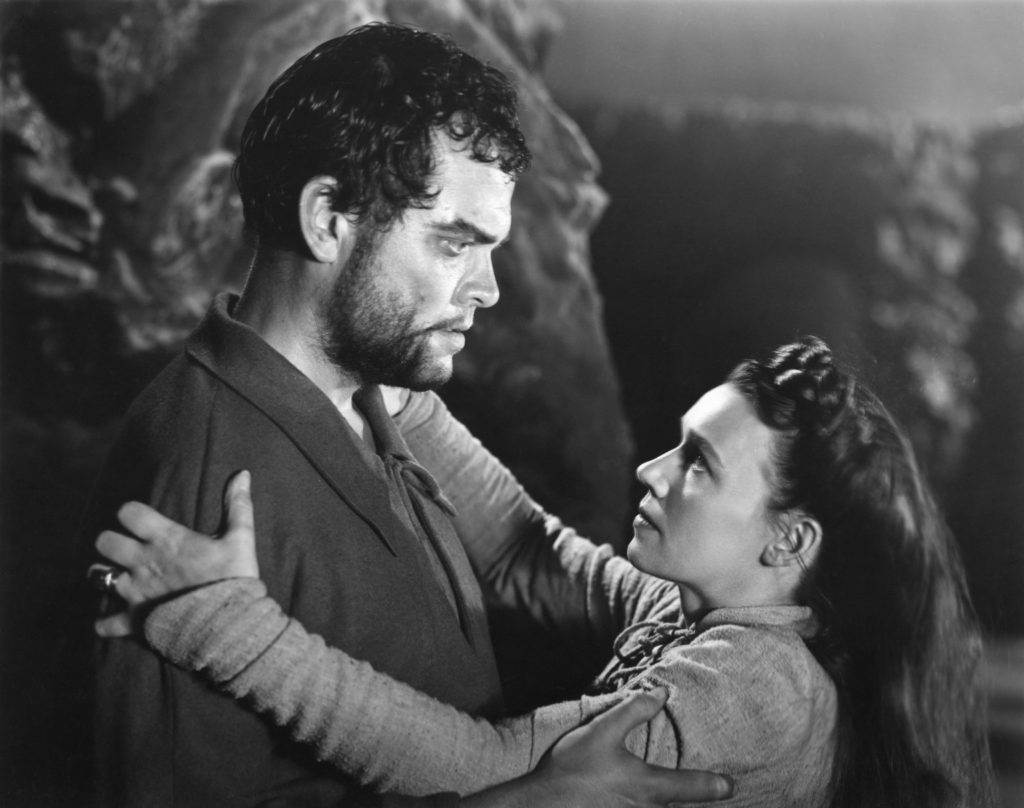
Orson Welles as Macbeth

Mac the Knife

Macbeth, an opera in four parts, music by Giuseppe Verdi, libretto by Francesco Maria Piave, conducted by Sir Antonio Pappano, 3rd revival of director Phyllida Lloyd’s 2002 production, designs by Anthony Ward, Royal Opera, 25th March 2018, reviewed by LESLIE JONES

Franceso Maria Piave had the temerity to write the libretto for Macbeth, the opera, after Shakespeare’s play. To be fair, certain sections of the latter clearly benefit from editing, even elision, notably the tedious scene in which Macduff persuades Malcolm to rescue Scotland. Verdi reportedly took inordinate trouble over this work, which he considered “one of the greatest human creations!” (letter to Francesco Maria Piave, 4th September 1846). But to what extent did he emulate Shakespeare’s achievement?

The stagecraft of this production of Macbeth is somewhat indebted to Kabuki Theatre. Witness the the stylised and synchronised movements of the chorus and the minimalist décor. Ditto, the costumes, with their stark colour contrasts, notably the red turbans and black cloaks of the witches and the incongruous white apparel of Banquo’s assassins. But there was also Christian iconography – to wit, the bloodied, spread eagled corpse of Duncan and of the “crucified” Thane of Cawdor. Continue reading

Posted in Cultural Matters, QR Home | Tagged , , , , , | Leave a comment

The Epistle to the Romans, Part 2

Caravaggio, The Conversion on the Way to Damascus

The Epistle to the Romans, Part 2

translated by Darrell Sutton

 INTRODUCTION

In a previous QR posting on October 10, 2017, I published some preliminary remarks on Paul’s Letter to the Romans. Those comments consisted of prefatory matter for a new rendition of chapters 1-5. Translating from one language to another creates its own problems, particularly if the source-tongue and receiving-language are developed in different language families. Other dilemmas arise even when languages of the same linguistic group are poised to convey one another’s meanings. Modern English, unlike Latin, is no longer an inflected idiom as it was 1200 years ago. At the time, Old English, the language of the Germanic tribes before the Norman Conquest, was able to replicate Greek and Latin nuances fairly closely. All the same, English in its present form is not undermined by its loss of inflections. A few more words merely are necessary to depict certain lexemes. Perceptive translators remain capable of rendering ancient thoughts for modern readers with precision and accuracy.

Paul’s Epistle to the Romans alludes to or cites ancient Hebrew passages in numerous places. Several Latin expressions have counterparts in other ancient Latin prose texts (Seneca’s Epistles: XLI.1-2 comes to mind). The Vetus Latina, which I presume derives from Paul’s hand, resonates. Turning over the soil in order to unearth these treasures for extensive examination requires effort even if one does so with or without concordances. The syntactical parallels between select ancient passages are traceable in Paul’s document. Romans is an intensely theological tractate. The notion of “sin”, as an act or as an inherent human defect, is carefully explicated. The five chapters below show Christ as the effective cause of our justification. There is an introduction (1.1-16); the universal guilt of mankind is described (1.17-32); the Jewish nation then is specifically singled out for their rebellion against the knowledge of God (2.1-3.19); redemption by grace [or justification] for Jewish persons and non-Jewish people is defined (3.20-4.25); but the results of this gratuitous act of God is outlined clearly (5.1-21). Continue reading

Posted in Cultural Matters, QR Home | Tagged , , | Leave a comment

South African Land Theft

South African Land Theft

By Ilana Mercer

Up until, or on the day, that a predictable calamity unfolds in South Africa, you still find Western Media insisting that,

* No, there’s no racial component to the butchering of thousands of white rural folks in ways that would make Shaka Zulu proud.
* No, the mutilated, tortured, white bodies of Boer and British men, women and children aren’t evidence of racial hatred, but a mere artefact of good old indigenous crime. No hatred crimes. No crimes against humanity. Move along. Let the carnage play on.

And the latest: To listen to leftist, counterfactual, ahistorical pabulum served up by most in media, a decision in South Africa’s Parliament to smooth the way for an expropriation without compensation of private property came out of … nowhere. Continue reading

Posted in Current Affairs and Comment, QR Home | Tagged , , , | Leave a comment

The Imminent Collapse of Cultural Marxism

John Martin, The Great Day of His Wrath

The Imminent Collapse of Cultural Marxism,

by Gregory Slysz

The dreadful damage inflicted on Western societies by Cultural Marxism, popularly known as Political Correctness (PC), has attracted much conservative commentary, most of which focuses on the imminent death of all things Western. The eleventh hour has been reached and the last chance of salvation from a Maoist nightmare is an Arthurian counter offensive whose chances of success are slim to nothing. ‘If Trump fails in his attempt to defeat political correctness’, writes Edward J. Erler, ‘no one—certainly no Republican—is likely to try it again. It is easy to predict the First Amendment’s fate if Trump fails.’

Yet terrible as the situation has become, the time for panic is premature. Re-capturing the state from PC zealots must remain foremost for conservatives, but to view it as a make or break situation not only invests the architects of Cultural Marxism with unparalleled sagacity but also overlooks the inherent, self-destructive contradictions of their ideology. Its progressive façade is no longer adequate to disguise its moral bankruptcy – its authoritarianism, its spiritual vacuity, its cultural nihilism and its irrationality. The more extreme it gets, the more it is rejected. Continue reading

Posted in Current Affairs and Comment, QR Home | Tagged , , , , , | 3 Comments

2001, Revisited

2001, Revisited

On the fiftieth anniversary of 2001: A Space Odyssey, Mark Wegierski reassesses this epoch making film

2001: A Space Odyssey (1968) brought together Stanley Kubrick, one of the most accomplished directors of the cinema, with renowned science fiction writer Arthur Charles Clarke, who wrote the screenplay. 1968, a pivotal years of modern history, was evidently also an extremely rich year for science fiction movies, including also Planet of the Apes. Clarke, the son of a farmer, was born in Minehead, western England, on December 16, 1917. Among his main influences were H.G. Wells and Olaf Stapledon, the author of cosmic histories stretching into the far-future.

2001 remains unsurpassed. Its special effects and cinematography were groundbreaking. It was one of the first truly intellectually challenging American science fiction films – after decades of mostly b-grade schlock in that genre. A notable feature of the movie is the balletic portrayal of spaceships in flight, accompanied by stirring, classical music. Continue reading

Posted in Cultural Matters, Film Reviews, QR Home | Tagged , , , | 2 Comments