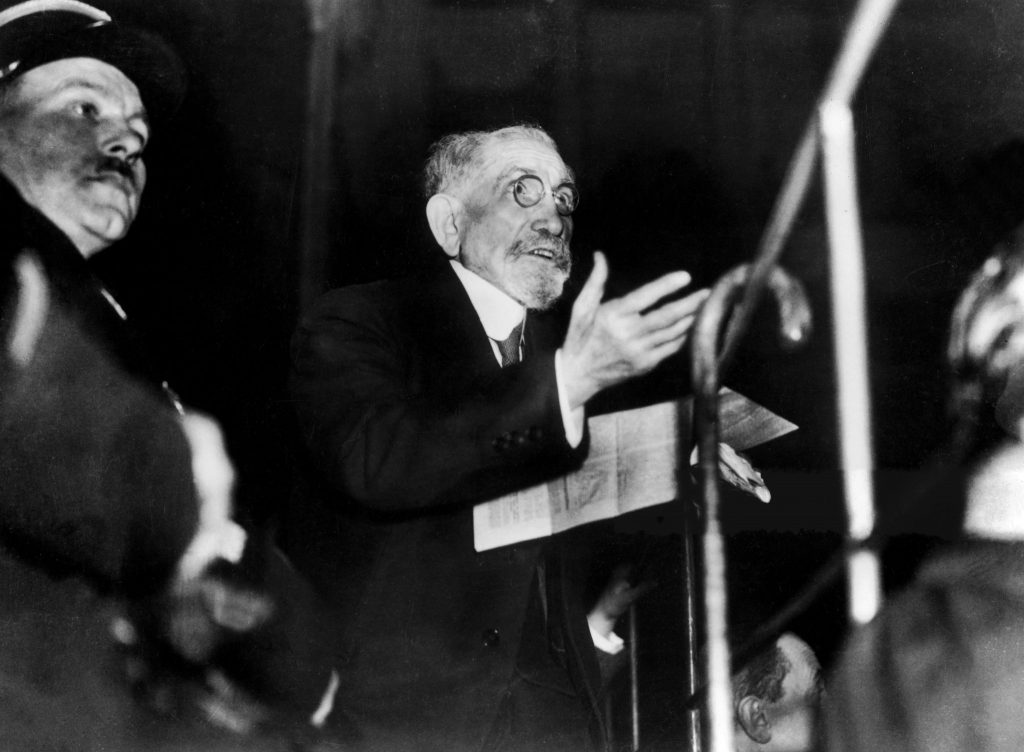
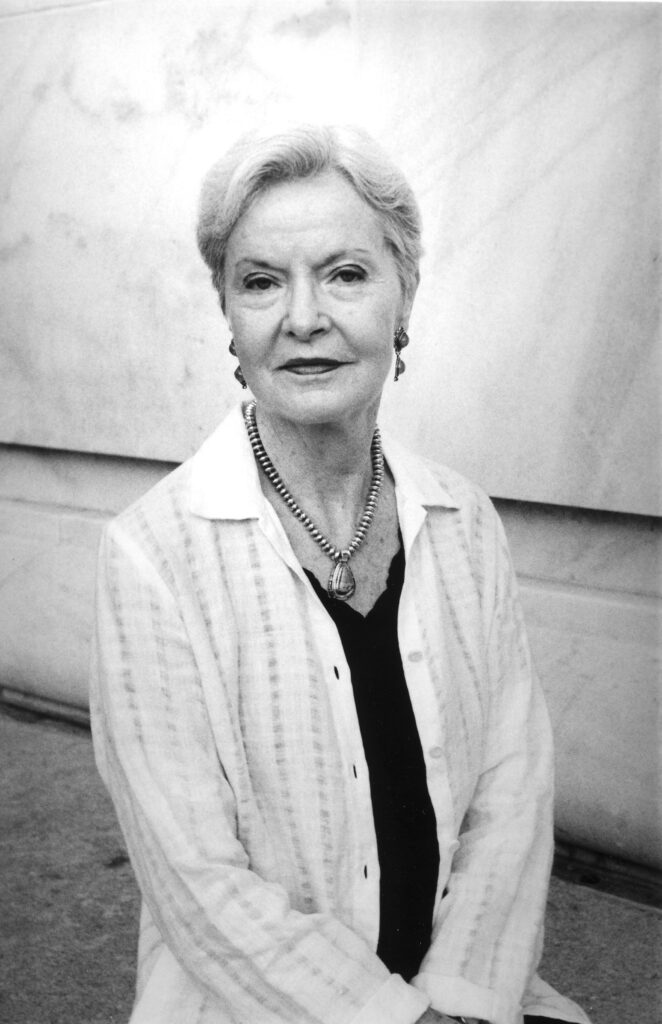
Overture for the 2013 English Music Festival

English Music Festival begins the year with curtain-raiser of rare gems

The Orchestra of St. Paul’s, conductor, Ben Palmer at St. John’s, Smith Square, London. 28th February 2013

STUART MILLSON

Before a note was played at February’s English Music Festival gala concert (part of their UK and European concert series), Mrs. Em Marshall-Luck, founder of this remarkable enterprise, took to the stage to introduce her players and repertoire. Unearthing old scores for the very first time, or rediscovering overlooked masterpieces of English and British music is the aim of the EMF, now approaching its seventh season; and as Em explained, the main Festival, beginning on the 24th May will contain three world premieres, two by Vaughan Williams, and one (the Second Symphony) by Sir Walford Davies, most famous, perhaps, as the writer of the RAF March Past. How strange that audiences have had to wait for so long to hear these compositions, and why is Sir Walford’s symphonic work unknown? The English Music Festival provides answers, and remedies, to these questions.

Ben Palmer

The evening at St. John’s afforded a glimpse of what will come in the spring: truly adventurous programming, and a desire to present an almost alternative perspective for English music. The first work which Ben Palmer and his versatile chamber-sized symphonic orchestra played was a 1938 creation in three short movements by Frank Bridge, Vignettes de danse; detailed and finely-proportioned miniatures, which created something of a Southern European spirit, and perhaps echoed Bax’s more famous and more direct-in-style, Mediterranean. Small-scale pieces work very well in the acoustic of St. John’s, that beautiful church near Westminster, now converted into a concert-hall. The textures of the Bridge Vignettes floated into the air, in an acoustic which although blessed with a feeling of reverberation and ‘echo’ is nevertheless clear and un-muddy, and free from any distortions and the dryness associated with more modern halls.

The main work in the first half was the Violin Concerto by Sir Charles Villiers Stanford, a great teacher and part of the English musical renaissance, particularly that part of the artistic flowering most associated with figures such as Parry, and Elgar: solid, romantic music, with connections to the Germanic style of the later 19th century, but with a profound, pronounced, perhaps difficult-to-summarise aura of Englishness. Stanford was once a famous composer, his Third Symphony (1887) being chosen to open Amsterdam’s great hall, the Concertgebouw; and yet today, we know him mainly for his setting of Drake’s Drum in Songs of the Sea. Fine and salty, and nostalgic, as this song is, it does not tell the whole of Stanford’s story.

Fortunately, the Violin Concerto, orchestrated by scholar, Jeremy Dibble, and admirably championed and played by the brilliant British soloist, Rupert Marshall-Luck, allowed us to see yet another unknown side of our musical heritage. Dating from 1918, the concerto had a lyricism (with lovely woodwind writing) and impressive structure, not perhaps as sweeping as Elgar’s incomparable work for the same combination of solo instrument and symphony orchestra, but nevertheless a ‘presence’ – especially, the darker slow movement which brought to mind clouds drifting across an Irish or Scottish landscape. (We should remember that Stanford was born in Dublin!) A sense of world events in the four years which led to the concerto’s composition should also not be forgotten. It must also be said that Rupert Marshall-Luck had a great deal of presence, too – and not just his brilliant skill and careful craftsmanship as a violinist. Full marks to this musician for wearing white tie and tails, clothing that is entirely right for music of this era, and for the act of music-making in general. Music is a ritual, and something to be honoured and savoured. It cannot, surely, be fully appreciated in casual dress.

Rupert Marshall-Luck

The interval saw the Festival CD ‘shop’ buzzing with business: eager English music enthusiasts buying the fine recordings which Em Marshall-Luck and her team of archivists and recording engineers have created; and it was encouraging to see this newish label receiving praise in the ordinary conversations of the concertgoers, all of whom seemed to be greatly attuned to the cause which the evening represented. The recording arm of the EMF, EM Records, is an institution that puts one in mind of Chandos or Lyrita, companies which combined a passion for exceptional sound, and rare, unregarded repertoire. So far, chamber music, and works for smaller-scale ensembles have formed the discography. It can only be a matter of time before large-scale symphonies enter the growing catalogue: Havergal Brian, I hope, or Elgar, or Cecil Armstrong Gibbs; perhaps, Parry, Bantock and Vaughan Williams.

And so it was time for the second half to begin, with an intriguing ballet score for small orchestra by Britten, Plymouth Town, an early work (1931) by this prolific Suffolk-born musician. We celebrate the Britten centenary this year, and how exciting that the Festival gave us a work that had been, for many years, lost in a huge pile of the composer’s jottings and student works. And again, we see just how important the EMF’s idealism is; a musical version, no less, of Channel 4’s archaeological programme, Time Team. Quite seriously, it is almost the same principle; hunches, investigations and revelations that bring our inheritance before our eyes.

Conjured into life by Ben Palmer and his orchestra, the opening rhythm of the ballet – almost primitive in its sparse strangeness – suggested the style of the score for Night Mail, the famous 1936 film which saw the collaboration of Auden and Britten. Plymouth Town has an instantaneous quality: by which I mean a realism, a sense of black-and-white, a directness and potency which evoked (to me) something of Stravinsky’s sinister, supernatural Petrushka. Britten’s Plymouth, though, is all about a sailor who succumbs to all kinds of temptations and misfortunes; and the very well-informed programme note for the evening suggested the theme of the corruption of innocence – an idea which informed several of the composer’s later works.

E. J. Moeran

Racing to the concert’s finale was E.J. Moeran’s Sinfonietta of 1944, dedicated to the great Sir Arthur Bliss, and inspired by the landscape of Radnorshire.

The arms of Radnorshire

Energy, wit, and quick wits abound in Moeran’s writing, and whenever his music is played (and it is played, I am sorry to say, infrequently) I cannot help but think of the composer’s time in the Kentish village of Eynsford, with that eccentric and elusive writer of the suite, Capriol, Peter Warlock. It is said, that on Sundays at their cottage in the High Street, “the kitchen was swimming in beer”! Moeran’s works have great force, a folkish, spritely spirit, and seem to exist in a sound-world that might be associated with Bax. The Sinfonietta provided an ideal end to this evening of discovery.

We now look forward to the 24th May at Dorchester Abbey, in rural Oxfordshire, for the first night of the main Festival for 2013.

STUART MILLSON is the QR‘s Music Editor

The English Music Festival’s website –  http://www.englishmusicfestival.org.uk/ – contains full details of this year’s programme, and a vast amount of composer-information.

Ben Palmer takes to the platform at Dorchester, conducting his Orchestra of St. Paul’s in a series of new commissions.

Martin Yates (who distinguished himself at last year’s opening night in works by Vaughan Williams, Ireland and Moeran) conducts the BBC Concert Orchestra once again, but this time in works which include the world premiere of Vaughan Williams’s The Solent.

Rupert Marshall-Luck appears on EM Records, and gives a truly beautiful performance of the powerful, noble and soaring themes to be found in the Bliss Violin Sonata.

Posted in QR Home | Tagged , , , , , , , , , , , , , , | Leave a comment

Uncollected Folk – Roy Kerridge on Lonnie Donegan

Uncollected Folk

ROY KERRIDGE remembers Lonnie Donegan

Ill at ease in the playground of my new grammar school, I roamed aimlessly around for a while, then stood transfixed as I heard a boy break into song:

“Railroad Bill, Railroad Bill,
He never worked and he never will.”

These sentiments went straight to my heart. Then and there Railroad Bill became my rôle model. Emboldened, I asked the boy what he was singing and he replied, “A Lonnie Donegan song”.

Railroad Bill, it turned out, was no longer alive, having succumbed to “a .38 pistol as long as my arm”. But Lonnie Donegan was very much around in the 1950s, and I pledged myself as his disciple then and there. It seemed only fitting that I should learn about this folksinger by word of mouth. Records and a record player soon followed.

Lonnie Donegan, a Cockney of Glasgow-Irish descent, died in 2002. A year later, Spencer Leigh, the Liverpool pop musicologist, wrote a witty and informative book about Lonnie, Putting on the Style (published by Finbarr International). Now a new and far more expensively-produced volume has appeared, Lonnie Donegan and the Birth of British Rock and Roll, by Patrick Humphries, published by Robson Press and costing £25.

Now Lonnie Donegan came from a jazz background, and never liked rock and roll. He wished to popularize hitherto unknown American folk songs, not to launch “British rock and roll”. However, he ended up doing both. Many young people became curious about the origins of his “skiffle songs”, but a surprising amount of youngsters assumed the revitalized ditties to be new. Many of the first lot became folklorists, and many of the second lot became rock musicians. Some excellent English rock and roll singers became deservedly well-known during the Donegan Years of 1956-60 – Billy Fury, Joe Brown and Johnny Kidd, for a start. They co-existed with Lonnie, but the Lonnie-inspired Beatles and Rolling Stones wiped him out.

Billy Fury Statue (Face), Liverpool Royal Albert Dock

I remember hearing Lonnie at the Brighton Ice Rink in ’63 or ’64. He sang and played banjo and guitar as well as ever, but the audience jeered at him. “Beatles! Rolling Stones!” irreverent young men shouted. “Beetles? I’ll get some D.D.T.” he yelled back lamely.

To the end of his days, Lonnie voiced his disgust at “British rock and roll”. He seemed particularly peeved at the Beatles and Stones being honoured with titles. “Sir Ringo? Syr-ringe, more like,” he once remarked.

Never associated with drugs, he censored American folk songs with “druggy” lyrics. “Have a Whiff on Me” became “Have a Drink on Me”, and the “reefer factory” in “Junco Partner” became, rather senselessly, a “roofless factory”. In doing so, Lonnie was following a time-honoured American Southern tradition. Freeny’s Barn Dance Band in the 1920s similarly censored “Have a Whiff on Me”, and equally senselessly changed the word “cocaine” to “croquet”! Blues singer Blind Lemon Jefferson favoured “crochet”! However, the Rolling Stone-type British singers not only sang openly of drugs but used them too, setting a bad example to their fans.

I met Lonnie Donegan twice, in the twilight of his career, and enjoyed two long conversations with him. He certainly knew his stuff – a great expert on blues and country music. Nervous of his reputation for waspish irascibility,   I quickly changed the subject when the conversation veered dangerously near the fact that immersion in Lonnie’s jailhouse songs once made me yearn for crime and prison. I could feel a surge of temper arising in Lon, but switched the conversation just in time, and all went well.

Since Lonnie disliked the Sixties wave of rock music, and poured scorn on the Beatles, it seems a little hard on the poor man that Humphries’ book consists largely of quotes from the very rock singers whose new style ruined him. True, the Beatles and Stones all praise Donegan, but the folk singer’s belief that theirs was an inferior music is treated as a foolish but loveable eccentricity. In my opinion, Donegan was right. When beat music became psychedelia, it became Satanic. How many minds have been lost through listening to such trash? Humphries takes for granted that the Beatles and Stones are gods, and Lonnie the John the Baptist figure. Admittedly Lonnie swallowed his pride and allowed himself to be photographed with an assortment of Beatles, as shown on the book’s brightly-coloured dust jacket. He accepted help from the Stones-Beatles set on an L.P. called Putting on the Style, and took some pleasure in ordering piano player Elton John about, giving the egregious star the nickname “Peaches” (a Peach Tree Man is a homosexual in blues parlance). When in such company, Lonnie seemed to smile through gritted teeth.

Some Englishmen enjoy country music, others enjoy blues, but if you meet a man who likes both, he almost certainly learned his tastes from Lonnie Donegan and is at least 70 years old! This is the age group who wish to read about Lonnie Donegan, and I think Humphries’ attempts to woo young readers by describing the 1950s as an unbelievable “olden days”, when people used washboards instead of washing machines, will irritate his ancient audience. My 1950s lasted until 1981, when our first household washing machine arrived. Washboards, mangles, washing lines and sheets hung on apple trees form a distant background to my life. In the Lonnie-inspired skiffle groups, the washboard became a percussion instrument. Donegan himself picked out the most skilled musicians he could find, with drums, electric guitars and finally the accomplished Nick Payne on saxophone.

Like me, the young Lonnie sought folk music knowledge in Collett’s Communist Bookshop, in London. Here I bought Woody Guthrie and Leadbelly songbooks, but could not find the records of these Lonnie-favoured singers. So I knew the words, but not the tunes, until rescued by Donegan (I can’t read sheet music). When communism fell, Collett’s vanished, no doubt bereft of Kremlin support.

I would like to have learned more about Lonnie’s inner life, his Roman Catholic faith belying his interest in Holy Roller songs. What were his politics, if any? In his late years, he played at Conservative clubs and occasionally at Labour Party rallies. I was pleased to find that he enjoyed Pepys’ diaries and the works of Dickens, but what other books did he like? The seeker for skiffle information gets only Beatle quotes.

I am guilty of Lonnie mistakes myself. I wrongly assumed he was brought up “posh” like his first bandleader Chris Barber. Not so – when Donegan sang “My Old Man’s A Dustman”, he was being “authentic” for the first time, using his real accent instead of an American Southern voice.

Sad to say, Lonnie died before achieving his ambition of recording an album of Irish songs. The few Irish songs he did sing are among the most poignant of his career, learned by word of mouth from his mother. He frequently toured Irish clubs in his later years. Lonnie’s greatness lies in the fact that he could transcend the gap between the self-conscious educated “folk audience” and the less sophisticated souls who grew up with music hall songs and Irish ballads. He could please both audiences, and at some point in his professional life he realised it is not immoral to sing a non-folk song. If you like a song, sing it! In working men’s clubs he could belt out “Me And My Girl”, “Tipperary” and other songs known to working men, in the days when men worked. At these times, he appeared to be genuine, the sort of person a scholar collects folk songs from.

Both Lonnie-ologists, Leigh and Humphries, are more than forthright in their likes and dislikes of Lonnie’s huge catalogue of songs. Unlike Spencer Leigh, Patrick Humphries makes several little mistakes when he writes about American folksongs. He dismisses “The Passing Stranger” as a lugubrious film theme song. It may have appeared as a film score, but it is actually a very creditable version of an Appalachian ballad more commonly known as “I Was Born in East Virginia”. Humphries refers to “John Henry” as a “Leadbelly original”, as if the composer of this age-old song could be nailed down to any one performer.

Incidentally, I used to wonder why I always pictured my grandfather Adolf as buried under a heap of sand, his real burial place unknown to me. Suddenly it came to me – I had confused him with John Henry!

“They buried John Henry by the railroad,

They buried him ‘neath the sand”

A crooked solicitor told me that “In Germany they bury people where they die, and as your grandfather died on a train there he’ll be buried beside the railway line somewhere”. This turned out not to be true. Lonnie himself made some mistakes with his songs, and mangled the historic accuracy of “The Battle of New Orleans” somewhat. In “The Doctor’s Daughter”, a rhymed re-telling of an Appalachian “Jack” story, he confused the folklore figure of Paul Bunyan with the booklore figure of John Bunyan. “Casey Jones” gets mixed up with “Steamboat Bill”, but never mind, they are still all great songs as performed by Lonnie.

The blues duo of Brownie McGhee and Sonny Terry often visited England during Lonnie’s reign, no doubt inspiring our hero. For his version of “Don’t You Rock Me, Daddy-O”, Lonnie borrows a verse from one of their songs, “Old Jabo”. Both the phrases “Rock me” and “Daddy-O” are found in old folk songs, incidentally – “Rock me” in many blues songs, and “Daddy-O” in a Scottish song performed by my top favourites, the Alexander Brothers, “The Day We Went To Rothesay-O”.

In his final years, Lonnie’s tastes diverged from mine, as he evidently grew to like ultra-modern country and western songs by Willie Nelson and Kris Kristofferson, un-Kerridgean characters both. I knew Lonnie when he was more Brownie McGhee than Bobby McGee, and his earlier songs will be listened to until my generation is no more.

ROY KERRIDGE is a folklorist and author

Posted in QR Home | Tagged , , , , , , , , , | 1 Comment

Special path to hell

Special path to hell

LESLIE JONES examines a German wartime functionary’s disingenuous memoirs

A Small Town near Auschwitz: Ordinary Nazis and the Holocaust

Mary Fulbrook, Oxford University Press, Oxford, 2012, hb, 421 pp, £20

Udo Klausa was the Landrat (chief administrator) of the Landkreis (County) of Będzin, in the border region of Eastern Upper Silesia, annexed by Germany after the invasion of Poland in September 1939. He was by all accounts a thoroughly “decent” German- a devout Catholic, a family man and a brave soldier. Yet qua functionary, he helped to implement racial policies designed to exploit, expropriate and ghettoize the local Jewish community, the prelude to rendering this area judenfrei (Jew free). Indeed, in Będzin town, Klausa and his wife lived in the “villa of the Jew Schein” which was filled with furniture confiscated from local Jews, acquired at knock-down prices. Whatever reservations Klausa may have had about the policies in question (reservations informed by his religious beliefs) their successful implementation depended on conscientious administrators like him. As Mary Fulbrook observes, it was ultimately how such people behaved in these years that mattered, not what they thought or felt.

Furstenberg High School

Concerning the pre-war community of Będzin, approximately half the population of the town at this juncture was Jewish. One former resident recalls that by late Friday evening, when the celebration of Shabbat commenced, it resembled a ghost town. A former student of the Fürstenberg Grammar School (or Jewish High School) remembers how the school’s brass band led an annual procession to the Great Synagogue, perched below the castle. There, the Rabbi would bless the school’s endeavours in the forthcoming year. Yet by the end of 1943, almost all of the school’s students and teachers were dead. Virtually all that remained of a rich Jewish community life were the memories of the few survivors and the photographs collected from victims’ clothing by Jewish prisoners in Auschwitz. As for the Great Synagogue, it was burnt to the ground in September 1939 with several hundred souls inside.

Born in 1910 in Allenstein in German East Prussia, Klausa belonged to the “war youth generation”. As a fifteen year old boy, he joined the Following (Gefolgschaft) which engaged in disguised military training. He was a convinced nationalist and critic of the Versailles treaty, especially in regard to the contested German-Polish border.

A lawyer by training, Klausa joined the Nazi party in February 1933 and was an enthusiastic member of the SA. After the war, Klausa claimed that his primary reason for joining the NSDAP was to progress his career. But he conceded that he had welcomed Hitler’s assumption of power, in particular his attempt to deal with the problem of unemployment and concomitant social unrest. He had also hoped to counteract the baneful influence of the “riff raff” within the movement’s ranks.

Klausa’s tenure as Landrat in Będzin commenced in March 1940. Yet before this date he held a succession of important positions in the administration of the annexed territories, first in the Sudetenland, then in Bohemia and Moravia and finally in Posen, where he was Personal Assistant to August Jäger, the Deputy of Arthur Greiser, Gauleiter of the Warthegau. In Posen, Klausa’s job was to implement a whole gamut of racial policies, notably the expulsion en masse of Poles and Jews into the adjoining General Government and their replacement with ethnic Germans (Volksdeutsche) from the Baltic States, Volhynia and Eastern Galicia. As Alexandra Klausa informed a friend in November 1939, referring to her husband’s “great task”, “Conquering the eastern territories and a farsighted colonization…could be something great – a parallel to…the Teutonic Knights”.

Udo Klausa in July 1939

Professor Fulbrook (the goddaughter of Alexandra Klausa) has painstakingly pieced together the details of his wartime career, both as civil servant and soldier. She considers in particular his exculpatory memoirs written in 1980, which enabled him both to live with his past but also to avoid punishment. He depicted himself therein as only nominally a Nazi and conveniently claimed to be on military service when some of the more notorious incidents occurred in Będzin. No mention was made of public hangings which he must have witnessed; of enforced starvation; of deportation to labour camps, including the labour camp at Golonog, whose ill-fed inmates had to work on railroad construction for eleven hours a day.

One infamous incident that took place in the Landkreis of Będzin while Klausa was in post was the execution by the gendarmerie of 32 innocent Poles at Celiny, on 6th June 1940, in reprisal for the killing of a German policeman. In 1960, this incident was investigated by the Ludwigsburg Central Office for the Investigation of National Socialist Crimes. Klausa told the Ludwigsburg authorities that he was on military service in France at the time. In fact he was on leave in the neighbouring Landkreis of Tarnowitz. He may even have authorised the killing over the telephone. Moreover, as the author convincingly argues, Klausa’s initial absences on military service (in 1940 and then again in 1941) were no “flight to the last bastion of decency, in an otherwise unbearable regime”, as he tried to suggest (not that the army was a bastion of decency*). He had always intended to serve his country militarily and in early summer 1940 was understandably keen to participate in a seemingly endless series of victories.

In the spring and summer of 1942, thousands of Będzin Jews were brutally rounded up and made to assemble in the Hakoach sports ground opposite Klausa’s villa and in other locations. Those deemed unfit for work were immediately dispatched to the gas chambers of nearby Auschwitz. Klausa, invariably economical with the truth, concedes in his memoirs that he witnessed some of the deportations during the week of 12 to 19 August. His version of these events is that he immediately returned to the front rather than play any further part. In reality, he did not resume his military duties until December 1st 1942. He was still in Będzin when the fateful decision to consolidate the Jewish ghetto prior to deportation was taken. He also denied knowing at the time that a programme of mass extermination was taking place at Auschwitz. Alexandra Klausa’s correspondence indicates that her husband’s nerves, a recurrent problem, were a serious concern at this juncture. Had the “sheer criminality of the Nazi enterprise” and his own role within it, however minor, become all too apparent?

In From Bendzin to Auschwitz: A Journey to Hell, Arnold Shay ruefully remarks,

“Bendzin** Jewry flourished in poverty and under Polish anti-Semitism, and we brought pride and civility to the cities we lived in. Now Bendzin as we knew it is no more, and will be no more…”

It was “decent” Germans like Udo Klausa who helped to destroy these once thriving communities.

Dr. LESLIE JONES is the deputy editor of the Quarterly Review. © Leslie Jones, February 2013

NOTES

* See Christopher R. Browning, Les Origines de la Solution Finale, p 53 and passim

** There are various spellings of this place name


Posted in QR Home | Tagged , , , , | Leave a comment

Ceuta – Spain’s Rock

Ceuta – Spain’s Rock

BILL HARTLEY visits a surviving fragment of the Spanish Empire

Gran Casino, Ceuta

The ferry from Algeçiras makes the world’s shortest intercontinental crossing as it travels to North Africa. Yet if the destination is Ceuta then the traveller remains technically at least in Spain. This strange exclave, one of two – the other, further down the coast, is Melilla – is considered part of Metropolitan Spain and returns a representative to the Cortez. The Moroccans disagree but the Spanish refuse to talk. Over in Gibraltar, Spain might be accused of hypocrisy but they believe international law is on their side. They argue that Ceuta was never a colony like Gibraltar.

This is a subject for debate perhaps among international law specialists. That apart though, what is the point of Ceuta? Strategically one can easily see some significance. From the air, the nine mile gap between Ceuta and Gibraltar is a tantalisingly narrow passage through which traffic in and out of the Mediterranean has to pass.

If Spain regained Gibraltar, so the argument goes, then it would control both sides of the straits. However since this is an international waterway little significance other than the symbolic can be attached to the idea.

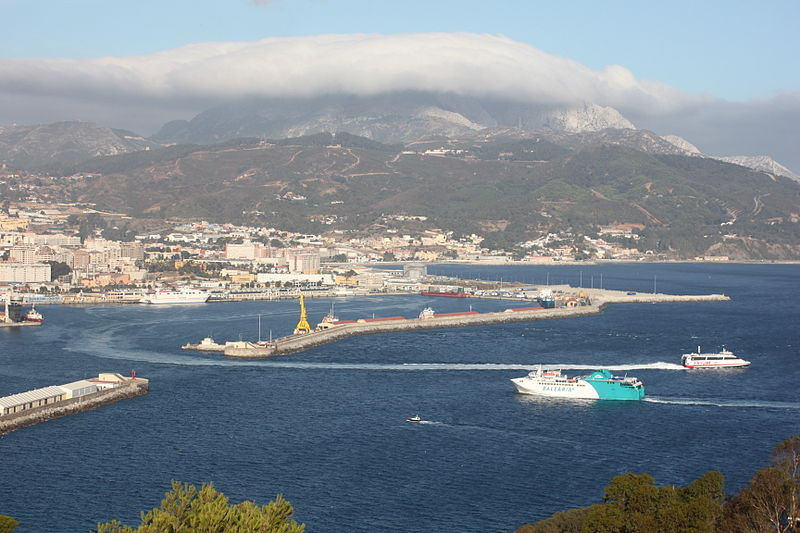
Arriving at Ceuta, one is immediately struck by how underused the port is. Evidently roll-on-roll-off ferries are adequate to meet the needs of the 80,000 Spaniards who prefer to live in Africa. The port has no modern cargo handling facilities and sees little traffic other than the frequent ferries. Even at the height of the summer season they run three quarters empty, hinting at the subsidy supplied to the Balearia Shipping Line by Madrid. Were ferry sailings reduced to a more realistic level, then arguably some Ceutans might not find the 19 square kilometre territory such an attractive place to live, especially since there is no airport or indeed room to build one. Like its British counterpart across the water, Ceuta is a steep and rocky place beyond the confines of the town. Lack of an international airport suggests that the territory can never really succeed. This was the case with the former Portuguese colony of Maçao which withered whilst Hong Kong flourished.

Ceuta is a place for curiosity seekers and day trippers with tax-free shops and some good restaurants. The beach nearest the town is a rather pathetic strip accommodating a few local families on summer evenings. There is a semi-interesting fort, and  the Spanish  Foreign Legion has a museum in the town. The theory that Ceuta/Gibraltar were the Pillars of Hercules of the ancient world is given credence by climbing to the summit of Monte Hacho, which overlooks the port. From here on a clear day Gibraltar stands across the water like its twin. The Legion has a fort here and another lies on Monte Anyera, above the frontier with Morocco.

Port of Ceuta

Apart from the vague strategic argument for hanging on to the place Ceuta would seem to be more burden than benefit for Madrid. Mainland Spaniards for example pay a 2% surcharge on their bills so that Ceuta gets its electricity. The burden is also illustrated by the rather silly sign at the frontier with Morocco announcing that the visitor is now in Spain. Not so silly to the would-be illegal immigrants from North Africa who see this bit of barren hill and rock as a stepping stone to Europe. Border policing is expensive and thorough and wouldn’t have looked out of place in the old Soviet bloc. The Civil Guard carefully check papers and search vehicles to make sure undesirables don’t get through. There must have been some successes though, since security is equally strict down at the ferry terminal. Up in the hills the whole territory has had to be fenced off at great cost and is patrolled by members of the Spanish Foreign Legion. Presumably this gives them something meaningful to do. Otherwise their presence might only exist as a deterrent against the Moroccans chancing their luck and just marching in, as the Indians did with the Portuguese territory of Goa in 1961. All those Legionnaires contribute to the high level of public sector employment in the territory which is said to be 33%, as opposed to 12% in mainland Spain.

Arguably Madrid’s refusal to discuss the future of the territory with Morocco has brought about its continuing decline. Unlike Gibraltar with its financial services, dockyard, employment for 4,000 Spaniards and a GDP of nearly two billion pounds, Ceuta generates little real economic activity. Down the coast Tangier has long been regarded as the ‘Gateway to Africa’, more a romantic statement than a reality since its port is little better than Ceuta’s. However things have changed. Between Tangier and Ceuta lies Tanger Mer, where the expression is rather more realistic. Here a new port has been established with modern cargo handling facilities for the rapid turn round of container ships. This is supported by an excellent road network and an electrified rail link. With a second deep water port planned, Tanger Mer is set to become the largest in Africa and will be able to take advantage of a free trade agreement with the EU which came into force in 2012. It is easy to see how Tanger Mer will run its tentacles deep into the Maghreb. The knock-on effect can be seen right up to the Ceutan frontier. The Moroccan town of Techuan with its 25 kilometres of fine beach has a long strip of new seafront properties and hotels. At the frontier, trade with Ceuta largely amounts to whatever the locals can carry in the back of a taxi. Arab patience is severely tested by the lengthy wait whilst security checks are completed.

There is then the sense of a curious backwater, a bit of Spain clinging on in North Africa and doing nothing of value. With the creation of Tanger Mer, Spain has probably lost its opportunity to do something with the territory that would be of benefit to both countries. The question the Moroccans must be asking themselves is how long can Spain with its financial problems afford the cost of maintaining this outpost in Africa?

BILL HARTLEY is a freelance writer based in Yorkshire, and a frequent contributor to the Quarterly Review


Posted in QR Home | Tagged , , , , , , , , | 1 Comment

Slavoj Zizek – the Left’s visionary of violence

Slavoj Žižek – visionary of violence

HENRY HOPWOOD-PHILLIPS examines one of today’s most lionized Leftists

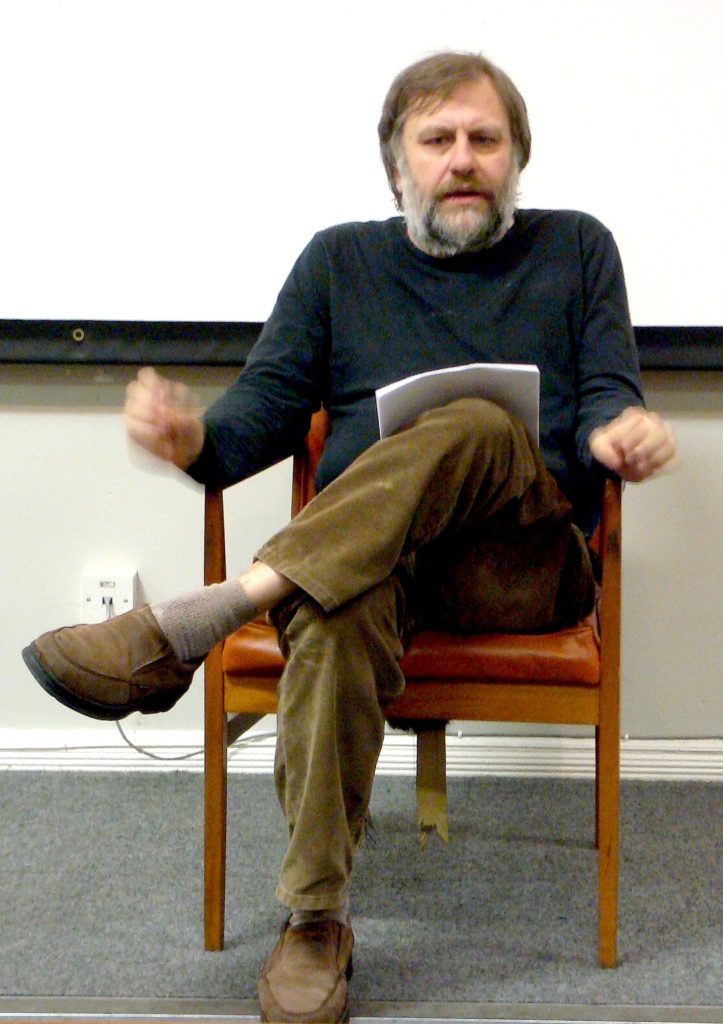
Slavoj Zeek

Born in 1949 to an economist and an accountant in Ljubljana, Slovenia, Slavoj Žižek is a cultural critic renowned for his innovative interpretations of the psychoanalyst Jacques Lacan. Žižek is quite possibly the closest thing the 21st century has to a living philosopher. Although an academic at several universities (including Ljubljana, Columbia, Princeton, New York and Michigan) the professor is far from fusty.

The Slovenian’s work is full of humour and contains a blatant disregard for the distinctions conventionally made between high and low forms of culture. Terry Eagleton’s description perhaps hits on the professor’s unique qualities:

“There are two jokes in particular that are, so to speak, on the Žižekian reader. The first…Žižek looks like a fun read, and in many respects is so; but he is also an exceptionally strenuous thinker reared in the high traditions of European philosophy. The second is that Žižek is not a postmodernist at all. In fact, he is virulently hostile to that whole current of thought… If he steals some of the postmodernists’ clothes, he has little but contempt for their multiculturalism, anti-universalism, theoretical dandyism and modish obsession with culture.”

Žižek steals postmodern clothes, including, if one wanted to be cruel, postmodern language – academese. Make no bones about it – it is often hard work deciphering him. However, his work can be summarised as an extended critique of the West’s current liberal and globalist ideology, which is so embedded in our consciousness that it has become almost second nature. The ideology has in fact become the system. He says,

“Ideology is strong exactly because it is no longer experienced as ideology…we feel free because we lack the very language to articulate our unfreedom.”

Žižek reminds us that in an age when we are encouraged to believe we are freer than any other,

“[M]adness is not only the beggar believing himself to be a King. He is the King who really believes himself to be a King.”

The current ideology is remarkably successful because it sells itself as an anti-ideology, in the same way a folk singer might adopt an anti-capitalist avatar to fulfill a market niche. It proposes no concrete positive project but rather its logic slowly shuts down the alternatives. The body politic facilitates this process by resisting political ‘extremes’, encouraging managerialism, and adopting a victimist narrative that cushions actors from their actions, arrests responsibility and incentivises stability. All values which are not already embedded in the system’s logic are dismissed alternately as quixotic or millenarian, naive or futile. Even its most serious historical opposition, Marxism, has been neutered. In such circumstances Žižek laments how the left has been “caught with its pants down”, failing to offer either a genuine alternative or even a proper critique. Even investigative journalism of a leftist bent rarely offers anything more adventurous than a “bourgeois heroism”: exposing inefficient practices such as corruption or criticising disproportionate rewards. Politics barely survives this political vacuum. It is reduced to the residue that remains when values are subtracted from life, its highest end relegated to little more than the coordination of interests.

Žižek violently disagrees with this therapeutic belief-system. In this post-political age, he argues that we are “desubjectivized” in the name of liberation without being offered new values or foci for allegiance. This is the plea of many who are grasping for an identity in a market place which offers rootless, disposable, superficial and flattened modes of being.

The global order is sustained less by explicit censorship than by restriction of scope. It is not what is proscribed but what is not acknowledged that matters. Immigration is a brilliant example. Žižek describes liberal multiculturalism as “barbarism with a human face”. Authentic difference is translated through a series of legal fictions into matters of sterile indifference. Prohibition is prohibited so that actual otherness is either illegal or personalised to the point of public irrelevance so that, with a paradoxical brilliance, the more tolerant a society becomes the more homogenous it becomes. Anxiety, identity and boredom replace fortitude, pride and being. “Respect” and “difference” become articles of faith, holy particulars forming misguided substitutes for the ideas of commonality that used to constitute the locus for Man’s liberation.

The global order is dependent on capitalism, which is now fleeing from its earlier liberalizing manifestations. International capital undermines national democracy and it is the latter which is jettisoned – as we are presently witnessing in Greece. Peoples, once valued as peoples using the market to fulfil themselves, are reduced to components used by markets to fulfil capabilities.

Yet the market is inherently unbalanced. Like a car spinning its wheels in a ditch, we remain stuck in “turbo paralysis” (1): a permanent emergency mode. The ruling classes have drifted from being direct owners of capital to being its detached managers who ‘do time’ for companies that can provide dividends to shareholders almost on autopilot, in return for astronomic remuneration irrespective of their performance.
Meanwhile the lower-middle classes are being re-proletarianised as their skills are rendered un-monetisable or replaced by machinery. The middle classes are becoming an anachronism, necessary to early and middle stage capitalism but increasingly irrelevant in its advanced forms. The future, says Žižek, is Dubai “where the other side are literally slaves”. Žižek is being flippant, but he hits on the point that the midde there is neither large nor organic, but rather an extension downwards of elites, like a court, rather than upwards of workers, as in orthodox models for economic advancement.

The welfare state has, accordingly, moved from being a safety net to a device that purchases the acquiescence of the unemployed. But this model is based on political calculation, not love or national fraternity. As technology races and income inequality soars, political reasoning may change. South Africa and its gated apartheid are more likely an indication of the future than the UK and its welfare state.
These profound changes in our system are being addressed in a woefully inadequate manner. Myopic managerialism has consistently and cynically addressed consequences instead of causes, and the bigger picture has been lost.
According to Žižek, when ideology “oppresses” in this manner, violent rebellion becomes nothing short of a moral duty. Although Žižek would doubtless dislike the comparison, such resistance to ideological weight lies at the heart of every fascist or jihadist. All wish, not for their own patch under the sun, but a new sun altogether. Indeed, some mainstream commentators have speculated that Žižek seems to desire a “perfected” non-racist form of fascism.

Žižek uses (or misuses) Hegel to justify this rebellion (2). He acknowledges that violence may be painful and dangerous but claims that it is also a duty to participate in the dialectic. Chaos and hope are held up as preferable to stability and despair. This revolutionary defeatist philosophy was best encapsulated by Mao: “There is disorder under heaven, and the situation is excellent”.
In any case, Žižek feels that violence perpetuates the system as much as it violates it. From law to foreign policy, ideology arbitrarily validates violence according to its own agenda. It is important to remember with Žižek that his conceptions of violence rarely promote the physical variety. For him, Gandhi was a true radical, because with little physical violence and great mental exertion, he completely replaced one system with another.
The Slovenian believes that violence has a redemptive power, a cathartic core. He demands that violence be acknowledged as capable of containing a kind of “goodness… able to injure – to injure savagery” (Brecht) – a violence not aimed at people as people but rather people as instruments. Such a rationale will sound tragically familiar to those familiar with 20th century history.

Žižek is fond of a modern rendering of St Paul’s quote in Ephesians 6:12:

“Our struggle is not against concrete, corrupted individuals, but against those in power in general, against their authority, against their global order and the theological mystification that sustains it”. (3)

Whether you agree with his analysis or not, Žižek opens your eyes to “an old world… dying, and [a] new struggl[ing] to be born”, a reluctant recognition that “now is the time of monsters” (4).

HENRY HOPWOOD-PHILLIPS works in publishing in London

NOTES

1. Mark Lind, Spectator, Christmas 2012

2. For example, “I adhere to the view that the world spirit has given the age marching orders. These orders are being obeyed. The world spirit, this essential, proceeds irresistibly like a closely drawn armored phalanx advancing with imperceptible movement, much as the sun through thick and thin. Innumerable light troops flank it on all sides, throwing themselves into the balance for or against its progress, though most of them are entirely ignorant of what is at stake and merely take head blows as from an invisible hand.” (Hegel writing to Niethammer, 5 July 1816). In reality, Hegel was strongly against violence

3. The King James original is “For we wrestle not against flesh and blood, but against principalities, against powers, against the rulers of the darkness of this world, against spiritual wickedness in high places

4. Gramsci, Selections from Prison Notebooks, 1971


Posted in QR Home | Tagged , , , , , , | Leave a comment

Why the Left is sometimes Right

Why the Left is sometimes Right

FERGUS DOWNIE examines the crossovers between supposed ideological enemies

In Arthur Koestler’s wartime novel Arrival and Departure, there is a striking scene where the author introduces a prototypically modern Nazi diplomat, who expounds on the intrinsically revolutionary character of the Third Reich before descanting on a vision of Europe in which history and tradition are rendered a junkyard. It is worth quoting at some length as it highlights a feature of the fascist worldview which is rarely explored with any intellectual rigour and consistency

“The laws of orthodox economy, customs, currency, frontiers, parliaments, churches, vested sacraments and institutions, marriage, ten commandments – all mumbo-jumbo. We start from scratch. I’ll tell you how…Close your eyes. Imagine Europe up to the Urals as an empty space on the map. There are only fields of energy: hydro-power, magnetic ores, coal-seams under the earth, oil-wells, forests, vineyards, fertile and barren lands. Connect these sources of energy with blue, red, yellow lines and you get the distributive network. Blue: the joint electric power-grid stretching from the Norwegian fjords to the Dnieper Dam; red: the controlled traffic-stream of raw materials; yellow: the regulated exchange of manufactured goods. Draw circles of varying radius around the points of intersection and you get the centres of industrial agglomeration; work out the human labour required to feed the net at any given point and you get the adequate density of population for any district, province, and nation; divide this figure by the quantity of horsepower it introduces and you get the standard of living allotted to it. Wipe out those ridiculous winding boundaries, the Chinese walls which cut across our fields of energy; scrap or transfer industries which were needlessly built in the wrong places; liquidate the surplus population in areas where they are not required; shift the population of certain districts, if necessary of entire nations, to the spaces where they are wanted and to the type of production for which they are racially best fitted; wipe out any disturbing lines of force which might superimpose themselves on your net, that is, the influence of the churches, of overseas capital, of any philosophy, religion, ethical, or aesthetical system of the past.” (1)

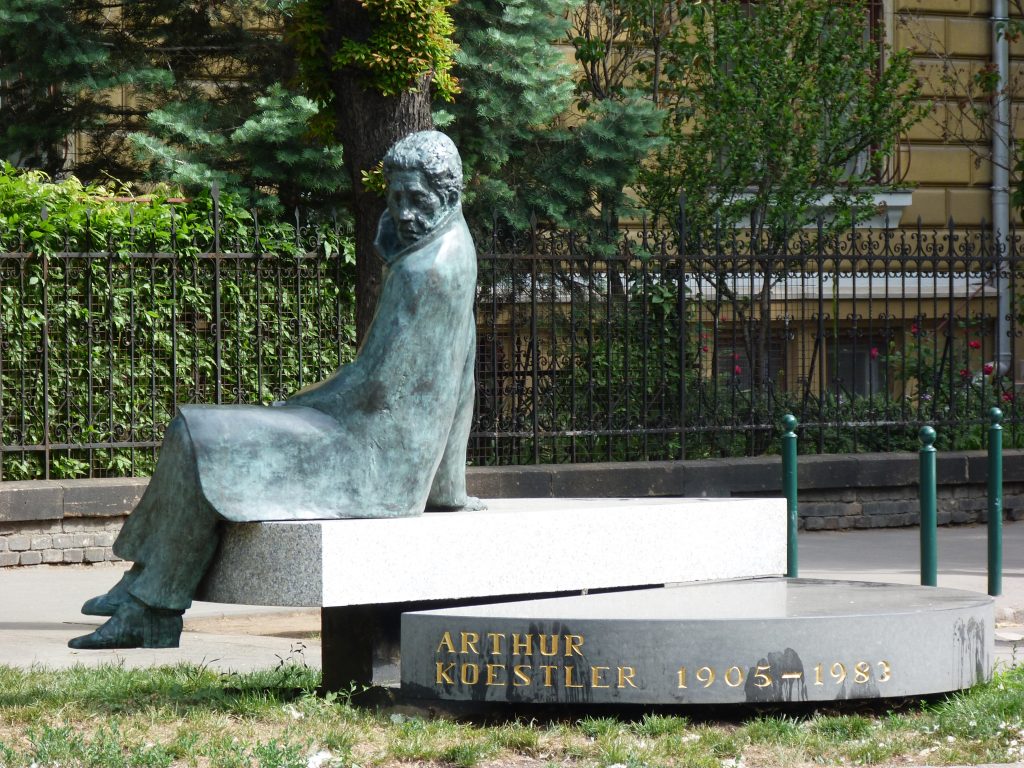
Arthur Koestler, Budapest

This is not an aspect of the Nazi world-view which comes across often in much of the laboured Marxisant-cum-Freudian analysis which hovers between some hackneyed variation on Nazism as the Final Crisis of Capitalism (the disastrous misjudgment of the German Communist party) and half baked theories of repression. Even where the studies are grindingly empirical they have a tendency unconsciously to assume that a focus on the human base material in itself captures the essence of a phenomenon as elitist as fascism. As a movement with a disproportionate following amongst an almost pre-industrial petit bourgeois threatened with proletarianisation, there has been an inevitable tendency to see Nazism as the last bloody gasp of an old world. What could be more indicative of this kind of recoil from the modern world than the pronounced anti-urbanism of the Nazis with all their glorification of the peasantry and the mittelstand, backed up by economic policies which might have been lifted straight from the Papal Encyclical Rerum Novarum? This is a misconception however, for what is more characteristic of the modern ideological age than the conscious recreation of tradition? Nothing is more revolutionary than a fascist, a fact which in large part explains the inordinate influence of Carl Schmitt, Martin Heidegger and Oswald Spengler on Frankfurt School Marxists.

Certainly, the modernity of fascism did not go unnoticed by the avant garde who recognized a kindred spirit when they saw one, and the endorsement of so many Futurists and Dadaists was handy for any movement staking a claim on the future, a pose historically adopted by socialists and the source of a cultural cachet which increasingly hemorrhaged towards fascist men of action. Most of the leaders of the fascist first wave saw themselves as self-consciously transcending the limitations of ‘actually existing’ socialism, and dissatisfaction with the increasingly bureaucratic and intellectually moribund state of parliamentary socialism had been mounting throughout Europe’s long fin de siècle.

In France, George Sorel’s antidote – an embrace of extra-parliamentary syndicalism and the aestheticisation of violence – presaged a kind of Left Fascism which was to become particularly influential in the 1930s. As far back as 1900 the Action Francaise founder Charles Maurras had asserted that

“…a socialism liberated from the democratic and cosmopolitan element fits nationalism well as a well made glove fits a beautiful hand”

and contrary to the Marxist cult of its own martyrdom (which conveniently diverts attention from their active collaboration with the Nazis following the Nazi-Soviet pact), the primary enemy of the extreme Right has always been bourgeois capitalism and the decadent world of parliamentary liberalism. Moreover, they furnished a critique which the Left was more than happy to adopt even when they remained on the Left.

FRANCE – CIRCA 1945: Nationalist, Germanophobic, Royalist Orleanist And Anti-Semitic Maurras Was Trialed For “Secret Dealings With The Ennemy”. (Photo by Keystone-France/Gamma-Keystone via Getty Images)

The greatest novelists and writers of the preceding two centuries had mostly been men of the Right, with Nietzsche only a belated complement. Joyce’s or Proust’s hatred of the bourgeois philistine could make them useful allies of the Left and when the Left replaced Marx with Nietzsche, they were able to enlist the literary tradition of the 20th century in the service of ostensibly progressive ends (3).

But it was ever thus. These fluid boundaries between Left and Right predate this Nietzscheanisation of the Left and are evident in the mental furniture of the first self-declared socialist, Saint Simon. An ardent admirer of de Maistre, Saint Simon’s vision of a socialist utopia had one foot in the future and the other firmly in the Counter-Enlightenment; his Religion of Humanity a harbinger of the “god building” (4) which the Bolsheviks were later to turn to in an attempt to provide their arid materialistic ideology with some spiritual ballast. Marx himself was well acquainted with the ever present possibilities for ideological synthesis: it was serious enough for him to devote an extended passage in the Communist Manifesto to attack the false consciousness of feudal socialism, and he himself was not immune to the charms of its chief theoretician Thomas Carlyle, from whose` lexicon of anti-capitalism he poached liberally (5). It is a noteworthy fact that little of what still inspires contemporary Marxists about the great man can be described as the product of influences which are unambiguously Left wing. Marx’s vision of a classless society and his moving critique of alienation owe little to the dialectical materialism which supposedly held the key to his unified theory, and everything to a German Romantic vision which could be picked up just as easily (and was) by völkisch proto-fascists like van den Bruck.

This is the pre-modern aspect of the socialist impulse which was usually obscured by its appropriation of the language of modernity, but evident nonetheless to individuals who made the journey to fascism through socialism. The continuity of socialism with certain aspects of the feudal past was certainly evident to Oswald Mosley, one of the great might-have-beens of European fascism, whose early socialist affiliation was a natural outgrowth of his aristocratic world view. As Robert Skidelsky observes in his brilliant biography of Mosley, his socialism was the modern expression of the feudal idea of community, and the reasons Mosley gave for his early gravitation towards the left of the British Labour Party is worth quoting at length in so far as it distills core elements in the corporatist-fascist vision.

“Feudalism worked in its crude and inequitable fashion until the coming of the Industrial Age. Today the Feudal tradition and its adherents are broken up as a political power and in most cases are ignobly lending their prestige and their abilities to the support of the predatory plutocracy which has gained complete control of the Conservative Party. In modern times the old regime is confronted with two alternatives. The first is to serve the new world in a great attempt to bring order out of chaos and beauty out of squalor. The other alternative is to become flunkeys of the bourgeoise. It is a matter of constant surprise and regret that many of my class have chosen the latter course.” (6)

Himself from the kind of minor landed gentry who had adapted the least successfully to the political and economic triumph of the industrial middle class, Mosley’s class instincts alone inclined him to see in the corporatist state the paternalist manorial regime of his ancestors writ large, a reproach incarnate to the laissez faire individualism of the nineteenth century, and the class war of a theoretically daring but politically timid Left.

One of the RAF’s first pilots, Mosley shared Hitler’s obsession with the possibilities of advanced technology harnessed to an archaic pre-modern vision, and in this, their hybrid visions mirrored the schizoid character of the world to which they tried to adjust (with considerable success). As Leon Trotsky noted

“Fascism has opened up the depths of society for politics. Today, not only in peasant homes but also in city skyscrapers, there lives alongside of the twentieth century the tenth or the thirteenth. A hundred million people use electricity and still believe in the magic power of signs and exorcisms…What inexhaustible reserves they possess of darkness, ignorance, and savagery! Despair has raised them to their feet – fascism has given them a banner.” (7)[1]

This is well put, and if you substitute Taliban for fascist it works just as well. Trotsky was a faithful enough materialist to attribute this to the social malfunctions of capitalist society, but what he was in fact observing was an enduring feature of the disenchantment of the world.

Max Weber, Nietzsche’s gloomy prophet in the social sciences, knew instinctively that the scientific worldview was fatal to that sense of the sacred necessary for any culture to endure, and posed the defining predicament for modern men destined to try and generate values whilst inhabiting an increasingly flattened bureaucratised world in which the sources of human creativity were progressively weakened. For the would-be Übermensch, fascism was a virile response to this stasis. As Skidelsky notes, the central dynamic of fascism was an attempt to fuse a quest for modernization with a revolt against the paralysis of the will that was its inevitable consequence, at a time when the heroic psychology of the “front generation” made this synthesis look feasible. Its prescriptions were bogus but we should always bear in mind that it took the protracted slaughter of a world war to make regulated markets and political democracy look the obvious remedy for staving off Europe’s social and political collapse; moderate solutions only look inevitable in retrospect, and the reprieve earned for Western civilization looks more temporary by the day. The European project famously was founded on a desire for repose, its technocratic planners believing, like Hobbes after the religious wars of the seventeenth century, that the continent needed a rest from the fanaticism of principles, and the long years of addled prosperity have been fatal for those human values which can only endure when tested by disaster or hardship. Nietzsche’s “tense bow” (8) has been slackened beyond repair and the continent’s ideological repertoire exhausted. Socialism has run its idealism aground on its supposed utopia, the welfare state. Orwell saw this coming in Wigan Pier, and Nietzschean socialists like George Bernard Shaw fretted at the prospect of rational administration driving out the heroic impulses and beckoning in the “men without chests”. In a world without enemies this is a cost easily borne, but in Western societies confronted with an existential civilizational threat it may yet be a fatal one.

FERGUS DOWNIE writes from London. © Fergus Downie, 2013


NOTES

1. The Nazi occupation of Europe actually laid the groundwork for several key EEC supranational  institutions such as the Common Agricultural Policy, and the European Coal and Steel Community

2. Conservatives seem unable to grasp this elementary point, which is why their thought gravitates between bland sociological analysis which ran out of useful insights after Burke, and elegy. It has the saving grace that the writing is beautiful. The pre-War ‘Conservative Revolutionary’ movement in Germany is a testament to the self-defeating project of political conservatism

3. It is important to remember that the  image of the bourgeois as a calculating and utility maximizing egoist stems from an aristocratic critique, which Marx adopted

4. The phrase was coined by the Bolsheviks’ grotesquely named “Commissar for Enlightenment” Anatoly Lunacharsky, and denotes the attempt to replace the worship of God with the worship of Humanity. Lunacharsky’s concern was that atheism could not inspire the emotional commitment and idealism that religion fostered. His unimaginative and somewhat circular solution was to deify materialism. It was not notably successful

5. ‘Cash nexus’ is one of Marx’s better known borrowings from Carlyle. Carlyle incidentally was christened the “first National Socialist” by William Joyce, the infamous “Lord Haw-Haw”

6. Letter to the Morning Post in 1928, reprinted from Robert Skidelsky’s Oswald Mosley

7. What is National Socialism, 1933

8. A metaphor used constantly by Nietzsche in Beyond Good and Evil, and used to attack creeds which seek to relieve the tension between ideas and the world. For Nietzsche, the Jesuits, with their relief of the experience of sinfulness through such concepts of mental reservation, were the main culprits; in our own times it is surely the therapeutic worldview


Posted in QR Home | Tagged , , , , , , , | Leave a comment

Aristophanes’ comedies of (political) errors

Aristophanes’ comedies of (political) errors

KENNETH ROYCE MOORE asks what we can learn about today’s politics from the Attic wit

Aristophanic Comedy and the Challenge of Democratic Citizenship

John Zumbrunnen, University of Rochester Press, 2012
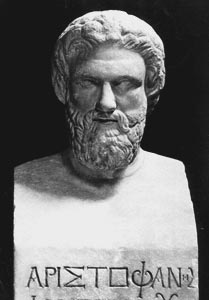
Aristophanes

Zumbrunnen’s book takes a new look at Aristophanes, the famed 5th-4th century Athenian comic playwright and his works, in terms of (as the title suggests) their embodiment of the challenges entailed by democratic citizenship. He does so with recourse to well-established lines of critical inquiry and, in particular, the Aristophanic scholarship of Sheldon Wolin, David Konstan and Josiah Ober and others, along with more broadly political thinkers such as John Rawls and Carl Schmitt; however, he reaches a different and novel conclusion based on his synthesis and treatment of these sources. He concludes that Aristophanes was neither conservative nor radical, as others have argued, rather that his focus was on ordinary citizens and the conflicting demands that those citizens faced as indicative of a serious concern with the possibilities and problems presented by democracy.

Before I delve deeper into Zumbrunnen’s arguments, it seems appropriate first to acquaint the reader (who may otherwise be a non-specialist) with Aristophanes and his approach to drama. Aristophanes of Athens (ca. 446 BC – ca. 386 BC) was considered in antiquity to be the foremost poet of Old Attic Comedy. This particular comic tradition is one from which we have only Aristophanes himself as the (extant) exemplar and barely eleven of his forty-odd plays still survive. Old Comedy is characterised by its bawdiness, overt sexuality and a visceral engagement in political discourse and criticism. It embodied the greatly prized ethic of free speech, which Athens enjoyed up till her subjugation to the rule of Alexander the Great. Not surprisingly, when absolute monarchy replaced democracy, freedom of speech was greatly curtailed and Old Comedy ceased to be written, being replaced by New Comedy, the largely a-political comedy of manners, romance and situation. During his heyday, Aristophanes was closely acquainted with the likes of the philosopher Socrates, the playwright Euripides and Alcibiades, a leading general and statesman during the height of the Athenian Empire (yes, it should come as little surprise that a democracy can also be an empire). According to one tradition, when the leader of Syracuse, Dionysius, in the 4th century wanted to learn more about “the polity of the Athenians”, Plato sent him Aristophanes’ comedies to study. Relatively little is known about Aristophanes’ personal life apart from the fact that he was aristocratic and somewhat conservative in his political views and that he was a member of a political faction that favoured, contrary to the more radical democrats in the Athenian Assembly, an honourable peace with Sparta during the Peloponnesian Wars. The latter point is highlighted in a number of his surviving plays. As a playwright, at least, Aristophanes reveals more than a keen interest in the political culture of Athens of his day and it is precisely this that occupies the central focus of Zumbrunnen’sAristophanic Comedy and the Challenge of Democratic Citizenship.

Of course, a priori, even a non-specialist might raise a hand and point out that the direct democracy of Classical Athens, where only freeborn male citizens over the age of eighteen had the franchise (and everyone else did not), is considerably different from representative democratic governments of the modern era. This is true.  And Zumbrunnen addresses the issue quite neatly in his introduction in order to establish the relevance that a study of Aristophanes may still have for us today with regard to current discourses on democracy. There are three main concerns here. First is the vast institutional difference between ancient and contemporary democracies alluded to above. Secondly is the absence of anything like the modern conception of pluralism in ancient Athens and, finally, Aristotelian connotations inherent in the language of disposition, which Zumbrunnen uses throughout, and which might seem to lack contemporary resonance.

The institutional differences have been highlighted by Sheldon Wolinand Josiah Ober. Wolin’s conception is of “fugitive democracy”, that is, that democracy is always at best a temporary form of government which periodically erupts as a “rebellious moment” in which a given demos (citizen body) acts to end its own oppression. Wolin developed his notion of “fugitive democracy”, applied to modern practices, by studying ancient Athenian politics. Democracy, read thusly, is a form of resistance to the kind of status quo imposed by elites. Josiah Ober, by contrast, “argues that democracy (demokratia) mean that ‘the capacity to act in order to effect change (kratos) lay with the public (demos) composed of many choice-making individuals’” (5).  Ober considers Athenian democracy to have evolved a set of institutions well-designed to capitalise on the knowledge and experience of individual citizens and to make that knowledge the basis of useful, collective action.  Zumbrunnen argues that Wolin and Ober are emphasising two distinct impulses within democracy which entail both the rebellious aspect and that of collective action that manifest in such as way as to exercise the power of the people. His argument ultimately maintains that the tension between these two impulses defines the challenge of democratic citizenship present in both ancient and modern democracy. As he writes, when “the power of the people had ended the rule of tyrants and oligarchs, the challenge became finding ways to preserve the rebellious impulse of democracy by, paradoxically enough, containing it within institutionalised forms” (7).

In that sense, then, the same theories that may be applied to Classical Athens may equally be compatible with a number of contemporary democracies even though their institutional structures are very different. Post-revolutionary U.S.A. and France seem two obvious examples as does the particularly British, democratic evolution of the United Kingdom. In all these cases, as too with the Cleisthenic and other reforms that brought about democratic Athens, there was a major change in constitution resulting from resistance to elite authority which was then, in turn, preserved as an on-going means of perpetuating collective action by being fixed through the advent of institutional arrangements. The forms of democracy in antiquity and the present are different but they both developed from a similar set of circumstances, ultimately reaching a similar conclusion.

The difference between the two in terms of pluralism is somewhat more problematic. Zumbrunnen rightly states that “nothing comparable to contemporary pluralism existed in ancient Athens” (8). The citizens who made up the Assembly were all males of the same ethnicity and, while representing a number of social classes, automatically precluded the sort of diversity which we expect to find in modern democracies, entailing instead a species of homogeneity virtually unheard of in contemporary societies – and therefore also precluding the prospect of pluralism in the modern sense of the word. Even so, as Zumbrunnen points out, the socio-economic distinctions between citizens in ancient Athens could be quite significant and the “dynamics of the ordinary-elite fault” represents considerable promise for making the case that, in general, something like pluralism did occur in Classical Athens (albeit in a narrowly defined manner according to social class and birth) and in particular for Aristophanes’ dramatic representations, with their special emphasis on this class divide, to be still quite relevant to our present-day incarnation of mass politics.

This issue comes to the forefront when we consider the subject of demagogy in Athenian politics which was also a special concern for Aristophanes. The democratic Assembly of Athens was where the power of the state and its citizens lay. It was where matters of law and even foreign policy were agonistically debated and directly decided by the people. Anyone who wished (who held the franchise) could speak in the Assemblybut invariably certain unelected individuals managed to lead the citizens (demos=people, agogein=to lead, thus “demagogue”) in making decisions, often through what we would perhaps consider the modern practice of “manufacturing consent”. Famous Athenian demagogues included the likes of Pericles, Cleon and Demosthenes and they were invariably representative of a social class other than that of the common people. The classicist Moses Finley has described a central problem of the stability of Classical democracy as the curious willingness on the part of people to have accepted, as the evidence suggests they did, the dominance of these demagogues who were drawn from a small elite group of politically active citizens. Zumbrunnen argues that for “elites to continue as elites” they “had to find ways to convince or persuade or manipulate or dupe the demos, and ordinary citizens had to navigate the political world in considerable part by means of the claims made by elites” (10).

This problem is one which still faces democracy today and which it may always face. Ancient Athenian elites, as with their modern counterparts, had to appeal to as broad a demographic as possible in order to achieve their aims. And their leadership tended to remain unchallenged by the masses or, if challenged, only so by other comparable elites. This led to the mass of citizens in the Assembly who were not elite demagogues taking on the role of spectators. By extension, therefore, the comic theatre of Aristophanes, charged as it was with political energy, in which citizens of all classes were also spectators, should help us to better understand the basic challenges faced by citizens of ancient democracy. Again, many parallels may be drawn with modernity here and the differences between types of pluralism, ancient and modern, may be smoothed over somewhat as both face similar issues in terms of their place in the grand scheme of things. Of course, Zumbrunnen is quick to point out that “thinking of the demos as a mass of ordinary citizen-spectators confronting a small elite risks collapsing the diversity of the contemporary demos into a false homogeneity and unity” (10).

The disposition (hexis) of citizenship is a term frequently used by Aristotle. Zumbrunnen is quick to point out that he is not deliberately trying to be Aristotelian in his discussion of disposition, though the subject is necessary with regard to Classical democracy. For Aristotle, virtue comes from an ethical disposition that is not easy to attain: the mean between the extremes. In Zumbrunnen’s reading of Aristophanes, then, “ordinary citizenship rests on a difficult to achieve comic disposition that holds democracy’s impulses in continual tension” rather than exclusively following one or the other (12). This, he indicates, may present a problem for the modern reader (or citizen of a democracy) in terms of lacking contemporary resonance. Here he has some recourse to Michel Foucault, Steven White and others who express the notion of an ethos of late-modern, democratic citizenship in the context of an “ethical turn” that can help orient citizens’ predicament in moving beyond a focus purely on rights, duties, membership and participation. This issue is later taken up in Zumbrunnen’s conclusions where he considers whether this particularly Athenian notion of disposition is still relevant in the contemporary era. For my part, I suspect it is, insofar as the informed, democratic citizen ought to consider all sides of a given political issue and seek the most rational and moderate course of action as opposed to the trend, particularly in U.S. politics, where voters can become hyperpolarised on certain issues due to near-total immersion in myopic discourses that exclude alternatives and decry all criticisms. But the gap between the real and the ideal here is apparent and I think that the late de-emphasis of the golden mean illustrates Zumbrunnen’s concern about the lack of “contemporary resonance” with Aristotelian/Aristophanic ethical disposition in the democratic politics of our era. Similar extreme polarisation occurred at various times in the Athenian democracy and was the subject of much criticism by the likes of Socrates and Plato and, in that sense, we do find a common ground with the ancients on this matter.

Zumbrunnen next deals with Aristophanes himself and, rightly, asks whether there is any serious political commentary to be found in his comedic fictions. He quotes a passage from Assemblywomen here where the playwright himself addresses his audience, encouraging them to vote for his play’s victory in the dramatic contest, in such a way that indicates his understanding of them as divided between the political elites and everyone else:

“I have a small suggestion for the judges: if you’re intelligent, remember the intelligent parts and vote for me; if you’ve got a sense of humour, remember the jokes and vote for me. Yes, it’s virtually all of you that I’m asking to vote for me” (1155-56).

It is interesting that there was a significant element of agonist democracy present even at dramatic festivals, where the audience would have mostly consisted of those who would otherwise be making up the Assembly, and that the challenges of democratic citizenship applied even there through voting for a winner in the competition. The “impulse towards collective action”, as Zumbrunnen writes, “is deeply implicated in the city’s role in funding” dramatic performances (14). Although, it is worth noting that the individual chosen by the Archon (chief magistrate) to put on a given performance and provide the chorus was almost invariably an elite member of that society, if only because they were expected to fund part of the production from their own resources. Aristophanes’ comedy here reflects upon the political and cultural divisions present within the demos.

Suffice it to say that there are many political elements and explicit political criticisms present in Aristophanic comedy. Most of his heroes and heroines are ordinary people who try to accomplish extraordinary things, although their achievements often come with disturbing consequences. At once he seems to celebrate the fact that ordinary people can make a difference but “he also seems to undermine the possibility that their actions will lead to lasting, positive change” (15). We have numerous examples to draw upon, but I will mention briefly Praxagora in Assemblywomen who succeeds in getting the fictional Assembly to put women in charge of the state with a resulting revision of the social order that resembles a parody of Spartan, communistic society. This communism even extends to sexual matters, which is initially met with alacrity by the characters, that is, until they learn that now the young must “service” the old before they can engage in relations with others of their own age. Elsewhere, Aristophanes has people riding dung beetles (in Peace) to the gods in search of an end to war; they establish a city in the sky (in Birds) to escape the litigiousness of Athens; and so forth. But all of these end badly or, at least, in such a way that the outcome would not be considered positive to most non-fictional Athenians.

These and other plays have led some critics to assert that Aristophanes was essentially hostile to democracy. However, Zumbrunnen cites David Konstan who has argued that Aristophanes was trying, perhaps even unconsciously, to bridge the fissures that had developed from tensions and contradictions within the Athenian cultural ethos.  This bridging works not to support democracy necessarily but to “temper it” with a healthy dose of Athenian conservatism (15). Josiah Ober has observed that Aristophanes presents exaggerated versions of his fellow citizens’ most closely held political beliefs. Zumbrunnenposits that Aristophanes should therefore be treated as an “internal critic” of democracy rather than an opponent of it. He is taking on the role which the ancient Greeks believed was appropriate for a poet: to educate the people. Zumbrunnen works from the position that Aristophanes need not be considered an ardent democrat or admirer of the common people, or the elites either, in order to have valuable insights into Athenian democracy. His criticisms of democracy are considered less important, in this book, than his portrayal of “ordinary people navigating the tension that lies at the heart of democracy and democratic citizenship” (16). Zumbrunnen reads Aristophanes’ comedies as recognising both the rebellious impulse present in the very nature of democracy, discussed above, along with its impulse towards collective action. As the comedy embodies and portrays these tensions, it encourages spectators to grapple with them as well, and to think about them perhaps more than they would have done otherwise.

Aristophanes’ audience may cheer on ordinary citizens in his plays who struggle against the status quo imposed by elites. However, as conservative readings of Aristophanes rightly indicate, he also calls on spectators to stand at a critical distance from his protagonists: while celebrated, they are also ridiculed. Their schemes may represent a moment of rebelliousness, as well as collective action, acted out in a kind of democratic fantasy, but their negative consequences imply an appeal to existing institutions and forms. Aristophanes satirised both the powerful and the powerless. His plays present fantastic notions of political change and then puncture those notions often with bitter irony. Zumbrunnen argues that he was striving to nurture a complex comic disposition in his audience which is akin to the kind of disposition needed for addressing the challenges of democratic citizenship. So, in his view, Aristophanes was “neither conservative nor radical” but was rather deeply concerned with the possibilities and problems inherent in the conflicting demands that citizens face in a democracy (17). Here I feel compelled to assert that the author’s intent may not be known. We do not have what Aristophanes thought, only what he wrote. However, Zumbrunnen’s argument seems sound and his interpretation as apt as any I have seen on the subject.

Chapter 1 is titled “Peaceful Voyages” and deals particularly with Aristophanes’ Peace and Lysistrata. Both plays entail a level of political criticism as well as advancing, through the vehicle of comedy, alternative possibilities for the future of Athenian and Spartan relations. In Lysistrata, probably the most widely produced of all of Aristophanes’ plays, the eponymous heroine, an ordinary citizen-woman, has a two-pronged plan to stop the war with Sparta. This involves the women of Athens and Sparta seizing the Athenian Acropolis where the funds for the war were kept and boycotting all sexual activity with their husbands until peace is made. Aristophanes’ Peace, by contrast not so well known nor as often staged as Lysistrata, entails the protagonist, one Trygaeus, flying a giant dung beetle to the realm of the gods and freeing the imprisoned divinity Peace so that her influence can end the war. The play concludes with typical Aristophanic celebration along with some concern expressed by certain elements of the Athenian citizenry as to the negative impact that peace will have on their livelihoods, which had been geared towards the war effort. Zumbrunnen’s conclusions here are multiple and follow from the work of scholars like Martha Nussbaum and Jacques Rancière. He picks up on the theme of madness (maniās) in these plays and how it is linked to both money and politics. He also observes how the plays strongly suggest that “wily and manipulative elites have duped the Athenians into seemingly perpetual war” (24). This theme certainly holds some modern resonance.

Zumbrunnen connects the fantastical elements of these two plays with his notion of “comic voyaging” whereby the audience is permitted to contemplate alternative modes of existence, through humour, so that they may then perhaps step back from their own, more normative, existence and consider  different paths. Both plays demonstrate the tension between rebellion and collective action and both invite the spectator to reconsider their own identity with regard to society as a whole. Zumbrunnen argues that these plays reveal, at once, that rebellious individuals as well as concerted, collective action can change the status quo, but also that neither radical change nor collective action by ordinary individuals alone will suffice to solve the problems faced by the Athenians. This is a seemingly paradoxical conclusion but one which seems consistent with Zumbrunnen’s reading of Aristophanes whose intentions must be regarded as subtle and complex at the very least.

Chapter 2 is titled “Ordinary Citizens, High Culture, and the Salvation of the City”. It deals with Clouds, Women at the Thesmophoria and Frogs. Here Zumbrunnen picks up on the theme, discussed in his general introduction, of what it actually means to be an “ordinary citizen”. He accepts that this is a broadly generalising term but one to which many people, ancient and modern, can in some sense relate. These three plays illustrate and explore the relationship between ordinary “heroes” and cultural elites. In the Clouds, the protagonist, Strepsiades, sends his son to the “Thinkery” run by a heavily fictionalised Socrates in order that he may learn how to escape his debts. The scheme goes awry when his son uses his new found sophistry to convince his father that it is acceptable for him (the son) to beat him (his father). Strepsiades then seeks his revenge by burning down the Thinkery. Both Women at the Thesmophoria and Frogs feature the tragic playwright Euripides, himself an acquaintance of Aristophanes, as a principle character in each. In the former, the women of Athens, at their annual all-female festival to Demeter “Bearer of the Thesmos (custom, tradition, law)”, decide, in a scene reminiscent of the Athenian courtroom (where only men were normally allowed—thus a comic reversal), to impeach and execute Euripides for portraying women negatively in his plays. After much comedic wangling, he convinces them to let him go by promising to be nicer in the future. In the latter, Frogs, the god Dionysus goes to the underworld to bring back one of the three great tragedians (Aeschylus, Sophocles or Euripides), at this time all deceased, so that the greatest of them can educate the Athenians again and help them to improve their political and civic situation, which has gone downhill due to the wars with Sparta. After a humorous contest between them, judged by Hades and Persephone, the eldest one, Aeschylus, is chosen for his conservative and manly values, having taught the Athenians of the generation of Marathon, at which he fought, to “breathe spears” by his poetic exemplars of virtue and courage. Euripides, quite popular though controversial, is rejected. Zumbrunnendoes not take the position, as some scholars have done, that these plays are “either straightforward populist celebrations or simple elitist warnings about ordinary people”, rather that they work to destabilise the category of the “ordinary” (43).

Chapter 3 is concerned withWasps and Birds, which Zumbrunnen argues, amongst other things, demonstrate the anger of ordinary citizens with the rule of elites. Wasps involves a conflict between father and son whereby the father, a follower of the demagogue Cleon, is addicted to attending court and prosecuting whomever Cleon wishes. In the end, through comedy, the old man is broken from his habit and Cleon’s demagoguery is brought low through ridicule. In Birds, the protagonists seek to establish a utopian society in the air which is aptly called “Cloud-cuckoo-land”, though the whole undertaking proves untenable and comes crashing down, so to speak. Zumbrunnen writes that these plays show both the possibilities and limitations of human imagination but that human beings cannot, godlike, rise too far above the pragmatic details and rules of ordinary life. Even so, while emphasising the inevitable fallibility of illogic, these plays also hint at the possibility of new beginnings.

Chapter 4 deals with Acharnians and Knights which consider the possibilities of rebellion by ordinary citizens against political elites. They illustrate the recurring themes of political populism, with the rhetoric of rebellion, alongside its susceptibility to elitist demagoguery. Zumbrunnen suggests that Aristophanes is exploring the difficulties of balancing these two impulses and, more particularly, how often ordinary citizens fail to meet the challenges of democratic citizenship represented by these opposing forces, albeit with some hint of faith in the possibility that cleverness on the part of individuals may yet point the way to salvation. Clever individuals may resist elite domination whilst coexisting alongside the sort of democratic anger discussed in chapter 3. Chapter 5, in turn, addresses Assemblywomen and Wealth, two of Aristophanes’ later plays which are sometimes characterised as “Middle Comedy” (inasmuch as they begin to transition towards the modes of New Comedy, mentioned above). These plays, Zumbrunnen argues, indicate a return to the sort of optimism for change encountered in some of Aristophanes’ earlier works by “holding fantasy and irony in perpetual and productive tension” (99). The fantasy element entails social justice—in the case of Assemblywomen by proposing a utopian society ruled by women, in Wealth by the fair redistribution of resources through (comic) divine agency—but the irony comes from the dystopian elements that obtain in these comedies. Assemblywomen in particular should not be read exclusively as some proto-feminist statement, as some have done, since the comedy largely derives from the reversal of the norm—women running the state, which is men’s business. But it does give the spectators pause to think, considering that women did run the households of Athens. Even so, the resulting dystopia ironically portrays the protagonist’s rebellious scheme as the subject of ridicule and humour.

After splendidly tying together all of the themes discussed here, and others, Zumbrunnen returns to his initial argument as to the value of Aristophanes’ dramatic engagement with democracy in Classical Athens and the issues faced by democracies in our own era. His position is concerned with modern debates on democracy as either “rebellious disruption” or “ordered and responsible collective action”, alongside the influential role of elites, and how these relate to Aristophanic comedy as revealing a similar theme (133). He asserts that Aristophanes’ position, as applicable in his own time as now, is that democracy is not a choice between these alternatives or extremes. Rather, these are competing democratic impulses, well illustrated by ancient Greek comedies and their own political experiences, and that Aristophanes is pointing us towards a comic disposition attuned to the tensions inherent in democracy. They serve to remind us that it is difficult to face the challenge of democratic citizenship and that we need to develop a “complex and fluid” disposition in order to meet that challenge. Such issues as who is “ordinary” and who is elite and what can be done to effect change remain central to democracy today as in Classical Athens. Aristophanes does not offer us an answer to these difficulties but his plays “suggest the disposition with which we should approach the questions” (135). And Aristophanes constantly reminds us that democratic citizenship is, and likely should always be, hard work.

Zumbrunnen’s scholarship is, on the whole, excellent and comprehensive. His readings of Aristophanes are as sound as any that I have seen and he makes thorough recourse to a wide range of secondary sources. On the latter point, I was particularly pleased that the book, despite being clearly composed within and largely for the North American cultural context, utilises a healthy array of sources from British and, to a lesser extent, European scholars, including such luminaries on the subject of Aristophanic comedy as one would consider appropriate for a project of this type. Indeed, without which, it would have suffered much by way of critical dearth. John Zumbrunnen’s Aristophanic Comedy and the Challenge of Democratic Citizenship should prove extremely useful to any student or academic interested in Aristophanes’ and the Classics as well, more broadly, to those in International Relations and Political History. I also suggest that it would prove equally useful to any individual, ordinary or elite, in a democracy who hopes to navigate the complex tensions afforded by that polity and who wants to be a “clever” and effective citizen – so too would it serve them well to view or read Aristophanes.

KENNETH ROYCE MOORE is a classicist

Posted in QR Home | Tagged , , , , , , , | Leave a comment

Stefan Zweig – yesterday’s man

Stefan Zweig – yesterday’s man

STODDARD MARTIN reviews a life of the aesthete and belletrist

Three Lives: A Biography of Stefan Zweig

Oliver Matuschek (2006), tr. Allan Blunden, Pushkin, £20

The fall of Hapsburg civilization was a catastrophe for some; for others it was cause for rejoicing. The ways of life emanating out of Vienna had for some time seemed to belong to no Leitkultur. A German-speaking majority felt insecure in a federal state where half the official dicta were in Magyar, much religion in Latin, musical culture in Italian and literary in French, service in a ragout of Slavic dialects and mercantilism in Yiddish or – by the turn of the 20th century – makeshift English. A sense of mélange adultère de tout was abroad, to use T. S. Eliot’s phrase re Europe immediately post World War I[i], in which Vienna was the great loser. A capital city grown so multi-kulti was in the end loved mainly by a precious few whose privilege diminished as its territories split off and raison d’être vanished. The many would shrug and carry on in the semi-depressive state they had always served in, half-unnoticed by narcissistic masters, surviving on trickle-down. In a vertiginous epoch of change they had at least the catharsis of schadenfreude in watching their ‘betters’ brought low.

Stefan Zweig’s career spanned this epoch, and its progress affected his subjects. His mature books on Joseph Fouché (1929) and Marie Antoinette (1932) were in effect studies of further types of calamity about to descend on an order he had been born into. His historical dramas Jeremias (1918) and Das Lamm des Armen (1930) were successes in part because bourgeois audiences saw in them analogues for their deteriorating situation. Yet the received notion that Zweig and kind wished their late Hapsburg delights to continue unmolested may be soft thinking, at least at the outset. Wöllust, a term comprising what the French called ‘volupté’, allied to what Mrs Thatcher used to brand ‘wet’, marked the youth of many like Zweig[ii]; but war altered much, and his fevered work on masculinist icons such as Balzac, Nietzsche, Dostoyevsky and Casanova – to say nothing of Bonaparte’s police chief – suggest unease with an identity as kuchen-und-sahne Baudelaire. Like Emil Ludwig’s contemporary Napoleon or Leon Feuchtwanger’s Jude Süss, Zweig’s Baumeister der Welt series was, despite liberal professions, read as avidly by journeyman Nazis as by carpet-slippered aesthetes[iii]; and his vast productivity, not least in creating this pantheon, may (in a nod to his revered Freud[iv], another target of biographical essay), suggest displacement activity mixed with wish-fulfilment.

Zweig’s own biography turned out more eventful than initially promised. Second son of a wealthy Moravian Jewish mill-owning family with Italian banking connections, he cut his teeth in the Vienna of Johann Strauss waltzes and haut bourgeois networking. Teenage was spent in the milieu of Schnitzler and Schönberg, Schiele and Secessionist renegades. This was the era of anti-Semitic, pan-Germanist Mayor Karl Lüger, whose speeches inspired another young Austrian of provincial extraction pursuing not dissimilar aesthetic dreams on meaner streets; and beside unknowns like Hitler, ‘self-hating Jews’ such as Otto Weininger and Karl Kraus were part of the scene, along with those who sought to evade populist noise and get on, such as Gustav Mahler and Hugo von Hofmannsthal. Young Zweig hero-worshipped, stood at theatre doors to collect autographs, ran after celebrity, left family affairs to his brother and enjoyed the light Don Juan-ism of a jeunesse dorée. He translated francophone poets – Verlaine, Émile Verhaeren – solicited manuscripts from the famous and set about acquiring those of the great dead. Imitation begat style, inauthentic yet conscientiously à la mode. The life choice de jour was to be an artist, literary above all; he pursued it with a Rastignac’s concentration[v] until his name became known.

Whatever Zweig’s true north as sexual being – and much has been speculated[vi] – he wrote semi-erotic novellas and became embroiled by age thirty with a married woman, herself an aspirant author. Professing complaisance about his touted liaison with a shop-girl in Paris and less specific adventures in bosky Schönbrunn, she separated from her husband and pursued Zweig with zest. Zweig married her suddenly towards the end of the war, acquiring two spoiled stepdaughters as well as a ‘top bunny’[vii] to establish a writer’s Asyl [viii] in a château on a hill over Salzburg. The choice was prescient. With the calm that descended over Europe in the mid-20s, a beau monde arrived to parade itself at the newly-established music festival. Protected by his wife, Zweig became a virtual writing factory and used proceeds to collect ever more compulsively, accumulating one of the most remarkable caches of manuscripts in Europe – eventually he bid for a speech of Hitler’s and the original of ‘Deutschland über alles’ – as well as Beethoven’s violin and ink-pot. His rooms were ordered to perfection, every book he could want near to hand, shelved from floor to ceiling. Yet continually he fled – to Paris, Belgium, north Germany, the Soviet Union and further afield.

Ostensibly this was to avoid festival crowds or fulfil invitations to launch books, read, lecture, speak at congresses, rehearse plays or research new topics. Emotionally, however, obscure restlessness drove him – the Nietzschean ‘wanderer and his shadow’ or, one might guess, the formerly contented bachelor bibliophile who marries an apparently affectionate housekeeper only to find her morphing into a monster who makes his life hell – the scenario of the novel Die Blendung (Auto-da-Fé) by young Elias Canetti, which Zweig helped to get published. Zweig’s domestic idyll, in short, may have been something other; yet who really knows what goes on behind the closed doors of a marriage? What is indisputable is that once the 1930s had begun to impel Jews, liberals, pacifists and others to take stock and then flight, Zweig was quick to liquidate his paradise, sell as much of his collection as he could and get out, first to Switzerland, then to England, where he proposed to settle, leaving wife and stepdaughters behind. Eventually – to her dismay, even denial[ix] – he divorced her and, as the receding skies of the continent grew darker, applied for a British passport.

The BBC, imagining its nation honoured, set up an interview with ‘Dr Zweig’ only to have him explain that he had moved to London because the libraries were good, there was plentiful music and you could work because no one bothered you.[x] Hardly a ringing endorsement of the land and its beauties, its culture or lively inspirations… England proved a refuge tout court, and how could it have been more after the mountains of Salzburg and a Viennese lad’s lifelong pursuit of versions of Parisian vie bohème? In this exile, Zweig acquired a young secretary, also Jewish, refugee from Silesia. Once his divorce was final, he married her and they bought a house, in Bath. It was grey. Then the war came in earnest, and they were restricted: put on an aliens list. It was not long before the old restlessness impelled Zweig to move on, this time to New York, just as important for a writer’s career and reputation as London, maybe more so, though no more paradisal. He could not settle there, nor upstate by the Hudson; evidence suggests that his health – he was now in his 60th year – broke down under the effort. So he ended by retreat or advance to the most exotic and colourful locale he had encountered during years of a literary lionized peripeteia: Brazil.

Here was paradise. It had the best coffee on Earth, but… where were the cafés, the artists, literati, musicians, feuilletonistes, politicos – that ‘world of yesterday’ he had thrived in, the grand monde he had known? In a green and warm suburb amid gorgeous hills above Rio, he finished his memoir, labouring as Nietzsche had said the superman must ‘at the edge of exhaustion’. ‘Give me only books that are written in blood because blood turns to spirit!’ Zarathustra had cried[xi]. Zweig’s memoir was one, and he must have known it. In a real sense it was the work he had lived to write. So, mission accomplished and affairs put in order, he overdosed himself – his young wife too, it seems, though when a servant entered the bedroom to discover the bodies, hers was still warm.

Zweig wrote letters implying that the reason for his end was political – the horrors abroad in his vanishing world. Others have found this a serviceable explanation and place him near the head of a list of writers driven to take their lives directly or contingently by Nazis. Such a list might include Zweig’s friends Ernst Toller, Josef Roth and Irwin Rieger, whose ambiguous death preceded his by a brief spell. It would surely include Auschwitz survivors Jean Améry and Primo Levi[xii], as well as other Jews whose careers were turned upside down by events – Romain Gary comes to mind; at a further stretch, Arthur Koestler, who shares with Zweig complicity in the simultaneous snuffing of a younger, suggestible consort. Suicide solo is ghoulish enough; à deux it raises worse spectres. Hitler and his younger wife took their own lives too, but which one took whose, and in what sequence and under what coercion? Such macabre questions may seem in bad taste, but in the case of a writer with a moral agenda – as Zweig decidedly had by his dramatic end[xiii] – they require exploration.

Oliver Matuschek’s biography does not take the hunt far. An archivist and documentary film-maker, this youngish man musters sources and facts but has neither the maturity nor the imagination to take the kind of speculative leaps that Zweig-as-biographer rarely shied from. He gets something of the “lebenskurve” which his subject always sought in his subjects but fails to show how the “innere Seele lodert und glüht[xiv]. He tells us that Thomas Mann suspected a sexual kink had resurfaced in Zweig which he could not face[xv]. This semi ‘death in Venice’ scenario may invite ideas of a Zweig inspiration for Mann’s famous novella, written years before, at the time of Mahler’s death[xvi], but its non-specificity leads the biographer only to muse on unsubstantiated rumours of Zweig being a serial exhibitionist[xvii]. The most credible explanation for suicide may be a feeling of exhaustion of powers and/or sense that the best words had been written and more could only mean less – something like what drove Hemingway to a similar act at the same age nearly two decades on.

This is to ponder. For others it will be the issues and tendencies in the man’s work that most matter[xviii]. So: what of them? The Wöllust and self-indulgence of the early phase, passing through the crucible of World War I (in which Zweig served as propagandist), became harder, more spare and clear in the ‘20s[xix], a shift not unlike that of bestselling, near contemporary D’Annunzio from overblown aestheticism in Il Fuoco to laconic soldier’s eye-view in Notturno[xx]. Another comparison might be to the transit of Somerset Maugham from Of Human Bondage via war experience as a spy[xxi], reflected in the Ashenden tales, to the bestselling Moon and Sixpence and Cakes and Ale. Zweig shared with Maugham ease of access into the imagination of the middle-brow. His fictions can be marvellously finished and on inspection fall prey to charges of manipulation and sentimentality – the war-traumatized amnesiac of ‘Episode an Genfer See’ or the blind collector in ‘Die unsichtbare Sammlung’ are examples. The ‘moral’ behind such constructs is Dickensian in emphasis on charity; it shares with Remarque, Rolland and Hesse[xxii] a modish ‘20s turn to pacifism.

In texture Zweig’s style is ever self-conscious, whether ornamental or spare. The biographical work which increasingly absorbed his energies became strikingly rhetorical, as if anticipating or mimicking great flings of speechmaking by a Mussolini or Hitler, yet always in housebroken mode, as if uttered as lectures out of the pit of a darkened cinema where silent films are simultaneously being unreeled. Coffee was Zweig’s tipple and Balzac his pace-setter. His narratives have a velocity evoking the ‘young man in a hurry’ which another bestselling contemporary, Jack London, depicts in his writer-hero Martin Eden, also a suicide[xxiii]. Zweig entitled his sole novel Ungeduld des Herzens[xxiv] and remained faithful, one could say, to the Decadent creed of ‘burn with a hard, gem-like flame’. If describing his achievement in terms of so many potencies seems pretentious, it is unlikely that he would have objected. A Valhalla of genius is where he longed to dwell, as you might guess of a fetishist of handwriting who pored over pages of Goethe or Mozart or even hapless Mary Stuart before sitting down to purple ink and featherweight paper at Beethoven’s writing desk.

Zweig’s Drang nach Grandeur, noticeable also in book layouts and bindings, lured his language into what many saw as rhapsodic, exaggeré, showily seasoned with foreign or exotic locutions; and when Rosenberg’s Kulturbund für deutsche Kultur got a grip in the mid-‘30s, it was branded ‘un-German’[xxv]. Fifteen of Zweig’s books were banned by the Deutsche Buchverein in the autumn following Hitler’s access to power. Too popular for suppression (50,000 copies of Marie Antoinette had sold the previous Christmas), they were restored to circulation in 1934, only to be banned again throughout Germany after the Dresden première of Richard Strauss’s Die schweigsame Frau in 1935. This opera, marking Zweig’s début in succession to Hofmannsthal as librettist to the greatest living German composer, caused a crisis in the Nazi arts establishment. Under normal circumstances, Hitler would have travelled anywhere to attend a new work by Strauss, but – with text by a Jew?[xxvi] Excuses were made; events held the Führer in Berlin; the performance was a triumph but after two more, it was banned and Strauss obliged to step down as President of the Reichsmusikkammer.

To Zweig this débâcle was cognate with police turning up at his house in search for weapons meant to be hidden on behalf of a socialist terrorist group. None were there, of course; the true terror was at the door. Of similar kind were the swindles and half-swindles and chiselling attendant on sale of his collections, and pusillanimity by publishers in continuing to market his work[xxvii]. Zweig was too prescient not to have foreseen this dénouement and was already gone before the worst came. Transposition, however, was never sufficiently more than in body. As his swansong and elegiac masterwork Die Welt von Gestern shows, there was – beyond memory and the covers of fine books – no elsewhere to hold him, not finally, not fully, certainly not in the kind of voluptuous embrace he had enjoyed during the long adagio of crépuscule over disintegrating Hapsburg domains.

Dr STODDARD MARTIN is a journalist and the author of numerous books on 19th century thought, and a regular contributor to the Quarterly Review


[i] A poem of this title appears in the pre-Wasteland Poems 1920, some of which are (notoriously) anti-Semitic

[ii] Zweig uses the term to describe the ‘Art Infektionsphänomen’, ‘Theatremanie’ and ‘absurd Enthusiasmus’ he felt as a young man. Die Welt von Gestern (1941), Frankfurt: S. Fischer Verlag, 1944, pp. 27, 45, etc.

[iii] Zweig suggests that his Fouché may have encouraged Goebbels and Goering (Ibid., 342)

[iv] He put Freud beside Mesmer and Mary Baker Eddy in Die Heilung durch den Geist (1930). This annoyed the doctor, but in thanking Zweig for a copy he merely said, “I could object that you overemphasise the element of petit-bourgeois rectitude in me – the fellow is a little more complicated than that!” (Three Lives, 248)

[v] Balzac’s hero. Zweig’s essay in the Baumeister der Welt series ascribes Balzac’s genius to an immense power of will manifesting itself in tireless concentration on his subjects and his work

[vi] Zweig’s brother thought him ‘a stranger to passionate love, merely observing it in others’; Fontana called him a ‘detached voyeur’. Zweig boasted to his future wife that only adventures with risk appealed to him; during their courtship he wrote in his diary, ‘the cards of perversion [were] put ever more openly on the table’. Later he mused, “I must make sure that it doesn’t become all about sex… sexual passion frightens me”. After his death, she would claim that he had been “no Don Juan” (Three Lives, 77, 82, 117, 121, 258)

[vii] Her prideful description of herself. (Ibid., p. 147)

[viii] There may have been a mutual fantasy that she should play Cosima to his Wagner

[ix] There were ‘fierce and protracted arguments’; she ‘refused to accept that their life together was over’. Zweig let her keep his name, and after his death she ‘tried to cover that [he] had remarried’. (Ibid., 13, 306)

[x] A transcript is in Three Lives (303-5). On his first trip to London in 1906 Zweig, coming from Paris, compared the change to “stepping out of the bright summer sunshine into the cool shade” (Ibid., 75)

[xi] Also Sprach Zarathustra, I, vii. My translation

[xii] I discussed this in ‘Jean Améry and multiple identities’. Quarterly Review, Winter 2011-12

[xiii] By the ‘20s his politics were pacifist, socialist and pan-European, these shared with friends such as Romain Rolland, whose later Stalinism he did not go along with. He became a member of German PEN in exile but at an international congress in 1936 found its ‘carnival of vanities quite repulsive’ (Three Lives, 298). He disliked Zionism, believing Jews had a key role in creating an international order. Subtitling his memoir Errinerungen eines Europäers, he states that for forty years he had worked for a free European Union and what did war or his own death matter if this should still come to be? (Welt von Gestern, 394-5)

[xiv] Zweig sets down these principles in his Einleitung to Mary Stuart (1935)

[xv] Mann floats this in a letter to his patron Agnes Meyer. (Three Lives, 288)

[xvi]Zweig had written ‘Gustav Mahler’s Wiederkehr’ on return from America in a ship that brought the ailing composer home to die. Mann absorbed the ‘dramatic pathos’ of this essay and wrote his novella shortly after. Though Mahler did not die in Venice (as Wagner did), Visconti’s film (1971) links Mann’s inspiration to him

[xvii] Three Lives, 285-8

[xviii] A fine, scholarly account of them is offered by Rüdiger Görner, head of the Centre for Anglo-German Cultural Relations at Queen Mary’s College, University of London. His Stefan Zweig: Formen einer Sprachkunst (Wein: Sonderzahl, 2012), unfortunately not yet available in English, reviews in succinct chapters Zweig’s attributes as poet, tale-teller, travel writer, dramatist, librettist, essayist, memoirist, political and aesthetic thinker. Görner emphasizes the pan-European, internationalist and pacifist ardours of this great cosmopolitan – the Erasmus impulse, if you will. At the same time he is not shy about pinpointing that fascination with the demonic which makes for such compulsive reading in Zweig’s treatment of figures like Nietszche and Dostoyevsky. Görner reminds us that, like Balzac, Zweig put enormous value on a kind of fanatic concentration, with its dramatic concomitant of zeroing in on what he called ‘sternstunden’ – the ‘star hours’ of human and individual history: cataracts, moments of fatal turning. Görner’s portrait is of an obsessive in the great sense, a late or post-Romantic type of genius – driven, idealistic, Angst-filled and finally tragic. Through his eyes, Zweig becomes what he inevitably must seem in the ‘Nerven’ of that sensitive reader with whom he wished to set up ‘Dialog’: a kind of emissary of the spirit; a voice urging as if from within, like Nietzsche’s ‘shadow’ or Kierkegaard’s conscience, impelling one on dangerously, eyes opened, looking backwards or forward through error towards what in civilization and/or personal experience has been or may be for the Good – a condition which, finally, can hardly be defined otherwise than by its fraternal Platonic attributes: Beauty and Truth

[xix] “After the war I told myself everything must be vehement, intense, hard-hitting” (Three Lives, 230)

[xx] I discussed this in ‘Hemingway and D’Annunzio’. Quarterly Review, Summer 2011

[xxi] Was Zweig a spy? He met future Weimar Foreign Secretary Walther Rathenau in Berlin in 1907 at a journeyman stage in his career. Rathenau suggested he go to India and America to view the Anglo-Saxon “colonial” system from the inside. He was given letters of introduction by Baron von Münchhausen and teamed with a journalist to play Hobhouse to his Byron. He was encouraged to send cards and photographs back to “important friends” and able to place every article he wrote in leading journals. In India he communed with geographer Karl Haushofer, seconded there by the military and inceptor of the Lebensraum theory later beloved of the Nazis. Zweig’s first wife, who would supervise his practical affairs, had been daughter-in-law to a high official in the Austrian foreign service, to whom she remained close. Zweig’s work for the imperial ‘hero factory’ in World War I morphed at the war’s end into lecturing abroad for the rump state. This helped raise his profile and by the ‘20s it was clear that the powers-that-be in Central Europe found him useful to promote worldwide. Kosher to a variety of régimes, he found his last phase marred by a rumour that the Brazilian government had subsidized him to write a book about the country in order to lure him to live and work there

[xxii] The latter two were friends and mentors to Zweig in pacifist and pan-European politics (see xii above).

[xxiii] London’s eponymous novel, by some considered his finest, was published in 1909. In an apprentice phase, Zweig had written a novella with similar plot; it was never published. (Three Lives, 42)

[xxiv] Impatience of the Heart, released in English under the bizarre title Beware of Pity

[xxv] An article in 1930 accused him of “crimes against the German language”. This was not just anti-Jewish; Kraus had made a similar attack earlier, and Hofmannsthal had always viewed Zweig as “sixth-rate”. Of his biographical work it was said that “he was always a storyteller first, not a historian”, yet an early review of his stories by his friend Hesse damned him in that genre with faint praise: “He has a singularly amiable personality… which is worth more than all the technique in the world”. (Three Lives, 65, 73, 261)

[xxvi] Hofmannsthal was partly Jewish, but Der Rosenkavalier had been in the repertoire for so long and was so popular that the Nazis did not dare ban it. See Erik Levi, Music in the Third Reich (Macmillan, 1994)

[xxvii] Pusillanimity was not always on one side. In 1933 Zweig agreed to write for Klaus Mann’s exile journal Die Sammlung, but pulled out once he realized it would make sale of his books in Germany more difficult

Posted in QR Home | Tagged , , , , , , , , , | 1 Comment

On An Anonymous Reviewer – Catharine Savage Brosman

Catharine Savage

On an Anonymous Reviewer

CATHARINE SAVAGE BROSMAN


A man? A woman? Quite close-lipped,

at least, invited to assess

a scholar’s lengthy manuscript.

It was shot down, without finesse.

“The work, I see, does not succeed

except most literally; such

will not suffice now.  As I read

its flaws grow evident.  Too much

historical concern – the worms

of time; too little theory, too;

clear prejudice revealed by terms.”

(The context does not count; what’s true

depends on dogma, and we must

rewrite the past as it should be.)

“Insensitive in tone, unjust;

two small mistakes in chapter three.”

In retrospect, it was naive

to think postmoderns might be fair;

they obviously can’t conceive

how they are blindly doctrinaire.

Envoi

The wheels of fortune surely turn;

your book may be the next to burn.


CATHARINE SAVAGE BROSMAN is the poetry editor of Chronicles.

An interview with her may be read here


Posted in QR Home | Tagged , , | Leave a comment

Replay – Star Wars (1977) by Mark Wegierski

Star Wars (1977)

MARK WEGIERSKI

Star Wars (original theatre-version length 121 minutes) is the George Lucas masterpiece that has led to the emergence of one of the most successful of the current-day pop-culture mega-franchises.

The film begins with the written lines, “Long ago, in a galaxy far, far away”. Then there comes the scrolling written introduction, which quickly sets the scene for us, accompanied by the astounding music of John Williams and the London Symphony Orchestra. The original soundtrack for Star Wars, with its echoes of Wagner, Orff, and Holst, is often acclaimed as the best soundtrack ever heard in film. George Lucas deliberately chose to have a classical music soundtrack, rather than a contemporary-sounding electronic one. This helps to suggest the ‘timelessness’ of his story.

Star Wars was one of the first major films consciously planned with a story arc extending over at least three films. Indeed, George Lucas had in mind as many as nine at one time. The original film has therefore been designated as Episode IV: A New Hope in the larger story. It was followed by Episode V: The Empire Strikes Back (1980) (which has been acclaimed as better than even the first, a truly rare occurrence for sequels), and Episode VI: Return of the Jedi (1983) (which was slightly less acclaimed).

Lucas’ marriage disintegrated a few years after the release of Return of the Jedi, and he thought at the time that it was unlikely he would ever do the prequel trilogy. Nevertheless, he returned to work in the late 1990s, and moved it to completion: Episode I: The Phantom Menace (1999); Episode II: Attack of the Clones (2002); and, Episode III: Revenge of the Sith (2005). The reaction to the trilogy was very mixed, and only Episode III has received considerable acclaim. Lucas was also said to have seriously mis-stepped with Jar Jar Binks, a comic-relief character deemed by some a “racist stereotype”. Those who had wanted to hate George Lucas and the films found a ready-made pretext.

The original film begins with an Imperial Star Destroyer pursuing a much smaller ship carrying the Princess Leia (Carrie Fisher). As the hatchway is broken down and Imperial stormtroopers swarm in, the sinister figure of the black-armour-encased Darth Vader (David Prowse; voiced by James Earl Jones) emerges into view. The distinctive voice of Darth Vader, with its belaboured breathing, is one of the leitmotifs of the movie.

Princess Leia has managed to entrust vital plans about the Empire’s latest weapon, the “Death Star”, and a holographic message to R2-D2, a short, squat robot (Kenny Baker) and his ‘friend’, the golden robot C3PO (Anthony Daniels) – who flee in an escape pod to the nearby desert-planet, Tatooine.

Eventually, the robots come into the dwelling-place of the teenaged Luke Skywalker (Mark Hamill), who is unhappily living as a farm-hand with his uncle and aunt. They have been programmed to seek a man named Obi-Wan Kenobi (Alec Guinness), whom Luke knows as Ben Kenobi. Luke realizes that his uncle and aunt are in danger, and returns to find them dead and his old home devastated. As Luke stares at the destruction, he can be seen as making a psychological transition to adulthood.

Obi-wan takes him under his wing and they head to a local cosmopolitan (multi-species) spaceport, looking for a space-captain to convey them to Alderaan, Leia’s home planet. They find Han Solo (Harrison Ford), a swashbuckling smuggler, and his first-mate, Chewbacca (an intelligent, large, hairy, bear-like creature, played by Peter Mayhew), and their ramshackle ship, the Millennium Falcon. It is one of the characteristics of the futuristic world portrayed by Lucas that it is very ‘lived-in’ and ‘gritty’.

Meanwhile, Leia is being interrogated by a torture robot to reveal the location of the hidden base of the Rebel Alliance. The torture is framed without any sense of gritty realism; this is the movie at its most child-like. The Grand Moff Tarkin (Peter Cushing) is the commander of the Death Star and a Regional Governor. Cushing brings a particularly sinister edge to the role.

The Death Star blows up Alderaan. Luke, Han, Obi-wan, and Chewbacca arrive in the vicinity of the destroyed planet, and are pulled by a tractor beam into one of the Death Star’s landing bays. They hide in the smuggling hold of the Millennium Falcon. After numerous subterfuges and scrapes they are able to free the Princess. Since their meeting in the desert, Obi-wan has begun telling Luke about the ways of the “Force”, an ‘energy’ that flows through the universe, and from which the ancient martial order known as the Jedi Knights draws its fighting powers and mental strength. Obi-Wan is a member of the order, and he chooses to confront Darth Vader (a Jedi who has gone over to the “dark side” of the Force) in a duel to allow the others to escape. Vader wins, but it is not clear that Darth Vader has conclusively eliminated Obi-wan. Indeed, the old Jedi Master continues to exist in spirit. Rushing back to the rebel base on the Millennium Falcon, Leia concludes that their moves are being traced, and that the Death Star will soon follow.

The Rebel Alliance discovers a design flaw in the Death Star, and a number of squadrons of one-man fighters are sent out to try to destroy it. Only Luke (with the help of the Force) is finally able to send the torpedo down the vent-hole, resulting in the total destruction of the Death Star. He is also assisted by Han Solo and the Millennium Falcon. Han Solo had received a rich payment and was planning to leave, but changed his mind in the end, choosing to renounce (at least for the moment) his usually mercenary nature.

The film ends in a huge assembly hall with the massed ranks of the Rebel Alliance troops arrayed in triumph. Luke and Han Solo (with Chewbacca by his side) receive medals from Leia – who looks much prettier and more feminine in this final scene than earlier.

The pacing is brisk and very well-plotted. The movie also introduced special-effects that were quite amazing for the time, and have held up well. The development of these various special effects was a hugely important part of the production. Lucas had to put together his own production company, Industrial Light and Magic (ILM), to get the job done. It should be remembered that this was before universal CGI.

Star Wars can be seen to have inaugurated – for better or for worse – the so-called “special-effects spectacular”. But George Lucas clearly understood that there also had to be resonating characters and a compelling story beyond the special effects. Basing himself partially on the notions of what Joseph Campbell had called “the monomyth” as well as evoking Jungian archetypes, Lucas has created one of the most enduring pop-culture ‘mythologies’.

Many psychological interpretations of the series can be made. For example, the sequence of the fight with the Death Star somewhat resembles the physiology of human conception, with numerous tiny sperm beating at the walls of the huge ovum. Only one of the many can actually get in. That sequence could also suggest a number of men approaching a particularly “unapproachable” woman. Only one has the total skill-set to overcome all her “defenses” and consummate the relationship.

It has been argued by some that the re-kindling of so-called “American optimism” by the original film series played some role in the election of Ronald Reagan in the 1980, and might have had an influence on Americans’ willingness to confront the “evil empire” of the day – that is, the Soviet Union. Reagan’s proposed Strategic Defense Initiative (SDI) was quickly dubbed as “Star Wars” by a hostile media – but the term might not have been as damaging to Reagan as some might have imagined. The 1980s was a time when many Americans were indeed ready to accept the depiction of the Soviet Union as an “evil empire” that had to be decisively resisted.

Nevertheless, even the original series could be seen as decidedly multivalent. The main ‘backstory’ of Star Wars – of the corruption of the Old Republic by a politician who eventually proclaimed himself Emperor – could have been seen as a reference to the so-called “Imperial Presidency” in America – typified to some by Richard Nixon. Thus the heroes of the Rebel Alliance could also have been seen as analogues for crusading journalists like Woodward and Bernstein, who eventually brought down Nixon.

The idea of a “rag-tag” rebel army confronting Imperial overlordship clearly stretches back to the founding myth of America. Various political tendencies in America – left, right, and centre – have tried to tap into this foundational myth. Its most prominent incarnation on the Right today is probably the so-called Tea Party movement. Certainly, many tendencies in American politics have tried to evoke the ambience of being embattled rebels, rather than part of an “establishment”.

While the notion of a handful of ‘good guys’ confronting the forces of darkness can be variously interpreted, it can also serve as a means of control. Left-liberals in America today imagine themselves as embattled heroes. The threat from an ‘evil’ rightwing continually re-appears in different forms and guises, and must be constantly beaten back. Nevertheless, the good guys always win in the end, and are able to smash evil into the ground.  This kind of “morality-play” has been enacted again and again, and for some, it is a highly convincing narrative. But perhaps the films should not in the end be freighted with too much ponderous meaning. Among the reasons for their popularity was that they were, above all, highly entertaining.

MARK WEGIERSKI is a science fiction and fantasy aficionado who writes from Toronto


Posted in QR Home | Tagged , , , , , , | Leave a comment