Monday night

Monday night


The roundest moon was resting on our road,

Making of the lane a silver stream –

A chilly channel running from some Sea

To carry its Tranquillity to me.


I waded in those waters ‘til it rose,

Falling upwards, bringing its own blue.

It shook itself untangled from the trees –

Stone in space, only seeming to be free.


Posted in QR Home | Tagged , | Leave a comment

Is it time for a new teleology?

Irregular Galaxy, Hubble

Is it time for a new teleology?

PATRICK KEENEY enjoys an ambitious assault on the materialist underpinnings of modern science


Mind and Cosmos:  Why the Materialist Neo-Darwinian Conception of Nature is Almost Certainly False

Thomas Nagel.  Oxford:  OUP, 2012, pp. 130

Thomas Nagel, University Professor in the Department of Philosophy and the School of Law at New York University, has written an ambitious book.  As he writes:

One of the legitimate tasks of philosophy is to investigate the limits of even the best developed and most successful forms of contemporary scientific knowledge (p.3)

Nagel sets out to challenge the standard assumptions of the dominant scientific consensus, and tentatively suggest a way out of what he perceives as the theoretical impasse which the current scientific orthodoxy has created.

Mind and Cosmos is Nagel’s attempt to examine the limitations of the current, orthodox governing assumptions about nature, what might be briefly characterized as the

…reductive form of materialism that purports to capture life and mind through its neo-Darwinian extension (p.128)

The starting point for his argument is

…the failure of psychophysical reductionism, a position in the philosophy of mind that is … motivated by the hope of showing how the physical sciences could in principle provide a theory of everything (p.4)

If that hope is unrealizable – if, that is to say, psychophysical reductionism is false as Nagel believes it to be – then the physical sciences are incapable of providing an explanation of everything, compelling us to speculate about possible alternatives to the dominant scientific world view.

What propels the book is Nagel’s insistence that failure of the dominant scientific consensus to account for mind is a singular and decisive omission, one which

…casts its shadow back over the entire [scientific] process and the constituents and principles on which it depends (p.8)

Nagel rejects the view that the mind-body problem inherited from Descartes can somehow be localized and kept apart from mainstream physical science. Rather, it

…invades our understanding of the entire cosmos and its history (p.3)

He finds naïve the notion that physics is philosophically unproblematic; rather, if we take the mind-body problem seriously and think through its implications,

…it threatens to unravel the entire naturalistic wold picture (p.35).

The repercussions of the brute facts of consciousness demand nothing less than re-thinking the place of the physical sciences in describing the natural order. Ultimately, the enlightened, contemporary culture which accepts the dominant climate of a scientific naturalism, needs to wean itself of that reductive materialism and explore other possibilities.

The task is to come up with an alternative (p.37)

Nagel rejects the idea that we can arrive at a full account of the origins and evolution of life by relying exclusively on the laws of physics and chemistry. He finds both the mechanistic reductionism inherent in the physical sciences, along with the physico-chemical reductionism in biology both unconvincing and improbable as accounts of the world, as they have been developed for a “mindless universe.” While he readily concedes that

…the great advances in the physical and biological sciences were made possible by excluding the mind from the physical world (p.8)

such advances have been purchased at the price of comprehensiveness. Without some account of consciousness, our understanding of nature can only be a stunted and partial one. Obviously, the universe contains minds, and

No conception of the natural order that does not reveal [consciousness] as something to be expected can aspire even to the outline of completeness.

He thus rules out any sort of psychophysical reductionism. The dominant scientific convention cannot be right, for how can any comprehensive account of nature ignore the bald fact of such a salient feature of the world as consciousness? As he suggests,

…the exclusion of everything mental from the scope of modern physical science was bound to be challenged eventually (p.36)

For Nagel then, the modern scientific desideratum – that is, a  quantified understanding of the world, expressed in timeless, mathematical formula — can never be anything other than a very partial and incomplete understanding of nature, as any full and comprehensive account of nature must include an account of consciousness. Yet current models of physical science leave no conceptual place for cognition, desiring, valuing, and all those other subjective mental activities which define our lives, and which are such an evident part of the world. As he writes,

Consciousness is the most conspicuous obstacle to a comprehensive naturalism that relies only on the resources of physical science (p.35)

In brief, science needs somehow to include the human mind in the natural order. For Nagel this is a commonsensical given, and he finds it incredible to think that any explanation of the natural world which left out an account of consciousness could provide anything more than a partial account of the universe. That vast numbers of people in advanced societies believe that a full understanding of nature is possible without an account of mind — that is, to buy into the prevailing forms of naturalism — represents a

…heroic triumph of ideological theory over common sense (p.128)

Nagel is astute in telling the history of science. In particular, his account of the rise of evolutionary naturalism is one of the highlights of this book. Darwin’s legacy continues to dominate our understanding of nature, so that in some important sense, we are all Darwinians now. Yet from the first, Darwin’s theory has been abused and misused. Perhaps the first and still most influential distortion was Social Darwinism, where survival of the fittest was used to justify social hierarchy. More recently, sociobiology trades on neo-Darwinian ideas of natural selection to explain various social phenomena, including ethnic violence, poverty, gender differences, and so forth. And the emerging field of evolutionary psychology, which attempts to link social patterns to genetic evolution, proceeds by postulating a radical reductionism, one which oversimplifies both mind and natural selection. For example, various cognitivist theories of mind hold that the mind is little more than an information processing machine, analogous to a digital computer, and that evolution has bequeathed us a “cognitive architecture” with pre-programmed software for dealing with the world.

One of the more unfortunate consequences of the intemperate attacks on Darwin from religious fundamentalists is the suggestion that any challenge to Darwin can only arise from some combination of religious mania and scientific illiteracy. Yet to accept Darwin is also to accept a host of implicated Darwinian ideas. And many of these Nagel finds intellectually unconvincing. In taking issue with Darwin, Nagel is forthright about his lack of a religious motivation, affirming that he “doesn’t have a religious bone in his body.” Yet as he is quick to point out, one does not need to be a scriptural fundamentalist to find fault with Darwin; disinterested reason and intellectual rigour combined with independent empirical evidence, point to deep problems in evolution and natural selection. In particular,

Consciousness presents a problem for evolutionary reductionism because of its irreducibly subjective character (p.71)

In Nagel’s estimation, the problems for Darwin’s theory  which grow out of mental functions such as thought, reasoning and evaluation have not been taken seriously enough:

The problem has two aspects. The first concerns the likelihood that the process of natural selection should have generated creatures with the capacity to discover by reason the truth about a reality that extends vastly beyond the initial appearances …. Is it credible that selection for fitness in the prehistoric past should have fixed capacities that are effective in theoretical pursuits that were unimaginable at the time? The second problem is the difficulty of understanding naturalistically the faculty of reason that is the essence of these activities (p.74)

In brief, Nagel  finds unconvincing the notion that rationality and consciousness could arise on a strictly reductive,  naturalistic account, one which relies solely on the mathematical probabilities of natural selection. Nagel, while an avowed atheist who by his own account “lacks any religious impulse”,  is nevertheless sympathetic to defenders of intelligent design, and the problems they pose for the orthodox scientific consensus.

…the prevailing doctrine – that the appearance of life from dead matter and its evolution through accidental mutation and natural selection to its present forms had involved nothing but the operation of physical law – cannot be regarded as unassailable.  It is an  assumption governing the scientific project rather than a well-confirmed scientific hypothesis (p.11)

As Nagel says of defenders of intelligent design,

They do not deserve the scorn with which they are commonly met.  It is manifestly unfair (p.10)

Yet if an atheist rejects the idea of God, and further rejects the notion that a non-purposive nature, guided only by the laws of physics, chemistry and mathematical probability, can account for the origins of life, what explanation possibly remains? Nagel believes that

…in some way the likelihood [of life] must have been latent in the nature of things (p.86)

That is, there may be inherent in the natural order of things teleological principles. Teleology is, as Nagel notes, a

…throwback to the Aristotelian conception of nature, banished from the scene at the birth of modern science (p.68)

He goes on to say,

I have been persuaded that the idea of teleological laws is coherent, and quite different from the idea of explanation by the intentions of a purposive being …In spite of the exclusion of teleology from contemporary science, it shouldn’t be ruled out a priori (p.66)

Nagel want to resurrect the idea of teleology as

…an explanation not only of the appearance of physical organisms but of the development of consciousness and ultimately reason in those organisms (p.92)

He readily concedes that

Teleological explanation may have serious problems, but in this case they are no more serious than those of the alternatives (p.88)

And he is clear that the teleology he seeks is quite independent from any theistic notion, or any idea of an intelligent designer.  It is rather a natural teleology, one which is perfectly consistent with atheism. He recognizes that the notion of a teleology which is part of the natural order

…flies in the teeth of the authoritative form of explanation that has defined science since the revolution of the seventeenth century (p.92)

Nevertheless, for Nagel, a naturalized teleology provides a credible alternative to the orthodox, reductive understandings of modern physical science.

The arguments in Mind and Cosmos are carried on at a high level of abstraction. Yet Nagel is a fine writer, and he manages to make these debates vivid, and show the reader what, exactly, is at stake in what might at first blush appear to be rather esoteric questions unrelated to the concerns of the everyday world.  Nagel points out at various junctures the intellectual muddle which has arisen by attempting to understand the mental in terms and processes taken from the physical – that is, by using the categories of a reductive physical science to understand the subjective. This error has had dire consequences for our understanding of the social world. The confusion has infested all of our institutions, from schools, to the law courts, to politics. All of these crucial institutions have come to rely on the guidance of the social sciences, which, like the natural sciences, are predicated upon a reductive materialism. Because of this intellectual corruption, much of contemporary social science has arrived at a theoretical dead end. In Nagel’s view, a productive social science can only come about by establishing a more accurate account of nature, namely one that can account for the fact of consciousness.

In sum, Nagel’s twofold task consists in demonstrating the shortcomings inherent in the “Neo-Darwinian conception of nature” and tentatively suggesting  a way forward in arriving at a fuller understanding of the world around us. Nagel’s positive thesis maintains that we can only arrive at a reasonably comprehensive view of nature if we somehow find a way of putting mind and consciousness at the centre of our understanding of the natural order. He further thinks that in order to do so, we will need to revive the discredited idea of teleology in nature, and work toward establishing a “naturalistic” teleology.

As I said at the outset this is an ambitious book.  I’m not sure that Nagel succeeds entirely in convincing the reader that we need to return to teleology, natural or otherwise; but he has certainly established beyond any doubt that there is a very real debate to be had – a debate which has important consequences for understanding the cosmos, and our place in it.

PATRICK KEENEY is a co-editor of Prospero, a Journal of New Thinking in Philosophy for Education. He is currently an adjunct professor in the faculty of education at Simon Fraser University


Posted in QR Home | Tagged , , , , , , , , | Leave a comment

ENDNOTES – Bruckner from Saarbrucken

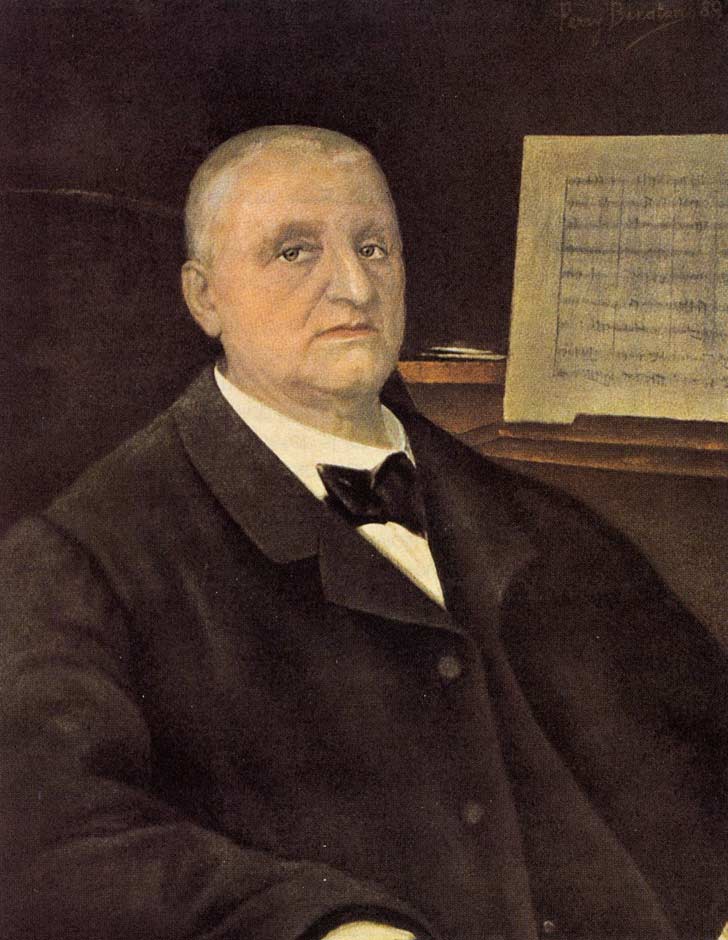
Anton Bruckner

ENDNOTES – Bruckner from Saarbrucken

STUART MILLSON is re-entranced by the magnificent Eighth

The recording of Bruckner’s Eighth Symphony by the Saarbrucken Radio Symphony Orchestra conducted by Stanislaw Skrowaczewski is not a recent issue. Nor is it considered one of the front-rank performances, towering alongside those of Furtwangler and Karajan, Giulini and Gunter Wand, or more recently, a reading by Pierre Boulez. However, I have decided to write about it for Endnotes, because it is – in my estimation – one of the most carefully-created and emotionally satisfying of all the versions in the Bruckner discography.

Anton Bruckner’s Eighth Symphony was premiered in 1892 under the baton of Hans Richter, the great Wagnerian conductor. Work began on the piece in the middle of the 1880s, and like many of the composer’s works, underwent numerous revisions. Bruckner was born near Linz in 1824, and spent many years as the organist at St. Florian – his life devoted to religious music, teaching, composition and a veneration of Wagner. He also had romantic feelings – but nothing more – for one or two of his young female students, but as far as we know, these emotions were never reciprocated, and the musician remained a somewhat awkward, solitary, bachelor figure – an elderly gentleman of Upper Austria; the man who locked up the rural church when Sunday was over. But as an organist, Bruckner was one of the great performers of his day, and came to London to play on the magnificent instrument built for the newly-opened Royal Albert Hall. A somewhat naïve figure (known to present a coin or cakes to conductors who performed his music well – and dedicating his Ninth Symphony to God), he was nevertheless a giant of European music, honoured by the Emperor of Austria, and living out his days in lodgings provided by the Emperor.

Bruckner’s nine symphonies (the last of which was unfinished) represent a transition in music; taking symphonic sound and organisation away from the world of Beethoven and Brahms, and into a more troubled landscape overshadowed by the lengthy music-dramas of Wagner, and finding a pathway for Gustav Mahler (who studied with Bruckner) and the sumptuously-orchestrated, febrile world of the early modernists, such as Arnold Schoenberg. Although by no means atonal, there are passages of great disturbance in Bruckner. There is also a sense – not of night-time exactly – but of twilight, or a supernatural half-light; or of mountainous places or buildings touching the heavens, but with cloud, or storms swirling about them – a threatening, demonic undercurrent to the cumulative force, certainty, and affirmation of the music.

It is the latter feeling that I find in the Eighth Symphony, possibly one of the greatest works ever written, alongside Bach’s Passions, the Mozart Requiem, or Beethoven’s Choral Symphony. The first movement alone seems like a symphony in its own right: a low, suspended-in-space grumble of brass and heavy, dark, cellos and basses, leading to an equally slow, but determined ascent to some never-to-be-gained summit – similar in ghastly grandeur to the mountain scene in Das Rheingold when Wotan confronts the dwarf, Alberich. The Saarbrucken Radio Symphony Orchestra players perform this movement with utter conviction, restraining themselves from unleashing their full power until the very last (and thus, perfect) moment. The Saarbrucken brass section seems to me to be the near-equal of the great ensembles of Berlin and Vienna, which are usually credited with providing the optimum Bruckner performances; and under Skrowaczewski’s direction achieve what can only be described as sonic splendour. Skrowaczewski himself is a very interesting figure: the son of a brain surgeon, who at first considered a career as a pianist, rather than a conductor – and who, as a maestro, led the Minneapolis Symphony Orchestra in America, and appeared in Britain with the Halle Orchestra (in Bruckner’s Seventh Symphony) and with the Philharmonia at the 1984 Proms, in Beethoven’s Ninth Symphony. He has an austere, serious look – and dare I say it, he resembles a figure from Cold War Eastern Europe, although he belongs to a generation of musicians (including, for example, Vaclav Smetacek) who existed for the seriousness of music, rather than for any marketing opportunity. The unrelenting quest for Bruckner, for musical perfection has made Skrowaczewski the extraordinary force that he is.

The second movement of Bruckner’s Eighth breaks the tension of the previous 20 minutes, with a joyous, rushing mountain torrent – a scherzo which is said to contain the freeborn, rustic simplicity and life-affirming spirit of a German character, or more correctly, the character of Germans, known as “Deutsche Michel”. Austro-German music somehow mirrors the defiant, determined (some might say strident) tone of their spoken language, but all of these characteristics give voice to Bruckner’s unstoppable power. The heavy Saarbrucken orchestral tone now assumes something of the element of silver or mercury, but by the time of the third movement – the longest section of the work – we are drifting beyond this earth, into space itself, feeling our way past planets and stars, or so it seems. I cannot think of anything like it in all music – this vapour, this transmigration of souls. And just as it seems that we can go no further, Bruckner sets in motion a finale, whose shuddering, short, stabbing initial steps set a scene for a succession of curiously disconnected, unexpected happenings, but which all lead in the end to a final attainment of darkness-to-light brilliance. The monumental build-up of still-unspent energy and forces, which any other composer might have sacrificed much earlier, is one of Western music’s great legacies. It is more than honoured by this German orchestra and Polish conductor.

STUART MILLSON is the QR‘s Classical Music Editor

Originally issued by Arte Nova, the recording also appears on the Oehms label. Recorded at the Kongresshalle, Saarbrucken, October 1993. The Arte Nova recording was a co-production with the Saarlandischer Rundfunk.

Posted in QR Home | Tagged , , , , , | Leave a comment

Fuzzy Math

Fuzzy Math

STODDARD MARTIN steps gingerly into an ethical quagmire

Hanns and Rudolf: The German Jew and the Hunt for the Kommandant of Auschwitz, Thomas Harding. Heinemann, Sept 2013. £20

Literature to do with the Holocaust implicates all of us. Any responsible person who has ever felt a twinge of anti-Semitism or other unwelcome prejudice reads with a growing unease: isn’t he too hiding a guilty secret? Disquiet of course travels further: what would he do were his society being directed by authorities who demanded a certain line of orthodoxy from him or else? When old Nazis were asked “Why did you participate in such horrors?” and responded “We were just following orders”, how many of us can truthfully say we would have stood out and not done the same? How many of us are willing to imperil our careers or the welfare of our families, to say nothing of our lives, in such heresy? The stakes are indeed high when one deals in literature of this genre, for the writer, for the commentator, even for the reader. A slight deviation in tone and one may produce the wrong inference. Terrible discomfort may afflict partial doubters. Descent into denial threatens moral collapse and/or relegation into a category of sociopath. An apt response may seem that of Martin Bormann Jr.: to relieve himself on his father’s picture.

Laws exist in Germany and Austria outlawing denial. In less implicated countries legislation seems extreme and, beyond cultural suasion, we are left to the mercy of our own intellectual/emotional responses to the evidence set before us. This is why veracity of memory is crucial and David Cesarani and other historians of the topic have worried about survivor accounts that bake facts, elide, exaggerate or otherwise distort, however innocently or – if not quite that – understandably. There are still frightful glissandos in this terrible saga. How many perished? Five million? Six? Many will say that to argue over figures is ghoulish and in any case beside the point: a massive state-sponsored crime. Yet perhaps it does matter to posterity that a chief executor of the horror first claimed that only ten thousand had perished in his camp, then later signed an affidavit saying two and a half million and was finally charged with and hanged for the death of four millions. How justice got to producing this staggering last figure is material to anyone used to weighing the reliability of evidence.

The executor in question was Rudolf Höss, a lower middle class Swabian, wounded in World War I, associated with Martin Bormann in dissident post-war activities and sufficiently trusted by Heinrich Himmler during the Third Reich to become commandant of Auschwitz. On a dark night in March 1946, Höss was captured in a barn on the Danish border by Hanns Alexander, an officer in the British army of privileged Berlin Jewish origin. By order and desire Alexander was impelled to hunt down war criminals. Hanns and Rudolf is a double biography of him and his prey by a great-nephew who knew nothing of Alexander’s war work until after his death in 2006. Thomas Harding (his branch of the family changed name) is a scrupulous person who has used all available means to unearth the truth in these matters, including testimony from Höss’s children and other relations, two of whom joined him in a visit to the death-camp. The account he gives is thus full of contradictions slight and grand. At one point he asks a Belsen survivor whom his father helped how people who experienced the same event from the same point of view could have very different recollections and she replies, “You can ask ten people who were in the same place at the same time and you will get ten answers[i]. If this is normal, how can truth be made stable? “Through the research process”, Harding states in a postscript to his book, I came to learn that history – like the story of the blind men describing the elephant – is never as clear as you would expect.”

When Hanns tracked down Rudolf on that cold night in 1946, he was leading a posse armed with axe-handles and motivated by “hatred for the bastards”. Höss was stripped naked and beaten, until a doctor told Alexander to “call them off unless you want to take back a corpse”[ii]. As prisoner, Höss was treated with not much more kindness nor interrogated with more gentleness than you would expect. One consequence of this, as the late Harold Pinter[iii] or other campaigners against torture might predict, is recorded by Harding in an endnote:

“Those ten minutes of abuse, along with allegations of further attacks by British hands, would be enough for scores of Holocaust revisionists to argue over the years that Rudolf Höss’ testimony was tainted. Their argument goes like this: Höss’ testimony was beaten out of him and therefore his evidence at Nuremburg, and later his autobiography, could not be relied upon. This led them, supposedly logically, to argue that because the ‘story’ of the Final Solution relied so heavily on Rudolf Höss’ testimony the Holocaust never really happened.” [iv]

Harding is right to imply illogic to the deniers’ conclusion. On the other hand, he follows many in seeing the testimony of Höss as crucial to the Nuremburg process – a much-needed ‘smoking gun’. He also sees the figures Höss eventually signed up to – the two and a half million, to say nothing of four million mooted in Warsaw (a Russian inflation) – as beyond credibility. “According to many historians,” he says in a further note, “including those at the Auschwitz Museum, the most likely figure is that 1.3 million people died at Auschwitz, of whom ninety percent were Jewish.”[v] This estimate ought to satisfy reasonable readers; it is compromised, however, by a previous note in which Harding states, “According to the Auschwitz Museum… 1.3 million or more people [were] deported to Auschwitz”. Did all of them die? The literature is now rich with tales of survivors. So between ‘died’ and ‘deported to’ which is the more accurate verb? What is the spectrum of probabilities?

Höss himself in both trial and memoir[vi] dismissed some of the larger figures as technically beyond the capacity of the killing apparatus he apparently so efficiently set up. His children, somewhat surprisingly given the atmosphere of admission and atonement in the culture they grew old in, maintained that – despite living within meters of the crematoria – they never knew what was going on. This they put down to having been kids at the time; but how easy is it to keep from a child’s eye all trace of crimes on the scale of even the lowest estimates now generally accepted? It is of course understandable that children should wish to retain doubt about evils ascribed to a father whom they prefer to remember as kindness itself; it is also understandable that, when pressed, they like others should retire behind the defence that he was only a cog in a machine, a soldier carrying out orders, and would have been punished had he behaved otherwise, perhaps even executed. And yet…

We are in danger of being led into a moral quagmire, a confusion hardly helped ex post facto by knowledge that successors to the victorious overlords of 1945 have seen fit to ‘sex up’ Gulf of Tonkin resolutions, weapons-of-mass-destruction dossiers and the like in order to pursue military adventures of dubious justification. Thomas Harding is a young man alive in a post-Watergate, post-Tony Blair era of unstable certainties. He is a Jew of a generation that has been enjoined to assert ‘never again’ and to believe that the ‘tough Jew’ is a necessity that too many of his great-grandparents’ era in Europe failed to credit, to their terrible cost. But what that cost was exactly his book is too even-handed to clarify. Prejudice, discrimination, threat, expropriation, extortion and exile are all established beyond doubt: these things happened to his forbears or were witnessed by them with their own eyes. The rest with all its subdivisions – how many to disease, euthanasia or starvation; how many to causes also being meted out to half a continent during the winter of ’44-’45 – relies on report, documentation, evidence and testimony; matters that require to be tested in court and in judgements whose probity must be validated not by the hot breath of immediate press report[vii] but by the cold eye of long-term history.

David Cesarani and others have been right to voice concern. No book on this topic can afford to be loose, let alone tendentious or sententious, understandable as those temptations may be. As we move on in time and new generations look back, more and more clarity, it is hoped, will emerge. Thomas Harding is an honest man who has done his best against some odds to find human dimensions in an arch-enemy of his forbears and take a cool measure of a family hero driven in large part by outrage, vengeance and hatred and with a penchant for pranksterish deception[viii]. None of this is easy. What it produces for us to ponder is, if not unpalatable, in any case a bitter pill. Little is resolved fully. Possibly it never can be. We are like blindfold horses turning the wheel of a mill, circling round and round imagining our progress to be towards clover-filled pastures, which we may never reach[ix]. It is easy to see how a writer may come to feel, as Anthony Julius confessed in the last paragraph of his six hundred page tome on anti-Semitism – Trials of the Diaspora – that he had staggered through ‘muck’ long enough and hoped he would never have to deal with the topic again[x]. Mystical and idealistic aspects of Jewish tradition are the pastures that those who truly care for this people may readily prefer to attend to.

Dr. STODDARD MARTIN is an academic and publisher

NOTES

[i] Lucille Eichengreen. See note page 314-15

[ii] Pg. 243. Höss’s whereabouts had been extracted from his wife by informing her that a train was about to take her 14 year old son to Siberia and that she would never see him again

[iii] The Nobel Prize winner’s views about torture are well-known and were vociferously expressed in person, in speeches, in plays and in his work for English and International PEN

[iv] See note pgs 318-19

[v] See note page 310. The apparently contradictory note which follows can be found on page 299

[vi] This was written largely in Warsaw when Höss was awaiting trial and was encouraged by the authorities there

[vii] Harding describes how Höss’s testimony at Nuremburg was reported instantly around the world, pg 259-60

[viii] Hanns enjoyed pulling off pranks from an early age, not least ones of identity with his twin brother Paul. This could provide comic outcomes, for example, in fooling girls whom one or the other wished to seduce

[ix] I am indebted for this Sisyphean image to the late Shusha Guppy whose award-winning memoir of her Persian childhood was entitled The Blindfold Horse (1988)

[x] Trials of the Diaspora: A History of Anti-Semitism in England (Oxford University Press, 2010), p. 587: “Anti-Semitism is a sewer. This is my second book on the subject and I intend it to be my last.”

Posted in QR Home | Tagged , , , , | Leave a comment

Uncollected Folk – Roy Kerridge’s last column

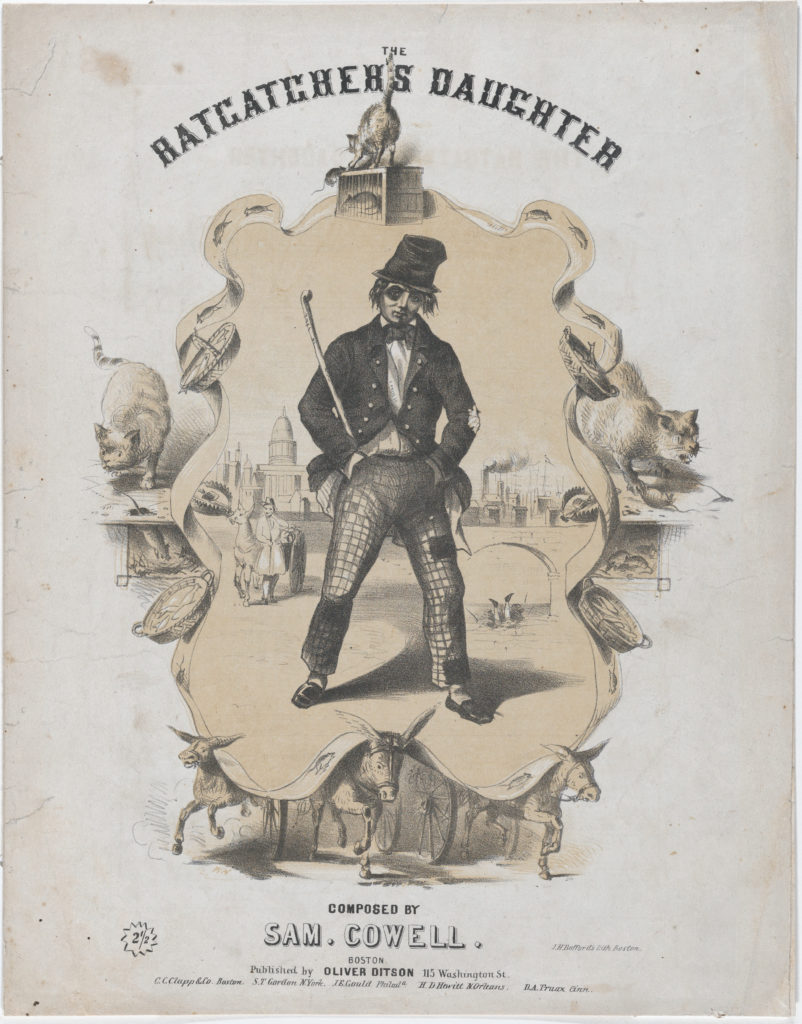
The Ratcatcher’s Daughter, sheet music cover

Uncollected Folk

In his valedictory Uncollected Folk column, ROY KERRIDGE imagines how future folk songs (if there are any) might sound

To those highminded Victorians who took part in the literary discovery of folklore, it was a revelation to find out that humble and illiterate people had developed worthwhile art forms of their own. Thanks to folklore’s pioneers, we have classic books of collected folk tales, from the Brothers Grimm to Uncle Remus, not to mention The Arabian Nights. Then came the folk song collectors, whose works can be studied in the wonderful library at Cecil Sharp House near Regent’s Park. But what happens to folklore when “the folk” learn to read and write?

In America, spirituals gave way to gospel music, a sometimes excellent body of song that deteriorates the further it gets from spirituals. In England, folk songs became literary as early as the 17th century, as printed broadside ballads, the same rule applying. Among the many topical songs printed traditional favourites such as “Careless Love” and “Barbara Allen” cropped up again and again, just as they were to do years later in America as country and western or blues records. Then, in the 19th century, folk song metamorphosed into music hall song. According to the music hall song bible, Colin MacInnes’ Sweet Saturday Night (published by MacGibbon and Kee), some of the first music hall songs known were “Sam Hall”, “Villikins and his Dinah” and “The Ratcatcher’s Daughter of Islington”, all folk songs on the verge of becoming ‘half folk”. Just as with American country music, professional songwriters appeared, specialising in music hall songs. The archetypal country and western American was a manly cowboy, the archetypal music hall Englishman a comic costermonger.

In our time, “Sam Hall” has become a cowboy song, sung with great ferocity by Frankie Laine. Frankie’s narrator is no longer a murderous chimney sweep but a Western bad man. When I was a lad, “Sam Hall” had become “Nobby ‘All”, a “dirty song” sung by soldiers and older schoolboys. “Villikins and his Dinah” became the well known country and western song “Sweet Betsy from Pike”, as recorded by Ken Maynard. As for “The Ratcatcher’s Daughter”, I have heard it sung by Ernest, a venerable Sussex tramp, in the 1970s.

English “half folk”, or “commercial folk”, is now only heard at old-time pub or party sing-songs where music hall is remembered. In the East End of London, I was once shown around a deserted, semi-ruinous music hall, a place that resembled a crumbling galleried barn. (It was in use as a West Indian church.) But what if English folk songs had not come to a dead-end, but had gone on developing and keeping pace with the times?

As this is my farewell column, I shall end with a few “folk forgeries”of my own.

I had a little nutcase, nothing would he do

But lie on a mattress drinking Special Brew.

The King of Spain’s landlord punched me in the face,

All because of my little nutcase.


***


Can she heat a pizza pie, Billy Boy, Billy Boy?

Can she heat a pizza pie, charming Billy?

She can heat a pizza pie in the twinkling of an eye,

She’s a young girl and cannot stand her mother.


***


As I was a-working on the Hadron Collider,

(To me way aye, blow the world up)

I made a black hole that got wider and wider.

(Oh give me some time to blow the world up.)

Chorus:

Blow the world up, boffins, blow it away,

Oh give me some cash to blow the world up.


ROY KERRIDGE is a folklorist, journalist and the author of numerous books

EDITOR’S NOTE: I would like to thank Roy Kerridge for his contributions to the Quarterly Review, in print and on-line, since 2007. It has been a great privilege to be able to feature his unique writing talents and the vast range of his recondite knowledge and experiences. Rarely has restless intellectual curiosity been tempered by such warmth and kindliness. DT


Posted in QR Home | Tagged , , , , , , , , | 1 Comment

EpiQR – The Spaghetti House, Kensington High Street

Spaghetti House, Kensington High Street

Spaghetti House is conveniently situated almost directly opposite the entrance to Kensington Gardens (thus making it a perfect lunch stop after a morning wandering the parks). Unmistakable, its exterior sports a traditional “Italian” look; honestly crying its wares at first glance. The interior is rustic and cosy, with walls red in either paint or bare brick, wooden tables and chairs, and some banquette seating in maroon colours that complements the wood and brick. A proliferation of large mirrors bounces light from the front windows around the room; whilst black and white photographs of food, cars and suchlike, and greyscale pictures of compasses lend a modern but tasteful air. The kitchen area is delineated in a light grey (with a hint of pink in the colour tone, which removes any trace of coldness), and is match-boarded in chunky wooden panels; while large items of furniture (such as sideboards) also bear this design and shade. There is a rather elegant and ornate door surround that struck me as really quite beautiful, and although metal pendant downlighters and anglepoise lamps lend a slightly ‘industrial’ air, these nevertheless tie in with the rustic interior and do not jar. The sadly ubiquitous pop music was not too loud, so not as offensive as it could have been – and towards the end of the meal it changed to more atmospheric and acceptable Edith Piaf – which I very much could have done with from the beginning!

We were seated on a banquette that was deeply comfortable and also nicely spaced from the other tables, thus allowing a decent measure of privacy. The service was friendly and very prompt (perhaps a little too much so – a waiter tried to take our orders before we had even opened up the menus); and we had barely taken our seats before we were brought welcome glasses of prosecco – this particular one being a very lemony-tasting, fresh, zingy wine. We were also presented at the same time with broad beans fried with salt and paprika which mysteriously disappeared while I was busy trying my prosecco (I knew I shouldn’t have let them place the dish anywhere within my husband’s reach…). The staff were dressed informally yet not scruffily (as befitted this unceremonious yet nevertheless professional type of restaurant), and there always seemed to be several waiters in attendance – although I fully accept that this may have been due to the presence of a journalist in their midst.

The wine list, brought next, offered a good range of Italian whites and reds – from a reasonable £18 up to £31, a couple of roses, a prosecco, cava and (interestingly) sparkling red, as well as a few rather fascinating-sounding Italian beers, digestivs and aperitivi.  The menu included a two course set menu; starters seemed perhaps just slightly uninspired, but there was a far better range of main courses: pastas; pizzas; meat dishes including burgers, saltimbocca and sirloin steak; roast salmon; and a few sides and salads as well. Everything on the menu was very reasonably priced (£7.95 to £18.95; the latter, most expensive thing on the menu, being the steak). Most, however, hovered around the £10-£13 mark – it crossed my mind, even before trying and thus being aware of the quality of the dishes on offer, that this was good value.

Italian wines being something of a weak spot in my armoury of wine familiarity and knowledge, I asked for a recommendation and, after some discussion, decided to essay the Peppoli Chianti Classico 2010. At first taste this appeared rather thin and slightly acidic but as it breathed in the glass during the meal, it developed a wonderfully rich and complex flavour (alas, the poor beverage was crying out meal-long to be decanted). It glowed with a ruby red colour, whilst its nose was of red berry fruits and brambles, with a hint of liquorice. The taste was dark, with coffee, chocolate and tamarind. Although it remained a little too much on the thin and light side for me, with such depth of flavour it would be an absolutely superlative wine were it a little more full-bodied.

Food arrived at a good pace – the starters after not too much of wait and the main courses after a fully respectable pause. We were just a little disappointed by our starters: in the Caprese salad the mozzarella was generally fine, albeit not the most sublime example of its kind that I had encountered, lacking in that creamy, light fluffiness that the finest mozzarellas boast; and the tomatoes were rather flavourless (admittedly it was not the tomato season). Mr Marshall-Luck had opted for bocconcini di pollo – chicken wrapped in breadcrumbs and parmesan and fried. This smelt absolutely exquisite but the taste was slightly bland in comparison to its tantalising odour. It was served with pleasantly, but not overpoweringly, spicy arrabiata sauce, which complemented the chicken well. The bread (arriving just shortly before the starters) was good – a dark-tasting, fresh and chewy sourdough, as well as crispy and moreish Sardinian music bread. Extra virgin olive oil was already present on the table (good) and a plate of fine balsamic vinegar was presented for dipping alongside the breads.

No complaints at all regarding our main courses – which were both excellent. My scaloppa milanese was, perhaps, not as thin as that to which I am accustomed – but was absolutely none the worse for that. The meat itself was flavoursome; the breadcrumbs pleasantly crispy and salty. Although the accompanying French fries were perhaps slightly non-descript, the broccoli all’aglio was good, with the broccoli itself perfectly done and in a beautifully buttery sauce, although the chilli was too overpowering for my (perhaps slightly delicate) taste-buds to cope with!

My husband’s pollo con funghi was also very good: the rich sauce complementing well the mildness of the chicken; the asparagus done well – not overcooked; and the resultant combination of flavours worked very well.  The accompanying potatoes were piping hot (to his initial chagrin!) but again, were not overcooked, and the rosemary lent a strong enough presence without becoming overbearing.

Dessert also impressed – the profiteroles were beautifully light and rich without in any sense being cloying, and their chocolate sauce had great depth in its flavour and was sufficiently complex (certainly not at all too sweet).  My tiramisu was served in a cup (which I found rather a nice touch – a little different), and the crunchy resistance of the amaretti biscuits which graced the top of the dessert provided a very good textural contrast to the creaminess of the tiramisu itself (as the mascarpone element was wonderfully full, thick and rich). The coffee flavour in the sponge was very intense (slightly too much so for me), and I slightly missed an alcoholic hit of brandy or amaretto – yet, I suppose, the Spaghetti House is a family restaurant and limits must be set! As a whole, the dessert worked very well indeed.

The staff seemed charmingly reluctant to let us leave without providing more examples of the culinary finesse of the kitchens and bar and so I allowed myself (although I can’t say I put up too much resistance) to be persuaded into finishing with a limoncello, with its cloying, sweet foretaste and sharp, physically pleasing bite of an aftertaste. This bestowed me with the perfect conclusion to what had been a superb meal overall – with excellent food and drink; a snug atmosphere; aesthetically pleasing surroundings and relaxed ambience, and top-quality, friendly service.

Perhaps nothing is better testament to how welcome, comfortable and well-looked after we felt than the realisation, as we all-too-reluctantly roused ourselves from the soft seats to depart, that we had been the first to arrive and, over three hours later,  were the last to leave.

EM MARSHALL-LUCK is the QR‘s restaurant critic


Posted in QR Home | Tagged , , | Leave a comment

ENDNOTES – Wagner, D’Indy, Handel and Verdi

ENDNOTES

STUART MILLSON

From Faust to The Flying Dutchman: Wagner from Scotland * An atmospheric collection by a French Wagnerian * Handel’s Xerxes * Proms farewell with Verdi

Chandos records continues to set remarkable standards in recording quality and presentation. Two of the company’s most recent releases include a first-class sequence of Wagner overtures and preludes, played by the Royal Scottish National Orchestra conducted by Neeme Jarvi, and an Early Opera Company performance on authentic instruments of Handel’s Serse, or Xerxes. Just a few months ago, the fifth volume in a series devoted to the music of French Wagnerian, Vincent D’Indy, appeared, so it seemed an opportune moment to mention the master of Bayreuth and his Gallic disciple.

There are many recordings in the catalogue of Wagner’s overtures, and Chandos itself (some 13 years ago) produced a similar pot-pourri: overtures to Rienzi, Die Meistersinger, Lohengrin and Parsifal, with the Danish National Radio Symphony under the baton of a conductor with the curiously Wagnerian name of Gerd Albrecht. So what distinguishes the latest CD? Although it repeats such well-known pieces as Die Meistersinger, maestro Neeme Jarvi has included three much lesser-known and infrequently-played works: the early Overture to Die Feen (The Fairies, an opera from 1834); the Overture to Theodor Apel’s play, Columbus (1835); the Overture to Das Liebersverbot of 1836 (an Italian-sounding composition, with a frenetic, near-comical opening – a foretaste, perhaps, of the Venusberg music in Tannhauser), and the stand-alone A Faust Overture, written during Wagner’s time in Paris (1840 – although the score was revised ten years later). My first encounter with the Faust piece was during the 1982 Proms season, a BBC Symphony Orchestra concert on Wednesday 4th August to be precise; and by chance, that very concert (given by the British late-romantic specialist, Norman Del Mar) also made room for Vincent D’Indy’s nature-worshipping symphonic poem, La fȏret enchantée. The Faust is a taut, thoughtful, expressively-romantic, eleven-minute orchestral study, more in the manner of Berlioz; not a showpiece, not showy, not even gripping, but an experience that draws you in to the troubled world of the subject – with a memorable, almost ‘questing’ motif on strings, welling up and dispelling tension, which appears a couple of times in this mini-drama.

However, the part of this disc which truly stands out is a very well-paced and beautifully-phrased account of the opera which first made Wagner’s name in 1842: Rienzi. Here can be found the beginnings of the composer’s true musical identity: a sound-world of high, uplifting, mystical themes, recognisably German, recognisably Wagner – especially in the dark, unfolding introduction; a gesture which, I am sure, would have made the opera audience at the Dresden premiere sit in solemn worship, gazing into the clouds of heroism and destiny. However, the opera is set in Rome, and concerns the life of “the last of the Tribunes”, the mediaeval Cola di Rienzi, a rebellious and revolutionary figure. But what is important is the accent of the opera: the listener can now truly feel that he, or she, is on the path to Lohengin, Tannhauser, and ultimately, the gold of the Rhine.

Recorded in the Royal Concert Hall, Glasgow, the Scottish orchestra has a decidedly deep, dark-wood tone; spot-on, unfuzzy, clear horn-playing, and heavy brass which, as a whole, has real might, and which rings out through your speakers. An authentic Wagnerian blast of sound, then – with an arresting drum-roll in Rienzi that is neither booming nor hollow, but hard, crackling and growling. Jarvi also phrases one or two parts of the overture in a slightly different way from many other interpreters. Listen to the first clear theme, or tune, just a couple of minutes into the overture, and you may see what I mean… A notable CD, and an important contribution to this celebration year for Wagner, the 200th anniversary of his birth.

Vincent D'Indy

Vincent D’Indy (1851-1931) is one of the 19th century’s, or Romantic movement’s, overlooked figures. If a French counterpart to the English Music Festival existed, D’Indy would be one of the revived composers at the heart of the concerts. Overshadowed by Saint-Saens, by Debussy and Ravel, D’Indy is nevertheless deserving of discovery – particularly the works which appear in this rewarding journey, prepared for the inquisitive listener by Chandos. We are in La France profonde, D’Indy being a French patriot and devoted Roman Catholic. Yet from across the Rhine and into the Gallic hills and villages comes the echo of Wagner, although the Frenchman has, I believe, preserved the subtle, attractive, more easygoing ways of his country in many well-orchestrated pieces, such as the Symphonie sur un chant montagnard francais, Op. 25 (1886). A simple, folkish mountain air, and the air with which you would fill your lungs on a high ridge of the Auvergne or Cevennes (the work is subtitled Symphonie cevenole); D’Indy’s tone-painting gives a rare flavour of a region, an out-of-doors spirit and a memory of a much-loved place in the heart of a Frenchman. Once again, Chandos has honoured its composer with a flawless recording, in the form of a warm, sunny Iceland Symphony Orchestra conducted by Rumon Gamba, with Louis Lortie, piano.

Handel, the German who became England’s most famous composer of the Georgian era, was a prolific writer of oratorio, opera, concerti, keyboard works, orchestral suites and anthems. Messiah (or extracts from it)and Zadok the Priest, Music for the Royal Fireworks and the Water Music can be heard each week on both Radio 3 and Classic FM. Today, the movement which demands an authentic, 18th century sound from period instruments has enabled us to appreciate these works through the prism of academic correctness: no more modern-instrument performances from modern chamber orchestras, or pared-down symphony orchestras, and certainly not the heavy, bold, well-upholstered sound of Beecham, Boult or Sargent’s Handel from the 1950s and ‘60s. As a result, the catalogue brims with lithe, delicate and dance-like, pure and astringent, church or cathedral-recorded crystal-clear renditions of Handel’s gargantuan output. And instead of yet another Messiah, Chandos has thoughtfully issued a three-CD set of Serse (Xerxes), the three-act story of the Persian king (written between 1737 and 8), in a version by the Early Opera Company, conducted by Christian Curnyn, a young, but already well-established musician, with performances at English National Opera and at Aldeburgh gaining him critical acclaim.

But Serses has one very well-known moment (again, often extracted by radio broadcasters and concert promoters), the aria in which the leading character (played by a mezzo-soprano, Anna Stephany) sings beneath the shade of a plane tree: Ombra mai fu (“Never was a shade”… [of any plant dearer or more lovely]). All the elegance of the baroque period seems to exist in this gorgeous, bittersweet tune, but if you purchase the new CD set – and I recommend you do so – passage after passage of the opera reveals other tunes, choruses, arias and recitatives of almost equal power and considerable beauty. The other leading characters, such as Arsamene (brother of Serses) and Atalanta (who is secretly in love with Arsamene, even though Romilda, her sister, is officially in love with him!) are well portrayed by David Daniels, Joelle Harvey and Rosemary Joshua.

Recorded at the Church of St. Silas the Martyr, Kentish Town, this is a production that will greatly appeal to enthusiasts of well-engineered, modern recordings, and admirers of a modern breed of artist which looks to the musical style and practice of nearly 300 years ago.

By the time this article is available on-line, the 2013 season of Henry Wood Promenade Concerts (now the property and branding of the BBC) will have ended. Verdi, like Wagner, was born in 1813, and the Proms celebrated the great Italian composer in the last week of the season with a beguiling sequence of operatic arias, performed by the tenor, Joseph Calleja, and the Orchestra Sinfonica di Milano, Giuseppe Verdi, conducted by Xian Zhang. But do not worry if you missed the evening’s broadcast. Fortunately, the relay of this very exciting concert is available via the BBC Radio 3 website for several weeks. An inspiring conclusion to a varied season, but I do wish that something could be done to improve the dynamic range, the ‘wideness’ of the radio broadcast sound. Having listened to several older analogue CDs of Proms performances, I am convinced that the high-definition quality of what we hear today just fails to capture the wide, open spaces (the richness and reverberation) of the Royal Albert Hall, leading to a sometimes dry, or too-close-to-the-microphone sound. I wonder if readers and Radio 3 listeners agree?

STUART MILLSON is the QR’s Classical Music Editor

Details of the recordings:

Neeme Jarvi conducts Wagner, overtures and preludes. RSNO. Chandos, CHSA 5126

D’Indy, orchestral works, Symphonie sur un Chant montagnard, Prelude to Fervaal etc. Iceland SO. Chandos, CHAN 10760

Handel, Serse. Early Opera Company. Chandos, CHAN 0797(3)


Posted in QR Home | Tagged , , , , | Leave a comment

Sadness and survival in Labour’s lacerated heartlands

Sadness and survival in Labour’s

lacerated heartlands

BILL HARTLEY attends two strikingly different manifestations of Northern working class culture

The 2008 Durham Miners' Gala. Photo: paul-thompson.org

Two annual events took place in the North of England this year. One was the Durham Miners’ Gala, the other the Lowther Show near Penrith. The former has been described as the last mass working class demonstration left in England, though as usual it struggled to attract senior representatives of the Labour Party. Ed Milliband made it in 2012, the first time a Labour leader had bothered to attend in 23 years. Alternative attractions this time included union bosses Bob Crow and Len McCluskey, after which it was downhill all the way into showbiz territory and the actor Ricky Tomlinson. As a demonstration of working class solidarity, the presence of a platoon of call centre workers hardly fitted in with the industrial heritage of the North East: the people who irritate us with cold calling walking behind the banners of the men who once toiled underground in dirty and dangerous conditions. These days the Gala is an enjoyable day out seasoned with a bit of nostalgia and a platform for class war enthusiasts. It might be more relevant to re-route the march through the nearby Beamish industrial museum.

June through to August is the season for country shows. The Lowther isn’t among the larger gatherings such as the Game Fair or the Great Yorkshire Show, with their numerous trade stands. Rather it lies somewhere between these big events and the homely village shows. A few manufacturers of the Land Rover and farming machinery variety show up but in the main the Lowther is about country sports; activities of the sort which presumably Labour would prefer to see confined to the dustbin. Yet the show is attended in droves by working class people of the white northerner variety, natural supporters of Labour you might suppose.

The local hunts are well represented, sending hounds to be submitted to the arcane judging processes which baffle the outsider. These aren’t the hunts of popular imagination. Up in the far North Country much hunting territory is just too rugged for gallivanting about on horseback. Going full tilt over dry stone walls on a horse would be a quick invitation to a broken neck. Instead the hounds on show belong to the fell packs. They hunt the fox on foot and followers need to be fit to keep up which is why the anti’s leave them alone; there are no horseboxes to provide a convenient focal point for demonstrators. Of course these days such activities are meant to be illegal but the Cumbria Constabulary seem to show little interest.

The people who attend the Lowther are an interesting mix: rural manual workers and tattooed townies with a seasoning of tweedy gentry types. A few years ago when the Lowther was still wedded to its origins as a carriage driving event with a country show thrown in, it wasn’t unusual to spot the Duke of Edinburgh mooching about among the working classes. These are the people whom the country writer Dickie Poole used to refer to as the “aboriginal English”. They come from all over the northern counties and what they have in common is an attachment to the land and country pursuits. Even in August their clothing is designed to deal with all vagaries of Lake District weather. The dogs that accompany them are an assortment of aggressive terriers and other working breeds, often giving a clue to the particular field sport which has brought the owner to the Lowther. Organisations representing different facets of shooting and fishing set out their stalls as do those bodies representing broader interests and allegiances. Service charities show up as does the Rugby Football Union. Even in far off Twickenham an effort is made to connect with the Cumbrian manual workers who play the game at grass roots level.

What links the Miner’s Gala and the Lowther is that each attracts the white working classes in large numbers. Whilst the Gala clings on to a heritage fast fading into history the Lowther in contrast reveals a vibrant culture which is wedded to field sports. In different ways neither gathering of the working classes seems important to senior figures in the Labour Party, perhaps because they can no longer communicate with the people who attend. Rather awkwardly the Lowther promotes some leisure activities which are ‘unacceptable’ to a party which claims to represent their interests. Perhaps it is easier to pretend there is a connection to the voters by settling for an allegiance to a football club on the basis that this provides sufficient common ground.

Labour politicians might find it instructive to observe those gentry types who mix with the working classes at the Lowther. Although well separated by education and social class from the mass of visitors, they have no difficulty in communicating with them because they share the same interests. It is safe to say that a Labour politician who came to the Lowther would meet people likely to show the old British value of tolerance and respect a willingness to look at both sides of the argument. It might help them better connect with the working classes too but just as they don’t much go to the Miner’s Gala you can be sure they won’t be at the Lowther show either.

BILL HARTLEY is a Yorkshire-based freelance writer


Posted in QR Home | Tagged , , , | Leave a comment

ENDNOTES – Stuart Millson on Domenico Barbaja, the Bel Canto Bully * Elgar, Bantock, Walton and Tchaikovsky at the Proms * A few old records revisited…

ENDNOTES

STUART MILLSON on Domenico Barbaja, the Bel Canto Bully * Elgar, Bantock, Walton and Tchaikovsky at the Proms * A few old records revisited…

Without the influence of the domineering Italian – or more correctly, Milanese/Neapolitan, impresario, Domenico Barbaja (friend of the gourmandising composer, Rossini) the course of European operatic life might not have been so grand and illustrious. A new book, written by opera aficionado and international businessman, Philip Eisenbeiss, brings the almost forgotten figure of Barbaja (born Barbaglia) out of the shadows, and casts new light on the development of an art form now associated in the popular mind with primness and social propriety.

Born in 1777 to a humble family, and earning a living, first as a coffee waiter and then a croupier, Barbaja was no aristocrat or natural aesthete. Instead, he was a self-made man of the early 19th-century who knew a good thing when he saw it, and heard it. Virtually illiterate, he nevertheless loved the spectacle of opera, and understood the power of great voices and grand buildings. With all the despotism of the impresario and the “stolid cynicism of the gambler”, he also understood the appetites and passions of his fellow countrymen, providing them not just with high-art, but with entertainments and diversions – the opera house serving as a place of high-society indulgence as much as a temple for music. According to the German writer, August von Kotzebue, the Neapolitans were:

…the elegant savages of Europe. They eat, drink, sleep and gamble… The nations of Europe are in turmoil; Naples gambles… the earth trembles, the Vesuvius spits flame, they gamble…

Gamblers and courtesans, financiers, kings, rulers, composers, artists – all succumbed to Barbaja’s charm and his demands. Yet despite the febrile atmosphere at his artistic court, the impresario ran a disciplined administration, Eisenbeiss discussing his “management style”; his insistence upon high standards and his understanding that cultural greatness often comes from and within magnificent, stately buildings. When fire destroyed the famed Neapolitan San Carlo theatre, for example, Barbaja made sure that a replacement was built, and all within just nine months. It was to be the greatest opera house in Europe, prompting the visiting Stendhal to observe:

There is nothing in Europe, and I do not say this lightly, which can even come close to give an idea of this. This auditorium, rebuilt in three hundred days, is a coup d’etat. It bonds the people to the king to a much greater extent than does the constitution given to Sicily. All Naples is drunk with delight…

The author and his publisher, Haus, have given equally great service to the operatic cause in this entertaining and well-researched book, written by a man clearly brimming with enthusiasm for the bel canto era, the years of Bellini, Donizetti and Rossini. Yet it is not just the dry details of the music, of who sang what and when, that makes this portrait so compelling. Eisenbeiss plays out his operatic scenes as European history simmers like Vesuvius around his story; the shifting political and dynastic alliances of the time; competing French and Austrian armies, and the rise and fall of Bourbon rulers and assertive republics. With Napoleon and his brother-in-law carving up Italy for good measure, daily events almost mirrored the goings-on at the opera houses which Barbaja made so great. And by locking Rossini in his room, making the composer work by denying him the food and drink which were such distractions, Barbaja (who needed to meet a deadline) was probably more responsible for the development of musical genius than he could have known. Bel Canto Bully runs to nearly 300 pages, and is priced at £30.

I wonder what Barbaja might have thought of our own Royal Albert Hall, a symbol of late-Victorian grandeur and British self-assertion? Opened in 1871, the Hall on Kensington Gore has given great service to the British Empire, and was once referred to as the “village hall of the Commonwealth”. In 1941, after the Luftwaffe had destroyed the Queen’s Hall (just by the BBC), the Proms moved to Kensington, and have been there ever since. On Wednesday 24th July, braving a hot, airless and most uncomfortable day, this reviewer made his annual visit to Victoria and Albert’s coliseum, to hear the BBC National Orchestra of Wales in a programme which combined the traditionally British and romantically Russian. Tchaikovsky’s Symphony No. 4 in F Minor (dating from 1877-8) and the longest work of the evening, concluded the concert: the uneasy, hypnotic slow movement giving way to the unstoppable force of the finale, an almost operatic end to a work which embodies the composer’s obsession with fate. How the BBC Welsh players (under the command of Dutch conductor, Jac van Steen) managed to produce such a perfect performance in the heat, I shall never know – as the Fourth makes huge physical demands on musicians, especially in its dashing, hurtling last few minutes. But the orchestra – distinguished by a precise, silky violin tone, elegant, airy woodwind, well-aimed and co-ordinated brass (almost light in tone, rather than blazing and heavy) – responded faithfully to their gifted conductor, causing the audience to deliver, in turn, a roar and a cheer at the end.

In the first half, the orchestra served up Elgar’s 1913 Symphonic Study, Falstaff. If all of human life is in Shakespeare, then a great deal of it has also been decanted into Sir Edward’s 35-minute-long musical portrait: the ale-drinking Sir John Falstaff and his dissolute company, his boasts and pomp, and also the touching reveries of a time there was… a time when Falstaff, as a young boy, served the Duke of Norfolk, and remembered a peaceful land of lost content. Falstaff shows Elgar as the master of orchestration and characterisation, qualities that elevated him to the European mainstream of Brahms and Strauss. For instance, there is a quirky sequence, with a bassoon centre-stage, almost like a voice, suggesting the knight’s surfeit-swelled frame, and his unsteady progress across the tavern floor. And there are many other theatrical moments in a story that takes the listener on Falstaff’s journey from Eastcheap to Shallow’s Orchard, Gloucestershire, and back again to London – to rejection and doom. A fanfare (Elgar’s trumpets always cause the spine to tingle) summons the knight and his army of yokels and scarecrows to do battle, yet there is no true heroism in Shakespeare’s troubled character. The young Prince Hal, later King Henry V, a one-time member of the portly knight’s gang of carousing friends, deals the old man his final blow, casting Falstaff away on his approach to the coronation throne with the merciless words, “I know thee not old man…” (At this point in the music, Elgar’s coronation march for the young King is a tour de force – and how perfect and uplifting it sounded in the RAH.)

It was remarked upon by the young post-Great War generation of composers, that when Elgar in his declining years attended a concert, it seemed as if one of the classical composers had returned from the after-life. Somewhat unkind perhaps, as without Elgar, there would have been no Constant Lambert, Arthur Bliss or William Walton. However, Elgar does seem to have been something of a Falstaff to men such as Walton, who in the 1920s were considered shocking and surrealist. From the scenic breadth and fullness of his symphonic study, Elgar clearly loved Shakespeare’s knight, but when Sir Edward’s music (after the Great War) was no longer in fashion, it seemed almost as if the times were repeating the young King Henry’s repudiation of the old stalwart. Falstaff may have a resonance for Elgar himself.

How ironic that the enfant-terrible, William Walton, later adopted some of Elgar’s musical mannerisms, and wrote Coronation marches for George Vl and our present Queen, and a film score for Olivier’s 1944 Henry V. And it was two excerpts from the latter which van Steen and the BBC Welsh National Orchestra brought to their prom: Touch her Soft Lips and Part, and The Death of Falstaff. Refined string playing, with a chamber-like intimacy, brought out the cinematic character of Walton’s music, and the performance made one very thankful for the BBC’s regional national orchestras.

Sir Granville Bantock (1868-1946), a lesser-known figure of English music (but once very famous), completed the evening’s musical array – his Sapphic Poem played with great charm and feeling by solo cellist, Raphael Wallfisch. Thanks to campaigns by the Granville Bantock Society (led by the English Music Festival’s Director, Em Marshall-Luck) Bantock is undergoing something of a revival, with several of his deeply-romantic works being played at this year’s Proms. Bantock’s music is highly individual, and nothing could contain the man’s ambitious writing; orchestral works that came near to Richard Strauss, or Mahler or Havergal Brian in their vibrant, vast colours and orchestration. Yet at this prom, we heard a slightly more intimate side to Bantock; a work with all the poetry of a Tchaikovsky or Max Bruch – especially in the Bantock encore, a Hebrew prayer melody, once again, brilliantly played by Wallfisch.

Visits to the Proms always revive old memories of conductors long gone, and great or unusual performances. In this spirit, I recently revisited some old vinyl records (still in very good condition) from my own early collection, firstly a 1971 Classics for Pleasure LP of Grieg’s Piano Concerto and Peer Gynt suite, played with all the expansiveness of a Nordic landscape by the London Philharmonic under John Pritchard (Sir John, from 1983). A veteran of many proms season, Pritchard recorded a great many “standard” works for the old CFP label. Budget price in its day, the interpretations were, nevertheless, first class, and on the Grieg record, the orchestra and soloist, Peter Katin, honour Norway’s most famous musical son. A refreshing break from modern CDs (it is a pleasure to hold a record cover and admire its artwork), my old vinyl friend, spinning round on the turntable, produced a faithful, strong, resonant sound: the sound of the whole orchestra, rather than the sharp digital spotlight which a CD shines on every instrument. In the few record shops that still exist, the Pritchard-Katin Grieg makes an appearance; and when browsing in the record sections of charity shops, I have come across several surviving copies. If you only have a CD player, all is not lost – especially if EMI chooses to re-issue the music on CD (which they have done with a number of CFP archive performances.)

Similarly, a Classics for Pleasure Borodin collection, including the heartfelt, lonely tone painting of In the Steppes of Central Asia (conducted by Walter Susskind) reminded me of just how worthwhile it is to keep old records. But there is nothing old or inferior about them: their analogue sound quality is true music. They are just as fresh and exciting to listen to as they always were, perhaps even better through the medium of a decent amplifier and good speakers. The Vernon Handley/LPO interpretation of Vaughan Williams’s A London Symphony also provided a most satisfying journey into our recent audio past, those Bloomsbury mists of the second movement drifting further into view with every revolution of the record. And the Handley recording of Elgar’s Falstaff (coupled with the Overture, Cockaigne), and Tippett’s Concerto for Double String Orchestra from the series are now available to everyone on CD. I hope that EMI’s producers and archivists will maintain the momentum and fill the catalogue with those Classics for Pleasure.

Times change, but the record collection has survived; the LPO lined up to give unfailingly good service when the prospect of a trip to London and the Royal Albert Hall seems too much, especially in the hot weather – and when an hour’s journey on a late-night South East commuter train threatens to break the post-concert musical idyll.

Bel Canto Bully by Philip Eisenbeiss, Haus Publishing Ltd. £30. ISBN 978-1-908323-25-5

Elgar, Falstaff and Cockaigne Overture, Classics for Pleasure, CD 5-75307

Tippett, Concerto for Double String Orchestra, Britten, Violin Concerto. Classics for Pleasure CD 5-75978 2


Posted in QR Home | Tagged , , , , , , , , | 1 Comment

Hell freezes over

Hell freezes over

LESLIE JONES is engrossed by a wide-ranging analysis of an iconic battle

The Stalingrad monument

The Stalingrad Cauldron: Inside the Encirclement and Destruction of the 6th Army

Frank Ellis, 2013, University Press of Kansas, 512 pp., hb., US$39

According to reports compiled by intelligence officers of the German 6th Army now lodged in the German Military Archives in Freiburg-im-Breisgau, large numbers of Soviet soldiers in the Stalingrad region deserted to the Germans in September and October of 1942. Yet as Frank Ellis records in The Stalingrad Cauldron, even after the Soviet counteroffensive commencing on 19th November (Operation Uranus) and the ensuing encirclement of the 6th Army, an indeterminate number of Soviet soldiers continued to desert to the German forces in the Kessel (Cauldron), including some in January 1943! They evidently did not believe that the Germans were really trapped.

Scepticism about the veracity of official pronouncements is a salient feature of a totalitarian system. Indeed, Dr Ellis suspects that the much vaunted duel of the snipers between Vasily Zaitsev and Major Konings may be apocryphal, a Soviet fabrication designed to boost morale.


A scene from "Enemy at the Gates", starring Jude Law as Vasily Zaitsev

There are various operational accounts of the battle of Stalingrad. Antony Beevor’s Stalingrad and David Glantz’s impressive recent trilogy spring to mind. But The Stalingrad Cauldron is something different –

…a study of a number of themes that, though not specific to Stalingrad, have their own Stalingrad footprint*

The account of such subjects as the Soviet treatment of German prisoners of war and of their belated repatriation, accordingly, is not confined to the experiences of Stalingrad veterans, however exemplary. Likewise in his compelling analysis of the German recruitment of Soviet national minorities, deserters and prisoners, the author ranges widely across the entire Eastern Front.

Apropos the latter issue, Ellis points out that some clairvoyant Wehrmacht officers such as Rittmeister (Captain of Cavalry) d.R. Dr Pfleiderer advocated the creation of Russian and Ukrainian units to encourage a civil war in the Soviet Union. The OKH’s (OKH = High Command) “Order concerning indigenous auxiliary forces in the East”, published in August 1942, identified various populations, the so-called national minorities, whose resentment towards the Soviet regime could potentially be turned to the German army’s advantage, notably Armenians, Cossacks,  Chechens, Georgians, Turkic peoples, Uzbeks, and Volga Tartars. The Webbs’ judgement that the Soviet Union had solved the problem of the existence of national minorities within a strongly centralised state by the creation of a federal system which ostensibly granted autonomy to national regions proved to be premature. Even the Russians, the dominant people during the period of Soviet rule, were robbed of their national identity and were consequently susceptible to the blandishments of the Russian Liberation Movement.

Indicatively, prior to the encirclement of the 6th Army, Don Cossacks and Kalmucks, the dominant populations in the Army’s rear areas, were allowed to retain their firearms and sabres. A policy document issued by 6th Army on 11th October 1942 envisaged using the Cossacks to provide internal security. 6th Army troops were instructed to give them preferential treatment relative to other groups and to respect their religious beliefs, an example of the age old strategy of divide and rule.

Ellis underlines the significance of desertion to any army. It weakens the forward line and demoralises the remaining forces. This may explain why between 23 August and 23 September 1942, the Germans dropped no fewer than 100 million leaflets behind enemy lines encouraging Soviet soldiers to desert.

As Ellis infers, high rates of desertion in the Red Army were an index of resentment towards the Soviet regime, especially in the Ukraine but also amongst other Soviet national minorities. It was from these latter elements, such as the Turkic and Caucasian ethnic groups, that the Germans raised combat and security units and recruited auxiliaries, Hilfswillige (sometimes also called Askaris), to undertake combat support roles and thereby free up German soldiers.

German divisional records testify to the indispensable support provided by these “Hiwis” to the beleaguered 6th Army. Indeed, so important was their contribution in what had become a war of attrition that General Friedrich Paulus, the commander of 6th Army, instructed that the Hilfswillige (many of whom were Ukrainians) receive the same rations as German soldiers. In a memorandum dated 6th October 1942, Paulus candidly acknowledged that there was no possibility of receiving substantial reinforcement before February 1943. Employing Soviet prisoners and deserters as Hiwis was clearly one way of increasing the Army’s combat strength.

The 162nd Infantry Division was eventually given the task of training legions of foreign volunteers recruited from Soviet prisoners of war. It remains unclear, however, whether the planned deployment of Turkic battalions to each of the 14 divisions of 6th Army (some 13,000 troops in total) was partially or completely forestalled by Operation Uranus.

As Dr Ellis drily remarks, German recruitment of Soviet national minorities, whether inside or outside of the Red Army, and the German stratagem of establishing Estonian, Latvian, Lithuanian and several other national committees, was “ably assisted by pre-1941 Soviet policies”, notably the policy of collectivisation, which now “returned to haunt the Soviet regime”. It was also helped by the predilection of the Stavka (High Command) for mass suicide attacks, strictly enforced by the machine guns of the blocking detachments, as graphically depicted in Enemy at the Gates. Here, the author, a former soldier and lecturer in Russian studies, skilfully draws on a rich fund of formerly classified material, including documents from NKVD archives that have been placed in the public domain since 1991. These documents paint an alarming picture which belies Soviet claims that the population were united in the face of fascist aggression.

Ellis cites, for example, an NKVD report prepared in July 1942 by the Crimean District Committee of the Communist Party. It acknowledged that the inhabitants of the southern Crimean coastal region were actively assisting the German-Romanian occupation forces. The Germans, it stated, had established detachments of volunteers to combat partisans. It also recorded that in April 1942, 15,000 Crimean Tartar volunteers had completed military training and were destined for the front.

The Germans conferred certain privileges on the Crimean Tartars. Those serving in the Red Army and captured by the Germans were allowed to return home. The Germans also encouraged the nationalist policy of “Crimea for the Tartars” and the construction of new mosques.

Although dispossessed Kulaks and Tartar nationalist elements formed the backbone of the so-called punitive or volunteer detachments, a follow up NKVD report prepared in August 1942 by Major G.T. Karanadze acknowledged that there were also large numbers of former communists and Komsomol members in these formations. Such reports had to be honest and objective, if they were to be of any value.

Dr Ellis believes that Marxist-Leninist ideology, in particular the dogma of “the subordinate position of the national question as compared with the “labour question”’ (Lenin, On the Right of Nations to Self-Determination) in conjunction with the official policy of atheism, made it difficult for the Soviets to deal effectively with the grievances of their national minorities.

A report delivered in November 1942, by Senior Major Nikolai Selivanovskii of the NKVD, conceded that the Germans had made considerable progress in establishing Cossack, Turkestan and Ukrainian volunteer detachments (or nationalist formations). In similar vein, a report compiled in October 1942 by Brigade Commissar Khalil Nadorshin underlined the operational shortcomings associated with the seven national divisions in the Northern Group of the Transcaucasian Front (two Georgian, three Azerbaijani and two Armenian). Nadorshin reported that in these divisions the bulk of the ordinary soldiers and junior officers did not speak Russian, precluding effective command and control. Nadorshin also complained that the more senior officers and political staff exhibited little or no cultural sensitivity towards these non-Russian nationalities. He found, not surprisingly, that the combat performance of such divisions was exceptionally weak and that desertion was rife.

It has been claimed that upwards of a million Soviet citizens (including Red Army deserters and prisoners of war) actively assisted the German army on the Eastern Front. Dr Ellis, for one, calculates that although the numbers of Hilfswillige attached to 6th Army at Stalingrad between October and December 1942 fluctuated quite widely, the total figure was never much below approximately 20,000.

These estimates suggest that the Soviet forces prevailed at Stalingrad, “structural weaknesses” notwithstanding. They also beg the question what would have happened had the Nazis

adopted an occupation policy that from the outset was both universally consistent and pragmatic …instead of pursuing a race war**.

In conclusion, 2013 marks the 70th anniversary of the German defeat at Stalingrad. Dr. Ellis has risen to the occasion. His new book enhances our understanding of an epic battle which unfailingly captures the imagination of each new generation.

Dr. LESLIE JONES is deputy editor of the Quarterly Review. © Leslie Jones, August 2013

*All quotations are from The Stalingrad Cauldron, unless otherwise indicated

** Or as Dr Otto Bräutigam, Ministerial Chief in the Ostministerium (Ministry for the Occupied Eastern Territories) opined, “…only an alliance with the peoples of the East…will enable Germany to irrevocably destroy the Stalinist system”. Quoted in Jonathan Littell’s novel Les Bienveillantes, Gallimard, Paris, 2006, p244


Posted in QR Home | Tagged , , , , , , , , | Leave a comment