Masada on Mount Sinjar ILANA MERCER

Israel, Masada

Masada on Mount Sinjar

ILANA MERCER wonders why no-one is helping the Yazidis

The year was A.D. 70. Jerusalem had been sacked, the Temple destroyed. In revolt against the Romans, the Jewish Zealots fled to Masada, a fortress “located atop an isolated rock cliff at the western end of the Judean Desert overlooking the Dead Sea.” From there they prepared to resist the Romans.

Masada, “a place of gaunt and majestic beauty,” writes the Jewish Virtual Library,

…has become one of the Jewish people’s greatest symbols as the place where the last Jewish stronghold against Roman invasion stood.

Remarkably, the Zealots held out for three years. But the 1,000 men, women and children were no match for the Roman legion, its battering rams and catapults. “It is still in our power to die bravely, and in a state of freedom,” said leader Elazar ben Yair, in a moving address to his people. The Jewish Zealots’ last stand was to kill one another; the last Jew standing fell on his sword. Continue reading

Posted in QR Home | Tagged , , , , , , , | Leave a comment

Belle – slave to ideological fashion ROBERT HENDERSON

Belle – slave to ideological fashion

Director Amma Asante

ROBERT HENDERSON

This is a straightforward propaganda film in the politically correct interest, the particular interest being that of racial prejudice and slavery. It is the latest in a slew of such films over the past few years, most notably Django Unchained, Lincoln and 12 Years a Slave. More generally, it is an example of the well-practiced trick of taking of a black person from history and elevating them way beyond their importance simply because they are black – the attempt to place Mary Seacole on a par with Florence Nightingale comes to mind.

Belle is set in the middle of the eighteenth century and is based extremely loosely on a true story, the looseness being aided by the fact that information about Dido is very scanty, resting almost entirely on entries in the accounts of the house in which she is raised (Kenwood House in Hampstead) and diary entries made by the one-time Governor of Massachusetts Thomas Hutchinson who was a guest in 1789.

The story told in the film is this. Around 1764 the Lord Chief Justice of England, the Earl of Mansfield, takes into his household a very young mixed-race girl, Dido Belle. She is the bastard child of a slave, Mary Belle, and Mansfield’s nephew, Sir John Lindsay (Matthew Goode). The girl is legally a slave by birth, but is treated as a freewoman once she is in England. Rather oddly, Lindsay is portrayed as absolutely doting on the child then vanishes entirely from the film, despite the fact that he lived for another quarter century.

The Mansfields have no children of their own. When Dido arrives, they have already taken in her cousin, Elizabeth Murray, great niece to Lord Mansfield. Elizabeth and Dido grow up together, in the film, supposedly as playmates and equals. This idea is largely derived from a portrait painted of the two girls [see above] in their middle teens by an artist originally thought to be Zoffany, but now relegated to by anonymous. The composition of the painting suggests that equality was not quite the relationship. The picture does have Elizabeth resting a hand on Dido, but shows Elizabeth ahead of the girl. In addition, Dido is carrying a basket with fruit and is dressed as the type of exotic ethnic human curiosity much favoured in paintings of the 18th century, the exoticism being signalled not only by her race but the fact that she is sporting a turban. Such touches suggest subordination. The Kenwood accounts book support this by showing Elizabeth receiving an allowance of £100 a year, and Dido only £30. Her position was indeterminate, above a servant but below an unashamed relative.

The film ignores such details. Dido is presented not merely as the natural equal of her cousin Elizabeth Murray, but judged on her merits and circumstances, as more desirable. Her social status is elevated. She is described as an heiress with a fortune of £2,000 (worth £300,000 at 2014 prices) left her by her father. This is simply untrue. Dido inherited a half share of £1,000 from her father and was left £500 and an annuity of £100 p.a. in Mansfield’s will, but this was years after the events covered by the film – her father died in 1788 and Mansfield in 1793. In the film Dido as a girl of twenty or so is  represented as being a prize in the marriage stakes because of the fictitious fortune, while Elizabeth Murray is portrayed as the young woman in danger of being left on the shelf because, the film tells us, she has no fortune. In fact, Elizabeth was an heiress with the added lure of being the daughter of an earl.

To give substance to the idea that Dido is the better marriageable property, the film has the son of a peer, Oliver Ashford ( James Norton) wooing and eventually proposing to Dido. His brother James (Tom Felton) objects on the grounds of her race and (mildly) physically assaults Dido. Several other members of the Ashford family also take exception to the match. There is absolutely no evidence for such a romance and it is most improbable that someone of Ashford’s social standing would have thought of such a match, let alone carried it through to the point of a proposal.

To this improbable confection is added the portrayal of the person who marries her. The name of the person, John Davinier, is true to life, but that is as far as reality extends. In the film Davinier is depicted as English, the son of a vicar and a budding lawyer who initially is taken under Mansfield’s patronage. In real life Davinier was French, the son of a servant, who worked as a steward or possibly even as a valet. That he was thought a suitable match for Dido points firmly to her social inferiority.

The second half of the film is largely devoted to Dido working to influence Lord Mansfield over a suit relating to slaves. In 1783 Mansfield has to give a judgement in a case involving the slaveship Zong and her insurers. The insurance claim is made after the cargo of slaves is thrown overboard with the ship owners claiming necessity on the grounds that the ship was running dangerously short of water and could not make landfall to take on water before the entire ship ‘s company was put in danger. Davinier in the film is depicted as a fervent anti-slaver who persuades Belle to get hold of some papers from Mansfield which proves that the Zong owner’s story is false. There is no evidence for Dido’s involvement in the matter and as Davinier is a fictitious character as far as the film is concerned, his involvement is a nonsense.

Next there is the dramatic treatment of Mansfield’s denial of the Zong insurance claim as a triumph for the anti-slavers. In fact Mansfield’s judgement was a very narrow and legalistic one. He did not proceed on the grounds that a slave could not be treated as property to be disposed of at the slave-owners will. All he did was rule that the insurance claim was invalid because the ship’s captain did not have the reason of necessity for his decision to throw the slaves overboard. The film does include this judgment but overlays it with anti-slavery rhetoric by having Mansfield quote in the Zong action his earlier judgement in a slave case – that of the slave Somersett in 1772. There Mansfield ruled that slavery in England could not exist because “The state of slavery . . . is so odious that nothing can be suffered to support it, but positive law” and freed Somersett, the positive law not existing.

The Somersett case is actually a better platform on which to put the antislavery case, but was foregone because Belle would have been at most ten when the case came to court and could not have been portrayed as taking a role in influencing the judgement other than by her mere existence.

There is also an attempt to paint Britain as being greatly dependent economically on the slave trade and the use of slaves in some of the colonies. On a number of occasions it is stated that Britain would be ruined if slavery was undermined. This was indeed a claim made by those benefitting from slavery but it was not the general opinion of the country, nor does it meet the facts. Hugh Thomas in his The Slave Trade estimates that by the second half of the 18th century the returns on slaving were no better than that of many other cargoes.

Simply judged as an theatrical experience, the film fails. Gugu Mbatha-Raw as Dido presents two problems. The first is her acting, which is horribly flat. Theatrically speaking, she was no more than a blank sheet to be written upon, a politically correct banner to be waved at the audience. The second difficulty concerns her looks and demeanour. Frankly, at least to this reviewer’s eyes, she is not the irresistible beauty the film suggests and in this role lacks feminine charm.

An impressive cast of established English character actors surround Mbatha-Raw and the film looks very pretty, but it is dull – very, very dull. This is for the same reason that 12 Years a Slave is dull – it presents only one side of a story in a very preachy manner. There is scarcely a moment when the viewer does not feel they are being told what to think. The slew of first rate English character actors do their best with the meagre fare they have been given, but even the best of actors cannot make a dull script excite.

It is unreasonable to expect an historical film to abide religiously by the details of a complicated story because of the pressure of time and the need for dramatic impact. What is unforgivable is the wilful misrepresentation of a person or event to satisfy an ideological bent. Belle does this in the most blatant fashion. Because racial prejudice has been elevated to the great blasphemy of our times, the film is not merely wrong but dangerous in its one-eyed nature and misrepresentations.

ROBERT HENDERSON is the QR’s film critic. He blogs on politics at livinginamadhouse.com


Posted in QR Home | Tagged , , | Leave a comment

Robbing Peter to pay Pedro ILANA MERCER

Robbing Peter to pay Pedro

ILANA MERCER fingers the immigration hucksters

When it comes to the vexation of immigration, the goalposts have shifted in mere weeks. Overnight the barking fest on TV has turned from how much immigration and amnesty the country can sustain, to an acceptance of a borderless America as the American way.

“No deportation without representation,” declared the minority leader in the lower chamber. Unabashed, Nancy Pelosi had previously held a meet-and-greet with the in-coming Democrats in the Rio Grande Valley. “We are all Americans,” she gushed to the Guatemalans, Hondurans and El Salvadorians streaming into South Texas. The hapless American taxpayer has no say in the matter. Drunk with power, representatives like Pelosi now believe they represent the world.

Correct they are. A government of the people, by the people? Of which people? For which? With unlimited access to the American taxpayer’s pocket, politicians can court and appease a constituency as wide as the world.

Nancy has made a unique contribution to the subversion of reason writ large. Until this loco legislator informed the nation otherwise – most sane Americans understood that the introduction of colossal government programmes, be they immigration or healthcare bureaucracies, would increase government debt. No matter what Obamacare mandated, the laws of mathematics dictate that expanding healthcare coverage to 32 million additional Americans would balloon the debt. Bolstered by the oafs at the Congressional Budget Office, Pelosi, however, “informed” the country that Obama’s $2 trillion healthcare plan was a deficit-reduction bill in disguise.

Now another Democrat, Rep. Chris Van Hollen, has galvanized Nancy’s legendary logic to assert that amnesty or immigration reform, whichever the euphemism du jour is, will reduce the deficit and debt and accelerate economic growth. Hollen deferred to the same bought-and-paid-for experts (as is their wont, the CBOafs later retracted their positive prognostication about ObamaCare). Who knew? Mired in moronity, our countrymen now believe that robbing Peter to pay Pedro increases prosperity.

Pelosi and her corrupt accomplices and sectional interests – the Congressional Hispanic Caucus, the ACLU, National Day Laborers Organizing Network, on and on – have been vigorously representing their newest constituency of undocumented Democrats, soon to reach the age of majority. Duly, hearings have been held to allow these Central American children to air grievances about their treatment at the hands of Border Patrol, stateside, before, presumably, being relocated to a destination of their choosing. In a furtive show of “thoughtfulness” – for they too can cater to the world – Republicans have proposed a raid of $659 million on the Treasury. This GOP gesture came close to appeasing no other than … Sen. Harry Reid, Democrat from Nevada. Colluding quislings all.

As numerous Texas sheriffs have relayed to news outlets, “ranches just north of the border are facing ripped fences, broken water pipes and a spate of stolen, wrecked and abandoned vehicles.” Yes, an open border is open season on private property, starting with the person’s prime real estate: himself.

In making their case for this sorry state-of-affairs, one fully expects Pelosi and those like her in both political camps to deploy “Appeals to Pity” instead of argument. However, hard to beat for his use of emotional language in the service of “deception and manipulation” was conservative columnist George Will. Preached Will: “We ought to say to these children, ‘Welcome to America. You’re going to go to school and get a job and become Americans.’ We have 3,141 counties in this country. That would be 20 [children] per county. The idea that we can’t assimilate these 8-year-old ‘criminals’ with their teddy bears is preposterous.’”

Argumentum ad misericordiam, Mr. Will. Explained the late Robert  J. Gula, author of Nonsense: A Handbook of Logical Fallacies: “Instead of giving carefully documented reasons, evidence, and facts, a person appeals to our sense of pity, compassion, brotherly love. We are shown a picture of an emaciated child,” yet little do we consider how much of our funds will be used for the “plush salaries” of the political administrators, for instance. As posited ever so rationally by the Center for Immigration Studies’ Jerry Kammer:

The 57,000 minors Will proposes to welcome are only a small part of the Central American exodus. According to an internal memo from Deputy Border Patrol Chief Ronald Vitiello, the number of minors detained by the Border Patrol is expected to reach 90,000 this year and 142,000 next year. There is a vast river of desperate humanity rising in Latin America, straining to flow northward, already eroding the dam of restraint that has long been a mostly psychological barrier constructed by the belief that the mighty United States wants to control its border.

A preponderance of this population are “unskilled single mothers traveling with children,” “fleeing poverty,” guaranteed to import into the US nothing but illiteracy and the attendant “social problems.” Where’s Will’s humanity for the non-consenting, paying host population?

Ultimately, as Kammer has suggested, George Will’s exhortation comes with full knowledge that

…little of the impact will be felt around his neighborhood in Chevy Chase, Md., where the median home price is $926,000. They can prescribe open borders with equanimity because for them the cascading consequences will be somebody else’s problem.

When all is said and done, the only rational actors here are the brazen trespassers streaming into Texas’ counties and beyond, seeking financial support. The rest of the country is being dragged by the Idiot Elite into a sinkhole of stupidity, where reason and righteousness have been replaced with dissolute “pleas of special treatment” for special interests, with “appeals to guilt,” “appeals to pity,” and, of course, name-calling.

ILANA MERCER is a paleolibertarian writer, based in the United States. She pens WND’s longest-standing, exclusive paleolibertarian column, “Return to Reason” and is a fellow at the Jerusalem Institute for Market Studies, an award-winning, independent, non-profit, free-market economic policy think tank. She is also a Quarterly Review Contributing Editor. Ilana’s latest book is Into the Cannibal’s Pot: Lessons For America From Post-Apartheid South Africa. Her website is www.IlanaMercer.com. She blogs at www.BarelyaBlog.com


Posted in QR Home | Tagged , , , , , , | Leave a comment

Endnotes STUART MILLSON

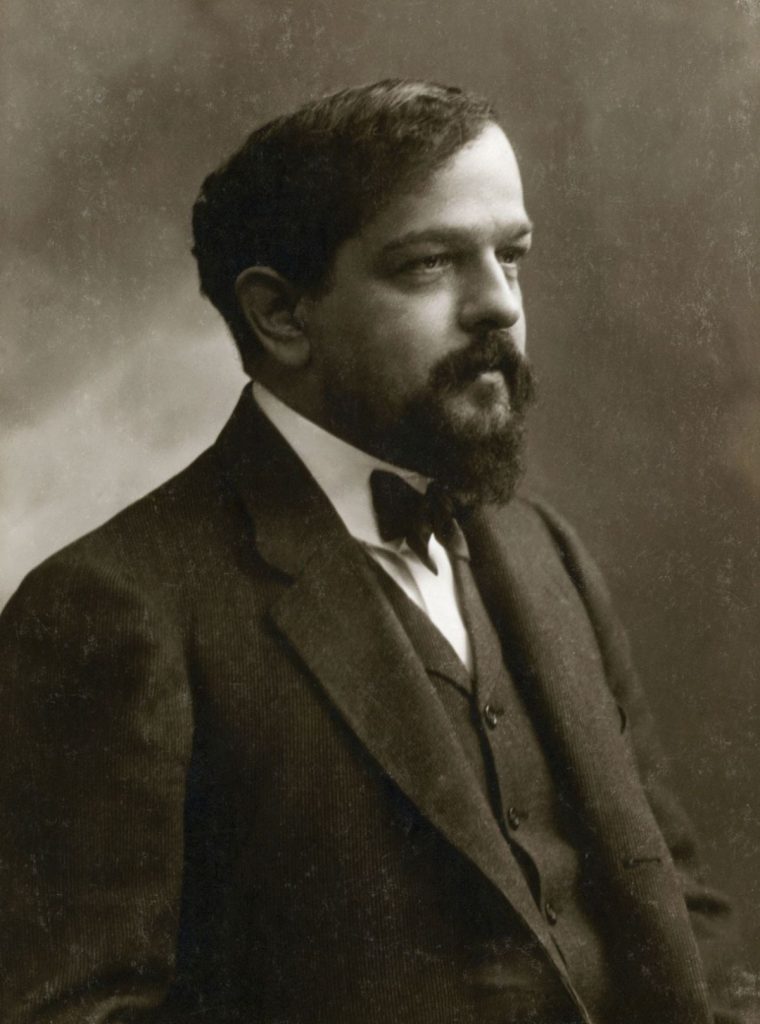
Claude Debussy

ENDNOTES

STUART MILLSON

In this edition: Debussy, Delius and Ravel from Midori Komachi  *  Ritual dances and processions by Joaquin Turina  *  Sir William Walton on Chandos  *  English song on Romney Marsh

Midori Komachi, violinist, is a highly-ambitious and hugely-gifted soloist of the younger generation – as you will discover if you listen to her remarkable debut CD, which contains an account of Debussy’s Sonata for Violin and Piano in G minor – a front-ranking performance of this monument in chamber music: the composer’s last work, and a piece which comes from the France of 1917. The late chamber works of Debussy evoke not so much a dreamy French impressionism (although a dreamscape of sorts is created by this strange, personal, detached music), but – to my mind – the sense or cult of an older France, “of the soil and the dead”. The Violin Sonata, and the Cello Sonata of 1915, flicker with glints of 20th century defiance; of an unending Gallic rural landscape, partly defiled by modern warfare, yet – in Debussy’s hands – inviolate, and expressive of the composer’s profound belief in French culture, imagination and sound-world, liberated from all Teutonic influence.

The composer thought of his Violin Sonata as not a bad work by a man at the end of his days – a work with something still to say. But had you not been told that this was Debussy at the end, there is little to suggest the great stage-curtain descending. Instead, the sonata is taut, compact (just under 15 minutes in length) – animated, and articulating many definite, melodious ideas, then ghostly and fleeting at times – then assuming more broken, more “20th century” gestures (such as the arresting opening of the second movement, Intermède). Midori Komachi’s response to this work is remarkable, not least because of the astonishingly bold tone of her playing, which soars with virtuoso brilliance – yet re-adjusts its focus entirely at those important moments when gentle, hushed, shadow-music suffuses the score. Partnered by another exceptional young player, pianist Simon Callaghan, I doubt if the chamber works of Debussy have found two finer exponents. I say this, simply because I have played the sonata over and over again – relishing the musical fantasy, the vapour-like delicacy of the playing and writing – with phrases and figures that sometimes seem to flicker like candlelight, fade, and then revive. The recording (made earlier this year at Potton Hall, Suffolk) is so clear, clean, refreshing, and extremely detailed.

Midori Komachi also performs the enchanting Ravel Sonata (again, a work in the key of G minor) and Frederick Delius’s Sonata No. 3 for Violin and Piano – Delius, Yorkshire-born of German parents, who haunted the bohemian districts of Paris and ended his days at Grez-sur-Loing, was very much part of the fin de siècle/early 20th century movement in arts and music. And it is actually the Delius sonata which has most preoccupied the soloist, as I discovered when I had the good fortune, way back in May, to meet her and discuss music and recordings.

Midori explained that Delius (in 1898) was the first owner of the Gauguin painting, Nevermore, and it was his association with the great and radical artists of the time which influenced the composer’s use of “deep, mysterious colours” – which lead “the viewers to drift away in their own imagination”. It was certainly unusual to find a Japanese musician who has become so devoted to Delius’s works – as despite Delius’s disdain for the idea of being an “English composer” and his love of the high hills of Norway and the orange groves of the American South, he is often only known for just one or two orchestral pieces which have (incorrectly) been viewed as romantically English in content.

For Midori, Delius is as international as Debussy or Ravel, and ought to be seen as such. She continued:

I am very keen to introduce more works by English composers to the Japanese audience, as the music has an appeal which is every bit as atmospheric and deep as the better-known, ‘European’ repertoire.

Over a very pleasant glass of wine, the Quarterly Review and this persuasive, communicative, hugely enthusiastic artist discussed the excitement of musical discovery (finding the symphonies of Kurt Atterburg, for example – enthusing over the E.J. Moeran Violin Concerto), and various hopes, projects and plans for a future recital and concert career. Let it be said in this column, that her new CD (entitled Colours of the Heart) will make Midori Komachi a significant name in classical music.

Meanwhile, in Manchester (or Salford, as I should say), the BBC Philharmonic has again been busy in the recording studio of MediaCity UK, its purpose-built concert hall and studio. This time, the orchestra responds with glowing colours and unabashed celebration to the lively, shimmering scores of Spanish national composer, Joaquin Turina (1882-1949). Turina studied in Paris, and despite emulating the rather formal styles of composers such as Cesar Franck, impressed the great and established Isaac Albeniz – Albeniz being the most famous Spanish composer of the early 20th century. But the senior musician told Turina to find inspiration from the culture, religion, folk-festivals, regional dialects and dances of his native country, and, on the eve of World War One, this is precisely the advice he followed – returning to Spain and perpetuating the “national school” which Albeniz had begun.

On this new disc from Chandos Records, the sense of bustle and happiness on a traditional Spanish feast day – Seville, in fact – is vividly conveyed by the large-scale orchestra, augmented by superb chiming bells and percussion. La procession del Rocio (Procession of the Dew, Op. 9) is the name of the work and it sets this pageant of atavistic music in motion, putting the listener in a carnival mood straightaway. Ritual dances, in spirits and speeds of all kind, form the Danzas gitanas, Op. 55 (offering touches, hints and imprints of Falla, or Debussy, perhaps, in some parts); and a romantic, reflective mini-piano concerto, the Rapsodia sinfonica leads up to the main piece in the programme, the Canto a Sevilla, Op. 37 – evoking the Spain of Holy Week, the bell-towers, the fountains and flamenco of the city.

Faultless playing throughout from the former BBC Northern Symphony Orchestra – now the international BBC Philharmonic – and conductor, Juanjo Mena, who handle these Respighi-like frescoes with marvellous panache. Martin Roscoe plays with great delicacy in the piano rhapsody, and soprano, Maria Espada, does fine things with Turina’s song of Seville, beautifully articulating lines such as: “Penitents and hooded Nazarenes./Scent of rose and camomile and a brightness in the skies./Explosion of spring,/carnations red and beautiful./On tableaux held aloft/Christs and Virgins shine.”

Chandos maintains the pace, this time on a CD devoted to two of the greatest works of 20th century, inter-war British music: Sir William Walton’s Symphony No. 1 (1932-35), with its crackle of pent-up, static energy; and the radiant Violin Concerto of 1939, interspersed (the second movement) with a sort of nocturnal Neopolitan tango. The First Symphony is undoubtedly one of the greatest orchestral achievements by a British composer: it is a work of absolute integrity – lucid and powerful, maintaining a clear, uncluttered, completely convincing progression. There is no scurrying off into irrelevant ideas, no noise for the sake of noise, and Walton was never interested in folk-music. It is an international symphony (Sibelian) in many ways: no obviously “English” characteristics, save perhaps for the touching,  bittersweet third movement, which for some time marked the work’s ending – until Walton (who swapped lady-friends at the time, Baroness Doernberg, for Lady Alice Wimborne) set to work on a triumphant finale. The BBC Symphony Orchestra under the baton of Edward Gardner (born 1974) deliver a first-class performance, but I have to say that I came to this recording having “grown up” with three definitive earlier performances: the Previn 1970s London Symphony Orchestra recording on RCA; the slower-paced, but stunning Philharmonia recording on EMI made in the early ‘80s with Bernard Haitink; and the tense, undercurrent-filled (Chandos again) reading by the London Philharmonic and Bryden Thomson.

In Edward Gardner’s version, especially in the second movement (where there is a great release of tension, but a malignant feeling still tugging throughout) I missed the prominent timpani thwacks and rumble which is clearly and excitingly heard on the Philharmonia and LPO versions, and felt – on the first play of the disc – a bit disappointed. The second and third time around, I became accustomed to the lower-key percussion, and began to feel that Gardner’s approach made a nice, subtle change.

Even better than his work on the symphony, Gardner’s approach to the Violin Concerto is absolutely faultless, with a real sense of everything fitting perfectly into place, and the orchestra playing at its best – especially with Tasmin Little as soloist, who soars and shines in the concerto’s two, key, heartfelt, and heart-stopping, romantic moments: the horn phrase, about two-and-a-half minutes into the second movement, which announces a dreamy section for the soloist; and that glorious, almost unbearably poignant wandering into a Mediterranean half-light of nostalgia and memory that comes just before the finale – itself, a dazzling, bewildering discharge of energy, surmounted by monumental brass-playing, sparkling with quicksilver, or virtuoso fire from the soloist.

Finding something to write about after the Walton Violin Concerto is extremely difficult, but I did manage to “cool off” – with a visit to the Romney Marsh Festival (or JAM Festival, so called after its founder, John Armitage [John Armitage Memorial]), enjoying a Sunday afternoon of English song from the period of the First World War. St. Dunstan’s Church, Snargate is one of those secret places of England; a mediaeval church in the middle of the reclaimed marshland, but – as I discovered – once a hive of activity for shipbuilders. In ancient times, the Marsh was a landscape of canals and channels, with the River Rother, which now flows into the sea at Rye, meandering out at the former port of New Romney. On a lazy, high-summer afternoon of pure sunshine, with magnificent views from St. Dunstan’s of billowing white clouds and fields ripe with corn, a 40-strong audience heard fine performances of Finzi’s Let us Garlands Bring, Silent Noon by Vaughan Williams, and songs by the Gloucestershire composer, Ivor Gurney, who served in and survived the war – but at the price of his sanity. Andrew Radley, counter-tenor, sang with great passion and belief in the music (his programme also included works by Howells and Bridge) and was sensitively accompanied by pianist, Alice Turner. A memorable occasion, and a wonderful landscape for English music.

Beckets Bridge, Romney March, geography.org.uk

Next time in Endnotes: reports from the Proms, Coronation Music for Wind Orchestra, classic Sibelius from Iceland

STUART MILLSON is the QR’s Classical Music Editor


Posted in QR Home | Tagged , , , , , , , , , | Leave a comment

Bernard’s razor HENRY HOPWOOD-PHILLIPS

Bernard Williams PRINCETON UNIVERSITY PRESS

Bernard’s razor

Essays and Reviews 1959-2002

Bernard Williams, University Press Group, 2014, £24.95

HENRY HOPWOOD-PHILLIPS finds a digest of decades-old asides and insights surprisingly to his taste

A book of over 400 pages of radios talks, public lecture notes, journalism and reviews by a don whose star first rose in the 1950s does not on the face of it sound either very entertaining or relevant, and yet it is both.

Bernard Williams was raised to the position of Knightsbridge professor of philosophy at Cambridge at the age of 37 on the basis of promise, and it is not difficult to see why. Three aspects of his thought and writing stand out.

First, the jargon-free language he uses. Williams’ beliefs on the subject are strong. In his review of B. F. Skinner’s Beyond Freedom & Dignity he remarks that the book’s

Jaunty jargon is so removed from any social reality that it could scarcely produce, directly at least, much evil in practice.

In an age of puffery the philosopher insists

There has to be a difference between what things are like if x is true and what things are like if x is not.

And this understanding plays out in his own prose which deftly navigates the reader round complex problems; obstacles that are rarely the straw-men journalists are prone to huff and puff at today.

Second is the humour. Wherever pomposity, humbug or abstraction inflates or detracts from the debate, Williams employs wit to prick the bubble and bring the focus back on to the matter at hand.

I found it surprising how many times Williams, beneath the spiky jokes, uncovered some very poorly-formed arguments. Lucien Goldmann’s book on Kant for instance claims reification is closely asssociated with the ‘modern bourgeois individualist order’, prompting Williams to remind the author that

The most notable example of this type of thought was Plato, who was not modern, nor bourgeois, nor confronted with a stock market.

Third, the confidence Williams displays in his own judgment is incredible (and often justified). Few authors are spared the lash of his tongue. B. Moore produced ‘a collection of materials rather than a book’, the ‘bulk’ of Bertrand Russell’s work was ‘unfruitfully archaic’, C. Lasch’s book on narcissistic culture is little more than a ‘Jeremiad’, Iris Murdoch’s offering on Plato and artists contains ‘barely intelligible references’, Gilbert Ryle’s late style was ‘mannered, empty and unconvincing’. Umberto Eco comes off especially badly when he talks of ‘the typical pattern of Western rationalism, the modus ponens’. Which Williams answers with another question: ‘How far east do you have to go for that to stop being valid?’

The greatest victim of the curt, arch and tart Williams is perhaps paradoxically the thinker most known for these attributes, Maurice Cowling. Williams is the master of that very British device: the courteous backhand, also known as the sentence you have to re-read to fully appreciate the sting in the tail. A good example is when he reminds the reader that

…if all religion offers is [he lists conservative concepts] then one [i.e. Cowling] needs some extra agency to keep one from immediate and close association with the more unreconstructed sort of cardinal.

He then attacks the hypocrisy of Cowling whose reputation as a ruthless critic of complacency seems unaffected by the fact he used the ‘dusty hassocks of an older Anglicanism’ as a crutch. The attack never descends into any sort of rebarbative Philippic however, because Williams has a serious point. How can Cowling ‘if all historical truth is relative’ have a leg to stand on when he complains about liberalism?

This is characteristic of all the essays. Beneath the trenchant tone is a plangent discernment that is very rare. Williams can see the deeper music that provokes the questions and ideas in the authors before he bothers to detect faulty logic in their application.

On a personal level, Williams seems to stand with Nietzsche in reckoning that the will-to-truth has ‘become conscious of itself as a problem’ and that morality (or at least the morality we have always known in this civilisation) will gradually perish now, especially as self-consciousness increases.  He believes the highest hope we have invested in philosophy, namely, a wish for the highest rationality to deliver transcendence, has ultimately trapped the current academic forms of philosophy in an ‘unhelpful, boring and sterile’ place, but that we will always need philosophy because scientists cannot justify their claim to be useful ‘simply by doing science – they have to do philosophy’.

One undoubtedly comes away from Williams with the intellectual armoury restocked and the will-to-truth reinvigorated, but does not exit the teacher’s study with a great sense of what the thinker was for on a shallower, political level. Perhaps this is Williams’ prerogative as a philosopher but it has marooned those who want more. It has caused Mary Beard to fall back on calling him a ‘tall, angular, paternalistic male’ and Roger Scruton to suppose he might be a ‘minimalist’ and a ‘snob’.

These criticisms fall flat not because they are necessarily incorrect but because Williams, at least in this book, exposes very little flesh to throw mud at. He ultimately feels like a giant Occam-razor to the cant of the twentieth century; a liberal counterweight to that other great classicist, the American Leo Strauss, a man trying to restore the ancient conception of Man’s vocation in philosophy and politics, a mission that Williams is fond of puncturing.

HENRY HOPWOOD-PHILLIPS works in publishing


Posted in QR Home | Tagged , , | Leave a comment

Prima donna M. W. DAVIS

Prima donna

M. W. DAVIS


When the President appeared on TV

she stood, purportedly out of respect;

but a handful of onlookers could see

the flash of something malicious in her


eyes—pride, an unnerving loyalism.

The squeaky new anthem peeled from speakers,

hidden by posters, embroiled in some

polyester bunting wrapped on the rail.


The podium’s just for decoration;

it’s broadcast live from somewhere deep in the

capital. He won’t show up in person

in this neighbourhood—her own, as it were.


Nor has she ever been any different.

When General What’s-his-name was shot, she

called her mother crying, quite confident

anarchists would be taking the streets soon.


When the junta was declared last April

she sang at the inauguration—sang

the same tune that, sixteen months and several

parades later, hasn’t been broken in.


That night she told the President it’d been

the happiest day of her life, better

than ‘96’s Eugene Onegin

in Boston, her first standing ovation.


You couldn’t understand it; just a sort

of prejudice, or an intuition.

Anyway, she’s their last—and best—resort:

if no one else, the angel sings along.


M. W. DAVIS is Poetry Editor of the Quarterly Review


Posted in QR Home | Tagged , | Leave a comment

Religion as Elementary Error, by LESLIE JONES

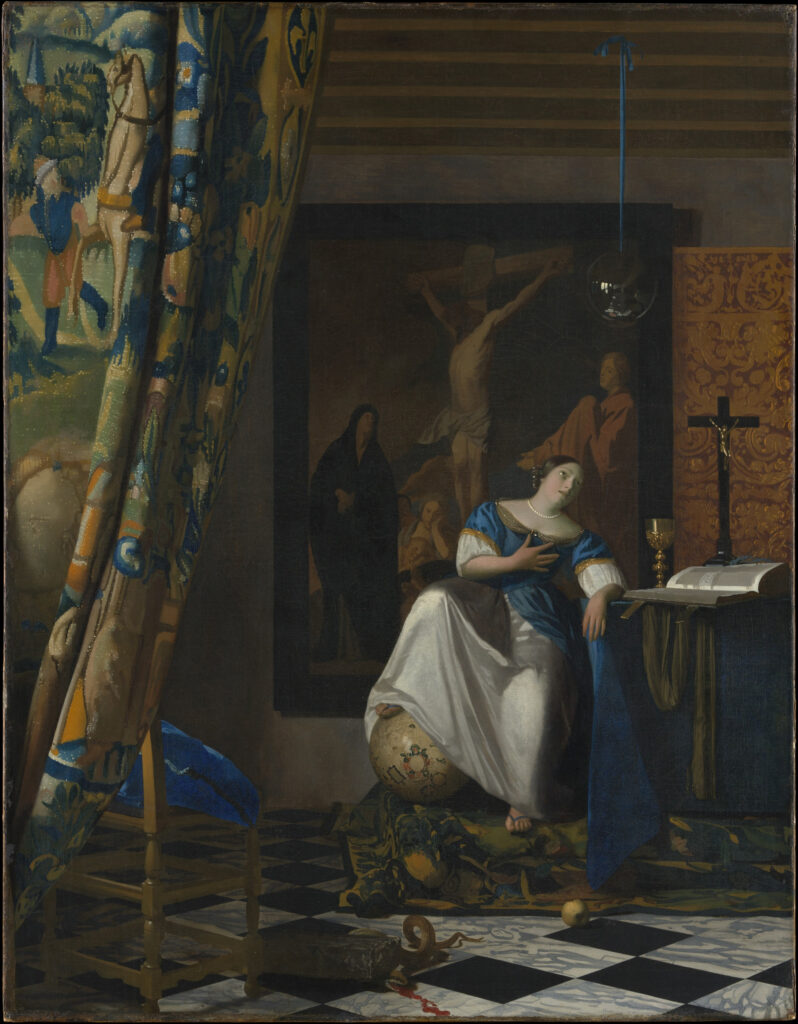
Vermeer, Allegory of the Catholic Faith, Metropolitan Museum of Art, credit Wikipedia

Religion as Elementary Error 

 by Leslie Jones

In a persuasive passage in Religion and Intelligence, anthropologist Dr Edward Dutton considers the category question[i]. He cites T. Rees’s definition of science, to wit, “thoughtful, sincere research”. As Dutton points out, this definition is so vague and capacious that research done prior to writing a novel could be characterised as a scientific activity, if done honestly.

Ironically, a similar criticism can be made of Dutton’s definition of religion. In chapter two entitled “Defining Science and Religion”, he endorses Pascal Boyer’s definition of the latter (in his book Religion Explained), as “a series of phenomena in human-thought generally involving logical or category contradictions…” (page 25). So broad is this definition that it allows Dutton to accommodate Marxism, Nazism and nationalism (and even certain conspiracy theories) within the category of religion or more precisely within what he calls “replacement religion”.

In other words, Dr Dutton conflates religion, hitherto almost always thought to be concerned with “explicit belief in a non-material existence and especially in gods” (as the author concedes on page 22), with ideology or belief per se[ii]. As an atheist or agnostic, he simply cannot accept that religion corresponds to anything real or true. Ultimately, for Dutton, religion constitutes faulty thinking or as Freud suggested in The Future of an Illusion, wishful thinking contingent on the precarious and painful nature of human existence. Anyone with a degree could debunk the arguments for the existence of God, in Dutton’s judgement. Continue reading

Posted in QR Home | Tagged , , , , , | 4 Comments

Oblivion’s grace DEREK TURNER

Time orders Old Age to destroy Beauty POMPEO BATONI (1746)

Oblivion’s grace

DEREK TURNER


In the deadness of Dove Wing

Mrs. Martindale waits –

For a Balt with an assortment of jars.

She’s a bird that has fallen,

Crashed into this place,

This carpeted cage without bars.

Stunned into quiescence,

Imprisoned by age,

What an end after flying so far!

The trolley is squeaking –

An Estonian face

Looms up and fades back into dark.

The wall clock is clicking

Low blood pressure pace,

The A-road’s a source of alarm,

And a TV is booming

In the residents’ space

Of worlds of ineffable charm.

Her daughter came calling

Once, furtive of face,

Impatiently eating her heart,

Couldn’t wait to be leaving

This embarrassing place

For her city so luckily far.

Since then, long dust falling –

Oblivion’s grace –

Slowly annealing all parts.

An old country yielding,

Through overthrown gates,

All ends going back to her start.

Hat-wearing each Christmas –

A delicate feast

As she watches the passing of cars,

Their lights on her face as

She looks vaguely east,

Hoping for prodigal stars.


Posted in QR Home | Tagged , , | Leave a comment

Thomas D’Urfey – earthy elitist for an extravagant era EDWARD DUTTON

Cavalier Soldier, Frans Hals, 1624

Thomas D’Urfey – earthy elitist for an extravagant era

EDWARD DUTTON rescues a larger-than-life character from undeserved obscurity


In an extreme reaction against the Puritanism that preceded it, the English Restoration was characterized by all that the gentlemen of the time held dear: flamboyant dress, sexual licence, more poetry than is necessarily healthy, unashamed snobbery, and a rabid attachment to King and tradition. Nobody better epitomized these attitudes than the bawdy song writer and children’s nursery rhymist, Thomas D’Urfey. Quite how the man who stuttered the immortal lines, ‘All animals, except man, know that the principal business of life is to enjoy it’ could have been so comprehensively forgotten by history should make us wonder what historians are smoking. D’Urfey deserves his very own Restoration.

Born in Devon in 1653, a penchant for fine apparel and wistful poetry coursed through D’Urfey’s veins. A descendent of French Huguenot refugees, D’Urfey’s people combined austere Calvinism with an unrivalled ability for weaving opulent fabrics and lace-making. It seems probable that D’Urfey was related to mercenary soldier Honore D’Urfe, Marquis de Valromey (1568-1625), the author of the ludicrously complicated novel L’Astree, described by one French philosopher as ‘the embodiment of spiritual love.’

Too distantly related to benefit from Honore’s family fortune, D’Urfey had to make his own way in the world. It seems the unappreciable dullness of working as a solicitor’s clerk began the young lyricist on his journey, which would culminate in 32 plays and over 500 songs, including ‘Over the hills and far away’ and ‘Quoth she, “What is this, so stiff and warm?”‘ D’Urfey made the initial error of attempting to write something serious, causing his first play, The Siege of Memphis, in September 1676, to be an abject failure. Realising his mistake, his spent all of two months penning a comedy, Madame Fickle, the prologue of which includes the line, ‘An Authors Wit lies buried in his Fear.’ By all accounts, D’Urfey’s script was pretty fearless. Produced by the Dorset Garden Theatre, it was so lung-burstingly funny that Charles II came to see it. D’Urfey was introduced to the womanizer, all-night partier, and Puritan hang-drawer-and-quarterer that was his head-of-state and they immediately hit it off. Charles commented that D’Urfey stuttered heavily, except when swearing or singing, and the King admired his ‘good natured willingness to be the butt of a jest as much as the author of one.’ D’Urfey became the de facto court jester to Charles II and every subsequent monarch until his death.

Backed by wealthy patrons, D’Urfey was free to write whatever he liked, as long as it entertained, and indulge in his passion for comical levels of snobbery and social pretension. In 1683, he changed his name from Durfey to ‘D’Urfey’ and began insisting he was related to the proto-Dadaist novelist we’ve already met. Despite being unable to afford it, he also went everywhere accompanied by a page boy in livery, and, in 1689, ended up fighting a duel with a musician named Bell, who had the temerity to criticize his sense of taste. History does not record who won the duel, only that,

With a Scratch on the Finger the Duel’s dispatch’d,

Thy Clineas (Oh Sidney!) was never so match’d.

But it must say something about D’Urfey’s quite proper inclination to run a mile from a ruffian and protect himself from fisticuffs that he apparently spent the rest of the year keeping his head down, teaching singing at an all-girls school.

Other poets took great pleasure in attacking D’Urfey for his penchant for resplendent dress and turning pomposity into an art-form; his play Love of Money was lampooned with the wildly successful pamphlet, Wit for Money, Or Poet Stutterer. But by about 1710, D’Urfey’s songs – a mixture of sexual innuendo, wittily abusing people he didn’t like, and his own children’s nursery rhymes (crammed full of sexual innuendo) – were so popular that no-one dared criticize him. Alexander Pope summed up the situation in that very year:

Dares any Man speak against him who has given so many Men to eat? So may it be said of Mr. Durfey to his Detractors: What? Dares any one despise him, who has made so many Men drink? Alas, Sir! This is a Glory which neither you nor I must ever pretend to.

D’Urfey’s songs were so amusing that grown men and children alike had no choice but to forget their woes and religiously follow D’Urfey’s advice in Madam Fickle:

For he that is sad/ Grows wretched or mad/ Whilst Mirth like a Monarch does sit/ It cherishes life in the Old and the Young/ And makes every day be both happy and long.

Unsurprisingly, D’Urfey was best known for his song book Wit and Mirth Or Pills to Purge Melancholy. Indeed, gentleman of a more technological inclination may be interested to know that this was released, in part, on CD by the band ‘City Waites’ in 1990, with a follow-up CD, Bawdy Ballads of Old England, in 1995. Fascinatingly, quite a few of our most beloved nursery rhymes were penned by D’Urfey and began life as humorous ditties about baby-making, before being unconvincingly sanitized by the Victorians. ‘Lavenders Green, Lavenders Blue’ originally included the line, ‘While you and I – diddle, diddle – keep the bed warm,’ while some of the language in ‘Over the Hills and Far Away’ shouldn’t be revealed to a child until he’s old enough to marry, and perhaps not then. Finding just a few lines to sum up the essence of Pills to Purge Melancholy is not easy but the song ‘Oyster Nan’ gives a pretty good taste. Sung in profound bass and with deadly earnestness, the satire (seemingly of Queen Anne) begins,

As Oyster Nan stood by her tub/ To show her vicious inclination/ She gave her noblest parts a scrub/ And sighed for want of copulation.

Or ‘Oh, Mother, Roger with his Kisses’ asserts,

He sits me in his lap all hours/ Where I feel . . . I know not what/ Something I never felt in yours . . . / Oh, tell me, Mother, what is that?

But D’Urfey moved beyond being witty, puerile, and amusingly school-boyish just for the sake of it. He was a man of strong passions, ardently fighting for a world focused on the transcendent, the sublime, and the interestingly waggish. His 1698 play The Campaigners was a wry satire of the fanatically humourless bishop Jeremy Collier’s anti-comedy/theatre campaign, which wanted to censor plays and cut out all the sex, violence, fun and neo-pagan philosophizing. Historians have commented that D’Urfey might have been more successful in his counter-campaign if he’d been more serious, and actually tried to grapple with the issues, but, alas, his mind was centred on creating comedy at all costs.

Alexander Pope could only marvel in envy at D’Urfey’s ability to make Restoration London laugh its plague-riddled socks off. And his rivals couldn’t avoid employing his raw talent. Ten of the 68 songs in John Gay’s The Beggar’s Opera were penned by D’Urfey and a number of his ballads were set to music by Henry Purcell himself. Those who saw themselves as high artists sneered at D’Urfey’s comedy, but as he rejoindered,

The Town may da-da-damn me for a poet, but they si-si-sing my songs for all that.

Friends with the founders of both Spectator and Tatler, D’Urfey moved in thoroughly salubrious circles and when he died, he was buried in the epicentre of the then up-and-coming St James’ – St James’ Church, Piccadilly.

Thomas D’Urfey deserves to be better known. Perhaps those of us with children or grandchildren can remember Mr. D’Urfey by lulling the little one to bed with the original versions of his nursery rhymes.

Dr. EDWARD DUTTON writes from Finland. His latest book is Religion and Intelligence (Ulster Institute for Social Research, 2014)


Posted in QR Home | Tagged , , , , , , , , , , | Leave a comment

Liam Guilar – medievalist and modernist M. W. DAVIS

Broken medieval glass at Holy Trinity Church, Coventry

Liam Guilar – medievalist and modernist

Rough Spun to Close Weave

Liam Guilar, Ginninderra Press: Port Adelaide, Australia

M.W. DAVIS is captivated by the precise but passionate imagery of a poet who draws from the Middle Ages as much as the present

In the 2010 collection Nth Degree: New Australian Writing, there sit back to back two poems; the first on page 91, the second beginning on page 93. The first, ‘Anno 787’, has lines such as:

Schooled by the sea’s indifference,

by storms, shipwreck, winter’s famine;

lotteries of loss and pain that make a life,

we move amongst your settlements

In the second, ‘Black’:

pull my hair / hard

hairy as kelp / rubbery swaying

darkness could have splashed and rubbed

while skin sucked streetlamp

‘Anno 787’ is by Liam Guilar, included in Rough Spun to Close Weave; ‘Black’ is by Stuart Cooke, an esteemed poet and lecturer at Griffith University. We begin here to highlight a necessary revelation that comes from reading Guilar, especially in his third volume Rough Spun: it can feel alienated from modern poetics, just as we can. Mr Guilar, almost singly among his contemporaries, doesn’t ask his reader to experience his personality. We needn’t share his tastes or bend our own to appreciate his work. An English boyhood, tertiary Anglo-Saxonry, immigration, homesickness, latent patriotism – all of which we certainly do find on the page – we experience just as we might the persons of Robert Frost, Thomas Hardy, or Robert Graves: that’s to say, we experience the infinite depths through their vessel. And, admire the vessel as we might, Mr Guilar’s poetry neither begins nor ends with Liam Guilar.

The sequence in Rough Spun moves beyond earlier stream of consciousness experiments, taking on a more chin-up character: his reveries aren’t linear, nor is every memory recounted with equal clarity. The longer poems, such as ‘A Love Story, Perhaps’ (26-30), grapple hopelessly with what’s ethereal; while the shorter, as with ‘A Craftsman Made These’ (60), are meditations on subjects and themes almost impossibly concrete for the lightness of its verse. A modern master of psychological realism (though not only this), the Guilar found in Rough Spun is coincidental. What we love is the vaster humanity evident in these poems.

Erotic poetry has always been difficult – and it’s increasingly so in our sex-obsessed culture. That’s not to judge the culture itself; only to say that what’s overbearing in public life can be difficult to present artfully in poetry’s exposure of private life. If sex is public, what can the modern poet possibly contribute? As with ‘Black Latex’ (see above), often it’s recourse to the perverse, the sadistic, and the taboo. Mr Guilar takes a much more arduous course, choosing instead to probe the mechanics of the brain on sex. In Part 3 of ‘A Love Story, Perhaps’ (28), he writes:

A cracked fouled leather glove

drifts along the inside of a thigh,

plays, lovingly, between these legs.

Don’t be ashamed if you’re aroused.

Once the tearing starts

There will only be reactions.

There’s no voyeurism in the poem, and nothing that looks to tread on toes for the sake of treading on toes. Sex isn’t presented here as profane, or as a holy thing profaned by over-exposure. It is treated like any other subject in Mr Guilar’s poetry – as he treats boating, saints, and poetry itself: something for the Muses to play with.

On the other hand, there’s the recollection in ‘My Grandmother’s Story’ (41), which begins,

We hadn’t been there long.

That night, we blew the candles out

said our prayers and went to bed.

Hobnailed boots on cobblestones

in the dark outside the window

heading down the garden to the shed.

There were no cobblestones

outside the window, just an

overgrown, untended flower bed.

The poem is gripping, easy, and follows the same playful rhyme scheme. It has the haunting suspense of the best of Poe, and yet never departs into the fanciful. I couldn’t bear to spoil any more for the reader, but this second-hand tale has all the charm the title promises: it’s a grandmother’s story, told in the days when we still went about the night by candlelight and said our prayers before bed. The poem is as much a reflection on our time – so inopportune for Gothic horrors – as it is an enjoyable story.

Readers of this journal, who so often remain willing to meet the ancients on their own terms, will certainly appreciate Mr Guilar’s willingness to serve as interpreter anyway. He never shies from his training as a medievalist, though neither does he over-saturate the chapbook with scholarly references. His ‘Presentiment of Englishry’ (40) on the 11th century custom of proving a fallen warrior was indeed English, including the Old English phrase Gehyrest Pu? – ‘Do you hear and understand and/or are you listening?’ And yet expect Mr Guilar to defy Beowulf and the Chronicles. Our poet isn’t so much a revivalist as he is, indeed, an interpreter. One could leave it at, ‘Guilar is looking for the human beings behind the myth’ – but that would be too easy. There’s none of the voguish exposé-style adaptation of the Classics that offer a more ‘authentic’ or ‘relevant’ telling. Guilar impresses one with an earnest appreciation for his Old English quasi-heroes, loving them because and in spite of their humanity. They’re bawdy and clever, real salt-of-the-earth battlers:

By what grounds English?

West Midlands, I. Not mercenary, prat, a Mercian! Of Penda’s  folk?

Gehyrest Pu? …

And in his easy movement in and out of time, Mr Guilar never thinks to idolize or condemns the ancients. He won’t come across one as a backward-looking Romantic or an uncomprehending Futurist:

Hatred handed down amongst the people

we defeated, and we reviled by those we did the fighting for.

So there are at least two interpretations of the Guilar-esque medieval the reader might follow: either the engaged, passive reporter on the front lines; or the aloof but affectionate Briton having a look up and down his family tree. And maybe he’s something altogether different. But the Quarterly’s readership should seize this occasion to take heart in knowing the labours of the ancients aren’t lost to all modern genius.

So many Western poets are still, like Ezra Pound a century ago, attempting to appropriate the concision of Asian lyricism to suit Western art. As it was then, the product tends to have an uneasy, Orientalist note, as though having been written uneasily, at arm’s length. Guilar’s tight verse has the benefit of emerging from and improving the Modernists’ project. His thoughts are complete and natural when written with such brevity, and still unmistakably influenced by precise Eastern forms and naturalist meditation, such as in “The River” (16):

The river joins the dots

encounters, moves on,

then forgets.

And in “The River Journey” (20):

The treeline

and the endless rain

donate another burden.

Those of us who covet that stoic, incisive movement – the magnificent collision of simple images that our native poets have never quite achieved – will have much to relish.

These are poems that will come back to you at unlikely moments if you’re ever seized with nostalgia while laying wallpaper, or are struck with déjà vu kicking along a dirty beachhead like an unhappy Stephen Dedalus. That’s the depth of thought Guilar impresses on the reader, and we don’t mind when it comes surging up again. By now they’re so familiar, anyway, they feel as though they’re only back where they belong.

M.W. DAVIS is Poetry Editor of the Quarterly Review

Rough Spun to Close Weave may be purchased from the publisher’s website: http://www.ginninderrapress.com.au/poetry.html


Posted in QR Home | Tagged , , | Leave a comment