Whence Isis?

Iraq_War_montage

Whence Isis?

Ilana Mercer traces the origins of a death cult

For the neoconservatives, ground zero in the creation of the Islamic State (ISIS) is the departure of the American occupying forces without a Status of Force Agreement (SOFA). At the behest of President Barack Obama, or so the allegation goes, the American military decamped, in December of 2011, without securing an SOFA. A residual American military force in Iraq was to be the thing that would have safeguarded the peace in Iraq. Broadcaster Mark Levin regularly rails about the SOFA amulet. Most Republicans lambast Obama for failing to secure the elusive SOFA.

So high is Barack Obama’s cringe-factor that conservatives have been emboldened to dust-off another awful man and present him, his policies and his dynastic clan to the public for another round.

The man, President George W. Bush, did indeed sign a security pact with his satrap, Nuri al-Maliki, much to the dismay of very many Iraqis. Although the agreement was ratified behind the barricades of the Green Zone, journalist Muntadhar al-Zeidi “spoke” on behalf of his battered Iraqi brothers and sister: he lobbed a loafer at Bush shouting, “This is a farewell… you dog! This is for the widows, the orphans and those who were killed in Iraq!”

Saddam Hussein—both dictator and peace maker—had no Status of Force Agreement with the U.S. He did, however, use plenty of force to successfully control his fractious country. Highly attuned to the slightest Islamist rumbling, Saddam squashed these ruthlessly. When the shah of Iran was overthrown by the Khomeini Islamist revolutionaries, the secular Saddam feared the fever of fanaticism would infect Iraq. He thus extinguished any sympathetic Shiite “political activism” and “guerrilla activity” by imprisoning, executing and driving rebels across the border, into Iran. It wasn’t due process, but it wasn’t ISIS. This “principle” was articulated charmingly and ever-so politely to emissaries of another empire, in 1878: “My people will not listen unless they are killed,” explained Zulu King Cetshwayo to the British imperial meddlers, who disapproved of Zulu justice. They nevertheless went ahead and destroyed the mighty Zulu kingdom in the Anglo-Zulu War (1879), exiling its proud king.

Ask any ordinary Iraqi struggling to eke out an existence in what remains of his pulverized homeland, and he’ll tell you: “Keep your Status of Force Agreement. Give us back the Iraq of Saddam Hussein.” True, the Kurds were not in a good place. And Shia madrasas were regularly shuttered. But some reconstruction was underway. Democratic plans were being drafted (albeit slowly). A “nonaggression pact” and a “cooperation council to promote economic and cultural development” had been established with the Arab neighbors (Kuwait, not so much). Best of all, Iran was on the run.

A 2012 Zogby poll, highlighted by The American Conservative, questioned Iraqis about the impact on their lives of the American invasion. “For the most part, Shia and Sunni Arabs perceive almost every aspect of life to have become worse or not [to have] changed.” And this was in Iraq BI: Before ISIS.

Not long after the “great” American troop surge of 2007, Global Policy Forum questioned Iraqis, too. (This was more than Bush had done when he ordered that bombs be dropped on their neighborhoods.) What do you know? With the surge and without an SOFA, Iraq was oh-so violent. By September, Iraqis were still citing a “lack of security and safety in general” as one of their most pressing existential concerns.

The answer to the question, “Who do you blame the most for the violence that is occurring in the country?” placed the U.S. up there with al Qaeda and foreign Jihadis as the root of all evil. Harmony being what it was in Iraq during the halcyon Bush years—Shia blamed Sunni and Sunni blamed Shia for their respective woes.

Guess who, in 1994, had advised against an invasion he went on to orchestrate, in 2003:

“….if we had gone to Baghdad we would have been all alone. There wouldn’t have been anybody else with us. It would have been a U.S. occupation of Iraq. None of the Arab forces that were willing to fight with us in Kuwait were willing to invade Iraq. Once you got to Iraq and took it over and took down Saddam Hussein’s government, then what are you going to put in its place? That’s a very volatile part of the world. And if you take down the central government in Iraq, you could easily end up seeing pieces of Iraq fly off. Part of it the Syrians would like to have, the west. Part of eastern Iraq the Iranians would like to claim. Fought over for eight years. In the north, you’ve got the Kurds. And if the Kurds spin loose and join with Kurds in Turkey, then you threaten the territorial integrity of Turkey. It’s a quagmire if you go that far and try to take over Iraq.”

This astute, if utilitarian, analysis was that of Bush’s Vice president, Dick Cheney. The architect of the invasion of 2003 had counseled against it in 1994. The man’s predictions have come to pass.

The Bush SOFA specified a complete withdrawal of U.S. forces by Dec. 31, 2011. Despite negotiations thereafter, Iraqis rejected any further infringements on their sovereignty.

In short, it was not the departure from Iraq that guaranteed the rise of ISIS aka ISIL but the invasion of Iraq.

ILANA MERCER is a paleolibertarian writer based in the United States. She pens WND’s longest-standing column, “Return to Reason” and is a Fellow at the Jerusalem Institute for Market Studies. She is a Quarterly Review Contributing Editor. Ilana’s latest book is Into the Cannibal’s Pot: Lessons for America from Post-Apartheid South Africa. Her website is www.IlanaMercer.com. She blogs at www.barelyablog.com

Posted in QR Home | Tagged , , , | Leave a comment

Elegy for Minor Emperors

Rothko

 Elegy for Minor Emperors

by Michael Davis

No one will mourn Caesar

Not the stiff-necked night-watchmen at the German border

Neither the green nor the black olives

Nor the disinherited crown

_

The grapes won’t sour on the vine

The cypresses won’t bow low as his carriage passes

The stars won’t reflect his majesty in the heavens

_

His consort won’t throw herself on his pyre

His sons won’t be seen about in rich black robes

His concubines won’t throw themselves on couches in the garden

His horse won’t rear beneath the weight of his absence

_

The foreign delegations will pay their respects and proceed orderly out

The women will sleep naked in their beds

The men will stay out and get wildly drunk

The servants will fondle one another on haybails

The barbarians will track mud on mud floors

The dogs will lie down in the kennel

The sheep will huddle on the dark hill

The beetles will hum a disinterested Taps

Michael Davis is QR’s Poetry Editor

Posted in QR Home | Leave a comment

ENDNOTES

Sergei Prokofiev

Sergei Prokofiev

ENDNOTES, February 2015

In this edition: Clare Hammond records for BIS * Somm issues Sonatas by Prokofiev * Céleste series – Concerti Armonici by Count Unico Wilhelm van Wassenaer.

With many triumphant performances at Kings Place, the Wigmore Hall, and at the Warsaw Autumn International Festival, pianist Clare Hammond is emerging as an influential, original musical force – not least because of her advocacy of contemporary music and neglected repertoire, such as the music of Andrzej Panufnik, and – in a new recording for the Swedish BIS label – six études by the South Korean composer, Unsuk Chin (born 1961).

Clare Hammond’s playing and technique seem so clear, methodical, unhurried, unforced, that to listen to her work – even in the “difficult” circumstances of modern music, with its fiendish torrent of atonality – is a pleasure; because every note is played with such thought and feeling, and attention to detail, and is made to count, especially in the well-chosen acoustic of Potton Hall, Suffolk, the venue chosen by the superb BIS sound engineers. She begins her recital on the disc (catalogue details: BIS 2004) with the late-romantic music of Sergei Lyapunov – three of his 12 Études d’Exécution Transcendante – one written in 1897, the others from 1900. If Lyapunov is unfamiliar to many English listeners, then it might be helpful to think of the works of Rachmaninov – but with a lighter, more folk-like feel; or perhaps as a Russian version of Liszt or Chopin.

In the CD booklet, which is (refreshingly) written by the recording artist (rather than by an onlooker), we discover that Lyapunov was an adherent of the New Russian School, and “in 1893 was commissioned by the Imperial Geographical Society, together with [fellow composer] Balakirev, to gather folksongs from the Vologda, Vyatka and Kostroma regions”. Clare Hammond informs us that: “…only one of his études, the Chant épique, uses a genuine folk melody, the three on this disc are replete with folk-like motifs.” A somewhat different experience awaits us in Clare’s gripping performance of Unsuk Chin’s études, which were not composed at the piano, but the product of the composer’s “aural imagination”. Idiomatic, abstract, resolute and assertive, and taking music into every conceivable dimension (even to that region which some might consider beyond music), this female disciple of Ligeti may yet come to intrigue and fascinate modern audiences – very much in the way Roxana Panufnik carries a torch for contemporary composers. The CD also contains 12 Studies by Szymanowski – that Polish 20th-century romantic, who combines elements of Debussy, Mahler and Scriabin – and Five Études by Nikolai Kapustin, a name unfamiliar to me until I discovered this enriching and stimulating collection.

Peter Donohoe (born in Manchester in 1953) has long been a fixture in British concert programmes and recordings, ever since his triumph at the 1982 International Tchaikovsky Competition in Moscow. He has often performed in partnership with Sir Simon Rattle and the City of Birmingham Symphony Orchestra (I remember him at the 1983 Proms in Rachmaninov’s Third Piano Concerto – a performance that ended with a great roar of approval from the Prommers). Somm Records has provided Donohoe with a splendid platform for his virtuoso style and love of Russian music, in a new Prokofiev collection (CD 256): Piano Sonatas, nos. 9 & 10, two sonatinas, and the Sonata for Cello and Piano, Op. 119 in C major. For the latter work – just over 20 minutes in duration – Donohoe achieves what must be a perfect realisation of Prokofiev’s emotions, style and state of mind at the end of a productive life, but one spent in the shadow of totalitarianism. The sometimes bare-boned music of the composer took some time “to grow” upon this reviewer, but over the years his work has made more and more of an impression upon me: a feeling of sinister Russian fairytales, orchestral violence, classical elegance (but in a 20th-century context) – and all overshadowed by the terrors and monoliths of the Stalinist Soviet state. It is difficult to conceive how creative, free-thinking men, such as Prokofiev and his fellow composer, Shostakovich, were able to live – either in a day-to-day sense, or at the higher artistic level – in such conditions. But they nevertheless managed to produce a large body of works, symphonies, ballets, operas, chamber music – which might, perhaps, have been less potent had they been nurtured in a liberal society. It is as if their works gathered an extra momentum and power from the very constraints which surrounded them.

Collectivisation

Collectivisation

The Cello Sonata, in which Donohoe is joined by the great Raphael Wallfisch (a cellist with a passion for contemporary works – and a student of Gregor Piatigorsky) seems to be a work which has escaped the Stalinist monitoring committee, despite being dedicated to Lev Atovmyan of the State Music Publishing House. It consists of three movements of individual feeling, conviction and thought, a powerful, noble voice – and resolute and uplifting in its Allegro ma non troppo conclusion – but a voice approaching the end of its life. The sonata was first performed in Moscow in 1950. Like Stalin, Prokofiev would be dead three years later. Once again, a very fine recording from Somm’s Producer, Siva Oke.

Finally, six Concerti Armonici have appeared on disc (for Somm Records, Céleste series CD 0141) – works which were once attributed to Pergolesi, but which we now believe (thanks to discoveries made by the Dutch musicologist, Alfred Dunning) came from the hand of the aristocratic, artistic diplomat, Count Unico Wilhelm van Wassenaer (1692-1766). Trained as a lawyer, and holding posts in various European capitals, the Count was also a member of the Dutch admiralty and that country’s East India Company. Malcolm MacDonald’s meticulous biographical notes inform us that van Wassenaer’s (serious) sideline was music and musical study, and that he spent time under the tutelage of Quirinus van Blankenburg, a harpsichordist of the early 18th-century.

Each concerto in this elegant collection consists of four short, melodious movements – some spirited, some grave and nostalgic, but all with the charm and finesse of an age of baroque palaces and halls; the culture and world from which Handel, Mozart, Haydn and eventually Beethoven, emerged. A lovely clarity comes from each section, with the Innovation Chamber Ensemble – a band of players from the ranks of the City of Birmingham Symphony Orchestra – performing with grace and precision, under artistic director, Richard Jenkinson. The instruments and accents, so well-pitched, modulated and blended together, seem to sigh with each reflective mood and moment, and throughout the 56 minutes and 54 seconds of this disc, the listener is transported back to the landscaped gardens of the ancien régime era which van Wassenaer inhabited.

Stuart Millson, Classical Music Editor


Posted in QR Home | Tagged , , , , , | 1 Comment

The Camel Ate My Homework

Marine Le Pen

Marine Le Pen

The Camel Ate My Homework

 More reflections on a massacre, from Ilana Mercer

The Fourth Estate has moved the country into the Third Dimension. The media lie so much, that when stuff happens that scares them, they no longer know where to turn for the truth.

For now, mainstream media have stopped meditating on Charlie Hebdo, and moved on to the weather and other woes. But something changed after this month’s strike, carried out by French recruits to Qaeda in the Arabian Peninsula, on the offices of Charlie Hebdo.

The frightful events that unfolded in Paris seemed to have triggered something of a come-to-Jesus moment among members of the media. For example, before Charlie Hebdo, supernova Megyn Kelly’s everyday “expert” on Islam was one Brooke Goldstein. Unless good looks qualify one to expatiate on Islam, Goldstein was—still is—gormless.

However, right after Charlie Hebdo, Kelly traded Goldstein for Ayaan Hirsi Ali, who is both victim of and an expert on Islam. Lo and behold, Robert Spencer of Jihad Watch made the rounds, myth-busting about Islam and its Prophet. The New York Times was really running scared: its editors solicited a piece from the pen of Marine Le Pen, leader of France’s rightist Front National. While she did not quite counsel pulling the drawbridge up, Le Pen questioned the wisdom of inviting “waves of immigration, both legal and clandestine” into the West.

Like lab rats, media are maze-bright, no more. Other scribes found solace by levitating in the Parallel Universe, pretending that in the Hebdo massacre we had a Whodunit to unravel. “Both the motive and the identity of the perpetrators are still unknown,” intoned a cipher at Slate. For a while, Wolf Blitzer of CNN was all wide-eyed wonderment, too. Across the pond, the constabulary in Hamburg, north Germany, informed its citizenry that the motive for an attack on the Hamburger Morgenpost, a newspaper that published the Charlie Hebdo cartoons, was “still under investigation.”

Just as some mediacrats still pretend the phrase “radical Islam” is not a redundancy, others make believe that the motive for shooting up a place of business while yelling praise for the Prophet is a mystery. Unless authorities say otherwise.

Disaffected, disadvantaged, disenfranchised is how progressives prefer to depict the murderers in their midst. After all, progressives hail from the school of therapeutic “thought” that considers crime to have been caused, not committed. Misbehavior is either medicalized and outsourced to state-approved experts, or reduced to the fault of the amorphous thing called society.

The most famous advocate of the-Camel-Ate-My Homework theory of criminal culpability is Barack Obama. Obama’s flabby assumption has it that the poor barbarians of France’s burbs have been deprived of fraternité. “Europe needs to better integrate its Muslim communities,” lectured the president.

Libertarians are also guilty of a social determinism that flouts their philosophy of individual freedoms. For the sins of man, hard leftists blame society and libertarians saddle the state: U.S. foreign policy, in particular. A war of aggression, Abu Ghraib, Guantanamo Bay, and torture are thus “principal catalysts for this kind of non-state terrorism,” argued Ray McGovern.

“The-state-made-me-do-it” argumentation apes that of the left’s “society-made-me-do-it” argumentation. Both philosophical factions, left and blowback-libertarian, are social determinists, in as much as they implicate forces outside the individual for individual dysfunction.

Myself, I despise U.S. foreign policy as deeply as any Muslim. But it would never-ever occur to me to take it out on my American countrymen.

In the context of free will, and in a week in which we remember the Holocaust, Viktor E. Frankl rates a mention.

Dr. Frankl came out of Auschwitz to found the Third Viennese School of Psychotherapy. The philosopher and distinguished psychiatrist said this of his experience in the industrial killing complex of Auschwitz-Birkenau: “In the camps one lost everything, except the last of the human freedoms, to choose one’s attitude in any given set of circumstances, to choose one’s own way.”

To plagiarize another Jew (myself): “You can see why liberals have always preferred Freud to Frankl [my family included]. They retain a totemic attachment to the Freudian fiction that traumatic toilet training is destiny.”

Dr. Frankl lost his beloved young wife in Auschwitz, yet told poignantly of finding her, if figuratively, in a tiny bird that flitted close by. If this man was able to discover the reality of free will and human agency in a laboratory like Auschwitz, so too can Muslims find the will to respond adaptively to events that enrage them and are indeed unjust: Western foreign policy.

The idea that the Brothers Kouachi and thousands of their coreligionists in the West who’ve joined ISIS were driven by “disaffection” to do their diabolic deeds conjures a skit from the “Life of Brian,” John Cleese’s parody of Judea under Rome.

In what is a typically Jewish dialectical session, Reg and his band of anti-Roman rebels are debating the merits and demerits of the enemy. So, “What have the Romans ever done for us?” asks Reg. “The aqueduct,” ventures one rebel. “Sanitation” pipes-up another: “Remember what the city used to be like?” A third praises the roads. A fourth, the public baths. Exacerbated by the growing list of Roman improvements, rebel-in-chief Reg responds: “All right, but apart from the sanitation, the medicine, education, wine, public order, irrigation, roads, a fresh water system, and public health—what have the Romans ever done for us?”

By the same token, what have those “cheese-eating surrender monkeys” ever done for their Maghrebian immigrants (les beurs, as they are known)—apart from replacing the mud huts of their ancestors with subsidized housing and modern plumbing, giving them schools, job-training institutes, cradle-to-crypt welfare, health care and, my personal favorite, the Musée du Louvre?

While Obama sounded a bum note, British Prime Minister David Cameron acquitted himself well with this take on criminal culpability: the murderers in our midst “have had all the advantages of integration,” they’ve “had all the economic opportunities that our countries can offer.”

ILANA MERCER is a paleolibertarian writer based in the United States. She pens WND’s longest-standing column, “Return to Reason” and is a Fellow at the Jerusalem Institute for Market Studies. She is a Quarterly Review Contributing Editor. Ilana’s latest book is Into the Cannibal’s Pot: Lessons for America from Post-Apartheid South Africa. Her website is www.IlanaMercer.com. She blogs at www.barelyablog.com

Posted in QR Home | Tagged , , , , | Leave a comment

A Modest Proposal

Top Gun

Top Gun

A Modest Proposal

Ilana Mercer does some lateral thinking

He adopted the religion of peace and forthwith proceeded to shatter the peace of his countrymen.

In the waning months of 2014, Quebecer Michael Zehaf-Bibeau shot Cpl. Nathan Cirillo in the back, at Canada’s National War Memorial in Ottawa. Zehaf-Bibeau then stormed Parliament, but was dispatched by a sergeant-at-arms before he could do further harm.

The mother of the martyr, Susan Bibeau, is a “deputy chairperson of a division of Canada’s Immigration and Refugee Board.” Mrs. Bibeau has done quite well as a Canadian bureaucrat, acquiring “homes in Montreal and Ottawa.” Her errant son told mommy dearest of “his desire to travel to Syria,” a fact she revealed only after the butcher’s bill came due; following Zehaf-Bibeau’s lone-wolf, wilding rampage on Parliament Hill.

Why would a convert to Islam want to travel to Syria? To visit the ruins? And why would a Canadian civil servant, who described her son as a misfit, not report Zehaf-Bibeau’s destination of choice to the authorities? In any event, it transpires that said authorities had been investigating Zehaf-Bibeau, but had yet to determine whether or not to confiscate his passport.

Before Michael Zehaf-Bibeau came another Quebecer called Martin Couture-Rouleau. Like Bibeau, Rouleau went to war with his countrymen upon converting to Islam. He rammed his car into two Canadian Forces members near Montreal, one of whom died of his injuries.

According to the Canadian Broadcasting Corporation, Couture-Rouleau was known to the Canadian Security Intelligence Service, or CSIS, and had been closely monitored. These authorities were confident that Couture-Rouleau and 90 other suspected extremists “intended to join militants fighting abroad.”

So what did the Canadian security apparatus do to forestall an attack on Canadian soil? First, the Royal Canadian Mounted Police staged an intervention. The Mounties tried to “talk Couture-Rouleau down” from his murderous mindset. Convinced that the therapeutic intervention succeeded, the Mounties then stopped monitoring him. Oh, and they also took away Couture-Rouleau’s passport.

The New Year brought us the Brothers Kouachi, who carried out the assassinations at the Charlie Hebdo headquarters in Paris. The brothers ate, slept and breathed “radical Islam.”

When Chérif Kouachi was not making a dash for Jihad Central in Syria—only to be stopped and arrested by the foolish French—or planning jail breaks for other Jihadis; he was recruiting French Muslims for no other than Abu Musab al-Zarqawi and his Iraqi operation. Al-Zarqawi is the fellow who had been admonished by Ayman al-Zawahiri (Bin Laden’s Capo Bastone) for being too … ruthless. Yes, Chérif’s mentors and compadres inhabited the revolving door of mosque and prison.

As to Saïd Kouachi: Other than welfare, the only thing he earned in France were frequent-flyer miles to Yemen. There he hung out with the would-be underwear bomber and the American al Qaeda preacher, Anwar al-Awlaki.

The Russian state security had informed the FBI and CIA that one of Boston’s own, Tamerlan Tsarnaev of the Boston Bombers Team Tsarnaev, undertook similar “vocational” training in Dagestan. The agencies, however, were more concerned about keeping terrorist tourism alive, than keeping Americans in the land of the living.

The point here is not to belabor well-known, accepted outrages. Instead, I’d like to float a modest proposal.

The Canadian government continues to “revoke passports from extremists so as to prevent them from traveling to-and-fro Syria and Iraq to join the Islamic State (ISIS).” Oddly, the same government will often opt to charge Jihad-minded men with “attempting to leave Canada to participate in terrorist activity.”

Why?

Revoking a home-based Jihadist’s travel documents is worse than dumb; it is a dereliction of duty. It demonstrates that whatever it does, the state acts irrationally—and certainly against the interests of those whose safety it has been entrusted to protect.

Naturally, no individual should be arrested for harboring wicked thoughts or hanging with wicked people. But when he leaves the Occident with the intent to train to wage war on his neighbors—this Jihadi must be stopped from re-entering the good country.

Let the West’s homegrown Jihadis wander from the killing fields of one crap country to another, like the nomadic hired guns they are.

By nature, this modest proposal is defensive (not to mention decisive) and, thus, eminently libertarian.

There are well over 3,000 Western fighters that have traveled to assist ISIS and its offshoots in forging a caliphate. They return with murder on their minds. They must not be allowed back into Western countries.

Citizenship is nothing more than a political grant of government privilege; a positive, state-minted right. Citizenship is not a natural right. Yet these state-stamped licenses—citizenship and attendant travel documents—are honored, at the cost of innocent lives.

Alas, the Monster State is inherently both stupid and evil. Like a primitive organism, it answers to nobody and nothing but its reflexive need to grow.

To wit, the Monster State refuses to protect its people from plagues. It welcomes high-risk travelers from the Ebola hot-zones. Simultaneously, it quarantines aspiring fighters for Jihad here at home, in the West, so the homeland is the only arena in which they can act-out.

The nightwatchman state of classical liberalism would keep killers out of the country, not in the country.

ILANA MERCER is a paleolibertarian writer based in the United States. She pens WND’s longest-standing column, “Return to Reason” and is a Fellow at the Jerusalem Institute for Market Studies. She is a Quarterly Review Contributing Editor. Ilana’s latest book is Into the Cannibal’s Pot: Lessons for America from Post-Apartheid South Africa. Her website is www.IlanaMercer.com. She blogs at www.barelyablog.com


Posted in QR Home | 1 Comment

Gender Studies, an Aberrant Ideology

Medusa_by_Carvaggio

Gender Studies, an Aberrant Ideology

Steve Moxon lets rip

 Jacqueline Rose, Women in Dark Times, Bloomsbury, London, 2014, £20

Women in Dark Times by Jacqueline Rose is feminist cant of such imbecility as to be a leading candidate for the most risible non-fiction book of the year, or even decade.

Most glaringly, it is riven through with comprehensively discredited notions from Freud and other psychoanalysts in their un-falsifiable and therefore wholly non-scientific ‘theories’, revealing that Rose has not even the slightest knowledge of psychology or any science. And no wonder: scientific illiteracy is an essential prerequisite to maintain the empty lines of her argument. Indeed, she explicitly decries “reason”, positing instead that “confronting dark with dark might be the more creative path”. Rose tries to make out that “man’s rivalry with women” – itself a non-existent, merely politically supposed phenomenon (there being no such thing in biology as cross-sex dominance interaction) – is “because she once was, is still somewhere now, a rejected part of himself”. This non-scientific twaddle, cited as being from the psychoanalyst Melanie Klein, was discredited somewhere in the middle of the last century, along with ‘penis envy’, the ‘death instinct’, ‘repression’ and everything else Freud and his disciples ever came up with. Somebody needs to tell university humanities departments.

From the outset, there is the stark assertion of empty political shibboleths without any attempt whatsoever at justification: “We cannot make it only by asserting women’s right to equality”, Rose opines in the very first paragraph; in which she also claims women’s knowledge as a new epistemology akin to some ancient mythic priesthood. Well, at least feminist special pleading is here put frankly. And she does concede that she can speak only for some women, though without pointing out that this is a tiny slither of the female sex; albeit indicating this well enough in her choice of a handful of rarefied individuals she considers emblematic women worthy of a chapter each. These, Rose supposes, are representative of female suffering that is “unseen”! Unseen! Since when was any female victimisation not the very centre of attention, together with various exaggerated or manufactured bogus forms of female victimisation? Never mind in instances of artistic or other fame, as is common to Rose’s ‘heroines’ here. It is male suffering which goes unseen: males are unable to seek help because they know they will not get a hearing and instead will be derogated; hence the extraordinary high rates of male compared to female suicide.

Rose’s exemplars are all supposed dire cases worthy of the label “survivor” – the standard giveaway charged misnomer – yet they are none of them any sort of victims of her ‘patriarchy’ bogey. Most are in no sense victims at all, but, on the contrary, successful if comparatively obscure contemporary artists. The remainder sustained ordinary damage and/or were caught up in grand upheavals that anyone and everyone succumbed to. Marilyn Monroe was passed between eleven different foster families before seeing her mother committed to a mental hospital. Rosa Luxemburg had risen from nowhere to hold court with the most famous communist leaders to express face-to-face severe criticism of them and their movements, that had she been male would have earned her execution long before she finally provoked that end (which, for her advocacy of mass slaughter, she well deserved in any case). And Charlotte Salomon had a family history of serious mental health issues, with her mother and two sisters all committing suicide; and as a German Jew was caught up with everyone else of her ethnicity/religion in the Nazi nightmare.

The heart of Women in Dark Times is where Rose gets away from her obscure artists and empty political or media pin-ups to look at ‘honour’ crime, but she gets this spectacularly wrong at the same time as unwittingly providing a window on the truth. [I say unwittingly, but it’s hard to see how she could be so blind, rather than wilfully addled by her quasi-religion.] Leaving aside that across cultures and through all history those on the receiving end of extreme violence in retribution for infidelity typically if not universally are men, yet ‘honour’ crime is explicitly defined in terms of only female victims; the instigators (rather than the mere proxies) are usually women — the family matriarchs or younger mothers. “One of the most disturbing aspects of these stories is the involvement of mothers in policing their daughters, and even on occasion in killing them”, Rose tellingly comments. “Purna Sen [of the LSE] sees such involvement by women as one of the distinctive features of honour crimes”. Rose cites cases of the target for violence being the male adulterer or both parties, and that the “mother can no longer hold her head”. That the male ‘honour’ killers are proxies of the instigators more than they are instigators themselves, and the ‘fall guys’ in the enterprise, is revealed in the following passage: “… the act is a matter of deepest regret, even as they are egged on, lauded and told to be proud. These young men, often chosen to enact the crime on the grounds that their youth will lead to a reduction of their sentence, mostly find themselves rejected and isolated by their families once in prison”.

It never crosses Rose’s mind that this phenomenon is not some ‘patriarchal’ [sic] imposition but is a female intra-sexual phenomenon which is supported by males inasmuch as they are duty-bound to do so given their civic role. Instead, Rose plucks out of thin air: “Honour is therefore vested in the woman but it is the property of the man”. On the very contrary, it is the ‘property’ of women; just as is Chinese foot-binding, female genital mutilation, and the various forms of face-veiling and body-shrouding (which pre-date and therefore are not from Islam). All of these cultural practices are similarly grounded in female intra-sexual competition for pair-bond partners. They clearly serve to indicate prospective fidelity or to dissuade girls/women who might be tempted to subvert a pair-bond. This is in the interests of high mate-value women, which in turn is in the collective interest of the reproductive group as a whole to maximise reproductive efficiency. [See my paper on human pair-bonding.]

Oblivious to any need to make a cogent case, Rose is at times wholly unguarded in her vacuity: (talking of women, of course) “we find it very hard to blame ourselves” – “No woman is ever as bad as her worst cliché”. Indeed, excruciatingly stupid clichés litter this entire tome. There’s even the utterly fatuous “the idealisation of women’s bodies can be a thinly veiled form of hatred (as we have seen in relation to Marilyn Monroe”). Men adore women’s bodies yet this is somehow inverted to be “hatred”.

Given the hegemony of ‘identity politics’, expect Women in Dark Times to become a multi-part BBC TV series in due course. It’s just the sort of bull the BBC loves to endlessly recycle in the firm belief that eventually everyone will swallow it. They will not.

STEVE MOXON is the author of The Great Immigration Scandal and The Woman Racket.

Posted in QR Home | Tagged , | Leave a comment

Fantasy Racism

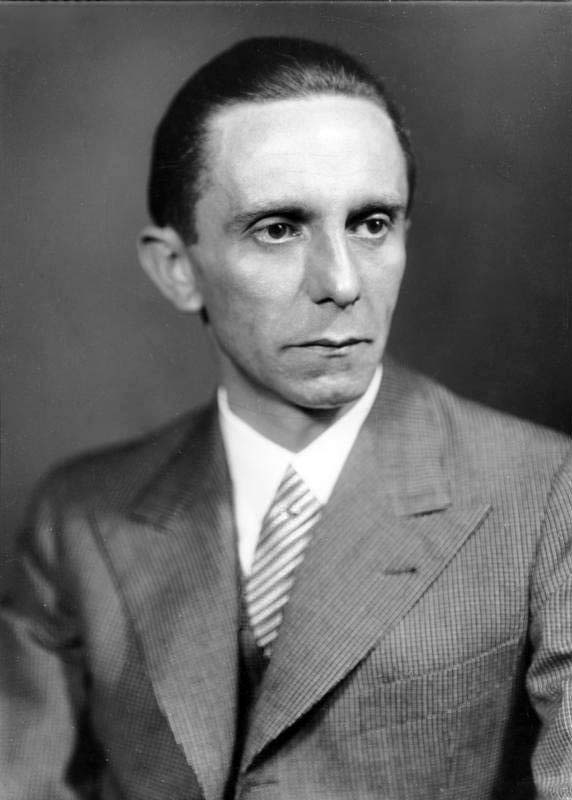
Joseph Goebbels, Bundesarchiv, credit Wikipedia

Fantasy Racism 

Henry Hopwood-Phillips peruses a provocative exegesis

Adrian Hart, That’s Racist! How the Regulation of Speech and Thought Divides Us All, Imprint Academic, 2014, pb, 136 pp, £9.95

Veteran anti-racist campaigner, teacher and film-maker Adrian Hart has watched as his cause, anti-racism, has been hijacked by successive governments in a manner that reminds this reader of James Delingpole’s Watermelons (2011) – where ‘green’ (environmental) problems were seized upon as excuses for (big-government) ‘red’ solutions.

The outline of his argument is that at the same time that society chose to purge itself of its racist edges (broadly coterminous with the emergence of the Macpherson Report, 1999), the UK government decided to use the report to justify an unparalleled increase in its own powers.

Hart notes that although we are drip-fed the failures of multicultural Britain by the media, Britain’s largest minority group is now the category formerly known as ‘mixed race’, showing that ethnic fusion is increasing, and perhaps more importantly, a rising proportion picking ‘English’ rather than the looser, baggier ‘British’ label on forms. Not only that, a Home Office Citizenship Survey of 2011 showed that whites were more likely to believe that racial prejudice had increased than the people who were supposedly experiencing it (by almost 25 per cent). Continue reading

Posted in QR Home | Tagged , , , , | 1 Comment

Babylon

Babylon

Babylon at the Roof Gardens

99 Kensington High Street, London W8 5SA

Babylon was, for us, literally a much sought-after restaurant – it took a few circumambulations of blocks of shopping arcades in Kensington to find it, tucked around the corner as it is, rather than actually being on Kensington High Street as expected. Reached through a concierged building, it is up on the seventh floor, looking out over London, with a variety of famous landmarks visible between the trees. The lift takes one straight to the restaurant reception desk, where the welcome is extremely polished and professional, yet friendly, with a waitress waiting to take one straight to the designated table. The restaurant takes the form of a long thin room, with booth seating on the side furthest from the window, a long row of tables consisting of banquette and chair seating in the middle, before square and circular tables looking out over the balcony and affording a splendid view out of the long, floor-to-ceiling window. The tables outside bear lanterns – but not, on the rainy, cold October day we visited, diners.

Babylon’s decor is smart but not overly-ornate – a wooden floor and a palate of different shades of green, from lime to olive, in the striped dappled wallpaper, the chairs and the screen-print-type paintings that adorn the walls. The tables are dressed with starched white tablecloths, elegant and stylish cutlery, a candle and a flower in a silver container. Golden hemispheres adorn the ceiling and discreet spot lights provide the main lighting, with small glass chandeliers over the individual booths.

Bread was brought within seconds of our reaching the table – rather delicious, very fresh and distinctive-tasting white baguettes, with a wholemeal and a black olive roll as well, and served with butter and a small bowl of olive oil with cider vinegar.

Water and an aperitif were offered at the same time as the bread appeared – a glass of champagne and a dry sherry did us for the latter – the champagne rather fine and elegant, with tight bubbles, and the sherry served at an appropriate temperature for the very rounded flavour, generating a welcome feeling of warmth on the all-too-chilly evening.

The menu opens with baked cheeses – all of them immensely tempting; and around eight starters main courses, with a good mixture of meat, fish and vegetarian dishes; all of them appearing well-thought-out.

The wine list was very impressive indeed, with an excellent range of wines from different regions and at a good variety of prices. I decided to go for the La Picoutine 2013 – a very light pink rose, with a dry nose tempered by its hint of strawberries. The flavour was very delicate but also extremely sophisticated – an initial dryness lead into a burst of strawberries and other red berry fruit yet with a slightly citric acidity balancing the juicy berries, and some straw and also spice to give a final bite.

I started with the autumn truffle risotto with parmesan, and was presented with a very sensible-sized portion, which nevertheless left me very replete. The rice itself was immensely creamy and well-cooked – neither too soggy nor too al dente (as risotto can all-too-often be). The creamy parmesan lent a savoury flavour, whilst the autumn truffles, shaved on top, added their own, exquisite, musty flavour.

My husband’s Leghorn Egg was also excellent, although perhaps a touch blander than he had expected. Both the interesting variety of textures and the flavours complemented each other well, and he found it a substantial portion that nevertheless left enough room for the main course to follow: in Mr Marshall-Luck’s case, the braised pork cheek and fillet, which he deemed superbly flavoured and wonderfully tender. It was served with crunchy kale and granny smith apple balls, the sharpness of which complemented perfectly the flavour of the pork. The accompanying apple sauce was superb as well, and he noted that this added an interesting extra dimension to the dish, being a very different flavour from the apple balls. The size of the portion was perfectly judged, leaving one feeling satisfied but not overly replete.

I had been entranced by the list of baked cheeses, and after much heart-searching went for the Ogleshield, which was served with new potatoes, pickled baby onions, gherkins and bacon. The cheese itself was very similar to raclette (hence working so very well with potatoes) – rich and intensely flavoured. The bacon was extremely meaty-tasting and added a further deep and intense savoury flavour to the dish, whilst the onions and gherkins lent a sharper, more acidic note as well as a crunchy texture to cut through the cheese. The dish was accompanied by a large basket full of sourdoughs, walnut and raisin breads and breadsticks, which were good for scooping out the final gooey strings of molten cheese from the dish. The only element of Ogleshield which disappointed me was the potato, which was a little too crunchy and firm and lent resistance to a dish that I would have preferred softer and crumblier.

I’m not entirely sure how we found room for desserts; but we managed somehow. My husband’s dark chocolate baked Alaska was very good, although he was put off by the inclusion of desiccated coconut (a bête noire)! However, working around it enabled his full enjoyment of a wonderful dessert: the rich, dark chocolate was surrounded by a delightfully light meringue-type coating – just enough to highlight the chocolate without in any way becoming the featured artist. Complementing mango and passion fruit set off the chocolate very well – a tried and tested combination, of course; but both fruits were of excellent quality and intensely flavoured, which raised the dessert above mere cliché.

My Velharona chocolate pave, meanwhile, was easily one of the best desserts I’ve ever had the fortune to experience. It wasn’t really a pave as such – more of a rich milk chocolate mousse covered with chocolate crumbs, with pistachio nut topping, the occasional flake of sea salt, a very thin roll of chocolate flakes (that weren’t flaky so much as crunchy), and a dark berry sorbet on top, the berries of which were sharply distinctive without being overpowering. It was most certainly the flakes of sea salt that raised this dessert to an art form, and one found oneself eagerly awaiting the saltiness as a foil to the rich sweetness of the chocolate. Perhaps a slightly increased dose of the salt flakes would have enhanced the pleasure of this dish even further; but it was mightily good as it stood.

Tea, coffee and petit fours were also excellent – the latter offered a selection of a salted caramel chocolate truffle that had the slightly darker notes of possibly coffee or carob; what appeared to be a lemony cross between a meringue and a marshmallow; a tart fruit jelly coasted in contrasting sugar, and a little almondy cake with a chocolate sliver in the middle. All delicious.

Only two aspects of the “dining experience” dampened our enjoyment of a quite superb meal – the irritating popular music present throughout the evening, and our fellow diners – the latter, of course, not the establishment’s fault! We seemed to be beleaguered by loud and raucous office parties, with drunken, football-hooligan-style bellowing punctuating the latter part of the meal. We were also treated to the apparition of a telephoning buffoon who, in artistically creased chinos and casually rumpled shirt, paced, like the ghost of Hamlet’s father, to and fro on the balcony, obviously desperate to prove to all in the restaurant what a terribly busy and important man he was, so indispensible that he was forced to take long, involved phone calls (using, inevitably, an extremely elaborate hands-free kit) even in the middle of a social occasion.

Do not be put off by Trip Advisor reviews stating that the service is “chilly” – this is emphatically not the case – one suspects that these reviews are written by people who are used to being addressed in restaurants as “you guys” (and, moreover and unaccountably, are comfortable with – nay, even approving of – this mode of address), rather than the entirely more appropriate “Sir” and “Madam”. The service is pretty close to perfect; as are most aspects of this restaurant.

Em Marshall-Luck is QR’s restaurant and wine critic


Posted in QR Home | Leave a comment

An Islamic Industrial Revolution?

The Silk Merchants by Edwin Weeks

An Islamic Industrial Revolution?               

Bill Hartley explores the putative contribution of Islamic civilisation to the development of industrialism

Recently I came across a critique of a book The Cultures of the West; A History by Clifford Backman. According to the writer, Backman proposes the idea of a ‘Greater West’ that involves the Islamic world as co-participants in most significant developments of the modern era including the Industrial Revolution. Having travelled extensively in the Middle East I am willing to admit that the people of the region have shown themselves very skilled at managing scarce resources, notably water but an Industrial Revolution?

Actually Professor Backman isn’t alone. There are a number of Islamic scholars travelling in the same direction, for example Salim Al Hassani in his essay ‘Filling the Gap in the History of Pre-modern Industry: 1000 Years of Missing Islamic Industry‘ which also suggests that the Islamic world was at it too. Well I’ll leave Professor Backman’s views on most things to others but I suggest that it would have been difficult at the time for an Industrial Revolution to take place in say France (no offence) never mind the Islamic world.

In the interests of fairness I recently put the idea to a group gathered at Neville Hall in Newcastle, home of the North of England Institute of Mining Engineers. Standing beneath the portrait of a past Fellow one G. Stephenson Esq. we were a multi-ethnic collection from a range of disciplines: engineers, an academic historian and a mathematician, all with a shared knowledge of industrial history. The response I received was one of mild incredulity with people pointing out to me that never mind the Islamic world or even Europe – the Industrial Revolution was a British phenomenon.

Professor Backman et al in their eagerness to include the Islamic world are missing the point. An Industrial Revolution could only come about if the right conditions were there on two levels. Without these then extending credit to a distant culture is a non starter.

The first requirement for an Industrial Revolution is coal and the incentive to use it. Britain is an island and the primary fuel source timber also happens to be an important building material. This meant tree cover was rapidly denuded, to the extent that there was less of it in the sixteenth century than there is today. As a consequence there was an earlier recourse to coal in Britain than in European countries with access to greater timber reserves.

Mr Al Hassani cites developments in the use of wind and water power in the Middle East. He’s correct of course but just as the windmills of the Netherlands were an excellent way of grinding corn or draining the polders, these were pre industrial techniques with an obvious drawback, best explained by quoting the historian AE Musson who noted that the use of steam power freed us from the ‘tyranny of wind and water’ both of which were unreliable and inconsistent sources of energy.

Obviously anyone mining coal will first go for the shallow deposits. Once these have been worked out then it’s necessary to dig deeper. This creates technical problems often associated with drainage. Solving these helped accelerate the Industrial Revolution via the introduction of the steam engine which was first used in mines. Even then it took a further seventy years for the final strand to fall into place; Abraham Darby learning how to make coke from coal, removing the impurities so it could be used in iron making. This freed the smelting of iron from being a charcoal based woodland craft and took it into the era of industrial mass production, which is why Darby’s forge at Coalbrookdale is a World Heritage site.

The second level was human; the ability and willingness of people to invent and innovate. Writers attempting to share the credit and portray it as some sort of multi-cultural exercise, might usefully compare conditions in this cool damp island off the coast of Europe with the Islamic world. Of course it would be unfair to dismiss achievements in the Middle East because they lacked the essential raw material for an industrial revolution. Leaving aside Professor Backman’s ignorance of the history of technology, what he and his fellow revisionists also choose to ignore in their books and pamphlets surprisingly enough, are the cultural factors which brought about the Industrial Revolution in Britain. It certainly wasn’t superior education, for example George Stephenson and his fellow locomotive builder Timothy Hackworth received nothing more than what we would today call a primary school education and even that was incomplete.

In Britain what men like James Watt, George Stephenson, Richard Trevithick and others had was the freedom and the incentive to innovate. They operated in a land which had not been devastated by the wars of the eighteenth century and where a patent system existed to reward inventors for the fruits of their labour. Such people operated in the right intellectual framework which welcomed the development of scientific knowledge and shared ideas through a network of philosophical societies. Underpinning this was the Protestant work ethic.

In contrast the values of the European enlightenment were anathema to the Islamic world because they challenged the authority of religion.

There is an irony when talking up Islamic involvement in the Industrial Revolution. Repressive regimes and religion still suffocate human creativity in parts of the Islamic world and the only way some of these countries exploit a fossil fuel today is on the back of technologies developed during the Industrial Revolution. Whilst earning revenue from this source they refuse to allow their human capital the freedom that was available to those pioneers of the Industrial Revolution in Britain.

William Hartley is a freelance writer from Yorkshire

Posted in QR Home | Tagged , , , , | Leave a comment

Orso, Covent Garden, London

Orso 2

Epicurean Expeditions with Em Marshall-Luck

Orso, Covent Garden, London

Orso boasts an extremely convenient location just down the road from the Royal Opera House – perfect for that pre- or post- (or even mid-, depending on the composer) opera meal; its whereabouts are not immediately obvious, however, due to a frontage that is fairly discreet. The rather modern appearance of the signage belies the warm, traditional Italian restaurant that will be found a short flight of steps below the entrance. In deference to the surrounding theatres, Orso has stagey elements – lighted steps reminiscent of a cinema and a little cubby hole akin to an old-fashioned box office, while numerous black and white photos of divas, actors and singers from stage and screen line the walls. The colour scheme is a warm orangey yellow on the upper walls and a duck egg blue on the wainscoting, which follows the walls round and also surrounds the bar – some similar coloured tiles adorn the pillars which separate the initial room we were seated in from further rooms beyond. There are rather ornate metal bar stools, and a wooden floor (marble in the entrance – this and the kicking-board around the bar counter recall Shropshire Blue cheese in their marbled rich orange-yellow and blue-black colours); lighting is provided by dim wall-lamps and slightly odd matching lampshades hanging from the rather pedestrian ceiling. This is lined with acoustic tiles (one suspects that this was a condition of the granting of planning permission in order to reduce to a minimum the sound leakage to the premises immediately above.) The tables are dressed in white linen – both tablecloths and napkins, with small candles and appropriate glasses and cutlery.

The welcome is warm; I felt very well looked after even with the restaurant as packed as it was (people who hadn’t pre-booked were being turned away at the door). The only two negative points we encountered at the outset were the chill blasts that reached us, seated as we were near the bottom of the steps from the door opening and closing above, and the gentlemen’s toilets, whose dustbins were overflowing, and the dim lighting which did not facilitate the changing of a baby!

Appetisers were brought swiftly – alarmingly large plates of very moreish battered courgettes and flatbreads, along with olives. These immediately impressed – the courgettes were nicely salted – just the right amount to lend further taste but not dominate, while the actual courgettes themselves were definitely determinable and very pleasant, while the flatbreads (the garlic one in particular) were absolutely delicious; the olives were sweetly flavoured, lightly oiled but not greasy.

The menu offers a reasonably small selection of dishes per course, but a large number of courses, if one counts appetisers and pasta / risotto dishes as extra courses! There were a number of tempting plates on offer, and at fairly reasonably prices, especially for Covent Garden.

We asked for a wine recommendation and were brought two wines to taste, both of which were rather wonderful and fully fitted the description I had given. Of these, we decided to go for the Appassimento 2013 from Casa Vinironia in the Venetian countryside, which is made using a traditional method whereby grapes are left on the vines during the autumn to gain extra fullness. It was a deep purple colour, with a full and intense nose of black berry fruits – cassis but bramble fruits also, along with hints of tar. It offered a surprisingly sweet foretaste, which then cross-faded into very full black fruits – again cassis and blackberry, but also sweeter fruits such as plums. With its deep and intense taste, slightly ashy dryness and retiring hint of liquorice in nose and flavour, it was a very satisfying wine overall and I was pleased with the recommendation.

The starters arrived as soon as it was clear that we were slowing with the flatbreads and courgettes (though I could easily have gone on nibbling at them all evening). My insalata di bufala was excellent – the mozzarella very fresh and gloriously creamy; accompanied by rocket and cherry tomatoes. My husband’s pizetti’s base was nice and crisp although possibly a little on the tough side, while the prosciutto had a good depth of flavour and the rocket was fresh and just crisp enough. He thought it a generous portion, making an ample but very pleasant starter.

The sea bass which I had ordered as my main course was, on the other hand, not a particularly large portion – which at first pleased me but I actually found on fairly easily clearing my plate that I could have done with a slightly larger sized fish! At first I found the taste slightly flat but as the meal progressed I found myself increasingly satisfied by it, with its slightly crunchy and salted exterior. Tristan absolutely adored it and wolfed it down in a way that I would never have expected from a nine-month old baby – high praise indeed (and of course this might also have had something to do with my wish for a larger portion)! It was accompanied by a mixture of new potatoes, slightly al dente green beans, very intensely flavoured and sweet roasted tomatoes and black olives.

Mr Marshall-Luck’s pork was slightly blander than he would have liked; but very tender with good crisp crackling that demanded savagery to eat it properly (cutting with a knife and fork well nigh impossible!); the accompanying roast potatoes were good – crunchy on the outside, melting tenderness on the inside, with a full flavour. The cabbage with carrot was surprisingly sweet and worked well with the pork, and especially with the gravy, which was very dark and rich and intensely flavoured. On the whole, we both very much enjoyed our main courses (as did the baby).

The dessert choices were quite tantalising – as was the selection of dessert wines and grappas. I am inherently incapable of resisting ice wines, so went for a glass of this on spotting it on the menu. It was sharper than I expected, with an intense nose of honeyed grapefruit, and a taste that combined a dark honey with predominantly citrus flavours. The highly chilled serving was good, as it suited the wine.

Our desserts themselves (once we had managed to make a decision) were absolutely spectacular. The flourless chocolate torte was rich, very dark and intense, gloriously moist, superbly light and very worryingly moreish. It was presented alongside kumquats and mascarpone, which worked extremely well with the cake. My tiramisu, meanwhile, was extravagantly creamy; served in a glass, with the spongy layer at the bottom and topped with rich, thick and sweet mascarpone, it worked very well indeed.

This is most certainly a restaurant that I look forward to returning to on our next visit to the Royal Opera House or local concert, and is one that I can heartily recommend to others.


Posted in QR Home | Leave a comment