ENDNOTES, April Edition

klimt

ENDNOTES, April Edition

The QR reviews Elgar’s masterpiece, The Dream of Gerontius – and interviews conductor, Ronald Corp, who conducted the performance at St. John’s, Smith Square, with the London Chorus, on 26th March

“This is the best of me…” These were the words of Edward Elgar, the English composer who, in 1899 and 1900, emerged as our country’s most renowned composer with two works, the Enigma Variations and The Dream of Gerontius – a setting of Cardinal Newman’s poem about the journey of the soul – “Jesu, Maria, I am near to death…” and on into heaven and eternity accompanied by an angel. Elgar is sometimes compared to Brahms or Richard Strauss, as an English version of those two Germanic composers, and Gerontius can certainly be likened at least to the idea of Strauss’s symphonic tone poem, Death and Transfiguration. But Elgar’s piece, which often seems operatic, or even in a visionary musical category of its own (rather than a tried-and-tested religious orartorio from the English provinces), uses for its near two hours of performance a large chorus, and three soloists: an English Parsifal, perhaps, or an element of William Langland’s Vision of Piers Plowman in an intensely Roman Catholic form.

The Wagner conductor, Hans Richter – who championed Elgar throughout his life – conducted the first performance on the 3rd October 1900 and described the Worcestershire composer as “…. this English genius”, begging the performers at the 1900 Birmingham premiere to give their very best. Unfortunately, Elgar was plunged into one of his many depressions by the premiere: the performers were, by all accounts, under-rehearsed, and the mystical elation he craved eluded him – at least for a time. How Elgar would have loved to hear recent and modern recordings of his work, not least (for this reviewer) Sir Adrian Boult’s outstanding version with the poised, blazing brass and silky strings of the New Philharmonia Orchestra, caught by the EMI microphones of 1975 on what must have been a day of great form and energy. One hopes that people in 200 years time will still be listening to this music – and understand its tenderness, its awe-inspiring heights (and demonic depths), its Englishness – all projected from Elgar’s own emotional heartland, ridged by the Malvern Hills.

Last month, I discussed these very ideas – the genius of Elgar, of what makes Englishness in music, and whether enough is being done to educate people (particularly the young) in classical music – with the conductor, Ronald Corp OBE, who was at that time preparing for a performance of The Dream of Gerontius with one of his “house” ensembles, the London Chorus. We met at a coffee shop near Regent Street on a cold February mid-morning – Ronald Corp, immediately enthusiastic and very warm and outgoing in manner, plunging into a stream of ideas, answers to my questions, and with some very amusing observations about music and musical life in this country.

A composer himself and a great enthusiast for English music, he has written a lyrical Cello Concerto (conducting his own work alongside the Herbert Howells concerto on the Dutton record label), numerous choral works, motets and very beautifully-realised settings of poetry – some with a strongly contemporary theme. He sees a great bond with Elgar. “Our choir, the London Chorus, was actually formed to give the first complete London performance of The Dream of Gerontius, way back in 1903.* Our founding father was a conductor called Arthur Fagge, a name from the heyday of London musical life in the days of Henry Wood, but which seems to have been forgotten over the years.”

Ronald Corp

Ronald Corp

Corp is very much attuned to musical links and connections, and sees a symbolic value in his project with the London Chorus. Despite championing new music, he also expresses some scepticism about certain contemporary trends in the arts: “Our 2015 Gerontius is a return to that heritage of the era of Arthur Fagge and Elgar, and a bond with the past. Too often today, contemporary works that are given just one outing are hailed as ‘masterpieces’ by some in the arts media, and that could be true, but how do we really know until something has stood the test of time? The first performance of Elgar’s work was actually not a resounding success, and yet Gerontius has emerged over more than 100 years as a symbol of the English musical renaissance, and an immense and spiritual work almost unrivalled in the English repertoire.”

Ronald Corp is very active generally in London musical life, having founded the New London Orchestra (which has many fine recordings under its belt – not least a series of British light classics), and also conducting the New London Children’s Choir and the Highgate Choral Society. “I like to think that I run a permanent ‘Three Choirs Festival’,” remarks Ronald, “and I am immensely proud of all that we have done together. During the Diamond Jubilee, for example, we took over the Barbican for a concert celebration of our Queen’s reign, and I conducted the Highgate Choral Society in another Elgar work from the turn of the last century, the Coronation Ode, which was written for Edward Vll. Despite more than a century having elapsed since those works of days of Empire, the greatness of his music speaks much to the audiences of today as it did to those people who lived in the quite different world of Edwardian England.” Ronald was also inspired to write his own patriotic work for this concert, entitled This Sceptr’d Isle – a pageantry-filled setting of the famous speech made by John of Gaunt, from Shakespeare’s Richard ll.

Yet the maestro and his singers are very keen to involve themselves in the pulse of contemporary life. Ronald has also composed a choral work –Things I didn’t say – which explores the difficult theme of Alzheimer’s disease, setting the words of a friend, Steve Mainwaring, which describe in clear, straightforward, everyday language, the gradual realisation that a loved one is beginning to disappear in the fog with which this disease surrounds the recesses of the mind. This was performed in the magnificent setting of St. Martin in the Fields, just at the edge of Trafalgar Square, with the London Chorus taking centre stage.

Ronald Corp also commemorated the anniversary of the First World War, and the pity of war, setting the words of a German poet, Gerrit Engelke, injured in the fighting and defying death, but eventually leaving this world before his time, as the composer explains: “We know so much about Britain’s war poets, and we honoured them fully in our concert, especially in our inclusion of Elgar’s For the Fallen from his Spirit of England, and the setting which we chose for our performance, the Chapel of the Royal Naval College, Greenwich. But little is known about what was going on in the trenches on the other side. I found the words of one German poet, and thought it would be interesting to show the war from another angle. It seems that war tends to have the same effect upon us all. I was very proud that my work formed part of our commemoration for the World War One anniversary.”

But what of music education – why are children not being told about classical music in schools? Why are the names, Elgar and Vaughan Williams, unknown to so many young people – why do they know no hymns or folk-songs? “I – and many others – are trying to counter this, and there are some fine schools and teachers doing great work. But yes, it is a pity, especially when music of every kind is now so easily available. As to folk music, perhaps some of the ideas in some folk-songs, which are by definition old-fashioned and of the countryside, are not liked today – perhaps the idea of a lady or maiden fetching water, or hanging washing on a clothes line upset some people?” An amusing point, which certainly added some laughter to our coffee-conversation!

And so we come to the performance at St. John’s, Smith Square, the conclusion of many rehearsals by the London Chorus and the New London Orchestra. It was clear to this critic and to the enthusiastic audience at St. John’s, that the players had given us a performance of complete integrity, and passion. Live classical music is as much a physical experience, for the eyes of the onlookers, as it is a “listening pleasure”, and throughout Ronald Corp’s evening at the helm of Gerontius, his orchestral players – in their expressions and movements – showed their total immersion in their work. The London Chorus, too, sang with a love of the work that I have seldom seen; and it is clear that their loyalty to Ronald Corp is not in question. They gave him their very best and how they soared and filled St. John’s in the passage which follows the first appearance of the bass (in this performance, the commanding Samuel Evans) – in part one of Gerontius:

“Go in the name

Of Angels and Archangels; in the name

Of Thrones and Dominations; in the name

Of Princedoms and of Powers; and in the name

Of Cherubim and Seraphim, go forth!”

Rising operatic star, Peter Auty, sang the tenor part of Gerontius (who becomes the Soul, in part two of the work) bringing concentration and passion, especially in that passage of swelling power and overwhelming ecstasy which begins with the Angel (a beautifully-clear Madeleine Shaw) singing: “We have now passed the gate, and are within The House of Judgement” – the Soul passionately replying and exclaiming:

“The sound is like the rushing of the wind –

The summer wind – among the lofty pines.”

With such a moment to treasure and savour, it seems ignoble of me to say that during Part One, I felt that Mr. Auty (a truly fine singer) sounded – at times – as though his voice was not truly embedded in the role; and I have to say, that I missed the other-worldly, almost ghostly, Peter Grimes-like delivery of tenor Peter Pears – to my mind, the best Gerontius, and the jewel in the crown of the well-known London Symphony performance on Decca, under the baton of Benjamin Britten. But by the second half, Peter Auty gave what we had all come to hear, the passionate pilgrimage of a soul.

Ronald Corp conducted in a restrained, careful manner – always giving clear baton strokes and cues for his singers and performers: a fatherly, serious, priest-like performance, faithful to Elgar’s Englishness and his religious introspection. With 50 players, the New London Orchestra created a full symphonic sound, but I wondered if, perhaps, the ensembles ought to have been augmented – to give that extra dimension which such a large-scale work deserves, such as in the hammer-blow-like flash of percussion where the Soul sees “the glance of God”? However, the chamber-like delicacy of the front-desk strings of the New London Orchestra came into their own in the beauty of the introduction to Part Two. If we are approaching heaven, then we must also be with Elgar on the Worcester-Hereford border; with music and woodwind interpolations over the hushed strings, conjuring the Elgar and England of The Wand of Youth, or a scene by the Severn in Caractacus. This was playing of great quality by the New London Orchestra, with Ronald Corp seeing not just the great gestures of Gerontius, but the shadows and quiet corners of the church that are found throughout the score.

I attended this performance with my Editor, Dr. Leslie Jones – who shares my enthusiasm for Elgar, particularly this emotional and emotion-provoking piece and we compared notes in due course. This was a Dream of Gerontius, from Ronald Corp and his New London Orchestra and London Chorus that truly came from the heart. As I left St. John’s, breathing in the cool evening air of Smith Square, I felt fulfilled – the mark of a successful concert.

“How still it is!

I hear no more the busy beat of time…”

STUART MILLSON is Classical Music Editor of QR

Notes: * Prior to the first full performance of the work in London, Sir Henry Wood had conducted a performance of the orchestral Prelude to The Dream of Gerontius, and the Angel’s Farewell in an Ash Wednesday concert at The Queen’s Hall. Elgar’s friend, A.J. Jaeger, the publisher wrote in 1901:

“…this morning we went together to Queen’s Hall to hear Wood conduct the Gerontius Prelude and Angel’s Farewell… Wood conducted it with loving care, spent one-and-a-half hours on it & the result was a performance which completely put Richter’s into the shade”.

From Edward Elgar, A Creative Life, by Jerrold Northrop Moore, Oxford University Press, 1984.

Conductor Ronald Corp has made a number of recordings, principally for the Dutton label, including the Herbert Howells Cello Concerto (with Alice Neary, soloist) and the orchestral work, Merry-Eye, and a compilation of music by the American composer, Elinor Remick Warren. His collection of British light classics appears on the Hyperion Label.


Posted in QR Home | Tagged , , , , | Leave a comment

The “We Need to Have a Conversation” Malarkey

Ilana Mercer

Ilana Mercer

The “We Need to Have a Conversation” Malarkey

Ilana Mercer deconstructs a liberal take on immigration

You know just how scholarly a policy paper is when it is studded with a clichéd expression like “we need to have a conversation about …” The pop-phrase is familiar from these farcical usages:

“We need to have a conversation about race”—when, in reality, we do nothing but subject ourselves to a one-way browbeating about imagined slights committed against the pigmentally challenged.

“We need to have a conversation about immigration”—when such a “conversation” is strictly confined to a lecture on how to adapt to the program of Third World mass immigration. This particular “conversation” involves learning to live with a lower quality of life, poorer education, environmental degradation; less safety and security, more taxation and alienation.

In this mold is a policy paper by Jennifer Bradley, formerly of the liberal Brookings Institute. Bradley had a stroke of luck. Matt Drudge of the Drudge Report found fit to link her essay on his eponymous news website site. Titled “The Changing Face of the Heartland: Preparing America’s Diverse Workforce for Tomorrow,” Bradley’s Brookings Essay would have been more honestly titled “Get-With the Program, Middle American. Demography Is Destiny.”

Disguised as scholarship, the Bradley essay schools Middle America at length on how to prepare its diversifying workforce for tomorrow. Thus, for example, she states that “America is on the cusp of becoming a country with no racial majority, where new minorities are poised to exert a profound impact on U.S. society, economics, and politics.” The implication here is that this seismic shift is due to a mystic force beyond the control of the host population, rather than to willful policies in which the native population has never had a say and will likely never have one.

Bradley’s particular concern is with “two demographic shifts.” The one is the aging of the predominantly white (and presumably productive) generation of Americans born after World War II. Another is the concomitant influx of “Mexicans, Hmong, Indians, Vietnamese, Somalis, Liberians, and Ethiopians.”

“According to the Minnesota State Demographic Center, the Asian, black, and Hispanic populations in the state tripled between 1990 and 2010, while the white population grew by less than 10 percent. This trend will continue,” warns Bradley: “From 2010 to 2030, the number of people of color is expected to grow twice as quickly as the number of whites.”

There goes that mystic force again.

“As Minnesota and the region go, so goes the nation,” states Bradley, matter-of-fact.

As Bradley sees it, a feature of the diversity explosion in the Minneapolis-Saint Paul Midwest microcosm is a widening “race-based education and achievement gap” that will “become a drag on workforce growths unless something was done to reverse these trends.”

Translated, this means the immigrant population isn’t measuring up.

I can think of a few unexplored options to narrow the gap described. One is to welcome immigrants who’ll add value to the economy, rather than drain taxpayer resources. Bradley, however, is here not to strike up a true conversation—which would include exploring all options—but to dictate the terms of the “conversation.”

Indeed, the raiment of scholarship she sheds as quickly as a prostitute sheds her clothes (only less admirably; working girls deserve respect). Bradley brays about the need to “reframe the conversation about race-based education and achievement gaps in Minneapolis-St. Paul—turning what had been a moral (and insufficiently effective) commitment to its underserved communities into an economic necessity. Leading figures from the worlds of government, business, and academia, and public and private groups throughout the region [all stakeholders, but you] are now trying to figure out how to undo the effects of decades of neglect, tackling the problem from many perspectives and with an ever greater sense of urgency.”

Because the imported population is failing to achieve parity with the host population, Bradley has inferred that the newcomers are “underserved”; that they require more resources, when the fault could just as well lie in the kind of incompatible immigrant being privileged by policy makers. The essay’s premise is that America is “underserving” her immigrant population, when it is the other way round:

Averaged out, the immigrant population is underserving the American economy.

In this “conversation,” the social “scientist” recommends throwing everything but the kitchen sink at the causality quagmire. The mass-immigration imperative, moreover, is presented as the antidote to a declining birth rate and an aging population, when in fact mass immigration is the excuse statists make for persevering with immigration policies that are guaranteed to further undermine civil society and shore up the Welfare State.

Demographics need not be destiny. The West became the best not by out-breeding the undeveloped world—not due to huge numbers—but because of human capital; people of superior ideas and abilities, capable of innovation, exploration, science and philosophy.

ILANA MERCER is a paleolibertarian writer based in the United States. She pens WND’s longest-standing column, “Return to Reason” and is a Fellow at the Jerusalem Institute for Market Studies. She is a Quarterly Review Contributing Editor. Ilana’s latest book is Into the Cannibal’s Pot: Lessons for America from Post-Apartheid South Africa. Her website is www.IlanaMercer.com. She blogs at www.barelyablog.com


Posted in QR Home | Tagged , , | Leave a comment

The Grotesquely Stalinist FDR

James Gillray, Plum Pudding

James Gillray, Plum Pudding

The Grotesquely Stalinist FDR

Ilana Mercer debunks a still iconic President

Franklin Delano Roosevelt is not the man to quote in support of the market economy. He was, after all, the president who gave America the assault on free-market capitalism known as the New Deal. He also capitulated to communism at Yalta, 70 years ago. There, in February of 1945, he and Winston Churchill met with Joseph Stalin, a genocidal butcher who dwarfed Adolf Hitler, to divvy up the world.

By the time the “Big Three” convened in the Crimean city, the region had long been subdued and decimated by the Bolsheviks. In November and December of 1920 alone, Crimea had been the site of a massacre of 50,000 souls. Kulaks, Cossacks, Ukrainians; priests, White Guards, socialists, nobles, Mensheviks and bourgeoisie: entire groups had been branded as counterrevolutionaries-by-class, designated as sub-humans worthy of extermination. That is if the Reds’ revolutionary utopia was to come into being, which it did.

For simply being who they were or if caught talking out of turn, anyone in communist Russia could be made “a head shorter,” in Trotsky’s “delightful” turn-of-phrase.

Why, Roosevelt and Churchill had just missed the deportation, in 1944, of the Crimean Tartars. According to The Black Book of Communism: Crimes, Terror, Repression that “800-page compendium of the crimes of communist regimes worldwide”— “of the 228,392 people deported from the Crimea, 44,887 had died after four years.” Still, the Anglo-American leaders saw fit to sit down with Stalin to “map out the postwar world,” ceding Eastern Europe to “Uncle Joe,” FDR’s affectionate moniker for the communist mass murderer.

Yalta Conference

Yalta Conference

In fairness, Churchill does not deserve to be lumped with FDR as an appeaser and enabler of ultimate evil. Churchill was avowedly anti-communist. He detested Stalin. For this very reason, FDR considered Churchill a “reactionary … an old incorrigible imperialist, incapable of understanding [Stalin’s] ideological idealism.” Against the wishes of Winston Churchill, Roosevelt agreed to “give Stalin what was not his to give,” noted historian Paul Johnson, in his History of the American People. Churchill went along with FDR because he was desperate for American financial support.

The greatest president of the 20th century? Au contraire, says the author of “FDR Folly: How Roosevelt and his New Deal Prolonged the Great Depression”.

Like many pseudo-intellectuals of his time, explained Johnson, Franklin Roosevelt was “grotesquely Stalinist.” Against all evidence to the contrary, he regarded the Soviet Union as a “peace loving democracy, with an earnest desire to better the conditions of the working peoples of the world.” As to FDR’s advisers in Moscow: they considered Stalin a benevolent, genial democrat. Indeed, “this monster, who was responsible for the death of 30 million of his own people,” was regarded by the American administration as “exceedingly wise and gentle.”

One can well understand why the medieval blood ties that tethered some Ukrainians to the Russians would have been severed by the criminal communist regime, which targeted the Ukrainian breadbasket with a vengeance. The communists robbed the Ukrainian peasants of their fertile farms, forced them into slave labor by corralling them into state-owned, collective farms, and systematically starved them by requisitioning most of their grain. The peasants had been left with a fraction of the amount of grain required to sustain life.

Yet these heroic, individualistic farmers rose up against the Reds.

The slogans of the Ukrainian peasantry, in 1919, were “Ukraine for the Ukrainians, down with the Bolsheviks and the Jews (whom they associated with the Bolsheviks), free enterprise, free trade.” Besides the standard mass executions, in order to wipe out this class of people, Stalin devised a diabolical man-made famine which killed up to 10 million.

Fast forward to Kiev, circa 2013, where Ukrainians tore down the statue of the founding father of Bolshevism and a mass murderer in his own right. But that man, Vladimir Ilyich Lenin still reposes in a mausoleum in Moscow’s Red Square.

Why, pray tell?

President Roosevelt had his lucid moments. Or moment, rather.

According to Johnson, “When asked what single book he would put into the hands of a Russian communist, Roosevelt replied: The Sears, Roebuck catalog.” Sears, Roebuck was one of the great American companies which, through mass production and mass marketing, made available to America’s own Kulaks the luxuries that were previously enjoyed only by her rich.

Today, libertarians will often favor Russia in its dispute with Ukraine and the West. So where are those tell tale signs of liberty we libertarians look for, when we throw our support behind this or the other side? And where, pray tell, are those “made in Russia” labels? Other than crude and commodities; Kalashnikovs (AK-47s) and Vodka —what does post-communist Russia peddle?

Ilana Mercer is a paleolibertarian writer, based in the U.S. She is a contributor to Junge Freiheit, Germany’s finest weekly, and is a fellow at the Jerusalem Institute for Market Studies. Her latest book is Into the Cannibal’s Pot: Lessons for America from Post-Apartheid South Africa. Her website is www.IlanaMercer.com. Follow her on Twitter. “Friend” her on Facebook.

Posted in QR Home | Tagged , , , , | Leave a comment

Some outstanding wine selections

Some outstanding wine selections

March 2015

I have two each of sparkling, red, white wines and spirits to recommend in this column; the common theme being excellence and value. One of the sparkling and red choices are both more for special occasions by dint of their price tags, but the other wines, ranging from between £6.50 and £15, all offer a more exceptional wine than their prices would indicate.

Nyetimber Classic Cuvee 2009 calls for something of a special celebration. Made using the traditional method, and with the classic grape combination of chardonnay, pinot noir and pinot meunier, this bottle-fermented sparkling wine hails from the chalky hills of West Sussex’s South Downs.

nye

The wine itself is a pale straw colour, with a lively nose full of fresh lemons. The taste is also predominantly of citrus fruits – an immediate and powerful burst of lemons, followed by grapefruit and even retiring hints of pineapple, mixed with straw. It is an elegant drink and a most suitable and acceptable English equivalent to fine champagne. Available from Waitrose at £31.99.

A more everyday option is Prosecco – a drink that, even though currently finding increasing favour with wine-lovers, can still be overlooked; unjustly so, for a good Prosecco is a gloriously refreshing and versatile drink that is not only a very good stand-alone option but works well with a surprisingly large variety of cuisines.

Piccini extra dry Prosecco is an excellent choice and one that I highly recommend – especially for those who are concerned that this type of wine perhaps will not be impressive or dry enough for their taste. The main characteristics of this particular wine, which is made entirely from Glera grapes selected from vineyards in Treviso, in the heart of the Prosecco DOC, are lively bubbles and a wonderful biscuity flavour. Lemony in colour and with a nose that combines gentle citrus and floral odours, it is refreshing and vibrant in the mouth, with those biscuits at the fore and citrusy hints – a little lemon, a little pineapple, a little grapefruit – retiring behind. This is a wine that will do as well for a smart reception as for a relaxed family evening in (available from Tesco, priced £15).

Perhaps one of the best red wines that I have encountered recently is the Chateauneuf du Pape Reserve 2010, Chateau Fortia. Chateau Fortia is one of the oldest estates in the Rhone Valley, and the wine it produces has a deep, dark purple colour – a rich and thick appearance, and a nose of dark berry fruits, brambles and woodlands. The flavour is surprisingly soft at first – very gentle, and fully rounded, and, like the nose, dark and woody. There is fruit – predominantly blackberries: ripe and luscious and slightly sweet, with not even the tiniest hint of tartness or harshness. There is a large amount of ash and a little tar – but tempered by that sweetness and restraint; there is also a little bit of liquorice and plenty of spice, but, again, gentler spices such as cardamom and cinnamon, with hints of sweetness, as opposed to anything fiery.

This is an intriguing and deeply satisfying wine of subtlety and sophistication, in which the full flavour is delivered in the most gentlemanly fashion possible, rather than using a sledge hammer. Chateau Fortia works particularly well with traditional dishes, such as the steak and mushroom suet pudding I cooked to accompany it – fine steaks and lamb dishes would also go down a treat; whilst the inherent sweetness would even pair it well with a chocolaty dessert, such as a fondant. Even the empty bottle, with its crosskeys and papal tiara embossed decoration, is a thing of beauty. Available from corkingwines.co.uk and highly recommended as a special treat (at £34.25) – perhaps to accompany the Paschal lamb.

If Chateau Fortia is a little above your budget, you can try a similar and also superb wine in Evans & Tate Breathing Space 2013, a Cabernet Sauvignon from Australia’s Margaret River. It boasts a deep ruby colour and a nose of dark berry fruits and enticing woodland odours. The first taste is overwhelmingly redolent of coffee – a fabulous combination of this and those bramble fruits. It is again very gentle and soft on the tongue – no hint of astringency here, yet it doesn’t lack power, with a suave darkness and a lingering aftertaste of blackcurrant, blackberries, raspberries and a touch of ash, white pepper and oak. The finish is wonderfully smooth. Available from Majestic at the price of £11.99, this wine delivers exceptional value for money.

Duo des Mers 2013 is a Sauvignon-Viognier available from the Wine Society, with a pale straw colour and gloriously floral nose, with odours of apple blossom and lime trees. The taste is more fruity, although as the flavour hits the tongue it does so with a micro-second burst of floral sweetness. Then the citrus flavours kick in – mainly grapefruit but with a little lemon as well and some pear flavour emerging from behind the grapefruit. The taste gathers in intensity from the subtle foretaste through to an aftertaste that lingers long of lemon and grapefruit. There is a little bite of spicy white pepper as well; and that apple blossom, very very subtle, throughout. For £6.50 (from The Wine Society) this is another outstanding wine at an extremely reasonable price.

Picpoul de Pinet 2013, from celebrated Languedoc winemaker, Gérard Bertrand, also has a beautiful bottle that is a work of art in and of itself, beautifully embossed with a decorative neck and Maltese-type cross. A light gold colour with a nose of peach, lychee and apricots, the wine inside is drier than the nose indicates but bears out well the fruity aromas. A crisp, refreshing wine, this starts with a burst of citrus fruits – mainly grapefruit, before opening out into more complex flavours, including the fruits determinable on the nose, and mineral elements as well. There is some white pepper and a little grass, and then a slight aftertaste of ash. The flavour is full and rich and smooth, and the only fault I can find with it is the typo on the label at the back of the bottle, advertising “foral aromas”! A fine wine for a balmy spring evening, and again, certainly worth the price of £10.75 (from corkingwines.co.uk).

If you’re after a spirit that combines tradition and something a little different and extra, Martell Spirits might have a solution in their Vintage Pear Spirit and Jack High Cider Spirit, both made in wood-fired copper stills. The former is very smooth and rather sophisticated; a clear and transparent fluid with a schnapps-y nose. It delivers an intense bite that marries a delicate sweetness with a strong alcoholic hit at 40%. Jack High, distilled from local cider, is a translucent liquid with straw-yellow tinge and intriguingly floral nose of apple blossom. Again, it is strong at 40%, but very appley – very much like a decent calvados, and with a smooth, almost brandy-like finish. Both come in traditional, yet smart and sophisticated packaging, and would make an interesting and special gift – if you can keep your hands off them yourself! Both are available direct from the Charles Martell website; Jack High at £30 and the Vintage Pear Spirit at £39 for 50cl.

Em Marshall-Luck is our food and wine critic

Posted in QR Home, Tippler | 1 Comment

Nazi Germany, some conflicting perspectives

Nazi Germany, some conflicting perspectives

Richard Evans rounds off his recent contribution to Third Reich studies

Richard J Evans, The Third Reich in History and Memory, Little, Brown, London, 2015, 483 pp, £25

The Third Reich in History and Memory is a collection of previously published essays, predominantly book reviews. As its author Richard Evans remarks in the preface it constitutes an unofficial report on significant shifts in perspective concerning Nazi Germany over the past fifteen years. And, we might add, an examination of certain key issues in this field, notably the question “was the Holocaust unique?”

Sir Richard notes in chapter 7, entitled “Coercion and Consent” that a consensus emerged amongst historians in this period that Nazi Germany was a political system that enjoyed widespread popular approval. In Fascist Voices (2013), also reviewed herein (chapter 15, “Hitler’s Ally”) Christopher Duggan adopted a somewhat similar line apropos Mussolini’s regime (see my review of Fascist Voices at www.quarterly-review.org/?p=2246).

What has been called the “voluntarist turn” in Nazi studies entails the thesis that support for the regime was freely given by many Germans. Some historians contend that the idea of a “people’s community” (Volksgemeinschaft) enjoyed widespread support after the “chaos of the Weimar years” (Evans page 125). In Life and Death in the Third Reich (2008), historian Peter Fritzsche underlined the fact that by the mid 1930’s only about 4000 political prisoners remained in concentration camps. (He failed however to mention the 23,000 political prisoners in Germany’s state prisons and penitentiaries).

The theory that Nazi Germany was a “dictatorship by consent” or Zustimmungsdiktatur was based on three main premises; first, that the Nazis won power legally in what Karl Dietrich Bracher calls a “legal revolution”; second, that Nazi terror and repression, including incarceration in concentration camps, mainly affected minorities, notably social outsiders, such as communists (sic), criminals, the mentally and physically handicapped and vagrants; and third, that the popularity of the regime was repeatedly demonstrated in national elections and plebiscites.

Professor Evans, however, both in this current volume and in his trilogy of books on the Third Reich, has consistently highlighted the role of violence and repression in the establishment of the Nazi regime and its dictatorial and manipulative elements thereafter. He upholds a Marxist, class warfare perspective on the Nazis’ consolidation of power, emphasising the destruction of institutions associated with the proletariat, notably the Communist and Social Democratic Parties and the trade unions. He emphatically dismisses the notion that the majority of Germans were not affected by coercion or repression. As he points out, in the Reichstag Elections of November 1932, the Social Democrats and Communists, mass parties whose officials were subsequently subjected to draconian measures, won 13.1 million votes compared to 11.7 millions for the NSDAP.

As regards the putative popularity of the Nazis as evidenced by elections etc, Evans notes that in the 1934 plebiscite on Hitler’s appointment as Head of State and, again, during the plebiscite in April 1938 on the Anschluss, gangs of storm troopers marched voters to poll stations where they usually had to vote in public. The institutions involved in the coercion of the German population included not just the Gestapo but also the SA (3 million strong by 1934), the Courts, the police and the prison system plus the ubiquitous block wardens of whom there were 2 million by 1939. Potential trouble makers amongst the work force could be compulsorily reassigned to work in war related industries far from home. The threat of withdrawal of welfare benefits was another means by which opposition to the regime was neutered.

From interviews of elderly Germans carried out in the 1990’s by Eric Johnson and Karl-Heinz Reuband (who, like Robert Gellately, maintain that Hitler and National Socialism were immensely popular) Evans infers that support for the regime was strongest amongst the younger generation growing up in the Nazi era and exposed to constant indoctrination in school and in the Hitler Youth. People who had reached adulthood before 1933, however, were more resistant to such indoctrination. Former supporters and members of the Catholic Centre Party (wound up in 1933 after unremitting intimidation by the Nazi Party) provide a telling example. One time Communists and Socialists were also relatively unreceptive to the regime’s propaganda.

These facts give the lie to Daniel Jonah Goldhagen’s characterisation of the German people in Hitler’s Willing Executioners: Ordinary Germans and the Holocaust as predominantly anti-Semitic. 

But why, given all this underlying potential opposition to Hitler, was there no popular revolt against his regime especially once it became clear that Germany was heading for defeat? Evans points out in this context that during the war executions in Germany reached the figure of 4 to 5 thousand per year and that 30,000 troops, likewise, were executed by firing squads. Contra Fritzsche, he detects the influence of Goebbels in the supposedly spontaneous demonstrations of support for Hitler in July 1944 after he survived Stauffenberg’s attempt to assassinate him.

The supposedly unique status of the Holocaust is another recurring theme of The Third Reich in History and Memory. In his influential volume South-West Africa under German Rule 1894-1914 (1968), historian Helmut Bley described the German war against the Herero and Nama tribes in Namibia (1904-1907). In some respects, this was a dry run for the Holocaust, with summary executions, incarceration in concentration camps, women and children left to starve, forced labour and laws forbidding racial inter-marriage.

Nama heads

Nama heads

The deliberate attempt to exterminate the Hereros unquestionably constituted genocide, in Evans’ estimation. Ditto some other notorious historical episodes such as the Armenian Massacres and the Ukrainian famine of the early 1930’s or Holodomor. The Soviet authorities also killed or deported or imprisoned large numbers of the Polish elite in Poland’s eastern provinces. At the end of World War Two, the Germans of Eastern Europe (like the Poles before them) experienced ethnic cleansing (expulsion and forced migration) on a massive scale with the usual accompanying atrocities.

Holodomor, Kharkov

Holodomor, Kharkov

Yet the Holocaust still remains sui generis, in Evans’ judgement. Only the Nazis killed people solely because of their alleged racial identity and characteristics. And as Max Hastings has observed in his review of Mark Mazower’s Hitler’s Empire (New York Review of Books, October 23, 2008) “the economic cost to the German war effort of the Final Solution and the Nazis’…efforts…to reshape Eastern Europe” were considerable. From a military and economic perspective, such policies “represented madness”.

According to Germany’s “General Plan for the East”, 85% of the Polish population and very large proportions of the Slavic populations throughout German occupied Eastern Europe would be left to die of hunger and disease. But whereas the Slavs, like the Hereros before them, were considered sub-human, merely an obstacle to German expansionsm, International Jewry was regarded as a threat to Germany’s very survival, as the “world enemy” or Weltfeind. The Jews were accused of fomenting socialist revolution in Germany in 1918 (the so called “stab in the back”) and of ultimately controlling Bolshevism in Russia and capitalism in the United States, countries which both supposedly posed an existential threat to the Third Reich.

At this point, however, one criticism – being left to starve by the Soviet Communists because you are ascribed to an allegedly parasitic class, the kulaks, comes to much the same thing as being shot in a ditch by the Einsatzgruppen because you belong to an allegedly inferior race. Dead is dead. Can were detect in Evans’ reflections on the uniqueness of the Holocaust some lingering notion that State Socialism was more progressive than National Socialism? But this is our only reservation about Professor Evans’ otherwise impeccable analysis.

Reviewed by Leslie Jones

©

Dr Leslie Jones is Editor of QR

Posted in QR Home | Tagged , , , , , | 3 Comments

Silence; we’re studying for our pregnancy test

 Bell_curve_and_IQ

Silence; we’re studying for our pregnancy test

Ilana Mercer deplores the stupidity of Generation Y

“Silence; We’re Studying for Our Pregnancy Test”, (2008), “Your Kids: Dumb, Difficult and Dispensable” (2010), “Higher Education Is A Hard Row To Ho” (2014): the author of such titles is well aware of how stupid, on average, American millennials are. She has been for some time.

The 2010 piece aforementioned warned that “the electronic toys our dim, attention-deficient darlings depend on to sustain brain waves are made, for the most, by older people,” and that “the hi-tech endeavor consist in older Americans and Asians uniting to supply young, twittering twits with the playthings that keep their brainwaves from flatlining.”

According to my sources in the high-tech industry, for every useless, self-aggrandizing Gen Yer, a respectful, bright, industrious (East) Asian, with a wicked work ethic, waits in the wings. The millennial generation will be another nail in the coffin of the flailing American productivity.

Encounters over the years with a relatively smart cohort, through this column, have solidified these impressions. Oh yes: I did my patriotic part. I attempted to employ a Millennial or two. I found them to be incapable of following simple written instructions. Their interactions were, moreover, pathologically personal, never professional.

Now, confirmation of these anecdotal impressions comes courtesy of researchers at the Princeton-based Educational Testing Service (ETS). Sponsored by the Organization for Economic Co-operation and Development, the ETS researchers found that, “Not only do Gen Y Americans trail their overseas peers by every measure, but they even score lower than other age groups of Americans.”

Millennials in the U.S. lag in literacy, “including the ability to follow simple instructions, practical math, and— hold on to your hat — a category called ‘problem-solving in technology-rich environments.’” Worse yet: “Even the best-educated Millennials stateside couldn’t compete with their counterparts in Japan, Finland, South Korea, Belgium, Sweden, or elsewhere. … Altogether, the top U.S. Gen Yers, in the 90th percentile, scored lower than their counterparts in 15 countries.”

This includes millennials with masters degrees and doctorates. Our best and brightest managed to best their peers in only three countries: Ireland, Poland and Spain. Much as Charles Murray has documented in his seminal “Coming Apart: The State of White America, 1960-2010,” the results obtain irrespective of class and race.

Rejoice! America is becoming an egalitarian Idiocracy.

Let us anchor these general findings about the nature of the Gen Y Beast in particular examples from the passing week.

A few students at the University of Oklahoma were caught in flagrante, singing a racist ditty while white. The cretins of cable were in high dudgeon. CNN’s Brianna Keilar crisscrossed a black student, Meagan Johnson, about her experience with racism on the UO campus.

Oh yes, replied the girl. She had indeed endured the indignities of racism at the UO. “We experience forms, different forms of racism on our campus all the time. It wasn’t shocking at all.” Keilar requested examples. Right away, the student replied that her “overall experience at OU has been a great one.” It was vital, she added, for “the University of Oklahoma … to focus on diversity across our campus. … it needs to be a campus wide effort to make OU [a] more diverse and more inclusive place.”

Here was an example of an educated lass who was incapable of comprehending and answering a straightforward question. Encouraged by Keilar’s effusive praise—”I love your perspective on this Megan”, she gushed — the girl went on to cop to experiencing “racial microaggression”: She had been asked for lessons in twerking and complimented on her weave.

A pedagogue, presumably, had taught the girl about “microaggression.” Race Robocop Keilar responded with compliments. Thus was this Millennial’s mindlessness reinforced.

Millennials have been pre-programmed and praised for stupidity. They’ve acquired an education yet they remain uneducated. For an educated young American would know that racist speech, too, is constitutionally protected speech. And an educated young American would know that, as professor Eugene Volokh teaches, “It’s unconstitutional for the University of Oklahoma to expel students for racist speech.”

It would appear that when the neocortex is underused, the reptilian brain takes over.

Hysteria and heightened emotions are the hallmarks of the Millennial Mind. They can “whip up a false sense of mass outrage” with ease. The Spectator’s Brendan O’Neill calls these walking dead dodos “The Stepford Students.” They sit “stony-eyed in lecture halls or surreptitiously police beer-fueled banter in the uni bar. They look like students, dress like students, smell like students. But their student brains have been replaced by brains bereft of critical faculties and programmed to conform. To the untrained eye, they seem like your average book-devouring, ideas-discussing, H&M-adorned youth, but anyone who’s spent more than five minutes in their company will know that these students are far more interested in shutting debate down than opening it up.”

Black, liberal and bright—oops; I committed a “microaggression”—comedian Chris Rock recently confessed that he avoids doing his stand-up routine in front of millennial audiences. “You can’t say ‘the black kid over there.’ No, it’s ‘the guy with the red shoes.’ You can’t even be offensive on your way to being inoffensive.”

In the Orwellian universe in which your kids are suspended, words speak louder than actions. Drunken youths sang a nine-second ditty while white—they did not defraud, steal, vandalize, beat, rape or murder anyone; they merely mouthed ugly words.

Unkind cuts, however, called for an exorcism. On cue, a petrified Waspy man, OU President David Boren, proceeded to perform the rituals that would soothe his unhinged charges. While Boren failed to fumigate the fraternity, tear his clothes; rub earth and ashes on his noggin and dress in sackcloth—he did shutter the doors to the dorm and board up its windows. A vice president of diversity was appointed. Soviet-style investigations launched, and summary expulsions sans due process carried out.

Tyranny, as we know, strives for uniformity.

In synch with their pedagogic pied piper, University of Oklahoma students gathered for prayer vigils, marches, demonstrations and lamentation. Burly athletes wept. One Oklahoma football lineman “decommitted,” or was committed.

This menagerie of morons—this institutionalized stupidity—would be comical were it not so calamitous, as shown by the research commissioned by the Organization for Economic Co-operation and Development.

iq-test_by_race_eu

ILANA MERCER is a paleolibertarian writer based in the United States. She pens WND’s longest-standing column, “Return to Reason” and is a Fellow at the Jerusalem Institute for Market Studies. She is a Quarterly Review Contributing Editor. Ilana’s latest book is Into the Cannibal’s Pot: Lessons for America from Post-Apartheid South Africa. Her website is www.IlanaMercer.com. She blogs at www.barelyablog.com


Posted in QR Home | Tagged , , , | Leave a comment

The “Flying Salzburger”

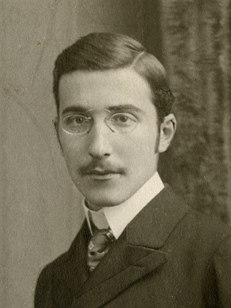
Stefan Zweig, 1900

The “Flying Salzburger”

Stoddard Martin considers the enigma that was Zweig

Among German-language authors of the first half of the 20th century Stefan Zweig is now being re-positioned near the top. Some contemporaries saw him as in ‘the first rank of the second rate’, to use Somerset Maugham’s self-deprecation; Hugo von Hofmannsthal, whom Zweig briefly succeeded as Richard Strauss’ librettist, put him several rungs beneath that.[i] In the moments of depression which darkened his later years Zweig may have seen truth as well as envy in such relegation. He was lucky however to have huge numbers of admirers, a public which bought his books in the hundreds of thousands, fellow humanists who shared his ideal of a finer pan-European order and above all an adoring young second wife, who followed him in a restless search for a final resting-place and finally joined him in suicide there.

From a literary point of view Zweig belonged to the last great era before writing was overtaken by other media as a principal means of telling stories and promulgating ideas. From a political point of view he belonged to a last gilded age before world war disfigured Europe. Child of privileged Jews in fin-de-siècle Vienna, he was one of its most famous sons by 1920 when with a fellow-writing first wife he decamped for a hill over Salzburg. There he busied himself on the novellas and plays such as he had churned out since his early twenties. He worked indefatigably, travelled peripatetically and cheated on his wife shallowly. In a life devoted to the written word, he was a manic collector as well as a producer. He gave public readings and lectures about culture far beyond his imploding Germano-phone sphere. And as his fame spread, his tendency deepened to explore of acts of danger, daring and will. Continue reading

Posted in QR Home | Tagged , , , | Leave a comment

Paleocons vs. Neocons in Board War Gaming

Board wargames

Paleocons vs. Neocons in Board War Gaming

Mark Wegierski reports on the curious world of conflict simulations

There are in America, Canada, and most Western countries today, a large number of what could be called “geek subgenres.” Apart from a more general interest in some of these areas by a larger proportion of the population, they are also followed by dedicated fan communities. These would include science fiction (such as Star Trek and Star Wars); fantasy (which was pioneered by J.R.R. Tolkien’s The Lord of the Rings); role-playing games (such as Dungeons and Dragons); comic-books; and multifarious types of gaming, including historical board games (also called war games, strategy games, or conflict simulations). Historical board games could be seen as a more reality-based alternative in relation to most forms of gaming and fan identifications today.

Having attended the same high school — University of Toronto Schools (UTS), a rather unique “model” school affiliated with the University of Toronto — in Toronto, Ontario, Canada as David Frum in the mid to late 1970s, I knew him to be a fairly avid war game player. Among the games popular at that time was Invasion: America, a war game portraying a hypothetical future invasion of the United States and Canada by three hostile powers — the “European Socialist Coalition”, the “South American Union” and the “Pan-Asiatic League.” Another very popular game was Sinai, a depiction of the major Arab-Israeli Wars of 1956, 1967, and 1973. There was also a game called Oil War, which portrayed a “near-future” attempt by the United States to seize control of virtually the entire oil supplies of the Middle East (in the wake of a new OPEC embargo) — by the launching of a simultaneous attack against Iran, Iraq, Saudi Arabia, and the smaller Gulf countries. The play of the game usually resulted in easy American victories, as the swarms of “nifty-looking” counters representing air force and naval aviation units — supported by airborne infantry and amphibiously-landing Marines — blasted away the curiously weak Arab and Iranian armies. There was no inkling that massive guerilla resistance to the American assault might occur. The Soviets were also conspicuously absent.

While there certainly was an element of gamers who enjoyed playing Nazi Germany in World War II East Front games a bit too much, there were also many young neocons who were drawn to the hobby. As a young, traditionalist-leaning student, I was repelled by what could be perceived, in its most pointed form — the “Nazi worship” elements of the hobby — but the main concerns of the young neocons also were, to some extent, remote to me. However, I appreciated their willingness at that time to confront Soviet imperialism.

Looking back at a shared interest in war games by persons of varying outlooks (most of which would be conventionally considered as being “on the Right”) I must say a number of contrasts have emerged today. Under the Bush Administration, David Frum was briefly one of the most important persons in the United States, who, it could be sharply said, was “playing war games for real.” It could be asked, however, if his interest in the hobby ever actually imparted a genuine historical sense to him — or of any sense of the real suffering entailed by war. Perhaps it is subliminally just a feeling of pushing colorful cardboard counters around on a finely designed map, in search of “the perfect offensive.”

Persons of “paleo” persuasions usually have their understandings of war leavened by a more careful study of history and culture. They understand, for example, that the program of a “global democratic revolution” cannot be considered as any kind of “conservatism”; and that the defense of America’s heartland “base” is actually more important than imperial engagements half a world away. So an adolescent interest in war gaming can lead one along various paths.

The interest in historical board war games can, nevertheless, be seen as among the most “conservative” of the “geek subgenres” mentioned above. Indeed one can highlight the contrast between historical board war games vs. role-playing games and electronic shoot’em-ups. Historical war gamers and players of Dungeons and Dragons are often considered as “mortal enemies” in the broader gaming hobby.

Historical board games have been commercially marketed in the U.S. since the late 1950s. Codified rules for playing with historical miniatures (i.e., so-called “toy soldiers”) are one of the origins of historical board gaming. Abstract military board games such as RISK, Tactics II, and Diplomacy are also close cousins. Diplomacy was one of the favorite pastimes of some university students, especially those studying political science.

Avalon Hill pioneered the genre in the late 1950s, with its 1958 game on the battle of Gettysburg. The company moved through decades of varying success, bringing out such titles as PanzerBlitz (World War II tactical armored combat), Third Reich (strategic WWII), and the Advanced Squad Leader (ASL) system of tactical WWII combat. The firm has been acquired in the late-1990s by toys and games giant Hasbro, resulting in the abandonment of nearly all of its game lines, deemed far too complex for the current-day audience

War gaming’s Golden Age was the mid to late 1970s, the heyday of its second major company, SPI (Simulations Publications, Inc.). It has been argued that historical board games were heavily undermined by the Dungeons and Dragons company, TSR, which took over SPI in the early 1980s, and let historical games languish, in favor of building up the fantasy role-playing games (RPG’s) market. Mostly arcade-style electronic games, as well as collectible card games (CCG’s) (now called trading card games – or TCG’s) (such as Magic: The Gathering — and, most spectacularly, Pokémon — both controlled by Wizards of the Coast) challenged what remained of board war gaming in the late 1980s and the 1990s. TSR was itself taken over by WOTC, which in turn has been bought out by Hasbro.

Today, board wargaming (as well as playing games of the wargame type in electronic format), might be seen as a more reality-grounded alternative to currently prevalent gaming genres. Fantasy RPG’s (especially of the newer, darker variety — such as those in X-Files-type settings), might tend to encourage an excess of florid and disorienting imaginings in some people. The mostly arcade-style electronic games (typically, the so-called First Person Shooters such as DOOM) are centered around grotesquely individualized, very graphic killing, and are in most cases entirely history-less. While there are of course more abstract, electronic, arcade-type games (typified by the 1980s PAC-MAN and TETRIS) addictive videoplaying conditioning is certainly present in most of them. In CCG’s, one finds, apart from the commonly-seen occult aspects, a combination of collecting and gambling impulses. (Mainly because of the way the cards have been marketed, with only a few “strong” cards randomly included in larger packets which are purchased unseen, like in a sort of lottery.)

The facts of the concreteness — of the historical situation, the game-board, as well as the counters representing military units — may help a person playing such a game avoid falling into the overwrought fantasizing sometimes found in RPG’s, and the sometimes addictive aspects of FPS’s and CCG’s.

Even when playing ahistorical board wargames (such as those based on near-future, alternative-history, or sci-fi situations, or those set in Tolkien-style fantasy worlds), or when playing strategy games electronically, there might be a certain residual concreteness, a distinct tempering of what is in other cases the often lurid “virtual reality” of the game. This concreteness is also present in historical miniatures, but the financial costs of these elaborately-painted historical “figures” are clearly much greater, particularly if one wants to play out such great battles as Waterloo. One should mention, also, the rather lurid subgenre of miniatures gaming represented by the Warhammer Fantasy and Warhammer 40,000 A.D. systems; as well as the existence of other fantasy and sci-fi miniatures systems.

Chatham Hill Games produces a number of small, simple, inexpensive games, suitable for children (not all of which are strictly wargames), based on American history. Gamewright Games produces a series of mostly young children’s games, most of which are not military-related. The main Internet portals for wargaming are www.grognard.com and www.consimworld.com. There are also a lot of wargames featured at www.boardgamegeek.com .

The major printed historical gaming magazine (which includes a game with each issue) is Strategy & Tactics (published by Decision Games, which has acquired what remained of the old SPI). They have also launched spin-off magazines on World War II and Modern game topics.

In December 2001, the other major gaming magazine, COMMAND, and its parent company, XTR, declared bankruptcy, after having produced fifty-four issues packed with military history (with one or two games in each issue) and several games outside of the magazine. A new magazine with a game in it is Against The Odds.

Some other extant boardgame companies include GMT, Multi-Man Publishing (MMP), Avalanche Press, Clash of Arms, Columbia Games, Critical Hit/Moments in History, L2 Design Group, and Eagle Games. There have also arisen companies that produce, through desk-top publishing, games on sometimes-obscure topics, such as Schutze, Microgame Design Group, and Victory Point Games. One should also mention the family-oriented boardgames imported from Germany (the so-called “Eurogames”) such as the very popular Settlers of Catan. These games, which typically have very high-quality components, are also less explicitly military. In Europe, there are also, among other enterprises, Azure Wish, Phalanx Games, and the French gaming magazine Vae Victis. The Australian Design Group (ADG) is known for its massive World War II games.

While they, too, can sometimes be very obsessive, historical boardgames could be seen as more grounded in reality and in somewhat useful knowledge (about military history, strategy, and real geography), than role-playing games and most electronic-based games. It could be argued that most board wargames can usually harness some fairly commonly-occurring “armchair general” desires to relatively positive ends. In some cases, however, the impact of the “wargame mentality” may be less salutary.

Mark Wegierski is a film buff and science fiction aficionado. He lives in Toronto

Posted in QR Home | Tagged , , , , | 2 Comments

It’s the Presidency, stupid

Hilary Clinton, 2016

Hillary Clinton, 2016

It’s the Presidency, stupid

Ilana Mercer observes how the liberal media protect their own

Big media are all about the angle, the spin. Look to the overarching theme that runs through each and every news story. Be hip to the meta-narrative being peddled.

Recent examples:

A perfectly logical statement made by Israeli Prime Minister Benjamin Netanyahu, in February, was framed by CNN anchorette Brooke Baldwin as “controversial.” In view of rife, Islamic anti-Semitism in Europe, Mr. Netanyahu told “all of the European Jews, and all Jews wherever [they] are [that] Israel is the home of every Jew.”

To the rational individual, unburdened by the obtuse thinking of a teletart, Netanyahu’s statement was utterly uncontroversial. It follows from an irremediable reality: the subordinate states of the European Union refuse—and no longer have the power—to properly and vigorously defend their innocent, Jewish and Christian citizens from an identifiable threat.

Another example of the meta-shaping of news came courtesy of Fredricka Witless, whose intellectual prowess I chronicled in “Joan Rivers: Antidote to PC Totalitarianism”.

Ms. Witless used leading questions in an interview with a man she introduced as the “controversial Swedish artist Lars Vilks.” In a free society, a painter—impressionist, realist, muralist, cubist, cartoonist—would never be considered controversial. He harms no one in the fulfillment of the requirements of his benign profession.

However, with her leading question, wittingly or unwittingly, Fredricka Whitfield was essentially asking an innocent cartoonist, who ekes out a life hiding from Muhammadans, whether he felt responsible for crimes perpetrated by his assailants. After all, the criminals were spurred by his drawings of their prophet.

Leading questions suggest a certain reality. They force defensive replies. They shift blame. They invert morality and reality.

Likewise has the logic of the debate been lost in the hyperventilating over Mrs. Clinton’s unorthodox email account. The dynamic at play: hound Hillary Rodham Clinton for lesser, technocratic offenses, thus allowing her to gracefully evade responsibility for serious war crimes: the war on Libya, for one, Benghazi, for another.

Clearly, the woman who cracked the whip at Foggy Bottom at the time had resolved to run the U.S. mission in Benghazi, Libya, as one would an open community center. This was meant to telegraph to the world that the war she and her she war-lords (Samantha Power and Susan Rice) launched was a success, when in fact Hillary’s gunpoint democracy in Libya has been as fruitful as Genghis Bush’s faith-based forays into Iraq and Afghanistan.

As evidence for the meta-narrative at play, consider the major, left-liberal media—the “circle jerk” leading the charge against Mrs. Clinton. It began with President Obama’s first press secretary, Robert Gibbs with CNN groupies like Brianna Keilar and Dana Bash. And with Ron Fournier of National Journal. He chimed in, calling the former secretary of state’s habit of conducting the affairs of state via a non-governmental e-mail address a “scandal; seedy, sanctimonious, self-important, slick.” Just in case, Fournier was careful to offer these disclaimers:

“I admire [the Clintons’] intelligence and passion and empathy. They’ve been good to my family. I’ve actually long thought that she has the potential to be a better president than he was.”

Not for nothing are they called the Stupid Party. Republicans have fallen for what I suspect is not so much a deliberate tactic on the part of the liberal media, but a reflexive strategy. GOPers are implicating Mrs. Clinton in statute violations which caused barely a stir when flouted by their own.

Gwb43.com, anyone? This private, Republican National Committee domain, from which five million emails were alleged to have been expunged, in 2007, stood for “George W. Bush, 43rd.” The Federal Records Act and the Presidential Records Act were purported to have been violated by the likes of Deputy Chief of Staff Karl Rove, White House Deputy Director of Political Affairs Jeffery Scott Jennings, President Bush’s Senior Adviser Andrew Card. Attorney General Alberto Gonzales was alleged to have been in-the-know. Then White House Spokesperson Dana Perino put a pretty face to the affair.

Hillary Clinton is to Benghazi as Les Aspin Jr. is to “Black Hawk Down.” Aspin, Bill Clinton’s secretary of defense, marooned the American men he sent to Mogadishu, Somalia, in October of 1993. The “Black Hawk” went down. But so did Dr. Aspin, at the behest of President Bill Clinton, who fired him.

The email line of attack on Hillary is not worth a straw. It lets her go scot-free for crimes the likes of which her own husband would have sacked her.

ILANA MERCER is a paleolibertarian writer based in the United States. She pens WND’s longest-standing column, “Return to Reason” and is a Fellow at the Jerusalem Institute for Market Studies. She is a Quarterly Review Contributing Editor. Ilana’s latest book is Into the Cannibal’s Pot: Lessons for America from Post-Apartheid South Africa. Her website is www.IlanaMercer.com. She blogs at www.barelyablog.com

Posted in QR Home | Tagged , , | Leave a comment

New Poetry from Australia

Peter Purves Smith - The Diplomats

Peter Purves Smith – The Diplomats

      Difference

on behalf of the
eccentrics, court jesters and poets
may I say
if everyone was like us
there may be chaos
but if no-one was like us
would dull uniformity win?

      Old Age

winds blow colder
and wounds heal more slowly
but love and humor
may broaden and deepen

      Mystery

who can explain life?
don’t try too hard
logic should be
a servant of love

    Dreams of a poet

will the storms clear
and the warblers sing?
can the love of wisdom
bring the wisdom of love?

   A few contrasts

the incredible human mind
and pedestrian powers of computers
marvellous old music
and repetitive pop songs
sometimes grand statements
and messy reality
enjoying the search for wisdom
and the delusion of dogma

Poet BOB COWLEY is a retired public servant. He lives in Adelaide, Australia

Posted in QR Home | Leave a comment