Savouring Hillary’s Vow of Silence

Hillary_Clinton_official_Secretary_of_State_portrait_crop

Savouring Hillary’s Vow of Silence

Ilana Mercer waxes prophetic

The national media are sulking. Hillary Clinton won’t speak to them. But what is it about this power-hungry dirigista that the media don’t already know?

Prior to taking a vow of silence, Mrs. Clinton promised to make President Obama’s legislation by executive action with respect to immigration seem like child’s play; a “DREAMers” delight, if you will.

Where’s the mystery there?

Big Media know full well about—and have just about forgiven—Madam Secretary’s habit of conducting state affairs via private server, later scrubbed clean of unflattering or incriminating communications.

The same press corps knows that the Clinton Foundation, in which Mrs. Clinton is mired, is awash in funds from foreign governments and likely beholden to these patrons. Those so inclined can check out Charity Navigator. For all its billions, the Clinton Foundation doesn’t rate a mention by the eminent Charity rating service. “In 2013, a measly 9 percent of the money went to charity!” “Repulsive,” avers John Stossel.

Making community college “free” was another of Hillary’s brain infarcts, voiced in Monticello, Iowa, in March this year. “There’s something deeply wrong about students and their families needing to go into debt to finance a college education” were Mrs. Clinton’s semantic strokes of genius, disgorged during her first meet-and-greet, with members of the press (mainly).

What’s there to miss?

Didn’t we have The Same Talk (in the same place) back in April of 2012, about America’s next financial bubble in search of a pin, the $1 trillion student-loan debt? Campaigning in Iowa, Obama promised America’s mis-educated Millennials to keep the student-loan bubble from bursting. During his State of the Union address of January 2012, Barry Soetoro Frankenstein vowed to mandate yet more loans at fixed prices.

When it comes, will the media react with wonderment at Hillary’s “fresh” take on educational central planning and price fixing?

Not content with acquiring wealth through the dishonest, predatory process of politics (to contrast with the honest, productive, economic means of earning a living)—Hillary Clinton and husband have protected their ill-gotten gains from the taxman through trusts. These are “common among multimillionaires, and help shield some of their estate from the [inheritance] tax that now tops out at 40 percent of assets upon death.” “Among the tax advantages of such trusts,” attests BloombergBusiness, “is that any appreciation in the [asset’s] value can happen outside their taxable estate. The move could save the Clintons hundreds of thousands of dollars in estate taxes. …”

The height of Hillary’s hypocrisy, however, is that while she shields her own fortune from it, she recommended, during her last campaign, that estate taxes be further raised on Americans who’ve managed to amass more than $3.5 million.

“… Clinton supported making wealthier people pay more estate tax by capping the per-person exemption at $3.5 million and setting the top rate at 45 percent, a policy Obama still supports. Congress decided to go in the other direction and Obama went along as part of a broader compromise. The per-person exemption is now $5.34 million.”

A “wealth tax” is how Clinton has characterized the estate tax.

Clinton’s express “inspiration” as a future president is to “ensure that granddaughter Charlotte and her generation are provided equal opportunities to live up to their potential.” She said as much in April.

How do you imagine that will be accomplished, if not by the use of every illiberal power-tool in the leftist toolbox? Taking by force from some to give to others, creating new, unelected, oppressive agencies to carry out the new potentate’s plans, raising armies to march on noncompliant nations, on and on.

Hillary Clinton and her armory of future, repressive laws should be properly dubbed illiberal (stupid, too).

“A ‘rationale’ for running,” gushed one particular tele-tart named Poppy Harlow. She was raving about Mrs. Clinton’s “brilliant” plans to weave her tangled web for Charlotte.

To say you want to be president for the good of your granddaughter’s generations is not a rationale. Rather, it’s of a piece with the standard statement made by the low-IQ beauty queen: “I want to make the world a better place.” Except that a pretty girl with no ship-of-state to steer is far more likely to spread peace and happiness than a power-hungry, illiberal, brutal battle-axe like Hillary Clinton.

If only a woman with the wicked wit of a Margot Asquith—countess of Oxford, author and socialite (1864-1945)—were around to put slobbering Poppy Harlow in her proper place.

When asked by American actress Jean Harlow how she pronounces her first name, Mrs. Asquith quickly retorted: “The ‘t’ is silent, as in Harlow.”

For now, let us savor the silence from Hillary and her media harlots.

ILANA Mercer is a US-based, libertarian writer. She pens WND’s longest-standing, exclusive, paleolibertarian weekly column, “Return to Reason.” With a unique audience of 8 million, the site has been rated by Alexa as the most frequented “conservative” site on the Internet. Ilana has also featured on RT with the “Paleolibertarian Column,” and she contributes to Economic Policy Journal (the premier libertarian site on the web), Junge Freiheit, a German weekly of excellence, as well as to the British Libertarian Alliance and Quarterly Review (the celebrated British journal founded in 1809 by Walter Scott, Robert Southey and George Canning), where she is also contributing editor. Formerly syndicated by Creators Syndicate, Ilana is a fellow at the Jerusalem Institute for Market Studies (an award-winning, independent, non-profit, free-market economic policy think tank).


Posted in Current Affairs and Comment, QR Home | Tagged , , | Leave a comment

Mongolia, a Retrospect and Prospect

Mongolia, credit Pixabay

Mongolia, a Retrospect and Prospect

The Ethnic Conflict Information Centre analyses Mongolia’s balancing act

Mongolia is one of those semi-imaginary places that, like Timbuktu or the far side of the Moon, conjure up mental pictures of extreme remoteness and desolation. Of course, Mongolia is in reality very much a real place. Once the largest landlocked country in the world (a title it lost to Kazakhstan in 1991) modern Mongolia has only two neighbours. That these are Russia and China gives some indication of why Mongolia may become of significant geopolitical interest in the future.

Mongolia is an independent, democratic republic of some 604,000 square miles, but with a population of only 2.9 million. Around a million of these are nomadic, so the country has one of the lowest settled population densities in the world. It comprises those regions which, in Chinese nomenclature at least, were regarded as ‘Outer’ Mongolia: Inner Mongolia has tended to be less well defined politically, but can be taken to be those southern and eastern regions of Mongol inhabitation that lie closer to the Chinese centre.

The early Mongols were nomadic herders, horsemen and traders who periodically banded together into immense marauding confederations, with China being the traditional target for their depredations. China’s response to these attacks, including its construction of the Great Wall, is a recurring motif in Chinese history. In the 13th century, under Genghis Khan, the Mongols carved out the greatest land empire the world has ever seen. Khan, whose reputation has undergone a significant rehabilitation in recent years, bequeathed to the Mongolian people a code of law, a written language and a sense of national identity that endures to this day. His successors, however, were unable to maintain the unity of his empire and the subsequent history of Mongolia has generally been one of decline and a gradual sapping of military and political strength. During the 17th century what remained of independent Mongolia crumpled and in 1691 the whole country fell under the sway of the Manchu Qing Dynasty, which ruled until its collapse with the Chinese revolution of 1911 and the creation of the Republic of China.

For nationalists throughout the Chinese empire, the demise of the Qing Dynasty opened up the possibility of creating independent states. In Outer Mongolia, a confused period of fighting eventually saw the emergence of the Communist People’s Republic of Mongolia in 1921. Mongolian independence was generally recognized in 1924, but in reality the Mongolian state was a satellite barely distinguishable from a full Soviet republic and political development closely followed the Bolshevik pattern of forced land collectivization, the suppression of religious worship, and the liquidation of dissidents who favoured a line independent from that imposed by the Kremlin. An estimated 30,000 were murdered in 1936-7 as Stalin’s purges reached Mongolia.

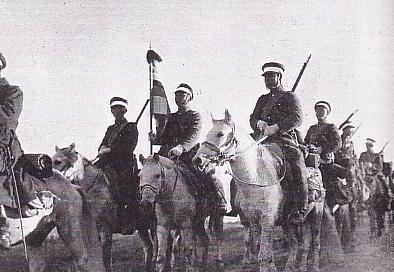
Meanwhile, events in the nominally Chinese Inner Mongolian territories were greatly influenced by the overall weakness of the central Chinese government and by Japanese aspirations. Japan invaded and occupied Manchuria in north-eastern China, establishing in 1931 the puppet state of Manchukuo, while in 1936 the Inner Mongolian potentate Prince Da Wang declared the provinces under his control independent as ‘Mengjiang’. Japanese imperial policy favoured the establishment of a string of ‘independent’ client states on the Asian mainland that could be moulded into an ‘East Asian Co-Prosperity Sphere’ with their economic life geared to Tokyo’s needs. Da Wang’s Mengjiang fitted well into that strategy, and potentially offered the basis for further expansion into Outer Mongolia. To this end, a ‘Mengjiang National Army’ was created with Mongolian men and officers under the direction of the Kwantung, the autonomous Japanese army command that ran Manchukuo as virtually a private fiefdom.

Manchuko Imperial Army

Tensions soon flared between the Japanese and the USSR over the demarcation of the Manchukuo/Mongolia border, with the Japanese claiming that the Khalkhin Gol River represented the border, while the Mongolians and the Soviets argued that it lay further east. In May 1939 a Mongolian cavalry unit entered the disputed territory, where they were attacked by Manchukuoan cavalry and forced back across the river. Matters speedily escalated. In June the Kwantung staged an air strike against Soviet air bases in Mongolia (an action apparently not authorized by Tokyo) and at the end of the month launched a full assault. Fierce fighting ensued, but it became clear that the Japanese had severely overstretched themselves as well as suffering from defective intelligence concerning the scale of Soviet deployments. The Japanese were decisively defeated on 31 August 1939 – just a few hours before Germany, far to the west, invaded Poland.

Almost wholly forgotten in Western histories, Khalkhin Gol had profound implications for the course of the broader global conflict. Since the 1904-5 Russo-Japanese war, a significant divergence of opinion had emerged within the Japanese military as to the correct course of imperial policy. The first group, the ‘Strike North’ faction, favoured consolidating the gains of the 1904-5 war and envisaged the eventual subjugation of China, Mongolia and much of Siberia, securing vast swathes of territory rich in resources. This view remained in the ascendency in the 1930s as Japan successfully invaded and occupied first Manchuria and then parts of China proper, but as the decade progressed, hardening Chinese resistance and the massive costs of the colonial war raised increasing doubts as to its sustainability. The defeat at Khalkhin Gol put a decisive end to the Strike North policy and truncated the Kwantung’s prestige and influence within imperial strategy circles. Japan never again seriously threatened an attack on the Soviet Union. This meant that it was Germany, rather than the USSR, that eventually faced a war on two fronts. Equally importantly, the demise of the Strike North policy led to the adoption of the Navy’s rival ‘Strike South’ maritime strategy. Japan initially scored significant successes against the British and Dutch in the East Indies, but the fatal consequences of Japanese over-extension and the attack on Pearl Harbour are well known.

In the dying days of the Second World War, the USSR used Mongolia as the jumping-off point for ‘Operation Autumn Storm’ – its attack on Japanese occupied China. In August 1945 over 1.5 million Red Army troops crashed into Manchuria and Inner Mongolia, routing the Japanese. Soviet conquests did not, however, lead to the widespread annexation of territory, either by the People’s Republic of Mongolia or the USSR that might have been expected. Instead, in a spirit of solidarity with their Communist allies, the territories were handed over to the nascent People’s Republic of China, which consolidated its Inner Mongolian holdings into an Autonomous Region in 1947, forming a rough crescent around southern and eastern Mongolia.

In 1949 the People’s Republic of China formally renounced all territorial claims over Outer Mongolia, but Mongolia was unsuccessful in its attempts to maintain a neutral stance as Sino-Soviet relations deteriorated in the 1960s. Instead, Mongolia witnessed a massive build up of local Soviet forces, with the Mongolian armed forces becoming little more than an extension of the local Soviet command, and the mass expulsions of Chinese from the country. (Ironically, many of the Chinese had moved to Mongolia under Communist-sponsored ‘friendship and reconstruction’ programmes in the early 1950s.) Perestroika and the eventual collapse of the Soviet Union had much the effect on Mongolia that it had among the Soviet republics themselves. A managed transition from Communism to a multi-party market economy took place and a new constitution was introduced in 1992.

It will be seen from this canter through the regional history of the past 700 years that Mongolia has often been a key geopolitical concern to its neighbours. Equally, the ability of Mongolians themselves to sustain a genuinely independent foreign policy has been severely circumscribed by the relative strengths and ambitions of their neighbours. Today, Ulaanbaatar needs to keep a close eye on developments in Beijing and Moscow, while both China and Russia retain an acute awareness of their common far eastern border, the scene of tensions and actual clashes during the Sino-Soviet Cold War.

For Moscow, the problems of defending or economically developing the vast territories beyond the mountains surrounding Lake Baikal remain immense. For Beijing, the reverse is the case – the region is perilously close to the economically vital Chinese eastern seaboard, and modern China, with its land borders to the south and west relatively secure, is well aware of its historical weakness to invasion from the north – whether by the Mongols, the Japanese or the Russians. However, since the end of the Cold War and the economic rise of China, the balance of power in this region has drifted inexorably in Beijing’s favour. China enjoys a massive demographic advantage, and has actively encouraged the settlement of Chinese communities on the Russian side of the far eastern border, building up a potential client population buttressed by economic investment. Pessimists with long memories – and there are plenty of those in the Kremlin – may see in this process an echo, under Beijing’s auspices rather than Tokyo’s, of the imperialist strategy of the 1930s. In July 2008 China and Russia signed a regional agreement that reflected this imbalance. In addition to protocols on economic co-operation and development, Russia undertook to return to China the Yinlong Dao and Heixiazi Dao riverine islands, which Russia had held since 1945 and over which China and Russia had fought in 1968. As real estate, the islands are insignificant. But it is virtually without precedent for the Russians to voluntarily surrender any territory – particularly over which blood has been spilled – and their willingness to do so on this occasion clearly demonstrates Moscow’s growing vulnerability to Chinese pressure.

It may also be significant that Moscow received only lukewarm support from the Shanghai Cooperation Organization, the security and development group linking Russia, China and the Central Asian states, for its 2008 recognition of the breakaway South Ossetian and Abkhazian republics in Georgia. ‘Separatism’ is one of the ‘three evils’ (the others being terrorism and extremism) that the Shanghai Cooperation Organization specifically opposes. In Chinese Inner Mongolia, a number of small groups exist calling for independence and there are undoubtedly also irredentist supporters who favour unification with ‘Outer’ Mongolia. (There is even at least one internet group that favours the restoration of Manchukuo.) As in other outlying territories of China, such as Tibet and Xinjiang, these factions argue that Beijing’s rule is essentially colonial, involving the exploitation of local resources and the in-migration of economically dominant Han Chinese settlers to create client communities and undermine local culture. The proportion of ethnic Mongolians within Inner Mongolia is only around 14%, but the Mongolian population of China in total considerably outnumbers that of Mongolia itself, and Beijing certainly does not want them to start drawing any inferences from the South Ossetian precedent.

Faced with the challenge of maintaining independence while sandwiched between two of the world’s great powers, neither of which have shown themselves in the past to be over-encumbered with scruples surrounding the rights of sovereign nations, the Mongolians have played the limited cards at their disposal with some originality and subtlety. Economically, Mongolia’s strongest ties are inevitably with China and Russia, but it has also courted investment from Japan, South Korea and the United States, and in 1997 was admitted to the World Trade Organization. In international diplomacy, Mongolia has similarly sought a balanced and pro-active approach in pursuit of the Government’s aim of an “independent, open and multi-prop (sic) foreign policy”. Central to this strategy is the ‘third neighbour’ policy under which Mongolia carefully nurtures its relationships with countries other than Russia and China. So, while retaining cordial relations with both its geographical neighbours, with each of whom it has signed aTreaty of Friendly Relations and Cooperation’, Mongolia unequivocally condemned the 9/11 terrorist attacks on the United States and supported the subsequent US-led ‘war on terror’. In 2003, Ulaanbaatar hosted the Fifth International Conference of New or Restored Democracies, at which over a hundred countries were represented. In the following year, Mongolia was invited to become a partner nation at the Organization for Security and Cooperation in Europe, while also becoming the first observer nation in the Shanghai Cooperation Organization.

Mongolia’s leaders also see the military as a resource for bolstering the country’s overall international standing. Looked at from a purely defence standpoint, it is clear that no conventional military build-up would ever be sufficient to counter or seriously deter an aggressor. But Ulaanbaatar has consciously used its armed forces in other ways: to modify Clausewitz, Mongolia has developed a doctrine that peacekeeping is diplomacy by other means. Mongolian forces have contributed to internationally sponsored peacekeeping activities in Ethiopia/Eritrea, Afghanistan, Sierra Leone, Iraq, Liberia, Kosovo, Georgia, Western Sahara, Darfur, Congo, Chad, and, most recently, a self-standing operation in support of the UN in South Sudan. Although the actual numbers of troops deployed is of necessity quite low, this is nonetheless a very impressive record. Indeed, apart from the ‘usual suspects’ of the larger NATO states, it is unlikely that many countries have been involved in more international interventions. Nor is Mongolian involvement mere tokenism; the robustness and professionalism of the Mongolian solider has earned them the respect of representatives of much larger powers and, for example in Afghanistan, the very obsolescence of Mongolia’s Soviet weaponry was turned to good advantage as the Mongolians proved to have unique practical experience in keeping operational the vintage Warsaw Pact kit used by the Afghan army.

A highlight of the ‘third neighbour’ policy is Mongolian sponsorship of Exercise Khaan Quest, a grandstand event in the US-managed Global Peace Operations Initiative. At the inaugural event in August 2006, held at Ulaanbaatar and the Five Hills Training Area in Tavan Tolgol province, forces from six nations received training in peacekeeping operations, including tactical operations designed to test international communications, interoperability, and their ability to respond to humanitarian and civil infrastructural needs. Successfully participating units were awarded ‘Training Recognition’ by the United Nations. Six hundred and fifty Mongolian soldiers participated, supported by around 500 troops from other nations, around half of them American. Apart from its practical benefits in the training of international peacekeeping forces, Exercise Khaan Quest, which is now an annual event, undoubtedly contributes beneficially to US/Mongolian diplomatic relations.

Whether Mongolia’s diplomatic balancing act proves adequate to the task of preventing the nation being sucked into the orbit of one or other of its neighbours remains to be seen. Current Kremlin strategy in Georgia and Ukraine looks very much like an attempt to re-create, however incompletely, the system of buffer states that defended the old Soviet Union. This in turn may lead Moscow to cast a renewed and covetous eye on Mongolia as a potential lever in its relationship with Beijing. Equally, the failure of the United States to protect its Georgian or Ukrainian allies does not set a comfortable precedent for Mongolia’s ability to call on practical support from Washington should Moscow – or Beijing – seek to re-assert its hegemony. That aside, the Mongolian military’s current role, of enhancing national standing while seeking to positively contribute to international security, is surely an honourable one for any soldier. Whether Genghis Khan – a shrewd diplomat when the circumstances demanded – would approve we cannot judge, but Mongolia’s very modern experiment in military diplomacy surely deserves sympathetic attention.

Ethnic Conflict Information Centre (www.ethnic-conflict.info)

Posted in Cultural Matters, QR Home | Tagged , , , | 5 Comments

ENDNOTES: From first to last night

Sir Simon Rattle

Sir Simon Rattle

ENDNOTES: From first to last night

Stuart Millson looks forward to the Proms

ENDNOTES, June 2015

In this edition: BBC launches its Proms programme for 2015 * Sir Andrew Davis conducts the enigmatic Charles Ives * Tasmin Little soars in Schubert * Simon Callaghan records Preludes and Variations by a lesser-known English composer * Leon McCawley performs Rachmaninov.

The April launch of the BBC’s Proms prospectus is always a much looked-forward-to event. My own Proms programmes (preserved in cardboard boxes and plastic folders) go back as far as 1981 – and I fondly recall their old design: a humour-filled illustration of the Royal Albert Hall, with Beethoven and his ear-trumpet, and Wagner peering at us from beside the Hall. The great Berlioz operatic work, The Trojans, was performed in 1982, which prompted the programme illustrator to include the legendary Trojan Horse on the cover, being pulled into the hall by a line of straining prommers. Today, the programmes have a softer, perhaps more surreal style of artwork – the idea being to let one’s imagination run riot, and (to quote the old slogan of BBC Radio 3), to “3 your mind”! Proms 2015 certainly achieves this, with a theme of music for all – a very important idea in this age when so many people, young people especially, have little or no exposure to classical music. (A strange thing, given the instant availability of music of all kinds, across so many media.)

The Proms season runs from July until September, culminating in the famous Last Night, which this year sees the return of Marin Alsop, the Baltimore-based conductor who became the first woman to raise a baton at an event often perceived as a bastion of old traditions and avuncular conductors – who try to keep (to some degree) a lid on the uproarious, cathartic grand finale. But for the final night to mean anything, the whole season has to be savoured, and there are – what promise to be – many exciting evenings ahead, with visiting orchestras (the Vienna Philharmonic and Sir Simon Rattle in Elgar’s The Dream of Gerontius), and symphonies by Sibelius, Mahler and Bruckner. Attempts have been made to reach out to people who would not normally go to the proms, a process which began in previous years with an “urban prom” (something which does not necessarily engage the core audience) and an evening with the 1980s’ pop group, The Pet Shop Boys, who, it must be said, did write for the Proms an original and creative “serious” work, The Man from the Future.

Despite raising some eyebrows and provoking accusations of “dumbing down”, the inclusion of non-classical music is, in fact, nothing new. In the Glock era, Soft Machine played at an experimental prom, and in 1983, I attended an all-night concert of Indian music – which followed a performance by Bernard Haitink and the Royal Concertgebouw Orchestra, Amsterdam, of Bruckner’s Ninth Symphony, which the composer dedicated to God. Although separate concerts, the Bruckner (which ended at about 9.30pm), and the Indian “Rags at Midnight” (which concluded at about seven the next morning) proved that music can bring a common, universal spirituality. But there must be a definition to life, and the BBC needs to think carefully: is the all-important need to reach out offering some factions in the artistic establishment the chance to blur the distinction between classical (broadly Western, and mainly “serious”) and styles of music which offer their audience a quite different type of experience? “It’s all music, it’s all valuable…” argue the egalitarians. It would be a pity, if at some point in the future, the Proms became simply a platform, or mash-up for all styles of music. After all, jazz, heavy metal, Rock, rap et al define themselves strongly by name and style: classical music (an imprecise, but still useful term) does the same for us. Long may Sir Henry Wood’s statue look down upon the platform at the Royal Albert Hall – at orchestras, choirs and opera companies… with the occasional foray into something quite different.

From his debut in Verdi’s Requiem at a Prom in 1970, to his famous bow at the end of his tenure with the BBC Symphony Orchestra some 30 years later, Sir Andrew Davis has become one of those Proms elder statesmen – joining the gallery of other musical knights, Sargent, Boult, Groves, Mackerras, Pritchard. (Nor must we forget the non-knights of the recent Proms past: Norman Del Mar, and that great Scot, James Loughran – who, with his wit and true stage-presence, was one of the best Last Night master of ceremonies we have ever had.)

Sir Andrew Davis returns to the Proms on occasions, and these days is increasingly associated with the Chandos Records catalogue. For one of his recent releases, Sir Andrew is in Melbourne, with the city’s very fine-sounding orchestra; bringing to life the music of that enigmatic American semi-amateur composer, Charles Ives (1874-1954) – on this CD, his first two symphonies. Ives seemed to belong to the world of small-town America – white weatherboarded houses in towns with wide thoroughfares and leafy avenues. Perhaps his most famous composition is Three Places in New England; a haunting score which goes far beyond any picturesque tone-painting, and takes us into a sound-world of shadows and unexpected tonalities. Ives could almost be the American Mahler – as spectral landscapes give way to the crashings and bangings of marching bands, which in turn disappear into what might be an almost religious limbo of unanswered questions.

Church and Autumn Leaves

Late-19th and turn-of-the-century America – presided over by that venerable academic and organist – Horatio Parker, had yet to develop a truly local or national style; Parker being a firm believer in the solid certainties of the European romantic movement. (It was Parker who thundered out on the Yale organ Land of Hope and Glory, in honour of Elgar’s United States visit, and who felt that even the all-American Ives should write as if he were at the Queen’s Hall or Cologne). But we should not complain about Parker’s solid old-world style, for in the Charles Ives symphonies, their compelling moments of drama and generally flowing feel (yes, reminiscent of Bruckner or Schumann) a new-world school of music is in the making. Hints of the Ives that we know are also present in the scores, as one Brucknerian ending seems almost disrupted by the sudden arrival (an out-of-step percussive march) of an over-enthusiastic town band. The listener can almost “see” the American hearties in their baseball caps and boaters on the Fourth of July! As always, the Chandos sound is exceptional. This is a recording that is well worth exploring.

Another Chandos artist of great note (and notes) is Tasmin Little. This column has celebrated her work many times, not least her definitive recordings of Elgar, Britten, Moeran and Walton. I would venture to say that her version of the Walton Violin Concerto is the best on record. But this time, we find Tasmin in the chamber world of Franz Schubert (1797-1828). Her accompanists are Tim Hugh, cello, and pianist, Piers Lane – who play the sublime Sonata, D 821 ‘Arpeggione’ of 1824, and join Tasmin in the posthumously recognised and numbered Adagio Op. 148, (written in the last year of the composer’s short life). The cerebral, sweet-sounding music of Schubert is made for the intimacy of small-scale settings – the pathos and good nature, and perfect tunes, of his sonatas finding their ideal interpreters in the Chandos performing team. Listen carefully in the second movement of the Sonata No. 1, Op. 137: here is music, which whilst not being exactly melancholy, generates a feeling of rest and reflection – the sun on a summer’s day obscured by misty clouds – only to be reinvigorated by the third movement, which seems to start immediately, with a new view and mood, carrying you away back to purpose and a jollier frame of mind. Chandos records the sounds of the instruments, almost as if being able to bottle spring air or capture reflected light from cut-glass crystal. Effortless performances (this may be a clichéd phrase) but the CD generates a mood of wellbeing; using three musicians who simply have to spin the potter’s wheel in order to create out of nothing, something of great beauty – including those earnest and bold phrases of Schubert which are often found in his symphonies. Not even these moments sound forced or hard-edged.

Recorded at the Old Granary Studios, Suffolk in the late August of last year, pianist Simon Callaghan – very much a new figure, and force, in recording and performance – has sought out, not easy repertoire or a name we know, but the complicated and almost unknown figure of Roger Sacheverell Coke. (Regular readers may recall our review of Coke’s music on the English Music Festival label, EM Records.) Coke was born in 1912, his family claiming lineage to the Plantagenet dynasty. His social position, whilst not exactly aristocratic (although semi-upper-class) was unencumbered by the usual demands of making money or earning one’s keep, and so Coke devoted himself to music – even producing a Shelley-based opera, which was decried by the musical press. The poor reaction to his work, his heavy-smoking, depression and accompanying disorders all combined to undermine this artist, and bury him in the far-flung reaches of musical history. Although achieving a measure of recognition at some points in his career, this essentially gloomy romantic found himself buried by the post-war musical establishment, keen as it was to embrace the continental, the avant-garde, the decidedly atonal. Not for them the two sets of 24 Preludes (Opp. 33 & 34) and 15 Variations (Op. 37) which Simon Callaghan has recorded for Somm: a testament to Coke’s very real and vivid creative strengths – an intense, often nocturnal inward-looking impressionism – which might lead the listener to think that an English Rachmaninov has been rediscovered.

There is a famous photograph, taken in the Proms days of Sir Henry Wood, of the conductor shaking hands with the original, wholly Russian Rachmaninov, after what must have been a dazzling performance before the London prommers. (Let us not forget that Wood brought Debussy, Delius, Berg and Rachmaninov to our concert-halls – the modern music of its day.) A romantic and an exile from his beloved homeland, Rachmaninov’s music seems to breathe the cold winds of Russian forests and lakes, and a sense of heartache, of loneliness, of a man longing for something which cannot be put into words – only music. His famously sad, lyrical but embracing Vocalise; the endless heartfelt depths and storytelling of the mighty Second Symphony; the strange, midnight atmosphere of the Symphonic Dances; the Gurrelieder-like opening of his canata, Spring – all contain the essence, or at least, a side of the composer’s character.

Written at different times of his life, Rachmaninov’s Preludes (24 in total) are an exploration of all the possibilities of the musical keys, and are – in piano form – a clear summation of everything for which the composer stands. In other words, if all the symphonies and the piano concertos were lost for all time, the 24 Preludes would still give the listener in some future barren world a connection to the heart of the Russian romantic master.

The international prize-winning pianist, Leon McCawley (also a Leeds prize-winner) has given us – via the recording facilities of Somm Records – one of the finest interpretations of Rachmaninov anyone could wish for; making the listener feel as though the Preludes were a single sequence, written at one time – such is the integrity and cohesion of McCawley’s interpretive vision and dedication. It could be said that the over-exposure of Rachmaninov’s Second Piano Concerto, or his Rhapsody on a Theme of Paganini, has taken us away from the “pure” essence of the composer – something which the Preludes seem to embody and exude. Perhaps, as a result of the achievement of Leon McCawley, audiences and CD buyers may be able to see another facet of a figure with whom we thought we were familiar.

Leon McCawley

Leon McCawley

As a final point, I would like to quote a small part of Robert Matthew-Walker’s immensely informative programme notes (for the Somm CD of Sacheverell Coke). It has a great deal of relevance for us, bringing together a view of the reputations of two romantic composers, and illustrating why “musical correctness” and the official view may not always serve the truth about the work of so many composers…

“…by the dawn of the 1960s the tide had turned against late-romanticism which Coke’s musical language maintained – one has only to consider the deplorable entry on Rachmaninoff [their spelling] one of the notable disfigurements of the fifth edition of Grove’s Dictionary of 1954 – and the time could not have been worse for the unveiling of the magnum opus of a composer [Coke] who was perceived to be eminently backward-looking and not even fully competent in his technique.”

The Quarterly Review would like to pay tribute to the life and work of Brian Couzens (1933-2015), the founder of Chandos Records. Launched in 1979, this proudly independent label came to prominence in the early 1980’s with its recordings of British music. A memorial service in Wivenhoe, North Essex, commemorated the passing of this remarkable and dedicated figure, who pioneered so much within the recording industry.

STUART MILLSON is the Classical Music Editor of Quarterly Review

Next time – we bring you reviews from the ninth English Music Festival, and of many distinguished new CD releases.

Posted in ENDNOTES:Music, QR Home | Tagged , , , , , , | Leave a comment

Pamela Geller offends ‘Sharia’ media

Pamela Geller

Pamela Geller offends ‘Sharia’ media

Ilana Mercer defends the WND columnist

Sandhya SomethingOrAnother is a “social change” reporter for The Washington Post. (Yes, the WaPo has such a beat.) Ms. Somashekhar (her surname copied and pasted) implied that WND columnist Pamela Geller ought to repent for staging a Muhammad Art Exhibit and Cartoon Contest in Garland, Texas, an event that was briefly attended by two, uninvited ISIS-Americans. Sandhya must have been angry because she called Geller, in error, “a housewife from Long Island.” Progressives don’t much like housewives.

Like most Geller haters, Somashekhar (her name copied and pasted) cited the Southern Poverty Law Center as her “scholarly” source for Geller’s hatefulness. The SPLC is a “leftist vigilante group,” explained Paul Gottfried, a real scholar. It is “unmistakably totalitarian in the drive to suppress and destroy deviationists from the party line on race, gender, and ‘discrimination.’” The southern-poverty-law-center is as dodgy in its financial dealings as it is in its strong-arming tactics.

“Stupid,” ruled a less obscure enforcer of political correctness, Bill O’Reilly, on Geller’s event. Also at Fox News, host Martha MacCallum suggested Geller ought to have explored kinder, gentler ways of protesting Islam-imposed restrictions on expression.

Pantomime, perhaps?

The left-liberal Jon Stewart took the safe route. The idiotic urge to kill over any annoyance was the object of the satirist’s spoof. Stewart’s Thou Shall Not Kill skit was hardly cutting-edge comedy. So he livened up the tired shtick with a curtsy in the direction of the Prophet’s avengers. Geller’s group, The American Freedom Defense Initiative, was about hate speech, warned Stewart.

The biggest clown in the media circus, however, was TV anchor Chris Cuomo. While Geller staged her vital challenge in private, Cuomo, a lawyer, flaunted his “smarts” in public. He tweeted that “hate speech” was unprotected by the Constitution. Not everyone was speechless. Another of CNN’s commentators, Alisyn Camerota, stood squarely in the corner of the victims: those poor ISIS-Americans whose descent into hell was hastened by a guard at Geller’s Garland cartoon contest

It was difficult to tell what it was about Pamela Geller’s position on impolite and impolitic speech—echoed in the 1st Amendment in the Bill of Rights—that so puzzled Camerota. Brow furrowed, she battled to score points against Geller, in an exchange that was more amusing than the Mayweather-Pacquiao match. Camerota came short.

ISIS and its local, low IQ Abduls have since vowed to kill Pamela and anyone who shields her. Duly, Fox News’ Greta Van Susteren worried about the welfare of … law enforcement. Greta accused Geller of jeopardizing her security detail’s safety. How’s that for ridiculous? First, it is not Geller who is endangering the police; it’s those who would kill her for the words she mouths. Second, protection of an innocent citizen’s life, liberty and property is the one legitimate function of government. Besides which Geller’s organization paid thousands out-of-pocket for protection.

THE FRENCH CONNECTION

Easily the most contemptible of Geller’s critics was a fellow called Jean-Baptiste Thoret, a film critic for the Charlie Hebdo magazine.

When Islamists hit Charlie Hebdo’s Paris headquarters, slaughtering a dozen of its cartoonists, the world, left and right, came out in support. When two ISIS-Americans stormed the Curtis Culwell Center in Garland this month Jean-Baptiste, however, came out post-haste to distance the Hebdo from the Geller cartoons.

From his affected conversation with broadcaster Charlie Rose—Jean-Baptiste is French and has little to no English—one gleaned that he believed the sexualized, infantile, witless depictions of the Prophet, produced by the Hebdo crowd, were clever. Conversely, Geller’s exhibit was unintelligent. Or so this fool implied.

Anyone who’s been made to watch a French film, serious or satirical, knows that the French have no sense of humor or irony. The last truly funny comedian to have made merry in France lived in the 17th century. He, too, was Jean-Baptiste: Jean-Baptiste Poquelin, aka Molière. To get a feel for what has since become of French comedy, watch Louis de Funès, whom the French consider a comedic giant. Even your typically humorless Hebdo cartoon—take the one in which the contours of Muhammad’s turban resemble his bare buns, accompanied by the caption, “And my butt, you like my butt?”—is wittier than Louis de Funès’ oeuvre.

Alluding to the intelligence with which Hebdo does commentary, Jean-Baptiste and pal Gerard Biard rejected any parallels between Charlie Hebdo’s defiance of Islamic blasphemy laws and Geller’s defiance of the same laws.

French cerebral agility is clearly as keen as French humour.

THE RED CONNECTION 

During the communist era, certain, ever-accreting categories of people were deemed unworthy of personhood.

True right wingers—members of the ancien régime, the clergy, the aristocracy, the bourgeois, the business and professional communities—they were “taken out of circulation” early on in the Bolshevik Revolution. Once the Right had been eliminated, during the Great Terror (1936-38), “right-winger” became synonymous with Communists who harbored too great an affinity for the peasantry (in other words, were insufficiently enthusiastic about collectivisation, and might have overseen the recrudescence of capitalistic practices (namely, making a living).

Maoist society, as “The Black Book of Communism” illustrates, promoted the “binary division between ‘red’ categories, such as workers, poor peasants, medium peasants, party cadres … martyrs of the revolution; and ‘black’ categories, such as landowners, rich peasants, counterrevolutionaries, ‘evil elements,’ and right-wingers. The labels stuck no matter what one did later. Even after an official rehabilitation, a right-winger would remain a target for mass campaigns and would never have the right to return to the city. … ” (P. 486)

Broadly speaking, American civil and political society privileges radical left-liberalism. To be of the Left is to be in the cool kids’ corner. Distilled, the double standard toward what is perceived as rightist speech (Geller’s) and left-wing freedom of expression (Hebdo’s) is, in my opinion, a holdover construct of communism.

ILANA Mercer is a US-based, libertarian writer. She pens WND’s longest-standing, exclusive, paleolibertarian weekly column, “Return to Reason.” With a unique audience of 8 million, the site has been rated by Alexa as the most frequented “conservative” site on the Internet. Ilana has also featured on RT with the “Paleolibertarian Column,” and she contributes to Economic Policy Journal (the premier libertarian site on the web), Junge Freiheit, a German weekly of excellence, as well as to the British Libertarian Alliance and Quarterly Review (the celebrated British journal founded in 1809 by Walter Scott, Robert Southey and George Canning), where she is also contributing editor. Formerly syndicated by Creators Syndicate, Ilana is a fellow at the Jerusalem Institute for Market Studies (an award-winning, independent, non-profit, free-market economic policy think tank).

Posted in Current Affairs and Comment, QR Home | Tagged , , , , , | Leave a comment

Living in the shadow of fascism

Wladyslaw Sikorski

Wladyslaw Sikorski

Living in the shadow of fascism

Mark Wegierski considers the ideological consequences of the Second World War

Seventy years after its end, World War II continues to shape the world. One of its main ideological results was the general discrediting of Western traditionalism and the delegitimizing of the possibilities of a “democratic Right” — or of a “social conservatism of the Left” — that is to say, various possible symbioses of traditionalism and liberal democracy.

Although it may seem quite remote from many persons (especially young people) today, we are in fact living in the shadow of the anti-traditionalist consequences of the Second World War. Recoiling from the horrors of Nazism, an evil ideology that was buried in the rubble of Berlin, Western countries such as Canada have reacted viscerally against anything that smacks of “right-wing” or “traditional” notions (albeit often misconceived and caricatured) with the result that an almost continual, uninterrupted, unremitting left-liberal surge has overtaken those societies.

Indeed, countries such as Canada today are on the “cutting edge” of late modernity. Canada is increasingly becoming a nation without history, or historical memory. Lacking a context or mooring in a richly textured sense of history, most Canadians today are cast adrift on an ever-thinning, improvisational present moment, driven by consumerism, pop-culture, and a few “politically correct” clichés about the past.

As a person of Polish descent who has studied history extensively, the author hopefully has a certain insight into totalitarianism – whether of the Nazi, Soviet, or politically-correct left-liberal variety. Although the latter is ostensibly non-violent and does not produce mounds of corpses – it is extremely thoroughgoing in the upholding and imposition of its ideas, as well as being what its critics would call “soul-killing”. And some would indeed cite the vast number of abortions in current-day Western societies as suggestive of actual mass-killing. As J.R.R. Tolkien has acutely observed — “evil always takes on another shape and grows again.”

The new evil was not only the manifest cruelty of the Soviet empire, to which East-Central Europe had been notoriously betrayed, but also a rising miasma of trends and tendencies that would eventually drive most Western countries into a socially disintegrative mode. Three major prophets of this new mode were Dr. Kinsey (who — according to perceptive critics like Judith Reisman — manifestly misrepresented the reality of sexual behavior in an attempt to create the very tendencies he purported to describe); Dr. Spock (who introduced highly distempering errors into the understanding of how to raise children); and Dr Timothy Leary (the Sixties’ guru and “youth drug culture” advocate).

Alfred Charles Kinsey

Alfred Charles Kinsey

Although many European patriots, conservatives, and traditionalists had fiercely opposed Nazi Germany, as of 1945, the entire “right-wing option” stood discredited in the eyes of the broad masses of most Western countries. In today’s world, those who continue to hold the ideals of such World War II heroes as Winston Churchill, Charles de Gaulle, or Wladyslaw Sikorski (the preeminent leader of the Polish Government-in-Exile and Commander-in-Chief of the Polish armed forces in the West) are often considered retrograde reactionaries.

Sikorski, McNaughton, Churchill, de Gaulle

Sikorski, McNaughton, Churchill, de Gaulle

It is possible to see the respective histories of a country like Poland since September 1939 (the beginning of an ongoing calamity for that nation whose consequences continue even to this day) and Canada since the 1960s as being tragic in the case of Poland and tinged with tragedy in the case of Canada — owing in both cases to forces, which although apparently dissimilar, often end up being quite alike in their disdain for living, breathing, actual societies and peoples.

Many Western countries such as Canada – under the direction of their “politically-correct” elites (or pseudo-elites) — appear to have lost their confidence and their belief in them selves. They have embraced low birthrates, and high immigration policies, which, when coupled with the refusal to exert meaningful assimilatory pressures on the new immigrants, may indeed render these countries long term future increasingly problematic. What may be particularly troubling is the unidirectional nature of developments such as social liberalism, multiculturalism, and high immigration, all of which tend in one direction, i.e., towards the ever-increasing subversion of traditional society.

Indeed, it did not take too long for the Left’s “long march through the institutions” to get underway. During one year at the alleged height of “McCarthyism” in the United States, a young William F. Buckley, Jr. went around talking to thousands of professors in the social sciences and humanities at prestigious U.S. universities. Only two or three actually admitted to being “conservative” and that was at the height of the “reactionary Fifties”! What may be concluded from this is that, in almost every sector of society, left-liberalism has been winning one spectacular victory after another, rapidly pushing further and further into all areas of social terrain. Authentic traditionalist conservatism in the U.S., but especially so in Canada, has, despite some apparent electoral successes, been run ragged for at least the last quarter century. As to the outlook for some parts of Western Europe, it is evidently dystopic indeed.

The only exception to this appears to be the economic sector. However, it should be understood that, with their manifest social prevalence in educational, academic, media, cultural, judicial, and administrative sectors, especially in Canada, left-liberals can well allow the existence of a large, dynamic private sector that functions to efficiently produce the economic goods that they want to give to themselves and to their client-groups. There is also a major difference between social conservatism (emphasizing family, nation, local communities, and traditional religion), and fiscal/economic conservatism. If one looks closely enough, one can see that fiscal/economic conservatism alone can, in fact, coexist with varieties of left-liberalism (as typified by the many technocrats in the Canadian Liberal Party today). And, while the Canadian Liberal Party held the federal government for many decades of the Twentieth Century, it embraced, for most of that time, what could be called a “traditionalist-centrist” consensus. So-called “right-wing Liberals” (such as John Turner, who invoked residues of a more substantive Canadian patriotism in his resistance to the Canada – U.S. Free Trade deal), as well as “social conservative” Liberals, had fragmentarily persisted into the later decades of the Twentieth Century. However, by today, it is manifestly clear that such residual tendencies in the Canadian Liberal Party are being driven out, especially social conservatism.

It may also be noted that such parties as the Co-operative Commonwealth Federation (the predecessor to today’s ultra-politically-correct New Democratic Party in Canada) were social democratic in economics, but mostly socially conservative on issues of family, nation, and religion. Some of these residues may be considered to have persisted in the NDP’s criticisms of globalization, and their stated concern for “average, ordinary Canadians”.

As for today’s Conservative Party, it in fact appears to have embraced fiscal/economic conservatism as virtually the sole “permissible” manifestation of conservatism. The leadership of the party has been running away from any overt manifestations of social conservatism.

We have come to a social environment in Canada today where any more substantive notions of traditionalism and conservatism, have been purged with particular thoroughness from the academic world – as well as from the education system and from most of the news media, and from both high- and pop-culture. And, for a number of decades now, it could be perceived that the Canadian administrative and juridical structures have been deployed mostly on behalf of left-liberalism. The result of this is that conservative and traditionalist ideas, especially those embracing a more substantive patriotism, are usually only inchoately expressed, in an untutored fashion, by some of the general populace, and so can be easily subjected to pejorative scorn and discredited.

The question that now faces Canada is sharp. Is it going to be “politics-as-usual”, a continuing slide in the direction the country has been going for at least the last thirty years, or will there be a belated attempt to generate some real countervailing tendencies – such as an attempt to tame the excesses of multiculturalism and of social and cultural anomie? It is possible that an uninterrupted continuation of the slide will result, in the next twenty to forty years (a mere sliver of time in terms of world-history), in the almost-inevitable social and cultural dissolution of Canada.

MARK WEGIERSKI is a Toronto-based writer and historical researcher


Posted in Current Affairs and Comment, QR Home | Tagged , , , , | Leave a comment

History through a glass darkly

King speaking

History through a glass darkly

Robert Henderson is simultaneously bored and exasperated by a sanitised depiction of Martin Luther King, Jnr.

Selma

Main cast:

David Oyelowo as Martin Luther King, Jr.
Tom Wilkinson as Lyndon B. Johnson
Carmen Ejogo as Coretta Scott King
Dylan Baker as J. Edgar Hoover
Tim Roth as George Wallace

Director Ava DuVernay

Selma is the latest in an ever-lengthening list of propaganda films in the politically correct interest. It is Alabama 1965. Martin Luther King is already internationally famous after his “I have a dream” speech in 1963 and the award of the Nobel Peace prize in 1964. The Civil Rights Act of 1964 is meeting with resistance and black voters are finding they still cannot register to vote because of the application of local electoral regulations in ways that are comically restrictive. King goes to the city of Selma with a clutch of supporters from the Southern Christian Leadership Conference (SCLC) to protest about this thwarting of the law, but their attempts to help blacks register in the city fail. As a consequence a protest march from Selma to Montgomery, the Alabama state capital, is planned. The first march is stopped brutally, the second aborted by King and the third allowed to happen.

That is the skeleton of the film. There is precious little solid dramatic flesh put on the skeleton. To be brutally frank Selma is boring. It is too wordy, too cluttered with characters, too didactic and unremittingly earnest. These are qualities guaranteed to lose any cinema audience. The problem is particularly acute when, as here, there is a large cast. Disputes and debates between King and his supporters or between King and the Student Nonviolent Coordinating Committee (SNCC) are so extended and detailed that anyone not familiar with the story would not know what to make of it and, in any case, as anyone who has ever been involved with an ideologically driven political group will be only too aware, of little interest to anyone who has not been captured by the ideology. Reflecting life too exactly on film is not always the best way to keep people’s attention. Propaganda films do not have to be boring, although they often are. The black director Spike Lee would surely have made a much less sprawling and vastly more watchable film whilst keeping the ideological message.

MLK and Malcolm X

MLK and Malcolm X

There is also a woeful and wilful lack of historical context. This one has at its core a vision of wicked Southern good ol’ boys oppressing blacks. White involvement is restricted to racists with a penchant for violence, a few white sympathisers with the civil rights movement who appear peripherally, adorned with looks of sublimely smug unquestioning utopian naivety not seen on film since the initial sighting of a hippy commune in Easy Rider. Lyndon Johnson is shown as sympathetic to King’s views but not interested enough to risk his political future by wholeheartedly embracing the legislation that King says is necessary. There is no attempt to see things from the viewpoint of the whites who opposed integration, unlike, for example, a film such as In the Heat of the Night in which Rod Steiger’s sheriff attempts to explain why whites in the South are as they are because of their circumstances, citing for example, their widely held and not unreasonable fear that a black population which has been suppressed may turn on whites. Instead Selma just rushes in and points the finger of moral shame at any white who does not uncritically embrace what King advocates with a complete disregard of the fact that every human being, morally and sociologically, has to start from the situation into which they are born.

The concentration of the film on a specific time and place is also problematic, because King’s ideological career was a far more complex thing than the film can show. It also removes the embarrassment which would have hung around a straightforward biopic of King, such as the plagiarism which gained him a doctorate and his marginalisation as a civil rights leader which eventually saw him reduced to going to support sewage workers at the time of his assassination. Mention is made of his gross womanising, but only in the context of a sex tape recorded by the FBI that was sent to King’s wife Cora. The fact that some who were close to him said he had a particular liking for white women – which could be taken as evidence of racism in King if his motive was to revenge himself on whites by abusing their women – goes unmentioned. Indeed, it is rather odd that a man as celebrated as King is in the USA and with a worldwide reputation should never have had a full-blown biopic. Perhaps the answer is that King’s private life was too messy to deal with in a film depicting his entire public life rather than a short period of it devoted to a specific subject.

Martin Luther King Jr and Coretta Scott King

Martin Luther King Jr and Coretta Scott King

More importantly the tight focus in Selma means that the fifty odd years since Selma go unexamined. No honest person would deny that the position of blacks in the USA and particularly those in the Old South was demeaning at the beginning of the 1960s, but is what has replaced segregation and Jim Crow laws really that much better for most blacks or, perhaps more pertinently, anywhere near what King hoped would happen? Perhaps the answer to the first question is a tepid yes, at least for blacks who have benefitted from “positive discrimination”, but it has to be an unequivocal no to the latter. Segregation by choice has replaced segregation by law. Illegitimacy and crime amongst blacks have rocketed. A fair case could be made for the individual personal relationship between whites and blacks being worse now that it was fifty years ago.

Tom Wilkinson is very decent LBJ but David Oyelowo does not quite cut it as King. It is not that it is technically a bad performance; it is simply that he does not capture the charisma that King undoubtedly had. His portrayal of King keeps a question nagging away at one: why would any one have followed this rather drab character? The rest of the cast do not really have time to develop their roles, although Carmen Ejogo as Coretta Scott King and Tim Roth as George Wallace have their moments.

The insubstantial quality of the film can be judged by the meagre Oscar recognition and its popularity with the public by the money it has taken. The film was nominated for Best Picture and best song but for nothing else, which is a rather remarkable thing. Nor did it win as best picture. A public fuss was made about Ava DuVernay and David Oyelowo being left out of Best Director and Best Actor categories, but only in the context of no black actors and directors being nominated. Considering the public political correctness the American film business emits, it is rather difficult to imagine that the tepid response to Selma by the Oscar granting Academy voters was the result of racism. In fact its nomination as Best Picture despite having no nominations in the directing and acting categories suggests that the opposite happened, Selma was nominated for Best Picture regardless of its mediocrity as a sop to political correctness.

The public also responded in less than passionate fashion. As of 16 April Selma had taken $52,076,908 worldwide, which placed it, 57th in the top grossing films of the previous 365 days. Not bad in purely commercial terms for a film which cost $20 million to make, but distinctly underwhelming for a film lauded to the skies by most critics and many public figures. The truth is that people both in the States and abroad have not been that drawn to it, whether because of the subject or the indifferent quality of the film. One can take the browbeaten horses of the Western world to the politically correct water but they can’t make many of them drink.

The pernicious nature of a film like this is not that it casts whites as the villain, but that it gives blacks an excuse for anything that goes wrong in their lives, the prize of an inexhaustible victimhood.

ROBERT HENDERSON is film critic of QR

Posted in Film Reviews, QR Home | Tagged , , , , | Leave a comment

Fame – deserved and undeserved

Kim Kardashian

Kim Kardashian

Fame – deserved and undeserved

Ilana Mercer distinguishes between heroism and celebrity

“True bravery is shown by performing without witness what one might be capable of doing before all the world,” said a wise man named La Rochefoucauld, centuries ago. That man’s definition excludes most of America’s contemporary heroes.

La Rochefoucauld’s understanding of courage certainly rules out most black community leaders. In Baltimore, a city devastated by anti-police, race rioters, these “leaders” made sure they were seen calling for calm following the orgy of destruction. Away from the cameras, their lives have been given over to causing chaos by preaching racial grievance against white America.

The same imperative of privacy and consistency precludes Bruce Jenner. The famous Olympian athlete turned TV personality has come out very publicly as a transsexual, who is in the process of transitioning to full womanhood; Jenner already has the psyche of a woman. For providing 17 million ABC viewers with a glimpse into his very real inner struggle with sexual identity, Jenner has been hailed as an American hero.

Coming out simultaneously as a Republican and a Christian failed to dampen the admiration with which the oppressed patriarch of the Kardashian clan was greeted—Jenner has been embroiled in a vulgar reality show, “Keeping up with the Kardashians,” on which he is generally belittled and berated.

The political and religious identities of Republicanism and Christianity are mortal sins in the eyes of Jenner’s celebrity peers and the audience to which he appeals. Granted, Republicanism is so meaningless a political identity that a Democrat can just as easily transition to being one, without much pain. Christianity, however, is supposed to set a higher bar for belonging. In the Kardashian clan, Jenner is rudderless dad to a bevy of catty exhibitionists. And he is ex-husband to the ball-busting matriarch, Kris Kardashian.

Is this what a man of faith looks like, these days? This is not to diminish Jenner’s excruciatingly difficult journey. However, a stoic Olympian battling his demons in private would have more closely approximated the qualities of a hero.

Still, Jenner is more of an American hero than the late Navy SEAL Chris Kyle. Kyle “held the record for number of kills by an American sniper. The Pentagon confirmed more than 150 of his kills. The previous record was 109.” Kyle lived by the sword and died by the sword. In 2013, he was “shot point-blank” by another veteran.

It is hardly an accomplishment to have killed so many individuals in the service of Uncle Sam. This Navy SEAL was like a real-life Jack Bauer, the character from the hit TV series “24”: a federal zombie in thrall to the state and trained to do its bidding.

To be sure, Kyle had the makings of a hero in the classical, Homeric mold. To follow the criteria outlined by the Fellowship of Reason, Kyle performed “extraordinary feats.” But for a fatal flaw, he was of “noble character.” As a masculine force at full tilt, his suffering was great and his death unusual. Kyle’s fatal flaw was to have slavishly toiled as an assassin for the Federal Frankenstein.

For reasons mysterious, America’s anointed heroes are either killing people in faraway lands, or crying on television here at home. The key to glory is to go public.

A British newspaper, the MailOnline, did its part in stripping heroism of meaning, literally. The paper ran a pictorial that depicted, to quote, “brave mothers and daughters baring all – and revealing their hopes and fears about ageing.” To get naked for the world to see is immodest, not heroic. Displaying “saggy tummies” and “stretch marks” does not a heroine make. Narcissism, self-adoration, bad taste, or just being comfortable in your own skin: these are not heroic, although they’ve been cast as such.

As their ideal, the Fellowship of Reason aforementioned hearkens to “the classic Aristotelian model of virtue as an expression of good habits developed purposively over time and maintained by thoughtful practice. This is coupled with an unabashed enthusiasm for the kind of individualism advocated first by the Enlightenment and put into practice by the romantic post rationalists of the Industrial Revolution.”

The “hero” adulated in the USA today is a deformed version of the Romantic-era hero: the battle that informs his life is “the courage to be me.” He makes up his own moral code. His is slave to his passions and exercises no control over them. Besides fame, his goal is self-knowledge, a goal that is limited by his profound superficiality, deep ignorance and lack of learning. His loyalty is not to higher, timeless principles, but “to a particular project and to a community of like-minded others,” the transgendered community, in Jenner’s case.

Bruce Jenner says his gender identity is female and so, too, is his pattern of sexual attraction. The two—gender identity and sexual attraction—are separate things. Jenner has always loved women and likely will continue to so do. Now that is heroic, given the shallow, silicone-stuffed, nasty women with whom poor Bruce is surrounded.

Bruce Jenner

Bruce Jenner

ILANA Mercer is a US-based, libertarian writer. She pens WND’s longest-standing, exclusive, paleolibertarian weekly column, “Return to Reason.” With a unique audience of 8 million, the site has been rated by Alexa as the most frequented “conservative” site on the Internet. Ilana has also featured on RT with the “Paleolibertarian Column,” and she contributes to Economic Policy Journal (the premier libertarian site on the web), Junge Freiheit, a German weekly of excellence, as well as to the British Libertarian Alliance and Quarterly Review (the celebrated British journal founded in 1809 by Walter Scott, Robert Southey and George Canning), where she is also contributing editor. Formerly syndicated by Creators Syndicate, Ilana is a fellow at the Jerusalem Institute for Market Studies (an award-winning, independent, non-profit, free-market economic policy think tank).

Posted in Current Affairs and Comment, QR Home | Tagged , , , | Leave a comment

After travelling

John Glover Patterdale landscape with cattle

John Glover Patterdale landscape with cattle

After travelling

back in the magical country

the great south land

where sunshine cheers

like the best wine

and more innocent histories

give the search for wisdom

a special relish

Bob Cowley is a retired public servant. He lives in Adelaide, Australia


Posted in Poetry, QR Home | Tagged , | 1 Comment

Marx out of ten?

 Marx, Napoleon, Jesus etc.

Marx out of ten?

On May Day, Mark Wegierski wonders what remains of value in Marxist thought

Karl Marx and his intellectual collaborator and patron Friedrich Engels established a heritage of thought which is said today to be nearly-universally discredited, yet which has both today and historically also attracted a surprising variety of supporters and defenders, across virtually the entire spectrum of left, right, and centre.

The Marxian tradition is evidently more multivalent than its identification with the former East Bloc system, nominally called “Communist” — suggests. Marx might well have had some serious disagreements with the current-day Left – and most certainly with the current-day left-liberal establishment.

This essay endeavors to avoid either the simplistic condemnation of Marx common among some anti-Communists, as well as the panegyrics which had been de rigueur in the former Eastern Bloc — which, along with the various depredations of the system — have today reduced Marx’s intellectual cachet far more in East-Central Europe than in the United States, Canada, and Western European societies that never experienced the “worker’s paradise.”

There are a number of interpretations of Marx’s thought which may be termed “mainline” — and a number which may be termed “dissident.” Intellectually-speaking, Marx brought a certain zest into political philosophy, as well as a sharp style of writing that tries to tenaciously “get at” what certain political and philosophical pronouncements “actually say.” He may indeed be characterized as one of the modern “masters of suspicion.”

He combined in what was — at that time — a new, interesting way — philosophical thinking, the claim of being scientific, and what should accurately be called “ideology” or “polemics.” Some of the “mainline” aspects of Marx’s thought include his central concept of desire for human liberation, the ferocious condemning of economic inequality, and a doctrinaire atheism, materialism, and hatred of traditional religion. Indicatively, Marx’s chosen motto for his doctoral thesis was the quote from Shelley’s Prometheus – “Above all, I hate all the gods.”

However, Lenin’s elaboration of Marx’s “dictatorship of the proletariat” seems to have been little more than a carte blanche for the exercise of power of a narrow ruling group that was supposed to be putting Marx’s egalitarian dreams into reality. To borrow the Marxian terminology, the “ideological superstructure” of the promise of the Communist utopia at the end of the road — where the state would famously “wither away” — was utterly unreflective of the reality of the brutal, coercive, totalitarian “base.” The fact that Soviet Marxism-Leninism and Maoism arose in so-called “backward” societies like Russia and China suggest that they had more in common with what Marx had disparagingly termed “the Oriental mode of production” — rather than “scientific socialism.” The depredations of the North Korean, North Vietnamese, and Pol Pot regimes are well-known today. The reception of Marxism in Africa also led to massacres, and usually intensified the underlying problems of those societies. In Latin American societies, Marxism appeared to have acquired an almost romantic mystique, as typified by Fidel Castro and Che Guevara.

The reception of Marxism in America, Canada, and Western European countries was somewhat different from that in Russia — in the former societies, it seemed to truly have vast intellectual cachet and was apparently based on the appeal to “liberation” and “humane values.” The “liberation” aspects — especially in regard to the so-called Sexual Revolution — were given a huge play in the 1960s and post-1960s period, whereas over several decades of the Twentieth Century many people believed that what was somewhat imprecisely called Communism was simply about ensuring a decent life for the laboring masses. The fact that the imposition of Soviet Communism on Russia and especially on the East-Central European countries during World War II and its aftermath proceeded by means of mass slaughter and massive repression and indoctrination was generally ignored.

Paradoxically the highly-disciplined Marx-inspired parties and movements were admired by the far right in various European countries, especially France and Germany. Whereas ultra-traditionalists such as Oswald Spengler looked to the socialist parties as vehicles for conservative social restoration, the German Nazis (National Socialists) identified with the harsh, totalitarian as well as anti-Jewish and anti-Polish aspects of the Soviet Communist regime. It should be remembered that between August 1939 to June 1941, Nazi Germany and the Soviet Union were close allies, united by the Molotov-Ribbentrop Pact. The admiration of the Nazis for the Soviet regime was, of course, for mostly different reasons than those of the legions of Western liberal “pilgrims” who genuflected before Stalin because they perceived Soviet Communism as the “progressive” utopia.

Oswald Spengler

Oswald Spengler

 Among the more fruitful re-interpretations of Marxism were those carried out by the Frankfurt School (Adorno, Horkheimer, et al.). The Frankfurt School has now become a curiously bivalent tradition, which has inspired some of the most serious critics of what is considered the current-day “managerial-therapeutic regime” (such as Paul Piccone, the late editor of the New York-based scholarly journal, Telos) — as well as providing one of the strongest buttresses of that system, i.e., the theory of “the authoritarian personality.” The psychological critique of “personality” at its most pointed considers “authoritarian” political identifications a form of mental illness to be eradicated by mass conditioning, and, if it is discovered in an individual, to be “cured” by semi-coercive “therapy.” However, the Frankfurt School’s deep-level critique of consumerist, consumptionist society — which could be seen as one of their main contributions to intellectual inquiry — is clearly evocative of traditionalist cultural conservatism.

Another fruitful re-interpretation of Marx’s thought can be seen among the so-called “social conservatives of the Left” — such as William Morris, Jack London, George Orwell and Christopher Lasch. In the age of the pre-totalitarian and pre-politically-correct Left, John Ruskin, a nineteenth-century aesthetic and cultural critic, could say, “I am a Tory of the sternest sort, a socialist, a communist.” However, these figures could probably be placed more in the ambit of “utopian socialism”, “guild-socialism”, or “feudal socialism” — tendencies which were polemically condemned in Marx and Engel’s The Communist Manifesto.

Another interesting off-shoot of Marx’s thought is the Syndicalist system represented by Georges Sorel, as well as by varieties of Anarchist ideas. The Papal encyclical De Rerum Novarum certainly was a reaction to Marx’s thought — and so-called “Catholic social teaching” tried to embrace what were seen as the positive aspects of Marx’s critique of capitalism and of extreme social inequality, while avoiding its iconoclastic radicalism and potential for abuse by power-hungry ideologues. G. K. Chesterton’s Distributism and C. H. Douglas’ theory of Social Credit were two further attempts to maintain the rights of decent small-property holders and workers against the depredations of monopoly finance-capital, without recourse to violent dictatorship.

Pierre-Joseph Proudhon

Pierre-Joseph Proudhon

Given the apparent irrelevance of “classical Marxism” by the 1960s — especially in regard to such areas as its underdeveloped theories of psychology, art, religion, and literature, and its thin materialism — there arose varieties of “neo-Marxism.” The presence of “neo-Marxism” allowed for the countering of the more common criticisms of earlier Marxist thought, which were now simply categorized as describing a “vulgar Marxism” that the new Marxist theorists did not themselves hold. In the attempt to “rescue” a more subtle Marx, great attention was paid to Marx’s Economic and Philosophic Manuscripts of 1844 – which were fully published in English only in 1959.

There were also, among the leading innovations of neo-Marxism — especially in the thought of Frantz Fanon and Herbert Marcuse – the embrace of social outcasts, racial and sexual minorities, and the Third World, in the face of what were characterized as the “embourgeoified” white working classes. What classical Marxism had disparagingly termed the “lumpenproletariat” now became to a large extent the focus of revolutionary energies for the neo-Marxist theorists.

Also important for neo-Marxism was Antonio Gramsci, whose claim to fame was the idea — in contrast to classical Marxism — that the “ideological superstructure” would actually bring into being the social and economic facts of “the base” — hence the need for “an intellectual war of position” and “the march through the institutions” in order “to capture the culture.” The existence of, and need to engage in, “cultural warfare” — can be seen as an idea with great cachet in virtually every part of today’s political spectrum. Indeed, it is arguable that what was actually happening in the 1960s in America was the creation by the now-deracinated haute-bourgeoisie of new ideological structures that would allow it to re-establish its dominance over the working majority. The triumph of the working majority in America — when a factory-worker was able, by his own labor, to earn enough to support his wife and family — was to be short-lived.

gramsci

These new ideologies combined counter-cultural lifestyles, mass media saturation, juridical and administrative social engineering, consumerism, and corporate capitalism, which led to ensuring again the hegemony of a narrow ruling group. Policies such as mass, dissimilar immigration and (what is now called) outsourcing were driven by the impulse to strengthen the consumerist-capitalist system — a system which was, of course, much different from nineteenth-century bourgeois capitalism.

Conversely, Paul Edward Gottfried, a leading American paleoconservative theorist, has argued that the Communists in the Soviet Union and East-Central Europe, as well as Communist party members in Western Europe, were, to a large extent, socially-conservative. Indeed, the Polish United Workers’ Party (PZPR) (as the Communist party was formally called in Poland) after 1956 had certain nationalist elements. It may be remembered that the quasi-“Trotskyite” opposition to the PZPR in the 1960s, characterized the PZPR as “too nationalist”, “too traditionalist” and “too conservative” — in fact, they openly called it “fascist.” Indeed, it could be argued that the main thrust of the Mensheviks, Trotsky and his disciples, and such figures as Rosa Luxembourg has been to be more consistently anti-nationalist, anti-traditionalist, and anti-conservative than “mainline” Communism.

Gottfried’s central argument is that, as the Communist and former Communist Parties in Western and East-Central Europe mostly embraced capitalism, consumerism, multiculturalism, and anti-national high immigration policies, they objectively became less, not more “conservative”. The East-Central European Communist Parties’ embrace of capitalism also appears to have been characterized by the phenomenon of what is called “the empropertyment of the former nomenklatura” (in Polish: uwlaszczenie nomenklatury) – which was mainly achieved through the sell-out of state industries to former Communist party insiders and foreign companies at ridiculously low prices. So the former Communist party insiders have in many cases become fabulously wealthy, capitalist bosses.

It had also been suggested in the 1970s and 1980s that the Soviet and Eastern European Communist regimes — with their “ruling Party caste” (nomenklatura) were ripe for a “true Communist revolution.” Indeed, in many Western countries — though probably to a lesser extent in Poland — much of the rhetorical appeal of the Solidarity independent trade-union movement (which was said to be truly representing the Polish working class) was based on echoes of Marxist thought.

However, what can be said of the situation today, when the economic “shock-therapy” which supposedly represents capitalism, has bitten hard, especially in Poland? The contrasts of wealth and poverty in Poland have arguably increased beyond anything seen during the People’s Republic of Poland (PRL). It could be rhetorically asked, is now actually the time for a “true Communist revolution” in Poland?

It could be maintained that Marxism, like most ideological systems, conveys a partial truth. In the nineteenth century, who could in good conscience support the exploitation of decent working people by various luxuriously-living overlords? Serious and reflective traditionalist thought had always been opposed to the cruel impositions of various iniquities. The arising of the labor movement in the nineteenth century was precisely what was needed to counter the monstrous power of capital.

In the minds of many Western liberals, Communism became associated with “decent values.” As the recently caught elderly British woman-spy said of the Soviet Communists, “They only wanted to give medicine and food to their people.” Obviously, what has happened is that the idealism of nineteenth-century workers’ protests has been grotesquely transferred to Stalin’s regime.

Interestingly enough, the Western apologists for the Soviet Union were virtually at their apogee precisely during what was later called the Stalinist period. It appears that when the Soviet Union was at its most “utopian” — and claiming to create “a new human life” — support for it was the strongest among Western intellectuals. After it had become more authoritarian (for example, under Brezhnev) rather than totalitarian — it no longer excited the same degree of enthusiasm among Western intellectuals. One does see today, however, a return to aggressive defenses of Soviet Communism — and even of Stalin — among some Western Marxist intellectuals.

In the twentieth century, Western societies have moved through various wrenching social revolutions and transformations — whose radical nature is not always apparent to observers. In today’s consumerist, consumptionist society in America and Canada, the labor struggle is usually seen as part of a broader, left-liberal coalition of rich liberals and “recognized minority leaderships.” Traditionalists and members of the so-called “disaligned Left” such as Christopher Lasch would be hoping for a renewed labor struggle that could be detached from doctrinaire left-liberalism — and from its putative acceptance of the ruling structures of the current-day managerial-therapeutic regime.

If one is looking for what is good in Marx-inspired thought, there is clearly the aspect of social protest against exploitation. There is also the notion of comradely struggle for a better world. At the same time, persons struggling against injustice should be careful to properly identify what true injustice and victimization actually consist of, and to avoid falling into the trap of excessively-ranging ressentiment. For example, before the 1960s, the social democrats in most Western countries (such as the Co-operative Commonwealth Federation party in Canada), while ferociously fighting for equality and the betterment of the working majority, accepted most elements of traditional nation, family, and religion as simply a part of pre-political existence, which they had no desire to challenge. They were thus economically socialist, but socially conservative. The causes which animate much of today’s Left (such as multiculturalism, feminism, gay rights, and cultural antinomianism) would have alienated many of them. There is clearly something inappropriate happening when a wealthy, privileged, left-liberal arrogantly condemns a decent, careworn, working man for the latter’s supposed racism, sexism, or homophobia.

In conclusion, in today’s world, when capitalism, as exemplified by globalization, is so overwhelmingly international (or transnational) and anti-traditional, the more independent-minded and less-politically-correct Left should be re-examining the importance of nations, nationalism, and nationhood as well as various traditionalisms, as part of the possible resistance to the incipient hypermodern dystopia.

MARK WEGIERSKI is a researcher and writer based in Toronto

Posted in Current Affairs and Comment, QR Home | Tagged , , , , , | 4 Comments

Meet the Ancestors

Amon Göth, 1945, credit Wikipedia

Meet the Ancestors

Ed Dutton enjoys a fascinating memoir

My Grandfather Would Have Shot Me: A Black Woman Discovers Her Family’s Nazi Past . . . by Jennifer Teege and Nikola Sellmair. Translated by Carolin Sommer. 2015. Hodder and Stoughton. Hardback. 221pp.

Over the last twenty years, a niche genre has developed in German popular literature: the relatives of senior Nazis pen their own autobiographies, focused on how their family dealt with the shame of being descended from prominent Hitler-supporters, how the authors feel about it, and how they have attempted to make amends for the crimes of their ancestors, for which they hold some hereditary guilt. A couple of these, such as The Himmler Brothers, by Himmler’s great niece Katarin Himmler, have been translated into English. The lives and feelings of these Nazi descendants seem to make compelling reading. We are impressed by those who have interesting ancestors, yet vaguely aware that personality is partly genetic. As such, the descendants of eminent Nazis both attract and repel us. They provoke our hope (perhaps their ancestors’ actions were mainly a function of environment) and our fear: maybe they were essentially a function of genetics. The authors struggle with the same hopes and fears. These are exciting combinations for a popular book.

Jennifer Teege’s newly translated autobiography My Grandfather Would Have Shot Me is, in many ways, more compelling than others in this genre, not least because the author is mixed race. Half German and half Nigerian, Teege’s mother was a mentally unstable and dysfunctional woman who subsequently married an abusive husband. Born in 1970 in Munich, Teege was raised in a Catholic children’s home until the age of 3, having semi-regular contact with her mother and her mother’s mother until the age of 7, when she was adopted by her educated, white foster family who then stopped her biological family from keeping in touch. When she was 20, her half-sister, by the abusive father, tracked her down and she ended-up meeting her biological mother, but there was no great bond between them and they lost touch.

Then one day, when Jennifer was 38 and married with children, she was in Hamburg Library when she happened to pick up a book called, I Have to Love My Father, Don’t I? by Monika Goeth. Looking through it, she realised that this was her biological mother. In fact, she recalled that she was once ‘Jennifer Goeth.’ Reading the book, she made a horrifying discovery. Her grandmother, whom she recalled with affection, had been the common law wife of Amon Goeth, commandant of the Plaszow concentration camp. This was no ordinary German war criminal. This was the commandant who had been portrayed, only a few years earlier, by Ralph Fiennes in Schindler’s List; the one who shot Jews from his balcony for fun; the so-called ‘Butcher of Plaszow.’ This revelation sent Teege, who we later discover had long suffered from mental illness anyway, into a long depression in which she obsessed with discovering everything she could about her grandfather. She goes on pilgrimages to former Nazi concentration camps in Poland and become wracked with guilt about the actions of her infamous ancestor.

The book is divided into two interspersed narratives, which is confusing at first but the benefits eventually become clear. On the one hand, there is Jennifer’s memoir, centred around the discovery of her forebear. Much of this is written in the present tense, as if she’s going through it all again as some kind of regression therapy. Then there is the broader historical narrative, written by her co-author, which includes interviews with Jennifer’s friends and relatives. This contrast eventually works quite well, meaning that neither part of the book becomes stale. It also means that the book genuinely presents Jennifer’s own words, rather than those of a ghost writer.

It seems unlikely that Goeth would have shot his grandchild. Jennifer’s assertions that this is so dismisses any attempt to understand Amon because his last words (before being hanged on the third attempt) were ‘Heil Hitler.’ However, this rather contradicts her later emphasis on the importance of blood to love. It is likely that her grandfather would have loved her, evil as he was to those outside his in-group. The translator has also chosen to make the title more emotive than the German version, which was merely ‘Amon’ and then the main title used in the English version.

But, overall, the autobiography is fascinating reading, even beyond the author’s discovery and its psychological aftermath. Jennifer’s insights into how it feels to be raised in a children’s home and how it feels to be an adopted child, especially a mixed race one adopted into a white family who already have two of their own biological children, are informative and poignant. She insists that you not only feel unwanted (as you have been given away) but you know that your adoptive parents, deep down, are bound to love their own children more than you. You feel, constantly, that you must earn their love and that it cannot be taken for granted. You are likely to be in the intellectual shadow, she explains, of your parents and their biological children. She observes that children such as her tend to suffer from mental illness and strongly rebel as teenagers, making this biography potentially invaluable, in that mixed race adoption appears to be a growing phenomenon. Teege, though perhaps slightly self-absorbed at times, is also an intriguing woman, independent of her circumstances and family tree. Before she knew about anything about Amon Goeth, she had lived in Israel, learning fluent Hebrew and obtaining a degree, taught through Hebrew, from Tel Aviv University. Her memories of life in Israel are very readable, and she ruminates, years later, over how to break to her Israeli friends whom she has discovered she really is. Interestingly, they comment that it would have been difficult to be her friend had she known (and told them about) her grandfather when she was in Israel.

This is a thought-provoking book that is well-worth reading both as examination of how it feels to descend from a notorious Nazi and of what it is like to experience interracial adoption.

Dr Edward Dutton is Adjunct Professor of the Anthropology of Religion and Finnish Culture at Oulu University

Posted in Book Reviews, QR Home | Tagged , , , | 8 Comments