ENDNOTES, July 2015

English Music Festival, First Night. Photo by Keith Barnes

English Music Festival, First Night. Photo by Keith Barnes

ENDNOTES, July 2015

In this edition:

An orchestral world première and a recent chamber commission at this year’s English Music Festival * Transcriptions for strings from Meridian Records

Dorchester-on-Thames in rural Oxfordshire is home to the English Music Festival, now in its ninth year. The ancient Abbey, set back from the village high street, provides the main venue for what is currently a four-day event, a fascinating series of orchestral and choral concerts, and specialist recitals of rare chamber music. There is a sense of the Festival as a place of pilgrimage; and each May “from every shire’s end of England” come the many enthusiasts and followers of the English musical renaissance – eager to hear lost works by figures such as Havergal Brian, George Butterworth, and less-familiar pieces by the high-priests of our musical tradition, Ralph Vaughan Williams, whose Bucolic Suite featured in the BBC Concert Orchestra’s first-night programme.

As you enter Dorchester from the main road to Oxford, there is a glimpse of a famous local landscape, the Wittenham Clumps – a promontory above the course of the River Thames, and a view which the 20th-century artist Paul Nash regarded as spiritual, or even pagan inspiration. Nash said that the view here was of: “A beautiful legendary country haunted by old gods long forgotten.” For amateur archaeologists, walkers, birdwatchers or just the weekend visitors with their guide books, Oxfordshire is known for its hill-forts and wooded ridges (such as Wittenham); and it seems as though the music played at Dorchester’s unique festival radiates from the very trees and soil of this soft, gentle countryside. It was certainly the case with Havergal Brian’s English Suite No.3 of 1919 – the second movement of which carried the atmospheric title: The Ancient Village. Conductor Martin Yates, a regular conductor now at Dorchester (and an indispensable one, considering the intensive scholarship and painstaking reconstruction of incomplete scores at which he excels) shaped a sense of a lost past from Brian’s romantic, but mysterious music. As dusk began to fall on that May evening, the listener could imagine the world of long ago: wood smoke rising into the ragged clouds, and the faint outlines of returning huntsmen on the nearby ridge.

One movement of the suite, inspired by a portrait of a rural labourer – The Stonebreaker – continued the mood of shadow and fantasy, but building to a noble crescendo, with the organ of Dorchester Abbey bringing a glimpse of Havergal Brian’s grand Gothic side into the evening. Just three years before the completion of those English impressions, another young composer, George Butterworth, was in the midst of a very different landscape: the terrible Western Front, which consumed a whole generation of young men – Butterworth among them. His death at the age of 31 symbolised the waste of the Great War; the flying bullets and shells making no distinction between factory worker or Eton scholar, mechanic or composer. Fortunately, threads of Butterworth’s music survived, and most listeners and concertgoers are familiar, at least, with his sunlit Banks of Green Willow. Darker and lonelier, though, is the orchestral rhapsody, A Shropshire Lad, and his settings (for baritone) of Housman’s poetry. The “new” Fantasia for Orchestra, completed and premièred by Martin Yates at this year’s Festival, belongs very much to the sound-world of the Shropshire Lad and those who would “die in their glory and never be old” – the score offering us, perhaps, a sense of what a Butterworth symphony might have sounded like. Not exactly an elegy, or a tone-poem with any discernible theme, the work nevertheless brought out a feeling of mild unease, but settling in the end into the sort of peace and calm which surrounds you at the end of Vaughan Williams’s Sixth Symphony – or in the sublime, mellow beauty of the second movement of Gerald Finzi’s Cello Concerto, the piece which concluded the concert.

Finzi – described by broadcaster and composer, Michael Berkeley, as an English version of Fauré – died in 1956 at the age of just 55. The extreme delicacy, and deeply-touching simplicity which are the hallmarks of the composer’s style are best known in his Eclogue for piano and orchestra, and Five Bagatelles, but the Cello Concerto is much larger and ambitious in its scale. World-renowned cellist, Raphael Wallfisch, received a warm welcome from the EMF audience, and did not disappoint a single soul that night in Dorchester Abbey in his commanding, all-involving, emotional performance of a work that emerged (to this reviewer, at least) as a worthy rival to the Elgar, Walton or even Dvorak concertos. It is no disrespect to Martin Yates to say that Wallfisch led the performance: he truly made the work his own.

But the evening began, not in the old, dead, tired world of World War One, but in “the New Age” of radical English composer, Richard Arnell: a man attracted to the New York of 1939, the city’s World Fair, and the flowering of purposeful modern music. If Havergal Brian and Butterworth gave us the England of winding lanes, Arnell gave us a thirst for the direct routes and fast speeds of the future. This was H.G. Wells distilled into musical form, and what a stirring, emphatic opening to the 2015 Festival – the BBC Concert Orchestra clearly relishing the dynamism and certainty of the music, which reminded me of the style of Arthur Bliss (composer of the film score of the classic Things to Come).

The Festival’s organiser and founder, Mrs. Em Marshall-Luck, must have been delighted by the quality of the musicianship, and the presence of a large, enthusiastic audience for what was a varied and off-the-beaten-track orchestral programme. The momentum established, Saturday morning at the Festival – a violin and piano recital – proved just as stimulating; with Rupert Marshall-Luck (violin) and his accompanist, Matthew Rickard, performing the G major sonata of 1915 (Gallipoli) by Australian-born composer, Frederick Kelly. A large-scale work, with many magnificent passages, it defies understanding as to why – for so long – audiences in this country (and elsewhere) have been deprived of such masterpieces. Rupert Marshall-Luck is undoubtedly the perfect artist for this repertoire: producing not just an immensely fine tone, but revealing much colour and subtle detail – and honouring the composer and everything for which the Festival stands by his immaculate presence, and clear liking for concert custom and formality.

The next work in his programme was a remarkable demonstration of how the English Music Festival is taking our artistic tradition forward – a repudiation of those critics who seem to make the mistake of viewing the EMF as something which only has an eye on the past. We must not forget that Havergal Brian, Cyril Scott and many others were the modern radicals of their day. Written with Rupert Marshall-Luck very much in mind, the Sonata for Violin and Piano, op. 130 by modern English composer, Stephen Matthews (b. 1960), was another very worthwhile discovery.

Here was a work which combined an insistent, contemporary sound-world (without in any way pandering to a pre-conceived avant-garde formula) with moments of mellow tonality, which mirror and perpetuate the traditions of our very finest pastoral composers of the bygone age. I must confess that the name of Stephen Matthews is new to me, but on the basis of this well-structured work which communicates itself strongly to an audience, I very much hope to be hearing more of this modern force for good. Finally, works by Alwyn and Sir Hubert Parry brought the morning music-making to an end. For me, it was time to bid farewell to Dorchester Abbey – and to the excellent inn just opposite, The George, the headquarters for many Festival-goers who value that other complementary English cultural tradition: the appreciation of real ale and civilised company.

From the musical landscapes of Wessex, to the Russia of Mussorgsky and Rachmaninov (and the Germany of Brahms) – courtesy of Meridian Records and their artists, the Isis Ensemble. Founded a decade ago, Isis is a professional chamber orchestra, achieving a strong reputation for adventurous programming; a policy which has resulted in this latest disc of string transcriptions of pieces such as Pictures at an Exhibition, which we tend to think of as belonging to the world of the full orchestra.

Arranged by conductor and composer Jacques Cohen, Mussorgsky’s gallery loses none of its colour, drama and well-drawn characters and scenes in this pared-down version. For the listeners who are familiar with Ravel’s orchestration, you might wonder how the Isis Ensemble manages to make up for the lack of snare-drums and breathless, virtuoso trumpet passages – not to mention the hypnotic atmosphere of the troubador by the old castle. But somehow, the panoply of the full orchestra is reproduced by the clever and exciting re-drawing of the score for strings. Rachmaninov’s Prelude, Op. 3, No.2 is also given a convincing and beautiful performance, as is the Brahms Sonata, Op. 120, No. 1, with Anna Hashimoto as the most impressive clarinet soloist. Listeners who relish the sound of a string orchestra – but a string band that achieves a wide sense of sonority – will cherish this well-engineered and satisfying disc.

Stuart Millson is the Classical Music Editor of The Quarterly Review


Posted in QR Home | Tagged , , , , , , , , , , , | 4 Comments

From Purges at National Review to Duggar Paedophilia

Josh Duggar

Josh Duggar

From Purges at National Review to Duggar  Paedophilia

Ilana Mercer uses the “I” word

Fellow Canadian Kathy Shaidle sends her latest Taki’s Magazine column, “Beta Male Suckiness at National Review.” In it I learn that Kathy’s benevolence approaches the saintly; only recently has she terminated her subscription to National Review (NR). I did so about 15 years ago. The Alberta Report, a Canadian paleoconservative publication with libertarian leanings, soon became the subscription of choice in the home of this budget-conscious, coupon-clipping, immigrant. (Scientific American was another guilty pleasure.)

Why, you ask, would a budding libertarian not patronize Reason Magazine? Well, once one becomes familiar with the libertarianism and writings of the American Old Right—Garet Garrett, Frank Chodorov, Felix Morley, James McClellan, Russell Kirk, Clyde Wilson; as well as Murray Rothbard, Hans-Hermann Hoppe, Ludwig von Mises, Ayn Rand, on and on—Reason rings hollow; its writers ooze a post-graduate cleverness lacking in philosophical depth. Yes (and yawn), we libertarians favor a free market in kidneys and drugs. No, this libertarian has no desire to read desiccated disquisitions on these dry-as-dust topics.

Then there is the delicate matter of my one-off submission to Reason. Here I must pause to apologize to our readers (who’re probably none the wiser) for the frequent use, in this column, of the first person. A difference of opinion exists about this practice, so prevalent nowadays. I (that honestly hurt) consider its overuse a cardinal sin—even by writers who’ve earned the right to use the “Imperial I.” The more frequent the use of “I this; I that” in a column; the crappier the writing. So says I!

With that disclaimer out of the way, I’ll proceed with one of the few chatty columns I’m likely to write.

“How Things Would Work In A Copyright Free Universe” had found favor with the fair-minded, superb editor of Canada’s Financial Post (Larry Solomon). Not so the gatekeeper at Reason! He grumbled that my piece fell short of Reason’s standards—so woefully inadequate was my essay that said editor hastened to use the “inferior” material in his syndicated column that same week. Thus did Reason Magazine become synonymous with pomposity and dishonesty.

Back to Ms. Shaidle from whom I learn that National Review’s editor has terminated Mark Steyn’s print-magazine column. I still recall searching frantically for Florence King’s back-page “Misanthrope’s Corner,” which was retired in 2002. That’s how long ago I bid “adios” to NR’s print version (I access Kevin D. Williamson online, as do I appreciate Josh Gelernter’s mention of my work on South Africa).

But why retire the Steyn byline? Steyn is a star. He also supports wars and is extremely talented. To wit, he managed to both defend and diss columnist John Derbyshire, who himself was dismissed from NR (where he freelanced), for writing “The Talk: Nonblack Version,” published, too, at Taki’s.

By the time the “girlie boys” of NR came for Ann Coulter, I was unaware the magazine still appeared in print. Ann’s column was expunged from National Review after 9/11. The reason? Most real people had a 9/11 moment. Miss Coulter’s cri de coeur was particularly memorable. For exhorting, “We should invade their countries, kill their leaders and convert them to Christianity,” she was given the boot. This was a puzzling purge, considering neoconservatives promptly adopted her recommendations, invaded Muslim countries and killed their leaders.

In fact, the neoconservatives at NR supported all Coulter’s recommendations save the peaceful one (Christian conversion). Still do. Clicking through the ENORMOUS icons on the new NR website reveals that Lindsey Graham, John McCain’s evil ideological twin, is touted alongside the Patriot Act, whose “expiration” is mourned. (Fear not, fearless ones, your metadata remains unsafe. The USA Freedom Act, to replace Section 215 of the Patriot Act, is a mere mutation. It privatizes the Patriot Act, by co-opting corporations into the service of the Surveillance State.)

Kathy Shaidle is displeased with NR for different reasons. She floats the possibility that founder William F. Buckley might have, “allegedly,” covered up for “liberal celebrity pedophile” Gore Vidal.

Unlike Buckley, whose prose was impenetrable, Gore Vidal was a brilliant belletrist, who dazzled with his original insights, and was wonderfully unsparing about assorted anal activists and all manner of “vulgar fagism.”

Personally, I’m more inclined to forgive the late Mr. Vidal his “predilections”—”poor choices,” as reality TV’s Duggar dynasty absolves child molestation—than I am to succor the simpering, sanctimonious, fruitfully multiplying Duggars and their priapic son (Josh), who preyed on his sisters.

As to why talent is vanishing from the TV screens and mastheads of mainstream media (which is what NR is): There’s a reason that everywhere the likes of S. E. Cupp, Kimberly G-string, Juan Williams, Alan Colmes, Judy Miller, Kirsten Powers, Leslie Marhsall, Andrea Tantaros, Jedediah Bilious, Margaret Hoover, Dana Perino, Kathryn Jean Lopez, Rich Lowry, Katherine Timpf (OMG!), Hannity’s Tamara Holder (OMG! again) and their editorial enablers are weighing in on weighty matters: However hard they try—the aforementioned cannot outsmart their hosts and higher-ups.

Indeed, mediocrity strives for conformity. Republicans have their own fellatio machine to maintain. For the GOP political establishment, intellectual equilibrium is optimally maintained when the Cupps outnumber the Coulters, the Malkins and the Steyns; a reality that would remain unaltered were James Burnham, Russell Kirk and H. L. Mencken themselves to materialize before our very eyes.

ILANA Mercer is a US-based, libertarian writer. She pens WND’s longest-standing, exclusive, paleolibertarian weekly column, “Return to Reason.” With a unique audience of 8 million, the site has been rated by Alexa as the most frequented “conservative” site on the Internet. Ilana has also featured on RT with the “Paleolibertarian Column,” and she contributes to Economic Policy Journal (the premier libertarian site on the web), Junge Freiheit, a German weekly of excellence, as well as to the British Libertarian Alliance and Quarterly Review (the celebrated British journal founded in 1809 by Walter Scott, Robert Southey and George Canning), where she is also contributing editor. Formerly syndicated by Creators Syndicate, Ilana is a fellow at the Jerusalem Institute for Market Studies (an award-winning, independent, non-profit, free-market economic policy think tank).

Posted in Current Affairs and Comment, QR Home | Tagged , , , , | Leave a comment

The West: Its Legacy and Possible Future

Hegel

Hegel

The West: Its Legacy and Possible Future

Mark Wegierski considers unfolding developments in America, Europe and the Middle East

The following essay is a 2015 iteration of the draft of a presentation read at the 2012 Telos in Europe L’Aquila Conference — The West: Its Legacy and Future (L’Aquila, Italy), September 7-9, 2012

This piece of philosophical and speculative writing is an attempt to distill and synthesize over three decades of study and reading in political and social philosophy, and especially such major articles and books as Benjamin J. Barber’s Jihad vs. McWorld, Samuel P. Huntington’s The Clash of Civilizations, and Francis Fukuyama’s The End of History – all of which have attempted to give a definitive explanation of various facets of the so-called world-historical crisis. (The term world-historical has been used in particular by Oswald Spengler, in his monumental work, Decline of the West, as well as by Hegel.) Especially since the 1960s, there have appeared a series of important articles and books that have attempted grand summations of the seemingly near-permanent crisis into which both the West and non-West have been plunged.

The delineation of a West and non-West has been established as a result of centuries of highly differing political history, traditions, and culture, in the Western and non-Western societies. One of the main differences between the West and non-West has been the Western emphasis on freedom and the individual.

In the 1960s, it could be argued that certain notions of radical freedom and individual autonomy that had germinated for several prior decades, reached the point of revolutionary explosion. In the aftermath of the 1960s, long-established notions of various traditions have been severely questioned, and both Western and non-Western societies have been thrown into almost continual social, cultural, and political turmoil. Nevertheless, much of this conflict can be explained in terms of a dynamic interplay of classical political theory notions of freedom, order, and security. Planet-wide cultural struggles over definitions of freedom, order, and security will determine the shape of the future.

Issues of balancing freedom, order, and security in society have clearly been given a higher profile because of the elevation of Western political philosophy in the world. Outside the West, many empires, kingdoms, nations, and peoples have been content to live for centuries in societies that mainly offered order, without much of what is today defined as freedom. This indifference for many centuries to what Westerners have considered natural notions of freedom is quite striking. It is something which is today quite difficult to comprehend, especially for Western people. Also, some thinkers of current-day non-Western societies find it difficult to account for this seeming indifference to freedom, and have elaborated various rhetorical approaches to explain or minimize it.

Even as the planet today possibly moves towards a post-Western, globalized world, the urgency for personal freedom in many countries of the world can be partially traced to the impatience with traditional arrangements which has characterized many Western thinkers and societies.

One also sees situations (as in Islamic societies) where a revolt against authoritarianism may in fact be driven by forces that are inimical to most notions of freedom, possibly actually desiring, at their most ambitious, Islamist totalitarianism. Perhaps this is reminiscent of the situation where the Bolsheviks fiercely agitated against authoritarian Tsarism, but eventually replaced it by a far more murderous totalitarianism (after a relatively brief transition period of liberal democracy under Kerensky).

Let us look at a number of definitions of freedom. The most conventional definition of freedom is doing precisely what one wants to do (presumably as long as one does not harm others). Freedom, to many people today, is defined in terms of personal and sexual freedoms, i.e., listening to whatever music one wants, indulging in whatever tastes one wants, and living whatever lifestyle one wants, without reference to received traditions of religion, nation, or history – or, on the other hand, to various politically-correct guidelines, for example, against sexism.

Conservative and some classical liberal thinkers have defined freedom in terms of persons aspiring to a more reflective existence, based on at least some study of the so-called liberal arts (philosophy, literature, classics, and history), which would allow people to live a more rounded, worthwhile life, and to exercise the full obligations of citizenship. According to this view, people have to be aware of the literature, history, and politics of their nation, in order to be able to meaningfully participate in its political life. Freedom is defined as the responsible exercise of one’s civic duties (being aware of politics, frequently engaging in responsible political debate, voting in elections based on very responsible assessments of the candidates, possibly standing for office, doing one’s jury duty if one is called to do so). Freedom defined in this way is considered supportive to notions of security, social order and virtue.

The third type of freedom is that defined by many left-wing thinkers today. While it offers a lot of personal lifestyle freedom, it also establishes very strong guidelines against various public behaviors and expressions considered impermissible and punishable by law or by social and professional ostracism. It also usually believes that one’s personal freedom is to a large extent dependent on one’s economic status – so a society where there are large disparities between rich and poor is criticized, as limiting the freedom of the poor. It is often claimed that economic democracy (i.e., a more equitable distribution of economic goods in society) is more important than political democracy (such as the right to vote – which is often not exercised). Left-wing thinkers encourage the obtaining of knowledge about politics and society, especially among those who are not economically privileged, and claim to embrace the idea of widespread political participation.

The fourth main type of freedom is that as defined by libertarian or capitalist thinkers. They believe to a large extent in freedoms defined as personal and sexual freedoms. At the same time, however, they wish to free individuals from almost all government taxation and regulation. Libertarians believe in political participation (if one voluntarily chooses do it), and if it is directed towards creating an ever-smaller state. Libertarians seem to combine aspects that could be conventionally seen as ultra-conservative, and as ultra-liberal.

A fifth definition of freedom, which may seem self-contradictory, is that claimed, for example, by Islam and other forms of traditional religious expression – submission to the will of God is the highest freedom.

Within many Western societies today, one sees the triumph of polymorphous sexual and lifestyle choices, along with the strengthening of various types of left-wing political-correctness, especially in academic life. However, despite the strengthening of the left, there are also marked advances in corporate capitalism. Corporations are growing ever-larger and more powerful, society is becoming consumption- and brand-driven, and an ever-smaller proportion of the population is controlling an ever-larger share of the economic wealth. The current-day system of most Western societies has been described by some as the managerial-therapeutic regime. It is said to be constituted by a therapeutic Left of state administrators, and a managerial Right of the trans-national corporations – both of which are said to be remote from more genuine notions of both Left and Right.

The condition of many Western societies today has also been characterized by some critics as decadence or decay. However, these critics — who stretch across various political outlooks — are often attacking the West from different angles, and criticizing it for different things.

The condition of the West today has introduced great strains and difficulties in the relations between West and non-West on the planet today. For example, North American (U.S. and Canadian) and Western European pop-culture is being spread around the globe, and is bringing what is considered moral decay into many non-Western societies, notably the Islamic ones. At the same time, the virtually open borders of the West mean that there is a huge influx of non-Western peoples into the West. Concurrently, the birthrates in Western countries have plummeted owing to the primacy of sexual and personal freedom and lifestyle choices in many of those societies. This combination of factors could introduce great stresses into Western societies.

The events of “9/11” have brought into focus the fact that there is a significant group of persons implacably opposed to what the West currently represents. Almost for the first time in its history, America was savagely struck at its very heart, in what was immediately, and correctly, called a war. In subsequent years, jihadist attacks have occurred in various Western countries, notably, Great Britain, Spain, Canada in October 2014, and France in January 2015.

The events of “9/11” also highlight certain issues of security today. With the spread of technology around the planet, almost any faction with a grievance can command the resources that can do enormous damage. If a faction is fanatical enough, it will consider the use of biological or nuclear weapons as entirely justified. If they could obtain biological or nuclear weapons, they would probably not hesitate in using them.

Some argue that so-called root-causes such as poverty, or the dispossession of the Palestinian people, are the real reasons for this anti-Western extremism. Actually, many of the jihadis have come from comparative and sometimes even great affluence, which has only fed their sense of grievance. And the total destruction of Israel would only be one stage towards achieving ambitions that are, in the jihadist rhetoric, globally encompassing.

Israel today, despite its massive armed forces, is in an increasingly intractable position. Any concessions it makes are likely to only increase the contempt in which it is held among many Palestinians, among many others in the Middle East, and among a considerable number of Muslims worldwide. At the same time, Israel – although increasingly characterized by some in the Western media as a blowhard regime — is temperamentally unwilling to undertake some truly draconian, punitive measures, and Western opinion is highly unlikely to allow it to do so. What would be the world’s reaction if terrorists managed to detonate a nuclear bomb in Tel-Aviv? What would Israel’s reaction be? Given the rhetoric emanating from some quarters of the Iranian leadership, Israel is certainly right to be concerned about the Iranian nuclear program.

The West has entered the so-called war against terrorism with various advantages and disadvantages. For example, the superb space-based and electronic technology of the West allows for fairly tight monitoring of much of the planet’s surface, and of electronic communications planet-wide. Its electronically-based weaponry makes it highly likely that it can soundly defeat any conventional army in the field.

However, many of the ideas prevalent in the West today tend to inhibit a successful prosecution of the war. The Western military effort is clearly hampered by the often debilitating impact of high casualties on the morale of the home societies (a situation much different from that of, for example, World War II), as well as by the imperative of not doing anything that would appear to be contrary to the rules of civilized war. The enemies of the West, in contrast, can act with total ruthlessness and callous disregard for lives (including their own), which could to some extent compensate for their lack of advanced technology.

Many consider the take-down of Saddam Hussein’s Iraq a disastrous misdeployment of Western strength, resulting in a veritable Sicilian Expedition. Getting bogged down in Afghanistan, chasing such chimeras as “democracy” – as opposed to launching a short, sharp punitive expedition – may be seen as maladroit. Some have argued that we are seeing the emergence of what has been called Fourth Generation War – which conventional Western armies are not adept in fighting.

It has also been suggested that there now exists a situation somewhat analogous to that of the Roman Empire, where a tremendously wealthy and comparatively populous America is able to enroll only a comparatively small percentage of its population in the military, whereas in some other societies such as Afghanistan, virtually every capable male from the age of sixteen up to very old age, is a warrior. The upshot is that even minor support for extremist factions in such societies may translate into considerable numbers of armed fighters. It should also be noted that the ratio of extremist Muslims to the general Muslim populations, is certainly comparable to the ratio of Bolsheviks in Tsarist Russia – and we should well remember what that tiny, fanatical faction was able to accomplish, when the circumstances turned in their favor. And America’s military is itself gargantuan in size, compared to the armed forces of Canada, or those of some Western European countries.

decline-and-fall-of-roman-empire_645_350

Nevertheless, Canada, as a Western “middle power” may have a helpful role to play in the struggle, especially as America since 2009 has had a President who is widely perceived as being somewhat ambivalent about the threat posed to the West.

There are also many intrinsic aspects of Western societies today that may weaken them in regard to preventing possible terrorist attacks. Large sectors of Western societies are highly critical of the West — from a multiculturalist direction — as well as very strongly concerned about possible human rights and privacy abuses in the prosecution of the war against terror. The West also has fairly open borders, and large immigrant populations in which the terrorists can blend.

However, it is unlikely that there could be the imposition of very tight border controls, immigration-restriction, or what would be viewed as a massive curtailment of the civil liberties of immigrant populations, in the West today. Although the societal and security contexts may be considerably different – with differing strengths and weaknesses — the West as a whole faces a dilemma similar to that faced by Israel.

Arguably one way for the current-day West to become more secure in the world would be an ever-accelerating process of cultural globalization. It is anticipated that non-Western societies will become increasingly like the West today. That is, they will increasingly exalt sexual and personal freedom. Their birthrates are likely to decline, they will become increasingly prosperous and consumerist, and North American and Western European pop-culture will become the global culture. However, a strong U.S. military will almost certainly have to be maintained for a considerable time, to deal with the possible final backlashes of traditional societies that are being assimilated to the global culture.

There is also the issue that some societies, for example, in sub-Saharan Africa, face such great obstacles today that they might never be able to become prosperous and consumerist. Another truly momentous question is whether the extension of the consumer society and consumer habits will result in the destruction of the ecosphere. While on the one hand, population is expected to decline as a result of consumerism, the populations of Third World countries are already comparatively high, and the shift in consumption-styles from those typical of Third World countries, to those typical of richer Americans, will place an even greater stress on the environment.

The main alternative to the universal globalization model would probably be some kind of conservative restoration in the West (or significant parts thereof). In regard to security issues, this would allow the West to defend itself more vigorously, sometimes with punitive and draconian methods – but at the same time to disengage from many global democratizing projects. Such a restoration would also presumably curtail the global reach and lifestyle extremes of North American pop-culture.

It may appear ironic, but a more truly conservative America might well be a far less aggressively imperialist and war-making America.

In such a scenario, most non-Western societies could probably better maintain their cultural distinctiveness, but the planet could resemble a series of armed camps, as these civilizations would be likely to clash.

The renewed self-confidence, and willingness to exercise its power, including technological power, of the West, would presumably shield it from the dangers posed by rival power blocs.

However, conflict between the various camps need not take the form of full-blown hot wars. Indeed, among the capabilities afforded by technology today is that conflict need not take the shape of full-blown hot wars but of trade blockades, cyberwar, and drone strikes.

Nevertheless, there would possibly be a series of cold wars and/or peripheral skirmishes.

While these neo-traditionalist Western societies would certainly claim to properly balance freedom, order, and security, they would doubtless be considered as highly repressive by left-wingers and libertarians. There would be far less freedom of sexual and personal lifestyles.

In Hegelian terms, the neo-traditionalist societies could see themselves as a proper synthesis of premodernity (the Affirmation) and modernity (the Negation) – that is, as the Negation of the Negation (i.e., as the true Synthesis). The inability to significantly challenge and overcome current-day late modernity would be seen as resulting in the Negation extended to ever greater extremes – a short-circuiting of real human progress.

The so-called global-culture society, on the other hand, would probably be characterized by various combinations of extreme sexual lifestyle freedom, left-wing political-correctness, and capitalism. It is difficult to see if any one of those tendencies would ever gain a global ascendancy. This kind of society could be seen as an ever-shifting kaleidoscope, as various ad hoc accommodations and coalitions between these three main outlooks would occur.

As the global-culture society was getting underway, there would be a period of extreme danger with a possible final backlash from some traditional societies. Thereafter, the primary dangers to security in most of the global-culture society would likely be internal, such as those arising from violent crime and economic disturbances in a society with few stable anchors. Among the forms these economic disturbances could take would be: the overstretch of the welfare-state, which would in the end probably entail massive cuts to entitlements; declining living standards in advanced economies because of competition from the less-developed world; a presumably transitory period of extreme exploitation of cheap labor in the less-developed world; possible business malfeasances such as those seen in the recent financial crisis (where very risky mortgages were packaged as high-grade investments and passed onto financial institutions outside the U.S.); ever-increasing numbers of various fraudulent or semi-fraudulent money-making scams — a society-wide collapse of trust; and the tendency of people to define their lives by their consumption habits, abandoning thrift, and falling into massive debts. A global-culture society would be extremely unsettled, hyper-modern, and in many ways vulgar and coarse. And, while organized warfare between countries might disappear, violence arising from organized crime, or between ethnic and cultural groups, or simply between individuals, might intensify.

The global-culture society — which is far from being the utopia some might imagine it as – looks to be the more likely outcome, from the current vantage-point. According to its critics, that society might in the more distant future come to resemble the dystopian settings seen in such movies as Ridley Scott’s Blade Runner (loosely based on Philip K. Dick’s Do Androids Dream of Electric Sheep?) — the “gritty” variant; or in Aldous Huxley’s novel Brave New World — the more “antiseptic” variant.

Tyrell Pyramid, Blade Runner

Tyrell Pyramid, Blade Runner

Mark Wegierski is a Toronto-based writer and historical researcher

Posted in Current Affairs and Comment, QR Home | Tagged , , , , | Leave a comment

A Very Modern Church

Jubilee Church, Tor Tre Treste

Jubilee Church, Tor Tre Treste

A Very Modern Church

Henry James contemplates the empty shell of Christianity

Take a trip to Rome and travel outside the city walls, far from the splendour of the Vatican and the beauty of the Trevi Fountain, beyond all of the medieval street patterns and squares, and you may encounter the underwhelming church of Tor Tre Treste.

Tor Tre Treste is not, to put it as kindly as possible, an area of Rome likely to inspire a second visit. A sprawl of high rise apartments and industrial buildings and warehouses, Treste sprang up in the middle of the 20th century, and ireflects the laziness and philistinism that characterised much urban planning in the middle of the 20th century. But in this nondescript location the lost tourist will find the Church of God the Merciful Father, known informally as the ‘Jubilee Church’ – for it was completed in 2003 to mark the ‘Great Jubilee’ of Roman Catholicism two years previously.

Designed by fashionable architect Richard Meier, the church is a construction of white concrete, notable for its distinct ‘shells’. These shells, three in total, are each taller than the last, and according to the website of the architect, symbolise the Holy Trinity. A reflecting pool is apparently intended to remind the viewer of the ‘role played by water in the sacrament of Baptism’. While the shells do provide a veneer of elegance the rest of the structure appears as a jumble of plate glass and odd rectangles jutting into the blue Italian sky.

In seeing this church you are left with no sense of awe or majesty or even spirituality. The church could just as easily be a conference centre for corporate events, a modern art museum, or perhaps if it were moved to a tropical island, the lair of a James Bond villain. It is a stark contrast to the churches found in the centre of Rome. No matter your beliefs, a visit to one of these older churches is an almost ethereal experience. You are transported from the bustle of the street to somewhere quieter and much more sublime. Whether it is the abundance of the candles, the simple beauty of the altar, or the marble statues – each feature seems made to provoke the feeling that there is something else out there, the mystic, the transcendental. Well, maybe I am overselling it a little. But whatever you want to call it, you are more likely to find it in these places than Tor Tre Treste.

This writer is a dyed-in-the-wool agnostic. I am hardly likely to be found in confession and my only real experience of religion has been Methodist Sunday school as a young child. Still, I am aware that the church is supposed to be the ‘House of God’. So if this is the case, shouldn’t said house be beautiful or inspiring? Ought it to attract rather than repel? If the church really is the House of God, then why saddle God with an ugly house? St Peter’s Basilica, with its rich exteriors and interiors, surely best encapsulates the spirituality a church is supposed to evoke. The Jubilee Church of Meier pales in comparison. St Peter’s uplifts those who approach it. Meier’s creation is a concrete mess that, if anything, will put you off going inside. The distinctive shells are like a veil the rest of the building uses to hide its shame to the outside world.

But it could be that the appearance of the modern church is simply a reflection of the health of modern Christianity. In trying to recall all the churches I have known recently, and the friends and acquaintances who attended them, what sticks out in my mind is that they seemed to have more of a community use than a religious function. Indeed, the website of Richard Meier suggests that the Jubilee Church was partly designed to ‘rejuvenate’ the community. It is not explained how this was intended to work.

The Baptist Church I always passed by on the journey to and from university was often full of practising bands and aerobics classes, while a Methodist chapel had a lot of notices on the outside advertising stuff like local fundraisers and book groups. A Quaker meeting house was emblazoned with social justice sloganeering, from Palestine, to Fairtrade, and the peril of ‘Islamophobia’. This isn’t necessarily a bad thing – a church should engage people who normally wouldn’t enter it – but at what cost? How far do you go until the church becomes wrapped in, and defined by, a soulless secular purpose it wasn’t made for?

The United Kingdom is now one of the most secular countries in the world, with the percentage of the population claiming allegiance to the Church of England dropping year by year. The leaders of the national church have tended to believe that the best way to win back the flock is to reject an austere, old-fashioned image and mould its views to better fit the reality of 21st century life.

A recent intervention by the Church of England illustrates the problem. Last year the church vowed to fight climate change and has since dumped many of its oil and gas investments – it has a £9bn endowment. Other Christian denominations have done the same. By making a song and dance about this the Church presumably believes its place in the national fabric will be better maintained. It will be more ‘relevant’. As it happens, the only Christian group I have come across – or rather has come across me – that seemed to have a proselytising drive, is The Church of Latter-Day Saints. Mormonism, ruthlessly-traditional-modestly-dressed-non-gay-marriage-accommodating Mormonism, is now one of the fastest growing faiths. It apparently hit 15 million devotees in 2013.

The modernisation strategy is an odd one. People who adopt a religion after a lifetime of indifference do so, you would assume, because they are dissatisfied with the secular life they lead and seek an alternative. The more the church tries to be relevant to an increasingly secular society the more it succeeds in becoming irrelevant. It has nothing to offer, so what is the point? An organisation with such a flexible approach to doctrine signals that its doctrine is not worth anything. People long for answers. They desperately crave a philosophy of life – not a wishy-washy church afraid of being seen as judgemental. A Church of England that blows with the winds of fashionable opinion only suggests weakness, pointlessness, and a lack of vitality. Much like the Jubilee Church, it speaks to nobody.

Henry James is a philosophy student in the Graduate School of the University of Amsterdam

Sources

http://www.dailymail.co.uk/news/article-2448051/Mormon-church-announces-milestone-15-million-members-leader-defends-opposition-sex-marriage-women-protestors-locked-meeting.html

http://www.richardmeier.com/?projects=jubilee-church-2

http://www.theguardian.com/environment/2015/may/01/church-of-england-wields-its-influence-in-fight-against-climate-change


Posted in Cultural Matters, QR Home | Tagged , , | Leave a comment

New Light on the Magical Realist

copyright Dimitris Yeros (reproduced with permission)

copyright Dimitris Yeros (reproduced with permission)

New Light on the Magical Realist

Dimitris Yeros photographing Gabriel García Márquez

Dimitris Yeros, foreword by Edward Lucie-Smith, Bielefeld: Kerber, 2015, 136pps., 36 Euros, www.yeros.com

Dimitris Yeros is a justly celebrated photographer and artist based in Athens. Edward Lucie-Smith is a highly-regarded poet and the author of authoritative art histories. And Gabriel García Márquez was – Gabriel García Márquez, “the greatest Colombian who ever lived” according to that country’s president, and often seen by the literary world as being “the voice of a continent”. This is a promising combination of talents, and this album does not disappoint.

Yeros’ images, explains Lucie-Smith, resemble Márquezian magical realism in that they

…present not just outer reality, but the operation of some kind of inner realm, linked to reality but somehow transcending it.

We see the eminent author in late life (except for a photo of a photo of him as a child), in a variety of moods and settings, in close-up and middle distance, in or around his houses in Mexico City and Cartagena, the latter an oddly boxy essay in burnt orange – not the kind of hideaway one might expect for so visionary a writer. His Mexican library is also highly functional – it seems he referred to it as his “office” – spotless and containing reams of reference books, the objects on his desk arranged and spaced with almost painful precision. (For all his vocal anti-Americanism, he had an Apple printer.)

Even his Mexican garden is rationally lawned (if naturistically planted), with almost the sole irruption of unreason an anguished-looking sculpture of St. Francis of Assisi, who bursts from a buttress clutching a book. There are also vistas from Cartagena, of colonial buildings and traditional characters who might just that moment have materialized themselves out of the pages of Love in the Time of Cholera.

The pictures were taken between 2006 and 2010, and Yeros gives closely observed detail about their encounters – how they met, the locations and their furnishings, the writer’s garb, his candour, his humour, his kindness (not least towards slightly awed Greek photographer-artists), his unexpected diffidence, his stiffness in front of aimed camera lenses – also his occasional inscrutability. This at times makes him sound almost menacing. He conducted detailed background checks (which he called “CT scans”) on would-be interlocutors –

I must tell you [he almost warns Yeros on their first meeting] that I get to know people in advance, who is suitable to be my friend and who is not’, he continued with a hint in his voice that I was unable to explain.

Images of geniuses are interesting even when dashed off by journalists, but Yeros probes more deeply than most. He understands not just technical framing, but also cultural framing, and the tiny flashes of significant beauty that illuminate every day, but which so few of us really look at – the shadows of furniture lying across a cool and ordered room, street musicians in scarlet, the shadows of wrought-iron lanterns, yellow roses in a clear vase, puddled streetlights in Cartagena Bay, Márquez’s gnarled hand holding a pen. He adds occasional apposite and typically counter-intuitive quotations from the author, accompanying just the right picture –

I am a sad and lonely creature. Contrary to appearances, this is typical of the Caribbean psyche.

As Lucie-Smith intimates, there seems to have been a real warmth between writer and photographer, and all kinds of shared understandings. Márquez’s language is famously visual, and he greatly admired Yeros’ paintings, which often feature small and lonely men racing through barren territories, stalked by outsized avifauna. Such motifs were always likely to attract an author interested in solitariness, escapes, and universes being upended. Márquez once observed he found his raw material in the gap between realism and nostalgia – and the same might be said of proud Hellenist Yeros, whose ultra-modern photos echo much older aesthetics. (On this subject of Greekness, I reviewed his earlier collection of images inspired by Cavafy here, including one he re-uses in this book, of the novelist gamely twirling an umbrella to illustrate Cavafy’s “Ithaca”.)

Yeros did not meet Márquez again between 2010 and his death four years afterwards, but even in 2010 Alzheimer’s was apparent – perhaps all the more dreadful when manifested in a man whose world revolved around retentive memory, imaginative élan, and endless subtleties of meaning. The author’s wife was always defensive of his dignity, and no doubt she was right that he would not have wanted to be seen, let alone immortalized, as an invalid, helplessly facing the greatest solitude of all. Yeros, ever the unsatisfied artist as well as considerate friend, regrets not having been able to capture even more aspects of this protean man. But he should not concern himself overmuch, because he has amply succeeded in producing what he hoped – “a tender and durable memento” of a passed past master.

copyright Dimitris Yeros (reproduced with permission)

copyright Dimitris Yeros (reproduced with permission)

Derek Turner is a novelist and freelance writer. He is the former editor of QR

Posted in Book Reviews, QR Home | Tagged , , | 3 Comments

Visiting Torun

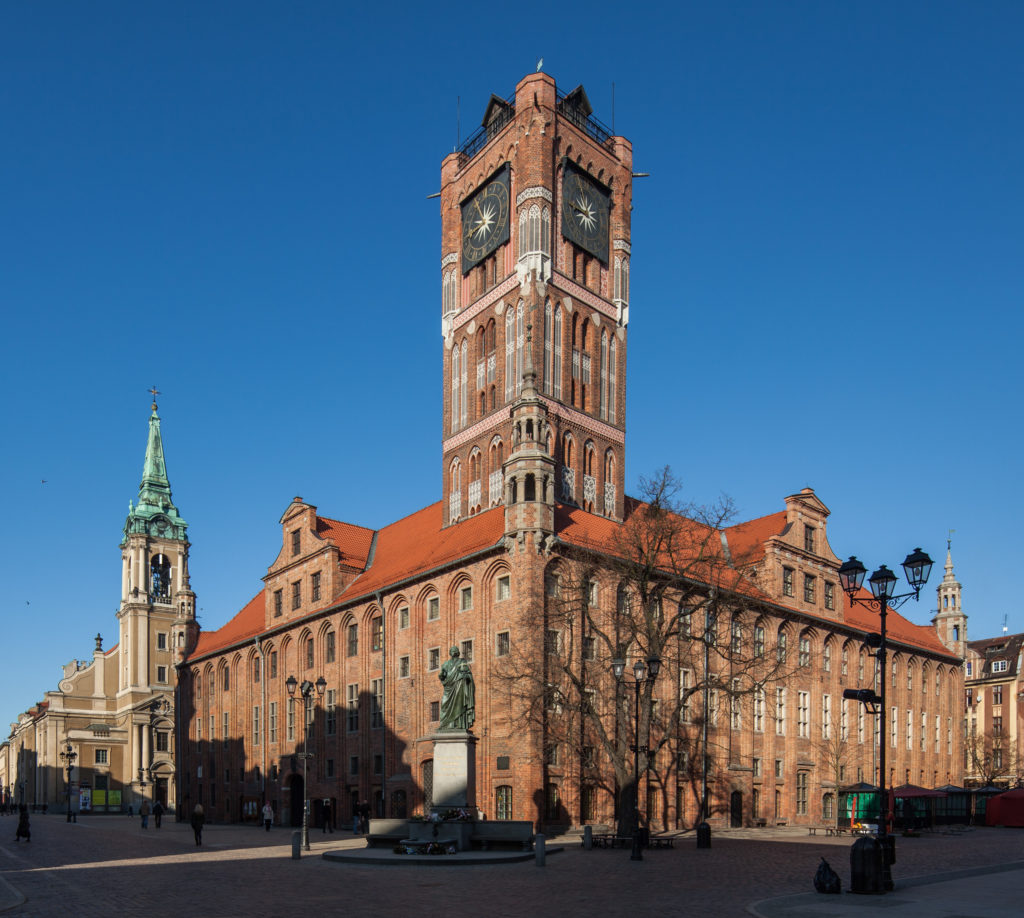
Torun, The Old Town Hall

Visiting Torun

Mark Wegierski, in the land of his ancestors

The venerable Polish city of Torun is located within easy driving distance of Ciechocinek, the spa and resort town at which I was mostly staying, in the summer of 2004. Torun is known especially for its very well preserved medieval Old Town, which includes the historic medieval walls of the city. One of the city’s tourist slogans is “Gotyk na dotyk” which can be loosely translated as – “where the Gothic comes alive.” Staying mostly at Ciechocinek, I was frequently driven in to Torun when my female relative travelled there.

The Main Square of the Old Town is especially lovely, with its magnificent Gothic City Hall, in front of which stands the statue of Nicolaus Copernicus (Mikolaj Kopernik) the famous Polish astronomer who was born in the town in 1473. The house in which he was born still stands, and is now a museum. There is a frequently cited verse in Polish about Nicolaus Copernicus, which, in approximate translation, says: “He stopped the Sun, he moved the Earth, the Polish nation gave him birth.” Copernicus challenged the received ideas of his day (which claimed that the Sun revolved around the Earth), and advanced a carefully elaborated and documented thesis that the Earth moves around the Sun. The Copernican theory is the grounding of all subsequent astronomical science. It’s possible to argue that the atmosphere of reflective tolerance and liberty that existed in Renaissance Poland under the humane Jagiellonian Kings – in marked contrast to most other European countries of that time — contributed to his willingness to enunciate those views. It takes tremendous intellect, courage and fortitude to be among the very first to arrive at and advance highly unconventional opinions, especially those that could result in severe censure and punishment (as seen in the later Trial of Galileo).

Torun also has the very well-regarded Nicolaus Copernicus University (Uniwersytet Mikolaja Kopernika) (UMK). Among the university’s more prominent scholars is Miroslaw Supruniuk, the head of the extensive Polish Emigration Archive (Archiwum Emigracji). The Polish Emigration Archive has, indeed, received a Turzanski Foundation award, for its contributions to documentation of the Polish-Canadian community. The awards of the Turzanski Foundation are the only major literary and cultural prizes of the Polish-Canadian community. They have been instituted as a result of a helpful individual initiative.

There are also some very exclusive shops in the Main Square of Torun and the surrounding cobblestone streets, including an especially elegant boutique mall that has been built into one of the Old Town’s oldest burgher-houses. Also to be recommended is the very finely stocked eMPiK (a magazine, book, and music store) in the Old Town area. In my searching for different Polish popular periodicals, I was guided by the general principle that if a certain publication could not be found in a popular outlet like the eMPiK, then its profile in the country was very low indeed. Nevertheless, I was able to find in that eMPiK a number of periodicals I had never seen or heard of before, such as the Wroclaw-based Opcja na Prawo (The Option on the Right).

The Old Town area also has a mini-multiplex cinema, as well as a fairly good planetarium. There are some prominent antique shops that are full of items that are usually far more interesting than anything to be found in Canada. There are also a number of elegant jewelry stores, and fashion and perfume boutiques, on the streets around the Main Square. Most of those streets are now reserved for pedestrians only, so a highly pleasant and unhurried feeling is created.

As far as dining in the Old Town area of Torun, I could recommend the restaurant of the Gromada hotel (a smaller hotel). I had some very tasty meals there in the Old Polish cuisine style, such as clear beet-soup with meat-filled pastry on the side (barszcz z pasztecikiem), as well as pork cutlets with spicy roasted potatoes and salad on the side.

The town of Nieszawa, which is about 10 kilometers to the south-east of Ciechocinek, is known especially for its church, which dates back to the fifteenth century, and has a unique set of frescoes. At most times of the year, it is a brief, pleasant drive to Nieszawa along a two-lane, properly-paved road surrounded by the green countryside, usually with very little traffic.

I recall a private reception at the Mayor’s ranch-style house in Nieszawa, where I drank champagne and nibbled on canapés, while looking at the Vistula below, and the verdant forests across the river, in the sun of the late afternoon. I had been invited to celebrate the imminent appearance of an article of mine in a smaller U.S. cultural and political affairs magazine in which I had tried to appear for at least fifteen years. I had written the article on the trip on a laptop computer, and submitted it through the Internet. That article about my trip to Poland and Nieszawa had been the breakthrough piece for me with that magazine.

Mark Wegierski was born in Toronto of Polish immigrant parents


Posted in Cultural Matters, QR Home | Tagged , , , | Leave a comment

Ask Bush why the Iraqi Military won’t fight

Sniper, Iran-Iraq War

Sniper, Iran-Iraq War

Ask Bush why the Iraqi Military won’t fight

The fall of Ramadi – Ilana Mercer apportions blame

It’s quite a surprise that John McCain did not rise on his hind legs when he got wind of what U.S. Defense Secretary Ashton Carter had said on the Memorial Day week-end. It was just the thing to make the War Party irate–even more so than the Iraqi prime minister was. (Who is he these days? Ah: Haider al-AbadiIt.)

Defense Secretary Carter’s quip was a no-brainer, really. Observations such as his were routine when Bush 43 began swinging the wrecking ball in Iraq. The War Party line, however, is to continue duping its ditto-heads into believing that the sorry state of Iraq began with Bush’s successor, President Barack Obama.

Said Carter: “The rout of Iraqi forces at the city of Ramadi showed they lacked the will to fight against the Islamic State. … They chose to withdraw. … What apparently happened is the Iraqi forces just showed no will to fight. … They were not outnumbered. In fact, they vastly outnumbered the opposing force. We can give them training, we can give them equipment – we obviously can’t give them the will to fight.”

ISIS captured Ramadi, the capital of the Anbar province, in early May.

The ineptness of the reconstituted Iraqi Army is nothing new. In 2006, then-Sen. Hillary Clinton demanded to know when the “Iraqi government and the Iraqi Army would step up to the task.” “I have heard over and over again, that the government must do this, the Iraqi Army must do that,” griped Clinton to Gen. John P. Abizaid, then top American military commander in the Middle East. “Can you offer us more than the hope that the Iraqi government and the Iraqi Army will step up to the task?”

Indeed, the War Party is in the habit of thrashing about in an ahistorical void—or creating its own reality, as warbot Karl Rove, George Bush’s muse, is notorious for saying. The neoconservative creed as disgorged by Rove deserves repeating:

“We’re an empire now, and when we act, we create our own reality. And while you’re studying that reality—judiciously, as you will—we’ll act again, creating other new realities, which you can study too, and that’s how things will sort out. We’re history’s actors … and you, all of you, will be left to just study what we do.”

The lowly “you” Rove reserved for “the reality-based community” (guilty).

Curiously, a military that has done nothing but flee before the opposition ever since the Americans commandeered Iraq, had fought and won a protracted war against Iran, under Saddam Hussein. The thing we currently call the Iraqi military has been unable and unwilling to fight the wars America commands it to fight.

Why?

For one, Bush’s envoy to Iraq, Paul Bremer, made the decision to dissolve the Iraqi Army and civil service, early in 2003, with the blessing of Bush at whose pleasure Bremer served. Bush’s minions viewed the dissolution of the Iraqi Army as part of the “De-Ba’thification” process.

Not the least of the difficulties, as DEBKAfile has observed, is that many in the Arab world see the battle with the Islamic State “not as an Arab but as a U.S.-European war. This line resonates widely in the other Arab countries aligned with the coalition.” It goes a long way in explaining the lackluster participation of the Emiratis, Saudi Arabia and Bahrain in the coalition against ISIS. In fact, the involvement by Amman turned out to be more symbolic than substantive, too.

Having grown up in Israel, I confess to harboring a bias about the mettle of the Arab fighting force, raised as I was on images of army boots piled up high in the Sinai desert, where in 1967, Egyptians (who had actually fought bravely) shed those shoes and fled before the IDF (Israel Defense Forces). Al-Qaida and ISIS reversed these biases; they’re fierce, disciplined fighters. Ditto the Iranian Revolutionary Guard, now leading the Shiite militias in the battle against ISIS.

Yes, let the locals take out their trash. Let regional players take care of ISIS. Army Gen. Martin Dempsey, chairman of the Joint Chiefs of Staff, seemed to second the sentiment. He thinks Iran’s involvement “could turn out to be ‘a positive thing.’”

But not if Chucky Krauthammer can help it. The influential neoconservative commentator was decidedly unhappy about Jordan’s initial and fleeting enthusiasm for the battle. The consensus in the U.S., as reflected by Chucky, is that only Muslims approved by the world superpower (the U.S.) and the region’s superpower (Israel) are fit to fight ISIS.

Another dynamic is at play in the region besides the Sunni-Shia divide. It is that between the forces of centralization and the forces of decentralization. As a rule, the U.S. sides with the former; the Arab people with whom we meddle generally side with the latter. Given the tribal, familial focus of their societies; Arabs are unlikely to abandon their particularism in favor of American statism.

Take the Houthi rebels of Yemen. Like the Kurds of Iraq, they are demanding greater regional autonomy. Alas, the U.S. is looking to empower another puppet central power like former Yemeni president Abed Rabbo Mansour Hadi, the better to lord it over its Yemeni client state. And never mind that the Houthis are fighting against al Qaeda in the Arabian Peninsula, whom we revile as well.

In the words of Sir Walter Scott, “Oh what a tangled web we weave when first we practice to deceive.”

Ilana Mercer is a paleolibertarian writer, based in the U.S. She is a fellow at the Jerusalem Institute for Market Studies. Her latest book is “Into the Cannibal’s Pot: Lessons For America From Post-Apartheid South Africa.” Her website is www.IlanaMercer.com. Follow her on Twitter. “Friend” her on Facebook.


Posted in Current Affairs and Comment, QR Home | Tagged , , , , , | Leave a comment

REPLAY: A Scanner Darkly

A Scanner Darkly

REPLAY: A Scanner Darkly

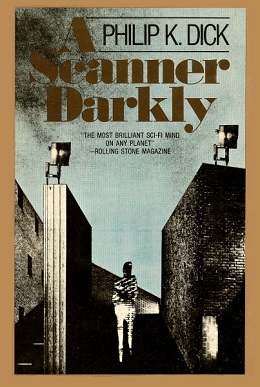
A Scanner Darkly, 100 minutes, 2006, directed by Richard Linklater, script by Richard Linklater, based on the 1977 novel by Philip K. Dick. Cast: Keanu Reeves (Fred/Bob Arctor), Winona Ryder (Donna Hawthorne), Rory Cochrane (Freck), Robert Downey, Jr. (Barris), Woody Harrelson (Luckman)

Review by Mark Wegierski

It should be stated at the outset that this is a recently animated-over version of a live-action movie or television special that was almost certainly released quite a few years ago. A number of scenes in the movie (especially the end-scene) seemed instantly familiar to the reviewer. That one of the central tropes of the movie is the U.S. Government’s “War on Drugs” would point to its earlier provenance. One could suppose the attempt to portray the film as “new” is a sort of “Phildickian” joke on the audience, supported by the film’s publicity efforts, which many major media outlets and websites have been going along with.

Philip K. Dick (1928-1982) was one of the most prolific and interesting American science fiction writers, and a number of his novels and short stories have been turned into big-budget Hollywood movies, most prominently, Blade Runner (based on his 1968 novel, Do Androids Dream of Electric Sheep?). Blade Runner (1982) directed by Ridley Scott, is one of the greatest science fiction movies ever made. Against the backdrop of an ecologically-wasted, future Los Angeles cityscape of almost perpetual black rain, a down-on-his-luck policeman has to take one last assignment to eliminate an escaped group of “replicants”, biological constructs who look like humans but have superior physical powers and intelligence, and whose built-in lifespan is four years. As he wanders through the hypermodern wasteland to carry out his grisly assignment, significant questions are raised about what constitutes the human and the natural in an environment where life can be artificially created, and nature has virtually disappeared from the Earth. Continue reading

Posted in Film Reviews, QR Home | Tagged , , , , | 7 Comments

Iraq Liars & Deniers: we knew then what we know now

Bush_and_Blair_at_Camp_David

Iraq Liars & Deniers:
we knew then what we know now

Ilana Mercer is vindicated by history

“If we knew what we know today, we would not have gone into Iraq”: This is as good an apology Republicans vying for the highest office are willing to offer, 12 years after launching a war that was immoral and unjust from the inception, as some of us pointed out from the inception, cost trillions in treasure, tens of thousands of lives (American and Iraqi), and flouted America’s national interests.

The big reveal began with Jeb Bush, who told anchor Megyn Kelly that knowing what we know now about Iraq, he would absolutely still have invaded Iraq. Broadcaster Laura Ingraham was having none of it. With the benefit of hindsight, she had arrived at the belated conclusion that the invasion was wrong. Ingraham suggested that Bush III was insane for sticking to his guns about Iraq.

Next to disgrace was Sen. Marco Rubio, also in the running. Six weeks back, Rubio had been unrepentant about the catastrophic invasion. After The Shaming of Jeb, Rubio changed his tune.

The title of Judith Chalabi Miller’s “rehab book tour” is, “If we knew what we now know ….” Over the pages of the New York Times, Miller, the Gray Lady’s prized reporter had shilled for the Iraq war like there was no tomorrow. In her reporting, she channeled Ahmad Chalabi, an Iraqi conman who fed Miller with misinformation and lies about Iraqi weapons of mass destruction (WMD). The other conman was Bush II, president at the time. His administration assisted Miller—a woman already prone to seeing faces in the clouds—to tune-out and become turned-on and hot for war (also the title of a January 2003 “Return to Reason” column). No tale was too tall for our Judith; no fabrication too fantastic.

Miller’s “mistakes,” and those of America’s news cartel, are no laughing matter. But it took a Comedy Central icon to deconstruct her national bid for redemption. The fact that others were on board, Republicans and Democrats, is not exculpatory. Idiocy is bipartisan. Not everybody got it wrong. Miller and her ilk chose not to consult those who got it right.

Miller had company. The Fox News war harpies were certainly a dream come true for many American men. Who cared about honest reporting or basic fact-checking when a heaving bosom is yelling from the screen, “Sock it to Saddam, Dubya!”?

In any event, the meme, “If we knew what we know now, we would not have gone to war in Iraq,” is false; a lie. We most certainly knew what we know now as far back as 2002, which was when this column wrote:

Iraq is a secular dictatorship profoundly at odds with Islamic fundamentalism. No less an authority than the former head of the CIA’s counterterrorism office, Vincent Cannistraro, stated categorically that there was no evidence of Iraq’s links to al-Qaeda. Even the putative Prague meeting between Mohamed Atta, the ringleader of Sept. 11, and Iraqi intelligence, turned out to be bogus. … Iraq has been 95-percent disarmed and has no weapons of mass destruction, an assessment backed by many experts in strategic studies.

The column excerpted was published on September 19, 2002 in Canada’s national newspaper. On that day, the flirty notes and the gracious dinner invitations from America’s leading neoconservatives ceased.

Indeed, there were many experts, credible ones, who categorically rejected the contention that there were WMD in Iraq. But they were silenced; shut out by the media—the Hannitys, the Millers, the dissidents, their handlers and their followers—none of whom should be allowed to deflect from the intellectual and moral corruption it took to invade a Third World country whose military prowess was a fifth of what it was when hobbled during the Gulf War, which had no navy or air force and was no threat to American national security.

Eleven years ago, “What WMD”, courtesy of WND, documented the same old verities. No, not everyone was bullish about the Bush administration’s WMD balderdash. The International Atomic Energy Agency’s Dr. Mohammed ElBaradei told the U.N. Security Council before the war: There were no nuclear-designated aluminum tubes in Iraq; no uranium was imported, and no nuclear programs were in existence. Between 1991 and 1998, the IAEA had managed to strip Iraq of its fuel-enriching facilities, tallying inventories to a T. In David Kay’s late-in-the-day assessment, “Iraq’s large-scale capability to produce and fill new chemical weapons (CW) munitions was reduced, if not entirely destroyed, during Operation Desert Storm and Desert Fox and 13 years of U.N. sanctions and U.N. inspections.” Kay was the former top U.S. weapons inspector who endeared himself to the media as an invasion enthusiast.

According to the Carnegie Endowment for International Peace (CEIP), Congress in 1999 was privy to intelligence reports which similarly attested to a lack of “any direct evidence that Iraq has used the period since Desert Fox (1998) to reconstitute its WMD program.” Accounts of this nature had evidently been available to Congress for years. These reiterated, as one report from the Defense Intelligence Agency did, that, “A substantial amount of Iraq’s chemical warfare agents, precursors, munitions, and production equipment were destroyed between 1991 and 1998.”

“Kay’s news ought not to have been new to the blithering boobs in Congress,” I observed in 2004. The CEIP further bears out that in October of 2002, Congress was apprised of a National Intelligence Estimate, a declassified version of which was released only after the war. Apparently, entire intelligence agencies disputed key contentions that the administration—its experts, and its congressional and media backers—seized on and ran with.

While clearly pandering to policy makers, U.S. intelligence reports were still heavily qualified by conjectural expressions such as, “We believe Iraq could, might, possibly, and probably will.” The State Department and the White House, however, cultivated a custom of issuing Top Secret “fact” sheets with definitive statements from which all traces of uncertainty had been expunged.

Having categorically denied she possessed the analytical wherewithal to connect the dazzlingly close dots between terrorism and Arab men practicing their aeronautical take-off skills stateside—Condoleezza Rice was suddenly doing nothing but connecting disparate dots. She, Powell, Rumsfeld, Cheney and Bush never stopped lying about a reconstituted Iraqi nuclear-weapons program, chemical and biological blights, Scuds and squadrons of unmanned aerial vehicles streaking U.S. skies, and traveling laboratories teeming with twisted scientists. The language they deployed ignored the deep dissent in the intelligence community.

All the above information addressing pre-war knowledge has been culled from WND’s early, “Return to Reason” columns.

In 2003, “Bush’s 16 Words Miss the Big Picture” beseeched our readers to “see Bush’s sub-intelligent case for war for what it was”:

The administration’s war wasn’t about a few pieces that did not gel in an otherwise coherent framework, it wasn’t about an Iraq that was poised to attack the U.S. with germs and chemicals rather than with nukes—it was about a resigned, hungry, economic pariah that was a sitting duck for the power-hungry American colossus.

By all means, the column implored, “dissect and analyze what, in September 2002 I called the “lattice of lies leveled at Iraq: the uranium from Africa, the aluminum tubes from Timbuktu, the invisible meetings with al-Qaida in Prague, an al-Qaida training camp that existed under Kurdish—not Iraqi—control, as well as the alleged weaponized chemical and biological stockpiles and their attendant delivery systems that inspectors doubted were there and which never materialized.”

“But then assemble the pieces and synthesize the information, will you?”

“Rationalize with Lies,” moreover, dealt a blow to the creative post hoc arguments made to justify the unnecessary war the United States waged on a sovereign nation that had not attacked us, was no threat to us and was certainly no match for us. The argument:

“To say that Saddam may have had WMD is quite different from advocating war based on those assumptions. It’s one thing to assume in error; it’s quite another to launch a war in which tens of thousands would die based on mere assumptions, however widely shared. It was not the anti-war-on-Iraq camp that intended to launch a war based on the sketchy information it had. The crucial difference between the Bush camp and its opponents lies in the actions the former took.”

Second, it matters a great deal when during the last decade someone said Saddam was in possession of impermissible weapons. To have said so in 1991 is not the same as saying so in 2003, by which time Iraq had so obviously been cowed into compliance and was crawling with inspectors.

Naturally, at certain times during Iraq’s belligerent history, opponents of this war would have agreed Hussein had a weapons program. But by 1998, sensible people realized that Operation Desert Storm, followed by seven years of inspections, made the possibility of reconstituting such a program remote. President Jacques Chirac said as much to both Bush and Blair, who pretended not to hear.

To arrive at the correct conclusions about Bush’s undeniable delirium for war, it was necessary to employ facts and reality, Just War Theory developed by great Christian minds like St. Thomas Aquinas and St. Augustine, the libertarian axiom which prohibits aggression against non-aggressors, the natural law and what the Founding Fathers provided:

“A limited, constitutional republican government, by definition, doesn’t, cannot and must never pursue what Bush and his neoconservatives were after: a sort of 21st-century Manifest Destiny.”

Republicans are still fond of presenting their opponents with the following false choice: “But what would you have done about Iraq?” they are in the habit of asking me. The assertion is intended to make you assume incorrectly that something had to be done about Iraq. However, “The burden of proof is on he who proposes the existence of something like WMD, not on he who claims that it does not exist.” That line was penned 12 years ago.

In the early days, Iraq had provided “documentary intelligence from Naji Sabri, Saddam’s foreign minister, that Saddam did not have WMD.” I recall the derision and mockery with which the Bush administration and its hangers-on greeted what turned out to be the only truthful document in the sad saga of Iraq.

ILANA Mercer is a US-based, libertarian writer. She pens WND’s longest-standing, exclusive, paleolibertarian weekly column, “Return to Reason.” With a unique audience of 8 million, the site has been rated by Alexa as the most frequented “conservative” site on the Internet. Ilana has also featured on RT with the “Paleolibertarian Column,” and she contributes to Economic Policy Journal (the premier libertarian site on the web), Junge Freiheit, a German weekly of excellence, as well as to the British Libertarian Alliance and Quarterly Review (the celebrated British journal founded in 1809 by Walter Scott, Robert Southey and George Canning), where she is also contributing editor. Formerly syndicated by Creators Syndicate, Ilana is a fellow at the Jerusalem Institute for Market Studies (an award-winning, independent, non-profit, free-market economic policy think tank).


Posted in Current Affairs and Comment, QR Home | Tagged , , , | Leave a comment

Timbrell’s Yard, Bradford-on-Avon

Bradford-on-Avon

Bradford-on-Avon

Timbrell’s Yard
Bradford-on-Avon

Timbrell’s Yard is centrally located in busy and beautiful Bradford-on Avon, just by the river in one of the fine old buildings with cream coloured stone and appealingly wonky angles. The fact that the whole building leans back like an elderly gentleman relaxing into a favourite armchair adds to its charm. Inside we found a mixture of traditional and modern, with much use made of natural materials – lots of bare wood and stone – while distressed furniture, metal and industrial-style lighting add a contemporary spin. One enters through a flagstoned courtyard (nicely delineated with low barriers formed of railway sleepers – an idiosyncratic touch) full of tables of patrons lazily enjoying drinks, and so to the buzzing bar.

We found it a little difficult to find someone to take us through to the restaurant and thus our table, but once we had located a member of staff he could not have been more affable – an attribute which all the staff shared. Every waiter we encountered was extremely friendly and helpful whilst also being polite and professional, with only their rather informal dress (jeans and t-shirts) and worrying tendency to call us “guys” to detract (do we look like extremely combustible straw-filled dummies?). Rather incongruously, it was the slightly hippy-looking sommelier, whose looks and long locks intimated a more laid-back and casual attitude, who addressed us more correctly as “Sir” and “Madam”. Our waiter, though young, was excellent. He asked for feedback on the new item on the menu (the lamb) and duly passed it back to the kitchen. He also forgot about Tristan’s fish and when we reminded him apologised so profusely that we ended up apologising for reminding him. I think it’s the first time I’ve ever heard a waiter say “It’s entirely my fault”. Impressive.

The informal air is continued through to the tables, which are undressed, with no tablecloth, just a single candle in a basic candleholder and the correct glasses and cutlery. The wooden chairs are mismatched between the tables, giving an air of slightly studied casualness. Lighting is provided by a large ceiling light, somewhat industrial in tone; and the walls a light-ish honeyed grey, with the railway sleepers in the courtyard echoed in the vertical, slightly rough wooden panelling.

We found the fact that there was no music incredibly refreshing. In fact, a rather attractive light jazz was playing in the lavatories, which would have been pleasant in the restaurant as well, but the lack of popular music was an absolute joy and showed a confidence in the establishment and the pleasures offered by the food and drink. In fact, the only negative point of a “comfort” nature arose from the fact that whether by some vagary of airflow from the front door or because of (slight) leakage round the edges of the single glazing, wafts of cigarette smoke found their way from time to time into the restaurant: singularly unpleasant to non-smoking diners, and especially those concerned that their young children aren’t subjected to health-damaging fumes.

Timbrell's Yard

The menu itself isn’t too extensive (a too-long menu is always a dangerous sign), yet still offers a good range of options, with starters broken into three sections of three items – “little things”, ”small plates and starters” and salads – the latter as either starter or main sizes. There are then a good range of nine main course choices, with a focus on meat but with some fresh fish and also more-interesting-than-usual vegetarian options. The sides all sounded extremely homely, comforting and tempting. The back of the menu lists suppliers – all very local, with meat from Bristol, fish from Poole, vegetables from Wiltshire and organic dairy products from near Frome. Bread and cakes are from Bath’s famed Bertinet Bakery, and Timbrell’s Yard make their own ice-creams; honey and most dry goods are local, while others are fair-trade. This all seemed jolly impressive, even before we tasted the goods on offer.

The wine list, on the other hand, was just slightly disappointing in that it doesn’t offer descriptions so appears rather basic, and although there are a reasonable number of red and white choices it would have been nice to see, for example, Gewurztraminer or some slightly more unusual grape varieties or locations.

We went for a bottle of Bogle Zinfandel, which was beautifully rich and powerful; dark purple in colour, with deep, ripe black berry fruits on the nose and a dark, suave and sophisticated taste of forests, with a tiny hint of sweetness tempering the blackness. A gorgeous wine that went very well with our food.

For starters both my husband and I went for one of the light bite options. My cauliflower and smoked Dorset red croquettes were excellent; with a spicy bite (I detected the inclusion of chilli), and a very strongly cheesy smoked flavour, these were gorgeously fluffy and light on the inside and beautifully crunchy on the outside with a perfectly-done breadcrumbed exterior. They were served with a creamy mayonnaise which was needed to cut through the salty smokiness and worked extremely well. Mr Marshall-Luck’s venison chipolatas were richly and darkly flavoured and, although they were not numerous, their intensity rendered the whole very satisfying, whilst leaving plenty of room for the steak to follow. The accompanying mushroom ketchup could have answered the venison more in piquancy, but was nevertheless well textured.

The following steak was superbly flavoured and cooked: some might find it a little on the fatty side but we found that this enhanced the flavour. Not only was it a generously sized steak, especially for the price and the cut, but it was accompanied by hand-cut chips – deliciously crunchy on the outside; melting within – and a simple rocket salad, which complemented the other items perfectly, being slightly peppery in flavour, and therefore holding its own against the steak, whilst in no sense overpowering it.

My lamb, cooked with pearl barley and spinach, was the only slightly disappointing dish: the meat was not particularly flavoursome, and the texture could have been firmer and more cohesive. The pearl barley was fine, but didn’t particularly help to lend flavour, and there could have been more presence in the spinach, too. Overall, we felt a little more work was needed on this dish.

Tristan, though still only a year old, nevertheless had the fillet of sea bream from the children’s menu. This came (served with rocket and a few chips) beautifully fresh and unadulterated by breadcrumbs (a pleasing touch), and was wolfed down with the greatest of relish.

We followed the main with a cheese course – one has a choice of two out of five English cheeses. We opted for the White Lady from Glastonbury and the Dorset Blue Vinny. The White Lady was the perfect goats’ cheese – a soft, creamy cheese coated in ash and with a delicate flavour and just slightly crumbling texture. I could have sat and eaten it all evening! The Blue Vinny was also excellent – a soft, creamy cheese with a piquant bite; these two were complemented by a deliciously fruity apple chutney, thinly sliced apple and celery, all of which, together with the accompanying savoury biscuits, made for a very satisfying course.

I couldn’t resist a glass of the Noble Wrinkled from Australia – a beautifully golden colour, sublime nose of fat, sun-drenched sultanas and a slightly dark, very rich and honeyed taste of citrus fruits tempered by lashings of honey and nectar. It worked beautifully both with the cheeses and with the following dessert. This, the chocolate and sea-salt caramel tart, was very well done, except that (an all-too-frequent complaint in British restaurants) the pastry was a little on the tough side. The chocolate, however, resisted the temptation to be too sweet and the sea salt brought out the flavour well. It was accompanied by extremely sticky honeycomb; a tried-and-tested combination with chocolate which brought an extra dimension to the dessert. The ice-cream, with a slight lemon flavour, was a little more incongruous but by no means unpleasant.

We also ordered a vanilla panacotta for Tristan. I cannot comment on this, as Tristan ate every last morsel, including with the very (and naturally) sweet rhubarb that it came with –but I think we can take this as a definite sign of approval.

We finished with tea and coffee and even this impressed. Tea was Clipper’s organic English Breakfast and very good it was too, whilst the coffee tended more towards the Germanic / Austrian end of the beverage – that is to say that it met my husband’s extremely high expectations, in being actually drinkable by him and not something that could pass for tepid dishwater. No petits fours – but, to be honest, these weren’t necessary and perhaps would have been slightly incongruous in the setting and with respect to the tone of the meal.

By the end of the meal we had managed to stay a good couple of hours later than intended (making for a relaxed evening of a good four-odd hours) – but we were never made to feel that we had out-stayed our welcome; it ended being one of the most enjoyable review meals we’d had for some time. Warmly recommended.

Em Marshall-Luck is QR’s Restaurant and Wine Critic

Posted in EpiQR, QR Home | Tagged , , | Leave a comment