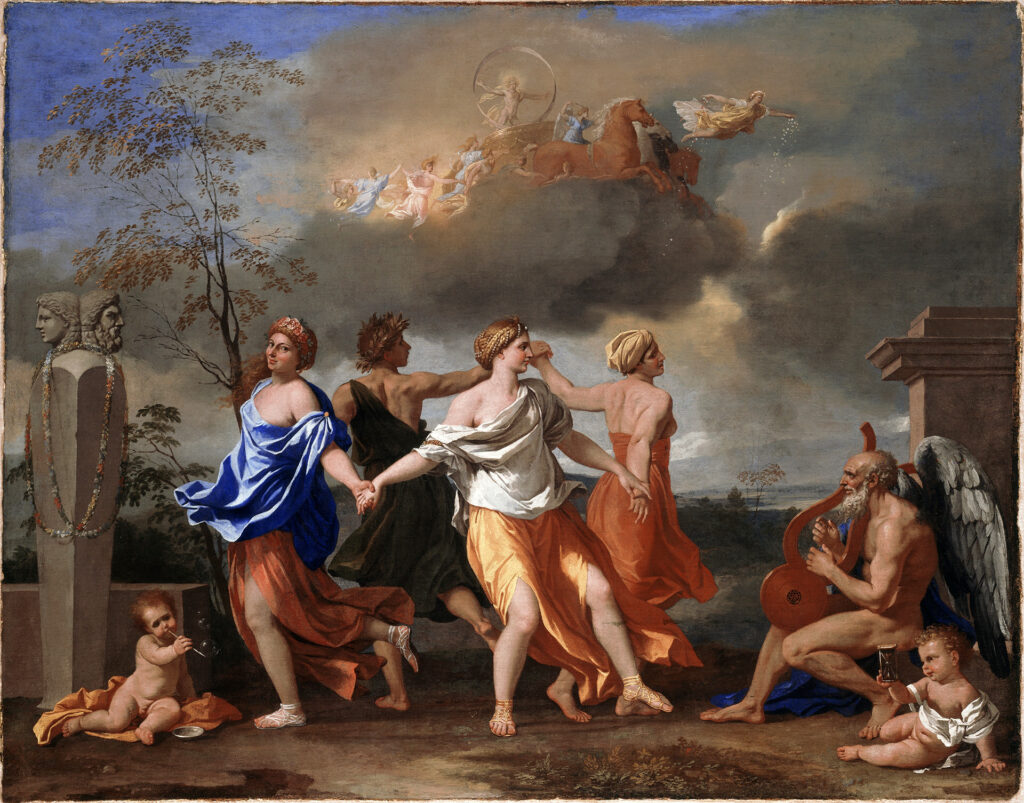
The Dance to the Music of Time, Poussin c. 1640, credit Wikipedia
Two Tribes, Part 2
By Mark Wegierski
Many of Canada’s problems derive from the fact that the country consists of “two nations warring in the bosom of a single state”, to quote from Lord Durham’s famous Report of 1840. The “two nations” are, of course, English-speaking and French-speaking Canada. Oft times, English-speaking Canada tried to pretend that Québec simply did not exist; then it moved, probably too late, into a stance of extreme accommodation; and finally, when English-speaking Canada became ideologically liberal, it moved to oppose Québec in the name of so-called universal rights, and in view of Québec’s “illiberalism”.
In an attempt to have Québec accede to the new Canadian Constitution, Prime Minister Brian Mulroney negotiated the Meech Lake Accord in 1987. A strange kind of fury seized English Canada, in opposition to the legal recognition of Québec as “a distinct society”, albeit an obvious historical and social reality but a blow to absolute individual rights, as well as to the notion that so-called “group rights” are normally afforded only to visible minorities (a term of official usage), as well as to Aboriginal peoples in Canada. The Accord failed in 1990, when it was rejected by the recalcitrant legislatures of two smaller English-Canadian provinces. Continue reading






Imagination – it’s an Illusion
Archbishop of Canterbury
Imagination – it’s an Illusion
Reimagining Britain: Foundations for Hope, Justin Welby, Bloomsbury Continuum, 2018, 300pp. Hardback, £16.99., reviewed by EDWARD DUTTON
The Rev. Dr Malcolm Johnson, Rector of St Botolph’s, Aldgate, once remarked, ‘I see the Church of England as an elderly maiden aunt. Most of the time you’d like to strangle her, but she comes into her own at Christmas and Easter and she’s there when you want her’ (quoted Caroline Chartres, 2007, Why I Am Still Anglican, Bloomsbury, p.104). Dr Johnson’s metaphor piquantly summarises the feelings that many English people have (or used to have) about the Anglican Church: she’s eccentric, unworldly, embarrassed about sex . . . but, deep down, she’s loving, reliable, and she holds the English family together at times of crisis. She reaches back, beyond living memory, into English history – perhaps her fiancé was killed at the Somme – into rituals our ancestors did, something vaguely eternal and ineffable. Somehow, with her, all will be well in the end.
It is, therefore, fascinating to a read a book by an Archbishop of Canterbury, the incumbent the Most Rev. Justin Welby, which reflects the way in which a very different model has taken over the Church of England. The elderly maiden aunt is, alas, a bit too old-fashioned for the new head of the clan, because he – like so many in senior clerical positions – is essentially a Multiculturalist in a mitre. The ideology of Multiculturalism traces its ideological roots to Marxism, wherein ‘the revolution is eternal’ and History unfolds according to the Hegelian Dialectic. There is always a ‘Spirit of the Age’. Whereas the elderly maiden aunt represented something eternal and unchanging, Mr Welby embodies this chaotic Zeitgeist. Continue reading →
Share this:
Like this: