Escape to the Country

Darlington Cattle Market

Escape to the Country

by Bill Hartley

There is elation in the town of Darlington because the local cattle market may be moving. Darlington might be best known as an old railway town but its roots lie in agriculture, serving both County Durham and North Yorkshire. The cattle market has been there for 140 years, longer than the houses which now neighbour the site. Admittedly on market days it is a smelly and noisy place, difficult for lorry drivers to get into from the narrow streets nearby and there may be a good argument for getting it out to a more accessible location. Everyone in officialdom, from the town’s MP to the local council, seems to think so and media reports reflect this, with, it would seem, no dissenting voices.

That said, a link to the agricultural life which surrounds the town will be lost. Interestingly, no-one seems to have considered the economic impact. For example, farmers may have other business to conduct in the town and spouses can travel with them in order to shop. Arguably the council should have considered this since Darlington is a town which has recently lost its Marks & Spencer and the House of Fraser store is under threat. In terms of retailing, the only visible growth is the number of coffee shops. Continue reading

Posted in Current Affairs and Comment, QR Home | Tagged , , , | 2 Comments

Calvinism for Agnostics

Westminster Cathedral

Calvinism for Agnostics

Messa da Requiem, music by Giuseppe Verdi, concert performance, Royal Opera Orchestra and Chorus, conductor Antonio Pappano, words from the Missa pro Defunctis, Royal Opera, 23rd October 2018

Verdi Requiem, Orchestra Révolutionnaire et Romantique, Monteverdi Choir, conductor John Eliot Gardiner, Westminster Cathedral, 18th September 2018

Reviewed by Leslie Jones

According to Nietzsche, Richard Wagner, in his dotage, fell snivelling at the foot of the cross. The same could hardly be said of Verdi, who never went to church once during his adult life. His Requiem, as Marin Alsop has observed, “…is a mass written by an agnostic”

The prospect of death, for an unbeliever, may be more terrifying than for a devout Christian, hell fire notwithstanding. In “A Powerful Expression of Life”, David Cairns calls Verdi’s Requiem “…the passionate protest of a man who rebels against the outrage that is death” (Official Programme, Westminster Cathedral). The final words of the Libera Me, sung by the soprano, are “Deliver me, Lord, from eternal death, on that dreadful day”. The soprano “is left stripped of any armour that religion might provide…there is no salvation at all but only eternal silence” (Peter Gutsman, Classical Notes, 2009). The last bars, appropriately, are marked morendo or dying away. Continue reading

Posted in Cultural Matters, QR Home | Tagged , , , , , | Leave a comment

The Euro FifthColumn

Carleton Martello Tower

The Euro Fifth Column

By Stuart Millson

With five months to go before our country disengages from the EU, a millionaire-funded, pro-Brussels movement is obstructing the democratic Brexit process.

With the ratification of the EU Withdrawal Act by Parliament earlier this year, Britain is now on course to leave the European Union at the end of March 2019 – a sea-change in modern political history brought about by the 17.4 million-strong Leave vote at the June 2016 referendum. And yet, despite Parliament originally devolving the decision on EU membership to the electorate, the Brexit process appears – to most everyday observers – a tedious stalemate: an endless to-and-fro exchange between the elected British Government, and the unelected leaders of the European Union on matters such as customs arrangements and the future of the Irish “soft” border; persistent calls from the defeated Remain side for a second referendum (variously) on the final Brexit deal or a complete re-run of June 2016; and the sympathetic parading on TV of the extraordinarily well-funded leaders of the anti-Brexit side.

Their Euro-banners flying at street demonstrations, and their spokespeople crowding the airwaves with the mantra that the people “didn’t know what they were voting for” or that post-Brexit Britain is heading for economic oblivion, the Remainers have emerged as a dedicated political “fifth-column” standing for the interests of the European superstate. And yet this group, despite its puffed-up prominence across the TV and social media, constitutes but a tiny minority of opinion: their many thousands of marchers a mere drop in the ocean when matched against the 17.4 million Britons who backed Brexit. Continue reading

Posted in Current Affairs and Comment, QR Home | Tagged , , | 14 Comments

The Caravan Cometh

San Salvador, gang member is handcuffed

The Caravan Cometh

By Ilana Mercer

The latest “caravan” community planning to crash borderless America is not part of Latin America’s problems; it’s escaping them. So say America’s low-IQ media.

And Latin America’s problems are legion.

The region, “which boasts just eight percent of the world’s population, accounts for 38 percent of its criminal killing.” Last year, the “butcher’s bill … came to around 140,000 people … more than have been lost in wars around the world in almost all of the years this century. And the crime is becoming ever more common.”

So writes The Economist earlier this year, in an exposé aimed at “shining light on Latin America’s homicide epidemic.”

As is generally the case with this august magazine, the shoe-leather journalism is high-IQ, but the deductions drawn therefrom positively retarded. Continue reading

Posted in Current Affairs and Comment, QR Home | Tagged , , , | 1 Comment

Rise of the Dominacrats

Rise of the Dominacrats

By Ilana Mercer

Throughout Brett Kavanaugh’s ordeal, Democratic women and their house-trained houseboys had attempted to derail the decent part of the process, rendering a U.S. Senate Supreme Court confirmation hearing a mean-spirited, undignified and gossipy affair.

In tenor, the Kavanaugh confirmation hearing resembled a tabloid, a woman’s magazine, or the female-dominated, Trump-watch panels, assembled daily by the Fake News networks.

As to the women folk in the Gallery: they were plain gaga. These libertine “ladies” appeared constitutionally incapable of abiding by standards of decency and decorum, as demanded in such a solemn setting.

Thank our lucky stars that Democratic distaff are not yet disrobing, as do their Russian heroines:

Pussy Riot, the Putin-hating, all-girl pop band, specializes in desecrating holyplaces and flashing holey places. Continue reading

Posted in Current Affairs and Comment, QR Home | Tagged , , | 3 Comments

ENDNOTES, October 2018

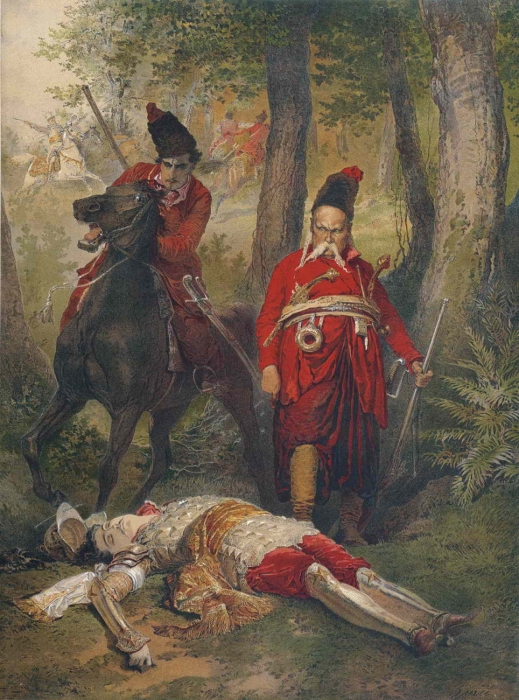
Taras Bulba by M.Zichy

ENDNOTES, October 2018

In this edition: Janacek from Decca, reviewed by Stuart Millson;
Bruckner, Wagner & Schoenberg, Royal Festival Hall, Southbank Centre, 30thSeptember 2018, Philharmonia Orchestra conducted by Esa-Pekka Salonen, reviewed by Leslie Jones

The late-19th/early 20th-century Moravian-born Czech composer, Leos Janacek (1854-1928) was a phenomenon in music. He seemed to follow no school or particular style; he wrote no symphonies, although he excelled in opera –Jenůfa, The Cunning Little Vixen, The Excursions of Mr. Brouček  – which took the hero to the moon. He saw himself as an artist in a new age for his people and homeland, and yet his work resounded with echoes of a noble past from lost centuries.

In a newly-issued recording from Decca – a further tribute to the last years of maestro and Czech music champion, Jiří Bělohlávek – three major works and one lesser-known offering of Janacek are presented: the 1926 Glagolitic Mass (Glagolitic – an ancient script of the ancestral Czech race); the rhapsody, Taras Bulba, a tense, three-movement symphonic poem about a Cossack warlord; and the life-affirming orchestral sequence – famous for its blazing massed-brass, the Sinfonietta. The last work on the disc – The Fiddler’s Child– shows how close Janacek was to the folkloric tradition of his native lands – and this is a work which shows some connection with the world of Antonin Dvorak, famous for his own symphonic pieces – such as The Noonday Witch– which came from local tales. Continue reading

Posted in Cultural Matters, ENDNOTES:Music, QR Home | Tagged , , , , , | 1 Comment

Behold, Fake History

Charles Lindbergh, advocate of America First

Behold, Fake History

Behold, America: A History of America First and the American Dream, Sarah Churchwell, Bloomsbury Publishing, 2018, £20, 356 pp., h.b., reviewed by Leslie Jones

According to Sarah Churchwell, Professor of American Literature in the School of Advanced Studies of the University of London, the American dream once denoted the principles of liberty, justice and economic equality, of curbing unbridled capitalism, as in the Progressive Era and the New Deal. It was about idealism v materialism, “about how to stop bad multimillionaires, not how to become one”.[i] These dubious contentions, an implicit criticism of President Trump, recur like a broken record throughout Behold, America. According to Churchwell, a naïve, self-styled social democrat, the concept was subsequently hollowed out and it now means rags to riches, the so-called “Alger ethic’. Needless to say, she fails to explain how liberty can be reconciled with equality without resorting to tyranny.

Historian Richard Hofstadter’s Anti-Intellectualism in American Life (1963) bears some resemblance to Behold, America, although Churchwell does not cite it in her selected bibliography. But, like Hofstadter, she perceives links between American nativism, isolationism, economic protectionism and racism. She depicts Donald Trump as a latter day W R Hearst or Citizen Kane. Continue reading

Posted in Book Reviews, Current Affairs and Comment, QR Home | Tagged , , , , , , , , , , | 1 Comment

High-flyer


Sir Edward John Poynter, The Visit of the Queen of Sheba to Solomon (detail)

High-flyer

Solomon, an oratorio in three acts, music by George Frideric Handel, text anonymous, orchestra conducted by Christian Curnyn, a collaboration between The Royal Opera and Early Opera Company, Covent Garden 11th October 2018, reviewed by Leslie Jones

Actors should never appear with children or animals. They can upstage you. The countertenor seems to enjoy an analogous advantage over his fellow performers, especially when the singer in question is as technically gifted as Lawrence Zazzo, in the role of King Solomon. With his floral waist coat and his extrovert manner, his imperious demeanour and expressive hands, he commanded the stage like royalty and at times seemed to be enjoying a private joke – “Happy, happy Solomon”, indeed. His stand out performance drew several rounds of spontaneous applause. Soprano Sophie Bevan, who combined the roles of his wife and the first harlot, also excelled. Continue reading

Posted in Cultural Matters, QR Home | Tagged , , , , , | Leave a comment

Dante’s Wake

Gustav Doré, Inferno

Dante’s Wake

Ian Thomson, Dante’s Divine Comedy; A Journey Without End, Head of Zeus, £18.99, 2018, reviewed by Stoddard Martin

Age after age has found Dante speaking to and for them. Ours may be another: we shall see. At present it is fashionable to confine socio-political opponents to a notional inferno– ‘Lock her up!’ etc. Public humour, if extant, tends towards the sarcastic and savage; torments and tortures are envisaged by our present-day Guelphs for Ghibellines and vice versa. The banking magnates of 13th century Florence have their loathed contemporary counterparts. Too many of us seem to be of ‘the worst’ who are ‘full of passionate intensity’*.

Ours is an age, in short, full of the incivility apparent in the first, most read, most translated and adapted part of The Divine Comedy. The follow-up question is this: do we have equivalent purgatorios and paradisos to move to? Do the ‘sunny uplands’ of Brexit resemble this? Does an America made ‘great again’? Where are the Virgils and Beatrices guiding our progress? Do we revere epic predecessors? Is there a sublime Ewig weibliche which may zieht uns hinan or at least beyond porny eros towards amor and finally caritas? Continue reading

Posted in Book Reviews, Cultural Matters, Current Affairs and Comment, QR Home | Tagged , , , | Leave a comment

Indelible in the Hippocampus

Sigmund Freud

Indelible in the Hippocampus

By Ilana Mercer

One of many cringe-making moments in Christine Blasey Ford’s protracted complaint before the Senate Judiciary Committee—and the country—was an affectation-dripping reference to her hippocampus.

“Indelible in the hippocampus” was the memory of supreme court nominee Brett Kavanaugh sexually assaulting her, some 36 years back, asserted Ford in that scratchy, valley-girl voice of hers.

With that, the good “doctor” was making a false appeal to scientific authority. Ford had just planted a falsity in the nation’s collective consciousness. The accuser was demanding that the country believe her and her hippocampus. Continue reading

Posted in Current Affairs and Comment, QR Home | Tagged , , , , | 1 Comment