The Left Wants America to go Borderless

Image from Infowars

The Left Wants America to go Borderless

By Ilana Mercer

That’s the law. Nothing can be done about it. And that’s the left-liberal reaction to any rational action to stop the stampede of uneducated and unruly masses toward and over the U.S. southern border. Leftists call law-enforcement unlawful. Or, they shoehorn the act of holding the line into the unlawful category.

Prevent uninvited masses from entering the country: unlawful. Tear gas marauding migrants for stoning Border Patrol personnel: illegal, immoral, possibly even criminal. Illegal. Unconstitutional. Immoral. Un-American. These are some of the refrains deployed by wily pitchmen, Democrats and some Republicans, to stigmatize and end any action to stop and summarily deport caravans of grifters, bound for the U.S. in their thousands and currently  rushing the port of entry in San Ysidro, California.

Our avatars of morality and legality seldom cite legal chapter-and-verse in support of their case for an immigration free-for-all. To go by the law, as professed by the liberal cognoscenti, claims-makers must be allowed to make their claims. Continue reading

Posted in Current Affairs and Comment, QR Home | Tagged , , , | 3 Comments

Joseph Bonomi’s Temple of Horus

Temple Works, Holbeck, Leeds, picture by Tim Green

Joseph Bonomi’s Temple of Horus

By Bill Hartley

Travelling west out of Leeds railway station the traveller can see three towers close to the tracks. They bring a touch of the Italian renaissance to a Yorkshire city and are all that remains of the aptly named Tower Works. The largest dates back to the 1860s and was designed by the architect Thomas Shaw, modelled on Giotto’s Campanile in Florence. The smallest of the three is a copy of the Torre Dei Lamberti in Verona and the third, added in 1919, is thought to resemble a Tuscan tower house. Taken together they perfectly reflect the Victorian idea of making even the most functional structures look pleasing. The factory they served is long gone, leaving the towers like moorings without ships but they are still a striking part of the cityscape. Generally, wool barons didn’t adorn their mills since size alone was enough to make an impression, meaning the Tower Works was unusual in that respect. Even more remarkable though is a building hidden up a side street not far away.

The Bonomi’s were a family of architects who came from Italy. Joseph Bonomi senior (1739-1808) was best known as a country house designer, famous enough to get a passing mention in one of Jane Austen’s novels. He had two sons: Ignatius (1787-1870) who did a good deal of work in County Durham, ranging from buildings on the Stockton & Darlington Railway to the local prison; he is remembered as the first railway architect. The second son Joseph Bonomi junior (1796-1878) was an artist and an Egyptologist who went on an expedition there in 1824. He sketched many antiquities with great accuracy and subsequently the time spent in Egypt influenced his designs. Bonomi went on to undertake a few minor building commissions such as the entrance to Abrey Park Cemetery in Stoke Newington, London but it was in Leeds that he was able to create something truly memorable. Continue reading

Posted in Cultural Matters, Current Affairs and Comment, QR Home | Tagged , , , , | Leave a comment

A Thought Experiment

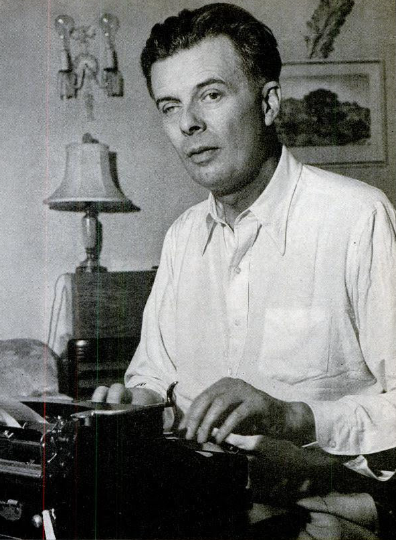
Aldous Huxley, 1947

A Thought Experiment

By Mark Wegierski

The thought-experiment is a recognized form of obtaining insight, even in the hard sciences. Aldous Huxley, who died on November 22, 1963, would probably have appreciated a hypothetical situation like the one below.

Let us suppose that Herbert Marcuse, the Frankfurt School theorist, often considered as one of the intellectual progenitors of the Sixties’ revolutions, is re-awakened several hundred years hence, in Huxley’s Brave New World. What sort of critique would he make of that society? It would presumably focus on the “masked nature” of the social order in question. What appears as a happy, free-loving society is in fact the product of continuous and thoroughgoing genetic engineering, which imposes class distinctions and barriers from the moment of (artificial) conception. The hierarchy of Brave New World is more rigid than that of any formerly existing society, as it is utterly predetermined. There is no rising even from the Beta class to the Alpha class. It is a society in which everyone is enveloped in an all-permeating “false consciousness”. Continue reading

Posted in Cultural Matters, Current Affairs and Comment, QR Home | Tagged , , , | Leave a comment

Public Flogging, a Modest Proposal

Public Flogging, a Modest Proposal

By Ilana Mercer

In the title of his magisterial novel, Fyodor Dostoevsky paired “Crime and Punishment,” not crime and pardons, or crime and “Civics lessons,” amnesty and asylum. Punishment must closely follow a crime in order to be both effective as a deterrent, as well as to serve as a public declaration of values and norms.

In explaining Texas justice and its attendant values, stand-up satirist Ron White performed the public service no politician is prepared to perform. “In Texas, we have the death penalty and we use it. If you come to Texas and kill somebody, we will kill you back.”

So, where’s such clarity when you need it? Something has gotten into the country’s lymphatic system. The infection is becoming more apparent by the day, not least in the way matters of life-and-death are debated (or not). Continue reading

Posted in Current Affairs and Comment, QR Home | Tagged , , | 1 Comment

Graffiti, Politti

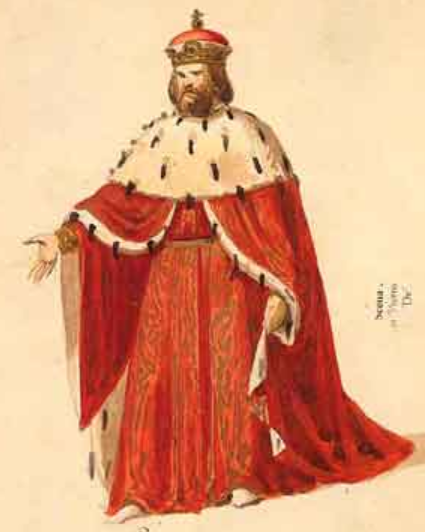
Set design by Girolamo Magnani for 1881 revision

Graffiti, Politti

Royal Opera, Simon Boccanegra, opera in a prologue and three acts, 15thNovember 2018, directed by Elijah Moshinsky, music by Giuseppe Verdi, libretto by Francesco Maria Piave revised by Arrigo Boito, orchestra conducted by Henrik Nánási, reviewed by Leslie Jones

The plot of Simon Boccanegra is complex and convoluted, even by the standards of Grand Opera. Contemporary critic Filippo Filippi complained that librettist Francesco Maria Piave only added to Garcia Gutiérrez’ play, upon which it is based, “a fantastic tissue of loves, abductions, betrayals, ready poisons and threatening axes”. Filippi’s final, damning verdict was that “There is no rhyme or reason nor any apparent justification of the strange comings and goings of the characters” (‘A Vital Legacy’, Alexandra Wilson, Official Programme).To complicate matters further, some of the characters, such as Jacopo Fiesco aka Andrea Grimaldi, have assumed identities.

Yet certain key themes or salient elements can be identified, the libretto’s “incomprehensibility” notwithstanding. As historian Christopher Wintle reminds us, in 1838 Verdi lost his daughter Virginia and two years later his wife Margherita (‘Padre, Madre, Figlia’, Official Programme). Wintle contends that Verdi subsequently sought out subjects that allowed him work through these losses, witness the ‘recognition’ scene in which Boccanegra and his daughter are re-united. Continue reading

Posted in Cultural Matters, QR Home | Tagged , , , | Leave a comment

Acts of Mutilation

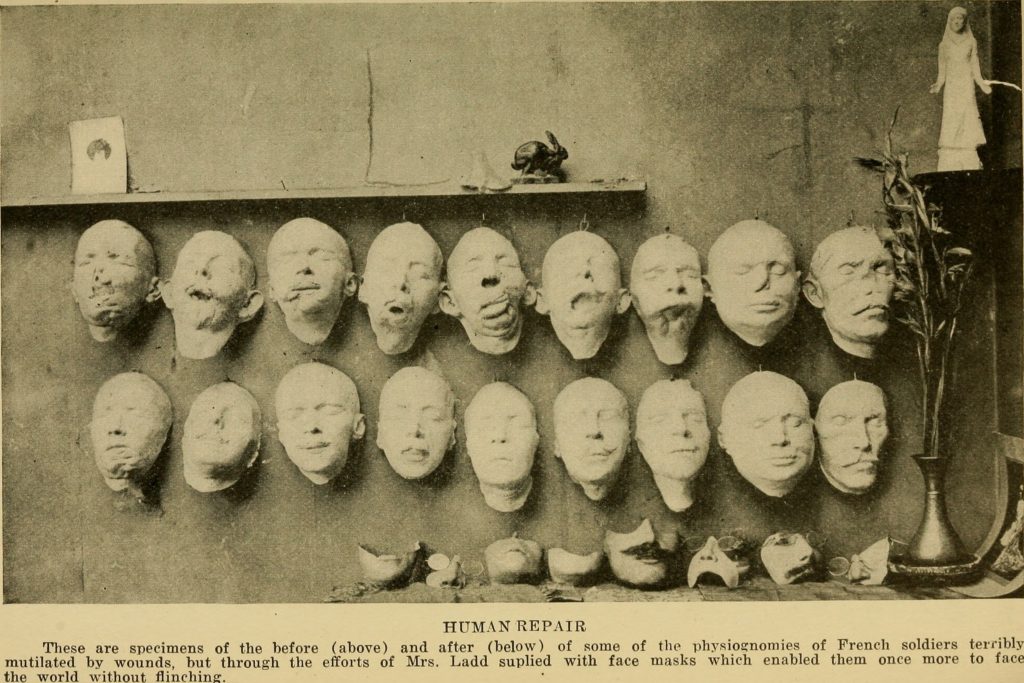
American Red Cross produce masks for mutilated French soldiers

Acts of Mutilation

ENO, War Requiem, music by Benjamin Britten, conducted by Martyn Brabbins, soloists soprano Emma Bell, baritone Roderick Williams, tenor David Butt Philip, text from the Missa pro Defunctis and the poems of Wilfred Owen, 16thNovember 2018, directed by Daniel Kramer, designs by Wolfgang Tillmans, reviewed by Leslie Jones

Is the War Requiem an oratorio or an opera? In an earlier, powerful performance of this work at the Albert Hall, on the 10th November 2013, conducted by Semyon Bychkov,   acting, costumes, sets etc, were dispensed with (see Quarterly Review, November 17th 2013). They would only have distracted the audience, which was allowed to concentrate on Britten’s music and Owen’s poetry, which speak for themselves.

But Daniel Kramer, the director of ENO’s new production of War Requiem, ignores the distinction between opera and oratorio. At the outset, we were presented with giant book covers onto which were projected pages from Ernst Friedrich’s pacifist tract Krieg dem Kriege (War Against War, 1924 and 1926), replete with disturbing pictures of mutilated soldiers etc. During the Dies Irae, likewise, when the soprano warns that “Nil inultum remanebit” (“Nothing will remain unavenged”), there were “relevant” references to “gender and genocide” in Srebrenica in 1992. Continue reading

Posted in Cultural Matters, Current Affairs and Comment, QR Home | Tagged , , , | Leave a comment

This Bank and Shoal of Time

This Bank and Shoal of Time

Macbeth, tragedy in five acts by William Shakespeare, RSC, Barbican Theatre, Saturday 10th November 2018, directed by Polly Findlay, reviewed by Leslie Jones

Time, as critic Michael Billington reminds us, is a recurrent theme in Macbeth. (The Guardian, 21st March 2018). Indeed, Shakespeare’s text is replete with references to its passage. In Polly Findlay’s production, accordingly, a digital clock counts down the little that remains of Macbeth’s life after Duncan’s murder. If “fate and metaphysical aid” will have him crowned, it will also have him killed. In the final scene, as Malcolm is hailed the new King of Scotland, the clock is re-set. Another cycle of tyranny commences.

In an earlier, notable production of Macbeth by Rupert Goold, premiered at Chichester in Summer 2007, with Patrick Stewart in the leading role, the three witches were assistants in a morgue. In this current production at the Barbican, they are no less sinister, as played by small children dressed in red, in a possible allusion to Don’t Look NowThe Shining and Schindler’s List. Continue reading

Posted in Cultural Matters, QR Home | Tagged , , , , , | Leave a comment

Slate’s Slanders

Slate’s Slanders

By Ilana Mercer

When Slate Magazine went after President Trump’s former speech writer, Darren Beattie, it chose to libel this writer, as well.

That’s a bully’s calculus: if you can, why not ruin the reputation of another individual, just for good measure? Ruining reputations by labeling and libeling unpopular others is all in a day’s work for the bully, who has nothing in his authorial quiver but ad hominem attack.

The individual who penned an unsourced hit piece on this writer is Slate Magazine’s designated “chief news blogger.” A hit piece is “a published article or post aiming to sway public opinion by presenting false or biased information in a way that appears objective and truthful.” Continue reading

Posted in Current Affairs and Comment, QR Home | Tagged , , , , , , | 1 Comment

The Disunited States

Statue of Robert E Lee, covered in a tarpaulin

The Disunited States

By Ilana Mercer

“We are one American nation. We must unite. We have to unify. We have to come together.” Every faction in our irreparably fractious and fragmented country calls for unity, following events that demonstrate just how disunited the United States of America is. They all do it.

Calls for unity come loudest from the party of submissives — the GOP. The domineering party is less guilt-ridden about this elusive thing called “unity.”

Democrats just blame Republicans for its absence in our polity and throughout our increasingly uncivil society.

These days, appeals to unity are made by opportunistic politicians, who drape themselves in the noble toga of patriotism on tragic occasions. The latest in many was the Pittsburgh synagogue massacre of Oct. 27.

In the name of honesty—and comity—let us quit the unity charade. Continue reading

Posted in Current Affairs and Comment, QR Home | Tagged , , | 2 Comments

ENDNOTES, November 2018

Chateau Wood, Ypres, 1917

ENDNOTES, November 2018

In this edition: In Remembrance, from the Chapel Choir of the Royal Hospital, Percy Sherwood’s Double Concerto from EM Records, Orchestral Works, by Ruth Gipps.

A century ago this month, The Great War– the “war to end wars”, shuddered to a close. From the Western Front to Gallipoli, from the deserts of Arabia to the sea-lanes of the Atlantic and the North Sea, British and Empire servicemen fought for a land “fit for heroes”. Yet their dreams and youth were lost in the mud of Flanders fields and are only remembered today by the poppy, the words of the war poets and the music of England’s composers.

In a salute to these events, SOMM Records has issued a stirring compilation of choral music, performed by the Chapel Choir of the Royal Hospital Chelsea – with the veterans of the Chelsea Pensioners’ Choir reinforcing performances of the much-loved Jerusalem by Parry, I Vow to Thee My Country (the famous hymn based upon a section of Holst’s Jupiter, from The Planets), and a lesser-known item – O Valiant Hearts, by one Charles Harris (1865-1936), a Worcestershire vicar and neighbour of Sir Edward Elgar. Much smaller-scale than his great choral-orchestral war-work, The Spirit of England, another Elgar elegy also makes an appearance, a setting of Cardinal Newman’s, They are at rest

“… We may not stir the heav’n of their repose
By rude invoking voice, or prayer addrest
In waywardness to those
Who in the mountain grots of Eden lie,
And hear the fourfold river as it murmurs by.”

Continue reading

Posted in Current Affairs and Comment, ENDNOTES:Music, QR Home | Tagged , , , , | Leave a comment