That opening ceremony – guest article by Peter Stark

That opening ceremony

Guest article by PETER STARK

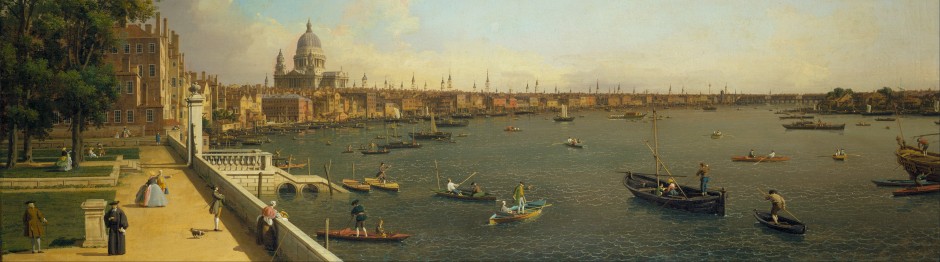
Anyone viewing the opening of the Olympics might have thought they had stumbled into an elaborate piece of Sixties guerilla theatre. The introduction was feted in advance as a pageant of English history. If this is true it was a highly idiosyncratic Marxist interpretation, in which most of the salient events were simply overlooked as having no relevance to a prevailing dogma.

It began with some youthful choirs in villages, at some indeterminate 14th-17th century period, in a rural England, singing Blake’s late 18th century Jerusalem, Britain’s unofficial anthem, to the tune of Sir Hubert Parry’s 1916 composition and Elgar’s 1922 orchestration. Paradise before the snake had taken up residence – innocent rurals. There was an absence of cities as if there were an assumption that there weren’t any before the 19th century. No royal conflicts, no 1066, no Magna Carta, no Wars of the Roses, no Tudors, no Armada, no Stuarts, no Marlborough, no British Empire, no abolition of slavery, no Wolfe, Nelson, Wellington or Napoleonic wars, no Second World War, although there was a hint of a First World War in which the common man was massacred by the stupidity of the ruling classes, no Churchill… but the examples are too many, the list endless.

History was bunk and had been abolished. What was allowed to survive was A People’s History, a derisive image of an England in the epoch of Blake’s “dark Satanic mills” with a group of men, representing amoral capitalists, procuring wealth and top hats at the expense of an oppressed working class. Kenneth Branagh, as a stovepipe-hatted version of Isambard Kingdom Brunel, began by lugubriously quoting Caliban in The Tempest

“Be not afeard; the isle is full of noises,
Sounds and sweet airs, that give delight and hurt not”

and then transmogrifying into a capitalist wandering about energetically with a frightening fixed grin, rubbing his hands at every new dark Satanic mill available if there was a profit in it. The oppressed workers moved with the jerky motions of robots (compare for originality with Fritz Lang’s Metropolis, Charlie Chaplin’s Modern Times, and Peter Brook’s Marat Sade among others).

The skies then darkened and a number of tall chimney stacks rose phallically to dominate the pillaged land of the stadium with the handful of top-hatted capitalists still rushing here and there excited at the prospect of further profits, wrung from the sweat of honest toilers’ brows. That was the Industrial Revolution that was… Nevertheless the chimneys excited intense applause among the sensation-starved spectators.

Somewhere along the line, English history apparently attained its apogee in the form of the National Health Service (the letters NHS were emblazoned on the ground) – ironically since the present government is panting at the prospect of reining in and ultimately destroying it. A large number of wounded soldiers were tended to by voluptuous maternal nurses in fetching late Victorian to Edwardian uniforms, ready to minister to the heroes home from the trenches, something like the film version of A Farewell to Arms, perhaps with a dash of Dennis Potter erotic phantasy thrown in (Pennies from Heaven). The routinely slipshod bureaucratic methods and delays more familiar to the NHS’s unfortunate victims of today were absent from this idyll.

Clearly Danny Boyle felt a new history of England was required – the apparachik version. Never mind the old saw that those who cannot learn the lessons of history are condemned to re-live it – history itself had been abolished as an assault on working class sensibilities, just as Shakespeare was abolished in the Chinese Cultural Revolution because there were too many kings.

As if having a sudden second thought, a reminder of modern, or ‘contemporary’ Britain was demonstrated in the person of the latest James Bond with the Queen at Buckingham Palace. They board a helicopter – this being shown on a screen in the stadium – and the helicopter takes in the buildings of tourist London on its way to the Games where two doubles for Bond and the Queen parachute into the stadium. Shortly afterwards the Queen and the Duke of Edinburgh make their appearance to open the Games. The role of the Queen requires some evaluation. While she obviously has a more playful aspect than might at first be suspected by her loyal citizenry, her alliance here with a phantasy figure from the film world (forget about the books) seems to suggest a disenchantment with pomp and ceremony and the implicit assumption that it’s all just cinema anyway.

We were also invited to admire the best-selling author of the Harry Potter books (A hundred million readers or two can’t be wrong), as well as Sir Tim Berners-Lee, the inventor of the revolutionary world wide web in a cameo role. Then there was Rowan Atkinson as Mr. Bean, dreaming of winning a race, another modern British ornament – all apparently examples of the best of modern Britain in the winners’ stalls.

Certain pop musicians also stood for something. In the Sixties there was a period when pop music really showed promise of becoming a new art form. Followers of different types of music, strangers, frequently came to blows over attitude as exemplified in their musical preferences. However it was soon all taken over by the formulaic money-makers, as are most things – look what they did with the miraculous invention of television – and now it’s difficult to tell if you’re in a club or an elevator, so banal is the push-button music competing to pluck your heart strings. Some of these singers, then, and their happily dancing fans were part of the Boyle perspective – though it was not clear what was the point, other than that they existed, so they had better be included.

In summary, the opening displayed a familiar feel of insincere concern for the poor, combined with a glib semi-educated finger-snapping commercialism. It might seem that the recession stricken newly impoverished punch-drunk English were suffering from some sort of collective nervous breakdown in which any semblance of reality had at all costs to be suppressed. In truth, an unlikely wave of patriotism seemed to have recently swept the nation. This was not the stalwart, my-country-right-or-wrong variant which made Samuel Johnson snarl – but rather a kind of sorrow and sympathy for the old nag, so long maligned, so weary, so abused by the kleptocracies of politicians and bankers and yet others that had battened on her helpless twitching carcass, as if despite everything they would not abandon her now in her hour of utmost need. And perhaps they were right and Olde Englande deserved better.

Meanwhile, the Chinese on the podium looked politely away and remained unfathomable, while taking another gold and looking for a palanquin. They knew who was in the driving seat now.

PETER STARK is a London-based poet and freelance writer


Free Google Ad cialis drugs no rx
Posted in QR Home | Tagged , , | Leave a comment

In defence of the Lords Spiritual and Temporal – guest article by Alfred Smith

In Defence of the Lords

Reinstating heredity and continuity to Britain’s constitution

Guest article by Alfred Smith

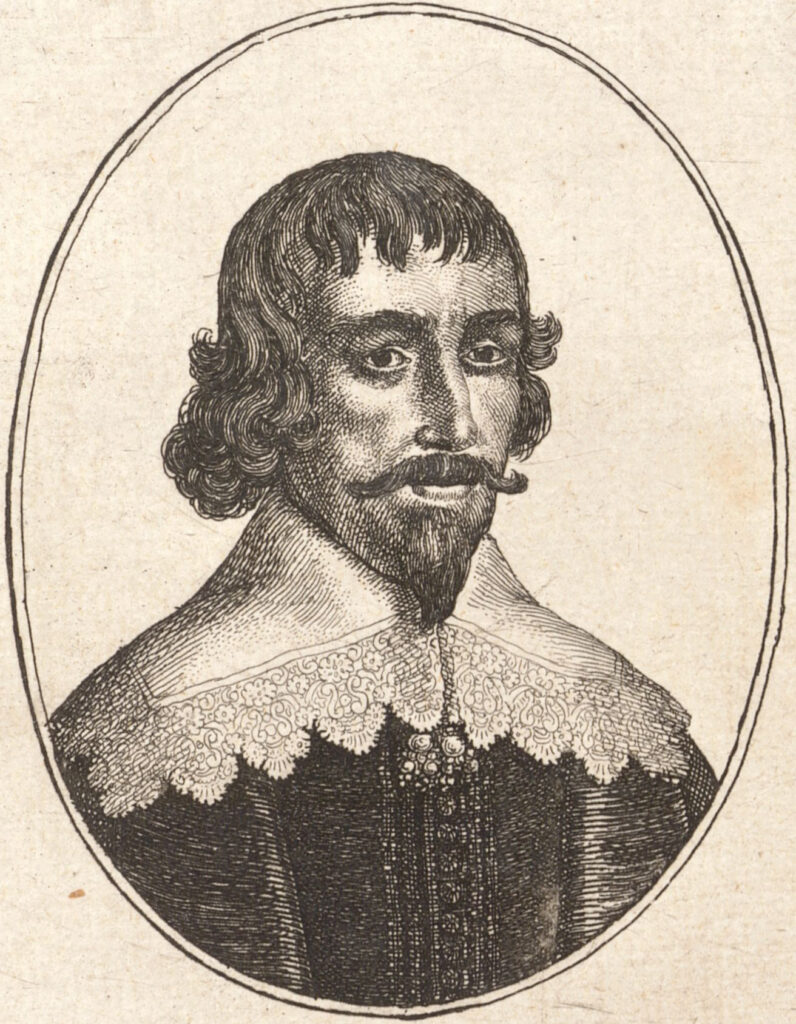
“Though true Nobility (always founded in virtue and real piety) needs no… Apologie, but itself, amongst those ingenious Spirits, who are able to estimate its worth; yet the iniquity of our degenerated Age, and the frenzie of the intoxicated ignorant vulgar is such, that it now requires the assistance of the ablest Advocates to plead its cause, and vindicate the just Rights [and] Privileges of the House of Peers, against the licentious Quills [and] Tongues of lawlesse sordid Sectaries, and Mechanick Levellers.”[1]

So wrote William Prynne in the Epistle Dedicatory of A Plea for the Lords, and House of Peers, the first edition of which he published in 1647 in response to Leveller pamphlets calling for the revocation of the ancient right of the Lords Spiritual and Temporal to sit, vote and judge in all the Parliaments of England. The 17th century was not, as it happened, so degenerated an age as Prynne feared. The Levellers themselves were never more than a coterie of scribblers and agitators. The House of Lords, though put in abeyance for a time, was restored to its former place after a succession of failed attempts by the Rump and the Protectorate parliaments to new-model England’s ancient constitution. The ignominious failure of these innovations on the one side, and on the other, the exhaustive recitation of precedents by antiquaries in the law such as Prynne, were enough to convince Englishmen of that era, who still held their ancestors in great reverence and piety, of the necessity of preserving the aristocratic part of their constitution.

Today, however, the factions of ‘sordid sectaries’ and ‘mechanic levellers’ are much larger and more powerful: I refer, of course, to David Cameron and the ‘modernising’ wing of the Conservative party, on the one hand, and the Labour and Lib-Dem parties in toto, on the other. Add to them the university professors and media gurus, who insist that no government can be just, unless it be based, exclusively it would seem, on the principles of democracy and universal human rights. The challenge for us is therefore much greater.

I should say at the outset that I agree with everything that Lord Sudeley said in his Quarterly Review article of Autumn 2011. But, given the depth of the problem, as I shall describe it below, I think he does not go far enough (I suspect out of modesty). The arguments he offers are mainly prescriptive and historical. Those of us who respect custom and the memory of our ancestors are persuaded by such appeals. But we know that to our 21st century levellers, and to the bulk of the nation who are under their spell, arguments from prescription and history are of no weight. “What have the Lords done for us lately? What can they do for us now?” one imagines them to ask. We must be able to answer them on those points. In such an age as this, when the levelling principle in all things (race, class, gender, national origin &c. &c.) has replaced Christianity as the established religion, the House of Lords, and the hereditary principle in general, need aggressive advocates who are prepared to declare forthrightly why democracy is not the only principle of legitimate government and why the democratic element of the British constitution ought to be kept in its proper place, and, furthermore, at every opportunity, to give the proponents of all forms of egalitarianism the thrashing that they, shameless canters and liars that they are, so richly deserve. The advocate must demonstrate precisely what is wrong with the ‘democratic’ rule of the Commons, and why not just ‘another house’ or an ‘upper house,’ but a house composed of bishops and hereditary barons is needed to check the exorbitances of the Commons.  To do this, one must be willing to speak of class, in particular of the different dispositions that characterize different orders of society. Such arguments inevitably give offence, but there is nothing for it. As Prynne insisted

“The Sun must not cease from shining because weak and sore Eyes will be offended with its splendor, nor seasonable truths of most publike concernment be concealed, smothered in time of general need, because ignorant, erroneous, sottish, hair-braind Levellers or Innovators will be displeased with, and storm against them.[2]

In the space allotted me here, I can hope to do no more than make a bare beginning of this task. Let us start by asking what democratic rule means? This, I hasten to add, is not intended as a question for philosophy. A better way to put it, perhaps, is ‘What does the thing political theorists call ‘democracy’ give us in practice?’

The answer, in brief, is government of the nation by and for persons who are animated chiefly by one of two main ideas: “leftist leveling” and “rightist reductionism”.[3] Whilst the leftist leveller wails about exclusion, class-based aesthetics, biased cultural and metaphysical assumptions, the classical liberal reductionist screams at any restrictions on the economic liberty of individuals. As Mr. Turner noted in his editorial, these are the two tendencies we observe in democratic politics. It is owing to the dominance of these very similar worldviews that our country is being filled with ugly “low-rise sprawl, where mean suburbs shade into retail parks, industrial sites, flyovers, motorways and back into suburbs”.[4] Indeed, blame for all of the other manifestations of ugliness we face at present may also be laid at the feet of the proponents of these twin ideologies of destruction and death, from the spectacle of homosexuals parading in the streets to the manifold horrors of mass immigration. We must not be surprised that those who rule in democracies have no taste, no culture, neither a sense of duty to their ancestors nor concern about their posterity, for they emerge precisely from those descriptions of citizens in whom these sensibilities and habits of mind are least developed, or utterly nonexistent. Unless we permit ourselves to speak of men as members of classes we cannot even grasp the problem.

Historically, both leftist levelling and rightist reductionism are ideologies of the third estate, or, if you prefer, the middle class.  The first demand for free trade came from that class of traders and merchants in the 17th century and later, who grew to resent the traditional restrictions on their methods of capital accumulation, and their powerlessness to break these fetters. This obsession with unfettered commerce, “free racing with unlimited velocity in the career of Cheap and Nasty” as Thomas Carlyle called it, has been with us a very long while. Leftist levelling is, if one discounts the 17th century Levellers who were no more than a flash in the pan, a more recent phenomenon. It did not spring from the mind of any worker or peasant. The proletarian speaks rarely, and then, almost never in his own words. Leftist levelling arose in the minds of members of the middle class, who were justly moved by the plight of the labouring poor in the age of industrialisation, but instead of asking the poor what they wanted, projected onto them their own middle class hatreds, disgruntlements and chimerical aspirations. Marx and Proudhon exemplify this sort of projection. Such are, in brief, the origins of the modern left and right. Capitalism and socialism, one must always remember, are two sides of the same coin, or, better yet, two heads of the same dragon.

The content of these ideologies is a product of the material conditions in which members of the middle class have lived. Tocqueville, I conceive, was right to identify mobility as the most important component of the social condition of members of the third estate. The bourgeois, or “democratic man” as Tocqueville called him, is rootless. The act of going off in search of his fortune severs his ties to his native soil, and even his family. Among this highly mobile class, said Tocqueville

“The woof of time is ever being broken and the track of past generations is lost. Those who have gone before are easily forgotten, and no one gives a thought to those who will follow.”[5]

The bourgeois fortune-seeker is not tied to any place; he has no memory of an earlier time. Day after day, he expends all his energy merely reacting to the exigencies of the present. Deeper cares eluding him, his life, by and large, becomes a restless quest to acquire as many of the ‘good things of this world’ as he can. In a life ruled by an “excessive and exclusive taste for well-being”, despaired Tocqueville, how are the “sublime faculties” of man, “a taste for the infinite, an appreciation of greatness, and a love of spiritual pleasures” to develop at all?[6] Such a condition of life is not conducive to the formation of taste, discernment, knowledge of and reverence for one’s ancestors, or care about one’s descendants. It is precisely that condition of life that gives rise to and reinforces the ideas of classical liberal reductionism and leftist levelling. Depending on the rootless fortune-seeker’s relative success or failure in materialistic accumulation, one or other of the middle class ideologies will appear to be the epitome of justice to him, a complete theory of political and economic life –  which of course it is not! All of this, I hasten to add, is not to say that all members of the third estate are necessarily narrow-minded, rootless, tasteless, grasping cretins. Your Humble Servant, himself of middle class extraction, hopes he is not such. But as their social conditions push them ever so strongly in that direction, it is only a minority of them who, by dint of intellect or experience, come to see things in a fundamentally different light.

It is not unreasonable, I think, to claim that the decline of European civilisation began from that moment when the third estate, itself only a part of the nation – and the most purblind and sickly part when left to its own devices and its own narrow views – subscribed to the fatal conceit that it alone constituted the whole body of the nation, and that its own peculiarly petty ambitions were the aspirations of all mankind. This truly pestilential conceit first announced itself directly in an essay of the famous apologist of the French Revolution Emmanuel Sieyes: What is the Third Estate? Sieyes summed up the plan of his essay as follows:

“What is the third estate?—Everything! What, until now, has it been in the existing political order?—Nothing! What does it want to be?—Something!”[7]

The first proposition, though objectively false, accurately depicts the self-image of the third estate. The second proposition is also objectively false, but accurately reflects the third estate’s ressentiment. The class of traders, artisans, shopkeepers, and various capitalists was never nothing. They always had, and now have, an important role to play in any nation, subject to guidance and restraint. The third proposition, supposing one has not forgotten the first, is an obvious lie. If the third estate imagines itself to be ‘everything’, then it will aspire to become ‘everything.’ And this, in short, is what has happened.[8]

The fanciful egalitarian promises of the bourgeois revolution, sold to the masses as a ‘democratic’ revolution, have, of course, never been fulfilled. Edmund Burke warned the French revolutionaries what would happen if they got their wish, if they succeeded in eradicating the hereditary nobility and the church from France. The result would not be democracy, understood as rule by the people. The revolution would establish not equality and plenty for all, but rather a new hierarchy with a new class of rulers at the top. Said Burke:

“The next generation of the nobility will resemble the artificers and clowns, and money-jobbers, usurers, and Jews, who will always be their fellows, sometimes their masters. Believe me, sir, those who attempt to level, never equalise. In all societies, consisting of various descriptions of citizens, some description must be uppermost. The levellers therefore only change and pervert the natural order of things; they load the edifice of society, by setting up in the air what the solidity of the structure requires to be on the ground.”[9]

There is much wisdom in these words. First, Burke was convinced that hierarchy was part of the natural order. Levelling is a fantasy that can never be realised. In any society, there is always some description of citizens who will be uppermost. The important question then becomes, not ‘What mechanisms will empower free and equal citizens to rule themselves democratically’, for that is a chimerical dream, but ‘What description of men, for the good of the whole, ought to be uppermost, and what descriptions ought to be on the ground?’ The new elite, he predicted, would be composed of precisely those descriptions of citizens who belonged in a subordinate position. The first four professional designations in Burke’s list need to be updated: craftsmen, peasants, money-dealers, and bankers – the fifth term, obviously, has not changed. One wonders about the first two descriptions. In the 21st century hierarchy, one does not see farmers or craftsmen at the top, and indeed, one hardly finds recent governments to be very solicitous of their interests. Perhaps Burke included these two in his list only to emphasise that a more natural order would place them at the bottom. Later in the Reflections, Burke said that the revolution in France would produce an “ignoble oligarchy” composed of “attornies, agents, money-jobbers, speculators, and adventurers”.[10] Indeed, the description that is now uppermost is the class of lawyers, speculators, investment bankers and other creatures of their kidney. On the whole (I say on the whole, for there are always exceptions – I know a few personally) this is the most mobile, and the most rootless description of citizens, the portion of the third estate most unfit to rule, because it is the most licentious and the most committed in principle to culture- and nation-killing reductionism. It is they who rule in the so called ‘democratic’ age.

We must, in the end, come to terms with the reality that all the propositions of ‘democratic theory’ are no less than a perfect fraud. The ‘will of the people’ which democratic institutions are supposed to represent is and always has been a phantom.  Nations do not have wills; they have interests. And it is always minorities who decide what those interests are to be. ‘Democratic’ elections today represent the interests of rootless moneyed and intellectual elites. If one desires confirmation, one need only examine the one instance in which Cameron has ostensibly stood up for British national sovereignty. Yes, if the profits of London banks are threatened by new EU taxes on financial transactions, then, and only then, does Cameron become a nationalist. The leftist intelligentsia, in spite of all the egalitarian rhetoric that its members spout from their perches in the media, the academy and the Labour party, has also proven itself entirely comfortable with the rule of financial wizards, perfectly happy to collaborate with them, for the global levelling that is facilitated by the rule of international bankers and speculators is very dear to their sentimental hearts.

Burke did not foresee our present condition in every detail. But it is a credit to his wisdom and prescience that he foresaw as much as he did. Fundamentally, he understood that if the third estate were to arrogate to itself all the political power of the nation and define its own narrow aspirations as the only legitimate interests of the nation, then it would destroy the nation. He was right. For that reason, he defended the monarchical and aristocratic parts of the ancient constitutions of Europe. Monarchy and aristocracy, he argued, must retain their power in order to restrain the destructive impulses and elevate the low aspirations of the third estate. It is true one does not find very much in Burke’s corpus that deals explicitly with the House of Lords. But he wrote a great deal of the special contributions of the Church and Nobility to the nation, and defended the ancient constitution which granted the members of both the right to sit, vote and judge in all parliaments. For, he said, one of the “excellencies” of the British constitution was that it consisted of “three members, of three very different natures”. He considered it “his duty to preserve each of those members in its proper place, and with its proper proportion of power”. Since the nature of each was different, it was necessary to “vindicate the three several parts on the several principles peculiarly belonging to them”.[11] It would be absurd to defend the aristocratic part of the constitution according to the principles of democracy, for the function of an aristocratic body of bishops and barons is to supply the knowledge, sensibilities and habits of mind which a democratic assembly lacks, and to be a brake on the deleterious tendencies to which a democratic assembly is prone. What, then, do Lords Spiritual and Temporal provide, that a democratic assembly lacks?

To my knowledge, Burke never specifically mentioned the Lords Spiritual. But he wrote extensively of the role of the church establishment. Apart from its essential duties of teaching the gospel, administering communion, and caring for the poor, the established Church had high political functions.  The Church was that institution which both reminded men of all descriptions, and especially the ministers of government, of their duties according to God’s eternal law, and protected and preserved a great portion of the nation’s spiritual and cultural treasures. As the earthly representative of Christ’s kingdom, the church ‘consecrated’ the state. Said Burke,

“This consecration is made, that all who administer in the government of men, in which they stand in the person of God himself, should have high and worthy notions of their function and destination; that their hope should be full of immortality; that they should not look to the paltry pelf of the moment, nor to the transient praise of the vulgar, but to a solid permanent existence, in the permanent part of their nature, and to a permanent fame and glory, in the example they leave as a rich inheritance to the world.”[12]

One of the political functions of a national church, then, is to elevate minds of men, especially of those who administer the government, from low concerns to high ones, from transient objects to permanent interests and eternal goals. The Church sets the eternal rewards of virtue against transient pleasures of earthly success, the permanent glory of those whose deeds echo through the ages against short-lived fame of those who have learnt the trick of tickling the mob’s fancy. With its presence in courts and parliaments, the representatives of the Church are to remind all of their sacred duties, to turn the glances of all toward the heavenly lodestar, far above the calculations of parties to gain transitory electoral victories, to satisfy low appetites of constituents and special interests.

The Church, as an institution, is also a protector of the nation’s spiritual and cultural treasures, the artifacts and monuments that are the concrete manifestations of its historical memory. In a long passage in the Reflections, Burke defended the Church’s vast property holdings on this basis against the confiscatory policy of the Jacobins:

“Why should the expenditure of a great landed property, which is a dispersion of the surplus product of the soil, appear intolerable to you or to me, when it takes its course through the accumulation of vast libraries, which are the history of the force and weakness of the human mind; through great collections of antient records, medals, and coins, which attest and explain laws and customs; through paintings and statues, that, by imitating nature, seem to extend the limits of creation; through grand monuments of the dead, which continue the regards and connexions of life beyond the grave; through collections of the specimens of nature, which become a representative assembly of all the classes and families of the world, that by disposition facilitate, and, by exciting curiosity, open the avenues to science? If, by great permanent establishments, all these objects of expence are better secured from the inconstant sport of personal caprice and personal extravagance, are they worse than if the same tastes prevailed in scattered individuals? Does not the sweat of the mason and carpenter, who toil in order to partake the sweat of the peasant, flow as pleasantly and as salubriously, in the construction and repair of the majestic edifices of religion, as in the painted booths and sordid sties of vice and luxury; as honourably and as profitably in repairing those sacred works, which grow hoary with innumerable years, as on the momentary receptacles of transient voluptuousness; in opera-houses, and brothels; and gaming-houses, and club-houses… [?]”[13]

As Burke suggested in this passage, there must be spaces in every nation that are free from commerce, whose general tendency is to build cheap, ugly and transitory structures for maximum short-term profit. The Church in particular builds according to a different plan. It uses wealth to preserve objects of beauty that elevate the soul and remind men of their connection to many generations of their ancestors. Together with its primary religious function, as a national institution charged with elevating the minds of the governors and the governed, and preserving spaces for national treasures, it is fitting that the Church should have permanent representatives in Parliament.

In A Letter to a Noble Lord, Burke argued that the Lords Temporal were the most important party to the social contract which he had defined in his Reflections as “a partnership not only between those who are living, but between those who are living, those who are dead, and those who are to be born”.[14] Reminiscing about his late friend Lord Keppel, Burke described the opinions of this peer of the realm, which he clearly shared, on the role of the hereditary nobility:

“[Lord Keppel] valued ancient nobility; and he was not disinclined to augment it with new honours. He valued the old nobility and the new, not as an excuse for inglorious sloth, but as an incitement to virtuous activity. He considered it as a sort of cure for selfishness and a narrow mind; conceiving that a man born in an elevated place, in himself was nothing, but everything in what went before, and what was to come after him. Without much speculation, but by the sure instinct of ingenuous feelings, and by the dictates of plain unsophisticated natural understanding, he felt, that no great Commonwealth could by any possibility long subsist, without a body of some kind or other of nobility, decorated with honour, and fortified by privilege. This nobility forms the chain that connects the ages of a nation, which otherwise (with Mr. Paine) would soon be taught that no one generation can bind another. He felt that no political fabrick could be well made without some such order of things as might, through a series of time afford a rational hope of securing unity, coherence, consistency, and stability to the state. He felt that nothing else can protect it against the levity of courts, and the greater levity of the multitude.”[15]

An hereditary nobility, Burke conceived, is no less than the chain that connects the ages of a nation. This is so on account of the sensibilities and habits peculiar to the members of this class.  The hereditary peer not only can trace his ancestry back many generations, but living as he does on the estate of his fathers, walking the same grounds, occupying the same rooms, surrounded by their portraits, in possession of their papers and other personal things, he is constantly reminded of them. The hereditary noble lives as much in the past, and in the future, as he does in the present.  For those who do think frequently and fondly of their ancestors are impressed with an awful sense of responsibility for future generations. What he has he owes to them. It is not his to do with what he pleases. The estate belongs to the family, and must be passed on to the next generation intact, else one’s ancestors are betrayed.

The hereditary noble understands instinctively, not only the duty of good stewardship, but the necessity of good breeding.  If the family is to be held in the respect that a high station affords, its manners must be worthy of the distinction.  But manners and dispositions are not the products of habituation only.  The hereditary noble knows, or ought to know, the importance of good blood, good stock in the production of worthy human beings.  Is each human, regardless of its parentage, born equal, a tabula rasa upon which one may scribble anything one pleases? Such a proposition is very hard for him to believe.

At his best, the hereditary noble is a man of taste.  Freed from the drudgery of the field, the factory and counting house, he has time for study and reflection, for the appreciation of beauty, for the refinement of his character. The deliberate cultivation in oneself of taste, judgment, and virtue is an extraordinary challenge for any man, and is near impossible for him who is occupied most of the time by the bare struggle for existence. In an hereditary aristocracy, supposing there is sufficient self-discipline among its ranks, standards of taste, judgment and virtue, cultivated over a long space of time are transmitted from generation to generation.

The hereditary peer’s habits of stewardship, his care for past and future generations, his taste for quality in all things, are precisely those sensibilities of which members of the third estate are, by and large, destitute.  When hereditary peers consider the affairs of the nation as a whole, they are bound to think precisely as they do in their private affairs. They know better than any member of the third estate what a nation is, and what it is not. As Burke said,

“The nation is not an idea only of local extent, and individual momentary aggregation; but it is an idea of continuity, which extends in time as well as in numbers and in space.  And this is a choice not of one day or one set of people, not a tumultuary and giddy choice; it is a deliberate election of ages and of generations; it is a constitution made by what is ten thousand times better than choice, it is made by the peculiar circumstances, occasions, tempers, dispositions, and moral, civil and social habitudes of the people, which disclose themselves only in a long space of time.” [16]
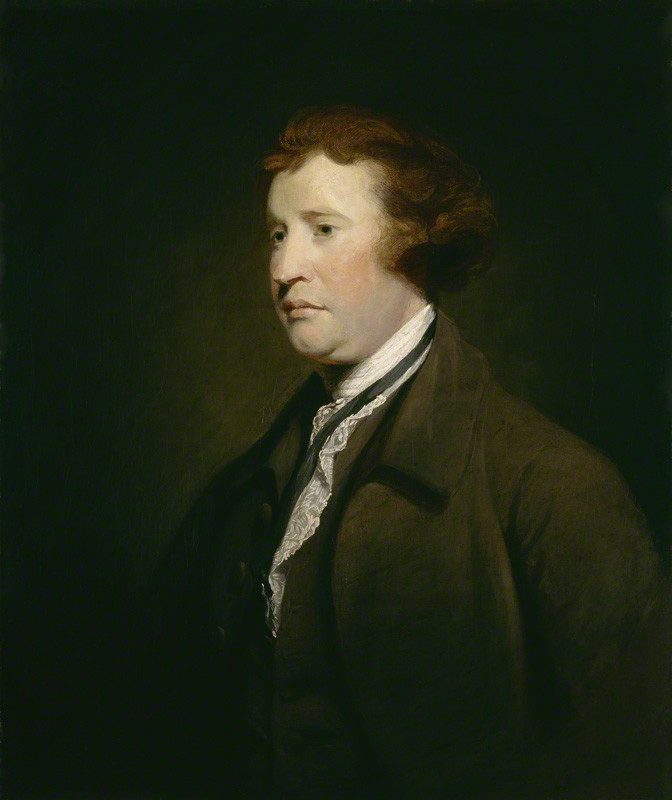
studio of Sir Joshua Reynolds, oil on canvas, (1767-1769)

It is far too easy for the multitude, or rather, for those in the Commons who claim to represent it, to think of themselves, mere life-renters that they are, one generation of many hundreds, as the ‘sovereign people.’ Such levity, such superficiality, such presumption are natural to uprooted men who perceive themselves to be armed with an electoral mandate. Such tempers are alien to hereditary lords who hold the idea of continuity, the choice of ages and generations to be of more weight. Therefore it is essential to the long-term survival of the nation, that such men be decorated with honour and fortified by privilege. If the men be held in honour, so will the principles which they publicly profess and live by, at least by some portion of the other classes. But since this disposition will never be dominant in the third estate, it is essential that hereditary peers have real political power to impose these principles on the rest of the nation for the common good.

Thomas Paine’s doctrine, noted by Burke, that the present generation must not be bound by duties to ancestors or posterity reflects perfectly the commercial and levelling spirit that was emerging in his time, and has now become dominant. ‘If the present generation desires to abrogate its ancient constitution and institute some other form of government, it has every right to do so.’ ‘Men are born free, after all.’ ‘How dare anyone suggest that their freedom be limited in any way!’ ‘Indeed, if the following generation desires to sell its homeland wholesale to Brussels, or certain parts of it to Pakistanis or Turks, who dares say it may not do so?’  ‘All this of duty to ancestors I do not understand, but this I know: bargains are sacred, if the price be right, there is no counterargument.’ ‘What an outrage to say that a body of free individuals may be deprived of a scheme to enrich itself?’
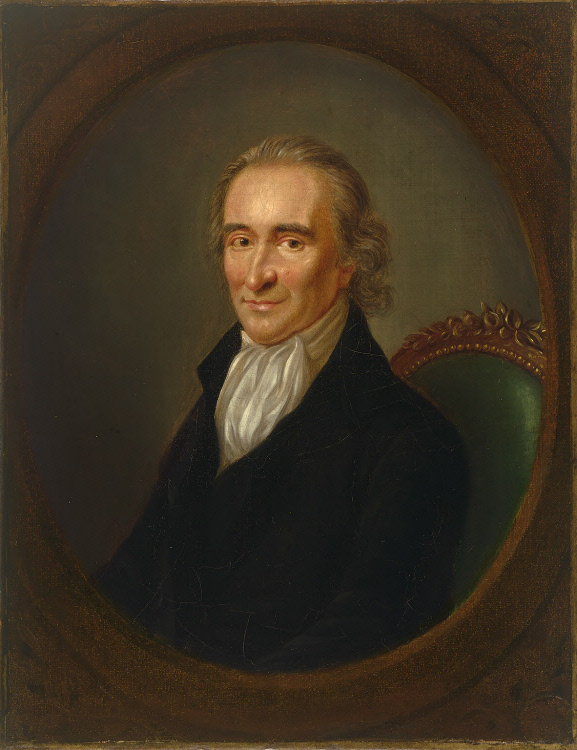
Portrait of Thomas Paine

Whenever I see a latter day Thomas Paine, some politician, businessman or media personality, carry on like this, my mind’s eye seems to see a noble lord step forward and declare ‘Sir, he who sells his patrimony, or counsels others to sell theirs, for a mess of pottage, is a swine. We shall not permit you and your pig philosophy to dominate here!’ What now can be seen only in a daydream must somehow become, as it once was, a constitutional reality. As Burke explained:

“The whole scheme of our mixed constitution is to prevent any one of its principles from being carried as far, as taken by itself, and theoretically, it would go… To avoid the perfections of extreme, all its several parts are so constituted, as not alone to answer their own several ends, but also each to limit and control the others: insomuch, that take which of the principles you please – you will find its operation checked and stopped at a certain point.”[17]

As I said at the outset, the democratic principle, in practice, is a combination of leftist levelling and rightist reductionism. The majority of members who get elected to the democratic assembly are always one or other breed of the species homo economicus. Their operation, which has been proven so deadly to the nation, must be checked and stopped at a certain point. If this is to happen, the men who sit in the other house must be of an entirely different character. ‘Life-peers’ will not be so. The problem with the ‘life-peer’ alternative is not limited to the fact that the party-political mode of selection too often produces egregious results, for instance, Jeffrey Archer, Nazir Ahmed or Michael Levy. The main problem is that this system fills the Lords with a majority of persons, who, whatever their merits, whatever their expertise, are in any event of the wrong disposition, that is, of the same disposition with those in the Commons. Only as a body of Lords Spiritual and Temporal, representing the principles of eternity and antiquity, the voice of God and ancestors, can the upper house check and stop the ruinous tendencies of the lower. Against all the Commons bills written by our 21st century Thomas Paines, only true Lords and Bishops can be relied upon to thunder out their nays and anathemas.

Can Britain’s present hereditary barons and Lord Bishops become again what Burke tells us they once were, and exercise the power they once exercised? I do not know. If it is at all possible they can, then, without doubt, it is the duty of all members of the third estate who, owing to the effort of intellect, or some jarring experience, have broken free from the illusions of the ‘democratic’ age, to support and campaign for a restoration of all the rights and privileges of the Lords Spiritual and Temporal according to the ancient constitution.  The relevant consideration should not be some abstract, atomistic theory of justice, but the requirements of national life. A wise member of the third estate will dismiss all the beguiling rhetoric about ‘fairness’ daily spewed from the maws of journalists, academicians and party hacks – for he understands that egalitarian fairness, in practice, means rule, not by the best, but by the most pernicious members of the third estate. Without noble and priestly classes to guide them, nations commit suicide.

ALFRED SMITH (alfred886@hotmail.co.uk) is the pen name of a post-graduate student of political theory. By day he performs the only song and dance that is permitted at 21st century Western universities. Under cover of darkness, he writes essays for The Devil’s Review (www.thedevilsreview.com), and serves as a contributing officer of the Ludovici Club, a group for the promotion of aristocratic virtues and culture. A list of his internet essays can be found here – http://theludoviciclub.com/Alfred_Smith.html

NOTES

[1] William Prynne, A Plea for the Lords, and House of Peers: or, a Full, Necessary, Seasonable, Enlarged Vindication of the Just, Antient, Hereditary Right of the Lords, Peers, and Barons  of this Realm to Sit, Vote, Judge in all the Parliaments of England (London, 1675), preface (no page numbers)
[2] Prynne, A Plea for the Lords, preface
[3] I have borrowed these more descriptive terms from Derek Turner’s editorial in the same issue of QR, p 2. One could also say ‘socialism’ and ‘capitalism’
[4] Ibid.
[5] Alexis de Tocqueville, Democracy in America, trans. G. Lawrence, (New York: Harper and Row Publishers, Inc., 1988), p. 507
[6] Tocqueville, Democracy in America, pp. 448, 543
[7] Emmanuel Sieyes, Political Writing, trans. M. Sonenscher, (Indianapolis: Hackett Publishing Company, Inc, 2003), p94
[8] This process obviously happened more gradually in Britain. The first step down this path, however, was the elevation of large numbers of businessmen to the peerage
[9] Burke, Select Works of Edmund Burke: A New Imprint of the Payne Edition, Vol. 2, Ed. E.J. Payne (Indianapolis: Liberty Fund, 1999),  p241
[10] Burke, Select Works of Edmund Burke, Vol. 2, p305
[11] Burke, Further Reflections on the Revolution in France (Indianapolis: Liberty Fund, 1992), p10
[12] Burke, Select Works of Edmund Burke, Vol. 2, p187
[13] Burke, Select Works of Edmund Burke, Vol. 2, pp266-7
[14] Burke, Select Works of Edmund Burke, Vol. 2. p192
[15] Burke, Further Reflections, pp321-2
[16] Burke, Select Works of Edmund Burke, Vol. 4, p21
[17] Burke, Further Reflections, p194


Free Google Ad cialis drugs no rx
Posted in QR Home | Tagged , , , , , , , , | 1 Comment

Dispatch from Damascus – guest article by Manuel Ochsenreiter

Dispatch from Damascus

Guest article by MANUEL OCHSENREITER

According to the mainstream Western media, a ‘civil war’ is raging in Syria. Campaigning groups like the London-based Syrian Observatory for Human Rights (1) make extravagant claims about huge numbers of casualties (they claim that around 20,000 people have already died) at the hands of the Syrian state security forces. Independent journalists, it is alleged, are not allowed to report directly from Syria, and the regime does not permit free press activities.

From such accounts, visitors might expect to find a country shocked and paralyzed by war, full of destruction. But when I arrived in Damascus on 12 July with a journalist visa to report for ZUERST! I saw none of these things. I took the land route from Beirut to Damascus, although a lot of people had told me the route wasn’t safe, because Free Syrian Army (FSA) rebels had declared that they controlled around 85% of Syria. But when I crossed the Lebanese-Syrian border, I witnessed the normal border traffic – no masses of refugees, no panic, no fights. The route to Damascus had several Syrian Army checkpoints, but was calm and safe.

Damascus itself was placid, and normal life went on. I was staying in the city centre, the al-Bahsa quarter. Shops were open, and there were people and cars on the streets. From the walls, the faces of President Bashar al-Assad and his father Hafez watched the daily life of the Syrian capital – sometimes friendly, sometimes strict, sometimes in civilian clothes, sometimes in military uniform, sometimes wearing sunglasses.

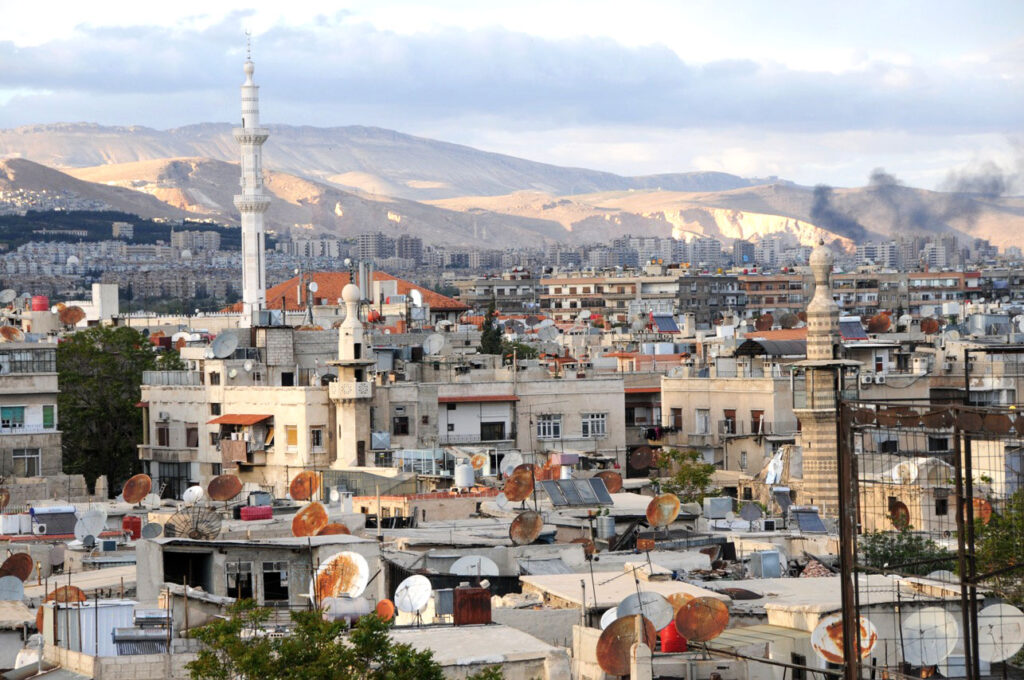
Damascus

I had read in the Western media about the FSA operation to invade the capital, but there was no evidence of war on the streets of Damascus. I walked through the city, speaking to shop owners, taxi drivers, people on the streets, policemen, women in headscarves and in Western outfits. The answer was always the same – the international media completely distort what is happening. They singled out the Qatar-based TV station Al-Jazeera for particular criticism.

On 16 July, I went to the old Christian village of Maalula, around an hour’s drive from Damascus. The inhabitants of Maalula are descended from the Semitic tribes which populated the Syrian desert and part of Mesopotamia fourteen centuries ago. The monastery of Mar Sarkis was built in the fourth century on the ruins of a pagan temple. Its Byzantine architecture contains one of the earliest surviving Christian altars. The monastery also possesses a unique collection of sixteenth to eighteenth century religious icons. Maalula is one of the very last places where one can encounter people speaking Aramaic, the language spoken by Jesus.

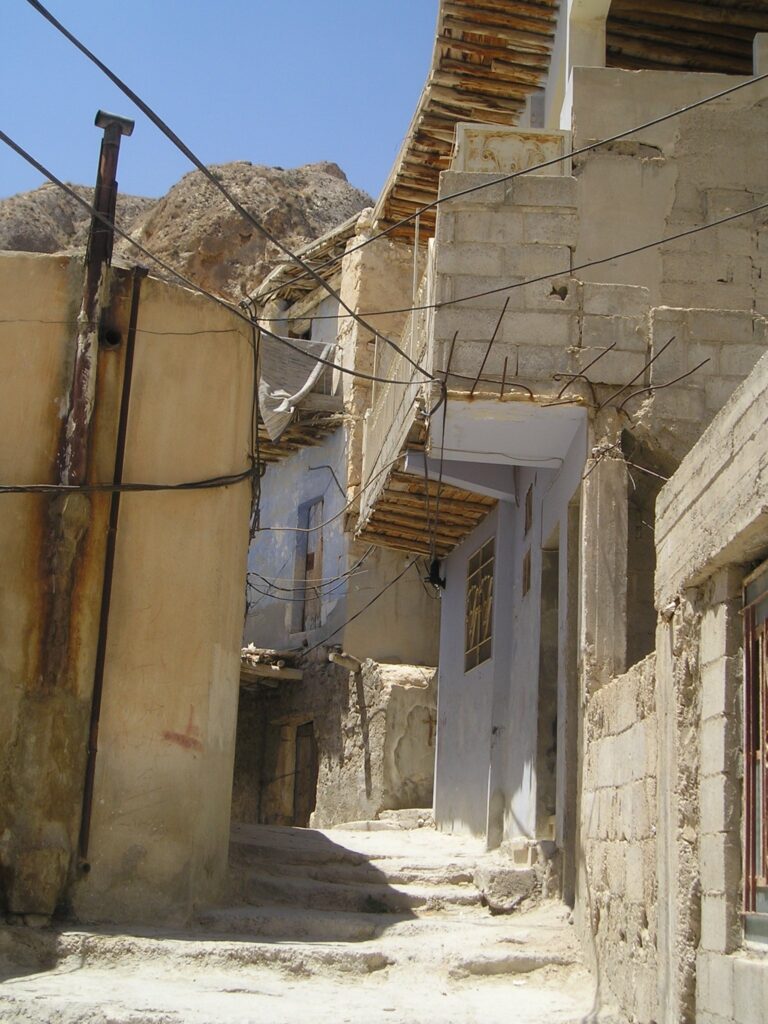
Maaloula’s narrow streets

Once again, the route was safe. There were many buses on the streets, destined for the cities of Hama, Homs and Aleppo. I interviewed inhabitants of the Greek Orthodox monastery of Mar Tekla and Arabic Christian pilgrims and visitors. They all expressed the belief that President Bashar would lead the country out of the crisis, and that in Syria Muslims and Christians live peacefully together. A nun told me: “This city and its church are founded on the rocks of Syria. They symbolize the stability and power of Syria. We will manage this crisis.”

Syria is a multi-faith society, and Christians in Syria make up about 10% of the population. The city of Aleppo has the largest number of Christians in Syria. Christians engage in every aspect of Syrian life – in the economy, academia, science, engineering, the arts, entertainment and the political arena. A number of Christians are officers in the armed forces. They have preferred to mix with Muslims rather than form all-Christian units and brigades, and formerly fought alongside their Muslim compatriots against Israeli forces in various Arab-Israeli conflicts.

I returned to Damascus via the city of al Tel, which the FSA had occupied briefly until the Syrian army re-took the city. One could still see the traces of the rebel forces and their supporters – notably graffiti on walls celebrating not freedom or democracy, but rather extremist Muslim preachers. There were also threats daubed on shops – “Go on strike or burn!” – painted by rebels seeking to force the shop owners to go on strike to place pressure on the government. Western policymakers have a woefully wrong notion of Syria’s “Arab Spring”. There is little or no liberal, progressive opposition; even the FSA is an assembly of different militia groups, including jihadis, mercenaries and criminals.

On 15 July, the rebels launched what they called “Damascus Volcano”, their military assault on the capital, claiming it would be a decisive operation. But all I noticed from al-Bahsa were helicopters flying high above some suburbs, and occasional explosions, about five kilometres from where I was staying. Normal life on the streets of Damascus went on, notwithstanding excitable Western media reports that the whole capital was an inferno. In most of the city the only things which burned were the coals on the hubble-bubble pipes of café customers. The war was confined to a few districts, like Al-Midan. The explosions went on for some hours, stopped and then started again. The city centre filled up with the residents of the disputed districts, and at nights soldiers at checkpoints asked to see my passport. Otherwise there was no evidence of conflict.

This changed on Wednesday 18 July, when a bomb killed several senior government officials during a meeting of ministers and heads of security agencies. The dead were the Syrian Defence Minister, General Dawoud Rajiha – Assef Shawkat, President Bashar al-Assad’s brother-in-law and deputy defence minister – the assistant to the Vice- President, General Hasan Turkmani – and Hafez Makhlouf, head of investigations at the Syrian Intelligence Agency. I was at the state TV station when I heard the news. Everybody was deeply shocked, and some female employees couldn’t hold back their tears. Meanwhile, Brussels and Washington welcomed the assassinations, while Islamists danced in the streets of Tripoli in northern Lebanon.

Meanwhile the “battle of Damascus” went on. After four days everyone became inured to the sound of the bombs and helicopters. I took the opportunity to visit the military hospital of Damascus, where every day around fifteen Syrian soldiers die from their injuries – this makes about 450 soldiers a month, in the Damascus area alone. I interviewed wounded soldiers, talked to doctors and to the families of the injured.

An interview with a 34 year old Syrian Army captain who had been lucky enough to survive a rebel attack was especially memorable. He and his unit had been trapped by the rebels, who bombarded them with rocket-propelled grenades and heavy machine guns. A couple of his comrades were killed during the fight and the captain was also hit, but survived the first wave of attack. He was lying on the ground, bleeding heavily but returning fire nonetheless. When his comrades came to rescue him, they also came under fire from the rebels. They finally managed to bring him to safety inside a building, but it took hours for the army to pull them out. When he was brought into the hospital, he had lost so much blood that he was already unconscious. He recollected

“I told my comrades to kill me before I fell into the hands of the enemy.”

I asked him why, and this was his disturbing answer –

“They torture us to death – they cut off our hands and cut our throats if they capture us alive.”

He assured me also that the rebels are not Syrians, but come from many countries, especially Libya, the Gulf States, Iraq, Afghanistan and Pakistan – jihadis and mercenaries who kill for petrodollars. Before I left the hospital, he showed me a picture of his two daughters and told me fervently that he was fighting for their freedom.

The director of the hospital showed me where a mortar grenade fired by the rebels had come down a day earlier, but mercifully didn’t explode. There were also bullet holes in the walls. The rebels had attacked the hospital several times, but the UN, Amnesty International or Human Rights Watch seemed uninterested in these violations of the conventions of war.

As the fighting continued, the whole city became nervous. Shop owners closed their doors early in the afternoon; they wanted to be certain of getting back to their families. Some took their money and things of value with them. They were worried that their shops might be looted and plundered – by the rebels, not by the army – if the fighting reached the city centre.

On Friday 20th July, while pro-rebel TV stations like Al Jazeera and Al Arabia broadcast stories about unremitting civil war in the capital, I listened to the birds singing in the city’s beautiful parks and watched the Damascenes enjoying their free day. Even the explosions in the outlying areas ceased. State TV broadcast that the rebel attack had been thrown back, and that the security forces were clearing the suburbs of the rest of the rebels.

I wondered if that was true or just state propaganda. So I went to al-Midan, where the fighting had been very intense. There were many soldiers and military vehicles in the centre of the district. The officer in charge of the central police station welcomed me and showed me around. There were still gunfights going on around 500 metres away, and I heard a heavy machine gun. I was brought in an armoured vehicle to the fighting zone at the edge of al-Midan. Traces of the war were everywhere. Soldiers were firing from cover at a building where rebel snipers were holed up. We had to move quickly from house to house, some of which were still smoking. The dead bodies of rebels lay in the street. The face of at least one was obviously non-Arabic; it seemed he had come from Afghanistan. I wondered who had paid his way, and what exactly he had been fighting for.

While we were still looking at the dead bodies, a small transport vehicle came along the street, loaded with the rebels’ arms and equipment. The driver showed me what they had found in the FSA control centre – huge amounts of ammunition, automatic guns, machine guns, and Syrian Army uniforms, used to discredit the state and confuse civilians. I wondered if all this had been staged for Western journalists; had the army prepared a ‘stage set’ for my benefit? Yet when I arrived, the fighting had still been going on, and no-one had had time to ‘prepare’ dead bodies; the area was ‘fresh’. I believe what I witnessed was authentic.

I met Foreign Ministry spokesman Dr. Jihad Makdissi on a day when he was dealing with what Al-Jazeera was calling the “Massacre of Trimseh”. Al Jazeera had claimed that the regime had slaughtered more than 200 civilians in the village, but later on it emerged that there had been a fight between the army and the FSA. Dr. Makdissi, who studied in Britain and speaks fluent English, repeated patiently over and over again in press conferences the facts – the security forces had killed 37 rebel fighters and two civilians in an attack on the village, which the rebels had been using as a base to launch attacks on other areas. He maintained believably that contrary to Al-Jazeera’s claims, government forces had not used planes, helicopters, tanks or artillery – and that the heaviest weapons used by the Army were rocket-propelled grenades.

I left Damascus on 21 July, to head back to Lebanon. I planned to go by car again. Several Syrians warned me that the journey would be dangerous, and that the border with Lebanon would be thronged by refugees. But when I asked them the sources of their ‘information’, they were always Al Jazeera and Al Arabia TV-news. So I decided to test this for myself, although I confess to feeling apprehensive. But sure enough, once again the highway to the border was calm, without much traffic. My passport was examined at a few Army checkpoints, and that was it. At the border station there were admittedly many people, but there was no chaos, nor masses of refugees. The whole exit procedure took no more than 20 minutes.

A final surprise came at the Lebanese side of the border. There I saw the first time the black-white-green rebel flag waving in the wind. Immediately beyond the Lebanese border station were a dozen Western TV teams, waiting for the ‘refugees’. Some of them were paying interviewees in dollars for short interviews; and the wilder the story, the better they seemed to like it. It seems that reality doesn’t mean all that much when the Western media talk about Syria.

MANUEL OCHSENREITER is Editor-in-chief of the national-conservative German monthly newsmagazine ZUERST! (www.zuerst.de)

Editor’s Note

1. There are apparently two organizations claiming this name, but whatever their other differences they share a passionate hatred of the Assad regime which must call into question their credibility. DT


Free Google Ad cialis drugs no rx
Posted in QR Home | Tagged , , , , , , , | Leave a comment

Sea Changes

Sea Changes

I am very pleased to announce that my immigration novel Sea Changes is now available as a paperback and e-book. A hardback edition will ensue.

See http://www.amazon.com/Sea-Changes-Derek-Turner/dp/1593680023/ref=sr_1_35?s=books&ie=UTF8&qid=1343341874&sr=1-35&keywords=sea+changes

Reviews to follow (gulp!).

Derek Turner, 26th July 2012


Free Google Ad cialis drugs no rx
Posted in QR Home | Tagged , , , , | 2 Comments

Euro 2012 – the BBC scores an own goal

Euro 2012 – the BBC scores an own goal

Guest article by GREGORY SLYSZ

The Euro football championships held in Ukraine and Poland ended with a most fitting finale, as Spain, the existing champions, as well as world champions, successfully defended their title with a stylish 4-0 victory against Italy. An unprecedented international consensus adjudged the whole tournament to have been one of the most successful in living memory. With nearly 1.5 million fans watching the matches in the stadiums, it was easily the best attended Euro football championship in history. A further six million watched the games in fan zones.  The football that they saw was, by common consensus, of the highest quality while the organisation and the carnival atmosphere of the tournament attracted universal praise from the Presidents of UEFA and FIFA, Michel Platini and Sepp Blatter, the federations of the participant nations, the pundits and journalists covering the tournament and above all the fans themselves, a huge proportion of which declared that they would return to the host countries on holiday. In short, it was an unforgettable spectacle for all who experienced it, all preconceived notions and racial stereotypes shattered. In fact, rarely has a major sporting event elicited so little criticism. But it wouldn’t have been like this, if the BBC had had its way.

Hubris and boycotts

This turnaround in attitudes could not have been greater. Ever since the tournament was awarded to Poland and Ukraine, opinion among established football nations towards the decision had been overwhelmingly negative. Media attention focused on dilapidated stadiums and transport infrastructure, poor hotels, inadequate training facilities and hooliganism. Regular reports claimed that nothing would be ready in time, while established football powers regularly lobbied UEFA, in the light of these reports, for the tournament to be moved to their countries. Michel Platini’s plan to extend the pool of host nations to Eastern Europe appeared to be in tatters.

By far the most tendentious report was produced by the BBC. Emanating from the production team of Panorama, the programme, Stadiums of Hate, was broadcast ten days before the tournament was due to start. While much of the pre-tournament coverage had been governed by a haughty indignation among the established football powers at being overlooked by UEFA in favour of what they regarded to be underdeveloped upstarts, the BBC’s offering was altogether in a different league as far as prejudicial and partial reporting went. Recorded over a month long period, the programme showcased racist and anti-Semitic behaviour among Polish and Ukrainian football fans as well as opinions from selected figures that seemed to confirm the worst about both countries. Among its many claims was that of the black former captain of the England team, Sol Campbell, who warned England fans that to go to the tournament risked “returning in coffins”. He added with dismay that UEFA should not have awarded the tournament to Poland and Ukraine on account of what he claimed was their racism. His views seemed to echo the advice of the British Foreign Office to ethnic minorities to take extra care if travelling to the host countries.
Unsurprisingly, the programme caused a stir. Shocked by the BBC’s revelations, other media proceeded to denounce Poland and Ukraine as racist countries. Paul Hayward, for instance, writing in the Daily Telegraph, sensationally declared that “the creep of extremism reminiscent of the 1930s could be felt in the Panorama exposé”[1] Incendiary statements were endorsed, most shockingly from the highly temperamental England-based black footballer, Mario Balotelli, who vowed to kill anyone who racially abused him, while even politicians sought to out do one another as to who could condemn the two host countries in the harshest terms. All reason in the matter seemed to have been suspended.

The pre-tournament atmosphere had already been soured by a boycott of Ukraine by many EU leaders, in protest at the jailing by Ukrainian authorities of the former Prime Minister Yulia Timoshenko. The boycott threatened to turn the championship into the most politicised sporting event since the Cold War boycotts of the Moscow and Los Angeles Olympic games during the 1980s. What was astonishing about the EU boycott was that it was determined by unsubstantiated claims by Timoshenko’s supporters that she had been subjected to a miscarriage of justice and mistreatment in prison. It all seemed too convenient for the EU, desperate to draw Ukraine from Russia’s orbit, to ignore widespread allegations of corruption against Tymoshenko herself.

Racial stereotypes displaced objectivity

The host nations, having spared no expense on preparations for the championships, reacted with consternation to the BBC’s claims. Repeated guarantees of fans’ safety were accompanied by angry rebuttals from officials. Oleh Voloshyn, a spokesman for the Ukrainian Foreign Ministry, scathing at the BBC’s exaggeration, accused the BBC of inventing myths. “You can criticise Ukrainian society for a lot of things,” he declared, “but as far as racism is concerned European Union member countries are a long way ahead of Ukraine.”[2] Markiyan Lubkivsky, the director of the championship added, “so much mud has been heaped on this championship. Ninety per cent is just not true.”[3] Poland’s Prime Minister, Donald Tusk expressed “disappointment” and “surprise” at the BBC’s allegations, especially as the programme specified Krakow as a “hot spot of Polish racism”. “Over 100,000 young English tourists come to Krakow every year,” he declared, who,” adding sarcastically, in reference to their well documented wanton behaviour, “enjoy themselves with extraordinary freedom. Never, I stress never, was there one report, one incident on racial grounds.”[4] Marcin Bosacki, a spokesman for the Polish Foreign Office demanded from Britain’s counterpart an explanation for its advice to England fans of ethnic background not to travel to Poland. He added that Poland “invites all British fans, ethnic minorities, Sol Campbell and all who wish to see for themselves, the real Poland, and not rely on stereotypes.”

Dariusz Rosiak, a journalist from the Polish daily Rzeczpospolita, recalled frustratingly that the only issue in Polish football that his BBC colleagues were interested in was racism and anti-Semitism.[5] “I told my colleague,” he noted, “that racism is not a big problem in Polish football, certainly no bigger than, for instance, in Italy or Russia … I then offered him an opinion on real problems in Polish football, in the FA, among the grotesque chairman of football clubs, the incompetent referees and players… and so on. All for nothing,” he continued. “The BBC was only interested in racism. And especially anti-Semitism… (It) was adamant to show that Ukraine and Poland are ill from their hatred towards blacks, Asians and Jews…English journalists will not rest, until in the course of the tournament, they discover a good example of a Polish anti-Semite …The BBC film,” Rosiak concluded, “is a dramatic triumph for ignorance, stereotypical thinking and political correctness in the service of alleged truth” For a journalist who is otherwise known for promoting multiculturalism in Poland, his opinion is a damning reflection of the damage that the BBC’s reputation has suffered there.

In a bid to maintain the momentum generated by its programme, BBC interviews at the start of the tournament with players and officials were prefaced by questions about racism, only for the tactic to be quietly abandoned when there was little to focus on. A few unfortunate isolated racial incidents were recorded at the championships of the type familiar to grounds all over Europe. But none involved fans from either Poland or Ukraine. [6]

However, a couple of days before the start of the tournament there was an attempt to pin something on Polish fans. At a training session of the Dutch squad in the stadium of the local side Wisla Krakow, the captain, Mark van Bommel, claimed to have heard monkey chants from a section of the crowd directed at the team’s black players.[7] Dutch journalists and UEFA officials claimed they had heard nothing untoward. Videos of the training session offer scant evidence in support of the allegations as it is very difficult to make out anything amidst the din of applause from the 25,000 appreciative fans. No complaint was ever lodged by the Dutch FA (KNVB) to UEFA and no investigation followed. The incident appeared closed until extensive lobbying from FARE (Football Against Racism in Europe) compelled UEFA to acknowledge that it has been made aware of isolated incidents of racial chanting. FARE’s chief executive, Piara Powar, subsequently added that “Van Bommel had no reason to invent such a claim. It’s quite clear it happened. And if there’s some confusion with the governing bodies, the KNVB of UEFA, then that’s regrettable. In our view, the incident took place.” Having already expressed his grave concerns about the championships like no other before because of what he called “well-documented problems with racism and anti-Semitism”, he went on to suggest that training sessions should in future be conducted behind closed doors. Alternative explanations for any chanting were rejected outright, one being that a handful of Wisla fans, well known for their passion in supporting their team, booed the Dutch squad in protest that their stadium had not been chosen as a venue for the championships.

The former Dutch Player, and current activist in race relations, Ruud Gullit,  immediately called a press conference to condemn what he believed to have been chanting and patronisingly lectured the two host countries that the championships offered “possibilities (for them) to put themselves on the map”[8]

However, several Dutch media outlets reported that the allegations of monkey chants were fabricated. According to the daily de Volkskrant, for instance, reported the leftist Polish daily Gazeta Wyborcza, the coach of the Dutch team had stated to the BBC that he had not heard the supposed chanting, nor did the rest of the team. De Volkskrant suggested that the entire debacle was stage-managed by a number of media outlets, including the BBC, which had generated pre-tournament race stories, in order to confirm their own propaganda regarding racism in Polish and Ukrainian football.[9]

The “well documented problems”, which Powar mentioned, was reference to a report conducted by FARE into racism in Polish and Ukrainian football in 2009-2010.[10] Over an 18 month period it charted 133 cases in Poland and 62 in Ukraine. Of these, the vast majority were what it categorised as, “displaying racist/fascist symbols” and only two incidents involved violence.  Even those who went along with the Panorama programme baulked at the claims of the report. These figures show, noted Andrew Gilligan, in an otherwise scathing article attacking Poland and Ukraine, that “the problem, though real, can be overstated.”[11]

An unfortunate clash between Polish and Russian fans did occur on 12 June, the day that Poland was due to play Russia in Warsaw.[12] Notwithstanding the pre-existing tension that a fixture between these two countries would generate, stoked up in large part by Polish and Russia media, the match coincided with National Russia Day which commemorates the fall of the Soviet Union in 1990. To mark the occasion thousands of Russian fans were permitted to march through the streets of Warsaw, offering ample opportunity for violent clashes. Moreover, such a march, charged with historical connotations that evoked painful memories of the murderous presence of the Red Army in Warsaw in 1944, was bound to provoke Polish fans to react to any provocation from Russian radicals.  The unlikely set of coincidences even drew suspicions of a pre-planned conspiracy. “Somebody really wants to make Polish football fans attack the Russians,” noted Wojciech Wisniewski, a member of the Polish Union of Football Fans. [13]

As regrettable as this incident was, it was ironic that some of the worst violence associated with the tournament occurred in Bedford, England, when gangs of England fans attacked local Italian residents in the wake of Italy’s defeat of England in the quarter finals.[14]

Victims rebel against victimhood

Such is the level of exaggeration by Western media of racial intolerance in Poland and Ukraine, and Eastern Europe generally, that communities that have been labelled as victims of racism are increasingly voicing their opposition to such stereotyping. The BBC’s assertions have been particularly challenged by leaders of the Poland’s Jewish community. “People from Western Europe frequently express themselves with great ignorance,” notes Michael Szudrich, Poland’s chief Rabbi, “The BBC programme was untrue in its extreme. It’s in the West that the situation for Jews is the more difficult.” Though Szudrich admits that anti-Semitism continues to persist in Poland, he stresses that it is decreasing and is not in any way as extreme as in Western Europe, something that is confirmed by research conducted by the European Jewish Congress.  He adds that “he would definitely want to live in Poland, which is more tolerant than France and other countries, which have forgotten what the word means.” [15] The situation in France, in the light of rising anti-Semitic attacks, is particularly looked at with concern by Jewish leaders. “I have no doubt,” notes Serge Cwajgenbaum, the Secretary General of the European Jewish Congress, in reference to a recent hammer attack on three young Jews in Villeurbanne, near Lyon, by a Muslim gang,  “that such a brutal attack as happened in France, would never have happened in Poland. There, as well as in other Western countries,” he adds, “this is steadily becoming normal.”[16] Second to France, Britain is highlighted as a source of concern. “For Britain to accuse Poland of anti-Semitism,” notes Israeli professor Gerald Steinberg “is not only to lie but is to attempt to draw attention away from itself.” In his opinion, the rise of anti-Semitism in the West is not only due to the presence of large Muslim populations, but also to the mindset of the intellectual elites and various leftist organisations who promote an anti-Israeli policy. “In Poland,” Steinberg stresses, “such an outlook is absent. Poland is pursuing a pro-Israeli foreign policy and is our greatest friend in Europe.”[17] Marek Magierowski of Rzeczpospolita poses a couple of rhetorical questions, albeit with a touch of sarcasm, about the safety of Israeli fans at the next Euro championship, which is due to be held in France in 2016. “I would like to see whether Israeli fans parading on the streets of Marseilles, for instance, dressed in their national team shirts emblazoned with the star of David, will receive a warm welcome from the local populations. And I would like to view a report from the BBC, in which some Israeli footballer advises fans ‘not to travel top France because you could return in a coffin.’ [18]

Adding their voice to the criticism of the BBC were representatives of Poland’s small black community. John Godson, for instance, one of two black MPs, labelled the programme “bias, one sided and rather sensational”[19] while the former NBA basketball star and current resident of Warsaw, Michael Ansley, took particular offence in a strongly worded rebuttal against Sol Campbell and what he termed his “racist attitude towards this great and welcoming country”.[20]

Biased reporting?

The BBC is no stranger to accusations of bias. Whether on the EU, the Israeli-Palestine conflict, trade unions, immigration, gender issues, religion, it has been accused from various quarters of taking a position which in breach of its governing charter that stresses a duty of impartiality. Andrew Marr, one of its leading presenters, recently claimed that there prevails among its staff  not so much a political but a “cultural bias”, while others have accused the BBC of practicing a Left-liberal bias. [21] Whatever the case may be about the working culture of the BBC, the Panorama programme deviated sufficiently from reality to suggest that its production was governed by some kind of bias.

Writing in the Irish Independent, Louis Jacob likened the programme to “the type of thing Sasha Baron Cohen comes up with through characters like Ali G or Borat. [22] Not only, he notes, did none of the coverage feature footage from three of the four host cities – Gdansk, Poznan or Wroclaw – but “the only real ‘evidence’ they found of this supposed racism and hooliganism, was racist graffiti on walls in undisclosed areas” while the stadium footage “was of local club Legia Warsaw’s hardcore fans (known as ultras) burning a flag.” In short, Jacob notes, “what the BBC did was akin to making a documentary about the dangers of travelling to a game at Wembley, and then showing sectarian hatred at an Old Firm game as evidence.” Echoing Rosiak’s aforementioned claim, Jacob stresses that once the BBC set of for Poland to make a documentary on football hooliganism, “they weren’t coming back empty-handed” and as such, he notes “The levels of dishonesty involved in this type of thing are extraordinarily high… Poland is the same as anywhere else in the world. Every city has an underbelly. If you go looking for it (the way BBC’s Panorama did so diligently with their documentary), you will find it.”

The producer of the programme, Leo Telling, emphatically rejected Jacob’s assertions that it was guilty of “narrow, agenda-driven sensationalism”, insisting in his “right of reply” that hooliganism and racism in Polish and Ukranian football are deep-rooted and expressing “astonishment” at Jacob’s likening of Poland to any other country in this respect. [23]He also downplayed the importance to the programme of Sol Campbell’s “personal views” and emphasised the dismay expressed by Jonathan Ornstein, director of the Jewish Community centre in Krakow, at both the hooliganism at Polish football stadiums and the long-standing racist graffiti.

Though Telling’s defence of the programme was predictable, it differed considerably from statements made by participants in the programme that appeared to confirm high levels of manipulation. “The BBC twice bypassed the truth”, writes the Polish daily Gazeta Wyborcza. [24] In a letter to the Economist, Jonathan Ornstein expressed indignation at the BBC’s “unethical form of journalism …that exploited me as a source … to manipulate the serious subject of anti-semitism for its own sensationalist agenda” and in so doing it “has insulted all Polish people and done a disservice to the growing, thriving Jewish community of Poland.”[25] In this, he argues, “the BBC knowingly cheated its own audience by concocting a false horror story about Poland (which) spread fear, ignorance, prejudice and hatred.” In an astonishing revelation he noted that the “tendentious programme … completely disregarded anything positive I said” notably how “the Krakow Jewish community feels safe and well integrated into broader Polish society” and how “the small number of football fans in Poland engaging in anti-Semitic and racist behaviour do not represent Polish society as a whole… (It) aired only comments critical of Poland”.  More astoundingly, he claimed that the reporting team disregarded his suggestion to interview “the two Israeli footballers who played for Wisla Krakow this season … so that they could hear firsthand about their positive experiences” on the grounds that “this line of inquiry ‘didn’t fit their story’, a response that perplexed me at the time.”

Though the BBC in response denied both taking Mr Ornstein’s comments out of context and having any recollection of his suggesting interviews with Israeli players, [26]a witness to the Ornstein interview, Mateusz Zurawik from Gazeta Wyborcza, was adamant that the suggestion was made. “I was surprised,” noted Zurawik, “when I read the statement from the BBC (which) is absolutely not true. He is taken further aback by the BBC’s denial of knowing who Mr Zurawik was. “I am becoming more and more surprised with what the BBC says. So far it has denied two situations I witnessed. I wouldn’t be surprised if the BBC prepared a statement saying that the Panorama crew has never been to Poland.” [27]

It is clear that the programme’s production team engaged in journalism better suited to tabloids than a serious media organisation. To manipulate and exaggerate such an important issue not only undermines the BBC’s own credibility but also the seriousness of the cause. It turned isolated incidents involving small minorities into mainstream events and gave unwarranted credence to outrageous threats to foreign fans from alienated hooded youths. As such, questions need to be asked about the motives of the presenter of the programme, Chris Rogers, and its producer, Leo Telling. But the BBC was not the only culprit in this affair. Guilty also was so much more of Britain’s media, which enthusiastically went along with the programme’s hyperbole and deception. The British Foreign Office too needs to clarify the basis on which it felt the need to issue advice to England fans from ethnic minorities not to travel to Poland and Ukraine for the championship.

Above the din of the media frenzy, a few voices of reason were heard. Mark Perryman, for instance, an official spokesman for England supporters, made it clear that he rejected the BBC’s coverage as well as other negative reporting. He noted with disappointment that not “a single report I’ve read has mentioned that England played in Ukraine in October 2009 with no racist incidents”, and recollected how Asian fan Yassir Sidique had declared “what a great trip it has been.”  Nor, he adds, did any reports mention the incident-free trips made by several premiership sides to Ukraine in European competitions. Memorably, a group of England fans in Donetsk, among whom were several from ethnic minorities, protested against Sol Campbell’s “ludicrous remarks”, as Peter Harper, a black England fan from Sheffield, put it. [28] In an apology to the local community that had welcomed them so warmly, they paraded with a makeshift coffin carrying the words “You’re wrong Campbell”. One cannot help think, however, that Sol Campbell himself was manipulated by the programme’s producers, though his haste to condemn the two host nations on the basis of a few minutes of manipulated footage was unfortunate. And it was encouraging to see Mario Balotelli, the player who had threatened murder before the tournament, enjoying himself in Krakow’s nightclubs and medieval squares.

The ultimate testimony to the BBC’s error was the overwhelming success of the tournament and the glowing reviews that both Poland and Ukraine have received from around the world. “The overwhelming feeling I have today”, declared Michel Platini as the tournament closed, “is pride. Pride for Poland and Ukraine, so often decried but who proved they were up to the task by putting on such a great tournament. And pride for the people of Poland and Ukraine, who were such wonderful hosts. Good luck, France (hosts of the European Championship in 2016), because the bar has been set very high.”

Dr. GREGORY SLYSZ lectures on history and writes on history and current affairs


[1] Paul Hayward, “Euro 2012: Governments of Poland and Ukraine must act now on racism or their tournament will never recover”, Daily Telegraph, 30 May 2012

[2] “Ukraine says UK press racism allegations ‘invented’”, Kyiv Post, 29 May 2012 –  http://www.kyivpost.com/content/ukraine/ukraine-says-uk-press-racism-allegations-invented-1.html

[3] Andrew Gilligan, “The Euro 2012 welcome that awaits in Ukraine”, Daily Telegraph, 3 June 2012

[4] “Polskie Stadiony – MSW che sprostowania of BBC”, Rzeczospolita, 29 May 2012

[5] Dariusz Rosiak, “Z Polski możecie wrocić w trumnie”, Rzeczpospolita, 29 May 2012

[6] Justin Palmer, “Spain and Russia face UEFA racism charges in Euro 2012”, Reuters, 26 June 2012

[7] “Euro 2012: Uefa acknowledges ‘isolated’ racist chants directed at black Holland players during training session”, Daily Telegraph, 8 June 2012

[8] Ruud Gullit, “There were monkey chants at Dutch Euro 2012 training”, Daily Telegraph, 8 June 2012

[9] “Holenderskie media: Opowieści o małpich odgłosach są wyssane z palca”, Gazeta Wyborcza, 14 June 2012

[10] “Hateful – monitoring racism, discrimination and hate crime in Polish and Ukrainian football 2009-11” – http://www.farenet.org/resources/Hateful_monitoring_report.pdf

[11] Gilligan, ibid.

[12] Luke Edwards, “Euro 2012: 183 arrested after Polish and Russian clash as march descends into violence on Russia Day” Daily Telegraph, 13 June 2012

[13] Edwards, ibid.

[14] Amy Oliver and Julian Gavaghan, “Four arrested after violence erupts in Britain’s most Italian town following England’s defeat to Italy in Euro 2012”, Daily Mail, 25 June 2012

[15] Piotr Zychowicz, “Polska przyjazna Żydom”, Rzeczpospolita 5 June 2012; Piotr Zychowicz, “Kto naprawdę bije Żydów”, Rzeczpospolita, 4 June 2012

[16] Piotr Zychowicz, “Kto naprawdę bije Żydów”, Rzeczpospolita, 4 June 2012

[17] Piotr Zychowicz, “Polska przyjazna Żydom”, Rzeczpospolita, 5 June 2012

[18] Marek Magierowski, “Francuski problem z antysemityzmem”, Rzeczpospolita,

4 June 2012

[19] “Stitch up unstitched”, Economist, www.economist.com/comment/reply/21556647/, 13 June 2012.

[20] “Ansley odpowiada Solowi Campbellowi” (Michael Ansley answers Sol Campbell), You tube, http://www.youtube.com/watch?v=TqqDOhlylhM

[21] Dennis Sewell, “How the BBC is dragging its feet on bias”, Daily Telegraph, 18 June 2012

[22] Louis Jacob, “Euro exposé earns Beeb a red card”, Irish Independent, 3 June 2012

[23] BBC objects to “dishonesty” claim – Leo Telling replies to Louis Jacob, Irish Independent , 10 June 2012

[24] Mateusz Żurawik, Stadiony nienawiści? Ujawniamy kulisy pracy reporterów BBC, Gazeta Wyborcza, 13 June 2012

[25] “Euro 2012 is overshadowed by accusations of racism and anti-Semitism, Economist, 6 June 2012

[26] “The BBC statement on its Panorama programme Euro 2012”, Economist, 7 June 2012

[27] “Mateusz Żurawik’s reply to the BBC”, Economist, www.economist.com/comment/reply/21556647/, 13 June 2012

[28] “We do what we want, Sol! Campbell faces ‘coffin’ backlash from England fans in Donetsk”, Daily Mail, 19 June 2012


Free Google Ad cialis drugs no rx
Posted in QR Home | Tagged , , , , , , , , , | 2 Comments

Ed Miliband’s immigration speech

Ed Miliband’s immigration speech

This is my latest contribution to the Chronicles blog

http://www.chroniclesmagazine.org/2012/06/22/miliband-on-migration/

Derek Turner, 22nd June 2012


Free Google Ad cialis drugs no rx
Posted in QR Home | Leave a comment

What We’re Reading – Peter Stark

What We’re Reading

In a new seasonal feature, QR writers and readers tell us what’s on their summer reading lists. This time – PETER STARK

At the moment I seem to need security foods. I will re-read, as I do most years, Orlando by Virginia Woolf, James Joyce’s Portrait of the Artist as a Young Man, and Kim by Rudyard Kipling. I like H.G. Wells again as much as I did when I was ten.

If there’s a new book by Christopher G. Moore, the Bangkok-based Canadian author, I’ll read that, particularly if it’s a Calvino private eye one. His novels, set among louche expatriates in a semi-criminal nocturnal demi-monde, managed to put Bangkok into a context for me when I was spending time in S.E. Asia. He leads you into hidden establishments and constructs, some palatial, some mean hovels in hidden side-streets, to which only a cat could find its way and that by accident.

Conrad’s many South East Asian tales didn’t do any harm either. Almeyer’s Folly if there’s time, summer or winter.

Evelyn Waugh still keeps his place in the list in spite of an abhorrence of him as a personality and even if his early work is beginning to remind me of P. G. Wodehouse. Grahame Greene, naturally. Hemingway’s “Nick Adams” stories.

Government House in Calcutta

English writers seem to become ever more predictable and provincial, not to say parochial. You need an umbrella to protect yourself from their sodden sanctimonious preoccupations, so many tears, so much rain and damp. There must be some others, but I just haven’t read them. Maybe it’s part of becoming a third rate power, though William Dalrymple’s White Moghuls flashed with a rare fire, English even if it was ignited by India. I read somewhere a while back that certain producers at the BBC wanted to reduce international coverage in the news because what really interested people, or them, was football – not foreign affairs or the intellectually over-demanding phenomenon of foreigners. Just like America then. No surprises. Fortunately, for those not entirely bent on migrating to Lesser Pokesdown, there’s still English language Al-Jazeera.

Maybe only a great power can have a great literature. Maybe only those in a great power can have the courage of their convictions or believe that they have something to say that must be said. Influence America and you still influence the world. The rest will have to write comic observations in the margins, the Good Soldier Svejk, say, performing mental somersaults in a station waiting room, waiting forever for the train that will never arrive, ha- ha. It will probably also be a long time before it arrives in Canada or Australia, themselves unconsciously stalled in a permanent crisis of national identity. The Irish Brian Moore was the best Canadian writer (not to mention American and English. He lived everywhere) unless you count Saul Bellow, an assimilated American. The much heralded arrival of English language Indian authors in spite of BBC chic has so far misfired for me, and none of them are as good as Dom Moraes was in the 1960s. No doubt their future is bright, but like it or not, the future of the English language is for the moment probably American.

I read history continuously, mainly ancient or, if English, Tudor to the end of the Second World War.

I will certainly re-visit certain of the poems of Rimbaud, Appolinaire, Rilke and Robert Graves as I always do and I will probably, as I usually do, re-read the letters of Byron, still entirely contemporary in feeling and as good as any of the best prose ever written in English.

PETER STARK is a London-based writer and poet


Free Google Ad cialis drugs no rx
Posted in QR Home | Tagged , , , , , , , , , , , , , , , , , , | Leave a comment

Done in Brussels by Sonya Jay Porter

Done at Brussels

GUEST ARTICLE

SONYA JAY PORTER on the ever-expanding, rarely-asking EU

The creation of a European union of states was considered a noble aspiration following the destruction of the continent in two world wars. First proposed in the Schuman Declaration of 1950 by the then-French Foreign Minister Robert Schuman, it aimed to transform Europe through a “step-by-step” process, leading to the unification of Europe and so ensuring that the individual nations of Europe should never go to war with one other again. But although senior politicians may have been aware of the gradual subsuming of their countries into a Federal Europe, most of their populations were not.

In Britain, for instance FCO 30/1048 which was written in 1971 by civil servants at the Foreign and Commonwealth Office but only brought to light in 2001 under the 30 year rule, shows that the FCO was definitely aware of the gradual loss of Britain’s sovereignty that entry into the Common Market would entail. However, introducing the 1972 Bill, Geoffrey Rippon, the Chancellor of the Duchy of Lancaster, said “there would be no essential surrender of sovereignty” and this was echoed by the Prime Minister, Ted Heath when he said in a Government White Paper of July 1971, “There is no question of any erosion of essential national sovereignty”. (On a TV current affairs programme in 1990, he was asked if he had known that this statement was untrue. His answer was “Of course, yes”.) So it would be unwise to take what the EU authorities say at face value, including the fact that it is a strictly European union of nations or that any other countries brought into its fold would be there simply as trading partners.

Turkey is not a member of the European Union, and may never be. Yet on 30th March 2012, the members of the European Commission (who are appointed by the governments of member states rather than elected) quietly decided to grant Turkish citizens the same residency and labour rights as full members of the Union.

This accord will apply to Turkish workers who are or have been legally employed in the territory of a member state and who are or who have been subject to the legislation of one or more member states, and their survivors; to the members of the family of workers referred to above, provided that these family members are or have been legally resident with the worker concerned while the worker is employed in a member state. The text reads:

“It follows from Article 12 of the Agreement establishing an association between the European Economic Community and Turkey (the Ankara Agreement) and Article 36 of the Additional Protocol to the Ankara Agreement (the Additional Protocol) that freedom of movement for workers between the Union and Turkey is to be secured by progressive stages.”

It adds,

“This proposal is part of a package of proposals which includes similar proposals with regard to the Agreements with Albania, Montenegro and San Marino. A first package with similar proposals in respect of Algeria, Morocco, Tunisia, Croatia, the former Yugoslav Republic of Macedonia and Israel was adopted by the Council in October 2010.”

As a mark of their devotion to openness and transparency, the following laconic note appears under the heading “Consultation of interested parties” –

“There was no need for external expertise.”

Later still, the following difficult-to-believe statement appears:

“The proposal has no implications for the Union budget.”

Algeria, Morocco, Tunisia, Croatia, the former Yugoslav Republic of Macedonia and Israel are not in the EU but many of their citizens will now be allowed to live in, and benefit from, EU countries – which could cause many problems, not least that of how the EU is going to cope with yet more unemployed at a time when the Union’s financial situation is so parlous.
The assimilation of countries on the southern and eastern shores of the Mediterranean was first discussed in Spain when the Barcelona Process was set up in 1995 to promote “democratisation, security and economic growth” around the area including Algeria, Cyprus, Egypt, Israel, Jordan, Lebanon, Malta, Morocco, the Palestinian Authority, Syria, Tunisia and Turkey. However by 2005, this scheme had to be judged a failure, but the EU was reluctant to let the matter drop and in 2008, cooperation agreements were re-launched in 2008 under the name of the Union for the Mediterranean (UfM).

Along with the 27 EU member states, 16 southern Mediterranean, African and Middle Eastern countries are now members of UfM – Albania, Algeria, Bosnia and Herzegovina, Croatia, Egypt, Israel, Jordan, Lebanon, Mauritania, Monaco, Montenegro, Morocco, the Palestinian Authority, Syria, Tunisia and Turkey. This partnership aims to turn the Mediterranean into

“a common area of peace, stability and prosperity through reinforcement of political dialogue.”

Meetings continue to take place and are co-presided over by one Mediterranean and one EU country. As from September 2010 the UfM has also had a functional Secretariat, based in Barcelona, a Secretary General and six Deputy Secretary Generals. Also in 2010 Jordanian, Ahmed Massade, became the first leader of the Secretariat of what is now commonly referred to as ‘Club Med’ or more properly as the Euro-Mediterranean Partnership. In various forms the European Union now stretches across the globe.

There is also a European Neighbourhood Policy (ENP) which was developed in 2004 to “strengthen the prosperity, stability and security” of EU neighbouring countries. This included the Black Sea Synergy (launched in Kiev in 2008) and the Eastern Partnership (launched in Prague in 2009). The ENP, which includes Armenia, Azerbaijan, Belarus, Georgia, Moldova and Ukraine as well as Israel, Jordan, Lebanon and Libya for the Eastern Partnership and Bulgaria and Romania in the Black Sea Synergy, “foresee a substantial upgrading” of the level of “regional cooperation and political engagement” (see here and here).

There are economic partnership agreements (EPAs) between the EU and African, Caribbean and Pacific (ACP) groups of countries, aiming through trade development to encourage “sustainable growth and poverty reduction”. EU relations with the ACP group date back to 1975 and were revised on four occasions until 1989. These were then replaced by the Cotonou Agreement in 2000, revised in 2005, and covers EU-ACP partnership to include a stronger political dimension.

The European Commission adopted a “European Union Strategy of Africa” in 2006 and in 2007 a Joint Africa-EU Strategy (JAES) was set up. The latest meeting was held in 2012 and lists their aims, amongst others, of

“promoting peace, security, democratic governance, human rights, gender equality and regional and continental integration.”

Fifteen Caribbean nations are currently part of the ACP and at a meeting held in 2012, the Heads of State and Government of the EU, Latin American and Caribbean countries agreed to create the EU-Latin American and Caribbean (EU-LAC) Foundation as a useful tool in strengthening their

“bi-regional partnership and to debate common strategies and actions.”

Ten years of negotiations with the European Union for an economic partnership agreement with the Pacific members of the ACP group still haven’t resulted in a permanent deal. Both parties are now adamant that an EPA ought to be sealed and signed before the end of 2012, although this may be wishful thinking.

The European Free Trade Agreement (EFTA) which comprises Liechtenstein, Iceland, Norway and Switzerland, was set up in 1960 as an alternative for those European states which were either unable or unwilling to join what was then the European Economic Community (EEC). Currently EFTA operates parallel to, and is linked to, the European Union. Three of the EFTA countries are part of the European Union internal market and the fourth, Switzerland, concluded a set of bi-lateral agreements with the EU covering a wide range of areas which has prompted EFTA to expand trade amongst themselves, and with the rest of the world.

The European Union also has bilateral relations with many countries around the world, from Canada and Latin America to China and Japan.

So, with its bilateral relations, trading agreements, its unions, neighbourhood policies and partnership agreements, the European Union now has a reach far wider than some people may have considered. Is there another step by step “noble aspiration” in progress here?

But there are at least two problems with this plan (if plan there is). The first part concerns money. Although most of these arrangements are currently limited in scope, there is the matter of where in future the EU will find the funding for them all. The common currency is in crisis and if Greece fails and has to leave the Euro then this might well be followed by other countries such as Spain, Portugal, Italy or even France. In this case the currency will go into meltdown, possibly creating a recession or even depression throughout the European Union.

Secondly, in order to cure the financial situation in the EU, Angela Merkel and others are now pushing for a political union of the countries within the Eurozone – and possibly of those outside it – but would this be possible? Is it likely that Britain or other member states, some with a long history as sovereign nations and others who have only recently emerged from the dictatorship of the USSR, would be willing to lose their independence? Or will the European Union now disintegrate? And if the latter, will most Europeans be sorry – or secretly relieved?

SONYA JAY PORTER is a freelance writer from Surrey


Free Google Ad cialis drugs no rx
Posted in QR Home | Tagged , , , , , , , , , , , | Leave a comment

What We’re Reading – Jonathan M. Paquette

What We’re Reading

In a new seasonal feature, QR writers and readers tell us what’s on their summer reading lists. This time – JONATHAN M. PAQUETTE

British History

Cecil, Gwendolen. Life of Robert, Marquis of Salisbury. London: Hodder and Stoughton, 1921. A magisterial, unfinished account of her father’s life, Lady Gwendolen’s biography of the Third Marquess is an achievement in its own right.

Cutmore, Jonathan Burke. Conservatism and The Quarterly Review: A Critical Analysis. London: Pickering & Chatto, 2007. A detailed study of the Quarterly Review’s ideological underpinnings and its influence on the early Conservative Party.

Cutmore, Jonathan Burke. Contributors to the Quarterly Review: A History, 1809-25. London: Pickering & Chatto, 2008. A series of biographical descriptions of key Quarterly Review contributors in its early years.

Fiction

Davies, Robertson. The Deptford Trilogy. New York: Penguin Books, 1990. Blending myth and magic, The Deptford Trilogy is Canadian author Robertson Davies’ magnum opus.

Hatto, A. T. The Nibelungenlied. Baltimore: Penguin Books, 1965. Plunging into Teutonic legend and sorcery, The Nibelungenlied ranks with Malory’s Le Morte d’Arthur as a great medieval romance. I’ve been meaning to read this work in its entirety for some time.

Le Fanu, Joseph Sheridan. Uncle Silas; A Tale of Bartram-Haugh. New York: Dover Publications, 1966. This chilling tale by Le Fanu takes place in an Irish mansion haunted by family secrets.

History of the French Revolution

Barruel, and Robert Clifford. Memoirs Illustrating the History of Jacobinism. London: Printed for the translator by T. Burton, 1798. Written by a French Jesuit, this account of the French Revolution declares that a secret occult conspiracy of philosophes, Freemasons and Illuminati toppled Louis XVI.

Carlyle, Thomas. The French Revolution; A History. New York: Modern Library, 1934. I’ve been meaning to read Carlyle’s history of the French Revolution for some time. It’s historically important in its own right and created so many of our assumptions about those momentous days.


Koselleck, Reinhart. Critique and Crisis: Enlightenment and the Pathogenesis of Modern Society. Cambridge, Mass: MIT Press, 1988. This is a clever theoretical work by a West German academic, which argues political authority became diffused and refracted by Enlightenment thought.

Taine, Hippolyte, and John Durand. The French Revolution. Gloucester, Mass: Peter Smith, 1962. Taine ranked as one of France’s greatest historians in the Nineteenth Century and I’m looking forward to reading his interpretation of the Reign of Terror.

Webster, Nesta Helen. The French Revolution; A Study in Democracy. London: Constable and Company Ltd, 1919. Similarly to Abbe Barruel’s, Nesta Webster wrote that a network of subversive movements began the French Revolution.

Occult

Conway, Moncure Daniel. Demonology and Devil-Lore. New York: H. Holt and Company, 1879. Written by a Harvard academic, this book still serves as a useful study of Western demonology.

Lévi, Eliphas, and Arthur Edward Waite. The History of Magic: Including a Clear and Precise Exposition of Its Procedure, Its Rites, and Its Mysteries. York Beach, Me: Samuel Weiser, 1999. A French occultist, Levi’s studies on Western esotericism is still worth reading today.

Waite, Arthur Edward. The Brotherhood of the Rosy Cross, Being Records of the House of the Holy Spirit in Its Inward and Outward History. New Hyde Park, N.Y.: University Books, 1961. Belonging to the Hermetic Order of the Golden Dawn, Waite provides his readers with an excellent study of the Rosicrucian Order.

Philosophy

Faye, Emmanuel. Heidegger, the Introduction of Nazism into Philosophy in Light of the Unpublished Seminars of 1933-1935. New Haven: Yale University Press, 2009. Written by a French academic, this book is a controversial interpretation of Heidegger’s ideological views.

Scruton, Roger. Beauty. Oxford: Oxford University Press, 2009. Defending classical aesthetics, Roger Scruton boldly argues for the concept of beauty’s relevance and importance in contemporary society.

Religion

Eliade, Mircea. Cosmos and History: The Myth of the Eternal Return. New York: Harper, 1959. An academic study that appropriately contrasts ancient, cyclical notions of history with modern, linear conceptions of human civilization

Yates, Nigel. Anglican Ritualism in Victorian Britain, 1830-1910. Oxford: Clarendon, 1999. Published by Oxford University Press, this revisionist work argues that Anglican ritualism spread beyond working-class Anglo-Catholic parishes into rural English churches

JONATHAN M. PAQUETTE writes from Rhode Island

His website is www.jonathanmpaquette.com


Free Google Ad cialis drugs no rx
Posted in QR Home | Tagged , , , , , , , , , , , , , , , , , , , | Leave a comment

What We’re Reading – Mariano Navarro

What We’re Reading

In a new seasonal feature, QR writers and readers tell us what’s on their reading list for the summer. This time – MARIANO NAVARRO

There seems to be a lot of activity on this summer’s family calendar, so I am a little concerned that I may not be able to get through all the books I had selected for the next few months. Still, one must try.

The book that has me the most excited is Mark D. Popowski’s The Rise and Fall of “Triumph”: The History of a Radical Roman Catholic Magazine, 1966-1976 (Lexington Books). Triumph was an unabashedly ultra-traditionalist Catholic publication founded by L. Brent Bozell, Jr. (William F. Buckley’s brother-in-law). It attracted some of the best and brightest conservative writers from counter-culture America and across Europe, including M.E. Bradford, Christopher Dawson, Jeffrey Hart, Russell Kirk, Dietrich von Hildebrand, Thomas Molnar, Erik von Kuehnelt-Leddihn, and Frederick Wilhelmsen. Popwski’s book looks well-researched and seems to be full of interesting anecdotes involving some great minds and legendary personalities.

Although I have not been able to keep up with his output, I have selected Roger Scruton’s The Face of God (Continuum) for summer reading. Based on his 2010 Gifford Lectures given at the University of St. Andrews, this book essentially examines the spread of atheism and its destructive impact on our culture and society. It can be seen, in part, as a response to Richard Dawkins and Christopher Hitchens; but it is actually an exercise in ‘philosophizing’ about God and the transcendent realm. Looks like another solid read from one of today’s finest philosophers.

Nearly 20 years after co-authoring The Bell Curve, Charles Murray continues to meticulously analyse socio-economic data — and continues to write provocative books about disturbing trends in American society. His Coming Apart: The State of White America, 1960-2010 (Crown Forum) looks at class structure among American whites, which he sees as increasingly stratified between a large dysfunctional underclass and a small, well-educated elite. The growing chasm between these groups, and the resulting erosion of the society that America once had, is what most worries Murray. After listening to his summary of the book delivered on February 6 at the American Enterprise Institute, I think Murray’s new book will really shake me up. Perhaps I’ll save it until the end of the summer.

One of the columnists I most enjoyed while living in Asia five years ago was “Spengler”, the pseudonym of a contributor to the on-line Asia Times. A few years ago, it was finally revealed that the man behind so many insightful articles about aesthetics and culture, mathematics and religion, was a financial analyst named David P. Goldman. In How Civilizations Die (and Why Islam is Dying Too) (Regnery Publishing), Goldman focuses on the dire implications of the demographic implosion and religious trends facing the West.

Theodore Dalrymple (Anthony Daniels) is one of my favourite essayists. He is clear and precise, and has a wonderful style with which he makes very important points with great humour — and without the bombast one finds in so many other writers. His recent Litter: How Other People’s Rubbish Shapes Our Lives (Gibson Square), a slim volume that I hope to read over a summer weekend, examines a phenomenon that I have noticed even in rural parts of the United States and Europe: the abundance of plastic containers, fast food wrappers and other trash that people increasingly seem to be leaving on the side of our roads and highways. What’s going on? The author, a retired doctor and psychiatrist, may have some ideas.

I realize that nearly all of the books I have chosen for summer reading are non-fiction and have to do with generally depressing matters. Well, why buck this gloomy trend with my one literary pick? This collection of Stefan Zweig stories published in 2010 under the title of The Governess and Other Stories (Pushkin Press) includes four stories full of psychological conflict, obsession, heartbreak and, as always, general disillusionment with life. Austrian writer Zweig was a master of this genre. I have read nearly all of his stories that Pushkin has translated and made available for a new generation of readers. Zweig is highly, highly recommended.

MARIANO NAVARRO is the pen-name of an Austrian academic and writer


Free Google Ad cialis drugs no rx
Posted in QR Home | Tagged , , , , , , , , , , | Leave a comment