Evil in the east – communism’s European legacy

Evil in the east – communism’s European legacy

FRANK ELLIS finds much to admire in a survey of postwar communist totalitarianism

Iron Curtain: The Crushing of Eastern Europe 1944-56

Anne Applebaum, Allen Lane, London, 2012, xxxix + pp.498, maps, photos, bibliography & index

In the first few years after the war, only about 10 percent of German children attended summer camps. But the German Politburo soon saw that it was the ideologically incorrect children who most needed camps which could teach them “firm friendship with all peace-loving human beings, especially with the people of the great Soviet Union and the best friend and teacher of all children, the great Stalin” (emphasis in the original).

Anne Applebaum, Iron Curtain

On the 7th May 1945 the Western Allies (in Reims) and, on 8th/9th May 1945, representatives of the Soviet Union (in Berlin), concluded their respective agreements with the inheritors of the National-Socialist regime, so marking the end of World War II in Europe.

For those people fortunate enough to have been liberated by the Anglo-American Armies and to be part of the post-war American, British and French zones of occupation the word liberation accurately and honestly describes what happened. The Western Allies made extraordinary efforts to mend the broken nations and economies of Western Europe. The contrast with what had already taken place in Eastern Europe as the Red Army and NKVD units replaced the former Nazi occupiers, and what was about to be inflicted on Poland, Czechoslovakia and the Soviet occupation zone in Germany was striking: whereas the Anglo-American Armies came as genuine liberators and nation re-builders, the Red Army and NKVD came with the mission to impose Marxist-Leninist-Stalinist totalitarianism on the Soviet Union’s newly acquired Eastern European empire.

In Iron Curtain, Anne Applebaum, weaving personal accounts of suffering, betrayal and survival into a grand narrative, explains what happened to the Germans, Czechs, Slovaks, Hungarians, Romanians and Poles from late 1944 to 1956. The book falls into two parts. Part I deals with the attempts of the communist parties and their Soviet minders to destroy all internal political opposition. When it very soon becomes clear to the Moscow-trained communists throughout Eastern Europe that communism was very much a minority pursuit, persuasion and cajoling soon give way to arrests, censorship, show trials, terror, class war, destruction of all forms of civil society and persecution of the Church. These were the standard methods used by Lenin and Stalin to totalitarianise the Soviet Union before 1939. Now they were being further refined and being deployed against new opposition.


The "cursed soldiers" - postwar anti-communist Polish fighters

In Part II Applebaum turns her attention to what she calls high Stalinism. This is the attempt throughout Eastern Europe to build socialist societies by ensuring that the state dominated all aspects of human behaviour: major assets were nationalised; internal enemies were to be dealt with; show case cities were built to house the workers; education harmonised and youth moulded for the future. As in the Soviet Union, the aim was to create, to forge some new creature called homo sovieticus. This hideous freak would be free of any hankerings after private property, would see sex as a duty not a pleasure, would glory in collective labour, would regard the desire for privacy as something of a bourgeois prejudice and would at all times, and in all matters, regard the Party’s decisions as final. This initial totalitarian programme ends in uprisings which were crushed and totalitarianism was reimposed, surviving in various mutated forms until the final collapse of Soviet Union’s Eastern European Empire in 1989.

Applebaum endeavours to navigate a path through the literature devoted to totalitarianism. She notes the origins of the term with the rise of Italian Fascism, although Mussolini’s Italy was a weak model when compared to the best exemplar of totalitarianism, the Lenin-Stalin state. Some of the best analyses of totalitarianism are to be found in the work of Friedrich Hayek, Zbigniew Brzezinski, Carl Friedrich, Karl Popper, George Orwell and Hannah Arendt, all noted by Applebaum. On the debit side, the critical insights of Evgenii Zamiatin, Vasilii Grossman, Zhelyu Zhelev, Stefan Amsterdamski, Leszek Kołakowski, Andrei Almarik, Valentin Turchin, Martin Malia and Ludwig von Mises are noticeably absent. Some reference to the Hannah-Arendt-Institut für Totalitarismusforschung would also have been in order.

One line of attack used by Western leftists to undermine the concept of totalitarianism was to argue that no leader, not even Stalin, could control everything. This misunderstands the nature of the problem. The critical point about totalitarian control is that the control mechanism is also psychological: the masses and the party leaders at all levels are conditioned to act in the spirit of totalitarianism, or at least sufficient numbers are. This is Grossman’s observation in Life and Fate. While Applebaum is correct to note that totalitarian is overused – often through stupidity and ignorance – it takes nothing away from the term’s descriptive power. One should not permit the term to become extinct merely because lazy journalists cannot understand it.

Applebaum effectively conveys the chaos and dislocation which overwhelmed millions of people after the end of the war, made much worse by the complete breakdown in law and order. Refugees sought sanctuary, armed gangs pillaged and killed at will, German women were raped en masse; and the warm spring sunshine was cold and indifferent. Such destruction induced profound despair. To quote Applebaum:

Widespread destruction – the loss of homes, families, schools – condemned millions of people to a kind of radical loneliness (Iron Curtain, p.16)

The power vacuum favoured the Moscow-trained communists, Walter Ulbricht (DDR); Bołeslaw Bierut (Poland); Mátyás Rákosi (Hungary), whom Applebaum calls the little Stalins. These national Quislings came prepared and, of course, enjoyed the coercive support of the Red Army, NKVD and SMERSH.

Even before the end of the war massive deportations and ethnic cleansing were taking place on a scale which is not grasped by people in the West, even today. This forced movement of people continued after 1945:

Ethnic conflict – deep, bitter, violent ethnic conflict, between many different kinds of groups in many countries – was Hitler’s true legacy, so much so that any discussion of the expulsions of Germans from Western Poland, the Sudetenland, Hungary and Romania after 1945 has to begin by recalling what had happened in the previous five years  (p. 126)

I am not convinced that all the blame for this dreadful racial-cultural violence can be placed on Hitler, and, in any case, the five year time frame is inadequate. To understand the racial-cultural violence that washed over Europe in 1945 the starting point in the twentieth century was the war declared on national loyalties and cultures by Lenin and Stalin in order to bring about the total communist control of all states which had the misfortune either to succumb to communist terror through the machinations of traitors or to be the victims of Red Army liberation-invasion. The prime cause of this misery was the totalitarian, internationalist plans of Lenin which prompted violent counter reactions (and not only in Germany). In order to realise their classless, brotherhood-of-man vision, Lenin and Stalin (after 1945 Mao) exterminated tens of millions of enemies and butchered on a scale only matched by NS Germany. Stalin clearly recognised the deadly and uncompromising threat to communism posed by loyalty to one’s own people and so he adopted the simple expedient of exterminating and incarcerating those who remained loyal to their nations and culture. The genocide in Ukraine – the Holodomor – was just one example. Stalin was waging class and race war before 1933 and after 1945.

Victims of the Holodomor - Ukrainian children being starved for humanity's sake

Applebaum recounts the fate of Gerhard Gruschka, a Silesian German, who had refused to join the Hitler Youth. On the face of it he was a German for whom Poles should have had some sympathy. No chance: he was forced to sing the Horst Wessel while being jeered by Poles. Somewhat perplexed Applebaum concludes that “Germans were not treated as individuals. They were treated as Germans” (p. 127). Well, yes that is what will always happen. Distinctions between the good and the bad cannot survive in the aftermath of persecution where one racial-ethnic group has persecuted another and the persecuted group now has the chance to exact revenge.

Post-1945, mass deportations beggar belief: oceans and continents of grief; starving children; homes lost forever; abandoned women; and men bereft of hope and faith. Germans, innocent and guilty, paid a dreadful price. In the words of Applebaum:

By the time it was finished, the resettling of the German populations of Eastern Europe was an extraordinary mass movement, probably unequalled in European history. By the end of 1947,some 7.6 million ‘Germans’ – including ethnic Germans, Volksdeutsche and recent settlers – had left Poland, through transfer or escape. (p. 132)

The Red Army took the lead in the deportation of Germans from Eastern Europe and the role played by the communist parties in Poland and Romania enhanced their standing. What we see here is precisely the connection between National Socialism and Marxist-Leninist-Stalinism identified by Grossman in Life and Fate and the readiness of both states to learn from one another. Clearly confirmed by Applebaum is that the forced march towards a classless society being pursued by the communist regimes in Eastern Europe is based on the same methods – massed roundups, deportations and expulsions – earlier pursued by NS-Germany.

The methods used to impose totalitarianism on Eastern Europe replicated almost exactly those used in the Soviet Union. Churches, youth groups and internal enemies were some of the main targets. Churches were especially feared by the communist regimes. They were independent of the state, owned land and buildings, had international links, produced great scholars, founded and funded charities. The churches also had history on their side, centuries of trials and tribulations, yet they had survived. Moreover, the fact that the Church saw man as a fundamentally spiritual being, not one who could live by bread alone but one compelled to seek God, was an explicit and insuperable rejection of the crude materialism of Marxism-Leninism-Stalinism. In East Germany, the regime banned the Kreuz auf der Weltkugel, the symbol used by the Christian youth group, Junge Gemeinde. (ibid., p.276). Applebaum is unaware of a small piece of local history. After the very tall radio tower was built in East Berlin, sunlight, when it struck the large sphere at the top, was reflected in such a way that it created the image of a ‘cross on the globe’ (Kreuz auf der Weltkugel). In East Berlin, I was told that this was known as the “Pope’s revenge”. The two main attacks on Church leaders were those mounted against Cardinal Jόzsef Mindszenty, the Hungarian Primate and Cardinal Stefan Wyszyński, the Polish Primate. Mindszenty challenged the regime head on, whereas Wyszyński tried to find some compromise. Eventually, Mindszenty was arrested and tortured; Wyszyński signed “an agreement of mutual understanding”. However weakened the Church was by these persecutions its presence and influence could not be eradicated. Indeed, this time in the wilderness and time of persecution may have helped the Church and resistance to communism in Eastern Europe. The Man from Krakόw comes to mind.

The great irony of the communist obsession with materialism and its war against the church and all manifestations of civil society was that in the area that mattered most (no pun intended) – economics – the socialist/communist project was a miserable failure from the outset. Based on my reading of Ludwig von Mises’s fundamental analysis of socialist economics and the consequences for all economic behaviour implicit in the Marx-Engels programme, I am tempted to conclude that the collapse of all socialist systems is inevitable. In theory, however, it would be possible to maintain a state of penury and material deprivation indefinitely provided the state retains a monopoly control over the means of coercion and violence and the will to use such means. Fortunately, for Marx and his imitators that is not a cost-free option. Such a state would mutate into a full slave state and all innovation would cease. At that stage, decline and regression to barbarism is inevitable. Given that after 1945 the whole world was not turned into a socialist anthill, the critical threat to regime survival stems not exclusively from within the regime – or behind the Iron Curtain or Wall – but from what is taking place beyond its borders. As Western economies prospered relative to the totalitarian regimes of Eastern Europe, and knowledge about these differences could not be prevented from penetrating the communist infosphere, even the regimes’ most dedicated supporters realised that in economic terms – and in just about all other indices of success – the Marx-Engels model had failed.

The absolutely critical point about socialist economics is that it is based on the “common ownership of the means of production”. Not only does this have disastrous economic consequences but it heralds a new era of lawlessness. Nationalization or the common ownership of the means of production is the theft of assets. Once the chain of the expropriation of assets has started – inflamed by the Marxist-Leninist call to “expropriate the expropriators” – there can be no incentive to invest, to innovate or to produce more than that necessary to sustain life since there are no safeguards in law from the rapacity of the state. The state, to borrow from Lenin and Stalin, becomes the “enemy of the people”. One unintended consequence of the common ownership of the means of production and one analysed by von Mises was the destruction of the pricing mechanism. Rational economic planning becomes impossible. Applebaum confirms the problem identified by von Mises and economists from the Austrian school when highlighting Poland’s experiment with socialist economics and five-year plans:

The targets set in these first plans were often pulled from the air, and the understanding of pricing mechanisms was unsophisticated, to say the least. One of Poland’s first economic bureaucrats tried to keep track of the fluctuating prices of coal and bread in the months before the first plan went into effect, imagining that would eventually help him to set the ‘correct’ price for all goods – prices, which, of course, would never need to be changed again, he thought, since there would be no inflation in a communist economy. (p. 260)

The following observation made by Applebaum pertains to the state ownership of all asset classes:

By the 1950s, most people in Eastern Europe worked in state jobs, lived in state-owned properties and sent their children to state schools. They depended on the state for health care, and they bought food from state-owned shops. They were understandably cautious about defying the state except in dramatic circumstances. (p. 417)

Highlighted here are the dire consequences for human freedoms, dignity, prosperity and family stemming from the Marx-Engels creed embodied in the “common ownership of the means of production”. Without the common ownership of the means of production there can be no totalitarian state. Economic freedoms go hand in hand with intellectual freedoms.

Show trials played a vital role in the consolidation of communist power. In the 1930s they were used by Stalin to eradicate all potential rivals, to create a climate of terror and to offer scapegoats for industrial and economic failures.  After 1945, throughout Eastern Europe, the expertise acquired in the 1920s and 1930s was deployed against the new wave of “enemies of the people”. It is important to bear in mind that the whole notion of communist show trials rested on the idea of prophylactic terror. Victims and arrestees were selected on the basis of their class allegiances or, more accurately, the class allegiances assigned to them by NKVD case officers and by what they might do not what they had done. Thus, the mere fact of being, say, the son of a Tsarist official or Army officer, was enough to arouse suspicion of activity in counterrevolutionary plots. The other important element in the show trial psychology was the effect on the party members themselves. In any dispute between what a party member believed to be the truth, and what the party told him was the truth, the party view at any given moment was the politically correct view to be held. This is what is meant by the Marxist-Leninist term, politicheskaia pravil’nost’ (political correctness). Truth does not equal correctness: on the contrary correctness because it is derived from the allegedly superior reasoning and insights of Marxism-Leninism is superior to truth or what are dismissed as “reactionary bourgeois notions of truth”. The effects of this anti-reasoning and relativism on the communist believer are revealed in the following remarks made by the Czech communist, Oskar Langer when justifying the arrests of so-called “enemies of the people”. The comments are cited by Applebaum:

These men are perhaps not guilty in the everyday sense of the word. But just now the fate and interests of individuals are of secondary importance. Our whole future, maybe the future of mankind is at stake (p. 310)

Bertolt Brecht, one of the middle-class Marxist cheerleaders on behalf of the Lenin-Stalin state, said something very similar. Sydney Hook records that when he asked Brecht whether he believed the arrested party members in the Moscow show trials to be guilty Brecht replied: “Je mehr unschuldig, desto mehr verdienen sie erschossen zu werden” (“the less guilty they are the more they deserve to be shot”). This is not justice in any recognizable Western sense: this is the ritual sacrifice of victims in order to propitiate the gods of class war.

Show trials before and after the war and campaigns against imaginary enemies support the view that in conditions of information deprivation and where access to information is controlled and manipulated people can be made to believe just about anything and that hysteria can be induced. Just before Stalin died in March 1953 Jewish doctors in the Soviet Union were hounded and denounced as “assassins in white coats”. As Grossman notes in Forever Flowing, the people who accepted these accusations were people who should have known better. Later, when East Germany was overrun by Colorado beetles this was blamed on US pilots who, it was claimed, were dropping these beetles from planes. The beetles were named Amikäfer (p. 312). Such naming implies, as I suggest it is intended to, that Americans are beetles, insects and vermin to be destroyed and so mimics the same sort of dehumanising language used by the Stalin regime to incite class hatred against Ukrainian peasants as the prelude to genocide.

Socialist realism was another Soviet import and was intended to impose and to promote orthodoxy in all forms of creative endeavour: literature, visual arts, music and sculpture. Casualties there were in all areas but Soviet and East European writers became very adept at outwitting the censors, employing allegory, references to classical authors – Tacitus was a favourite – and all kinds of Aesopian allusions. In the Soviet Union and throughout Eastern Europe, ‘to read between the lines’ took on a new meaning. It meant not just the ability to note what was printed but what was not. Puns and juxtapositions of images could also be used to bypass the censors. Thus when Boris Pasternak died, the reference to his death was juxtaposed with an article on the Czech poet Vitĕzslav Nezval entitled “A Magician of Poetry”. The title of the article was meant to be read as an allusion to Pasternak as well.  Thus for his own security an alert censor checks not just the wording of an article in the press but also its layout. Incongruous juxtapositions do undoubtedly escape the censor’s attention. In an edition of the Soviet trade union magazine Trud which appeared in 1937 there was a picture of Stalin.  On the reverse side, there was a picture of a worker swinging a hammer.  If the paper is held up to the light it appears that the worker is hitting Stalin on the head with the hammer. A scandal was caused in Moscow when it was discovered that the picture of a torch on a matchbox label resembled Trotsky’s face. There is also an example in which Lenin is misquoted:  parazitel’no malo (parasitically few) was printed instead of porazitel’no malo (strikingly few). One of my favourite examples is the omission of the letter “l” in the Russian word supreme commander, a reference to Stalin. So instead of the correct word, glavnokomanduiushchii, we get govnokomanduiushchii. In Russian, the word govno means excrement or shit.  According to the conventions of akan’e the unstressed ‘o’ in Russian is pronounced as an ‘a’. So glavno without the letter “l” sounds like govno. As another example, I cite the paper headline: ‘The Fishing Season in the Far East – Into the Sea with all Communists!’  Applebaum herself is aware of these sorts of errors, deliberate or otherwise. She cites one example of a printing error that occurred after Stalin’s death. Instead of “Stalin was a great friend of peace” the typesetter wrote “Stalin was a great friend of war” (p. 435).

Multiculturalism, the inheritor of the one-world internationalist ideology of Marxism-Leninism-Stalinism, by denying racial and national differences (race and nations are social and political constructs) increases racial and national tensions which, when the we-are-all-brothers façade can no longer be maintained by state coercion collapses into open racial-cultural violence (cf. Yugoslavia in the 1990s). Just how fragile and deceptive this façade of neighbourliness can be is painfully illustrated in Life and Fate. Jews in Ukraine discover that no sooner have the Germans arrived than their Ukrainian neighbours, neighbours they had long believed had accepted them, turn against them, seize their property and rejoice in the arrival of the Germans. Communism and its obsession with waging class war and exterminating so-called “enemies of the people” bears a great deal of responsibility for creating an ideological climate in which racial differences are exacerbated and can be exploited, as they were by the NS leadership.

Applebaum cites any number of grim episodes of racial-cultural hatred and violence which bear witness to the fact that Lenin and Stalin (and their successors) had not solved the nationalities question. In the summer of 1943, Ukrainian partisans with links to the Ukrainian Insurgent Army killed some 50,000 Poles living in Volhynia (p. 435). After Ukrainian partisans assassinated the Polish Deputy Defence Minister, General Karol Świerczewski, on 28th March 1947, the Polish regime launched Akcja Wisła (Operation Vistula). The Soviet Union launched a similar operation in Western Ukraine. There is no doubt that both operations were intended to destroy a tightly knit Western Ukraine culture. As Applebaum notes,

Both operations were popular. Polish peasants who had been tormented by Ukrainian partisans were delighted to see them gone – and grateful to the Soviet and Polish troops who had dispersed them (p. 141)

Diversity really is strength. Communist regimes believed that human beings could be endlessly moulded so as to create some template creature, and without the need to pay any attention to biology and genes. To quote Applebaum:

Stalin’s famous suspicion of genetics derived precisely from his conviction that propaganda and communist education could alter the human character, permanently (p. 163)

Here is another example from Applebaum:

[…] from 1948 onwards, the theories of Marxism-Leninism would be explained, expounded and discussed in kindergartens, schools and universities, on the radio and in the newspapers, through elaborate mass campaigns, parades and public events. (p. 272)

Living in the people’s democracies with the pressure to conform to the state-organised lying about the joys of socialism created dreadful tensions, as Applebaum recognises:

Splitting one’s personality into home and school, friends and work, private and public, was one way to cope with the requirement to collaborate. Others tried what Iván Vitányi called “a brainwashing made by myself.” This wasn’t quite the same as Oskar Nerlinger’s determined effort to transform himself from an abstract painter into a socialist realist, but something more like self-silencing (p. 425)

One of the most promoted parts of the politically correct programme in the USA is affirmative action. Once again, communist regimes prepared the way. In Poland, Applebaum notes, members of the working class received preferential treatment under the programme of awans społeczyny (p. 328)  which means something along the lines of ‘social promotion’ or ‘social furthering’. In the Soviet Union these policies were known as korenizatsia (indigenization). Such schemes led to the promotion of poorly qualified and often incompetent members of racial-ethnic minorities. In Rakovyi korpus (Cancer Ward, 1968) Solzhenitsyn provides a brutally accurate description of one such equal-opportunity appointed surgeon who bungles every operation.

Generally speaking, Applebaum provides a comprehensive account of the way in which the regimes imposed socialist realism and censorship, yet there is one glaring and serious omission: language. Censorship, affirmative action and Marxism-Leninism-Stalinism all required a new language to hide the failures and to maintain the grip of the Lie. A person’s willingness to use the new standardised, politically correct language signalled one’s acceptance of the regime’s ideology and thus, publicly at any rate, marked one down as a conformist. The refusal or failure to use the new language attracts immediate attention and censure since it indicates a lack of conformity. Once again, the communist corruption of language for ideological ends clearly anticipates the way language is manipulated in order to serve the purposes of feminism and multiculturalism.

Overall, Iron Curtain is an excellent book which fully exposes the ugly nature of communist totalitarianism. Particularly valuable is the wide range of source material used and the various interviews. I did come across some errors: Applebaum says that the Germans found the mass graves of the Poles murdered in 1940 at Katyn and other sites in 1941 (it was April 1943); that Arthur Koestler’s Darkness at Noon was published in 1941 (it was 1940); and that the Russian word kulak means ‘wealthy peasant’ (it means ‘fist’).

In my view, Applebaum’s book holds clues to the future. It seems to me that the question of German lands lost to Poland after 1945 has not gone away. Applebaum herself notes, somewhat dismissively, that various Germans demanded that changes to borders be made in 1989. As an outsider looking in, I do not see how a Germany that has morally and psychologically recovered from the NS past; that is now the most powerful economy in Europe; that is assertive and confident, will be able to accept the consequences of the Oder-Neiβe Grenze agreement as a permanent settlement. Germans will argue that such a settlement belongs to the Cold War and now that the Cold War is over the time has come to revisit the question of boundaries. De Gaulle was right: treaties last while they last. The Euro-Alptraum rules out any changes for the next decade or so but in any post-EU Europe – and that might happen suddenly and unexpectedly – all the certainties about European integration and security will have gone and the political-strategic geometry will have changed for good, or rather it will look familiar from the point of view of the long term past.

Dr. FRANK ELLIS is a former soldier and academic, and is now a military historian. His latest book is The Stalingrad Cauldron. Inside the Encirclement and Destruction of the 6th Army (University of Kansas Press, 2013)


Posted in QR Home | Tagged , , , , , , , , | Leave a comment

20th century tumbrils – the first victims of the Bolsheviks

20th century tumbrils –

the first victims of the Bolsheviks

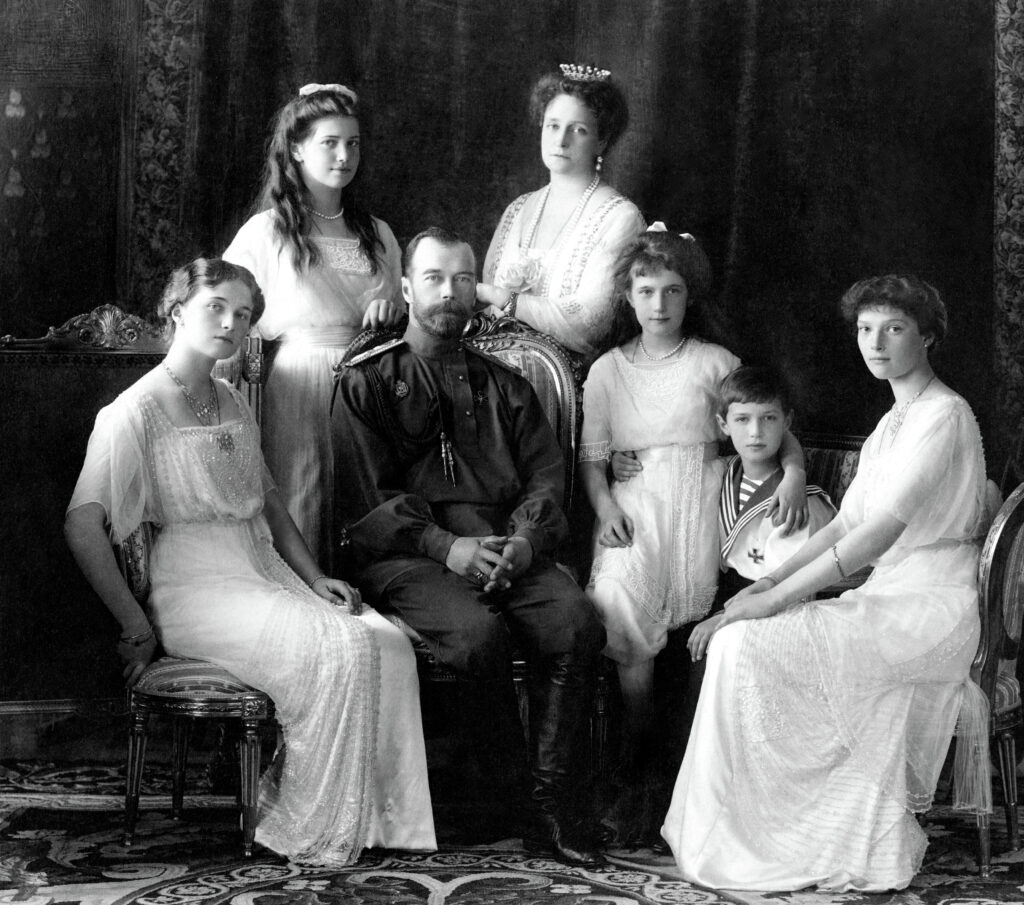
Russian Imperial Family 1913

EDWARD DUTTON enjoys a rare insight into the melancholy fate of the Russian nobility

Former People: The Last Days of the Russian Aristocracy

Douglas Smith, Pan Books, 2013, pb, 464pp., £8.99


History, as Douglas Smith points out, tends to focus on the winners. But history’s losers can be just as fascinating. This is especially so if they were once dominant themselves and experienced a fall from power and privilege that would not be out of place in a Shakespeare tragedy. The Russian aristocracy, whose story is skillfully told for the first time in a work of popular history, appears to have many of these ‘tragic hero’ qualities. There was much to admire in the Russian nobility – pretty much all Russian high culture was associated with this class. However, their tragic flaws – a romantic attachment to Mother Russia, a naive belief that the former serfs were somehow content, and a failure to understand how fundamentally their world had changed after 1917 – led to their destruction.

In telling the story of the “former people”, as these class enemies and outcasts were officially known in the Soviet Union, Smith makes the sage choice to focus on two prominent families – the Sheremetevs (who were counts), and the Golitsyns (who were ‘princes’) – and the various families into which these clans married. This method gives Fomer People a much needed personal touch and adds to the sense of poignancy. We follow these families from the 1860s, when most Russians were still serfs, right up to World War II. We become absorbed in the unfolding saga as we gradually discover which characters survive and how long they survive for in the face of relentless Soviet persecution. We read their worried diaries and self-deluding letters from the beginning of the last century as they gradually notice that things are going very wrong. Continue reading

Posted in QR Home | Tagged , , , , , , , | 1 Comment

“Me too” history

“Me too” history

FRANK ELLIS finds that the best that can be said about a new biography of Hitler is that it adds nothing to our understanding

Hitler: A Short Biography

A. N. Wilson, Harper Press, London, 2012, pp.190, Notes, Bibliography

“No, no, I was saying that you, Miss Elk, were an, A.N. not A.N.N.E., expert.”

The Dinosaur Sketch, Monty Python

First published in 1952, Alan Bullock’s biography of Hitler, Hitler: A Study in Tyranny remains an effective analysis of one of the politicians that tore Europe apart in the mid-twentieth century. Other historians have followed Bullock’s trail: Ian Kershaw, David Irving and Richard Evans. In the realm of film, Bernd Eichinger’s Der Untergang (The Downfall, 2004) is also a must see for anyone interested in the rise and fall of Hitler: Bruno Ganz’s interpretation of the Führer is utterly bewitching. New and compelling source material or an examination of existing material in such a way that casts new light on the subject would certainly justify another study. So the obvious question is whether Wilson should attempt to write on a subject that has already been covered in enormous detail by serious historians, and in such a shortened format.

There are parts of the Hitler phenomenon that still require an explanation. For example, Wilson points out that Stalin and Mao killed more people than Hitler, yet

Hitler has retained his place as the Demon King of history, the ultimate horror-tyrant.

Now this is a serious question and the perfect opening and opportunity for Wilson to pursue it further. Why is the benefit of the doubt always given to Lenin, Stalin and Mao, and why when examining genocide carried out by communist regimes, as in, for example, the Holodomor and other communist crimes against humanity, does the evidentiary threshold have to be so much higher than anything suspected to have been committed by the Nazis? School curricula properly mandate that our schoolchildren learn about the Holocaust, but the 6,000,000, mainly Ukrainian, victims of the Holodomor, and the 40,000,000 + who were exterminated in Mao’s Terror Famine are passed over. Victims of communist genocide do not seem to matter. Part of the answer lies in the fact that even now, after the slaughter of tens of millions of people in the name of the equality-and-brotherhood-of-man cult, international socialism still commands loyalty.

The Wilson view of twentieth-century history, especially as it concerns the role played by the Soviet Union, is imbued with the brazen nonsense I expect to find in the work of Eric Hobsbawm. To quote Wilson:

The tragic paradox at the centre of mid- to late-twentieth-century history is that Europe, and the world, owed its deliverance from the tyranny of Hitler to the heroism of the Red Army.

Wilson clearly does not grasp what took place in Eastern Europe after 1945 or, worse still, is trying to play it down. The sort of people who are able to regard with equanimity the hideous Red Terror that was imposed on the states of Eastern Europe in the last month of the war, and long after, are fanatical Stalinists, ignoramuses or those with an agenda intended to deny the truth.  The arrival of the Red Army meant class war; the mass rape of German women of all ages; mass deportations and expulsion of millions of people and the imposition of totalitarian systems which on every available index of state terror were even worse than anything created by National Socialism. Well into the 1950s, Belorussian, Ukrainian, Polish and Lithuanian nationalist groups waged a no-holds-barred insurgency against the NKVD and the Red Army occupation of their countries. The Stalin state and its successors were not interested in liberation, only the imposition of totalitarian control. To describe the occupation of Eastern Europe from 1945-1989 as liberation is a gross misuse of language, no different in spirit from the Nazi ‘Arbeit macht frei’ that taunted arrivals at Auschwitz-Birkenau. Claims about Soviet liberation of Eastern Europe are obviously inconsistent with the later view – and also evidence of poor editing – that:

The war which had begun to rescue Eastern Europe from the hands of two repressive tyrannies – Nazi Germany and Soviet Russia – was about to be won by Soviet Russia.

If Wilson eventually concedes that Nazi Germany and Soviet are both ‘repressive tyrannies’ and that the Soviet Union, a ‘repressive tyranny’, liberated Eastern Europe, does this mean that Barbarossa can also be seen as a campaign of liberation, as Nazi propagandists claimed? Wilson’s claim that the war was started to rescue Eastern Europe from two repressive tyrannies is not only preposterous, but shows no grasp of the facts: Hitler started World War Two by invading Poland, and the Soviet Union, taking advantage of the secret protocols of the Nazi-Soviet Non-Aggression Pact, invaded Poland from the east on 17th September 1939.

Examples of Wilson’s succumbing to the pro-Soviet narrative of the Great Fatherland War are evident when he writes:

The immense strength and skill of the Red Army and the titanic heroism of the Russian people in resisting invasion must have taken Hitler by surprise.

Wilson evades, first, the obvious fact of Stalin’s catastrophic failure to heed all the intelligence warnings of imminent invasion – mercilessly castigated by Churchill in Volume III of his history of The Second World War – and, second, the fact that the Red Army was not as competent as the German Army and that this lack of mastery had to be compensated by blood. Moreover, as Joachim Hoffmann has pointed out, the willingness of so many Soviet citizens, including Russians, among them General Andrei Vlasov, to collaborate with the German invaders reveals the fundamental lack of legitimacy enjoyed by the Soviet state. A third point is that Wilson shows no understanding of the critical difference between ‘Russian’ and ‘Soviet’ (or between Ukrainian and Soviet and Belorussian and Soviet and so on). Soviet was a Marxist-Leninist construct designed to eradicate – psychologically, culturally and physically – any sense of national identity (just like its successor cult multiculturalism).

Turning to the rise of Hitler, Wilson conflates Darwin and the survival of the fittest with the Nazis. The survival of the fittest is not a doctrine that justifies genocide. It explains why some living creatures, being unable to adapt to changes, are less successful, less fit for purpose – the primary purpose being survival – than others, and so are either marginalised or perish. The survival of the fittest does not exclude the extermination of rivals in order to survive, but rivals are just one of the problems that must be overcome as the living being confronts the challenges of its environment. Success in war also reveals fitness for purpose (survival) since superior intelligence, itself an evolutionary adaptation, will mean that the more intelligent tribes, races, populations will produce better weapons and thus be able to destroy or to dominate rivals.

Wilson would also have us believe that the spectre that was stalking Europe was not communism but bankruptcy. According to this view, bankruptcy was the major factor in the rise of Hitler. The Weimar hyperinflation and the Wall Street crash played their part – of this there is no doubt – in radicalising the German middle class, but it was the provisions of the Versailles Treaty (in Germany) and fear of communism which fuelled the growth and rise of the nationalist reaction embodied in National Socialism and Italian Fascism. Bankruptcy alone cannot explain the rise of Hitler.

Wilson’s interpretation of Hitler – his origins, military service in World War One and political qualities – says more about Wilson than it does about Hitler. Is it true or even broadly consonant with what is known about Hitler to maintain that:

For twelve years, this man who had no obvious talent for anything except public speaking, the manipulation of crowds, and the manipulation of individuals through emotional bullying, dominated European history.

If this was the real Hitler that dominated Europe for twelve years, what does it tell us about the rest of Europe? It strikes me as grotesquely inadequate in historical terms to portray Hitler in this way. Only a unique individual and one with exceptional abilities could have achieved power in the circumstances that obtained in Germany between 1918 and 1933. The ends to which this power was put, having been secured, is another matter. Hitler consistently outmanoeuvred his domestic and foreign rivals. Conservative Germans – officers and politicians – who dismissed Hitler as some Bohemian, failed-artist-impostor-corporal who would be put in his place – simply failed to understand not merely the catastrophic aftermath of World War One but the nature of the forces which propelled Hitler to power and which he manipulated with consummate skill. Only a master politician could have achieved such success.

When he comes to the matter of Hitler’s winning the Iron Cross, Wilson confirms his personal agenda. He plays down any suggestion that Hitler deserved the Iron Cross, claiming that it was comparatively easy for an infantryman to win the Iron Cross, First Class, if he was in constant touch with officers. First, given that all German infantrymen were in constant touch with officers, this would suggest that German infantrymen were being showered with Iron Crosses. And how did officers secure the award of medals? Did they just make sure that they were around other, senior officers? Second, Wilson insults the competence of German officers and the bravery of all those German soldiers along with Hitler who were awarded the medal. When Wilson sneeringly dismisses the award of the Iron Cross to Hitler “for being, in effect, little more than an obedient postman”, he insults the bravery and dedication of all German (and Allied) combat runners in both world wars. Was the German Army alone in using ‘obedient postmen’? Third, the fact that Hitler was a regimental runner, somewhat back from the immediate front line is irrelevant. Artillery in World War One was one of the main causes of soldiers being killed and wounded, and German regimental headquarters and soldiers were well within range of British and French guns. Delivering messages from regimental headquarters down to battalion level involved considerable risk, especially when forward positions were under fire. Furthermore, the closer a runner is to the front line, the greater the risk of his being hit by aimed or spent small arms fire. Fourth, the fact that Hitler was wounded while sitting in a tunnel close to regimental headquarters and not while delivering messages has no bearing at all on whether Hitler deserved the Iron Cross. In all armies, awards are often made for sustained good service rather than one act of outstanding bravery. Wilson’s attempts, in the manner of some tabloid hack, to destroy any notion that Hitler deserved the award of the Iron Cross, are not serious history.

There is also a stark inconsistency in the way Wilson refers to what German officers thought about Hitler. On the one hand, mere constant contact with a German officer is sufficient to secure an Iron Cross, so the judgment of the officer that wrote the citation is suspect in Wilson’s eyes, yet when it suits him Wilson takes the assessment of Hitler’s officers that “he possessed no leadership qualities” at face value. To believe that Hitler could have got as far as he did without leadership qualities of any kind strikes me as bizarre. Hitler cannot be merely dismissed as a conjurer. Conjurer he was, but he was also a master tactician. Master conjurers might instantly recognise the audacious brilliance of Erich von Manstein’s plan to defeat the Anglo-French armies in the summer of 1940, but the plan still requires tanks, superior leadership and tactical doctrine. Nor does it matter that the conjurer is not the best dressed man about town, or that he is constantly farting. I mention the latter since Wilson informs the reader that Hitler suffered from excessive farting – the technical term is meteorism – caused by his vegetarian diet. Later, the reader learns that

Hitherto, since the First World War, his [Hitler’s] career had been one of meteoric ascendance.

Perhaps this explains why politics stink and why so many vegetarians are misanthropic megalomaniacs.

Again, as with the clumsy and spiteful attempts to render unworthy the award of the Iron Cross to Hitler, Wilson makes a fool of himself when he expects us to believe that

it was the very fact of his limitations which gave him such strength. He had few abilities and it was these which carried him along.

The question here is how did this apparent non-entity who enjoyed none of the social privileges and economic advantages of, say, Churchill, manage to gain control of Germany, then consolidate his power in a series of brilliant internal and external coups, oversee, and make contributions to, the military destruction of the British and French in the summer of 1940 (the most immaculate military campaign in history?). Was this success merely down to an astonishing gift for public oratory alone?

Any attempt that Wilson makes to present this deadly serious subject is repeatedly undermined by the author’s exaggerated snobbery. Thus, he tells us that Göring cut a “preposterous figure”. So what? Göring was a highly intelligent individual and as a World War One air ace, was awarded the Pour le mérite, Germany’s equivalent of the Victoria Cross. Likewise, when Wilson tells us that Goebbels was “a shameless liar”, he fails to realise that being a shameless liar, and in the case of Goebbels a highly effective one, is the ideal qualification for someone who is head of propaganda. A majority of politicians in all political systems are, in any case, shameless and psychopathic liars. Unfortunately for many of them, they are not in the same class as Dr Goebbels. On the subject of lying and propaganda, Nazi exploitation of the 1936 Olympics to support Nazi views of a racial élite, which Wilson singles out for criticism, is no different in principle from the way xenophiles exploited the London Olympics in 2012 in order to disseminate and to promote the neo-Marxist worldview of multiculturalism.

Wilson’s snobbery is not only irrelevant, it contributes to a distorted picture of his primary subject. According to Wilson, Hitler was

…the cringing lower middle-class man who felt ill at ease with his social or military superiors and would do all in his oleaginous power to be ingratiating.

Like any politician seeking favours, Hitler could be ingratiating, yet all the evidence suggests that it was not Hitler who was ill at ease in the presence of people who, before his ascent to power, would have been considered his social and military superiors. It was the other way round. As Führer, Hitler enjoyed not just the formal authority emanating from his status as head of the Third Reich and NSDAP but dominated, perhaps mesmerised, his generals and civilian administrators; and when some of them eventually betrayed him very late in the war (20th July 1944) they were shown no mercy. In most contexts, Wilson’s snobbery would be a minor irritant, a symptom of his own sense of social inadequacy. However, it becomes a serious impediment to serious analysis when it prevents him from seeing through superficial trappings such as clothing and status. Thus, he describes Goebbels’s wife as “tragically majestic”.

Corinna Harfouch as Magda Goebbels - "a demonic figure straight from the pages of Dostoyevsky"

Magda Goebbels – brilliantly interpreted by Corinna Harfouch in Der Untergang – colluded with the SS doctor in Hitler’s bunker in order to poison her children. I see no aureole of majesty here. I see a demonic figure straight out of the pages of Dostoevsky. Where others in the Third Reich and in the Soviet Union succumbed to evil, unable to resist because they knew not what they did, this woman knowingly and willingly embraced evil in the deliberate pursuit of moral depravity and perversity.

Should historical outcomes other than those that occurred be taken seriously? Wilson speculates whether Hitler might have been stopped had the British and French been firmer only to tell us over the page that:

Events unfolded as they did. To ask whether things could have happened otherwise is the task not of history but of the parlour game.

Given that history is our only guide to the future, it most certainly is the task of historians and military thinkers to consider what might have happened. Resolutely inconsistent Wilson plays the very parlour game he has earlier condemned when he asks:

What would have happened if Chamberlain and Daladier, the French premier, had moved in troops and tanks and planes to help the Czechs?

There are a number of serious errors of fact in what is a very short essay. First, Britain did not go to war in 1939 to defend Jews: we went to war because of recklessly given guarantees to Poland, one of the most virulently anti-Semitic nations in Europe. Second, it was Germany that pioneered terror bombing, not Churchill. Third, it is not the case that Rommel ‘was largely responsible for the defeat of France’.

Fourth, the invasion of Poland was launched on 1st September 1939, not 3rd September, as claimed by Wilson. A half-competent copy editor would have identified this gross error: 3rd September 1939 marks the day when Britain declared war on Germany.

These errors of fact are often accompanied by some bizarre assertions. For example, Wilson makes the claim that the Normandy landings were accomplished “with terrible loss of life on all sides”. The landings were a personal triumph for General Montgomery. Complete tactical surprise was achieved, and by the end of 6th June 1944 thousands of Allied soldiers and their equipment were ashore. Considering the scale of this operation Allied losses were low (c. 12,000 killed and wounded). Moreover, the deception plan – Operation Fortitude – convinced the Germans that Normandy was a feint and so Panzer divisions that might have tipped the balance had they been deployed were not deployed but were kept in reserve in anticipation of the major landing at Calais. By the time the Germans realised that Normandy was the main landing ground it was too late. Poor copy editing also failed to pick up Wilson’s erroneous use of “to beg the question” which he uses to mean the same thing as “to raise the question”. Wilson shares this failing in common with other tabloid journalists and the BBC.

Wilson’s real purpose in writing this short biography is not to inform, but to parade his politically correct credentials and to demonstrate that he is not a secret fan of the Führer. In other words, what we are being offered in Hitler: A Short Biography is a declaration of the author’s loyalty to the politically correct ideology of our time, a contribution to the genre of confessional tabloid journalism, certainly not to serious history. I am reminded of the concluding lines of 1984:

Two gin-scented tears trickled down the sides of his nose. But it was all right, everything was all right, the struggle was finished. He had won the victory over himself. He loved Big Brother.

At least poor old Winston went down fighting. For his part, Wilson has headed in the direction indicated by the weather vane on top of Broadcasting House: it is so much easier – and less troublesome professionally – to poke fun at Hitler rather than to explore the fundamentals which say something about the good, the evil and the depraved in all human beings and in all political systems.

Dr. FRANK ELLIS is a former soldier and academic, and a military historian. His latest book is The Stalingrad Cauldron: Inside the Encirclement and Destruction of the 6th Army (University of Kansas Press, 2013). © Frank Ellis 2013


Posted in QR Home | Tagged , , , , | 1 Comment

ENDNOTES – Vaughan Williams from Oregon – and an elegy by Herbert Howells

ENDNOTES

STUART MILLSON enjoys Vaughan Williams from Oregon –

and an elegy by Herbert Howells

American conductors and orchestras have long been interested in British music. The two Leonards, Bernstein and Slatkin, both made memorable recordings of Elgar; Robert Shaw conducted Walton and Vaughan Williams in Atlanta; and this September, Marin Alsop (well known for her work with the Baltimore and Sao Paolo symphony orchestras, and for championing modern American composers) will be the first woman to conduct the Last Night of the Proms – including in her programme the rarely-performed music of Cornishman, George Lloyd (his HMS Trinidad March).

Earlier in the year, PentaTone Classics issued an elegantly-presented super-audio CD of The Oregon Symphony Orchestra under Carlos Kalmar* playing three important English works: Elgar’s Cockaigne Overture, subtitled by the composer, ‘In London Town’; the Symphony No. 5 by Vaughan Williams; and Britten’s Four Sea Interludes and Passacaglia from Peter Grimes. Benjamin Britten has been well served by the Endnotes column in recent months, so this review will be devoted to the Oregon Vaughan Williams – a version of the work that has intrigued me and made me listen to this newly-minted CD time and time again.

My definitive Vaughan Williams 5 has to be the majestic, deeply-felt performance by that great British music specialist, the late Vernon Handley – a conductor who must have made nearly a hundred recordings of music by composers from these islands. Handley was a pupil of Sir Adrian Boult (for many, the “high priest” of Vaughan Williams and Elgar performance) – but (for this reviewer) it is Handley and the Royal Liverpool Philharmonic Orchestra on a 1980s’ EMI disc who find the meaning of life in this score.

Kalmar and his Oregon players, meanwhile, have set off on their own path to RVW – understanding the work’s Englishness, but finding all the serenity and moody depths of a piece which was first performed at the Proms in 1943, conducted by the composer. Vaughan Williams’s Fourth Symphony – a work of the dissonant 1930s, and a dissonant work of the 1930s, too – had led many to expect the successor-work to be a commentary on the devastation of war. When Vaughan Williams raised his baton on that summer evening at the Royal Albert Hall, instead of war music, the audience (which undoubtedly contained many servicemen and women enjoying a precious few hours of leave) heard horn calls from “over the hills and far away”; soft, high strings which seemed bathed in the last rays of the early-evening sun; and threads of melody – hymns or folk-songs – rising and falling in an orchestral English impressionism.

The composer had long been working on a great project, The Pilgrim’s Progress – which eventually became an opera. (Incidentally, a BBC Radio Classics recording exists of a suite which Vaughan Williams made of “pilgrim’s” themes for a wartime radio broadcast – so it is clear that musical ideas, inspired by this subject, lodged themselves in many of his works.) The Fifth can therefore be seen as part of the pilgrim’s progress – a musical counterpart, perhaps, to the film, A Canterbury Tale, which Michael Powell and Emeric Pressburger released in 1944; and – once again – thousands of miles away in the Oregon of today, English esoterica has not eluded or baffled a modern overseas band! Instead, the song is sung with a definite American accent: the taut, springy tone of the Oregon S.O., with its punchy, strong-willed, trombones and trumpets (with that blast and slight rasp – a hallmark of the American brass sound) bringing Vaughan Williams into the wide-open spaces of North America.

The second movement – with its jagged, spectral shadows; its demons, gargoyles and marsh creatures (the sort you might see carved into the stone and woodwork of old East Anglian churches) – is played brilliantly, and when a high-hills, clear-skies theme suddenly appears in that complicated movement, breaking the tension, conductor Carlos Kalmar seems to have glimpsed the pilgrim’s imagined eternity and peace. Fine things also come in the third movement, the Romanza – once described as one of the high points of English romantic music. The movement’s opening is like a sigh, and Kalmar’s players treat it with reverence: it is as if they are passing a piece of stained-glass window between them, so careful and delicate is the sound.

If Vaughan Williams’s Fifth was an oasis of peace in 1943, a wiping of the brow in wartime, the essence of the unchanging landscape, a pilgrimage; then the PentaTone record label has truly revived it – or revisited it: a digital realisation – a “product” of the year 2012, recorded at the Arlene Schnitzer Concert Hall, Portland, Oregon, and edited, mixed and mastered at Soundmirror, Boston; an age away – it seems – from the time when RVW wrote his four-movement benediction. Perhaps the last word should go Steven Kruger, whose insights make the CD booklet one of the best you could ever hope to read. He writes of the last moments of the work…

It is as if the symphony takes you lovingly by the hand to lead you home. And as you approach its doorstep, it seems that the music would slow down for a proper goodbye. But instead, with a tiny push forward, the penultimate two chords slip through your fingers – and break your heart.

The heart-breaking quality of English music can also be found in the Elegy for Solo Viola, String Quartet and String Orchestra (Op. 15) by the Gloucestershire-born composer, Herbert Howells (1892-1983), a contemporary of Vaughan Williams, and musician who shared all of RVW’s mystical love of the hills and country of the Severn and the Cotswolds. Howells has been well-served, not just by the English Music Festival, but by a wide range of conductors, including – surprisingly – the Russian, international master, Gennady Rozhdestvensky, who recorded his Missa Sabrinensis (Mass of the Severn) with the London Symphony Orchestra and Chorus. Once again, we are seeing that English music does travel – that it is both English and universal, and needs only the gentle nudge of our world-class conductors and foreign orchestras to launch it on trackless seas.

From Chandos comes a re-issue of Howells’s Elegy, conducted by the late Richard Hickox, a much-missed recording artist who was equally at home in the baroque and late-romantic repertoire. On this disc (commemorating the legacy of the conductor), the orchestra is the City of London Sinfonia, and they have been given the finest recording quality for what is a lament for the dead of the First World War – in particular, the loss of a violinist friend of Howells, Francis Purcell Warren, who perished in the mud of Europe.

The CD also includes the Concerto, Serenade and Suite for strings – reminding us of the great industry of the composer, and a body of work that should be better known.

STUART MILLSON is the QR’s Classical Music Editor

CD details

Vaughan Williams, Fifth Symphony (with Elgar and Britten). Oregon Symphony Orchestra/Carlos Kalmar. PTC 5186 471

Howells, Music for Strings. City of London Sinfonia/Richard Hickox. Chan 10780 X

*Carlos Kalmar, Music Director in Oregon, has worked extensively in Germany, serving as Chief Conductor in Hamburg. In England, he has conducted the City of Birmingham Symphony Orchestra, and has also presided over performances in Tokyo, Canada, Chicago and Boston.


Posted in QR Home | Tagged , , , , , , , , | Leave a comment

Photographs from last summer

Photographs from last summer


I

The blossoms of bindweed

Strewn on Towton field like Meissen plates.

Delicate dirt; if I turn them,

Will there be crossed swords on their base?


II

Deer-prints point to the sea,

Sharp-stepped, firm-pressed, precise;

I follow, clumsy –

When I get there, they’ve been wiped.


III

On the road, a bumble queen knocked over –

Her hot fat fur throbs dangerous in my hand;

I enthrone her in a stateroom of red clover;

She restores herself – and populates a land.


DEREK TURNER is Editor of the Quarterly Review

Posted in QR Home | Tagged , | Leave a comment

English as she is spoke

English as she is spoke

A commentator says that sloppy speaking means sloppy thinking

When I took up computer programming, I realised how important it is for the language to be as simple and clear as possible. Any syntactical rule that doesn’t yield a definite benefit is annoying. As technology has progressed, using it has become ever simpler; in the 70s you needed to think like a machine in order to control one, but nowadays virtually everyone can do it because computers have been made ‘user-friendly’. While this means that a vastly greater number of people can ‘take part’, it also makes redundant the skill and study that used to be required. This means that a bad programmer will not even realise that he is inferior to an excellent programmer, since the latter’s skills are no longer necessary or championed.

A similar thing is happening with language, at least in the Anglosphere, and certainly within Britain, and especially within Scotland. Complications that used to denote advanced mastery of English – like might/may – are now virtually forgotten. In fact, complications that denote basic mastery of English – fewer/less and simpler/more simply – are increasingly forgotten, and the pedant who bemoans this cast as a Luddite, elitist, arrogant, and so forth.

When simplifying a programming language, the goal is to make it clearer and easier to use. Indeed there are things about English that I think should be simplified – receive and believe, etc. – because they are pointless and only confuse people. But that is something which would be done, if at all, by conscious orchestration.

The simplification of English that we see in real life is not increasing clarity, and it is certainly not enriching or deepening the scope of the language. This is because it is wholly unconscious and un-orchestrated. For the most part it is a result of laziness. People are speaking in degraded forms of English because they can’t be bothered to learn the rules. Those who have learned the rules often can’t be bothered to remember them.

Obviously there is an exacerbating factor. While people are getting lazier, those who used to curb it – teachers, employers, parents, etc. – are now choosing not to, or are not allowed to, or are not able to, since their own education was sub-standard. We’ll come back to that later. The next section comprises predictions as to how the degradation of English will progress.

Predictions

The first prediction is obvious because it is nearly complete: the extinction of the word whom. The rules for when to use who and whom are quite fiddly, and the words are so similar that it is little wonder one of them is being absorbed into the other. This is a shame because whom is a useful word. You couldn’t really say: “For who is the film intended?”

Certain words will be given easier pronunciations. For example, bottle will become bottuww, as we’re seeing among television journalists and, for myself, in the people of daily life. As part of this, usage of the glottal stop will increase, as it has been for years. Eventually the spellings will be updated to reflect how the words are pronounced.

Syllable-merging will be a general thing. One example of it we’re already seeing is suppose becoming spose. A more ornate example is the replacing of there’re with there’s, because it’s easier to say. The unabbreviated versions are being duly merged, so that we see statements like there is three cars. The same is happening with the past tense – there was five people.

Consonants will be universally swapped for ones that are easier to pronounce. The hard TH (as in that) is being replaced with D, so that you hear dis and dat, especially in London since it fits very well with the “Jafaican accent”. In Scotland, young people are increasingly saying F instead of the soft TH, so that you get free wise men and frough fick and fin.

In terms of punctuation, life will be extremely simple: there won’t be any, except for the comma. Already, the comma is seen as an all-purpose solution and has replaced the colon, semi-colon and dash, and is quickly replacing the full stop.

The disappearance of the full stop is very revealing psychologically. A full stop splits text up into several sentences, and thus is the beginning of bestowing structure upon the text – organising one’s ideas so that they are clear and digestible. This process demands consideration, planning and revision. It demands, in other words, that the writer considers everyone else, not just himself. People can’t be bothered doing that, so they forego structure altogether: no full stops, no sentences, no structure. They just use commas to separate ideas. The result is one long sentence, a shallow splurge, a stream of consciousness that has simply been written as each idea occurred to the writer:

We went to the shops, it was pretty boring, Jim got some shoe’s but i cudn’t be bothered, we had an argument the day before and he was still acting funny, we had lunch and he was saying stupid thing’s just to wind me up, i shud of went home, i guess i was hopping we could work it out…

I’ve packed a few other things into that example….

Spelling is being simplified. The correct spelling of could is not consistent with good etc. so it’s being simplified to cud, and presumably good will eventually become gud. Unnecessarily complex spellings (love) and irregular spellings (penguin and location) will surely be nixed by a populace requiring as few rules, and exceptions to them, as possible. So we can expect luv, pengwin and lokaeshin. How people will then know that luv is pronounced differently from gud is anyone’s guess – presumably, it simply won’t be pronounced differently: we will lose a vowel.

Words that have multiple spellings will be merged, with the shortest spelling winning out. Again, we’re seeing this with you’re becoming your and too becoming to.

Past and past-perfect verbs are being merged. For example, went instead of gone, done instead of did, seen instead of saw, wrote instead of written. Among Scottish people under the age of 30, I almost never hear the correct word used. This is true even of 20 year-olds fresh out of top Edinburgh private schools. Some time ago I spoke to one such young man, the son of an accountant. He described a Rolling Stones concert:

I seen them last year. They done Ruby Tuesday, they done She’s So Cold, they done Jumpin’ Jack Flash, they done all my favourites, they done Angie… It was awesome, man

Though this young man is intelligent and very enthusiastic, were I an employer I would find it difficult to take him on because of the appearance he would give to the company, and how his diction would undoubtedly affect that of other employees.

Another feature of the speech of young Scottish people is the word yous, a plural of you. (“Are yous following this?”) Just ten years ago this trait was confined to the working-class. Now it is virtually ubiquitous among people under 40. Returning to the Anglosphere in general…

Unusual plurals, like stadia, cacti and wolves, are simply being forgotten.

Have is being replaced by of. We see I would of and she could of. I think this is happening because in that context we will, in our less uptight moments, pronounce have without the H sound – now the spelling is being altered to suit. As a bonus, of is a shorter word than have and doesn’t have the confusing E at the end of it.

Any words that end with an S are increasingly being written with an apostrophe. At first this was done with plurals (many school’s, three play’s, etc.) where at least there was a historical explanation: we had been incorrectly writing CDs as CD’s and the 1940s as the 1940’s for many years. But it is now being done with non-plurals: it become’s green, she learn’s faster etc. There is no rhyme or reason to when people do this. I think it may become ubiquitous because people don’t want to have to think “should I use an apostrophe here?”. It’s simpler just to do it every time. But eventually, since it will have come to denote nothing, people will wonder what the point of it is and will completely stop using it.

Whatever happens in the future, the current use of the apostrophe reflects widespread uncertainty. One can see this in all sorts of things, such as the haphazard use of capital letters (“We went into Town 2day”). Many simply don’t know the rules anymore; everyone is guessing.

It is quite interesting to see people doing something correctly and incorrectly within the same sentence, meaning that, when they get it right, it is just by accident. For example, people cover their bases by using multiple spellings of a word, thinking that one of them will be right. Here is a genuine example from Facebook:

To you, there animals. To me, their family.

The person must have known they were using the same word twice. It’s just bad luck that neither of the spellings they tried was correct. Tragically, we can see that the person is perfectly capable of handling different spellings but has either been let down by illiterate teachers, or picked up bad habits from friends, or both. It’s becoming a free-for-all. Who’s to say in 20 years’ time that something is incorrect when everyone is doing it?

Effects

It is worth speculating what effects the degradation of English will have. The most obvious effect is that people’s thinking will become shallower. This happens on two levels.

The first can be illustrated with a story. There was a forum I used to frequent. In 2003 it had a rule that people should endeavour to use correct English. Posts tended to be thoughtful and well-considered; inevitable if you are reading over your work for spelling, punctuation, etc. In 2008 the forum changed ownership and the new owner scrapped the rule about correct English, and moreover implemented a new rule: people were not allowed to comment on other people’s literacy. I returned to the forum two years later and was shocked at the decline in not only spelling and grammar, but quality of debate. People no longer seemed to put care into what they wrote, so their posts had become trivial and ignorant. I believe this was a direct result of the change in the forum’s literacy policy.

But if bad literacy makes for bad writing, bad writing makes for bad thinking. This is the second, and more insidious, way in which degraded English will degrade people.

While I don’t agree with Orwell that all thought is verbal, I do believe that available language extends the range and depth of thought. Without language to fix and sharpen ideas, ideas will remain unfixed and blunt. Without a language capable of expressing complex ideas, only simple ones will be expressed and, eventually, formed in the first place.

Degraded English condemns the speaker (and thinker) to a kind of cultural purgatory from which they can never escape. Take the case of Emma West, the tram-bound, toddler-toting racist of dubious education. Her inarticulacy meant that she made her complaints about mass immigration in the most clumsy, simplistic, repetitious and unenlightening way. She had not the language to do otherwise. Her remarks were basic because her thought was basic because her literacy was basic. As such, she has been easily written off as a ruffian whose views on multicultural Britain must be the product of ignorance. This ‘writing off’ has been unspoken, for nobody wants to appear snobbish, but we all know what will have been said about Emma West in the bars around Westminster, Islington and BBC Television Centre. To put it in perspective: Emma West’s inarticulacy was so damaging that it neutered an issue which is of intense concern to 95% of her countrymen; because of the inarticulacy, the issue went unaddressed. Dictators dream of having that kind of control over public discourse.

But degraded English has worse effects still. It makes people aliens to themselves and to each other by making analysis and evocation impossible. Let us review the fictitious account of a shopping trip by a couple in a turbulent relationship:

We went to the shops, it was pretty boring, Jim got some shoe’s but i cudn’t be bothered, we had an argument the day before and he was still acting funny, we had lunch and he was saying stupid thing’s just to wind me up, i shud of went home, i guess i was hopping we could work it out…

Few would say this is a sophisticated analysis, or even an analysis. We can tell the girl is annoyed with her boyfriend but nothing more. Her language cannot sustain nuance or hidden meanings so her account is entirely factual. As such, it is useless for anyone trying to understand the girl or her relationship. Both the narrator and the subject disappear amidst the fuzz of a low-quality transmission. Nothing, in the end, is achieved, for the girl writes only what she already knows: the facts. No self-study or other-study is even possible. We end where we started, except that our memory has been blunted by being consigned to paper with a blunt instrument. Any missed nuances will be forgotten as the badly-written account becomes ‘the truth’.

There are also geographical implications of the degradation of English. In the absence of an ‘official’ language (standard English), I think we may see English diverging into local dialects. Of course these have always existed but, for centuries, anyone who went to school has had standard English as a common language that they can use to communicate with people from anywhere else. I suspect that standard English will survive, in a slightly simplified form, for centuries, much as Latin survived for centuries after it was a ‘dead’ language, but like Latin it will be a tool of the intelligentsia. People ‘on the ground’ will be speaking wildly different versions of English. We’ll have Glaswegian English, Edinburgh English, Manchester English, Newcastle English and, dare I say it, Asian English and Brixton English. The more that the official version becomes irrelevant, the more people will leave it for a dialect which allows easy communication within one’s neighbourhood (and, in so doing, bestows identity).

Now, you may say that the Internet will counter this, being a platform where one can communicate with people in any other country. It is reasonable to assume that people will want to retain that capability, and therefore will retain a grasp of standard English. But I dispute this. People only talk online to people they want to talk to; one’s Facebook friends list largely reflects one’s real life social milieu. I see friends of mine on Facebook writing in broad Scots – how many English people or Australians or Americans can understand what they write? Here is a genuine sample:

Hes no an addict. He went 3 weeks wioot it in the hoose

The websites one visits reflect the range of one’s curiosity, regardless of the vast number of websites available. In the same way, there is no reason to assume that, just because everyone is available on the Internet, your average badly-educated Briton will want to converse with them. On the contrary, I think that, just as they stick to X-Factor and Daily Sport websites, they’ll stick to the social milieu of their real-world life, and this insularity will intensify as their language gets ever more ‘local’. This would be a case of the Internet reinforcing real-life boundaries – something I have never seen discussed, yet which seems very possible to me.

Of course, given the low cultural tastes now abounding, this may not be such a problem; you don’t actually need verbal language in order to partake of the trivial nonsense that now constitutes much of Internet ‘culture’. People can share this Monday’s web fad without using any words at all. When it comes to expressing their opinion of it, they can simply use a smiley face, 0-5 asterisks, or the Like button.

It may transpire, in fact, that the degradation of verbal language is just a step on the path towards wholly symbolic/visual communication, a universal dialect of thumb-ups and thumb-downs expressing the considered critique of trifles by humanity from all corners of the Earth.

It is easy to overstate the importance of grammar, spelling and punctuation. At least, it is easy for someone to accuse you of doing so. Pedantry is always annoying. Ultimately, if we look at people as functioning organisms, all that is important is that they understand each other’s signals. When someone emails me saying “I could of ate five apple’s buy now”, I know that they mean “I could have eaten five apples by now”. That’s what they wanted to get across, and they’ve managed it. Yet, I am more than a functioning organism, and I can’t help but feel insulted when someone communicates with me in bad English. It also seems ridiculous that, in Britain, we look upon the transmitting of extremely simple ideas as a challenge so big that just to manage it is an achievement. But that is the situation.

To me, using bad English suggests several things about the person, any of which could be true:

  • they are unintelligent
  • they have low linguistic ability
  • they simply can’t be bothered to speak/write properly
  • they were badly educated and are not embarrassed about it
  • they were perfectly well-educated, but have since succumbed to some kind of nihilism
  • they consider themselves so interesting, and their thoughts so inherently beguiling, that they see no need to ‘dress them up’ for other people’s convenience. Indeed, to do so could even be perceived as a lack of self-confidence since one would be humbly considering other people.

Of these possibilities, I would never hold it against somebody that they were badly educated, but I would hope they’d be embarrassed about it. I wouldn’t want them to feel inferior, but I’d want them to quietly be aware that education was a good in itself and people who had it were very lucky. This is where culture is vital. Only an elitist culture which believes in good and bad and its own right to make such pronouncements will consider education a good in itself. What we’ve had since Anthony Crosland in the 1960s is an anti-elitist culture which disparages ‘the finer things’ and sees education as a mere means to an end. That end was initially ‘make kids employable’ but soon morphed into ‘use kids as putty for social engineering’. Neither of these mindsets values cultivation, and language is the core of cultivation. As such, it was inevitably going to suffer

But the education establishment is probably not the ‘root cause’ of the decline. I think they accelerated it, and one should not underestimate their power (or desire) to do so, but ultimately I think they were just opportunists, seizing the chance to indulge a beloved utopian idea fifty years after it had been discredited by events.

What really caused the decline, and what is really being represented whenever a British person uses bad grammar, is a catastrophic collapse in self-confidence by Western civilisation.

For whatever reason, we have lost faith in a particular idea of what our culture represents. The manufacturing/design mentality is thriving in our technology sector where we are making ingenious tools that do wonderful things. I think it would be a mistake to overlook that because it shows that we still believe in progress. But it is a generic kind of progress, which could easily be taken up by another culture (say, China) that totally lacks the history and character of the West. That history and character is what we no longer believe in, and no longer teach to children.

Since we no longer believe in it, nobody wants to appear to be it. Here, cultural Marxism attacks twice at once. It’s against Western culture, but it’s also against hierarchy. Thus, its perfect target is the individual at the top of Western culture and primed in its traditions: the educated gentleman.

To be ‘educated’ indicates faith in one’s culture. You have been nurtured and cultivated to represent the higher ideals that your culture stands for, to possess the more expensive skills it can afford, to be, in short, the best your culture can achieve within the arena of a single human being. Therefore, if people want to appear anti-establishment, the best way is to appear uneducated. And the best way to appear uneducated is to appear ineloquent.

Watching our language degrade, we see a faithful rendering of our civilisation’s fall. That we tolerate, actually endorse by inaction, the degradation of our language means that we would endorse the degradation of our culture, perhaps even to its extinction.

When liberals claim that they welcome other cultures to Britain, what they are really saying is that they welcome the dilution of British culture. When they sanctify ‘alternative’ forms of English, they are really hoping for the destruction of standard English. When educationalists say that children are as wise as adults and their ideas just as valuable, they are really saying that they have no faith in the culture those adults should be imparting, and are secretly pleading for someone – anyone, even a child – to relieve them of the burden of tradition.

We are in some kind of cultural death spiral, and our intelligentsia is, perhaps unknowingly, equipped only to lock us into that spiral ever more tightly. By this I mean that each generation of academics train the next to be even more liberal than they were. The only thing they really believe is that they, and their forebears, are not worthy. With such a belief, the only logical path is liberalisation; the gradual and systematic dismantling of our civilisation; the vain hope that, with enough change, we will no longer feel the heavy breath of our ancestors on the backs of our necks.

The low, the high and the rule

With the government suddenly aware of the decline in English that must have started about fifty years ago, the designers of the forthcoming new National Curriculum are considering making grammar lessons compulsory. Now, for all I know, it may work. We should not mindlessly scoff at the idea. But I am not optimistic about it.

Who is going to teach grammar? Even if special teachers are trained up, their lessons will be undone by all the other teachers to whom the children are exposed.

A perfect example of this is given by an acquaintance of mine, now in her sixties and very much operating against the tide of educational orthodoxy. She teaches seven year-olds at a local school. Throughout the year, she drums it into her class that there is no such word as “yous”. This has to be repeated often because they hear the word all the time. By the end of the school year her pupils generally speak good, proper English. But when she meets children she taught the year before, their English has sunk back to degraded levels. Why? Because they are now taught by younger teachers who speak badly. (“How are yous doing with that poster?” etc.) The headmaster does nothing about this because that would be snobbery. This makes my friend’s efforts to teach the children proper English completely futile.

She also teaches them that “thir’y” and “for’y” and “finking” are not words, and that they should say “please” and “thank you”. These lessons, too, are immediately undone the next year by young teachers who see no need for good diction or politeness in children who are, after all, only expressing themselves. I am glad my friend is about to retire, but it saddens me to imagine the young teacher who will inevitably replace her.

In Scotland, the teacher training colleges have made a big thing in the last ten years of taking on working-class students. This would be commendable, but only if these students were being trained to become culturally, and linguistically, middle-class. On the contrary, political correctness dictates that the colleges must not correct their grammar. Furthermore, political correctness (and general anti-elitism) means that middle-class students adopt the diction of their working-class colleagues so as not to appear snobbish. As a result, many new teachers now emerge from training inarticulate and uncouth, before beginning the career in which he or she will teach hundreds or even thousands of children.

Already, we have teachers and even heads of department who admit to their retirement-age colleagues that they can’t give lessons in punctuation or grammar because they don’t know the rules themselves. This is happening at both primary and secondary level. At a primary school in my town, a recent wall display had this heading: “P4 have wrote these stories.”

It would have been bad enough if the children had typed that up and not been corrected by their teacher. It would have been even worse if the teacher herself had done it. But, through the grapevine, I know that it was typed up by the deputy headteacher of the school. What chance does a literate teacher at that school have of insisting that her colleagues use correct grammar so as not to undermine her lessons, when their mutual superior is herself illiterate? Illiteracy has jumped from the uneducated to the educator, and now filters down to all those whom she educates.

A well-spoken child attending that school began using incorrect grammar – “I done it”, “we seen it before yous did”, etc. When his mother admonished him, he said that it must be correct because it is how his teacher spoke. While this boy is the only case I know of personally, I think it is bound to be very commonplace. In fact I expect that every middle-class parent now has to contend with this; it is guaranteed that every child will have at least one badly-spoken teacher, and, when that happens, he will emulate their lazy diction, and then any subsequent teachers will be afraid to correct his English for fear of being snobbish.

Defenders of political correctness say that this really doesn’t matter very much. In an online argument, one person told me that every teacher should use a variety of dialects, rather like a human jukebox, in order to “include” all of her “students” and acknowledge local “culture”. I find that idea utterly ludicrous. First, it advocates deliberately teaching incorrect grammar to children. Second, it would create a situation where an adult frequently switched into different linguistic “modes” which would be surreal and very confusing for the children. And third, it ignores the blatant feature of human life that bad habits breed other bad habits.

Last year, the younger teachers at a local school (those aged between 22 and 40) decided to celebrate the end of the school year. Whether teachers devoted to their profession would “celebrate” the end of the school year is open to question – but the nature of their celebration is very telling: a pub crawl around the small town in which they teach, their drunken shenanigans visible to everyone who entrusts their infant children to them. When I mentioned this to a friend who had recently started teaching, he said there was nothing wrong with it whatsoever. He said, “it’ll be at night. The kids won’t see them” – totally ignoring that pub crawling does not befit pillars of the community, which teachers used to be. After all, they were the representatives of civilisation, educating the children of all social classes to be competent in the First World. But try telling that to one of the teachers on that pub crawl, who, on the matter of school inspections, remarked: “yiv go’ae woatch yer grrrammur”.

On the one hand, such a decline as this is inevitable when you pour a working-class cohort into a previously middle-class profession and do not insist that they “up their game”. But it also rests on the middle-class cohort. This is a general phenomenon, not confined to the education sector, if especially egregious within it. Simply: the middle classes have given up their authority.

An experienced teacher once told me that children from ‘rough’ families are often, at five years old, pleasant and amiable and willing to please, but that by the age of eight, most of them have become rough: unpleasant, impolite, unfriendly, uncooperative, deceitful and aggressive. This is a survival tactic; the child realises that being ‘nice’ is dangerous when there are ruffians about and the prevailing culture doesn’t keep them at bay. No matter the ratio, civilised people need law to protect them from ruffians, otherwise those ruffians will dominate proceedings. I see that as an exact parallel of the situation with literacy. If 75% of people are well-spoken and 25% are badly-spoken, eventually the well-spoken ones will degrade their diction so as to ‘synchronise’ with the minority, unless the prevailing culture makes the opposite happen. That is what’s happening on a national scale across the whole of Scottish society, and it is happening because the prevailing rule of cultural law, so to speak, no longer defends the civilised, or even recognises them as being more civilised. The result? The rough naturally takes control, for power is all it knows.

Let us imagine the very likely scenario that, within twenty years, all teachers in Scotland will speak and write bad English. The effect this will have on us as a nation can hardly be over-stated. Our literacy (already dismal) will degrade rapidly and dramatically. Our culture (already unimpressive) will plummet to suit the language that is available to express it. Soon, broad Scots, or some web-savvy 21st century variant, will be the language of Scotland. There will be no-one, absolutely no-one, speaking proper English. We are already well on the way to that; indeed, I know nobody else of my generation who speaks proper English by nature, and those just ten years younger are very noticeably worse. The same processes are at work in England. Although thirty year-olds can speak properly when forced to, twenty year-olds cannot. The decline has been astonishingly fast – and this while the teachers are well-spoken. God only knows what it is going to be like when today’s infants, taught by illiterates, are fully grown.

We will be like creatures from a sci-fi dystopia: surrounded by the decaying remnants of a great civilisation, bewildered by its majesty. Correct grammar, diction and spelling is not mere pedantry, nor one-upmanship. There is a much, much bigger game being played, and lost – and it is nothing less than civilisation versus barbarism.


Posted in QR Home | Tagged | Leave a comment

Turner – visionary or conservative?

Turner – visionary or conservative?

SELBY WHITTINGHAM rides to the rescue of Turner’s legacy

J. M. W. Turner

Ever since 1966, when Sir Lawrence Gowing organised a Turner exhibition at the Museum of Modern Art at New York, it has been widely accepted in the art world that Turner was one of the most revolutionary of English painters, anticipating first Impressionism and then Abstract Expressionism. But in recent years, Andrew Wilton, one of Sir Lawrence’s successors at the Tate Gallery, has waged a battle against the portrayal of Turner as a revolutionary. He returned to the attack in The Times Literary Supplement (7 September 2012).  The importance of this stale debate lies in that in the process Wilton does the opposite of what he claims to do.  So far from clarifying our picture of Turner he inadvertently aids its distortion.

Wilton, calling in aid Professor Sam Smiles (author of J.M.W.Turner: The Making of a Modern Artist, 2007), alleges that the idea of Turner as a modern artist was all got up in the 20th century by Modernists, who unhistorically used Turner’s unfinished works as the basis of their argument that Turner anticipated first.

Yet the fact that Turner was a revolutionary was plain both to Turner and to his contemporaries.  It is well known that he jokingly compared his pictures to plates of salad.  A Punch cartoon in 1845 carried this further by depicting two of his finished exhibited oil paintings of Venice as purely abstract.

Many a truth is revealed in jest.  For the truth simply look at the late exhibited finished pictures, such as Snow Storm – Steam-Boat off a Harbour’s Mouth.

Snow-Storm - Steamboat off a Harbour's Mouth

Literal-minded scholars imagine that it was being claimed in 1966 that Turner was an Abstract Expressionist, whereas all that was being highlighted was a tendency which resonated with some then. Gowing in the Times Literary Supplement in 1974 denied flatly that Turner was “the first pioneer of amorphous abstraction.”  That tendency was not simply a function of a late style, as implied by the recent Turner-Monet-Twombly exhibition.  Painterliness and sketchiness were traits Turner inherited from the school of Reynolds, Gainsborough and Wilson. These qualities and abstract compositional underlays went back to Baroque painting.  In 1799 he told Farington that he drove “the colours about till he has expressed the idea in his mind.” A few years later Joshua Cristall witnessed how he enlisted children’s doodles as a basis on which he could build and compared his compositions to a plate of sugar plums. What is significant is that he gradually introduced this tendency into his finished pictures, making them uniquely revolutionary.

A bit later his exhibited pictures were described, according to Hazlitt, as “pictures of nothing and very like.” That remark may have been inspired by Snow Storm – Hannibal and his Army Crossing the Alps of 1812. In a 1965 broadcast Michael Kitson declared that that was essentially a landscape, one in which the historical subject was unimportant.  Bowing to the fashion which now stresses the importance of history in Turner he later recanted. But, stand in front of the picture and consider what is particularly remarkable about it and one is hit above all by the evocation of storm and the novel semi-abstract composition.  A generation later his Light and Colour (Goethe’s Theory): Morning after the Deluge was avowedly part abstract.

Light and Colour (Goethe's Theory)

Turner in some of his late works was bifocal, casting his gaze simultaneously on two quite distinct topics.   His interpreters today tend to be monocular.  Many,  having given little if any thought to the matter and seeing that these experts have studied the artist for decades, too readily accept their pronouncements.

In vain did P. G.Hamerton, relating Cristall’s anecdotes in the 1870s, appeal to “every candid reader” to agree that “we have a mind … seeking colour combinations for themselves, without reference to the truth of Nature.”  Truth to Nature he maintained was not, as Ruskin said, Turner’s goal. Hamerton, it is now countered, was influenced by Aestheticism.  Today we can see that both Ruskin and Hamerton were people of their ages, more anxious to contradict others than to arrive at a balanced view.  It never seems to occur to today’s writers, however, that they too may have a view distorted by the present, represented by either artistic or intellectual fashion, which is more a matter of reaction than of perception.

What Gowing argued for, by contrast, was to see Turner whole.  “Rather than picking and choosing, it seems better,” he wrote in The Sunday Times in 1974,

to journey wandering through the distinct and disconcerting changes – perhaps two dozen separate Turners, each of them worthy of more comprehension and credit than has sometimes been his lot.

That opportunity is now denied to us.  Snow-Storm – Steam Boat and the Deluge pair, representing the abstract tendency, are repeatedly sent on tour, the second lost to thieves for eight years. Others are either in the National Gallery or scattered around Tate Britain, some whimsically skied half out of sight.  Among these dispersed masterpieces are the Fighting Temeraire and Peace – Burial at Sea (Turner the Symbolist), Rain, Steam and Speed (the Impressionist), The Parting of Hero and Leander (the Romantic) and the great early seapieces with which he made his name, such as Calais Pier and The Shipwreck.

Peace - Burial at Sea

Rain, Steam and Speed

The Parting of Hero and Leander

Calais Pier

These last should of course receive their due as well as the late works.  But that cannot support the generalisation made by Michael Prodger, reviewing last year’s Constable, Gainsborough, Turner and the Making of Landscape at the Royal Academy, that Turner was the “most traditional” of the three, though “the most technically radical.”  Was the breakthrough of, say, Snow Storm – Steamboat really due more to new technique than to new vision?   It is moreover a sleight of hand to use the young Turner’s Dolbadern Castle (1800) as a fit comparison with the mature works of Gainsborough and Constable as Prodger and the exhibition seem to do.

Of Turner’s 1847 exhibit of the casting of a statue of Wellington, the Athenaeum’s critic spoke for the rest when he wrote,

Full of fine passages of chromatic arrangement, it has so little foundation in fact that the sense is merely bewildered at the unsparing hand which the painter has spread forth the glories of his palette.

Recently Dr Jan Piggott, invoking Turner’s words of decades earlier about “those mysterious ties that appear wholly to depend upon the association of ideas,” suggests all sorts of associations that Turner could have had in mind. One recalls also, however, Turner’s remark that Ruskin saw more in his works than he did. However that may be, the focus on content is the fashion of today, whereas the focus on the paint belongs to Turner’s own day, just the opposite of what Smiles and Wilton assert.

Wilton argues that the whole oeuvre represents a continuum,  the early works a premonition of the later ones, as Hazlitt’s famous remark in 1816 heralded. He declares that Turner’s idea was that his finished pictures should be displayed in rotation, whereas in fact the will said that they should be kept “constantly” in the Turner’s Gallery extension to the National Gallery. That, however, does not suit the Tate. When its previous régime planned the Clore Gallery, it said that all its Turner oils would normally be kept on view. The policy of the present one, however, is one of repeated rotation.

When I proposed in 1975 a separate gallery to reunite the Turner Bequest and to show Turner whole as Turner and many then wished, Wilton’s stated objection was that the bequest cannot show Turner whole, as it largely lacks his finished watercolours and especially those representing the summit of Turner’s achievement, the late Swiss ones. This objection was a red herring.  Put, in your imagination, a gallery composed solely of the exhibited oils and another of the finished watercolours.  Which would have the greater impact, which could withstand constant display, which would show the fullest range of Turner’s ambitions in subject and style?  If one turns to the popular books on Turner of today, one sees that the famous finished oils predominate among the reproductions.  At auction the oils fetch  by far the highest prices. In short the setting up of the watercolours at the expense of his major exhibits has done far more to confuse our ideas of Turner than those Wilton attacks.

The preference is natural in Wilton, who had his training in charge of the bequest watercolours at the British Museum, just as it is natural for him after a literary education to emphasise the literary aspects of Turner’s work. Gowing by contrast was an oil painter, and emphasised the importance of the way Turner handled oil paint.  Wilton, author of Turner in his Time, is concerned with the artist’s place among his British contemporaries; Gowing had a 20th century perspective, though acknowledging that Turner was steeped in 17th century painting.  It is hard to resist believing that both, like so many others, have seen Turner through their own selective spectacles, though Gowing had a clearly more catholic approach.

Gowing is not the only target of Wilton’s fire.  Other artists such as David Hockney and now Vija Celmins are accused of distorting Turner by selecting only watercolour sketches on which the artist never intended posterity to base its judgement of him.  But Turner did think (in a draft) of providing for his sketches to be shown in rotation with the finished pictures after his death, but only if the nation failed to build a Turner Gallery on to the National Gallery, in which case they would be shown temporarily in the cramped quarters of his house  – a provision which Wilton conflates with the actual terms of his bequest to the nation. So far from the sketches being purely “private” works, as is often claimed, they could be exhibited.  Moreover hundreds of them passed into private hands, presumably sold or given by the artist, something which Wilton fails to explain.  At that time connoisseurs and artists often considered an artist’s sketches as superior to his finished works, a Romantic notion, not a Modern invention.  In 1798 Farington noted, “At Christies. – best Wilson sold cheap.  His blots & sketches dear.”   W. J. Müller  wrote on the back of a picture of 1843 “left for some fool to finish and ruin”.  By contrast Turner’s academic oils, meat to modern historians, were largely spurned by contemporary collectors and their complicated subjects ignored by the critics.

Why Turner excluded his sketches from his bequest to the National Gallery tells us nothing about his attitude to them, but only about the nature of national galleries, which showed only finished works (without rotating them!). True, we do know that he resented his finished pictures being mistaken for sketches, which was easily done, as the distinction between the two in his later years could be slight.  He would not have put the sketch and work for exhibition on a par, as the latter had more content and ambition, and it is for that reason that the emphasis on the finished in his will should now be respected.

That said, the most popular Turner at the Tate is the unfinished oil Norham Castle – Sunrise. Did Turner simply never get round to finishing it, or did he think that it was perfect as it was and would only be finished by Müller’s “fool”?  Wilton and most scholars declare the first.  But in truth we do not know what Turner thought.   Sir Charles Eastlake, artist and Director of the National Gallery, when asked if the unfinished works were valuable as a guide to artists, replied,

I look upon every thing that Turner did, either in a finished or unfinished state, as excellent in art, and painters who are competent might learn much from his half-finished works.

The National Gallery Keeper, Ralph Wornum, by contrast, dismissed “many” of the unfinished oils as “mere botches; pieces of canvas with paint on them.”   When Eastlake and his fellow assessors determined which were finished and which unfinished, they were not absolutely certain where to draw the line.  This is because the late works blur the distinction to some extent.

Artists have always had a licence to take what they want from their predecessors, and there can be no objection to shows of sketches curated by Hockney or whoever to illustrate their view.  But museums do not have the right to be selective, in the process riding roughshod over the wishes of their artist-donor, in the effrontery of claiming to know better than the artist what he intended.  The effective corrective to temporary shows such as those at the Clore Gallery is the permanent display of the artist’s chief works in all their diversity and excellence as Turner intended.

That is not what the scholars want.  Like Pope’s waving groves, they “part admit, and part exclude the day.”  They are more interested in promoting their own views – of Turner as devotee of Nature, of the Sublime, of Colour, of Associationism etc.  Yet some Turners lack colour, are not sublime, have no associations or leave nature far behind.  And the scholars disagree amongst themselves as to which was Turner’s leading characteristic, and in the process are cavalier not only in describing the ideas of Turner, but of each other.  Anxious to assume the mantle of the late Dr John Gage, Eric Shanes denies that he saw any connection between Turner and the French Impressionists.  Yet Gage devoted three essays (1969-83) to expounding that and in 1999 ended his discussion of Turner and colour by citing the parentage of Monet as being from Turner via Ruskin.

Admittedly Gage contrasted views of the West Front of Rouen Cathedral by Turner (1832) and Monet (1892-4), saying that the latter sought colour harmony, whereas Turner introduced bright local colour.  The 1830s was a period when Turner briefly used new colours such as emerald green and when he checkmated Constable by painting a buoy bright red.  That trick was employed also by Constable and is regularly used by Turner’s successor as Professor of Perspective, Ken Howard, who, however, paints more in the tradition of Monet than of Turner!  Turner himself was also keen on harmony, and one can find plenty of works of the 1840s which are closer than his Rouen to Whistler or Monet. The evidence of artists such as Pissarro, Signac and Matisse that they appreciated Turner is indisputable, but those wanting to disassociate Turner entirely from Impressionism will have none of that.  Wilton asks why Turner alone has been seen as a precursor of such later movements.  His question provides its own answer.  What other of his contemporaries has resonated so much with later artists of various persuasions?  Hardly Cotman or Cox to the same degree.

Of course Monet and Turner were very different artists.  So were Turner and Constable, but one does not hear the same critical passion spent on those differences as from those anxious to disassociate Turner from all later developments. Why? Neil MacGregor, when Director of the National Gallery, conceding that Turner is shown “not as he expected” , said that

…in the Tate Gallery … he is shown as the pivot of the British landscape tradition; in the National Gallery he is a giant on a European scale.

This justification does not convince. How was Turner such a pivot, when he had virtually no followers in Britain, and was admired in France and America? Of course the contrary claim suits the Tate well, and in furtherance of it Turner’s idea for showing his work together and distinct is sabotaged further by introducing works by others into the Clore and dispersing the Turners through Tate Britain.  Curators, relying on prejudice rather than their eyes, imagine that works of the same date and place will naturally show important affinities.  Yet in the recreation in 2009 of a Blake exhibition two centuries before an “attempt to place Blake in the artistic context of his time” by showing also two works by Turner also exhibited in 1809 was dubbed “ludicrous” by the Tate’s former Keeper of British Painting, Martin Butlin.

Sir Joshua Reynolds told Edmund Burke that, in distinction to foreign painters,

…you may observe here, as an emblem of the Freedom of the Country, every artist has taken a different road to what he conceives to be excellence.

The Revd. James Dallaway echoed this in 1800:

Perhaps it might be difficult to assign to the English school, as exhibited in the Royal Academy, any perfect discrimination, as each painter either implicitly follows his own genius, or attaches himself to that particular manner of the foreign schools which approaches nearest to his own ideas of excellence.

Two years later the Monthly Magazine wrote that Turner’s pictures “do not resemble those of any other artist.”  That opinion was repeated endlessly down the generations.  In 1964 Sir John Rothenstein and Martin Butlin opined that

Turner’s claim to fame rests … on his own achievement, not on his place in art-historical development.

John Gage said that “Turner left far fewer traces of his contact with contemporary art than with that of the Old Masters.”  The son of his oldest friend, Trimmer, recalled,

I never heard him [Turner] speak highly of modern pictures … I think he hardly did justice to his brother landscape-painters, most of whom, I fear, he considered beneath criticism.

Though Turner was imbued  with the Romantic spirit, manifested more in literature and music than by his fellows at the RA,  he saw the task of the artist to be a prophetic one, not to act as a mirror. Born into the age of oil lamps, he matured in the age of gas lighting, as the Punch cartoon slyly noted. In Rain Steam and Speed he seemed not so much to document a contemporary phenomenon as to herald a world that was going to go faster.

What all agree is that for the half century after his death Turner had no followers to speak of in Britain.  In 1903 George Gissing wrote that,

…one reason for the long neglect of Turner lies in the fact that his genius does not seem to be truly English.

If he was appreciated by English artists after c.1900, it is significant that these were those who came under the sway of the French Impressionists, not the lions of the Chantrey Bequest.  Turner himself seems, in his annotations to the writing of Opie and Shee,  to have made a distinction between patriotism and “Nationality with all her littleness”, the “riggid adherence to [national] forms and customs” having a debilitating effect, as the French preoccupation with drawing demonstrated.

One may agree with Smiles and Wilton that the exhibition of Turner’s unfinished works over the last century has sometimes given a false idea of his modernity.  But the alternative is not to put him back in a box at Tate Britain as part of a historical sequence.  Turner was far too varied to fit into such a straitjacket.  His genius has been described as Shakespearian, by which is meant that his mind was like Shakespeare’s, a sponge which soaked up ideas from all sorts of sources, its fertility having fructified in times remote from his own.  It is clearly impractical to show such influences radiating in all directions in the linear confines of a display.  Gowing and others have seen this and the consequent value of showing his work separately.  In 1856 the Art Journal wrote that “None but himself can be his parallel.”  In 1974 Gowing echoed,

It seems that Turner is one of those artists who require to be read in a context which they created for themselves. Others may imply the whole story in every single work; … But with some artists each separate work contributes to the significance of all the rest; it is as if the oeuvre as a whole had a vast syntax of its own, which we must recapture if we are to weigh its meaning … The more of his work that is seen together, the more apparent the quality of truth in the hyperbole.

Hamerton objected to the stipulation of Turner’s first bequest involving juxtaposition of his work with Claude’s.

It is always a mistake to suppose that two great artists can be compared with anything like a critical result, for the simple reason that originality is an essential part of greatness and that two originalities are not proper subjects of greatness.

From a purely aesthetic view he was surely right, though Turner’s idea has to be seen as less of an art historical statement than as a response to the depreciation of the moderns as compared with the old masters.

My proposal in 1975 for a separate Turner Gallery was the best means of realising Gowing’s aim and of honouring the central wish of Turner for his main bequest: that of keeping his main works  permanently on view in a dedicated “gallery” (which alternately he situated at his projected almshouse or at the National Gallery).  This was predictably opposed by the three museums sharing the bequest, and still is by the two which yet now divide it.  So also by the curators, who exhibited the same retentive reflexes.  Robert Medley, who echoed the plea made by A. J. Finberg in 1939 for an “unedited” presentation of Turner, wrote in The Spectator in 1976 that “it is perhaps naïve to expect them to support proposals so contrary to the momentum of their careers.”   Their response has been shortsighted, narrow and self-defeating.

The public could be left to make up its own mind about Turner.  It would be quite capable of doing so if the Turner Bequest was fully and systematically displayed.  For that a proper Turner’s Gallery is needed at least three times the size of the Clore Gallery and free from the depredations of the national galleries and the vogue for travelling exhibitions.

That, however, has not only been opposed by Wilton, but has filled Professor William Vaughan with alarm.  “All of us can recall,” he has said, “the melancholy experience of going to visit a gallery dedicated to the works of an artist who was once revered but has since fallen out of favour.” He did not name any examples, but maybe he was thinking of the Watts Gallery, which, however, since he wrote in 1990 has undergone a renaissance.  But does he really equate Turner with Watts rather than with the handful of all-time greats who have never really lost favour? What about the hugely popular museums devoted to artists such as Van Gogh, Picasso and Dalì?

The guard against a decline in Turner’s popularity, Vaughan argued,  lay in the hands of historians who would situate Turner in his proper academic context. How will the popularity of Turner be increased by telling the public that it is wrong to admire especially Norham Castle – Sunrise, the subject of the most popular postcard at the Tate, and should focus instead on early academic imitations of past masters dealing with subjects unfamiliar to it?  It is like saying that people will only continue to love famous operas if they study in depth the sometimes feeble libretti and the finer points of musicology.

The public for the most part is astonished when told about these Turner debates, as they go to an exhibition to see the works, not to read all about them.  If they enjoy Norham Castle, it is not because Gowing or someone else has told them they should. Maybe Wilton thinks that somehow a modernist miasma hangs in the air and that people unknowingly imbibe it, and it requires someone like him to vaccinate them against this infection.  Scholarship should not regulate taste, but be at hand for those – a minority – who want to know more.  Unfortunately all too often people leave the Clore Gallery “for Turner” (but now for anything that goes) disappointed and confused.

SELBY WHITTINGHAM is an arts writer, and founder and secretary of the Independent Turner Society


Posted in QR Home | Tagged , | 1 Comment

Beryl Bainbridge’s ‘major phase’

Beryl Bainbridge’s ‘major phase’

STODDARD MARTIN burns incense to a great 20th century chronicler, and her literary mentors

Beryl Bainbridge in 1985

The second half of the 20th century had no ‘Bloomsbury Group’ as such. In his first book, The Movement, Blake Morrison tried to define a circle of poets of the ’50s as working and thinking in a group sort of way. Some, like Kingsley Amis, may slop over into identity with the Angry Young Men, who set a tone in theatre in the later part of that decade; but neither group, if either quite existed, had the range or impact of one stretching from Lytton Strachey in historiography to Maynard Keynes in economics to Virginia Woolf in letters and her sister in painting. Was there any circle in the Elizabethan half of the century that had comparable reach, living and dining and loving as one in the manner of precursors of the Georgian epochs?

A candidate might be what we could call a Duckworth cenacle, centred on the publishing house set up by Woolf’s step-brothers and run from the later 1960s until his death by Colin Haycraft. Situated at the Old Piano Factory not far from Haycraft’s home in Gloucester Crescent, Camden Town, Duckworth made the name of novelists such as Beryl Bainbridge and Caroline Blackwood and earned praise for works on the classics, philosophy and psychology by scholars such as Hugh Lloyd-Jones, Freddie Ayer, Richard Gregory and Oliver Sacks, to name a few. The parties Haycraft and his fiction-editing wife threw – she who wrote novels and columns in The Spectator under the pseudonym Alice Thomas Ellis – were legendary in their day, and much came from liaisons between principal players, not least between Haycraft and Dame Beryl, as she would become, whose rivalry with Anna/Alice went back to art college in Liverpool of the ‘50s.

Scholars may wish to define a territory in literary and intellectual history belonging to this group, but its boundaries in fiction may not reach far beyond its two principal women. Beryl started producing novels in the later 1960s and had her first success at Duckworth with Harriet Said in 1972. That and five books which followed, all mid-wifed by Anna, traced autobiographical material of growing up in lower middle class Liverpool, migrating to North London, engaging in affairs à la mode, being a single mother and having a not very satisfactory love life, mostly adulterous. Black comedy and menace typified these books, culminating in the tidy tour de force Injury Time, whose backdrop – also typical of the decade – involved a botched IRA heist. The baton of contemporary topicality passed to Anna as she began publishing her ‘Alice’ fictions in 1977 and over the next fifteen years produced a dozen witty novellas skewering hypocrisies of the church, politics, a so-called New Age, marriage, the counter-marriage of adultery, teenage fecklessness and home life. During this period, as Alice’s star rose, Beryl’s did not shine so bright, at least not in the type of fiction her early books had pioneered. Between the spoof of Young Adolf in1978 and return to Liverpool youth in An Awfully Big Adventure in ’89 stretched a chasm filled largely by work recycled from before Beryl had come to Duckworth, as well as two works of non-fiction based on projects for the BBC. Her sole major new fiction in a period when she confessed to writer’s block on TV to psychiatrist Anthony Clare was a historical novel about a celebrated Victorian murder, Watson’s Apology.

This portentous book, longer than any other Beryl or Anna would write, was different in kind: serious to a point of solemnity, highly researched, attentive to older, more traditional values. Though far from her most popular work, Watson prefigured a genre Beryl would concentrate on in later years – her ‘major phase’ to use a phrase F. O. Matthieson applied to the later Henry James and his last three completed novels. Beryl’s equivalents of The Ambassadors, The Wings of the Dove and The Golden Bowl were Every Man for Himself, Master Georgie and According to Queeney. I won’t stretch the parallel to link James’ last unfinished novel, The Ivory Tower, to Beryl’s last attempt, The Girl in the Polka Dot Dress, ‘finished’ after her death by her long-time secretary Brendan King; but clearly the three last books completed in her lifetime return like James’s to themes of earlier work, only in richer guise, with more complex content and style. Indeed, when set against her romans à clef of the 1970s, or even her first outing in the historical vein, the density of Beryl’s late work is analogous to that of James: ‘rendered’, to use his term, with new roundness, ellipsis, nuance, layering. It is often observed that the ‘difficulty’, ‘obscurity’, even ‘unreadability’ of James’s late work may have had to do with a shift from pen to dictation, and one might posit that the touch of opaqueness which enters Beryl’s late books is a result of some new self-consciousness or reflection linked to working with a secretary or on a word-processor. This too is a matter for scholars to come. What concerns us here is what Beryl was attempting in relation to an era she was now growing old in.

Haycraft’s death in ’94 knocked a prop out from under her, professionally and personally. Another support was eaten away by the coolness Anna/Alice progressively showed towards her: rivalry, jealousy, genuine difference in style and opinion; elements in evolution of a friendship also too speculative to go into here. Such supports removed, Beryl was more on her own as writer and otherwise; and her quest for direction, like that in the spirit of her time and place, involved gazing back toward perceived greater days – moments of empire when British values had been at their zenith as norm, to find not only what was right in them but where hubris lurked. Every Man is foregrounded on the sinking of the Titanic; Master Georgie on the Crimean War, According to Queeney on the circle – cenacle, as it was – around Dr Johnson. I leave out The Birthday Boys, based on the Scott expedition, published before Haycraft’s death and arguably a prelude to Beryl’s final phase rather than full-blown part of it, though like Watson it prefigured a new sharp-eyed focus on what had been ‘true grit’ in British values. Beryl’s relations with the Haycrafts stand behind the late books, which are in one way or another all homages to Colin, the fascinating Scurra in Every Man memorializing his voice, Myrtle in Georgie being a caricature of Beryl’s persona with him and Johnson in Queeney exploring a principal model for his career, continuation in altro of the sole book he authored, The Sayings of Dr Johnson, under the pseudonym Brenda O’Casey. The calamities against which Beryl fixes her narratives reflect aspects of failures she associated with him, and each provides an occasion for her to reveal aspects of what she saw as the malaise plaguing her ‘New Elizabethan’ era and to indicate possible cures for it.

Anna/Alice told an interviewer in 1998 that she had begun to write because “the world had gone mad” and continued to do so out of anger and to excoriate the mess. Beryl also saw the age she lived in as fallen but was concerned less with laying blame than with finding jewels in the muck – values to get on with, means to cope. While Anna ended in despair about man and yearning for union with God – a rather unforgiving deity in her version, many thought – Beryl in her late books would offer pity for individuals struggling in situations they had not chosen, presided over by what Somerset Maugham dubbed “our betters”: masters, would-be guardians, businessmen, politicians, military leaders; gods in a Homeric sense whom few mortals can glimpse or know, though they must twist in the wind of their passions, rivalries, fickle rages and neglect. The Bruce Ismays, the Lord Raglans – someone above has not done what he ought to have; maybe many haven’t. Mere mortals in consequence must swim for their lives or slog through mephitic sludge, and most will die of chill or the dysentery. None will get out of the greater struggle alive: the ‘awfully big adventure’ of Death. So: how to face it? Beryl had watched Colin try to stare down professional reversal, creditors, lawsuit, marital strife and physical collapse. She had inspected his corpse in the morgue and the grave into which his coffin was lowered. Her lifelong curiosity into death was met by an intimate fact of it, and she knew that figuratively hers was next. How to conduct oneself in view of this fatal sentence is at the heart of her late books and why they are more focused on fortitude and the like – values she saw as belonging to those greater eras – than the sexual mores, interpersonal japes, deceptions and pranks that had been hallmarks of books of her relative youth, when Life had been the big issue.


"New Elizabethans" in North Kensington, 1957 - Photo: John Deakin

Her New Elizabethan era continues in the shadow of decline identified by Angry Young Men. Watch It Come Down had been the title of the Osborne play which closed the National Theatre in the decade when she made her name. It was a heyday of Pinter, Howard Brenton, Trevor Griffiths, John Arden and Margaretta D’Arcy; of working-class Marxists not quite enbourgeoised; of subscribers to a historical dialectic by which an old order was debunked and soon to be gone, if not dead already. For Beryl, who began her career as an actress and occupied her last years as theatre-critic, this was an undeniable state-of-Britain, if far from a happy one. Nostalgia she had a-plenty, but turning the clock back was not a real option, except in fiction. No Thatcherite, she nonetheless filled her books with a call-to-arms for ‘Victorian values’ – or more precisely, the best in Edwardian (Every Man), Victorian (Georgie) and Augustan (Queeney). Can we define them?

The Birthday Boys shows characters meeting the tests of endurance thrown up by their blind odyssey in team-work, everyman doing his duty, fellowship, conversation, taking care of one another, sloughing idle gossip and tetchiness. The vision attending their catastrophe is a hallucination of John Brown leading Queen Victoria on a pony ride, by which we construe a message to ‘be British’ – a natural one for a World War II child – and throughout are strewn homilies to fill a good soldier’s chapbook: ‘The cold will snap you in two if your heart isn’t whole’; ‘Abiding by the rules does away with introspection [and] leaves one to get on with the game’; ‘Bravery is a conscious act of discipline’; ‘Willpower overcomes all adversities’; ‘There is something splendid, sublime even, in pitting oneself against the odds’; ‘The missing link between God and man is brotherly love.’

Similar precepts surround the messages of Beryl’s final three novels, yet set with irony, qualification and an eye towards what the five doomed narrators of The Birthday Boys cannot achieve: survival.

The sole narrator of Every Man for Himself is an orphan who is also a privileged nephew of J. P. Morgan. He learns in the course of his voyage on a ship owned by his uncle not only courage and compassion required by disaster but also insight into how to overcome the follies of class. Around him are naïveté, sycophancy, envy, bitchiness, phony enthusiasm regarding love, sex, friendship, fun, career – attributes of an enclosed order based on wealth and rank. Contrasted to these are forms of excellence: diligence in duty by a ship’s designer, analysis in talk by the polymath Scurra, craft in creation by a Jewish tailor, passion in performance by an opera-singing, abandoned mistress. Common to each is concentration: absence of the sort of drift that threatens to leave the narrator in a permanent eddy as to what constitutes a lived life. Even before God walks in in the form of the Titanic hitting ice, he undergoes a re-education, correcting or stripping away givens of his partly Hooray Henry background. It is not a question of scuttling the politeness, gentility, kindness or other virtues native to the best of his kind, but of adding to them or at least not subtracting from them a sense of truth and fairness such as found equally among denizens of the underdeck. A man must stand up, as Scurra’s final gesture from the sinking ship indicates: whether in dinner jacket or grimy as a stoker, he must, as illusions of Edwardian safety swirl away, ‘be a man’ in such senses as that formula has traditionally connoted – physical strength, mental clarity, focus on the object, awareness of environment, luck, faith, intuition, resourcefulness, application, desire and dogged work.

That such conventionally ‘masculine’ values are not restricted by gender is shown in the next of Beryl’s books. Its heroine, Myrtle, also an orphan, though in her case brought up in a middle-class home, embodies them to a point of obsession, nor does she have to strip away false education to realize them. She has clung since rescue from slum origins to the book’s eponymous hero, a photographer and physician of ambiguous sexual inclination and inconstant attention to her, hardening herself with the mantra ‘All my life… I will stand by your side.’ This vine-like attachment leads her to commit deceptions for Georgie, to have his children when his wife turns out barren, to follow him to Crimea when he signs on as doctor and to reject advances from his sometime assistant and catamite, Ptolemy Jones, a scamp who claims similarity to her and has his own version of survivor values. ‘A man, so long as he keeps concentration, can will himself into staying alive,’ Jones posits in the midst of the Crimean débâcle and manages to do so by promising himself a future in which he will rise in his profession, marry a down-to-earth woman, pursue no more wealth than he needs, provide for his children and grow old surrounded by them. To this agenda, which could also be hers, Myrtle adds: don’t worry about where you come from, only where you are going; rate obsession over mutual love, as the latter tends to burn out; ignore perceived betrayal and turn the other cheek; blunt the senses when dealing with death, lest you go mad; focus on birth, which lifts the spirit, because life otherwise is so ‘portentous’.

These two of the book’s three narrators survive, though Georgie, who binds them together and sets a course for their lives, does not. The third narrator, Dr Potter, is of different ilk: well-educated and without history of deprivation. Unlike his friend Georgie, he is no leader; his skill is to observe and reflect, though without the cynicism of Scurra in Every Man or any directly educative intent. Potter nonetheless embodies a principle of education. A classical scholar, he sees all via how the ancients might have seen it and ascribes the miseries of the Crimean misadventure to lack of similar perspective among its leaders. He deplores the contempt in which aristocratic warlords hold foreign cultures and ‘adulation of rank’ which allows them to stay in place. To their faults he adds an ‘abasing impulse to profiteering’ and a ‘nauseating display of patriotic fervour’ in their lieutenants. The second calls to mind Dr Johnson’s famous quip about patriotism as refuge of the scoundrel; and in his insight, introspection and melancholy Potter anticipates the hero of Beryl’s last finished novel. Concerned with vagaries of literary life, According to Queeney is far from the coruscating denunciation of war which is Master Georgie; but it shares with that book, as with Georgie’s predecessor, focus on how individuals interact in groups under stress. With characters as vividly painted as Beryl’s, it is possible to miss the extent to which her portraits are collective; but especially in these last books, her genius lies in part in the care taken to balance disparate personalities and principles while avoiding undue favouritism to any.

Every man has his own nature, not least the troubled Johnson. Every man needs a support system, however grand; nor can it be made up solely of yes-men. In a constant interplay between individual and collective, unequal abilities must be taken into account. Lead figures are essential, but all have human frailty; and whereas in her early work – The Bottle Factory Outing, for instance – Beryl showed how supposed friends could play pranks and harm one another, in these late books she demonstrates more often how they may be kind and do good. Again one is reminded of the later James, whose characters and situations are much the same as in early books but ethics and intentions are refined. One is put in mind too of the loose-structured films of Robert Altman, with their repertory of actors, most of whose roles are granted equal weight – films which depict how societies function as units, individuals being singular yet emphasis rarely accorded to a sole charismatic one. This is an aesthetics of democracy. In According to Queeney, it exists in tandem with the presence of a charismatic individual – a Celtic gelfine, as it were. Beryl’s sensibility gravitates naturally towards nostalgia for a leader, God or ‘monarch’ in a literal sense, while the order she has lived in has been moving towards not quite chaos but an arrangement more fundamentally multi-polar. The final analogue she presents for her ‘new Elizabethan’ era proceeds in a realm both Hogarthian and Augustan: the gods, albeit in human disguise, performing as in Homer – loving, bickering, subjecting each other to inappropriate fancies – yet also suffering to an extent that gods rarely do. It is an apt final nod to her most sturdy inspiration, the classicist Colin Haycraft and his Duckworth cenacle of the halcyon days in which she grew to become its most memorable figure.

Dr. STODDARD MARTIN is a critic, editor and novelist. He has taught at Harvard, Oxford, Lodz and Warsaw universities and writes reviews and articles for The Times Literary Supplement, The Jewish Chronicle and Quarterly Review. He is an associate fellow of the Institute of English Studies, University of London


Posted in QR Home | Tagged , , , , , , , , , , , , , | 5 Comments

ENDNOTES – Farewelling Aldeburgh 2013

ENDNOTES – Farewelling Aldeburgh 2013

STUART MILLSON enjoys the last weekend of the 2013 Aldeburgh Festival and several enticing new CDs

Durham Cathedral Choristers at Aldeburgh  *  New work by Wolfgang Rihm performed at Snape  *  Cello sonatas by Rachmaninov, Delius and Bridge  *  Exciting new recording of Britten Piano Concerto

The final weekend of the Aldeburgh Festival brought unsettled, but in the end poignant summer sunshine; in a sky washed through by earlier showers and sea-breezes, and dominated by large white clouds moving slowly across a clear blue heaven. Weather, just like place, is important for mood and for music. The venue of Aldeburgh Parish Church (St. Peter and St. Paul) stands at the top of a slight hill, which leads down to Crabbe Street and the town beach. Britten used the church many times and it continues to play a part in the annual festival of music and the arts, although it is the modern concert hall at Snape Maltings which is the headquarters and spiritual home of this remarkable two-week creative undertaking.

Aldeburgh parish church

On Saturday 22nd June, the church welcomed the Durham Cathedral Choir – although I have to point out that despite the inclusion of works by Byrd, Weelkes, Britten, Tippett, James MacMillan and Edgar Bainton, this performance (oddly) was not an official part of the Festival. Under the direction of James Lancelot, with Francesca Massey (organist), the Durham choristers performed with profound concentration, creating a sound which had all the glory and the intimacy of the English church tradition. May I also point out, on a personal note, that my interest in the evening was given additional weight by the fact that my god-daughter is a member of the choristers. How curious, or perhaps, how fitting, that she shares her name with the patron saint of music! In the slanted light of the church, with its arches, stained glass, civic decoration, flags honouring the fallen and general sense of an old, faraway world of dreams and the dream of the world to come, the anthems and motets of J.S. Bach, Anton Bruckner and Henry Purcell had a living warmth and radiance. Full marks to James Lancelot for connecting the English worlds of Purcell (17th century) and Benjamin Britten (20th century) – a connection that was to be explored the following day at the Snape Maltings.

Sunday afternoon at Snape – and on the platform, the white-tie-and-tails Halle Orchestra, under the baton of the earnest Sir Mark Elder, in his now trademark long black shirt, fastened at the neck, but with no bow tie! Yet Sir Mark, despite this concession to modernity, walks with all the gravity of an elder (forgive the pun) statesman of British music, which is exactly what he is. The man is at the height of his fame and achievement, and there is no doubting his utter commitment to what he is doing: his thorough preparation and execution of often difficult and lesser-known scores; his belief in music education and understanding – his readiness to talk to the audience about the pieces he is about to play, such as Britten’s highly-challenging Our Hunting Fathers (Op. Eight) – with Emma Bell, soprano, clearly and with piercing drama, taking us through the disjointed angles, politically-shaded tensions, upheavals and dances of death – and rats – of this 1936, strongly Auden-influenced sequence.

Even more challenging was the second-half’s opening work, the world premiere of Wolfgang Rihm’s Tribute (Uber der Linie Vlll)* of 2013 – a 20-minute showpiece for orchestra that took this particular member of the audience to a gloomy Wagnerian forest, yet through the strange prism of 20th/21st-century stresses and strains. Fortunately, the sunny interval, the beautiful clear light of the late afternoon, and the pastel colours of the reed-beds and the Snape landscape, cleared the mind before this second journey of the day into musical intensity and extremes. And what an incredible piece Wolfgang Rihm has created: a dark orchestral landscape, with a chasm of clanging percussion – a Schoenberg-like descent into discord, but then a change of mood, with a warmer, Mahlerian breath of air, a slower section for strings, and then powerful motor-rhythms recalling, perhaps, The Rite of Spring – all leading to a slow, touching ending played mainly on front-desk strings, with a flute floating in the distance. Somehow, it reminded me of the feeling one might have at the end of Britten’s own Dowland-influenced Lachrymae (for strings and solo viola): a sense of music, fading into thin air, on a Sunday afternoon at the edge of England. Was this Rihm’s own lachrymae? Possibly. Balint Andras Varga’s programme note gives an explanation:

… A Tribute… leaves the identity of the dedicatee open. In his centenary year, Benjamin Britten would be an obvious choice… In truth, Wolfgang Rihm has eschewed in the music any direct reference to Britten. Rihm sees his new composition as a homage to English music in general: it is a sign of his affection for the composers and their music this island has given to the world. Benjamin Britten stands as a symbol of them all.

To conclude the Festival, Sir Mark Elder and his players performed that most English of works, and possibly Britten’s best-known piece: The Young Person’s Guide to the Orchestra (Variations and Fugue on a Theme of Purcell) – in which a great, noble, stately but never bombastic tune by Purcell is subjected to all manner of dissection, ornamentation and mutation by the instruments of the modern symphony orchestra; and then re-assembled for a mighty, sweeping-all-before-it peroration – phrases and themes tossed here and there by Britten’s strings, which are made to perform spine-tingling surges up and down the scales; and side-drums, timpani, cymbals, trumpets and horns affirming Purcell’s somehow “national” tune. With a surprise restoration of the original narration (the introductions to each section spoken by an excellent new Radio 3 presenter whose name has escaped me!), the Festival ended on the proverbial high-note! One amusing, but perhaps rather worrying thing… our Radio 3 man was, with great emphasis, cheerfulness and wit, narrating a script, written in 1945, with young people firmly in mind. His address to the “young people” of the audience caused some mirth: hardly anyone seemed to be under the age of 40. One can only hope that Sir Mark Elder’s modern crusade for music education helps to create an audience for the future.

And so to the Snape car park, and home along the A12; but happily, with some fine new recordings of cello sonatas to enjoy, all on the VIF Records label. The Romantic Cello, no less – two CDs, and a treasury of music played by Philip Handy (cello) and Robert Markham, his piano accompanist. Excellent and rich recordings (performed in Beaulieu Abbey, and obviously a wonderful venue for chamber music) – and satisfying works, too – sonatas by Frank Bridge, Delius, John Ireland, the American, Samuel Barber, and that great master of Russian romanticism, Rachmaninov, whose four-movement work for Cello and Piano has all the nocturnal brooding, and quick, stabbing energy which lovers of his symphonic works would appreciate. Bridge’s Cello Sonata has long been a favourite of mine, its dark saying evoking a wintry, or solemn landscape, and it might have been a good idea to have recorded it alongside Debussy’s defiant, melancholic work for the same instruments, conceived during the Great War. I can remember hearing the Bridge Sonata on German radio, during a holiday to that country, some 25 years ago; and it is somehow one of those profoundly English works that holds its own among the continental late-romantic, early-20th-century mainstream. Its ending – a curious and passionate declamation, which is suddenly repeated – like someone re-emphasising the same words at the end of a serious speech – never fails to thrill.

Finally, if you want to enjoy Britten’s music now that the sixty-sixth Aldeburgh Festival has come to an end, what better choice than a new CD from Chandos records, which features the Piano Concerto (breathtakingly performed by Howard Shelley) and the Concerto for Violin and Orchestra, Op. 15, in which Tasmin Little takes the solo role. Both soloists are supported by the BBC Philharmonic Orchestra, under Edward Gardner (a former assistant to Mark Elder). The Piano Concerto is a child of the 1930s, but the piece underwent a revision in 1945 – and the recording appears with the revised third movement and a separate performance of the original part of the work. The Piano Concerto is played with sharp attack and zest – in fact, the first movement leaps off the page (or out of the CD player) in a dazzling realisation, made even more invigorating as an experience by a recording that seems to place the listener right by the orchestra and pianist. But what I particularly like about this 33-minute Prokofiev/Shostakovich-like masterpiece is the surprising final movement – the use by Britten of a style and tune which could almost have come from the pen of Malcolm Arnold, or to be more precise, Malcolm Arnold writing for a St. Trinian’s film! The Musical Times of 1938 even asked of “Mr. Britten”: “How did he come to write the tune of the last movement?” I won’t spoil it for you, but suffice it to say that the music could be an ideal accompaniment for the appearance of the famous, rather disreputable, but likeable George Cole character. An unexpected delight.

STUART MILLSON is the QR‘s classical music editor

NB *Uber die Linie – according to programme notes by composer, Colin Matthews, for Wolfgang Rihm, Linie denotes “line” or “limit”

The Halle Orchestra concert from Snape will be broadcast by BBC Radio 3 on 30th June

VIF Records have issued “The Romantic Cello” on two CDs, VRCD076 & VCRD082

Britten’s Piano Concerto can be ordered from Chandos Records, catalogue number: CHAN 10764


Posted in QR Home | Tagged , , , , | Leave a comment

EpiQR – Greyhound-on-the-Test, Stockbridge & King’s Arms, Lockerley, both Hants.

Greyhound-on-the-Test, Stockbridge, Hants.

King’s Arms, Lockerley, Hants.

EM MARSHALL-LUCK

The Greyhound-On-The-Test is situated on the broad, handsome high street in the Hampshire village of Stockbridge. Immediate appearances from the outside are attractive and inviting, and this appearance is not deceptive; the Greyhound being a pleasantly welcoming place to enter. One finds low wooden beams, wooden floors and rustic wooden tables, comfortable chairs and wood-burning stoves. The bar is smart, modern and uncluttered, with clean lines and ales on tap. The sophisticated grey wall colour hints at Farrow and Ball, and lighting comes from lamps with large shades, pillar candles on mantelpieces and smaller candles on tables. Colour is injected into the room by paintings of bars, cafes and restaurants (all of which were for sale; thus one presumes that they are by local artists). The Greyhound branding is clear, clean and attractive – we later found greyhound paper placemats in a smart, sophisticated font and with a dog logo. The toilets continue the theme with the Ladies’ bearing the head of a greyhound wearing a fascinator and necklace; the chaps a dog with a pipe and tie – slightly quirky and fun.

The only negative point that presented itself in the first few minutes of walking through the door was the irritating pop music, which was rather too loud and featured lots of wailing – thankfully, however, this later moved on to jazz. The second drawback to become apparent was that the dry sherry that we ordered at the bar was not chilled.

Nevertheless, we were soon happily ensconced in the bar area with our drinks and the menus – these are printed on marbled and slightly textured A3 card, which gives a sophisticated feel without straying into the realms of pretention. The dish options aren’t, however, desperately clear – the starters and mains alternate grey and black print – at first it looks as though the grey options are the accompaniments to the main dishes in black. There is a fairly small choice for each course / dish type (not that this is necessarily a negative point). As well as the starters and main courses, there is also a good salad section, an oyster and seafood menu, a greatly appealing “On Toast” section (with croque monsieur and the like), and a tempting special for each day of the week. There isn’t a tremendous amount for vegetarians: this is proper hearty British cooking – burgers, lamb navarin, roast beef, ox tail and oyster pudding, local rabbit cassoulet and steaks. The menu also gives the password for the internet should clients wish or need to connect. Obviously this would be far from desirable in the restaurant, but is a thoughtful touch for customers in the bar who might like to log on.

The wine list is excellent – pleasingly varied options for whites, roses and reds by the glass; a fine selection of sparkling (including a Hampshire sparkling rosé), and about 35 reds and whites each in total, with a healthy price range from  £17.95 to £70, most of them in the £20 / £30 mark. These cover a reasonably good range of countries with mostly French but also Italian, New Zealand, Chilean, American, Australian, Spanish and South African wines.

I chose a Californian Zinfandel (2009 Four Vines, Old Vine Cuvée), with its deep purple colour and immediately rich hit of bramble fruit, ash and tar – and a hint of petrol – on the nose.  The taste is spicy – with white pepper, black fruits, coffee and a lingering black bite –very dry, with not much tempering sweetness: a good, characterful wine.

We were relocated, in due course, to one of the separate dining areas – a room with a vast brick fireplace with wood-burner, dominated by a great lintel and with bread oven inside – nice features. The decor had changed to a slightly more distressed look here – a battered hamper presenting old silver cutlery; food-orientated pictures presented in distressed frames, and old china displayed on a large plate rack on the wall. Intimate without feeling at all cramped; private without feeling isolated, it had a relaxed ambience yet one which did not lack vibrancy.

The service – like the welcome – was pleasing; friendly and knowledgeable and prompt but not pushy. One of our knives was a little grubby, and we were brought sparkling instead of still mineral water, but these were easily changed, though, and no harm was done.

Bread arrived in the form of doorstop wedges of granary and white. The granary was particularly good – a slightly rubbery crust, with a soft yet not-too-yielding crumb; the white was rather blander. (No separate bread knife, though, and not enough butter, either)!

The starters were absolutely spectacular – so much so that I regret to confess that I ate both my own and my husband’s. He had foolishly gone for the breast of lamb croquette and as consequence was allowed barely a mouthful. These were not croquettes in the traditional Spanish sense, but rather long thin chunks of immensely flavoursome lamb (quite fatty – but the marbling of fat lent a glorious extra flavour) wrapped in a well-seasoned crunchy bread-crumbed crust and served on a bed of tender lentils. Exquisite – truly one of the most sublime starters I’ve ever enjoyed.

My buffalo carpaccio was also excellent (and a nice touch that the chap on the table next to ours was pointed out as the farmer). Again, the meat was very flavoursome – quite rich, gamey and almost smoky. It was served with celeriac and a vinaigrette with pine nuts that cut through the richness of the meat well.

I had selected whole lemon sole for my main course. The general rule at The Greyhound is that food is as locally sourced as possible, and this was from Brixham – not that close, perhaps, but good and fresh nevertheless. It was served simply but effectively with capers and a butter sauce and was generally well-cooked – tender and very delicate, although parts of it were slightly too pink and lacking in firmness for my liking, hinting at almost being under-cooked. It came with gratifyingly crunchy green beans and potatoes (although I preferred the deliciously buttery creamed mash that we ordered as a side). Mr Marshall-Luck chose poussin, which he deemed excellent – very tender and flavoursome, with slightly crunchy and lightly salted skin, which complemented the texture of the meat.  The prune, fig and apricot stuffing that the bird was served with was an excellent accompaniment; not overpowering the meat but rather enhancing the flavour.

This, he followed with a dessert of rhubarb and apple crumble, served with vanilla ice-cream (the latter tasting home-made, he noted with approval).  This afforded a good contrast of textures – and the crumble featured an interesting and unusual mixture of ingredients, including oats and (we guessed) sunflower seeds. Although the rhubarb was perhaps a little on the sweet side for my husband, it was only fractionally so and very much a subjective issue; and the rest of the dish worked very well indeed.

I decided to go French and eschewed a dessert in favour of a salad, choosing the apple, beetroot and goats’ curd. Tangy, salty, creamy goats’ curd combined well with the sweet and earthy white and purple beetroot and the thin slivers of apple.  The leaf salad with walnuts and clean, fresh-tasting vinaigrette also worked well and the whole dish provided me with a satisfactory conclusion to a really excellent meal.

The King’s Arms at Lockerley is the sister pub of the Greyhound and was once, apparently, the “roughest pub in Hampshire” – although it is hard to see how this might be, given that it seems to be in a traditional and apparently quite well-heeled, respectable and reasonably remote village.

The interior is, like the Greyhound,  tastefully decorated, with flagstone and wooden floors, walls grey or a bold red, subdued lighting and candles on the wooden tables which, like the chairs, were an idiosyncratic mixture of elegant antiques and more rustic items of furniture (my rather bucolic chair was immensely uncomfortable – the luck of the draw!). There is a smart wooden bar, at which one may perch on comfortable, backed, leather-seated bar stools.

The walls sported an eclectic range of pictures – ballerinas, French impressionism, botanical drawings, landscapes, seascapes – all of which were for sale (again, local artists). There were also some grand and impressive mirrors and a beautiful commemorative flag (alas, not for sale, or I would have snapped it up at once!)

The pub’s name was, again, reflected in the toilets, with the Gents’ labelled “Kings” with the Ladies’, unsurprisingly, “Queens”. I found nothing amiss in mine, although my husband reported that the Gents’ were slightly odd in that they were overstuffed with framed prints and old books; this veneer of antiquated civilisation being somewhat at odds with the powerful smell of urine.

The one item that immediately and irrevocably endeared the pub to me was the presence of a pub Labrador. Excellent. Every pub should have one. Said Lab clearly realised she had an ally as she kept ambling over to say hello (and, no doubt, investigate the possibility of any tit-bits that might find their way in her direction), despite being chased out of the restaurant area (to my deep disappointment) several times by the patient staff.

Service was not as slick as at the Greyhound – slightly on the dopey side, and my husband took great exception to our being referred to as “guys”; suggesting that he should arrange next time for us to arrive seated on top of a bonfire.

It was noticeable that the clientele is very different from that at the Greyhound, and it is to the pub’s tremendous credit that they have apparently retained their old customers as well as presumably bringing in new patrons for the food. The music, however, was, we supposed, what would have been to the taste of the regulars rather than the occasional diner – rather ghastly pop and rock. Thankfully the speaker next to us was broken so it wasn’t too intrusive.

The menu is a simple and more basic version of that at the Greyhound, still with a different special for each day of the week. As a general rule, however, the food here is less interesting and less fancy – there are fewer choices as well. The food that is on offer is again traditional, nourishing, British fare: sausages and mash, pork belly, braised beef. The wine list, like the Greyhound, is good; both food and wine seemed to me to be slightly cheaper than at the Greyhound.

We were led through to the restaurant area, which had a rather odd and cold atmosphere – nothing to do with the decor (with which there was nothing wrong at all) – more an unsettling echo or feel. Tap water is placed on the table as one is seated – a nice touch, but it tasted very chlorinated to me, so we had to order mineral water instead. The bread, brought shortly after we had been seated was pleasingly chunky if just slightly nondescript and the butter was brought later after quite a pause – we wondered whether they were churning it specially!

I ordered a bottle of the 2008 Spice Route Shiraz from Swartland; a truly beautiful wine with a dark purple colour, and nose of black berries, vanilla and coffee. Its taste was rich and full, with cherries; dark but not at all bitter; velvety smooth and sweet yet with a full bite. Absolutely spectacularly good value.

For starters I essayed the goats’ cheese and beetroot salad (pretty much the same dish as with which I concluded my meal at the Greyhound, I realised, when it arrived). The white beetroot was a little too sweet for my taste but the purple cut through the salty savouriness of the goats’ cheese well. The pesto added further interest, and the walnuts a different texture: a dish full of good, earthy flavours.

Mr Marshall-Luck opted for wild mushrooms on toast with poached egg, with which he pronounced himself slightly disappointed. The mushrooms, apparently, did not have enough depth of flavour and the toast was a little on the soggy side. The onion marmalade was excellent, but it should be the supporting act, not the main feature, as it proved itself here.

The fishcake appealed to me for a main; served on a bed of spinach and accompanied by delicious pureed peas. Yet the cake itself seemed really to be too huge, and this meant that the ratio of crunchy outside to fluffy inside wasn’t right and the delicate balance suffered as a result; there was also too much potato and not enough fish proportionately. The breadcrumbs tasted rather false and manufactured; their very orange appearance added to this suspicion. My husband’s steak was a better choice – it was nicely flavoured and came doused in an absolutely exquisite powerful garlic butter sauce (most of which I siphoned off – really quite addictive). The whole was perhaps slightly on the salty side for my husband’s taste (and also arrived rarer than requested) but was, overall, very commendable indeed.

The finale was slightly disappointing in that it lacked sophistication (perhaps again catering for a different clientele?). We choose the chocolate and hazelnut marquise, which was slightly bland and insipid – not nearly intense enough. It was served with a sesame seed toffee that glued one’s teeth together and was covered in popping candy – not, sadly, a dessert designed to please the discerning palate.

Nevertheless, on the whole, the meal was a good one, and both pubs can be commended as decent places to eat (the Greyhound especially being outstanding), and enjoyable establishments in which to spend an evening.

EM MARSHALL-LUCK is the QR‘s restaurant critic


Posted in QR Home | Tagged , , , , , | Leave a comment