Down Mexico way DEREK TURNER

Down Mexico way

DEREK TURNER reads a fictional evocation of US-Mexican borderline personality disorder

The Education of Hector Villa

Chilton Williamson, Jr., Rockford, Illinois: Chronicles Press, 2012, pb. 208

“Roads fade out before you reach the line,

And the signposts disappear”

Jimmie Dale Gilmore, Borderland

Native New Yorker Chilton Williamson, Jr. has an impressive pedigree as conservative intellectual, as former history editor for St. Martin’s Press, literary editor for National Review and, for the last twenty-five years, senior editor for books at Chronicles. He also pens the latter journal’s What’s Wrong With the World column – not to mention a plethora of reviews and essays, often celebrating the Old West, and highly-regarded books of both fiction and non-fiction. The Education of Héctor Villa is his fourth published novel.

The protagonist is a Mexican-American who came illegally to New Mexico two decades prior to the book’s opening, but who has almost forgotten this awkward technical detail in his earnest desire to embrace El Norte. He is, as one might expect, thankful for the economic opportunities which have allowed him to make a very comfortable living repairing computers, and support his wife and two children in a way that would have been out of the question in old Mexico. He appears to have embraced almost completely the mainstream modus vivendi of hard work, adherence to the law, participating in elections, SUVs, Walmart, overindulgence, personal debt, and occasional forays to Vegas – a city which for him epitomizes the dizzying vitality he border-crashed to find. The family quit the Catholic church after the priest refused to baptize their daughter Contracepción, and they now attend a typically suburban evangelical church instead. They are, in many superficial ways, almost indistinguishable from millions of other Americans. Hector would like to think of himself as ‘fat, dumb and happy’.

Yet in some recess of his mind, he is not fully assimilated, and suspects he can never be. The front yard of their Belen home sports certain Mexican-inspired ‘ornaments’ which early fall foul of zoning laws, to Héctor’s hurt bafflement, and giving his wife palpitations about being sent back to Namiquipa. They watch Spanish-language TV. His chief friend is a prickly race-proud Rio Abajo New Mexican. His personal hero is Pancho Villa, from whom he claims descent, although his loyalty to the “Centaur of the North” does not entail much more than occasional boozy soirées. And in his pleasant heart he does not much like the eroticised, glitz-to-garbage culture to which – lo que una victoria! – thirteen year old Contracepción is as beholden as any of her Anglo friends.

Existential unease may be why he has started to over-identify with his chosen country, wilfully ignoring its obvious faults, absorbing a neoconservative narrative through Fox and the pulpit of their Assembly of God church – the parable of a plastic proposition nation defined only by bloodless ‘freedoms’. He has even developed a bizarre and rather unhealthy admiration for George W. Bush, to the extent of burdening his infant son with the Christian name Dubya. Even his mailbox is painted red, white and blue. This impels him at last into running on the GOP ticket for the House of Representatives, and so commences a series of events that will cause him great embarrassment and expense, and undermine all his ideas of America’s avuncularity.

Many of the incidents that ensue are grotesquely comic – a muddle about jihadis-who-weren’t, a car-crash of an election campaign, sponging illegal relatives who turn up unannounced, brushes with anti-immigration patrols, Contracepción’s infatuation with a Muslim who is supposed to convert to the Assemblies of God but never does, an extra-marital affair that is never consummated, an arduous treasure-hunt that of course turns up nothing (an allegory of poor, puzzled Héctor’s hunt for the American chimera). All these incidents are recounted to excellent sardonic effect.

But the overall result is a deeply serious critique of today’s America – the perverse immigration and foreign policies, the facelessness, heartlessness and incompetence of government, the distrustfulness of diverse societies, the ugliness of popular culture. It is not for nothing that the title evokes The Education of Henry Adams, because it is likewise an indictment of an entire era. It is also, importantly, an indictment without biliousness, levelled by a man as kindly as he is cultivated. Furthermore, the outdoorsman author knows the landscape well, and can conjure it onto the page with ease.

The author was concerned about diversity and its discontents long before the subject registered on the extremest edge of the Overton Window, and sympathetic knowledge radiates from the plot as Héctor wars within himself, as do all others caught up in this fluid and fractious America. Anything and everything can become racially-charged at any time, and every group has been at different times occupier and occupied, oppressor and oppressed. The disputed desert is strewn with rubbish, used condoms and occasional corpses left behind by wannabe American citizens – the detritus of “an intergalactic rainbow of aggressively importunate human cultures”. Old grudges run deep and sore, power tilts one way and then the other, and ghostly galloping ‘Centaurs’ seem to be always refighting spectral Pershings just behind all headlines. Héctor’s sole point of disagreement (but it is an important one) with George Bush is that the Head Honcho of State does not comprehend the reckless reality of his administration’s invitation to the world. The author navigates these shoals with subtle skill.

At the nadir of his disillusionment, Héctor decides it would be in the family’s best interests to relocate to Chihuahau, and so they sell up and repatriate themselves. For a time, this works well – he enjoys the sense of historical continuity so lacking in America, and finds Mexico’s lack of diversity deeply refreshing. But a terrifying assault on his son puts him once again on edge, and as the book closes, we find him (now in possession of U.S. residency papers) pondering Vegas, and rebooting the old American Delusion –

The Dream had stepped forward in his mind once more, a Lady clothed in green and bearing aloft a flaming torch, and he understood that, where they were going, it really was morning again, every day of the year.

His optimism against all experience is in its way a truly American trait, and we cannot but wish poor Héctor well. We also know that if and when he returns he is bound to be disappointed all over again.

DEREK TURNER is editor of the Quarterly Review, and the author of the novel Sea Changes

Posted in QR Home | Tagged , , , , , , , , , | Leave a comment

Clinton II – revenge of the weird sisters ILANA MERCER

Clinton II – revenge of the weird sisters

ILANA MERCER’s heart sinks at the prospect of President Hillary

Hillary Rodham Clinton has done some “conscious uncoupling” from reality. The term was disgorged by a celebrity, Gwyneth Paltrow, to announce a separation from her spouse. In the same breath, the actress bemoaned her gilded, glamorous life, and offended America’s military sacred cow by comparing the cyber-attacks she endures to the experience of war. As heir to a political dynasty founded by a powerful man, Hillary has received millions of dollars to write books. Over the years, she and husband Bill Clinton have made hundreds of millions from both book deals and speaking engagements. Yet in a recent ABC interview, the former “First Housewife” complained about emerging from the White House not only

…dead broke, but in debt…We had no money when we got there and we struggled to … piece together the resources for mortgages, for houses, for Chelsea’s education. You know, it was not easy.

Another reality Hillary has worked to deconstruct is Benghazi. Hillary dare not admit that, by leveling Libya, Americans invited into that country the very lynch-mob that took their lives. The Americans targeted at the U.S. mission in Benghazi had become an irritant to the long-suffering Libyans, who will use any U.S. provocation, real or imagined, to expel those who “came, saw, and conquered.” Still less is the former secretary of state willing to cop to having left the post undefended. This scribe has long subscribed to the view that, at bottom, the woman who cracked the whip at Foggy Bottom had imagined she would run the Benghazi compound like a community centre. How better to signal that the war on Libya, Hillary’s special project, was a smashing success?

In a fit of “estrogen-driven paternalism on steroids,” Hillary and two sisters in the Obama administration – “humanitarian hawks” Samantha Power, then a member of the president’s National Security Council, and National Security Advisor Susan Rice, then Ambassador to the United Nations – launched a “war of the womb” that left Libya in shambles.

All along, our globetrotting hegemon evinced little respect for regional powers and their right to handle their own affairs, in-house, so to speak. On behalf of the African Union, South African President Jacob Zuma had brokered a deal with Libya. By the Telegraph’s telling, the AU had

…outlined a political solution to end the fighting in Libya based on an immediate end to attacks on civilians and a ceasefire which would be monitored by a credible international organization. The ceasefire would lead to a transitional period and culminate in elections.

Col. Gadhafi agreed. Judging from what befell Libya, Hillary and her harridans would have none of it. They refused to give peace a chance. War it was. The rest is history, as is Libya.

Who can forget Hillary Clinton’s blood-curdling cackle, “We came, we saw, he died!”, when tidings arrived of the actions of her thugs of choice in that country? Backed by American drones and French fighter jets above, the Libyan rebels to whom the U.S. had taken a shine intercepted Col. Gadhafi as he fled his hometown of Sirte, dragged him from his vehicle, and lynched him then and there. Hillary’s ululations were a perfect complement to the rebels’ harangues of “Allahu Akbar.”

The focus of Hillary’s next blood-inspired hoedown was to be Syria. She had wanted to arm rebel forces there. Obama objected. Or so she tells readers of her latest, I-did-it-my-way memoir. A story broken by Frankfurter Allgemeine Zeitung, almost two years back, implicated Hillary’s Syrian soul-mates in the massacre of over ninety Alawi and Shia villagers, “predominantly women and children.” “Rebel atrocities,” relayed National Review’s foreign correspondent, were “being repackaged in both Arab and Western media accounts as regime atrocities.” As President, count on Hillary to devise a creative casus belli for the “humanitarian” invasion she hankers for in Syria. For if she has learned anything from Benghazi, it is not that America ought to divest from democratizing the word, but that our country needs more Green-Zone fortresses everywhere.

Whether this strong-as-a-horse politician was concussed or cowering, in the waning days of 2012, we will never know. Mrs. Clinton was scheduled to testify in December

…before the House of Representatives and Senate foreign affairs committees on a report on the deadly attack on the U.S. diplomatic post in Benghazi, Libya, that killed the U.S. ambassador and three other Americans.

She was a no-show.

But on CNN, love is in the air. Viewers have expressed a belief that Hillary would restore the country to the Clinton years of peace and prosperity. Bill Clinton bombed Iraq in 1998, as well as a Sudanese pharmaceutical company that turned out to be the main manufacturer of medicines and vaccinations in Sudan. And he strafed the Serbs in 1999. Stateside, Bill butchered seventy-six men, women and children in Texas. Alas, so long as Hillary steers clear of another Waco, and confines her murderous sprees to killing far-away people from high above – few boots on the ground – her countrymen will consider her a peacemaker.

While prosperity during the Clinton years was due less to Clinton-economics than to Reaganomics and a Republican Congress not yet completely comatose, in fairness, Bill does grasp something about prosperity. “This is good work,” he famously said about Mitt Romney’s much-maligned work at Bain Capital. Hillary, conversely, has no economic acumen. “There are rich people everywhere, and yet they do not contribute to the growth of their own countries,” she grumbled at the Clinton Global Initiative, in 2012. According to economist George Reisman’s cogent analysis – and contra Mrs. Clinton’s crushing ignorance –

a highly productive and provident one percent provides the standard of living of a largely ignorant and ungrateful ninety-nine percent.

As for Obama’s North-Korean style health care, instead of aborting it, Hillary will guarantee that Obamacare reaches full-term gestation.

Another wily fox called Bill (O’Reilly) has defended Mrs. Clinton’s riches as capitalism’s reward for hard work. Not quite. Hillary has accrued wealth by using the predatory political process to wield power over others. Gwyneth Paltrow, on the other hand, has made a living in the honest, productive, non-predatory and salutary ways of the free market. Paltrow’s affluence, unlike Hillary’s, is a reward for assets she peddles to people who choose to purchase them.

ILANA MERCER is a paleolibertarian writer, based in the United States. She pens WND’s longest-standing, exclusive paleolibertarian column, “Return to Reason” and is a fellow at the Jerusalem Institute for Market Studies, an award-winning, independent, non-profit, free-market economic policy think tank. She is also a Quarterly Review Contributing Editor. Ilana’s latest book is Into the Cannibal’s Pot: Lessons For America From Post-Apartheid South Africa. Her website is www.IlanaMercer.com. She blogs at www.BarelyaBlog.com


Posted in QR Home | Tagged , , , , , , | Leave a comment

Convenient amnesia – airbrushing the history out of History FERGUS DOWNIE

Convenient amnesia – airbrushing the history out of History

FERGUS DOWNIE recalls an unjustifiably revered and self-deluding historian

Eric Hobsbawm

Historians, as Khrushchev once observed, are dangerous people, but how could this be otherwise when they are entrusted with a power that not even the Gods possess – the power to change the past. Little wonder that Marxists have taken such care to ransack it for signs of a society pregnant with the possibilities of their drab utopia. As a cursory glance at the British Academy’s hall of fame reveals, the academic preeminence of Marxist historians is hardly in doubt – and nowhere is this more evident than in the enduring fame of Eric Hobsbawm.

The last great survivor of the Communist Party Historians Group, Hobsbawm’s passing in 2012 was accompanied at the BBC and other barometers of correct thinking by the kind of fawning necrologies more often seen in the defunct People’s Republics. Indulged in his lifetime, he was all but canonized in death. Most of this eulogizing admittedly came from academics who, unlike Hobsbawm, kept no flame flickering for the deceased Soviet Union. The likes of Tristram Hunt and Simon Schama who distinguished themselves with particularly treacly eulogies are at most members of the soft Left, but this simply emphasizes the cachet that Marxism has retained even as its political prospects waned. It is easier after all to indulge wild thoughts when they safely lead nowhere – and this perfectly captures the moral universe of the consumer Left, a world where the absence of a public role opens up a world of symbolic transgressions and fashionable poses; the ultimate low cost, low obligation morality of the bourgeois bohemian. Continue reading

Posted in QR Home | Tagged , , , , , , , , , , , , , | 1 Comment

Subduction HAMISH WOOD

After the Deluge - Cornelis Cornelisz van Haarlem

Subduction

HAMISH WOOD


Elihu fronts the

storm.


behold, I am vile.


something moves. revolutions of the air.

rain has this smell.

static. the world, too, is

electric. the world, too, is moving.

then, the Lord answered

Job, out of the whirlwind.


The waters prevail. intermittent,

a voice shakes with

strength, the world is flattened.

the tremor. Fault lines –


the foundations of

the great deep broken up.


the waters above and

beneath spill forth. the flood –

Atrahasis,


where wast thou

when I laid the foundations

of the earth?


and, as the sky clears,

where is the way where light dwelleth?


Posted in QR Home | Tagged , | Leave a comment

To Richard II M.W. DAVIS

To Richard II

M. W. Davis


Which hooligan would think to scrawl that name

Across the soundwalls of the M40?

Let sleeping tragedy lie. What a shame

They couldn’t stay awake in English class.


What’s the half-life now on Heaven’s favour?

When no English heart cries out, God Save King

Richard! will the Good Lord’s love expire

And so disinherit that sacred blood?


Oh, Forgotten: and so the Earth parted,

Dust to dust, and swallowed a nation’s shame.

No working stiffs left to get it started:

The riots, weathered banners,                              Reaction.


Not for you, sweet prince. History shuffles

By, nose down, Alls well, The wells all burning.


M. W. DAVIS is the Quarterly Review‘s newly-appointed Poetry Editor. He is soliciting high-quality submissions at mwdavis(at)quarterly-review.org


Posted in QR Home | Tagged , | Leave a comment

Failure to return BILL HARTLEY


Failure to return

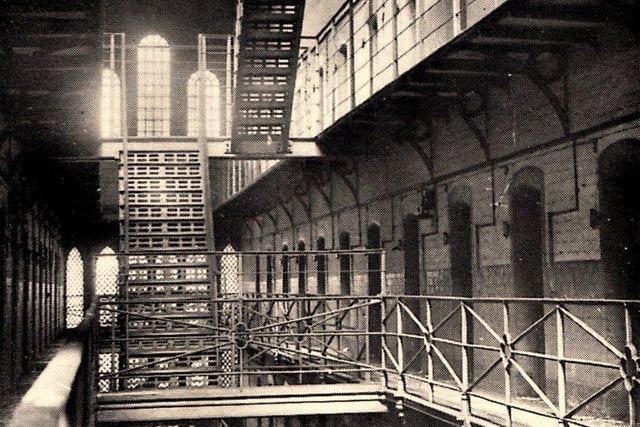
BILL HARTLEY finds that today’s prison staff are sometimes more constrained than their charges

The recent abscond of a high profile prisoner from Stanford Hill open prison is nothing new. Each year there are a steady trickle of disappearances, or ‘failures to return’ as they are known in the trade. When a notorious prisoner absconds then a constant operating problem for the Prison Service attracts fresh media scrutiny, with subsequent disappearances gaining a greater level of interest than might otherwise have been the case. Stanford Hill has until now kept a low profile. In the past the focus was generally on Ford and Leyhill prisons, which are rather better known for losing prisoners. The governors of these jails may be casting nervous glances at their gates each morning as prisoners exit for work or day release.

The first victim of the heightened media attention following the Stanford Hill abscond was HMP Kennet situated in Liverpool, where two prisoners went awol. Unlike the other prisons mentioned this is a Category ‘C’ jail, not an open prison. Here as a reward for good behaviour prisoners are allowed the occasional day out. However, the only real difference is that at Kennet the prisoners who failed to return will have had a few hours less of a head start before the alarm was raised.

Be prepared for the inevitable ‘tightening up’ as politicians demand action. No-one in Prison Service senior management is likely to suggest to politicians that they are getting over excited about a system which in the main does what it is meant to.  Temporary release is firmly embedded in the Rehabilitation Revolution that ministers like to talk about. The public might not like the idea of prisoners wandering along the high street but that is what happens. At an open prison going out to work each day is the reality for many prisoners. The problem lies not in the idea but its execution. The majority of prisoners coming towards the end of a long sentence or with the prospect of release on license looming, will treat temporary or day release as a test of their reliability and quite possibly as an opportunity to reintegrate back into society. Most will be careful not to jeopardise this.
Continue reading

Posted in QR Home | Tagged , , , , | Leave a comment

Crumbling Wall ROBERT HENDERSON

Greed, by Carol Highsmith (1946)

Crumbling Wall

ROBERT HENDERSON compares and contrasts two revealing films about high finance

Wall Street (!987)

Director Oliver Stone

The Wolf of Wall Street (2013)

Director Martin Scorsese

Twenty six years lie between Wall Street and The Wolf of Wall Street (TWOWS) hitting cinema screens. Wall Street is fiction, although there are reputedly people in real life from whom the film’s main characters were developed, for example Sir Larry Wildman (Terence Stamp) is supposedly drawn from  on the British financier Sir James Goldsmith. The Wolf of Wall Street (TWOWS) is based upon the autobiography of a Wall Street trader, Jordan Belfort. How much of that is fact is debatable, although the general tone of the man’s life given in the book is plausible.

Both films begin their action in the 1980s. Both deal with the shady world of finance. Both are vehicles for the unbridled egotism of their main characters. There the similarities end. Wall Street is about corporate raiders, men who seek to take over companies and then asset-trip them,  sell them on quickly for a profit or run them as a business for a while, reduce costs (especially by cutting jobs ) and then sell them. The main criminality involved in the film is insider dealing.

TWOWS is simply about making a fast buck and the faster the better, with not even a show of doing anything beyond making money. These people use any method from the huckster selling of penny shares to insider dealing, and celebrate each success in the spirit of the man successfully running a hunt-the-lady scam in the street. They are the masters of the universe and those who lose out are suckers. There is zero concern for or even awareness of the greater general good of society.

The protagonists in Wall Street are a young stock trader, Bud Fox (Charlie Sheen), and a corporate raider, Gordon Gecko (Michael Douglas). Bud idolises Gecko and manages to work his way into Gecko’s circle by passing on privileged information to him, information which he has received from his father Carl (Martin Sheen), who is a union leader at Bluestar Airlines.

Once inside Gecko’s circle, Bud sheds his morals and is content to help Gecko engage in insider trading until he discovers he is being used as a catspaw by Gecko, who is trying to take over Bluestar to dissolve the company in order to access cash in the company’s overfunded pension plan. Bud rediscovers his conscience after a fashion, and outmanoeuvres Gecko by making an agreement with Wildman – whom  previously he had helped Gecko to defraud through insider trading when Wildman wanted to take over a steel company –  to buy a majority shareholding in  the airline on the cheap  and run it as a going concern. In doing this, his  motivation is more revenge for being betrayed than suddenly being disgusted with what he had become under Gecko’s influence.

Leonardo DiCaprio’s Jordan Belfort is a trader who loses his job with a Wall Street broker when the firm crashes, moves into boiler-room trading in penny shares (which are barely regulated and allow for huge commissions to be charged to naïve investors who are often buying shares which are next to worthless). He makes a small fortune doing this.

Belfort then decides to strike out on his own account in rather more up-market  surroundings. With a friend, Donnie Azoff (Jonah Hill),  he sets  up  a suitably Ivy League-sounding firm of brokers Stratton Oakmont. They operate on the principle of “pump and dump”  (artificially inflating a company’s share price by tactics such as spreading false rumours or simply buying heavily and then selling the shares rapidly). Stratton Oakmont is given lift off by an article in Forbes magazine which calls Jordan “a twisted Robin Hood” and the “Wolf of Wall Street”, which appellations prove a first rate recruiting sergeant for Stratton Oakmont, with hundreds of young stock traders flocking to make money with him. From that point on he becomes seriously rich.

What the films do admirably is show the difference between the cinematic portrayal of  the American financial world  in films released  in 1987 and 2013. To refresh my memory I watched Wall Street again before writing this review.

The striking thing about that film is how restrained it is compared with TWOWS. Michael Douglas’ Gordon Gecko is far more disciplined than DiCaprio’s Belfort. He has some semblance of intellectual and arguably even moral justification for what he does, most notably in a scene where he is addressing a shareholders’ meeting of a company he is trying to take over. This is where Gecko utters the most famous words in the film “Greed is good”. The words have serious context. Gecko is peddling  the laissez-faire line that competition is an unalloyed good, because it is the agency which creates natural selection amongst companies and it is only that which keeps an economy healthy. He also puts his finger on a real cancer in big business: the development of the bureaucratic company where the company is run for the benefit of the senior management rather than the shareholders. Gecko rails against  the huge number of senior managers on high salaries in the company he wishes to buy, a business which has done little for its shareholders.  Whether you agree with the raw natural selection argument in business  – and I do not – at the very least it shows that the likes of Gecko feel the need to  justify what they do, to provide an ethical cloak for their misbehaviour.

There is also a serious difference in the general behaviour of  Gecko and Belfort. Gecko, for all his faults, is not a libertine. For him money is both an instrument and an end in itself. It gives him power and status, a medal of success in his eyes and the eyes of the world he inhabits. There is purpose in Gecko.  He enjoys the material trappings of wealth but is not overwhelmed by them. In Belfort there is merely an ultimately empty grasping of licence with drugs, whores and absurd status symbols, such as an outlandishly large yacht, which his ego drives him to wreck by ordering the captain to sail in weather which the captain tells him is unsafe. He acquires a trophy girlfriend, and dumps his wife. There is no solid foundation to any part of his life.

The other big general difference between the films is ethical.  Wall Street has a moral voice which acts as a foil to Gecko’s amorality. Bud Fox’s father Carl puts the case against capitalism red in tooth and claw. After Bud’s discovery of Gecko’s attempt to buy Bluestar, Carl’s dissenting ideological  voice is added to by Bud. In TWOWS there is no moral voice or pretence by Belfort (or any other character) that what they are doing has any social function or ethical content. Instead the public are simply viewed as a bovine herd to be milked as ruthlessly as possible. The fact that what is being done – whether it be selling penny stocks in a boiler room or using insider information in more sophisticated company –  is no better than a confidence trick does not cause Belfort and his fellow participants the slightest discomfort, only unalloyed joy. They are getting rich at the expense of suckers. It’s all a game whose only end is to make the individual rich, and to be rich is a validation of their existence.

Gecko and Belfort end up in prison, so in that respect at least they honour the old American film tradition of never showing the criminal getting away with it – although  in the case of Belfort he ends up in a place which is not so much a prison as a country club.

Both films are strong in all the technical ways – script, plot, characterisation and acting – that are used to judge films. Michael Douglas’ is a more studied performance than that of  DiCaprio who brings an amazing energy to the role. But arresting as Douglas’ performance is, the film has ample space to fill out other characters. Indeed, in terms of screen time it is Bud who wins out.

DiCaprio’s Belfort has strong claims to be the best performance in an already long career, but it utterly dominates the film and consequently the other characters have little room to develop. They either remain one rather dimensional or, like Matthew McConaughey, appear only in cameos.

The quality of the films as films is reason enough to watch them, but their primary value, as a pair, is their charting, unwittingly, of the decline of moral sense between the 1980s and now.

ROBERT HENDERSON is the QR‘s film critic


Posted in QR Home | Tagged , , , , , , , | Leave a comment

Pre-Renaissance Man HENRY HOPWOOD-PHILLIPS

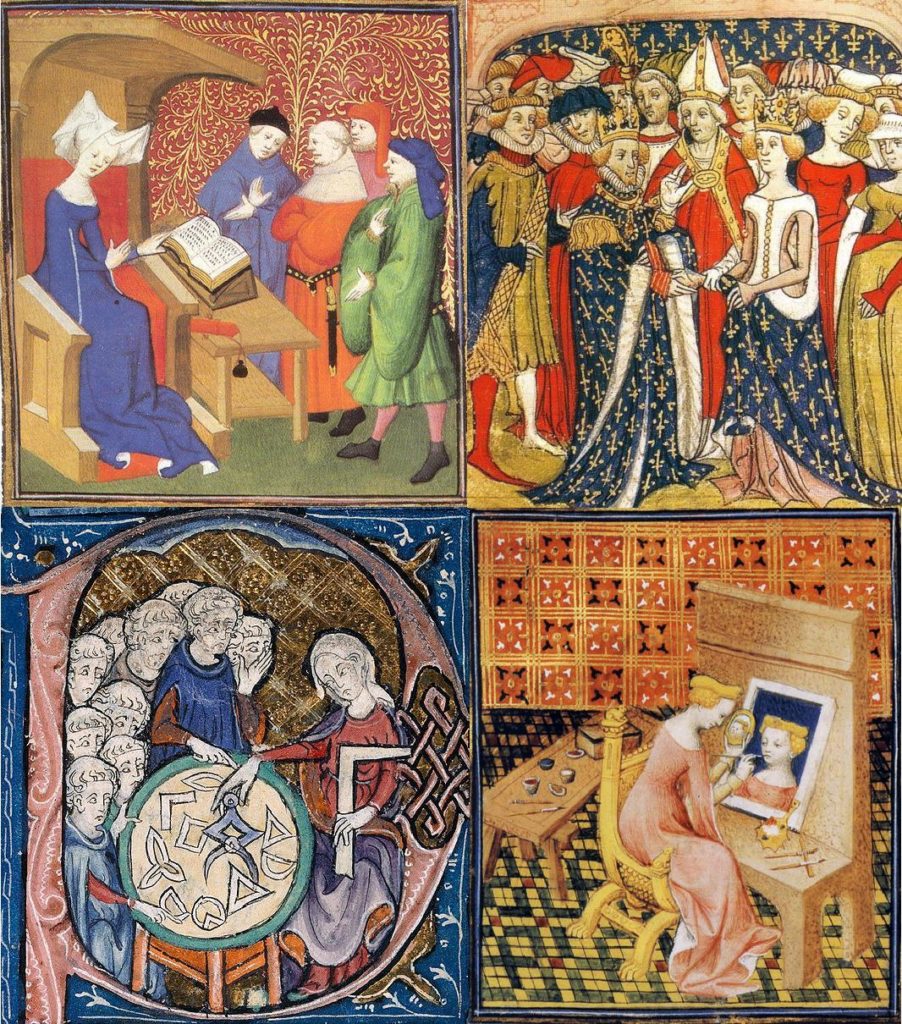
Women Activities in the Middle Ages

Pre-Renaissance Man

HENRY HOPWOOD-PHILLIPS is impressed by an audacious re-imagining of medieval thought

Inventing the Individual – The Origins of Western Liberalism

Larry Siedentop, London: Allen Lane, 2014, 448 pps

Larry Siedentop’s introduction gets straight to the point. We have ‘lost our moral bearings’, we ‘lack a narrative of ourselves’, indifference and permissiveness characterise a West that has been left unmoored and dissolute by the tides of history. Complacency is the tenor of an age which has forgotten that belief-systems must still compete; Islamic fundamentalism and the ‘crass utilitarianism’ of China constitute very real threats today.

In his epilogue, the author emphasises how the West rests on shared beliefs, best outlined today as liberalism – and that the greatest peril to its future success lies within our self-understanding of how its philosophy evolved. Typically abridged and truncated poorly in conventional narratives, this point especially concerns how we understand the Middle Ages and Christianity’s role in establishing individuality, equality and freedom as lodestars of the West’s collective conscience. General audiences, victims of this bowdlerisation of History, forget that the instincts that forged these values were created and honed by the Church in the first place, before they were turned against it.

The book constitutes no less than a rebalancing act of the entire Western historical canon. What drives this ambitious project?

If we do not understand the moral depth of our own tradition, how can we hope to shape the conversation of mankind?

Siedentop demands.

The Middle Ages must be re-acknowledged as a period of serious achievement in furthering the values of individuality, equality and freedom. Too often written off as a black hole defined and illuminated by its bookends, antiquity and modernity, Siedentop works hard to restore it to prominence.

The author’s shift of the historiographical centre of gravity away from the anti-clerical Enlightenment of the Philosophes has serious ramifications.

The importance of the Renaissance has been grossly inflated to create a gap between early modern Europe and its preceding centuries – to introduce a discontinuity that is misleading

he explains, as he attempts to restore proportion to the historical landscape. He is quite clear that history has been choreographed for too long to appear as though liberal ideals somehow emerge from nowhere after a senescence of over a millennium.

In Siedentop’s re-reading, antiquity was not the secular, tolerant and free lost-land many modern thinkers anachronistically paint it. Instead, it was a world in which every possible unit: family, paterfamilias, clan, city and imperial leader operated as a quasi-church, each suffused with the ideas and language of religion. As a result, the individual had no real existence outside these institutions, being entirely defined by them.

Even non-personal aspects of society, law and property for instance, were considered through a religious lens. The intellectual world was infused with the idea that paideia and pietas were consubstantial. Reason was a tool that commanded morality and social hierarchy. Liberty was nothing, the res publica everything.

This is all set against a Judaism that treated Law as ‘Yahweh’s will’, separating truth from society’s demands and channelling it instead as an external command. This type of thinking invades the West at first with Jesus’ incarnation, and second, with Paul, its great expositor.

According to Siedentop, Paul is one of the great underrated revolutionaries of history. His key theme, that the incarnation was proof that God operated a hotline to people on an individual level, effectively bypassed every other factor that constituted a person’s corporate identity, and would eventually turn almost every contemporary notion of society on its head. ‘There is neither Jew not Greek, neither slave nor free, there is neither male nor female; for you are all one in Christ Jesus’, Paul said. And this fundamental identity rendered each and every soul to be equal, individual and deserving of a dignity (a germ of jus naturale) that included liberty.

The rest of the book is essentially a re-investigation of history with the pivot placed on this Pauline revolution. It throws up some very surprising results. Just to touch upon a few of the most significant:

  • Aristotle and Plato are depicted as reactionaries trying to resist the sophists’ challenge to the old assumption that nature and culture sleep in the same bed.
  • Augustine is less a crusty Church Father than a restorer of will to its rightful place in partnership rather than in subjection to Reason; a discoverer of the pre-social self, the original existentialist.
  • The Gnostics are not so much hippy Christians with loose and free theologies, as conservatives who felt uncomfortable jettisoning the platonic framework of how knowledge and society connected.

But the big idea that is tirelessly tracked throughout the book is the ‘equality of souls’, an idea that contributed to:

  • Turning work from a shameful activity into one that bestowed self-respect.
  • Informing the notion that was a difference between power and rightful authority (especially through Duns Scotus and William of Ockham).
  • Converting heroism from social notoriety into martyrdom – the witnessing of a conscience acting against the norms of society.

One of the biggest surprises is how the Church worked against feudalism. The two are often conflated in the Western imagination. But Siedentop reminds the reader that though the Church ‘adjusted’ to it, it ‘could not endorse it’, for only God owned souls.

The general reader will also be astonished to see the Cluniac reforms and the centralisation of the Papacy read through the lens of notional equality rather than ecclesiastical power-games. As Guizot (heavily leaned on by Siedentop throughout) inferred, it was in the space between the temporal and the newly legitimized spiritual sphere that liberty of conscience developed.

Larry Siedentop

Breathless revisionism on such a grand scale deserves high praise. Hugh Trevor-Roper used to compare specialist-historians to snipers who would take pot-shots at anybody brave enough to attempt works of synthesis. It requires fortitude and insouciance to range so far and wide in the minefield that is medieval studies – a discipline with opinions that range from Chris Wickham on the one hand to Jacques Le Goff on the other.

Siedentop also deserves credit for rehabilitating the study of History as a place where narratives can flower as a cause for good. For too long, historiography has been the universe of impenetrable texts. The subject’s relevance suffers in such circumstances. Siedentop has sought to give the West its story back. He will doubtless attract numerous detractors for daring to do so.

HENRY HOPWOOD-PHILLIPS works in publishing


Posted in QR Home | Tagged , , , , , , , | Leave a comment

ENDNOTES – English music renewed STUART MILLSON

ENDNOTES – English music renewed

STUART MILLSON relishes four world premieres at the English Music Festival

The English Music Festival’s first concert took place in the autumn of 2006. An ambitious undertaking by its founder, Em Marshall-Luck, the Festival set out to perform rare and unheard-of works by our more famous composers, and obscure and sometimes difficult works by many forgotten figures. Believing that Vaughan Williams’s works for piano and orchestra are as important as anything by Prokofiev or Ravel (Vaughan Williams actually studied with the French impressionist composer), or that sonatas by Cyril Scott and Granville Bantock were as intricate, searing and rewarding as Bartok, Em founded a musical event that has in the eight years of its existence challenged every preconceived notion about English music – and also, showed how uncompromising belief in an artistic cause can generate momentum, support and success.

As I entered, the orchestra was in rehearsal – the gentle breathing of Vaughan Williams’s pastoral vision… PHOTOGRAPH - STUART MILLSON

The Quarterly Review was very honoured to take its place alongside other music critics at this year’s Festival first night, held in the English Gothic magnificence of Dorchester Abbey – one of the most notable of Oxfordshire’s churches. Sitting as I was beneath the chancel arch, I was able to watch the light filtering through the great arched window of the Abbey; the glass changing from a sparkling, cream light, to – at dusk – a blue-green-opal edifice. With virtually every seat sold, and a great sense of anticipation as Radio 3’s announcer, Christopher Cook, began his commentary; the concert (which began with the audience singing Parry’s Jerusalem) led us away on a journey through a lost English landscape.

Rutland Boughton (1878-1960), whose dream was to create a cult centre of Arthurian opera at Glastonbury, provided the first main work: a deeply-personal, dark and uncompromising overture entitled Troilus and Cressida. Impressive and well-orchestrated, the Boughton gave the BBC Concert Orchestra and their conductor, Martin Yates, an excellent chance to stretch their muscles for the main work of the first half, the large-scale Violin Concerto (1942) by E.J. Moeran – a work championed at the Proms by Sir Henry Wood.

Joining the BBC orchestra was solo violinist, Rupert Marshall-Luck, who shares his wife’s crusading zeal for English music. Believing this work (much overshadowed by Elgar’s great concerto of 1910) to be a lyrical, reflective masterpiece, Mr. Marshall-Luck proceeded to deliver a performance of utter commitment: never any histrionics or show, just total, unfussy, clear application and dedication to the score – careful in every way, and yet carefree, too, in those moments when Moeran seems to be closing his eyes and dreaming of his Irish roots and the coastal landscapes of Eire. Radio 3’s announcer had, in his commentary, quoted certain critics who believed that this concerto lacked backbone. Rupert Marshall-Luck’s performance showed us that a concerto need not have the rigid Germanic structure, or getting-from-A-to-B simplicity which some might demand from their music. Instead, a beauty of sound and feeling, and the sense of many impressions and ideas being cradled by a good soloist gave the work, not backbone exactly, but a structure and “story” – to make it satisfying and ultimately cohesive.

However, for me the most poignant of all the works on offer at this English Music Festival treasury and living archive, were the two Vaughan Williams pieces which dated from the years just before the Great War – the period of the Pax Britannica, The Wind in The Willows, and the romanticism of Rupert Brooke and Edward Thomas. In 1902-3, Vaughan Williams had envisaged the creation of a sequence of impressions of Hampshire and the New Forest. Last year, the Festival performed the rare, unknown symphonic poem, The Solent, and this year, we found ourselves on dusty summer lanes, leading to Burley Heath and Harnham Down (the latter completed in 1907). A few hours before the concert, I wandered into the Abbey foyer – the Box Office and hub of the Festival. As I entered, the orchestra was in rehearsal – the gentle breathing of Vaughan Williams’s pastoral vision filling the spaces of this building, a place truly made for works named after heath and downland. I paused and listened, along with a few other Festival-goers and Abbey visitors and sightseers; drawn into music which seemed to have come out of the woods and fields. There was that indefinable, understated woodwind voice – so plaintive and typical of Vaughan Williams – and the violas and gentle rocking to and fro of the strings; with “glints of folk-song” (to quote Christopher Cook) but no clear, single tune. A haze of early summer, an evocation of May: a time of the world, and of England, before the obliteration of the First World War.

The first night of the Festival concluded with another rare, unsung masterpiece (and it was a masterpiece, as we were to hear): variations for the orchestra, by Sir Arnold Bax – probably best–known for his surging symphonic sea-work, Tintagel – in which the realism of a place gives way to the dreams of an artist, and to echoes of Wagner, King Arthur and Tristan and Isolde. The new, old work which we were to hear and applaud had waited for over one hundred years for this performance. How is it that such a situation could exist? It is almost as strange as finding out that the National Gallery has just found new works by John Constable piled up behind a door in the cellar, and that nobody has been sufficiently interested to investigate what was standing there for all those years, covered in cobwebs. Em Marshall-Luck’s gathering together of a circle of musicians, musicologists, and musical “French polishers” has ensured that major works – vital parts of our national, communal heritage and cultural experience – are rescued, revived and enthroned in their rightful place in the concert programmes of this, and other countries.

To begin with, Bax’s variations did not sound much like the Bax we know. There was little evidence, for example, of his well-known Celtic legends or dark, peaty scores which resemble a heady mixture of myth and Sibelius. But this was one of the composer’s early works, and it struck me that there was a certain Germanic side to the score – with a heavy-footed waltz (clearly liked by the orchestral players) reminiscent of Richard Strauss. Nothing, however, prepared us for the finale: the great organ of Dorchester Abbey chiming in, and urging the BBC Concert Orchestra on to a Parry-like finale, with a sense of pomp and circumstance and procession – even a sense of the triumphant style of a World War Two era film score. I closed my eyes and imagined the Bax peroration fitting nicely into the end of a cinematic tale of wartime heroism – and yet, in this 1904 work, we are a fair way distant from either of the 20th century’s two conflicts.

I came away from Dorchester that evening, feeling as though England’s music had been revived. A worldwide audience had heard the concert and it was reassuring to know that BBC Radio 3 maintains the Corporation’s commitment to high-culture, serious music, and the importance of our own tradition and soul.

STUART MILLSON is Classical Music Editor of the Quarterly Review


Posted in QR Home | Tagged , , , , , , , , , , , , | Leave a comment

Waiting to die on the government’s watch ILANA MERCER

Bureaucrat by Salvador Dali (1969)

Waiting to die on the

government’s watch

ILANA MERCER lambasts a bloated and cruel bureaucracy

Why would a talented, dedicated cardiologist choose to be confined in a medical gulag, weighed down by incompetents, his wages capped; his rewards incommensurate with his drive and dedication? He wouldn’t. Surprising as this seems to some, the best and brightest do not work for the state. Increasingly, government workers are carefully selected for the colour of their complexion, for their sex and sexual or political orientation, not for their competence.

In a policy statement, the Veterans’ Affairs (VA) commissioner for Connecticut, a woman of course, crowed that applicants to her department are screened to ascertain “minimum qualifications.” “Maximum qualifications” are not required in this killer of a system. “Applicants who meet the essential level of preparation,” writes the woman, “are not excluded. The Human Resources Administrator must work to bring as many protected members into the system.” Her words. Once recruited, the needs of these precious, “protected-group members” are jealously guarded.

If “diversity” trumps talent in government hiring; so too is job security a legislated article of faith. In order to set in motion a termination or two – pursuant to public outrage over the scandal in the Phoenix Veterans Affairs facility, where as many as 40 gravely ill veterans died while waiting to be treated – Congress has had to convene to pass “The VA Accountability Bill.” In the unlikely event of a layoff, seniority is given priority over the quality of the worker. A good healthcare provider will be terminated before a tenured provider.

Layoffs are as scarce as hen’s teeth. A man has to commit mass murder before he is sacked. I wager that Maj. Nidal Malik Hasan – the jihadi who committed fratricide at Fort Hood – is still on the government’s payroll. Courtesy of the Immigration and Naturalization Service, the 9/11 assassins retained valid student visas long after their demise. For his part, Hasan worked at Walter Reed Army Medical Center, where he terrified the patients entrusted to his care. By necessity, a private hospital (to the extent that such a thing still exists in post-Obamacare America) would have done its utmost to fire problematic personnel for fear of litigation.

It is becoming crystal clear that the rot pervades the “1,700 hospitals, clinics and other facilities” operated by the command-and-control federal government. “A common language of bureaucratic corruption” is how The Daily Beast described the routine exchanges between VA staff in several states, so far, in the course of conspiring to lie to the auditing VA inspector general, to “forge appointment records,” and to secrete away lists of soldiers who believed they were waiting for care, but were in fact waiting to die.

Given the hiring process at play in the VA, can you picture how this could come about? I can.

No leap of logic is needed to predict that the culpable will not be named, shamed or jailed. The department will not be dissolved or declared bankrupt, morally or financially. If anything, expect budgetary increases. As we are lectured, the offenders were merely “overwhelmed and under-resourced”; encumbered by “a lack of funding.” That’s how Democrats are framing root-and-branch rot in the lumbering VA bureaucracy. Such special pleading is standard in explaining murder and mismanagement across the $63.4 billion-dollar government agency, whose discretionary budget Obama has only increased.

This too is a lie. According to Investor’s Business Daily,

The VA’s budget has been exploding, even as the number of veterans steadily declines. From 2000 to 2013, outlays nearly tripled, while the population of veterans declined by 4.3 million. From 2008 to 2012 alone, per-patient spending at the VA climbed 27 percent. To put that in perspective, per capita health spending nationwide rose just 13 percent during those years.

Driving these costs, moreover, are not Iraq and Afghan vets, who “account for 7 percent of those treated,” and “were responsible for only 4 percent of its health costs.”

The Beast accretes reflexively. Not unlike Obamacare, which has compelled insurers to cover an extensive and exotic list of services, the VA under Bill Clinton – he signed the Veterans’ Health Care Eligibility Reform Act of 1996 – expanded the sort of services and coverage eligibility to many more categories of veteran, among them high-income enrollees.

As expressed in its output and input, the efficiency of the VA healthcare system should tell a fighting man all he needs to know about his fighting chance within the belly of the beast. According to The Daily Beast, the Albuquerque VA houses “eight physicians in the cardiology department. But at any given time, only three are working in the clinic, where they see fewer than two patients a day.” On average, that’s only 36 veterans per week. The average single private-practice cardiologist sees more patients in a week than the Albuquerque VA’s entire eight-person cardiology department. Surveyed, 60 percent of cardiologists in private practice “reported seeing between 50 and 124 patients per week. In the course of two days, a single cardiologist in private practice sees as many patients as the entire eight-person Albuquerque team sees in a week.

All the same, these government workers trust that their identities and salaries are shielded: taxpayers will pick up the legal tab for the deaths they caused through deliberate delays, medical and criminal malfeasance. When workers’ pay is untethered to performance; when people are hired for the wrong reasons and seldom fired – they will, at the very best, produce less and less. It is in the nature of The Beast.

ILANA MERCER is a paleolibertarian writer, based in the United States. She pens WND’s longest-standing, exclusive paleolibertarian column, “Return to Reason” and is a fellow at the Jerusalem Institute for Market Studies, an award-winning, independent, non-profit, free-market economic policy think tank. She is also a Quarterly Review Contributing Editor. Ilana’s latest book is Into the Cannibal’s Pot: Lessons For America From Post-Apartheid South Africa. Her website is www.IlanaMercer.com. She blogs at www.BarelyaBlog.com

 

Posted in QR Home | Tagged , , , , , , | Leave a comment