Displays DEREK TURNER

Displays

DEREK TURNER


Black-brown stinking sty

Rising green

Camomile.


Bright Red Arrows fly –

Great writings

Scraped high.


This breathless July –

Do these things

Signify?


Posted in QR Home | Tagged , | Leave a comment

Joan Rivers – antidote to PC totalitarianism ILANA MERCER

Joan Rivers in the 1960s...

…and now

Joan Rivers: antidote to PC totalitarianism

ILANA MERCER salutes a personality who has somehow lived on into the post-personality era

WARNING: If you suffer from spineless conformity; a deformation of the personality often euphemized as political correctness—quit reading this column, NOW!

If you don’t quite know whether you are thus afflicted, ask yourself this: Do I police what people say for political propriety? To the extent that I seek it out, do I scrutinize great literature, music, art, television or comedy for signs of so-called sexism, racism, elitism, homophobia, antisemitism and meanness? Am I incapable of appreciating a superbly written script or book; a sublime painting or symphony; a smart stand-up routine, if only because the material and its creator violate the received laws of political correctness?

Still unsure if you belong to the tyrannical, joyless tradition of cultural Marxism, read on. In the event that you convulse with laughter, give yourself a clean bill of health. If you foam at the mouth, fit to be tied, go away. And stay away.

Women who should make themselves scarce but won’t are the prototypical, inquisitor-cum-anchors plaguing leftist “news” networks. Acting anchor-enforcer for Fourth of July was CNN’s unremarkable Fredricka Whitfield. Fredricka What’sHerName would have left behind a sustained programme of non-achievement. No longer. Henceforth, her claim to fame is that she attempted to re-educate an iconic comedienne, Joan Rivers.

Since cultural Marxists police speech for propriety, if not consciously, then reflexively, they will take pains to stigmatize and isolate those who violate standards set by the PC set. The term re-education is associated with this totalitarianism. It has been used in the context of both brainwashing as well as “reformation” induced in labour camps.

Through a series of loaded, snide taunts, coupled with unhinged body language, the prissy preachy Fredricka set about reeducating her featured guest about the rules of conduct in the post-personality era. “You shall not be mean” (except to all men and all conservatives and authentic contrarians) is the latest monomania to grip the politically correct.

Alas, as the object of her pelting, Fredricka the fundamentalist was foolish enough to target the wrong funny lady. Rivers is too old and too independent for “rehabilitation.” Already in her 80s, the octogenarian is best-known nowadays for the sartorial send-up Fashion Police. The Rivers repartee is so ribald – it’s fair to say she’s the only woman who can get manly men to watch a show about fashion. While her humour has become a tad tame for me – Rivers once even disgorged, albeit with difficulty, praise for the loathsome Lena Dunham of Girls fame – she, nevertheless, stands out as the only public persona who flatly refuses to apologize for her signature wit.

Examples: Joan has compared the guest room she occupies at her daughter’s abode to the basement in which the “Cleveland kidnapping victims, Gina DeJesus, Michelle Knight and Amanda Berry, were bound, raped and tortured for years before their escape. ‘Those women in the basement in Cleveland had more room,’ quipped Rivers.

Describing one awful outfit on Fashion Police, Rivers ventured that “on the scale of really bad ideas, it falls between marrying Charlie Sheen and using Oscar Pistorius’s bathroom.”

When Madonna accused Lady Gaga of stealing her “music,” Joan wanted to know how you could steal a rash.

And Ms. Rivers walked in on a football party thrown for her grandson and his rowdy small friends by daughter Melissa. Looking on with disdain at the grubby little boys, Rivers blurted out: “I don’t know how Jerry Sandusky managed to do it.”

All wickedly clever.

Although a reporter is not supposed to privilege her own values, here, finally, was Fredricka Witless’ chance to publicly shame the lively contrarian into submission.

Whitfield: … your fashion critique is very mean in some ways.

Rivers: It’s not mean.

Whitfield (pulling grotesque faces): Really? It’s not mean?

Rivers: I tell the truth. I’m sure I said the same things that all your friends said to their friends sitting next to them on the couch. We’re one of the few shows that says, ‘That’s an ugly dress.’

Whitfield (cackling loudly as if to drown-out her guest and grimacing like a Gramscian explaining the theory of “Cultural Hegemony”): You’re never worried about feelings being hurt? What about things that seem off-limits to people? In your book you joke about the death of Casey Anthony’s baby, about Princess Diana dodging so many landmines.

Rivers: Life is very tough. If you can make a joke to make it easier and funnier; do it. Done. That’s all. Winston Churchill said, ‘If you make someone laugh, you give them a little vacation.’

Whitfield (baring fangs, humming non-stop like a deranged syphilitic): Yeah, and people love to laugh, that’s why they love you, but they also know that you have shock value … On the cover of your book you’re wearing fur, although you knew this would outrage animal activists …

Rivers: You know, this whole interview is becoming a defensive interview.

Whitfield (more face-making): Nah.

Rivers: Are you wearing leather shoes?

Whitfield: Yeah.

Rivers: Shut up. I don’t wanna hear, “You’re wearing fur.” You’re wearing leather shoes! You’re eating chicken! You’re eating meat. I don’t wanna hear this nonsense. Come to me with a paper belt, and I’ll talk to you.

Whitfield: Nah.

Rivers: All you have done is negative … I made people laugh for 50 years. I am put on earth to make people laugh. My book is funny. I wear fur that was killed 15 years ago. I work for animal rights. Stop it with, “And you do this, and you’re mean, and you’re that.” You are not the one to interview a person who does humour. Sorry.

It’s hard to surpass such a fabulous finale, but I think Joan would second this column’s coda.

Not so long ago, I wrote a favourable blog post about Mike Tyson (who really is an interesting guy), only to be immediately assailed, unfriended and unfollowed on social media.

The social-media collective: “How dare you praise a man with an anti-woman background like Tyson’s!”

Me: “Hush your mouth. So Tyson slapped a woman. Who hasn’t felt like doing that?”

ILANA MERCER is a paleolibertarian writer, based in the United States. She pens WND’s longest-standing, exclusive paleolibertarian column, “Return to Reason” and is a fellow at the Jerusalem Institute for Market Studies, an award-winning, independent, non-profit, free-market economic policy think tank. She is also a Quarterly Review Contributing Editor. Ilana’s latest book is Into the Cannibal’s Pot: Lessons For America From Post-Apartheid South Africa. Her website is www.IlanaMercer.com. She blogs at www.BarelyaBlog.com

© 2014 ILANA MERCER


Posted in QR Home | Tagged , , | Leave a comment

FILM – Transcendence ROBERT HENDERSON

Transcendence

Director: Wally Pfister

In terms of pure filmmaking, this is a seriously flawed film. The dialogue is often clunking, there is a lack of character development and  the storyline is weak. Nonetheless, it  is a work which will repay seeing because it deals with the lethally threatening potential of digital technology, threats which will almost certainly become reality within the lifetimes of most people now living.

Will Caster (Johnny Depp) is a scientist specialising in artificial intelligence. He is married to Evelyn (Rebecca Hall) who works in the same field. As the film opens, Caster believes he is close to creating an artificial intelligence  that is truly sentient and  which he believes  will create a technological singularity – the point at which computer technology exceeds the capability of homo sapiens – a state Caster calls Transcendence.

This hope is cut short when Caster is shot by a neo-Luddite group, Revolutionary Independence From Technology (R.I.F.T.), who also carry out attacks on his artificial-intelligence computer laboratories. Caster survives the shot but the bullet is coated with radioactive material for which there is no antidote. The prognosis is that he has about a month to live.

Evelyn refuses to accept his imminent death and, with the help of Caster’s best friend  Max  (Paul Bettany), arranges to upload Caster’s consciousness, personality, mind – call it what you will – to a quantum computer. Max helps do this, despite the fact that he has grave doubts about the wisdom of the act. His doubts rest on the possibility that Caster’s brain contents will not be uploaded uncorrupted, or that a Caster reduced to a digital form will not be Caster anymore because of the immense change in his environment.

Once uploaded, Caster appears on the computer screen looking and sounding like his real world self, although there is a new coldness about him. He immediately demands to be connected to the Internet. Max sees the profound dangers of this; if Caster is malign, he will be able to copy himself throughout the Internet. Consequently, Max  tries to persuade Evelyn not to do it. Evelyn, obsessed with her desire to have Caster in any form, shrugs aside Max’s doubts and throws him out of the laboratory before linking Caster to the Internet where he  promptly does just what Max feared and copies himself throughout the virtual world.

The digital Caster is, if not omniscient and omnipotent, a significant way along the road to both, because he now has the capabilities of both human and computer with access to the data and facilities of the entire digital world. He is not malign in the sense that he is consciously malicious or self-serving.  Rather, Caster is beset with the sin of those who are sure they know best. His monomaniac desire to make the world a better place is suddenly released from the shackles of his emotions and the practical limitations on implementing his plans which existed when he was merely a man. It is a cliché that with power comes a disregard for anyone else’s opinion, but Caster not only knows better than anyone else, he now has the means to realise his dreams.

Using Evelyn as his instrument in the real world, the virtual Caster makes a fortune rapidly and uses this to take over an isolated desert town called Brightwood. Over the next two years, he develops advanced technologies  in the fields of energy, medicine, biology and nanotechnology. His plan is to rid the world of the blight of disease, pollution  and ultimately mortality. The problem is Caster intends to do this not only without reference to anyone else but also by using nanotechnology to control humans, so that they are in essence robots.

While all this is going on, forces are gathering to sabotage  Caster’s ambitions. Shortly after Max breaks with Evelyn , he  is kidnapped by R.I.F.T  and eventually agrees to join them to disrupt Caster’s plans. Then the US government, in the form of  F.B.I. agent Donald Buchanan (Cillian Murphy) and government scientist Joseph Tagger (Morgan Freeman) unofficially (so they have deniability) join forces with R.I.F.T.  in their attempt to thwart Caster.

Evelyn gradually moves from willing and committed collaborator to a frightened and deeply worried woman. The process of disillusionment is completed when she  sees that Caster can remotely connect to and control people’s minds.  Distraught, Evelyn approaches R.I.F.T who develop a computer virus which will destroy Caster’s source code, killing him and, as a side effect, destroy the technology on which modern society has become recklessly dependent. This happens because the digital Caster is spread throughout the Internet. To destroy him, the Internet has to be destroyed.

Regardless of the technological devastation the virus will create, Evelyn agrees to upload the virus to end whatever it is that Caster has become. But on returning to Brightwood she finds Caster resurrected in biological form, his body having been replicated, presumably, from the digital information stored when his brain contents were uploaded.

Caster is aware that his wife has the virus and  intends to destroy him but does not act against her. The F.B.I. and R.I.F.T. attack the Brightwood base, and in the process mortally wound Evelyn. Evelyn persuades Caster  to save her by uploading her mind as his mind was uploaded. Caster does this even though he knows it will end him and the Internet. The virus seemingly kills Caster and Evelyn, and technological disaster ensues.

But all is not quite as it seems. Years later, Max visits the Casters’ old garden. The garden is  protected by a device called a Faraday Cage. This stops any electrical transmission reaching what is inside the cage. Max notices that a drop of water falling from a sunflower petal instantly cleanses a puddle of oil. The drop contains one of Caster’s nano-particles, which is intact because of the protection afforded by the Faraday cage. Max thinks, logically correctly, that Caster’s and Evelyn’s consciousnesses are contained within the active nano-particles. Perhaps Caster even knew when he wittingly uploaded the virus that there would be copies of Evelyn and himself retained in the nano-particles in their old garden…

Depp’s performance as Caster has received a good deal of criticism on the grounds that it is a flat, emotionless portrayal. This is to miss the nature of the character he inhabits once he exists only in digital form. He is then someone robbed of the kernel of what makes them human. Hence, his performance is exactly what is required.

The rest of the performances range from serviceable in the case of Rebecca Hall to colourless in the case of  Paul Bettany, and slight in the case of everyone else simply because there was no space for them to expand their characters.

This could have been a much better film if two issues had been given much more space, namely, the general arguments against incontinent technological advance and the devastating effects which would result from a closing down of the Internet and  the ending of connectivity which is not only so much a part of modern everyday life but also vital for the maintenance of necessities such as power stations and large factories.

The  R.I.F.T. characters are anaemic and their arguments against technology do not go much beyond the mantra “intelligent machines are bad”. There is no discussion of how human beings may simply fail to survive because they become demoralised by the superior capacity of machines or machines or that intelligent machines will take not only the jobs humans do now but any other jobs which arise. As for the post-virus technological upset, this is barely touched upon.

The strength of the film is that it puts before its audience the possibilities of technology moving beyond the control of human beings and, even more fundamentally damaging, calling into question what it is to be human. The dangers of intelligent machines are straightforward enough – either they replace humans by making them redundant, or they engender in humanity the trait seen in tribal peoples encountering Europeans: the tribal peoples often became terminally demoralised, by the sophistication and scope of European culture with which they were faced.

More fundamentally, until now we have known what a human being is. We are on the brink of losing that happy state. If the human mind could be copied and exist within a computer file there is the potential for immortality. The mind could exist within a robot body or be distributed throughout the Internet (or whatever supersedes it). If the mind can be uploaded to a computer file so could all the data needed to create a digital replica of  a person’s body, into which the uploaded mind could be uploaded in turn. If the technology to do that existed, then in principle it should be possible to upload a digitised mind into a body developed from someone else’s uploaded data….  That is not a world I should wish to live in. See Transcendence for its warning of the shape of things to come.

ROBERT HENDERSON is the QR film critic. He blogs at livinginamadhouse.com


Posted in QR Home | Tagged , , , | Leave a comment

Free spaying for Stalinists ILANA MERCER

Free spaying for Stalinists

ILANA MERCER supports faith-based businesses

Today we celebrate the proclamation of the Declaration of Independence, on July 4, 1776. Just how little is left, in 2014, of the Declaration’s inalienable rights was demonstrated by the Supreme Court’s ruling, in the case of the Secretary of Health And Human Services versus three faith-based, family owned businesses.

Having found a way to affirm the constitutionality of the unconstitutional Obamacare in the first place, a scurrilous SCOTUS, a branch in a tripartite tyranny, agreed to allow Conestoga Wood Specialties Corp., Hobby Lobby Stores Inc. (arts-and-crafts), and Mardel (Christian books) a miniscule degree of freedom in the use of their property. The individuals who own and control these businesses had objected to paying for what they consider abortifacients. Instead of being compelled to cover 20 FDA-approved methods of contraception favored by their employees, the firms will be permitted to pay for only 16.

The obsequious are celebrating. The owners, the Hahn and Green families, were facing crippling fines of $475 million per year for Hobby Lobby, $33 million per year for Conestoga, as well as $15 million per year for Mardel. By dictate of the Patient Protection and Affordable Care Act of 2010 (ACA), a refusal to pay for employees’ healthcare all together would have resulted in hefty penalties, too.

The U.S. government – originally founded to uphold, not calibrate, the people’s leave-me-alone rights to life, liberty and property – had claimed that the free exercise of religion did not apply to for-profit corporations. The legal lodestar followed by government and Court alike is not the unequivocal Constitution – it instructs Congress to make no prohibition on the free exercise of religion – but rather the equivocating Religious Freedom Restoration Act (RFRA).

Contra the Constitution, The Act which, it must be said – is commendably succinct and clear, implicitly recognizes that government can and does act to “burden a person’s exercise of religion,” that it “should not substantially burden religious exercise without compelling justification,” and that when it does, government ought to opt for the “least restrictive means of furthering that compelling governmental interest.” Still, Barack’s bureaucrats seem to have “forgotten” that since the RFRA protects nonprofit corporations, there is no reason in logic to deprive for-profit corporations of the same protection.

Another legalistic, semantic smack-down, in the case of the Secretary of Health And Human Services v. Hobby Lobby Stores, Inc., is the state’s contention that religious rights attach exclusively to individuals, and that corporations aren’t entitled to what are, ostensibly, the rights of persons.

But corporations are, in essence, individuals who convene voluntarily to cooperate for a common purpose. Or, as Justice Samuel Alito who delivered the opinion of the Court put it: “A corporation is simply a form of organization used by human beings to achieve desired ends.” Furthermore, and as the SCOTUS blog confirmed, “Another federal law – the Dictionary Act – specifically includes ‘corporations’ in its definition of ‘person.’”

Judging from their splenetic screeds, the ladies of the left and their male lap dogs begrudge bosses this small, sad victory. “Scalia Law is a lot like Sharia Law,” tweeted one histrionic. “What a hilarious caricature SCOTUS is. All 5 in Harris majority are, naturally, men. All 4 dissenting include the women justices,” screeched another. Hillary Clinton intimated that this petty permission – allowing a devout proprietor to opt out of funding certain abortifacients that offend “sincerely held religious beliefs” – is “a disturbing trend that you see in a lot of societies that are very unstable, antidemocratic, and frankly prone to extremism.”

But even the Clinton screech could not best Terry O’Neill, president of the National Organization for Women, who spoke in tongues:

I think it’s really important to remember apartheid in South Africa was justified on religious grounds; the Southern Baptist Convention justified slavery, and later Jim Crow and segregation, on religious grounds. There are some religious beliefs we no longer honour in our government, and the Supreme Court is simply wrong to honour gender bigotry that Hobby Lobby stores and Conestoga Wood are promoting.

Settle down “ladies.” You’ll get your free IUDs and morning-after-pills, if not from your employer or the insurers, then from the increasingly desperate taxpayer (who, by now, might even consider paying for a spaying, too).

ILANA MERCER is a paleolibertarian writer, based in the United States. She pens WND’s longest-standing, exclusive paleolibertarian column, “Return to Reason” and is a fellow at the Jerusalem Institute for Market Studies, an award-winning, independent, non-profit, free-market economic policy think tank. She is also a Quarterly Review Contributing Editor. Ilana’s latest book is Into the Cannibal’s Pot: Lessons For America From Post-Apartheid South Africa. Her website is www.IlanaMercer.com. She blogs at www.BarelyaBlog.com


Posted in QR Home | Tagged , , , , , , , | Leave a comment

Testing for humanity – The Plague Dogs revisited DEREK TURNER

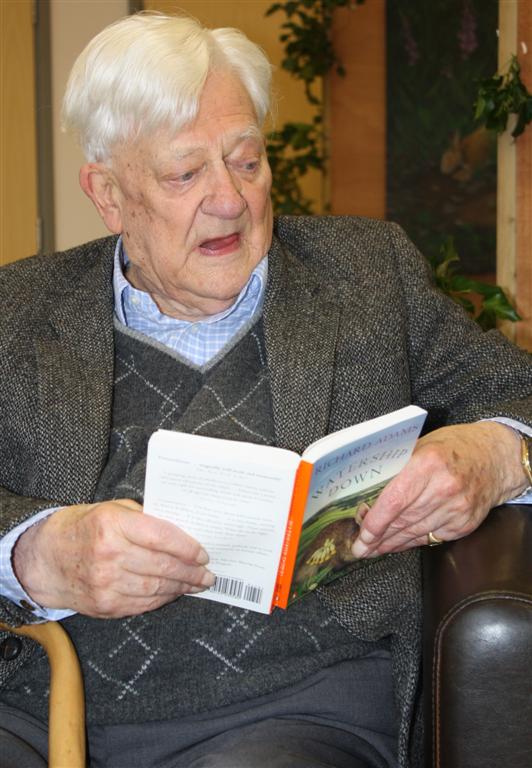
Richard Adams, 2008

Testing for humanity

The Plague Dogs (book 1977, film 1982)

DEREK TURNER revisits an animal rights classic

I came across by chance recently a DVD of The Plague Dogs, a 1982 animation of Richard Adams’ bestselling 1977 novel. I was catapulted immediately back to childhood, when I had read the book shortly after publication, with a sense of distress and anger I can still taste. It had seemed to me an unusually powerful story, and I was surprised I had not known of the film’s existence. In fact, the film seems to have been unduly neglected, notwithstanding a notable voice cast – including John Hurt, Patrick Stewart, James Bolam, Warren Mitchell and Bernard Hepton – and superb painting and animation. I accordingly purchased a copy of the book to remind myself why it is considered an anthropomorphic classic, on a par with Bambi (the book – although the Disney travesty has probably been more influential), Tarka the Otter, Ring of Bright Water, and Adams’ own Watership Down.

For most of their respective lengths, book and film follow the same storyline. Two dogs – Rowf, a large and fierce Labrador cross, and Snitter, a fox terrier – escape from a government animal research establishment in the Lake District. Rowf has been used to study physical endurance, and to this senseless end has been forced to swim daily in a water tank, while scientists monitor his functions and time his staying power. They always leave him in the tank until he starts to drown, only retrieving him when he sinks to the bottom. Snitter has been used for complex brain surgery, designed to make him confuse the objective and the subjective – and this has been all too successful.

Snitter is especially pitiable, because unlike Rowf he has known security and kindness from humans, and he is only here because he was responsible for his master being knocked down by a lorry, and was subsequently sold to the institution by his master’s loathsome sister. He has frequent flashbacks to his old life, and this sharpens his confusion and sense of hurt at the latex-gloved hands of the ‘whitecoats’.

Nevertheless, Snitter has retained sufficient acuity to be able to spot an opportunity for he and Rowf to escape, and the two animals pass fearfully and uncomprehendingly at night through seemingly endless, Moreau-esque laboratories silent except for the subdued whimpering and fidgeting of animals deprived of one or other senses or body parts. They escape at last through a vent in the wall of the establishment’s incinerator, after resting for a time among the sharp bones of even less lucky inmates.

They find themselves at large in one of the very few places in England escaped dogs could hope to remain at large for lengthy periods – the sparsely-populated and barren Lake District, with winter coming on. Both book and film convey the spirit of this locale extremely effectively, the film unusually beautiful with its muted North Country palette, the novel featuring drawings by the renowned Alfred Wainwright, and both strewn with regionally-specific topography, nomenclature, flora, fauna, dialect and history. The fells, screes, becks, tarns and abandoned mines form a magnificent, merciless backdrop, and the animators shot most of the action from low-level, so that one gets the sense of painful progress along unyielding contours. Director Martin Rosen – who also directed the film of Watership Down – opted for a dog’s-eye view of the action, with human faces and expressions usually obscured or out of shot, adding to the meaningless nightmarishness.

Snitter is unusually intelligent and Rowf unusually strong, but they are also unaccustomed to fending for themselves, and with understandable behavioural problems – Rowf terrified of bodies of water, clearly at a disadvantage in this District, Snitter spasmodically hallucinating. The dogs nearly starve, but eventually contrive to kill and eat a sheep. They then fall in with a fox – the choice of James Bolam as “the tod’s”  voice was inspired – who offers survival tips if they share further “yows” with him, and for a while the uneasy alliance works. But farmers quickly notice their depredations, and the connection is soon made to the research establishment, despite bland official denials. A publicity stunt hunt for the sheep-killers is organized by a local businessman, but he is a kindly man haunted by the Holocaust, and when he sees the hideously scarred Snitter takes pity on the delighted dog, only to be killed by terrible accident when Snitter gets tangled in the trigger of his gun.

An irresponsible newspaperman (a woman in the film) discovers that the establishment has a secret military section, where a former Buchenwald doctor is researching germ warfare – and in true tabloid fashion suggests that the dogs could have come into contact with bubonic plague fleas. Of course the dogs had not, but the suggestion naturally causes a frenzy. When the gaunt dogs devour the corpse of a fallen man (this scene was cut from most original releases of the film), public revulsion wells up. Soldiers are sent to the area to exterminate the dogs, and the wily fox’s luck runs out when he is killed by hounds.

The dogs manage one last lucky escape, by stowing away on a tourist train that carries them unseen through the military cordon, all the way down to the sea at Ravenglass. Here they are trapped between the terrifying and icy Irish Sea and the advancing soldiers, and eventually strike out to sea in a panicky attempt to find Snitter’s mythical “Isle of Dog”.

At this stage, the book and film diverge, but unusually the film is truer to the author’s intentions than the book – because the publishers prevailed upon Adams to alter his original ending. The film ends with the dogs still just afloat as Rowf’s strength ebbs for the last time and cold chews into their bones, while far out in front flickers a mirage of the green land they will never reach. This lump-swallowing outcome would probably be upsetting for most adults as well as children, and must be why the film never really caught on.

By contrast, in the book as redacted by the publisher, it transpires that Snitter’s master is not dead after all, but merely seriously injured. Recognizing one of the fugitives as his beloved terrier, he contacts the newspaperman, who had in any case been hoping for an uplifting end to the saga. The journalist castigates the master’s sister, and rushes Snitter’s owner to the beach at Ravenglass. Real-life naturalist Sir Peter Scott sails providentially into the bay, with just enough time to haul the foundering beasts aboard. Snitter is reunited with his owner, who also gives Rowf his first home. In both book and film, there is redemption for a young scientist who realises the awfulness of his employment and quits, liberating a test monkey and taking it home.

Reading it again now, this last chapter feels highly contrived, and tacked-on – but one can easily understand why a publisher in this (to use a tabloid cliché) “nation of dog-lovers” would have wanted such a conclusion to so unrelenting a story. Some earlier segments also seem heavy-handed – especially those to do with the media and politicians – and there are even a few Victorian-style examples of “Dear Reader…” But these things are amply compensated for by the moral and social significance of the subject, and Adams’ evocations of sensate animality – as the dogs wander and chase down prey or talk to the shrewd tod, they seem to transmute at times into the wolves that loped up and down Lakeland as recently as the 14th century. (There is a tradition that the last English wolf was killed in 1390 on Humphrey Head, an outlying fell of the District.)

As Adams notes in his introduction, Animal Research, Scientific and Experimental (with its ponderously jocose acronym) is unlike real establishments, because too many different kinds of experiments on too many different species are carried on there. Yet all the experiments described in the book were or are still carried out on real animals, and the sheer superfluity of many of these experiments shock and sicken now as they shocked and sickened in 1977. That the two central characters are dogs makes the story particularly poignant, because dogs have the closest relationship with men of any animal, and are bywords for trust and loyalty.

In the UK, vivisection has been pared back in recent decades, largely in response to hostile public opinion as formed by Adams and others, with companies that had carried out non-medical research often being pressurized into discontinuing (sometimes through violent direct action). This public opinion is fickle and at times hypocritical, because many who detest vivisection yet benefit from the medical advances that stem in part from these practices. In 2009 3.6 million procedures were carried out on live animals in British laboratories (1). While these things may make us “sick with horror” (to use Darwin’s words about animal experiments), it seems clear that sometimes there is no alternative, and that animal testing will be with us into the foreseeable future. Always in the background, powering our guilty emotions will be Adams’ story of harried innocents in one of England’s last wildernesses, which even if dated in specifics, still adds something to great, ongoing questions – about what it means to be an animal and, even more importantly, human.

DEREK TURNER is editor of the Quarterly Review

NOTE

1. The official UK figures for 2009 may be found by following this link. The global figure is estimated as anything between 50 and 100 million vertebrates. The number of animals used is expected to rise again across the EU, in order to comply with ever more stringent food and medicine safety laws


Posted in QR Home | Tagged , , , , , | Leave a comment

Desperadoes in diapers ILANA MERCER

Desperadoes in diapers

ILANA MERCER finds a minor problem on the

US-Mexico frontier

First they came: thousands of unaccompanied illegal minors rushing the south-western border. Then came the theories as to why they came. Determined not to miss a trick, America’s traitor elite – open-border interests and enemies of private-property rights – called the arrivals refugees, victims  of nativist Know-Nothings who want invaders turned away. The desperadoes in diapers were also said to have fallen victim to a sudden deterioration in conditions in Central America. No proof has been advanced for the claim that, all of a sudden, things in Guatemala, Honduras and El Salvador have worsened. Because they reason in circles, no-border advocates deploy no logic to justify their claims. Only this did these Aristotelians say:

That Central American minors are arriving, hat-in-hand, is in itself proof that their homes have become uninhabitable. Quod erat demonstrandum (as Erik Rush likes to say); Q.E.D.; case proven.

Having been given the go-ahead by media mogul Rupert Murdoch – he came out for de facto limitless importation of third-world immigrants – his employees at Fox News cued the violins. Shepherd Smith was weeping and gnashing his teeth:

Not politics, but the disgusting conditions in their countries have sent these kids to our shores

he asserted.

What is a caring nation to do? Their parents love them so much; they gave them to smugglers for a better life.

However poor, this here mother would never have handed over her daughter to a smuggler. But what do I know about parental love? No more than the nation’s first president knew about the glue that was meant to keep America together.

In his Farewell Address, George Washington presented what historian Paul Johnson calls

…an encapsulation of what [he] thought America was, or ought to be, about. America, said Washington, “is a country which is united by tradition and nature…With slight shades of difference, you have the same Religion, Manners, Habits and Political Principles.”

What a dummy!

“The children, the children,” wailed Fox News’ Megyn Kelly.

It’s all about the children. We are the United States, what do we do about the children?

Such showy “humanitarianism” invariably means the following: working people in the U.S., with children of their own to mind, will be roped into supporting the children of the world. Enslave one set of people to whom American politicians are beholden by law, for the benefit of another. Where’s the humanity for the non-consenting host population?

Bastiat’s “What is seen and what is not seen” principle is relevant here. While open-border libertines love Bastiat’s elegant argument, they seldom apply it to mass immigration, where these implacable enemies of America choose to see only benefits. Thus, for every mound of cheap strawberries, there are crops of criminals, failing schools, folding hospitals and environmental despoliation.

In 2011, only 6,560 unaccompanied minors marched across the U.S. border. Following Barack Obama’s reelection in 2012, and once he was ensconced as open-border enforcer, the numbers increased more than tenfold (90,000 and counting). Still, the submissives who pay the bill are told, in no uncertain terms, that these numbers no more correlate with Obama’s Deferred_Action_for_Childhood_Arrivals permisos than criminal wrongdoing coincides with the voiding of all emails from hard drives belonging to IRS dominatrix Lois Lerner and her bandidos.

The DACA delayed – more like halted – the deportation of children who had entered the U.S. illegally. The fact that, strictly speaking, the current crop of kids is ineligible for DACA privileges does not mean that they understand this. Despite what Facebook’s Mark Zuckerberg thinks of the economic potential of this pool of dependants, the kids and their caretakers likely do not comprehend the finer points of the law. Their instincts, however, are better than good. President Camacho, supreme ruler of the American idiocracy, is famous for flouting the law. The migrants are sufficiently savvy to bet on their chances of being allowed to stay.

My money is on the minor migrants.

Word about America’s free-for-all immigration policies has reached the untapped pool of potential dependants across Central America. Channel 5 News, an ABC affiliate, is but one of many sources to have seconded what Central Americans are reporting, which is that

…news reports in their countries are encouraging them to make the journey north to the United States. A mother and child told Channel 5 News that the message being disseminated in their country is, ‘Go to America with your child, you won’t be turned away.’ … Bercian Diaz said she has no family in the United States. Her hope of staying here relies on her little girl. She said the message in her country is that America’s borders are open to all families.

There is a very good reason Facebook free-loader Zuckerberg can promise the world to “young undocumented immigrants,” or “Dreamers”; that he can pretend that by lobbying to let them stay in the USA, he is tapping into endless possibilities; that he can make like they’re God’s gift to the American high-tech industry (when they’re not), and generally carry on like a filthy rich tool. The objects of his affection – young, illegal migrants – live at the expense of the taxpayer.

Legalization of low-skilled or no-skilled migrants amounts to a transfer of wealth from American taxpayers to big business and big government. Barricaded in well-protected mansions, the first get to feel good about themselves, and are accepted into the smug, self-satisfied, D.C. establishment. (Cheap labour is, in my opinion, secondary to the powerful pull of liberal conformity.) The second band of looters has purchased future voters with money mulcted from the politically disembowelled taxpayer.

This very corruption, resulting from “great importations of foreigners,” was addressed by another dummy, in Notes on Virginia (Q.VIII, 1782. ME 2:118):

… They will bring with them the principles of the governments they leave, imbibed in their early youth; or, if able to throw them off, it will be in exchange for an unbounded licentiousness, passing, as is usual, from one extreme to another. It would be a miracle were they to stop precisely at the point of temperate liberty.

Good God, what a fool was Thomas Jefferson.

In 1819, John Quincy Adams gave voice to the policy and philosophy of self-reliance, one that was expected from all arrivals to America’s shores:

The American Republic invites nobody to come. We will keep out nobody. Arrivals will suffer no disadvantages as aliens. But they can expect no advantages either. Native-born and foreign-born have equal opportunities. What happens to them depends entirely on their individual ability and exertions, and on good fortune.

Protest as they do over any impediment to the free flow of people across borders, even libertarians must concede that Adams’ reality is anathema in today’s America. The U.S. is a welfare-warfare state, in which Zuckerberg, Murdoch and John McCain have their snouts in the trough and can reach deep into … our pockets for their naturally illicit projects.

In part, the meandering case for open-borders is based on the positive, manufactured right of human kind to venture wherever, whenever. No such thing! Whether they’re armed with bombs or bacteria, or guilty of the intent to commit welfare, stopping weaponized individuals from harming others, intentionally or unintentionally, falls perfectly within the purview of the “night-watchman state of classical-liberal theory.”

I’ll go so far as to say that telling a kid, “No, you can’t go there” comports perfectly with, anarcho-capitalism; it is an absolute good no matter who does the deed – a voluntary neighbourhood watch, a state militia, or a private protection agency in a stateless society.

For the same reason, it matters not why they came and continue to come. The right thing to do is to send the kids back whence they came, and invite bleeding-hearts stateside to send their own funds to support the kids in Guatemala, Honduras and El Salvador.

ILANA MERCER is a paleolibertarian writer, based in the United States. She pens WND’s longest-standing, exclusive paleolibertarian column, “Return to Reason” and is a fellow at the Jerusalem Institute for Market Studies, an award-winning, independent, non-profit, free-market economic policy think tank. She is also a Quarterly Review Contributing Editor. Ilana’s latest book is Into the Cannibal’s Pot: Lessons For America From Post-Apartheid South Africa. Her website is www.IlanaMercer.com. She blogs at www.BarelyaBlog.com


Posted in QR Home | Tagged , , , , , , , , , , , , , , , | Leave a comment

Go East, Young Woman, LESLIE JONES

Mutter mit Kindern, Bundesarchiv Bild

Go East, Young Woman

LESLIE JONES discovers that women are equal to men

Wendy Lower, Hitler’s Furies: German Women in the Nazi Killing Fields, Chatto & Windus, London, 270 pp, £18.99

In Hitler’s Furies: German Women in the Nazi Killing Fields, Wendy Lower challenges the comforting illusion that violence is an exclusively masculine characteristic. As she points out, in 1944 Nuremberg prosecutor Robert Kempner and his wife Ruth presented an official report entitled “Women in Nazi Germany”. The Kempners noted that the millions of women who had joined the Nazi movement included some of its most fanatical supporters. Indeed, every German, irrespective of sex, was subjected to remorseless anti-Semitic conditioning.

Moreover, in the “wild East”, Nazi women had ample opportunity to be every bit as brutal as men. Enter Erna Kürbs, one of Lower’s thirteen case studies of “witnesses, accomplices and killers”. A farmer’s daughter from Herressen in Thuringia, in July 1938 she married Horst Petri, an SS officer and protégé of Dr Richard Walter Darré, Chief of the Race and Resettlement Office. Horst Petri shared Darré’s vision of the agricultural mission of the Nazi Party. The soldier-farmer was the key to German expansion in the East. From the summer of 1942, the Petris administered an estate called Grzenda outside Lviv in eastern Galicia. It was here that Erna Petri cold bloodedly executed six starving children who had escaped from a train taking them to a concentration camp.

‘Liesel’ Riedel Willhaus was the wife of Gustav Willhaus, SS commander of the Janowska slave labour and transit camp in the Ukraine. Her party piece was to shoot Jewish labourers from her balcony with a parlour rifle. Johanna Altvater Zelle, the personal secretary of Wilhelm Westerheide, regional commissar in Volodymyr-Volynsky, had a different modus operandi. She lured Jewish ghetto children with sweets, then threw them off balconies or bashed out their brains against a wall. After the war, Altvater became a child care officer.

But Hitler’s Furies is not only about the woman qua perpetrator and murderess. Wendy Lower also shows how German women became an “integral part of Hitler’s machinery of [military] destruction” and of the accompanying programme of ethnic cleansing. The emphasis on German women as the victims of allied bombing and of mass rape (as in Antony Beevor’s Berlin: the Downfall 1945) has obscured their role as cogs in a killing machine.

At least half a million German women went East, according to the author’s calculations, where they performed invaluable support roles in the army, the SS, the Order Police and the new imperial bureaucracy. The East offered women job opportunities, escape from limited lives, adventure. Granted, it was the men of the SS and Order Police were carried out the Holocaust on the ground but the lower echelons of these organisations were staffed by women. Thus, it was female auxiliaries who provided the refreshments for the Einsatzgruppen during the so-called “Holocaust of bullets”.

Thousands of nurses trained by the Red Cross worked in field hospitals and in soldiers’ homes. Thousands more women worked for the Wehrmacht as radio operators and clerks. Women auxiliaries were also employed by the SS and Order Police in offices of the gendarmerie, in prisons and as guards in concentration camps. In occupied Poland, female social workers, racial examiners and teachers laid the groundwork for Germanisation and colonisation. As secretaries in the civil administration of occupied Poland and Ukraine, women organised the placing of Jews in ghettos or on forced labour assignments. And female detectives working under the auspices of the Reich Security Main Office tracked down Jewish and Gypsy children and had them incarcerated and killed.

The certification of nurses was regulated by the Nazi Party and to achieve full certification nurses had to demonstrate political reliability. The author cites the case of Pauline Kneissler, a municipal nurse in Berlin in the 1920’s. A member of the Nazi Party from 1937, she volunteered in 1939 for a secret assignment at the Grafeneck Castle, outside Stuttgart, where she administered gas and fatal injections to “useless eaters”. Kneissler and other nurses may also have given severely injured German soldiers the coup de grâce.

“What would you have done?”, demands former concentration camp guard Hanna Schmitz (played by Kate Winslet), when accused of helping to select those to die at Auschwitz, in the film The Reader. If Professor Lower’s remarkable book has a fault, it is that German women of this era had far fewer choices than she imagines.

Irma Grese, SS Concentration Camp Guard

Dr. LESLIE JONES is Deputy Editor of the Quarterly Review

©

Leslie Jones, 2014

Posted in QR Home | Tagged , , , , | 3 Comments

ENDNOTES Proms, patriotism and pacifism STUART MILLSON

Owain Arwel Hughes SOURCE: PATRICK GARVEY MANAGEMENT

ENDNOTES

News from conductor Owain Arwel Hughes * Major new Sibelius cycle from Chandos * ‘Owen Wingrave’ at Aldeburgh * Piano music by Panufnik

Orchestral conductor Owain Arwel Hughes, CBE, is approaching one of his busiest times of the year, with preparations and rehearsals for July’s Welsh Proms series in Cardiff. Founded in 1986, the Proms – which take place at St. David’s Hall in the heart of the Welsh capital – have become a traditional fixture of Welsh, and indeed British musical life, attracting some fine soloists and orchestras from the United Kingdom and abroad. In past seasons, Owain has presented a varied combination of the great classics, alongside contemporary and early 20th century music: Prokofiev, Orff, Mahler, Beethoven, Sibelius, Dvorak – interwoven with orchestral scores by Hoddinott, Mathias, Karl Jenkins, and the conductor’s father, Arwel Hughes, who for many years headed the Music Department of BBC Wales. For 2014, concertgoers in Cardiff can enjoy the same successful formula.

We are performing Dvorak’s slightly lesser-known Seventh Symphony, and the brilliant Chloe Hanslip will be joining us as soloist in Tchaikovsky’s Violin Concerto,

enthuses Owain.

We have also programmed an enticing collection of popular classics, with the Bournemouth Symphony Orchestra, and I have chosen Shostakovich, Elgar, and William Mathias for the Last Night, with Gareth Wood’s specially-composed Songs of Wales – a chance for some lively community singing to take place – rounding off the season.

The Quarterly Review caught up with “OAH” (as he is known in music circles) a couple of months ago, enjoying a pleasant late morning of coffee and discussion at a hotel in central London.

Because this is the Dylan Thomas centenary, and because my own orchestra, Camerata Wales [a flexible, mainly younger ensemble that can be expanded or contracted according to repertoire and venue] has a commitment to taking music into the community, I will be busy not just with the Welsh Proms, but with several other exciting projects.

Owain continued:

We have a churches and chapels series, and will also be touring a participatory community work by Mervyn Burtch, entitled The First Dragon. This piece, written in 1999 for Music Centre Wales is a sort of companion piece to the ever-popular Prokofiev classic, Peter and the Wolf. There will be a Dylan Thomas weekend later in the year, and the Camerata will play at that commemoration. We also work with modern Welsh composer, Paul Mealor, and I am also very pleased now to have been awarded an academic position at the University of Wales, Trinity St. David – Professor of Performance.

Yet fair weather, it seems, cannot be entirely taken for granted on the Welsh musical horizon – Owain expressing to us his concerns about local authority funding priorities for music, and the worrying news that some within Cardiff City Council do not seem to have a long-term view for the future of St. David’s Hall, and the New Theatre – the famous venue for Welsh National Opera.

St. David’s Hall, without a doubt, transformed the musical life of South Wales when it opened in 1982. The acoustics are brilliant, and the atmosphere is large-scale, yet intimate. For me, it is the perfect place for orchestral concerts. Despite the City’s huge support for music-making, it is disturbing to hear that there are some who would like to see this hall sold off – who see it just as a building or an asset. Serious, classical music-making in Cardiff is served by St. David’s Hall. Yes, we have the Millennium Centre, but this is more for larger-scale, spectacular, populist events. Thanks to St. David’s, many of the world’s great orchestras have come to Cardiff. We cannot lose this very special place.

Despite the Welsh emphasis on Owain’s work, he has managed to find time to record three rare English works, for the EM Records label. Conducting the BBC Concert Orchestra in sessions at the Watford Colosseum from the 7th-9th January, he has now set down on disc the world premiere performances of Stanford’s Violin Concerto No. 2 in G Minor, Op. 162, and the revelatory 1937 score, the three-movement Violin Concerto by the undeservedly obscure figure of Oxford-born Robin Milford (1903-59). Also included on the CD is a breezy, brassy, energetic rendition of an early work by Holst, his Op. 7 Walt Whitman Overture, of 1899. All three works receive strong, convincing, flowing interpretations – the Milford work showing us the hand of a profound, reflective composer (in the world or style of Gerald Finzi, perhaps): a warmth, a bitter-sweet sentimentality, tenderness of tone, with many repeated lyrical phrases which linger in the mind, and a general sense of memory and melancholy, lovingly realised by soloist, Rupert Marshall-Luck.

Another notable recording which spans the greatest musical emotions has come to us for review, this time from Chandos. Here we have an epic journey in music: the complete symphonies of the Finnish nationalist, Jean Sibelius (1865-1957). The works span Sibelius’s life and world: from the late-romantic, Tchaikovsky-like intonations of the first and second symphonies – the music of snow and rock, folk-feeling and Finlandia – of a composer making a loud, yearning, defiant national statement; to the thicker, cloudier, denser, more spectral sounds of the Fourth, Sixth and Seventh symphonies.

From the moment I pressed the play button on my CD player for the Andante opening of the Symphony No.1, to the final utterances of the 22-minute-long Seventh, I knew that these Chandos performances were of a quality and timbre not usually found in recordings of this composer. Of course, dedicated Sibelians will know and love the timeless interpretations of Paavo Berglund, the majesty of Herbert von Karajan, Lorin Maazel, Ashkenazy, and the authentic, rugged style of Okko Kamu and others. But Finnish conductor, John Storgards, and the BBC Philharmonic seem to have entered another world altogether: summoning a Sibelius from the winds and the elements – the symphonies coming to us as if they were part of the composer’s music for The Tempest. Nothing is forced, and there is no deliberate crescendo, or anything that is hard, strained, driven: the sound has a wideness, and a softness – it seems to gather, like smoke or mist, and you feel as though John Storgards is almost standing still, eyes closed, gradually building a beautiful, mysterious sound from his orchestra.

The sound of these CDs is almost seductive to the ear – although don’t misinterpret me: there is a resounding force where necessary, and all of the power of those great skies and flocks of migrating geese, and Thor’s hammer in the Fifth Symphony. But it all comes with a clarity and preparation that I have seldom found matched in other symphonic recordings. This approach particularly serves the recording of the Sixth Symphony, Op. 104, which dates from 1923 – a short time before Sibelius, like a musical Prospero, worked upon his incidental music for a production of The Tempest, in my view, the finest music by the composer. Symphony No. 6, which I increasingly find the most satisfying of the symphonies, seems to be a prelude to the world of Shakespeare’s magic island, with its lonely opening, elusive spirit, light dancing on water, and subtle changes of gear, with glints of harp music and ethereal detail well-defined, thanks to Chandos sound engineering. In the booklet notes, the Sibelius scholar, Timo Virtanen observes:

In reviews the Symphony was not welcomed with overwhelming enthusiasm but rather, a moderate and reflective gratitude.

We also learn that Sibelius himself said of the work, that there are many theories about it, but people do not see “that it is a poem above all”. The new Sibelius collection contains an interesting feature – just over two-and-a-half minutes of previously unrecorded music. “Three Late Fragments”, as they are titled, could possibly be all that was ever left of sketches for the Eighth Symphony, which was supposed to have been completely destroyed by the composer. They say that after the Seventh, Sibelius lapsed into a long silence. But could these short passages, conducted by John Storgards, be the tantalising signs and signals from a mind still brimming with music and inspiration? We shall never truly know.

The sea and coastal landscapes of Suffolk offer us a faint English echo of the Nordic loneliness with which Sibelius was familiar, and against that background of water, reeds, birds and sky the QR, once again, found itself as one of the guests of the (67th) Aldeburgh Festival. Our attendance took place on Sunday 15th June, for a 3pm performance at the Snape Maltings – one of the country’s best concert-halls and locations for music. The work: the pacifist-themed opera, Owen Wingrave, of 1969/1970 by Benjamin Britten, a composer who, despite possessing deep feelings for Englishness and an attachment to the Royal Family, opposed violence and militarism – and who spent the war years as a conscientious objector. Based upon a story by Henry James, the work concerns the rejection of militarism and rebellion against tradition on the part of a young man, Owen, scion of the Wingrave family – an ancestral old English family of soldiers and imperialists.

Fully-staged, and with a chamber orchestra “in the pit” (the Maltings can be magically converted into an opera house), conductor Mark Wigglesworth led the two-hour story of the young Wingrave’s growing disillusionment: with the military studies and cadetship which torments him; with war (all the great heroes of the past? – “I’d hang the lot of them”), and his family, with whom he clashes in a series of tense stand-offs in the gloomy family home, Paramore. Disinheritance and death follow – the death caused, not just by the grim reaction of the Wingraves to their disloyal offspring, but by the presence, or overpowering psychological “haunting” of accusing ancestors, and by the spiritual residue, present in a room at Paramore in which a Wingrave father killed a “cowardly” son. The family portraits, incidentally, were presented and brought to life on stage, in the form of soldiers in uniform and men in formal dress. Director Neil Bartlett did a fine job here – with great menace and tension kept up at all times, but I wondered if, perhaps, the soldiers (whose uniforms were of the same type and era) might have suggested “the past” more effectively if they represented a pageant of several centuries of military history? The musical score, at times, reminded me of Stravinsky’s Symphony in Three Movements, with a sinister, stumbling, disturbing phrase appearing and re-appearing. Mark Wigglesworth’s players in the Britten-Pears Orchestra were of the very finest quality – a hand-made band for the works of this remarkable composer.


Richard Berkeley-Steele as General Sir Philip Wingrave SOURCE: ALDEBURGH FESTIVAL/ROBERT WORKMAN

The leading part, played by Ross Ramgobin, was brilliantly done: the singer appearing at first, as a shuffling, resentful figure – but then becoming ennobled as if by defending the very ideal of peace. This Owen Wingrave also found courage to bark back at the family, although I must say, I did understand and sympathise to some extent with their incomprehension at Owen’s pacifism. General Sir Philip Wingrave (Richard Berkeley-Steele) – a sort of Lord Roberts figure – was not without some qualities, although one reacted (as the composer would have wished) against the spiteful Miss Jane Wingrave, played by a frowning, angry Susan Bullock and the pitiless Kate, Owen’s fiancee.

A truly enjoyable, and thought-provoking trip to the Suffolk coast, but I could not help but wonder at one moral problem. Britten stated before a wartime tribunal for objectors that his entire life had been devoted to acts of creativity and that he could not, in any way, engage in acts of destruction – and this is a perfectly decent belief to have. However, the question nags: if Germany had triumphed in 1939-45, would an Aldeburgh Festival of music and the arts have ever taken place in 1948 – supported by an Arts Council of Great Britain? Would Benjamin Britten himself have been captured by the invaders – his radical sympathies at that time condemning him to oppression, even death; his advanced and challenging music despised as alien to the regime? On a personal level, despite not wanting to have wars or to kill other people, I do believe that occasionally we have to defend what we know and love, with either the force of arms, or at least, non-violent resistance.

Finally, to another composer, influenced by the events of the 20th century and a commitment to peace. Sir Andrzej Panufnik (1914-91) was a significant and original voice of our times – indeed, I can remember hearing his Procession for Peace (a commission from the Greater London Council of the early-1980s) played by the Royal Philharmonic Orchestra at Kenwood House, Hampstead, at a picnic concert, of all things (and coupled with Elgar’s Enigma Variations) – a curious juxtaposition of non-nuclear Ken Livingstone-ism and English country house.

New from the Swedish BIS label is a collection of Panufnik’s piano music, from the Twelve Miniature Studies of 1947 (revised in the 1950s and ‘60s), the Homage to Chopin (arranged by the composer’s daughter, Roxanna, whose work also appears on this CD – her piece of 2003, Second Home), and a collaboration between father and daughter, Modlitwa – or ‘Prayer’. The pianist, Clare Hammond, executes this repertoire with enormous technical panache and total concentration – as this emphatically 20th century music (sometimes, to my ears, in the manner of Bela Bartok) makes clear demands of both performer and listener, although a softer lyricism enters into the composer’s Chopin homage. Clare Hammond was acclaimed by The Daily Telegraph as a soloist of “amazing power”, and her name is well known to visitors to the Wigmore Hall and Kings Place in London. Panufnik’s Twelve Miniatures must be close to her heart, for it seems as though this succession of short, instantaneous pieces becomes a much “greater” work in her hands. A fascinating and rewarding disc – BIS capturing the depths and detail of the Steinway Grand Piano with complete mastery.

STUART MILLSON is Classical Music Editor of The Quarterly Review


Posted in QR Home | Tagged , , , , , , , , , , , | Leave a comment

Don’t know Shiite from Shinola ILANA MERCER

Don’t know Shiite from Shinola

ILANA MERCER wonders why people are surprised by Iraq’s tragic fate

Almost unanimous on the right is the mystifying notion that a reduced American footprint in the world, President Barack Obama’s doing, has brought about the “sudden” eruption across Iraq of a particularly savage faction of Sunni fundamentalists called the Islamic State in Iraq and Syria (ISIS). This small band of zealots has conquered a third of Iraq, including the metropolis of Mosul, from which 500,000 residents have fled. Tikrit too is under ISIS control. Fallujah fell in January.

Odd too is the idea that ISIS, currently barreling towards Baghdad, is somehow a new killer on the block. While the gang, led by newcomer Abu Bakr al-Baghdadi, is not as ancient as the Egyptian goddess by the same name—ISIS was previously known as Al Qaida in Iraq (A.Q.I.), reflecting its earlier, more modest mission. A.Q.I. was the brainchild of Abu Musab al-Zarqawi, described aptly in the New Yorker as “a Jordanian who had been a convicted thief and sex criminal before turning to radical Islam.” Commensurate with its morphing, expansive ambitions, A.Q.I. changed its name to ISIS. Whereas “Al Qaida was originally envisioned as a kind of Sunni foreign legion, which would defend Muslim lands from Western occupation,” writes New Yorker staffer Lawrence Wright, “Zarqawi had a different goal in mind. He hoped to provoke an Islamic civil war.” George W. Bush’s invasion primed Iraq for Zarqawi’s purposes. “There was no better venue than the fractured state of Iraq, which sits astride the Sunni-Shiite fault line.”

So savage and extreme is ISIS, always has been, that it had been “booted out of the Al Qaida consortium,” attests Wright. Remember the “Dear Al (Zarqawi)” letter penned by Ayman al-Zawahiri to Abu Musab al-Zarqawi, in 2005? In it, Bin Laden’s Capo Bastone (Zawahiri) had asked the lieutenant (Zarqawi) to reconsider the wisdom of slaughtering so many Shia civilians in Iraq. Al-Z No. 1 broached the topic by counseling Al-Z No. 2 about the wisdom of bringing “the Muslim masses to the mujahed movement.” To that end, killing so many of them was probably unhelpful. Yes, the Shia are a handful – theologically problematic – conceded Zawahiri. Suspect too was the Shia’s history of “connivance with the Crusaders.” But while Zawahiri didn’t give a dried camel’s hump about his Shia brethren, he thought better of slaughtering them, preferring to forgive their “ignorance.” Besides, added Zawahiri as an afterthought, it’s impossible for the mujahedeen to kill all Iraq’s Shia.

While Zarqawi rejected Zawahiri’s soft approach, his personal odyssey had a happy ending, when he died, killed by Americans in 2006. But his legacy, like that of Bush’s invasion of Iraq, lives on in ISIS. Shia Iran, once a bitter enemy of Saddam Hussein’s Iraq, now has pride-of-place in the Iraq that Bush built. The Islamic Revolutionary Guard Corps has been galvanized to the aid of the Iraqi army. But it is not the 930,000 members of the Iraqi security forces that the Revolutionary Guard aims to rouse. Despite the princely sums ($25 billion) Americans spent to train and prepare it, in Mosul, this inorganic, artificial creation of the Bush brigades fled before 1,300 ISIS fighters. To fight the marauding Sunnis, the Revolutionary Guard will likely corral well-motivated, tribal Shia militias. (In Iraq, Shiites make up about sixty percent of the population. Sunnis comprise less than twenty percent.)

It is this cauldron of sectarian strife that Saddam Hussein kept from bubbling over.

What’s unfolding in Iraq, with ISIS, is no more than a progression along a predictable continuum, the starting point of which was an American occupation that unseated an extremely effective law-and-order leader: Saddam Hussein. Consequently, where there was once oppression and order, there is now only chaos and carnage. The lawlessness we brought to Iraq with our messianic, faith-based initiative has allowed the manifestation of divisions that have riven the region for four millennia.

As this column predicted in 2007,

Once we decamp, some Saddam-like strongman will fill the power vacuum left. The dictator to emerge from the ruins of Iraq will impose Sharia, pray to the hidden Imam, and compel women to walk about in black nose bags. We had it good with Saddam because he was secular, an enemy of fundamentalist Islam. Can we have back what, in our folly, we fouled up? No.

There is little reason for me to hope to impart something new about the predictable progression of Iraq from (sectarian) rogue state to failed state to Islamic state, in the wake of the American occupation. There is no reason to expect me to best a column dated December 2006, entitled “At Least Saddam Kept Order”:

…If Iraqis appear ungrateful or disoriented, it is because they are busy … busy dying at rates many times higher than under Saddam. In the final days of Saddam’s reign of terror, i.e., in the 15 months preceding the invasion, the primary causes of death in Iraq were natural: “heart attack, stroke and chronic illness,” as  The Lancet reported. Since Iraq became a Bush object lesson, the primary cause of death has been violence… Hussein’s reign was one of the more peaceful periods in the history of this fractious people. What a shame it’s too late to dust Saddam off, give him a sponge bath, and beg him to restore law and order to Iraq. Secretly, that’s what anyone with a head and a heart would want. We could promise solemnly never to mess with him again – just so long as he kept his mitts off nukes, continued to check Iran (which he did splendidly), and minimized massacres. To be fair, Saddam’s last major massacre was in 1991, during which only 3,000 Shiites were murdered. That’s less than Iraq’s monthly quota under “democracy”… No one is praising Saddam, yada, yada, yada. But even the Saddam-equals-Hitler crowd cannot but agree that Iraq was not a lawless society prior to our faith-based intervention. Even the war’s enablers must finally admit that under our ministrations Iraq has gone from a secular to a religious country; from rogue to failed state…Put yourself in the worn-out shoes of this sad, pathetic people. Would you rather live under Saddam – who was a brutal dictator, but did provide Iraq with one of the foundations of civilization: order – or under a force made up of ideological terrorists, feuding warlords, and an “Ali Baba” element, all running rampant because they can, and where not even mosques provide a safe haven from these brutes and their bombs?

“Iraq has slipped back into chaos,” huffed one of Fox News’ interchangeable commentators, who, heretofore, had been oblivious to the pall of despair that has engulfed this Gulf state; to the Christian community’s near annihilation; to the millions of displaced Iraqis, refugees living in squalor within and without their country, all since Bush sicced the dogs of war on it.

“I wish the Americans had never come,” Baghdadi Mohammed Rejeb told veteran war correspondent Arwa Damon, a decade after the American Nakba (catastrophe). “They ruined our country. They planted divisions. They made us cry for the days of Saddam Hussein.” Wept another Iraqi woman, on that anniversary: “I lost hope six to seven months ago. You don’t feel it’s home anymore.” One after another, Iraqis all speak of the “corruption, suspicion and tribalism” that have seeped into civil society since the invasion.

No. Iraq hasn’t suddenly “slipped back into” this backward and benighted state. It was bombed there by a mulish military power which didn’t know Shiite from Shinola.

ILANA MERCER is a paleolibertarian writer, based in the United States. She pens WND’s longest-standing, exclusive paleolibertarian column, “Return to Reason” and is a fellow at the Jerusalem Institute for Market Studies, an award-winning, independent, non-profit, free-market economic policy think tank. She is also a Quarterly Review Contributing Editor. Ilana’s latest book is Into the Cannibal’s Pot: Lessons For America From Post-Apartheid South Africa. Her website is www.IlanaMercer.com. She blogs at www.BarelyaBlog.com


Posted in QR Home | Tagged , , , , , , , | Leave a comment

To Hylas M. W. DAVIS

To Hylas

M.W. Davis

They don’t know what to make of all this flesh,

The clear blue eyes, as nature intended.

With no such charm to keep those dark locks fresh

Someday he’ll wade the pool to cool his joints.


Someday he’ll dribble in his oatmeal bowl,

With that bright wonder faded from his lips.

(And Greeks, we know, don’t age well on the whole;

The odds of picturesque old age aren’t great.)


And someday, remembering how he’d writhe

And howl by night, engulfed in Delphic fire.

He’ll fall proudly through the dim-lit sky,

Smoldering, lonely, with a broken hip,


The lovely mocking eyes of youth shut tight…

And all of which I would’ve learned to love.


M. W. DAVIS is poetry editor of the Quarterly Review


Posted in QR Home | Tagged , , | Leave a comment