Gaddafi has the last laugh

Colonel Gaddafi

Colonel Gaddafi

Gaddafi has the last laugh

Ilana Mercer meditates on unintended consequences

When they destabilized Libya and overthrew strongman Muammar Gaddafi in 2011 the U.S. and its Canadian and European allies unleashed a series of events that accounts for the steady flood into Europe of migrants from North Africa. There are, reportedly, “up to 1 million” poor, uneducated, possibly illiterate, predominantly male, and by necessity violence-prone individuals, poised to board rickety freighters in the Libyan ports of Tripoli and Zuwarah, and make the perilous journey across the Mediterranean, to southern Italy. The 900 migrants who perished off the coast of Libya when their vessel capsized embarked in Zuwara.

Zuwara has always been “famous for people smuggling,” notes Richard Spencer, Middle East editor of The Telegraph. “The modern story of Zuwara and its trade in people,” says Spencer, whose newspaper has documented the genesis of the exodus well before the U.S. press awoke to it, “was a key part of the late Col. Muammar Gaddafi’s relationship with the European Union.”

The “indigenous, pre-Arab inhabitants of North Africa,” Berbers, as they are known in the West, have long since had a hand in human trafficking. As part of an agreement he made with Silvio Berlusconi’s government, “Col. Gaddafi had agreed to crack down on the trade in people.” For prior to the dissolution of Libya at the behest of Barack Obama’s Amazon women warriors—Hillary Clinton, Susan Rice and Samantha Power—Libya had a navy. Under the same accord with the Berlusconi government (and for a pretty penny), Gaddafi’s admiralty stemmed the tide of migrants into Europe.

Here’s an interesting aside: because he cracked down on their customary trade, the Zuwarans of Libya rose up against Gaddafi; the reason for this faction’s uprising, in 2011, was not the hunger for democracy, as John McCain and his BFF Lindsey Graham would have it.

Back in 2007, Labor Prime Minister Tony Blair also shook on an accord with Gaddafi. Diplomacy averse neoconservatives—they think diplomacy should be practiced only with allies—condemned the agreement. The “Deal in the Desert,” as it came to be known derisively, was about bringing Libya in from the cold and into the 21st century. In return, and among other obligations, Gaddafi agreed to curtail people smuggling.

Ever ask yourself why so many northern and sub-Saharan Africans flocked to Libya? As bad as it was before the West targeted it for “reform”—and thus paved the way for the daily privations of the Islamic State—Libya was still one of the mercantile meccas in this blighted and benighted region.

As dumb as “W” was in unseating Iraq’s dictator, Saddam Hussein, he acted wisely with Gaddafi. Both George Bush and Bill Clinton, before him, saw to it that, in exchange for a diplomatic relationship with the U.S., Gaddafi abandoned terrorism and weapons of mass destruction.

Africa has always provided what the cognoscenti term “push factors” for migration: “Poverty, political instability and civil war … are such powerful factors,” laments Flavio Di Giacomo, a spokesman for the International Organization of Migration in Italy. More recently, the Middle East has been the source of the flight. The chaos and carnage in Iraq is ongoing—has been since the American invasion of 2003. Of late, the civil war in Syria, in which the U.S. has sought to topple another strongman who held it all together, has displaced 4 million people. Jordan, Lebanon and Turkey have absorbed hundreds of thousands of these refugees, as they should. But there are at least 500,000 more war-worn Syrians ready to be put to sea.

Programmed from on high, Europeans, like Americans, are bound by the suicide pact of political correctness to open their borders to the huddled mass of Third World people, no matter the consequences to their societies. Gaddafi was without such compunction. In 2010, he openly vowed to “turn Europe black,” unless the neutered Europeans rewarded him handsomely for doing the work they refused to do: patrol and protect their coastline.

“Tomorrow Europe might no longer be European, and even black,” roared Gaddafi, “as there are millions who want to come in. We don’t know if Europe will remain an advanced and united continent, or if it will be destroyed, as happened with the barbarian invasions.”

Presidential candidate Hillary Clinton cackled barbarically when she learned of the demise of Col. Gaddafi, but the colonel is having the last laugh.

ILANA Mercer is a paleolibertarian writer, based in the United States. She pens WND’s longest-standing, exclusive paleolibertarian column, “Return to Reason.” She is a contributor to the preeminent libertarian site Economic Policy Journal and to Junge Freiheit, a German weekly of excellence. Ilana is a fellow at the Jerusalem Institute for Market Studies, an award-winning, independent, non-profit, free-market economic policy think tank. Ilana’s latest book is “Into the Cannibal’s Pot: Lessons For America From Post-Apartheid South Africa.” Her website is www.IlanaMercer.com. She blogs at www.barelyablog.com.

Posted in Current Affairs and Comment, QR Home | Tagged , , , , , | Leave a comment

The “right-wing Green” critique of America

Rachel Carson

The “right-wing Green” critique of America

Arguments presented by Mark Wegierski, on the 45th anniversary of the first Earth Day

Based on a draft of a presentation for the 2013 Conference of the Polish Association for American Studies (PAAS) (Eating America: Crisis, Sustenance, Sustainability) (Wroclaw, Poland: University of Wroclaw, Department of English Studies), October 23-October 25, 2013

Green or ecological/environmentalist ideas, which are sometimes instantiated by capital-G Green parties, are usually identified today with the Left. For example, there has been a Green-Red alliance in Austria. In Canada, the Green Party won its first seat in the federal Parliament in the May 2011 election. The leader of the Canadian Greens, Elizabeth May, has been generally supportive of the Liberal Party and the New Democratic Party (Canada’s social democrats), and opposed to the currently-ruling Conservative Party. In the highly important 2000 U.S. Presidential election, Ralph Nader ran as a third-party candidate under the banner of the Green Party. Some have argued that, in drawing away some support from Al Gore, Ralph Nader coincidentally assisted George W. Bush in eking out a narrow win.

Despite its strong association with left-wing parties, Green philosophy has also appealed to tendencies that could be denominated as “right-wing”. Some academic and popular political discourse in America has been very critical of these “right-wing Greens”. It is often suggested that they are hijacking or appropriating Green ideas to promote a “far right” agenda. Among their most vociferous critics is the watchdog body, the Southern Poverty Law Center (SPLC), which has branded most of these tendencies as “hate groups”. However, the labeling policies of the SPLC have themselves come to be considered as tendentious in recent years. Perhaps people should make up their own minds about the right-wing Greens, by examining the evidence.

Their main publication is probably The Social Contract journal, based in Petoskey, Michigan. Evidenced by this journal, its contributors eschew extremism. For example, they support large elements of the early twentieth century capital-P Progressive movements in America. In their very marked opposition to mass, dissimilar immigration, they frequently mention its deleterious effects on poorer Americans, especially African-Americans. The leading American politician associated with this tendency is probably Richard D. Lamm, formerly the Democratic governor of Colorado.

On the basis of the ideas of certain “pessimistic scientists” – who have sometimes been termed “the right wing of the Enlightenment”, the right-wing Greens have worked out, over the last five decades, a consistent and thoroughgoing critique of current-day America. Unlike most persons on the self-described right, this critique is delivered with minimal reference to organized religion. Deeply critical of various aspects of current-day American society, of both corporate consumerism, and of redistributive welfare policies, both the commodity-consumption mode of life and the so-called managerial welfare-state are perceived as anti-ecological. Pointed questions are asked about the bureaucracy, such as the ratio between the costs of administration, and the amount of money delivered to the actual needy person – and about how much real wealth massive government bureaucracies have ever produced. They consider that the ecological idealism which was possibly the best part of the 1960s movements, has failed to find much practical instantiation today — America has become more commercialized and paved-over in the interval, and big corporations are more powerful than ever.

Although not usually religious, right-wing Greens criticize materialism when exercised at the expense of a holistic approach to the human being living in nature. They argue that despite the attempts of some exponents of the welfare-state to distinguish between the “bad” materialism of corporate consumerism, and the (supposedly) “good” materialism of redistributive welfare-policies, the differences are minimal. Welfare-state proponents often claim to disdain economic values in favor of “social” issues, but in many cases, their programs and policies amount to little more than getting themselves and their various client-groups “a bigger share of the pie”. It is argued that a genuine sacrifice in the welfare-state administrators’ and propagandists’ consumption-lifestyle, on behalf of something like the ecological future of the planet, is comparatively rare. One of the most obvious inducements to conservation of such resources as electricity is to charge market prices for them, yet this is usually considered as leading to impermissible inequity.

Certain pitfalls among commonly held environmentalist arguments are discerned by right-wing Greens, notably the encouragement of a power-grab by so-called big government, by the creation of vast adjudicating agencies. Some exponents of right-Green philosophy infer that strictly emphasizing property rights could be a salutary corrective for environmental abuses. One of the most frequently employed arguments concerns “the tragedy of the commons” – the title of a famous 1968 article by biologist Garrett Hardin. It is argued that land or other resources held as “commons” tend to be mercilessly exploited, which leads to increasing environmental degradation. For example, why should anyone limit their water-consumption if they are receiving it for free (or almost free), and know that even if they limit themselves, others will use as much as they wish? Indeed, the frequent absolving of individual responsibility today is seen as incompatible with serious conservation efforts.

They also aver, citing a long line of earlier American conservation efforts – represented by figures as illustrious as President Theodore Roosevelt — that arguments for conservation should be focused on the preservation of a national ecological heritage, not necessarily on an abstract “planet”. Indeed, it might be markedly more difficult to make arguments for sacrifices in one’s own consumption, if one’s national resources will invariably be drawn upon by ever-increasing immigration, and ever-increasing populations abroad. For example, the Kyoto Accord would probably have had almost unanimous support in Western countries in its first year, if it had been extended to China and to India or, indeed, to the entire world.

Opposition to high immigration policies is prevalent amongst right-wing Greens. They stress the totally unprecedented size of immigration numbers today. The proposed so-called comprehensive immigration reform that failed to be passed by the U.S. Congress (and which President Obama has now largely carried out by Executive Order) they consider a massive amnesty coupled with an immigration “surge”, which they do not hesitate to label as “nation-breaking” in its consequences. They estimate that it will quite quickly bring at least 30 million people into America as citizens (the illegal immigrants and their direct offspring). They also argue that the introduction of mass immigration after the 1960s has made the titanic effort of integrating American blacks all the more difficult. And they emphasise the possible consequences of massive population increases on what remains of the American wilderness.

The Sierra Club, one of the leading ecological organizations in America, was not hostile to arguments about restricting immigration in earlier decades. But as a result of a maneuver in the mid-1990s, in which they were essentially offered a huge donation (over 100 million dollars) on the expectation that they would stop talking about the immigration issue, they have dropped the subject entirely from their agenda. David Gelbaum, the donor, was quoted as saying: “I did tell Carl Pope in 1994 or 1995 that if they ever came out anti-immigration, they would never get a dollar from me.” (Kenneth R. Weiss. “The Man Behind the Land.” Los Angeles Times, October 27, 2004). Carl Pope was an executive of the Sierra Club at that time. Indicatively, various “alternative”, “reform” candidates in the Sierra Club executive elections – who said they would be willing to consider immigration matters – have not fared well in recent years.

Unlike much of the U.S. right, right-wing Greens do not hesitate to support family planning policies in Third World countries, and have not been opposed to the legalization of abortion and contraception in U.S. society. Paul Ehrlich’s The Population Bomb (1968) is still sometimes cited by them concerning out-of-control population growth, especially in regard to the situation in some Third World countries. They certainly take notice of the disparate population growth rates between most of the Western world (with rapidly aging populations), and most of the Third World (where most of population is very young). Insofar as most Western societies are unwilling to maintain important distinctions between citizens and non-citizens, and unwilling to properly secure their borders, the danger they perceive is that virtually the whole world will eventually be characterized by overpopulated urbanized areas with stressed infrastructure and dwindling nature.

What the right-wing Greens have most in common with most Green thought is their well-considered critique of the current-day belief in a “perpetual growth” economy. They argue that “perpetual growth” is in fact a belief — that it cannot be sustained over the long term. They frequently point toward what would be the apocalyptic effect on the environment of extending the typical U.S. lifestyle across the planet. Extrapolating the possible ecological consequences of a compounding GDP increase (which is largely coterminous with ever-increasing consumption and resource-use patterns) over a period of a few hundred years is indeed alarming. The maintenance of what are (by any historical measure) the comparatively very high living standards of a Western welfare-state can probably only occur with the intensifying despoliation of the natural environment; or with net negative population growth.

Various resource shortages (food, water, etc.) are discussed by right-wing Green commentators and in particular, the so-called peak oil theory. (Among the more mainstream works concerned with resource collapse is James Howard Kunstler’s The Long Emergency: Surviving the End of Oil, Climate Change, and Other Converging Catastrophes of the Twenty-First Century (2006)).They uphold the notion that persons should live, as far as possible, frugal, economically modest, and abstemious lives. They believe that, even as ever-greater wealth is generated today, American society loses many of its earlier good habits that would allow it to utilize and carefully conserve that wealth toward ensuring a long-term, sustainable existence. They see great waste at most levels of American society, extending from the grotesque lifestyles of many entertainment and sports celebrities, to the very comfortable lives of the managerial corporate and administrative elites, even to the careless resource-use habits of some welfare-recipients.

They maintain that older, lower-middle-class and working-class people generally live the most abstemious, self-sacrificing, “conservationist” types of existence. Conversely, the so-called “bourgeois bohemians” or “bobo’s” (this term was coined by prominent commentator David Brooks), who claim to be “progressive” and environmentally-sensitive, usually have far more conspicuous consumption habits. The right-wing Greens call out those self-described environmentalist activists who actually live lives of great luxury, and in fact consume far more than those in the lower-middle and working-classes, who are today expected to make the environmental sacrifices.

Various globalization tendencies, such as so-called Free Trade, outsourcing, and the bringing of cheap labor into America, especially through illegal immigration, are criticized by conservative Greens. They argue that so-called cheap labor mostly serves the interests of “the plutocracy” (or what today have been called “the one percent”). They point out that supporters of the recent “amnesty and immigration surge” legislation have included some of the wealthiest persons and companies in America, who are part of various pro-immigration lobbying efforts that have spent close to 1.5 billion dollars (US) since 2007.Lamenting the disappearance of millions of American industrial jobs, many of which have now apparently been shifted to places like China, they insist that the maintenance of “hard industries” is still important for the future of any great nation.

In 1988, The New York Times commissioned an op-ed piece from Edward Abbey, the famous environmentalist and radical writer, on immigration issues. However, after they saw it, they refused to publish it, nor did they even give him his kill-fee (the fee paid to commissioned authors if their article remains unpublished). “Immigration and Liberal Taboos” (1988) is an argument for immigration restriction, on the grounds of environmental preservation as well as national interest.

In the October 1998 issue of Harper’s, there appeared a remarkable ecological /environmentalist article, “Planet of Weeds” by David Quammen – “Earth will soon support only survivor species – dandelions, roaches, lizards, thistles, crows, rats. Not to mention 10 billion humans. A grim look into the future by David Quammen.” One of the favorite books of conservative Greens is French author Jean Raspail’s The Camp of the Saints (1973), a dystopia which portrays Western civilization overrun by mass Third World immigration. Some of the dystopian science fiction films which are suggestive of their concerns, are: Silent Running (1972); Soylent Green (1973); The Road Warrior (1981); Blade Runner (1982); District 9 (2009); Dredd (2012); and Elysium (2013). One should also mention the unusual environmentalist film, Koyaanisqatsi (a Hopi term for “life out of balance”) (1982).

Blade Runner

The right-wing Greens frequently cite Rachel Carson’s Silent Spring (1962) as an inspiration. They also appreciate the ecological dimensions of J. R. R. Tolkien’s writing. They point out that traditionalist philosophy shares with ecology a profound disgust with the late modern world, a critique of current-day capitalism, and an embrace of healthy and thrifty living — rejecting the current-day, ad-driven, consumption culture of brand fetishism and profligate waste. The commonalities and convergences of traditionalism and ecology have been pointed out by, among others, British political theorist John Gray (formerly at Oxford, now at LSE) in his insightful essay, “An agenda for Green conservatism.” (See Beyond the New Right: Markets, Government and the Common Environment (1993)). John Gray has also published, among other works, a sharp indictment of globalization — False Dawn: the Delusions of Global Capitalism (1998), which a reviewer has characterized as written “with all the dash and recklessness of a Polish cavalryman”. In 2012, Roger Scruton, often considered one of the leading conservative thinkers of the contemporary era, released his book, How to Think Seriously About the Planet: The Case for an Environmental Conservatism (2012), which was a revised edition of his earlier work, Green Philosophy: How to Think Seriously About the Planet (2011).

On July 1, 2013 (Canada Day) the right-wing critique of immigration was offered unexpected support by David Suzuki, a prominent Canadian environmentalist usually identified with the Left. During an interview with a Quebec reporter, he openly stated that “Canada is full”, and that the country – in those southern areas which were easily habitable — was near to exhausting its carrying capacity. He also made the argument that Canada, by drawing the more enterprising people from Third World countries, was doing a disservice to possible progress in those countries.

The conservative Greens are linked to the American Agrarian thinkers today, typified by Wendell Berry (who is also an acclaimed fiction writer), Bill Kauffman, and the website, frontporchrepublic. Rod Dreher coined the term “crunchy cons” to describe a subset of pro-ecological traditionalists. The grand old figure of American conservatism, Russell Kirk, certainly had “bohemian Tory” tendencies, and characterised the automobile as “the mechanical Jacobin”.

Western welfare-societies are the very opposite of premodern “stable-state” (or “steady-state”) societies, according to conservative Greens. They suggest that had the resources offered by the consumptionist welfare-state over the last fifty years been carefully husbanded, they could have possibly lasted for centuries — relative to previously available material standards of living for most of human history and humankind. They suggest that the Western-derived, socially-liberal, multicultural, consumptionist welfare-state might well be only a very brief episode in human history, before some kind of massive dissolution into chaos, or, possibly some sort of new re-integration, takes place.

In conclusion, the right-wing Green outlook involves re-examining many central ideas of current-day America, in the hope of achieving a more stable-state society. It offers a possible way out from current-day mega-crises and mega-dilemmas.

Mark Wegierski is a Toronto-based writer and historical researcher

Posted in Current Affairs and Comment, QR Home | Tagged , , , , | Leave a comment

The Walpole Bay Hotel and The Minnis, Margate

001

The Walpole Bay Hotel and The Minnis, Margate

“You either get it or you don’t”, says the proprietress, with a retro-skirted swish of dress, and a passion that burns for the hotel like a girl for her fairy castle. If you “get it”, you fall in love with the place, and see beyond the flaws to a wonderful recreation of a turn-of-the-last-century seaside hotel, with all the glamour and excitement that that entails. My husband did not “get it”. So he saw a building still in serious need of refurbishment, with faded and worn carpets and cracked and peeling paint in the public areas and slightly poky, stained and basic bedrooms (they have been greatly expanded from the original rooms, but are still on the small side). A little of the fairy dust rubbed off on me, and I was able to buy in to The Story more. But neither of us was able to deny either the absolute commitment and adoration that the proprietors have for the property, or the fact that The Story is an incredible one.

Margate’s Walpole Bay Hotel was built in 1914 and was a thriving establishment until the craze for holidaying abroad caught the public imagination, and the hotel consequently lost much its trade. Times became so hard that the needed upkeep could not be carried out, and the hotel was eventually destined for the wrecker’s ball. The current owners used to court on the beach outside and had fallen in love with the building; they used to dream about owning it and restoring it to its former glory, but could never imagine being able to afford it. When, however, they heard of its imminent destruction they were determined to save it: so they gave up their jobs, put a business plan together and scraped together every penny from every source possible; when they finally thought they had managed to secure the building, they discovered that the mortgage had fallen through due to poor survey results. Despair yet again turned to elation when the then-owner – who also did not want to witness the hotel’s destruction – agreed to let them have it for five years to see if they could turn it round. They did, and, although finances are still extremely tight, the hotel continues to welcome visitors.

Consequently it is still work in progress, all profits being ploughed into the next upgrades, and one is asked to overlook the obvious defects in favour of the bigger picture. Personally, I would have focused on getting certain rooms up to a very high standard and only opening those rooms alone to the public rather than having the whole hotel open but scrimping on things such as flowers, fresh milk, linen napkins, quality teabags, decent toiletries and suchlike – the small things that really make a place.

The first impressions – after admiring the exterior with its seafront location and flower-filled veranda – were of a cluttered space with rather fussy decor (overblown floral-patterned wallpaper and elaborately-gathered curtains) bursting with knick-knacks – the lobby full of everything from trophies, gramophones and old clothing, through machinery and plants to jugs and cups. I was immediately enthralled, however, by the wonderful old-fashioned lift (with two drawgates) – an original 1927 item which took me right back to some of the old London underground stations from my very early childhood.

The hotel doubles as a museum. It started out with various objects left by the previous owners, including hotel registers going right back to the initial years of the hotel alongside laundry, cleaning and kitchen items dating back to the earlier decades of the twentieth century. Over the years an increasing number of people have donated items, so the fifth floor is crammed with tiny rooms (the original bedrooms and bathrooms), while glass cases line the corridors full of particular, themed, objects – cleaning implements, doctors’ instruments, gloves, a nurse’s outfit, hats, dolls, and so on. There is also even a functions bar and ballroom with original sprung floor. It’s really quite fascinating. Another oddity is the napery collection – another Story, which has resulted in an extensive collection of the original linen napkins that customers have taken away, decorated and returned – with artwork in every imaginable medium, or with poems written on by those of a more literary and less artistic disposition. These are displayed framed in the dining room and corridors – some are rough and crude; whilst others really are works of art.

Our room had bold modern floral wallpaper and a very high and extremely soft bed; a tiny balcony looking out over the bowling green with just enough room on which to squeeze two chairs; the obligatory large TV screen facing the bed; a large wardrobe and several chests of drawers, but a rather boxy feel. A very basic kettle is provided along with PG Tips, instant coffee and UHT milk (oh dear). The room was baking hot when we entered – so much so that we were physically knocked back by the heat and had to immediately switch all the radiators off and open all the windows (at least they opened, unlike in some hotels!). The bathroom was so tiny that with the bathmat laid before the bath one couldn’t open or close the door, yet it was clean enough, with smart if not particularly classy tiles and it did, thankfully, have a bath.

I have to be honest and say that the food was not the high point of the stay – but then, I don’t think it is meant to be. Although the restaurant aimed at being a recreation of an Edwardian dining room, with banqueting chairs, plastic tablecloths and paper napkins, the appearance, I’m afraid, was more of a sterile conference centre. The service from the waiter was good, attentive, thoughtful and friendly (even if his shoes could have done with a polish). He forgot to offer us the wine list – or even a drink at all – but apologised profusely for not doing so when I requested this. I must confess that I was shocked to discover later that he was not actually a dedicated waiter, but also the night-duty porter, and my appreciation of his waiting services rose in light of this multi-tasking.

One of things that most impressed us was the fact that the highchair provided for baby Tristan was spotlessly clean – including the hard-to-clean (we know from experience!) straps – which was a very good sign. The music was also better than one usually finds in restaurants, with Frank Sinatra and other easy-listening bands; although this was interspersed with rather more aggressive 1970s numbers, at least the volume was low enough not to preclude conversation.

Alarm bells immediately rang when we saw the menu populated by too many items for them all to be anything special; almost all options, furthermore, were stuck rigorously in the 1970s, the starters especially. Rolls, which were proffered first, appeared to be of the baked-from-frozen variety, and my leek and potato soup was very salty; barely any other flavours were discernible, and it was of the great-chunks-of-vegetable rather than the finely pureed type. My husband’s smoked salmon was simply served, with a basic salad, tartar sauce and lemon. The salmon was fine, although the edges of it seemed a little stale and dry and the quality of the fish was not spectacular. His duck had been cooked consistently, and was, pleasingly, all meat and not interspersed with lumps of gristle as can be the case. Unfortunately, however, he declared the flavour non-existent, and it had a rather tough, chewy texture to boot. The accompanying vegetables, again, were appropriately cooked but rather lacking in taste. My sea bass had a delicate flavour and was served on rocket with a parsley butter. It was a generous portion, but had a slightly chewy texture. Baby Tristan seemed to enjoy it immensely.

Those with sweet teeth would be in seventh heaven at the Walpole Bay, with the desserts saccharine incarnate: the lemon and ginger cheesecake and Alabama Fudge Cake were both very sticky and extraordinarily sweet.

We were not displeased to be dining out on the second evening of our stay, at the award-winning The Minnis at nearby Birchington. Right on the seafront, this has two rooms, one housing the rather functional-looking bar (with some sofas as well as bar stools in faux leather and wood), and the second the dining room proper. The dining room chairs are also faux leather; and the tables rather basic with wood-effect plastic veneer. The decor is predominantly white (walls, ceiling and some of the chairs); and there is a rather worn, utilitarian grey carpet; colour is injected by coloured lighting on the walls and by some of the photographs – the seascapes are in vibrant colours; ones of people are greyscale. Metal fans above the tables lend an American diner air; the most elegant part of the room is the wainscoting.

The-Minnis-at-night

Tables are left undressed with just a flower (pleasingly, a real one), tumblers for water and slightly blunt cutlery (no bread knife). We were seated at a table by the long, PVC windows looking out over a patio area with the seafront just beyond.

The menus immediately impressed – there are daily options as well as a set menu, with interesting and tempting choices. The wine list, on the other hand, was basic, with relatively few options for each wine, and all on the cheap and cheerful side, so we went for a bottle of Prosecco (cowards!). The service, although causal, was very friendly and, as always, baby Tristan was well looked-after and fussed over. Bread was brought to the table – nice thick chunks of this, but it rather lacked flavour.

I had opted to start with the beef croquettes, which were very good, with meltingly slow-cooked beef inside and a nicely crunchy breadcrumbed exterior. The accompanying tomato ketchup rather let the side down – it was overpowering and unnecessary, as the croquettes were perfect as they were. My husband described his haddock rissole as rather nondescript – lacking in flavour and with was no attempt to provide a foil of texture, as he deemed even the breadcrumb exterior soggy, but I was personally more impressed by this dish than he was, and felt that there was a slightly acidic element to it which cut through the salty and creamy haddock well.

The pork also failed to please Mr Marshall-Luck, which he again found lacked flavour, which was made up for in excess by the mustard-orientated sauce and overly-seasoned mashed potatoes , yet he enjoyed the nicely steamed vegetables.

Perhaps I was making better choices, for my slow cooked beef brisket was good – two large chunks of meat in a huge bowl full of vegetables and gravy. The meat itself was quite tender and succulent; the marbling of fat lending extra flavour. The addition of pancetta in the dish lent a smoky, bacon-y flavour which was another welcome dimension. The herb dumplings provided a good contrast to the beef and were nicely herby, although too much on the dry side for my personal taste.

The desserts were very 1980s, with a “deconstructed tiramisu” and ice-cream, neither of which particularly excelled, and my husband was also disappointed with his coffee which was served with sachets of UHT cream. My tea, however, was lovely – proper Twinings English Breakfast; a relief after PG Tips at the Walpole Bay Hotel.

On the whole, a slightly mixed meal – yet prices were very reasonable indeed and I certainly felt that my very good starter and main course were good value. And so back we rolled to the popular and quirky Walpole Bay Hotel, a short drive away, and its soft and comfortable bed…

Em Marshall-Luck is QR’s Restaurant and Wine Critic


Posted in EpiQR, QR Home | Tagged | 2 Comments

The Demography of Evil

Building the White Sea Canal

Building the White Sea Canal

The Demography of Evil

Ilana Mercer demands a “victims of communism” day

April the 15th marked Holocaust Memorial Day. Nearly everyone knows about the industrial killing of 6 million Jews, for no other reason than that they were Jews. “Serious historiography” of the subject has ensured that The Shoah, Holocaust in Hebrew, is “consigned to posterity”; its lessons remembered and commemorated throughout the civilized world.

Although she failed to dignify the Armenian genocide of 1915, CNN’s Christiane Amanpour certainly covered the Holocaust, the killing fields of Cambodia, Bosnia, northern Iraq, Rwanda and Darfur, for a 2008 documentary about genocide. In the interest of pacifying its Turkish allies, American officialdom has generally aped Amanpour, refusing to implicate the Ottomans in the mass murder of up to 1.5 million Armenians, 100 years ago.

This month, Kim Kardashian and Pope Francis, in order of importance, remedied the Armenian “omission.” The Pontiff called the massacre “the first genocide of the 20th century.” The Armenian-American reality TV star, her posterior and the rest of her entourage, visited the Genocide Memorial in Yerevan, Armenia, to pay their respects.

There is no philosopher of Hannah Arendt’s caliber, today, to give dignity to the victims of the systematic starvation of the Boers by the British, during the Second Boer War. Fifteen percent of the Afrikaner population was rounded up, interned and starved to death–27,000 women and children. The image of young Lizzie van Zyl, who died in the Bloemfontein concentration camp, ought to be engraved in popular memory. It is not! When she died, Lizzie looked like the Jewish bags of bones who perished in the Nazi death and concentration camps.

Mention of Hannah Arendt is a must since this remarkable philosopher illustrated the similarities between “our century’s two totalitarianisms,” the Nazis and the Soviets. Arendt’s “Origins of Totalitarianism” spoke to a truth unmentioned until the publication of “The Black Book of Communism”. Both “systems massacred their victims not for what they did (such as resisting the regime) but for who they were, whether Jews or kulaks.”

If anything, “The Black Book” treads too lightly when it comes to qualitative comparisons between the Nazi and “Marxist-Leninist phenomenon.” On the quantitative front, “Nazism, at an estimated 25 million,” turned out to be distinctly less murderous than Communism, whose “grand total of victims [is] variously estimated at between 85 million and 100 million murdered. … the most colossal case of political carnage in history.”

Qualitatively, the “‘class genocide’ of Communism” is certainly comparable to the “‘race genocide’ of Nazism.” In its reach and methods, moreover, nothing compares to Communism’s continual, ongoing invention of new classes of “enemies of the people” to liquidate. “Mass violence against the population was a deliberate policy of the new revolutionary order; and its scope and inhumanity far exceeded anything in the national past.”

The fact that socialists and communists are still voted into power—with swagger in Greece—demonstrates that communists, despite their murderous past, “belong to the camp of democratic progress,” whereas the Right is forever open to suspicions of unforgiven fascist and Nazi sympathies.

The Jewish people have carried out “the solemn obligation to keep the memory of its martyrs alive in the conscience of the world.” The civilized world has internalized the methods and meaning of the Final Solution. As “The Black Book” observes approvingly, “Hitler and Nazism are now a constant presence in Western print and on Western television.”

Alas, although “their practices were comparable,” the “moral auras” of Nazism and Communism are still “antithetical.” “The Communist project” is permitted to claim “a commitment to universalistic and egalitarian goals, whereas the Nazi project” is said to offer only “unabashed national egoism.” The liberal world has refused to similarly stigmatize Communism. “The status of ex-Communist carries with it no stigma, even when unaccompanied by any expression of regret.”

“Even more skewed is the situation in the East. No Gulag camps have been turned into museums to commemorate their inmates; all were bulldozed into the ground during Khrushchev’s de-Stalinization. The only memorial to Stalin’s victims is a modest stone brought to Moscow from the Arctic camp of Solovki and placed in Lubyanka Square (though well off to the side), where the KGB’s former headquarters still stands. Nor are there any regular visitors to this lonely slab (one must cross a stream of traffic to reach it) and no more than an occasional wilted bouquet. By contrast, Lenin’s statue still dominates most city centers, and his mummy reposes honorably in its Mausoleum. Throughout the former Communist world, moreover, virtually none of its responsible officials has been put on trial or punished. Indeed, everywhere Communist parties, though usually under new names, compete in politics.”

The regime that was launched “in Sarajevo in 1914 and ended in Moscow in 1991” turned “mass crime into a full-blown system of government.” “Crime [was] the defining characteristic of the Communist system throughout its existence.”

“Islamo-Nazies” is how rightists have taken to dubbing the ISIS Islamists. But nothing beat the communists when it came to the execution by “firing squads, hanging, drowning, battering, [even gassing and beheading], poisoning; the destruction of the population by starvation, through man-made famine, the withholding of food, or both; deportation, through which death can occur in transit (either through physical exhaustion or through confinement in an enclosed space), at one’s place of residence, or through forced labor (exhaustion, illness, hunger, cold),” all meticulously planned and documented by the central authorities.

Perpetuated by the Left and acquiesced to by a perpetually frightened Right, the double standard adopted toward Communism is “scandalously out of line with the century’s real balance sheet of political crime.”

It must end!

On the week in which we commemorate the Holocaust, let us remember the forgotten victims of Communism who, too, were exterminated for who they were:

U.S.S.R.: 20 million dead
China: 65 million dead
Vietnam: 1 million dead
North Korea: 2 million dead
Cambodia: 2 million dead
Eastern Europe: 1 million dead
Latin America: 150,000 dead
Africa: 1.7 million dead
Afghanistan: 1.5 million dead
The international Communist movement and Communist parties not in power: about 10,000 dead

As suggested by Ilya Somin of “The Volokh Conspiracy”, a “Victims of Communism Day” is long overdue.

ILANA MERCER is a paleolibertarian writer based in the United States. She pens WND’s longest-standing column, “Return to Reason” and is a Fellow at the Jerusalem Institute for Market Studies. She is a Quarterly Review Contributing Editor. Ilana’s latest book is Into the Cannibal’s Pot: Lessons for America from Post-Apartheid South Africa. Her website is www.IlanaMercer.com. She blogs at www.barelyablog.com


Posted in Current Affairs and Comment, QR Home | Tagged , , , , , | Leave a comment

ENDNOTES May 2015

Rudolf-habsburg-olmuetz

ENDNOTES May 2015

In this issue: An Archduke from Beethoven * Intimate letters from Janacek * A sonata for strings by Malcolm Arnold * Pageant of British music from Chandos.

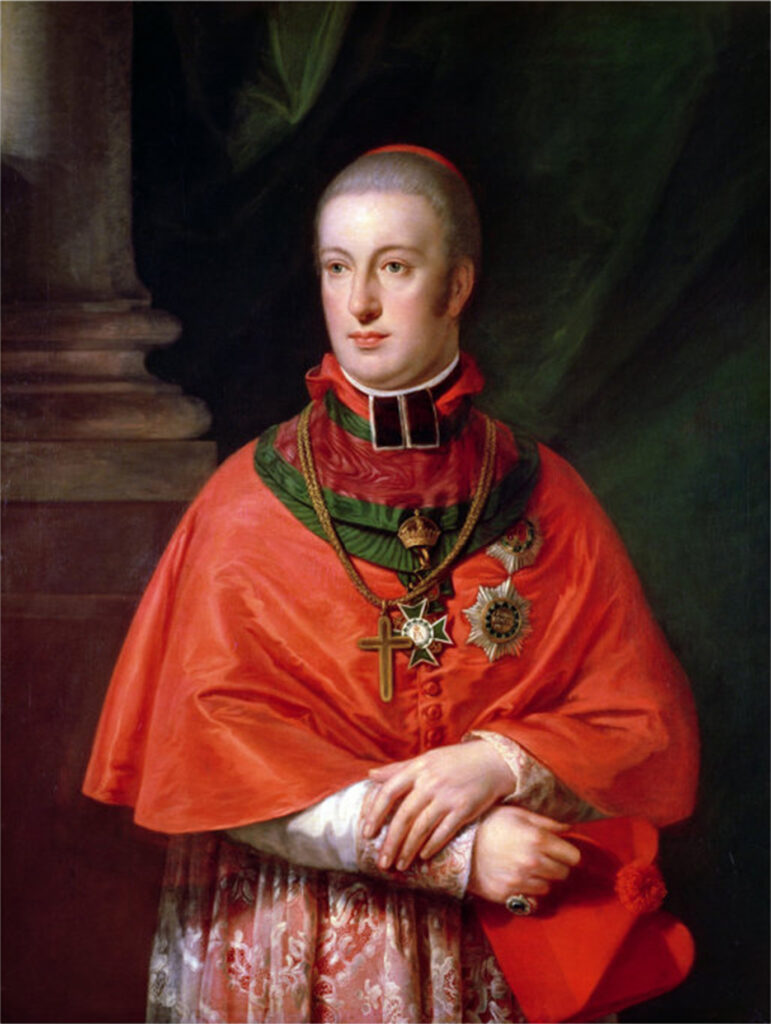
Recorded live in the fine acoustic of St. George’s Bristol, the complete piano trios series from Somm Records continues to set a benchmark for chamber music. Volume 4 more than lives up to what has gone before, with that perfect blend of analytical precision and generosity of rich, melodic tone that are the hallmarks of the Gould Piano Trio (Lucy Gould, violin, Alice Neary, cello, and the pianist, Benjamin Frith). They delight us on CD with three Beethoven masterpieces, the Trio in E flat major, Op.1, No. 1; the trio in E flat major (which has the designation, Hess 48), and the well-known “Archduke Trio” – the four-movement Op. 97, B flat major work, which Beethoven dedicated to Archduke Rudolph (1788-1831), a keen music student who benefited from the tutelage of the composer.

All successful chamber groups and ensembles have that indefinable “second sight” – the ability to play and listen as one, and to anticipate the next move, gesture or inflexion, but the Gould Trio achieves a rare oneness of expression and sound in their elegant transitions through Beethoven’s many compelling themes, variations and fertile, flourishing ideas. For a composition for three players, the Op. 97 is surprisingly “large”, dynamic and wide-ranging: the listener can immediately tell that Beethoven is a symphonic composer, able to fill his imaginative landscape-in-sound with many commanding peaks, and gentle valley floors. The two outer movements, marked Allegro, have great vitality, as does the second scherzo section. The 12-minute-long Andante cantabile shows us the depths of Beethoven, and in the hands of the Gould Trio, I doubt if any listener could wish for a better interpretation.

Beethoven’s example as a composer of chamber music and symphonies probably inspired every other musician who came in his wake. Following Beethoven’s example, Bruckner, Mahler and Malcolm Arnold wrote nine symphonies – as did Vaughan Williams, although Sibelius fell short by two. And Beethoven’s idealistic opera, Fidelio, and the Ode to Joy finale of his Ninth Symphony showed how, in revolutionary times, serious messages could and should be disseminated by the artist. His legacy is vast – and far-reaching. In the new spirit of 20th-century national consciousness, both Janacek and Martinu – Czech nationalists – continued the European tradition of expressive chamber music with the writing of string quartets; Chandos records bringing us three such pieces on their new disc, performed by the Doric Quartet – an ensemble of brilliant musicians from the younger generation, and the winners of leading international prizes in the chamber genre, in Japan, Italy and Germany. First performed in 1924, in the presence of the composer, Janacek’s First String Quartet was inspired by a Tolstoy tale, The Kreutzer Sonata (which took its name, in turn, from the sonata by Beethoven). Concerned with the suffering of a woman in a “swinish” marriage, Tolstoy’s protagonist forms a liaison with a fellow musician, and together, they perform Beethoven’s sonata – which leads to an explosion of jealous rage on the part of the woman’s obsessive husband. Janacek’s own personal life had its own complications (his marriage was coming to an end – due to his infatuation with a lady, many years his junior, by the name of Kamilla Stosslova), and his sonata reflects these emotional disturbances, although – curiously – he writes not out of self-pity, but of pity for the wife and her unhappiness.

Kamilla Stosslova

Kamilla Stosslova

The second quartet, subtitled Intimate Letters, is similarly concerned with Kamilla; and the 600 or so letters that he penned to her, his muse:

“For the last eleven years you have, without knowing it, been my idol. Whenever there is warmth of feeling, sincerity, truth and ardent love in my compositions, you are the source of it.”

For Janacek, this was music composed in the very immediacy of experience: “acquiring its shape in fire”, rather than something re-created from the memory of embers and “hot ashes”. The quartets are clearly not “constructed”, or in any way an exercise in form. This is physical music, burning its way from the body and soul, with an ever-present spikiness and tension – the Doric Quartet leading us through the loneliness, the sudden outbursts of desire and anger which open and close like the doors of a sinister house of secrets.

Bohuslav Martinu’s String Quartet No. 3 (first performed in the United States in 1930) completes this Czech collection, and for those unfamiliar with Martinu, I can but point you, either to the unique Fifth Symphony – one of my first introductions to this overlooked figure – or to the film which Ken Russell made in the early 1990s, The Mystery of Dr. Martinu – a biopic, or more correctly, composer-phantasmagoria, so typical of this “appalling talent”, as Russell was once described by critics. With strange dreams and suggestions unfolding in Martinu’s (and Russell’s) febrile mind, maidens (in various stages of undress) brandishing Czech flags, and dancing through Bohemia’s woods and fields – and even an appearance by a locomotive of a miniature railway in Kent – the film is an unusual but effective piece of music-education! The Doric Quartet, though, pulls us back into the actual Martinu: the composer whose music suggests new worlds and sound-worlds, complex and compact forms, with the ability to shape some noble phrases from raw energy, and a colliding, curdling, kaleidoscopic 20th-century tonal background.

Prague Castle

Prague Castle

If there is one British composer who could be likened to Martinu, it might be Sir Malcolm Arnold (1921-2006): trumpet player, symphonist, prolific composer of film scores (from The Sound Barrier to St. Trinian’s), writer of breezy English, Scottish and Cornish Dances (not to mention a march for the Padstow lifeboat), and conductor – in 1969 – of the diverse-and-democractic-before-its-time Concerto for Group and Orchestra, in which Deep Purple joined the Royal Philharmonic at the Albert Hall. Arnold could be the most generous of men, but throughout his life he fought against many inner demons and suffered from a darker side, all of which accentuated in his music a tragedy and tenderness. Yet there was a gift for radiant, loving, transcendent melody – curving away into chirpy, street-corner tunes that make you want to whistle along (even some hymn-like phrases now and again), but these passages can suddenly twist into blistering, shrieking Shostakovich-like marches and dances of death.

From Somm, comes a beguiling rendition of his Sonata for Strings (actually a string quartet from the mid-1970s, later expertly arranged by fellow composer, David Matthews, and first performed just before the composer’s death) – played by the 16-strong Orchestra of St. Paul’s, conducted by Ben Palmer. May I offer a warning to listeners? If you are in any way a sentimental person, it might be best to avoid playing the fourth movement Allegretto-Vivace-Lento music of the sonata: Arnold has written a wistful, soft-flickering idea, so simple, so evocative of lost days, or lost loves or deep memories of some kind – irreplaceable and locked-in-the-heart – that it is difficult not to feel a gulp in the throat, or the tingle of a tear at the corner of the eye. This is a truly beautiful piece of writing, and Ben Palmer’s players make much of its deep saying; its gentle, poignant, understated magic.

Meanwhile, and with equally polished playing, Chandos bring us a magnificent box-set of all nine Arnold symphonies, the conducting shared between the late Richard Hickox, and the British music enthusiast (and film-music specialist), Rumon Gamba. The London Symphony and BBC Philharmonic orchestras are presented in dazzling Chandos sound: the high-octane percussion and brass, and the many softer details, too – the innocent first-movement idea, like gentle rain, and the string tremolo which buoys up a confident, even cocky theme (third movement) in the Fifth Symphony – brought into vivid focus by the sound-engineers of this exclusive label.

Finally, our British pageant comes to a conclusion with an extremely interesting collection of music for wind band, or wind orchestra, played by the Central Band of the Royal Air Force, under their director, Wing Commander Duncan Stubbs. The famous Holst and Vaughan Williams suites appear (and how deeply and solemnly the RAF players deliver the first movement of Holst’s First Suite, Op. 28, No. 1, dating from 1909). Percy Grainger’s Lincolnshire Posy (written just two years before the Second World War) – full of fragrant, salty tunes, and reflective folk-melodies from an old English shire by the North Sea – is a delight; but it is particularly good to see the name of Ernest Tomlinson (b. 1924) represented. His Suite of English Folk Dances was written for a festival of music and dance in 1951 – a time when the avant-garde was beginning to assert itself, but when an English audience still wanted the reassuring sense of home.

Sturdy, catchy tunes from old village processions – suggestive, perhaps, of Hardy’s Wessex, or from a May Day Morris dance in Gloucestershire – are framed by slower-in-pace pastoral tunes, which evoke lonely hills and an English landscape of the heart. Tomlinson’s simple, ancestral melodies nudge at stronger emotions. It is like watching the sun rise on a misty morning near Orford Ness, or enjoying a Romney Marsh dusk, coloured by a haze of pink sunset half-light: the experience, the music truly touches one of those unfathomable parts of the soul.

STUART MILLSON is the Classical Music Editor of Quarterly Review.

Posted in ENDNOTES:Music, QR Home | Tagged , , , , , , | Leave a comment

Subtracting the self

Julianne Moore

Subtracting the self

Robert Henderson is impressed by a harrowing depiction of dementia

Still Alice:

Main Cast
Julianne Moore as Alice Howland
Alec Baldwin as John Howland
Kristen Stewart as Lydia Howland
Kate Bosworth as Anna Howland-Jones
Hunter Parrish as Tom Howland
Shane McRae as Charlie Jones
Stephen Kunken as Benjamin

Directors: Richard Glatzer and Wash Westmoreland

I am decidedly wary of films that revolve around disability because they all too often dive into a morass of self-conscious sentimentality. Still Alice avoids this fate because of the excellence of Moore’s performance and the often selfish and neglectful behaviour of her family, although, sadly, there is a sentimental ending wholly out of keeping with the rest of the film.

Alice (Julianne Moore) is a professor of linguistics at Columbia University who finds her self struggling with her memory and concentration. At first it is just the odd word or name that escapes her, something that happens to all of us as we get older. But soon she is forgetting appointments and social occasions, finding herself disoriented in familiar surroundings and being unable to lecture coherently. She meets people then a few minutes later has forgotten that she has met them. Worried, she sees a specialist and finds that she has early onset Alzheimer’s.

From that point onwards Alice stumbles ever further into a world that is increasingly both incomprehensible and unmanageable. At first she devises strategies such as writing three or four words on a board and then covering it up for a time before trying to remember what she has written. She gives a talk to the Alzheimer’s Society that she is only able to do by highlighting each sentence as she speaks it to tell her what she has already said. She puts questions about people she knows such as their names and relationships on her phone and tries to answer them. But these exercises and stratagems become increasingly redundant as time passes and we watch a personality shrinking as faculties are remorseless subtracted from her.

The diagnosis adds a further complication: Alice has a form of Alzheimer’s that is hereditary. She has three adult children, one of whom is pregnant with twins. Her eldest daughter, Anna (Kate Bosworth), tests positive for the Alzheimer’s gene; her unborn twins test negative, as does her doctor son Tom. Alice’s youngest daughter, aspiring actor Lydia (Kristen Stewart) refuses to have the test.

While Alice still has most of her marbles she tries to prepare for the time when she will not be able to look after herself. Under the pretence that she is looking for a place for her father she visits a retirement home which specialises in dementia cases to get an idea of what the future will hold and comes away dismayed by what she sees, a host of people defrocked of their dignity and purpose. Perhaps prompted by this dismal future she leaves a message for herself on her computer giving her future self instructions about what to do when she can no longer answer questions such as “Who is your eldest daughter?” These instructions consist of telling her where to find a bottle of pills (which will kill her if they are all taken in one go) and to swallow the lot.

As her state worsens Alice forgets the recording giving her the instructions to kill her self, but inadvertently clicks on the computer file containing it when she is already well advanced in the decline of her mental powers. She makes several abortive starts to find the pills because she keeps forgetting the instructions to find them. Eventually Alice finds the bottle, but just as she is about to take the pills someone returns to the house and the sound of them causes her to spill them onto the floor. The interruption causes her to forget why she was holding the pills and her chance of escape from an increasingly undignified existence is lost without her even knowing that it existed.

Alice’s family are not outrageously unsympathetic, but most of them display a greater concern for their own lives which leads them to behave selfishly in the face of   Alice’s growing needs. Her husband John, a medical research scientist is negotiating a deal with the Mayo Clinic and eventually leaves his wife to take up a post a couple of hundred miles away, the elder daughter Anna is preoccupied with her pregnancy and the youngest daughter Lydia displays the selfishness and lack of patience of a moody teenager, although in the end she returns to look after her mother.

The acting is uniformly good with Moore unreservedly first rate in her portrayal of someone shrinking from a confident adulthood to something less than a child. Just by her facial expressions she manages to give the impression as the film progresses of a mind becoming less and less functional until at the end there is little left other than vacancy. It is a remarkable feat of acting.

It might be objected that by concentrating on a high performing individual the film misrepresents, even in a strange way glamorises Alzheimer’s, because someone like Alice seems to have more to lose than most dementia sufferers, her diminishing to be of greater consequence. This strikes me as a complaint without substance. It is true that the vast majority of Alzheimer’s patients will be people without any special intellectual distinction and perhaps the classic patient will be someone who is poor with little education, but there are plenty of people in Alice’s situation, Iris Murdoch being a recent famous example. Alice is not an anomaly in the world of Alzheimer’s. Moreover, perhaps there is something more tragic about someone like Alice because she has a dimension to lose in addition to that of the common run of humanity.

If the film has a weakness it is the heavy handed over egging of the poignancy of Alice’s situation. Her background story is just too facile, containing as it does the grand and obvious irony that someone who knows so much about the workings of language is being stripped of that knowledge and in the end of language itself. I think it would have been better if she had been an historian. The irony of her position would have still been telling but more subtle and probably more apt, because she would have been a woman whose life involved knowing a great deal of the past having that knowledge eroded to nothing.

Then there is the making of the disease Alice carries hereditary. Alzheimer’s can be inherited but the odds in real life are very much against it, with perhaps 5% of cases involving heredity. By introducing the chance of the disease being carried by the children the focus is unnecessarily moved away from Alice’s plight that is all that really matters here.

But these are quibbles when placed in the context of the general excellence of the film.

ROBERT HENDERSON is QR’s film critic

Posted in Film Reviews, QR Home | Tagged , , , | Leave a comment

Libertarian Anarchism’s “Justice” Problem

ilana_nuut2

Libertarian Anarchism’s “Justice” Problem

Ilana Mercer grapples with “the nit and the grit” of reality

To the extent that the Constitution comports with the natural law—upholding the sanctity of life, liberty, privacy, property and due process—it is good; to the extent it doesn’t, it is bad. The manner in which the courts have interpreted the U.S. Constitution makes the Articles of Confederation, which were usurped in favor of the Constitution at the Philadelphia Convention, a much better founding document than the Constitution.

THE SIN OF ABSTRACTION

Unless remarkably sophisticated and brilliant (as only Hans-Hermann Hoppe indubitably is), the libertarian anarchist invariably falls into sloth. Forever suspended between what is and what ought to be, he settles on a non-committal, idle incoherence, spitting venom like a cobra at those of us who do the work he won’t or cannot do: address reality as it is. This specimen has little to say about policy and politics for fear of compromising his theoretical virginity.

Suspended as he is in the arid arena of pure thought, the garden-variety libertarian anarchist will settle for nothing other than the anarchist ideal. And since utopia will never be upon us, he opts to live in perpetual sin: the sin of abstraction.

Indeed, arguing from anarchism is problematic. It is difficult to wrestle with reality from this perspective. This is not to say that a government-free universe is undesirable, on the contrary. However, the sensible libertarian is obliged to anchor his reasoning in reality and in “the nit and the grit of the history and culture from which it emerged,” in the words of columnist Jack Kerwick.

This mindset maligned here is not only lazy but—dare I say?—un-Rothbaridan. For economist and political philosopher Murray Rothbard did not sit on the fence reveling in his immaculate libertarian purity; he dove right into “the nit and the grit” of the issues.

And the “nit and grit” for this not-quite anarchist concerns the problems presented by the private production of justice.

COMPETING THEORIES OF JUSTICE

A belief in the immutably just nature of the natural law must elicit questions about the wisdom of the private production of defense, as this could, in turn, give rise to legitimate law-enforcement agencies that uphold laws for communities in which natural justice has been perverted (in favor of Sharia law, for example).

It’s inevitable: in an anarcho-capitalistic universe, fundamentally different and competing views of justice (right and wrong) will arise. And while competing, private protection agencies are both welcome and desirable, an understanding of justice, predicated as it is on the natural law, does not allow for competing views of justice.

How, then, does one reconcile this inevitable outcome with the natural law and the emphasis on the search for truth as the ultimate goal of justice?

To let the victim forfeit—or choose his own form of—redress for certain misdemeanors is fine. Many legal solutions are a result of mediation and other perfectly private solutions to non-violent offenses.

To leave punishment for murder, rape and other violent crime to the vicissitudes of the victim or his proxies is, however, unacceptable. The likelihood that in a stateless state-of-affairs, a victim or her proxies will choose to let a violent offender go free in favor of financial restitution cannot be ignored or tolerated. It matters not that such an eventuality may be rare, or that similar injustices occur under the state. These should never happen. Not under the state. Not under anarchy.

Furthermore, does the voluntary forfeiture of just retribution not imply, in the case of murder, that the right to life is a right the victim’s surrogates may choose to alienate or relinquish at will? How else does one construe this position?

The danger of reducing justice, in cases of violent crime like homicide, to a negotiated deal amounts to moral relativism and is a recipe for nihilism.

Anarchists also ignore that a violent offender presents a clear and present danger to others, and that his fate, at least in a civilized society, is the prerogative not only of the victim.

Libertarian anarchists will correctly counter that, under a minimal state and certainly under the state today, criminals could—and do every day—get away with murder. This is because the justice system is horribly flawed. This fact is insufficient a reason to support a state of affairs where, as a matter of principle, proportional, moral retribution will not necessarily be the goal of justice. The kind of justice sought in anarchy would depend on the victim, not so? It is unlikely that she will support unconditional love—euphemized these days as restorative justice—as an antidote to rape. But if she’s of the Left, it’s quite possible.

Conversely, under a system in which competing theories of justice prevail, personalized “justice” may well take the form of vendetta. For example, and as one anarchist retorted: “If a woman is raped, she could demand proportional restitution (e.g., whatever fines imposed on the criminal necessary for the emotional harm caused her, including castration and the unexpected forced rape of the criminal). The criminal would simply be enslaved to the victim (or her punishment agency, more likely, if she didn’t want to deal with him), until repayment had been met. The court could decide, for example, that for restitution, the rapist is to pay the victim $1 million and be violently raped himself.”

What if the offender dies due to castration or forced rape? Is that proportional justice? What was suggested above is barbaric vigilantism.

Under anarchism, the proposal above could be adopted as a matter of principle rather than as an aberration to be rectified. Civilized, moral retribution should aim to avoid such barbarism.

JUSTICE FOR ALL VS. CLIENT-CENTERED JUSTICE

As was observed, victims could demand disproportionate punishment and the enforcement agency would comply. Not all victims, moreover, will be covered by private protection agencies. Who ensures that justice is meted in cases where individuals cannot afford or opt not to contract with a private protection firm? There is little if no incentive for such an agency to pursue a dangerous offender who has not harmed their client. Do we, then, rely on good Samaritans to take up arms and hunt down the offender? Or do we as a society, through the common law, make a public declaration of the few abiding values we wish to uphold?

To the extent possible, there must be a commitment, however imperfect, to justice for all and not only for those who’ve contracted with a private protection agency.

So while the current criminal justice system is often egregious in its approach to victims, the libertarian’s characterization of the private production of defense as “victim-centered” is misleading. It is client-centered.

Again, that we suffer depredations under the state is insufficient an argument for making this state-of-affairs a viable, “principled” option, which would likely be the case under anarchy.

Finally, libertarian anarchists often make their case with wacky references to anarchism in small homogeneous societies—Medieval Viking Age Iceland—or even less convincingly, among the murderous tribes of Africa. For some loopy reason, they prefer this no-man’s la-la land to the followers of John Locke.

I don’t conceal my preference for Western tradition, nor the positive view I hold of the accretive genius of the common law. Ultimately, it is better to distinguish good from bad arguments than to separate anarchist from minarchist positions. The goal of libertarian justice should therefore be to advance just, rights-based positions.

ILANA MERCER is a paleolibertarian writer based in the United States. She pens WND’s longest-standing column, “Return to Reason” and is a Fellow at the Jerusalem Institute for Market Studies. She is a Quarterly Review Contributing Editor. Ilana’s latest book is Into the Cannibal’s Pot: Lessons for America from Post-Apartheid South Africa. Her website is www.IlanaMercer.com. She blogs at www.barelyablog.com

Posted in Current Affairs and Comment, QR Home | Tagged , , , | Leave a comment

What next in Russia’s “near abroad”?

Tiraspolsupremesovietleninstatue07052011-scaled.jpeg

What next in Russia’s “near abroad”?

The Ethnic Conflict Information Centre identifies possible scenarios

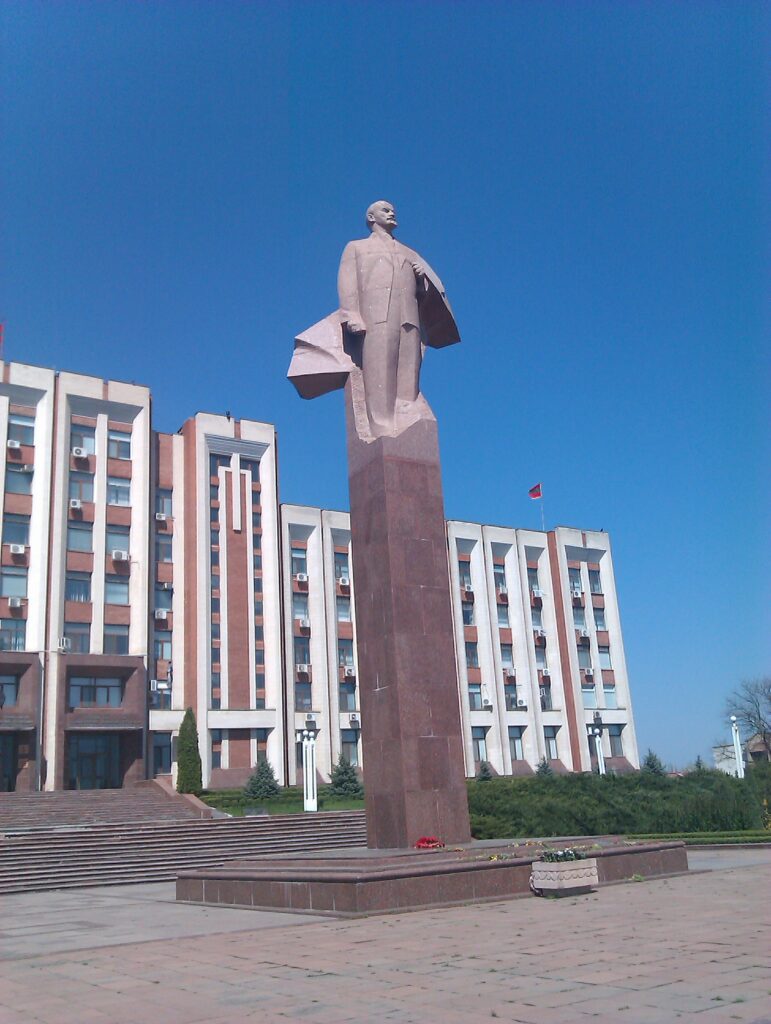
Ukraine’s modern history has been dominated by its struggle for national identity and self-determination in the face of aggression and outright occupation from its bigger Russian neighbour. Since independence from the USSR in 1991, Ukraine has periodically challenged Russian geo-military ambitions, for example through the denial of Ukrainian airspace for Russian reinforcements to Kosovo, support for Moldova in its dispute with Moscow over the breakaway region of Transnistria, carrying out joint exercises with NATO, and floating the possibility of both EU and NATO membership. Even before the dramatic escalation of hostilities between the two countries that occurred in 2014, Russia in turn had regularly threatened Ukraine with potentially crippling energy and other economic sanctions.

Both Moscow and Brussels have sought to interfere in Ukrainian elections, the results of which have oscillated between broadly ‘pro-Russian’ and ‘pro-Western’ outcomes. 2004 saw the ‘Orange Revolution’ in which the ‘pro-Western’ Viktor Yushchenko triumphed over Viktor Yanukovych in the back-and-forth battle for the Ukrainian presidency. In a dangerous and significant pointer to the future, the Orange Revolution showed a widening political division between the nationalist west of the country, and the more Russophile east and south, including the Crimean peninsula. In Ukraine’s December 2004 poll, electorates in south and east Ukraine voted solidly for Viktor Yanukovych, and this trend was repeated in the 2010 election, in which Yanukovych regained the presidency.

Despite his perceived pro-Russian bias, Yanukovych initially favoured closer relations with the EU, agreeing an association agreement with Brussels that would secure EU funding on the condition of major reforms to Ukraine’s economy and political structures. Later, however, Yanukovych dramatically reversed course, refused to sign the EU association deal, and in 2014 agreed instead a treaty and a multi-billion dollar loan arrangement with Russia.

The consequences are now well known. In a more violent re-run of the Orange Revolution – the so-called Euromaidan Revolution – Yanukovych was driven from office. In the ensuing confusion, Russia annexed Crimea, and full-scale conflict erupted in parts of eastern Ukraine. Accusing Moscow of open aggression against a sovereign European state, the West imposed economic sanctions on Russia – and Russo-Western relations crashed to a new post-Cold War low.

Such, broadly, are the facts. Further interpretation rapidly becomes mired in the conflicting narratives of the two sides. This divergence is in itself significant, illustrating as it does the extent to which the West has failed to understand what motivates Russia, how Moscow interprets regional developments, and, by extension, what practical limits may exist on Western geopolitical ambitions.

The 2004 Orange Revolution and the 2014 Euromaidan uprising are, in fact, viewed by Russia and the West in almost mirror images. For the West, Russia’s interference in Ukrainian political life, including an attempt to poison Yushchenko (leaving him visibly scarred) clearly revealed the work of the Russian FSB, successor to the KGB. For the Russians both the mass Orange demonstrations and the Euromaidan “coup d’etat” (as Moscow termed it) were patently the work of American and EU interests.

Similarly, Russia places a wholly different interpretation on its annexation of Crimea to that offered by Western governments. The Russians point to Crimea’s Russian majority population, the fact that it has been Russian throughout most of its history, and that it was actually part of the Russian Federated Soviet Socialist Republic until 1954, when jurisdiction was transferred to Ukraine. This move, uncontroversial while the USSR existed, meant that, upon the collapse of the Soviet system, Crimea became a part of Ukraine despite its Russian history and ethnic majority. For most Russians, therefore, the reunification of Crimea with Russia was simply the rectification of a Soviet-era internal border, and one that carried the overwhelming endorsement of the people of the peninsula.

Understanding Russian actions in Ukraine does not make them excusable, but it does make them explicable and – more importantly – predictable. Yet the failure of the West to understand, let alone accommodate, Russia’s interests and worldview is all the more revealing because the West was given a clear warning, back in 2008, of the limits of Russian tolerances of US and EU encroachment into its ‘near abroad’. In that year, Georgia, buoyed up by the rhetorical support of its friends in Brussels and Washington, was prompted to a recklessness that led to disaster. In August 2008, the Georgians attempted to forcibly seize the city of Tskhinvali, capital of the breakaway region of South Ossetia. Russia, in a clearly pre-planned countermove, acted massively and decisively against the Georgians, and within a matter of hours had driven them out of South Ossetian territory entirely. By 10 August the Russians were moving into Georgia proper, occupying the city of Gori (incidentally the birthplace of Stalin) and threatening the Georgian capital, Tbilisi.

In making such a bold move, the Russians calculated that the United States, bogged down with the wars in Afghanistan and Iraq, would be incapable of effective intervention. (One can reasonably assume the possibility of any effective European Union reaction did not weigh too heavily on the minds of Kremlin planners.) In this, Moscow proved entirely correct. Faced with complete military collapse and the possibility of wholesale Russian occupation, and perceiving no possibility of foreign intervention or re-supply, Georgia sued for peace, under terms dictated by the Kremlin but agreed nominally under the brokerage of France, which was then holding the Presidency of the European Union. Moscow then went on to formally recognize South Ossetia and Abkhazia, a second breakaway region, as independent states.

The Russian attack on Georgia was a primarily a “war of demonstration.” It was intended to prove three things to Washington and Brussels. First, that the Russian army was back in business after its precipitous decline in the 1990s. Secondly, that Western snubs, such as the recognition of Kosovo over Russian objections, would have their consequences. Thirdly, that the further eastern encroachment of NATO and the EU into the Russian sphere of influence, into Ukraine for instance, would be resisted.

Clearly, these messages, specifically the third, were lost on the West, which largely blundered on with ‘business as usual’ with regards to Ukraine.

So, what, or rather where, next? One potential flashpoint to watch is Moldova where, as in Ukraine, corruption has long been entrenched in government and the question of whether the country should look east or west for its future has dominated general elections. Currently, pro-EU elements are in the ascendency, and at the November 2013 summit in Vilnius, Moldova signed up to a keynote Association and Free Trade agreement with the EU. This was the same summit that led to the Ukraine crisis when then-President Viktor Yanukovych refused to sign a similar agreement.

Furthermore, in an echo of Georgia, Moldova has its very own Russian-dominated breakaway state, Transnistria, whose rulers have on occasion indicated an enthusiasm for joining the Russian Federation, and which has a useful in-country contingent of Russian ‘peacekeeping’ troops. Another flashpoint could be the autonomous region of Gagauzia, in the south of the country. The Gagauzians are a Turkic people with pro-Russian sentiments. In 2014 a local referendum overwhelmingly supported closer links with Russia and called for Gagauzian independence should Moldova join the EU, while gubernatorial elections in March 2015 saw the election of a strongly pro-Moscow candidate. Russia’s Foreign Minister, Sergei Lavrov has said that Moldova’s signing of the EU Association agreement meant Russia needed to do more to support potentially dissident regions such as Gagauzia. Russia imposed a ban on Moldovan agricultural exports in the aftermath of the Moldova/EU agreement – but pointedly excluded Gagauzia from the embargo.

Moldova’s parliamentary elections in November 2014 resulted in victory for a pro-EU coalition. However, the largest single party, with over 20% of the vote, was the Party of Socialists of the Republic of Moldova – a markedly pro-Moscow party whose leader enjoyed a well-publicized meeting with Putin during the election campaign and which is committed to binning the Association and Free Trade agreement. A fatal fracturing of Moldova’s already delicate political structure could easily occur if, for example, overtures towards full EU membership were to be made either by the Moldovan government or by Brussels. Given the EU’s propensity for hoovering up any country that falls into its sphere of influence, the precedents for Brussels displaying the subtlety to manage the complex situation that would result are not encouraging. Equally, it would not be hard to see Russia enthusiastically seizing any opportunity to make mischief in Transnistria and/or Gagauzia.

An even more dangerous set of scenarios would see Russia stirring up trouble in the Baltic. Estonia, Latvia, and Lithuania are members both of NATO and the EU, so this would represent a very significant escalation. Although ‘probing’ and ‘nuisance’ attacks are possible it remains highly unlikely that Russia would deliberately provoke a full-scale shooting match with NATO. But there are tangible dangers of an accidental war being ignited.

Short of overt armed conflict, Russia could provoke or exploit unrest amongst the Baltic’s Russian minorities. Should riots or paramilitary activities by Russian activists overwhelm the local authorities, as is quite likely, the only remaining recourse would be to use NATO forces in some kind of policing or peacekeeping role. This would place them in the invidious position of being portrayed as aggressors against a civilian population – a propaganda gift to the Kremlin.

Cyber attacks are also likely. Indeed, Estonia has already been the victim of at least one sustained cyber attack that many – not least the Estonian Government – believe Russia was responsible for. As all three Baltic States are members of the Eurozone, cyber terrorism against their financial infrastructures could have consequences well beyond their borders.

The advantage for Russia of this tactic is that it stops short of physical violence, and culpability is very difficult to prove. However, it would still be a very risky game to play. As NATO members, the Baltic States have the right to invoke Article 5 of the NATO treaty, by which an attack on one member is to be regarded as an act of war against all members of the alliance. The only time Article 5 has been invoked was by the USA in the aftermath of the 9/11 attacks. So a precedent – indeed, the only precedent – for Article 5 to be used exists in circumstances where the attack was unconventional and not directly involving a hostile nation state. It is not too far a reach, therefore, to see Estonia, say, successfully invoking Article 5 as a casus belli in response to a Russian-based cyber attack.

In assessing whether any Russian leader would seriously risk armed conflict with NATO it is necessary to bear in mind that the cards are not by any means all in the Kremlin’s hand. Although regionally formidable, there are serious doubts as to the training, logistical and technical proficiency of the Russian Army and whether it could really stand up to a fully engaged America. Longer term, the broader geopolitical and economic prospects for Russia are not particularly encouraging either. Responsible for two-thirds of export earnings and half of all tax returns, the Russian petrochemical industry is both a strength and a weakness. In the current climate of depressed oil prices, Russia seems increasingly vulnerable. At the beginning of 2015, the Russian economy looked like it was in freefall, battered by Western sanctions, a collapse in the value of the rouble, rocketing interest rates, and a crippling fall in petrochemical revenues.

The Russian people’s capacity for the stoic acceptance of suffering is proverbial, particularly when its patriotic instincts are engaged. But it may not be limitless, and unlike in the days of Stalin and the Great Patriotic War, there is now a class of influential Russians well acquainted with the delights of Western consumerism. Should the members of the Russian Union of Industrialists and Entrepreneurs – the “oligarch’s club” – start to feel the pinch this will have much more impact on President Putin’s policies than bombast from Western leaders. Of course, the counter argument exists that Putin may be provoked to military adventurism precisely because Russia’s economy is weak and, like Argentinian President Kirchner vis-à-vis the Falklands, he needs a external scapegoat and rallying point to deflect domestic discontent.

In Soviet times, Russia, as the core Soviet republic, benefited from not one but two rings of buffer states – the outer Soviet Republics themselves, and the Central and Eastern European ‘satellite’ states, which were integrated into one military bloc through the Warsaw Pact. Soviet armed forces, the product of a much higher proportion of GDP expenditure than is now possible even under Putin’s re-arming of Russia, were capable of global reach. Furthermore, for all its vileness, Communism was an exportable commodity, not least among influential liberal elites in Western Europe and North America; Russian chauvinism has a much more limited appeal. In short, Russia does not enjoy many of the power projection advantages possessed by the old Soviet Union. The question may therefore be asked how, if Russia really is intent on a second Cold War, she believes she would fare any better than the USSR?

Although the possibility of a new Cold War is now raised openly in certain Western circles, the question may be a false one. It is quite possible that the Kremlin holds an entirely realistic evaluation of modern Russia’s strengths and weaknesses. Vladimir Putin may genuinely have no global superpower ambitions – but he does demand that Russia be taken seriously in the European and Eurasian theatres.

©

Ethnic Conflict Information Centre, April 2015

www.ethnic-conflict.info

Posted in Current Affairs and Comment, QR Home | Tagged , , , , , , | 1 Comment

Strangeways Remembered

Strangeways Prison

Strangeways Prison

Strangeways Remembered

Bill Hartley recalls the notorious prison riot 

Twenty five years ago in April 1990 the worst riot in British penal history took place at Manchester’s Strangeways prison. Much has been written about the event notably the report by Lord Justice Woolf and doubtless more will appear during this anniversary year. The consensus was that the riot occurred because of the appalling conditions that prisoners had to endure. Well, as someone who was there I have an alternative theory to offer.

It was a very different prison system to the one we have today. Back then one cynic described the Prison Service as a working class organisation with middle class aspirations. And it was run with an iron fist by the working class; recruits tended to come in from the declining industries, for example the former trawler men who ran HMP Hull or the ex miners of HMP Leeds.

Conditions in the big northern ‘local’ prisons were squalid. Years of under investment had seen to that. I remember once going into the roof space above ‘I’ wing at HMP Liverpool to discover rubble from wartime bomb damage had been dumped there and forgotten about. Strangeways wasn’t the worst. For sheer awfulness Leeds topped the lot. Prisoners entered its reception area down a flight of steps plunging into a subterranean world designed by the Victorians to subdue new arrivals. Above was a soot blackened jumble of buildings whose silhouette was said to resemble Windsor Castle. There was a landing for psychiatric cases. Cell doors had been adapted and fitted with what officers called cat flaps. This allowed hospital staff to feed potentially violent prisoners without unlocking them. In a mildly humanitarian touch these flaps were left open to allow prisoners some sight of other human beings. For the newcomer it was an unnerving experience to have to walk a straight line along the centre of the landing. Deviate and you risked being grabbed by arms hanging out of the cat flaps.

The thing was that prisoners accepted these conditions as normal. It was assumed that if you went inside then you entered a decayed and overcrowded version of what the Victorians had created. Cells were larger than strictly necessary because their design envisaged single occupants who would need space to do whatever work was given them. In 1990s Strangeways three prisoners could find themselves in this space with no work to do. Rex Bloomstein’s famous 1979 documentary introduced the public to what life was like in the prison. Eleven years later things were starting to change and the clamour for reform had finally reached the ears of prisoners. I actually heard prisoners complain of being locked up for ‘twenty three hours a day’. Admittedly an unemployed prisoner was locked up for an awfully long time but simple arithmetic should have told them that the daily routine made twenty three hours in a cell impossible. Such was the power of propaganda.

My first inkling of how serious the situation was at Strangeways came during my time as duty governor at HMP Liverpool. I was called down to Reception to monitor the arrival of some prisoners. With the disturbance at its height many had surrendered before being moved to other jails. This group though were different. They were sex offenders freed by Strangeways staff who had the presence of mind to release them before withdrawing. I encountered a group of men white faced and shivering in shock and fear, conscious as I learned later that they had narrowly escaped a beating or worse.

Subsequently I was sent to Strangeways as negotiations advisor to assist the night commander of the incident. By then the hold outs were on the roof and the jail was a surreal place to be. Our operations room was the clothing store, close enough to manage the incident but protected from missiles flying down from the roof. At intervals claxons would blare, this being an attempt to keep the rioters awake and on edge. With care it was possible to approach the central rotunda of the prison. Here they had erected scaffolding for a painting job. One can imagine how lethal a scaffolding pole thrown from height could be. This inadvertent provision of ammunition for the rioters was one reason why it was decided not to retake the jail. The fact was though that the initiative had been lost in the first few hours. Lord Woolf chose not to blame the people on duty because presumably he knew a command and control failure running right to the top when he saw one.

A man like Lord Woolf would have been appalled by the conditions he found but working class prisoners were rather more accepting. Indeed a report around that time by the Chief Inspector of Prisons described HMP Liverpool as having ‘the worst levels of deprivation in any English prison but the highest morale among prisoners’. It really depended on how the staff ran the jail and the relaxed approach in Liverpool kept the place quiet.

It’s my belief then that what happened wasn’t a spontaneous protest against conditions but rather a quirk of northern working class culture. Liverpudlians and Mancunians don’t get on. Usually they are at opposite ends of the East Lancashire Road but there used to be many stories about friction in Warrington – Runcorn New Town, where sections of each tribe had been dumped.

Liverpool had its share of sex offenders: Rule 43s as they used to be called. Someone had the idea of locating them on the prison’s ‘H’ wing that would then be a dedicated unit managed for those classed as ‘vulnerable’. They certainly were. Exercising on ‘H’ yard had to be abandoned after the sniper on neighbouring ‘G’ wing struck once too often. He was an anonymous prisoner with a catapult who could fell sex offenders with considerable accuracy. No-one minded much until officers realised they too might be at risk.

The prison didn’t have enough Rule 43s to fill ‘H’ wing and it was unthinkable that ‘ordinary’ prisoners could remain there. An approach was made to Strangeways to take all their Rule 43s. This was accepted with alacrity since Rule 43s were considered a nuisance to manage. In exchange the prisoners from ‘H’ wing were sent to fill the vacant spaces at Strangeways and they were not happy about going there. A factor contributing to the stability of a local prison is the sense that though a man is incarcerated he is still close to home.

The prisoner who began the uprising in the chapel that Sunday morning was Paul Taylor from Birkenhead, a former Liverpool prisoner. Night after night I sat with the commander as the numbers upon on the roof slowly dwindled and noticed that the last hold outs were mainly Liverpool men. You won’t find any of this in Lord Justice Woolf’s report but it leaves me thinking that wrecking Manchester’s prison was a Liverpudlian thing to do. 

_81599729_729bd1bc-3cb8-427e-aa2f-01b45a8291a1

Bill Hartley, who worked in the prison service, writes from Yorkshire

Posted in Current Affairs and Comment, QR Home | Tagged , , , | Leave a comment

Get off Your Knees, Gov. Pence! (You’re not in a Gay Bathhouse)

Ilana Mercer

Ilana Mercer

Get off your Knees, Gov. Pence! (You’re not in a Gay Bathhouse)

 Ilana Mercer enlists in the culture wars

Pretend the U.S. is as free as the Founding Fathers intended it to be. In this authentically (and classically) liberal America, no one can tell free men and women what to do with their property, namely their bodies, their abodes and their businesses.

The individual living in America as it was meant to be is free to run his business as he wishes, associate with those he likes, dissociate from those he dislikes or disapproves; hire, fire, rent to or evict from, invest and disinvest, speak and misspeak at will.

This hypothetical free man is at liberty to bruise as many feelings as he likes, so long as his mitts stop at the next man’s face. So long as he harms nobody’s person or property, our mythic man may live as he wishes to live.

Americans have been propagandized for so long; they no longer grasp the basic building blocks of liberty. A crude reductio ad absurdum should help:

A retail store selling Nazi memorabilia opens its doors in my neighborhood. I enter in search of the yellow Star of David Jews were forced to wear during the Third Reich. The proprietor, decked out in Nazi insignia and regalia, says, “I’m sorry, we don’t serve Jews.” “Don’t be like that,” I say. “Where else can I find a pair of clip-on swastika earrings?” The Nazi sympathizer is polite but persistent: “Ma’am, I mean no disrespect, but back in the Old Country, Jews murdered my great grandfather’s cousin and used his blood in the leavening of the Passover matzah.” “Yeah,” I reply. “I’m familiar with that blood libel. I assure you my own mother’s matzo balls were free of the blood of brats, gentile or Jewish. No matter. I can see where you’re coming from. I’m sorry for your loss. Good luck.”

There! Did that hurt?

Did I rush off to rat out my Nazi neighbor to the Civil Rights Division of the Department of Justice? Not on your life. A principled Jewish libertarian (with a sense of humor)—who believes in absolute freedom of association and the rights of private property—would doff his Kippah and walk out.

Similarly, if a restaurant refused to serve a gay family member and her partner; why would we wish to compel its sincere owners to wait on us? Why make them uncomfortable? Why not take our business where it’s wanted?

Ultimately, anti-discrimination law banning the private discrimination just described is inconsistent with freedom of association and the right of private property.

“That right to discriminate is the very essence of freedom,” remarks Roger Pilon of the Cato Institute. “That’s why people came to this country, to escape forced associations—religious, economic, political, or otherwise.”

Not all jurists have a good understanding of liberty.

While poor, hapless Governor Pence has a far better handle on freedom than legal positivist Judge Andrew Napolitano—the Judge condemned the spirit of a law that grants a defendant a legal standing to argue his case in a court of law—Pence lacks the TV persona’s bombast.

Get off your knees Gov. Pence; you’re not in a gay bathhouse (where only gays are, presumably, welcome). Muster a coherent defense of the bedrock of a free republic—and of civilization itself: the rights of private property and freedom of association.

Why do men like Mr. Pence, who understand these principles all too well, buckle before a mob of lobotomized tyrants with the intelligence of a Miley Cyrus?

I’ve read Indiana’s Religious Freedom Restoration Act. I believe the relevant section is a modest thing: “… the court or other tribunal shall allow a defense against any party and shall grant appropriate relief against the governmental entity.”

This small clause came as a surprise, unaware as I was that American courts deny a manifestly religious defendant the right to mount a faith-based defense. The legal defense reclaimed by the Indiana law is thus almost pitiful. How illiberal have U.S. courts become if a defendant has no legal standing to argue his religious convictions.

Canada operates an extra-judiciary Human Rights Tribunal that, likewise, affords its victims none of the traditional defenses Canadian courts usually allows. For example, mens rea, or criminal intention—the absence of the intent to harm—is no defense in this Tribunal. Neither does “truth” qualify as an argument in a “court” that prosecutes thought crimes. If he denies the Holocaust, a defendant in these Canukistan courts cannot assert a sincere belief in this conspiracy.

The absence of due process in Canada’s Human Rights apparatus makes it one of the most oppressive instruments at the state’s disposal. Not for nothing is it referred to as a Kangaroo Court.

And it is a Kangaroo Court that says yes to the Twinkie Defense*, and no to the faith-based defense.

*Editor’s note: The Twinkie defense as used in the trial of DanWhite, who murdered San Francisco Supervisor Harvey Milk and Mayor George Moscone. Twinkies are junk food with a high sugar content

ILANA MERCER is a paleolibertarian writer based in the United States. She pens WND’s longest-standing column, “Return to Reason” and is a Fellow at the Jerusalem Institute for Market Studies. She is a Quarterly Review Contributing Editor. Ilana’s latest book is Into the Cannibal’s Pot: Lessons for America from Post-Apartheid South Africa. Her website is www.IlanaMercer.com. She blogs at www.barelyablog.com

Posted in QR Home | Tagged , , , | 2 Comments