Keep it in the Family

Keep it in the Family

Ed Dutton assesses a pioneering thinker

The Life History Approach to Human Differences: A Tribute to J. Philippe Rushton, Helmuth Nyborg (Ed.), 2015, London: Ulster Institute for Social Research, 369pp. £20 (paperback), £5 (e-book).

J. Philippe Rushton (1943-2012) was unquestionably Canada’s most controversial academic when he died of Addison’s disease at the end of 2012. Upon his death, Canadian headlines termed him ‘controversial’ and one even asserted ‘Rushton’s Ideas Died With Him.’

This book is a testament to the inaccuracy of that assertion. Edited by Danish psychologist Helmuth Nyborg, himself no stranger to the trouble caused when academic research questions the dogmas of the Political Correctness, it brings together a series of essays by academic supporters of Rushton originally published in the journal Personality and Individual Differences. These are preceded by an interview with Rushton, conducted by Nyborg and originally published in that journal, and Nyborg’s obituary of Rushton.

From these two sources, we learn that Rushton was born in Bournemouth but that his parents emigrated, first to South Africa and then to Canada. Rushton returned to the UK to do a degree in psychology at Birkbeck and then a PhD on the subject of altruism in children at the LSE. However, he first rose to prominence in 1989, by now working at Canada’s University of Western Ontario. At a conference in that year, at which the media were present, he advanced his ‘Life History Approach to Human Differences’ which gives this book its title.

Continue reading

Posted in Book Reviews, QR Home | Tagged , , , , , | Leave a comment

The Reappeared

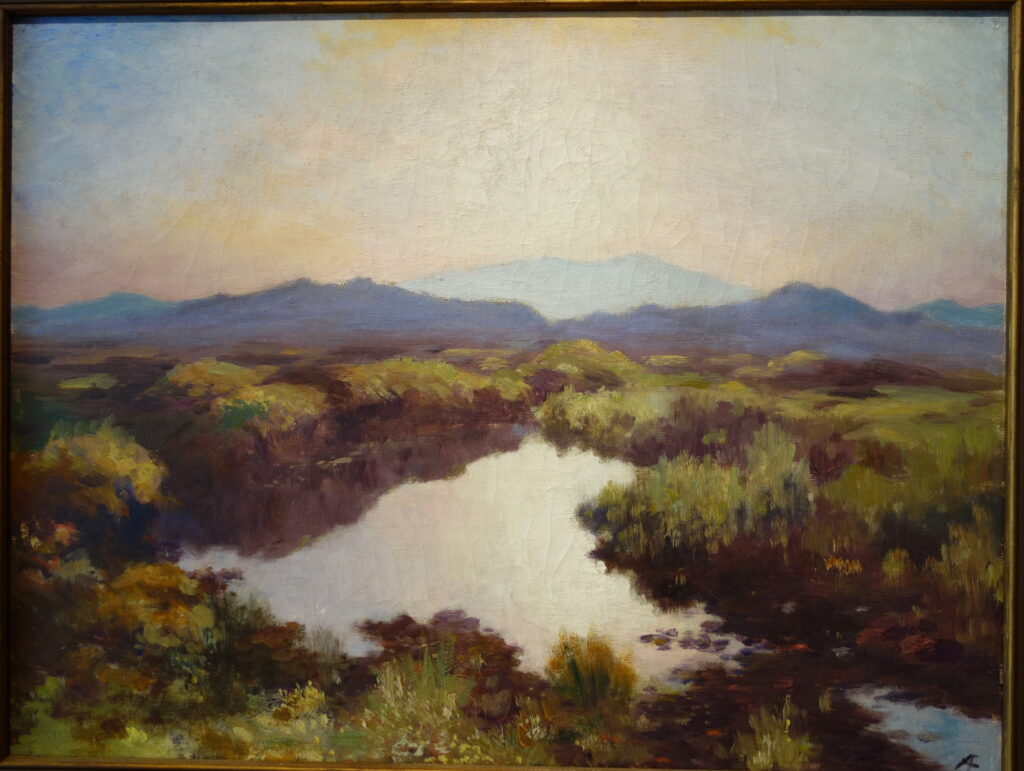
Boglands by AE (George William Russell)

The Reappeared

by Derek Turner

Deep in the tangle of the past
He dreams, and we sometimes dream of him –
Lying in anxiety of roots,
Dead seeds, and splatted fruits,
Waiting in the acid earth
For the blade that brings rebirth.

Rains rolled above his head
While he lay, blacked the tufts, greened them again,
Time-lapse regathered clouds assailed
And curlews almost pierced his veil
Their thin cries swirl like paint in water,
Corpse-lights show the place of slaughter.

Long-legged time – insect time
Skaters, boatmen, whirligigs
Danced across his private drain
While peat pickled and stained
His pallid flesh to leather beige,
Uniting with the Iron Age.

And so we see his grin again,
His blank stare across bog-blooms
Trembling in sun like that he’d seen
In the days before he came here –
Came here? – More like pushed and dragged
Rope-burned, half-choked, poleaxed

For reasons of state, cause, rite,
He relinquished his claim on the daylight,
Shuffled hour-long last minutes on foot
(Or bundled and bounced in a car-boot)
Last sight – he swears – last thought, “No chance!”
Ice moon, moss that squelched to distance.

Blent with the fragrant turf, sewn
Into the flag fabric, he warms homes
With reveries of buried sunlight
National lies still legend-bright –
Except one home, where a few remember
Fading, fated family member.

Rushes and reeds, marsh weeds
To bind the sod together –
Millennial torso in a museum
Gun salutes at an arboretum –
Volunteers fallen, or traitors shot –
Troubles will always be our lot.

Poem by DEREK TURNER, the former editor of QR

His website is at www.derek-turner.com

Posted in Poetry, QR Home | Leave a comment

Tradition in Fantasy and Science Fiction

nazgul_by_danijel81

Tradition in Fantasy and Science Fiction

Mark Wegierski examines four main foci for traditionalist impulses in these genres

[This article is based on a draft of a presentation read at the Fantastic Literature Conference, The Basic Categories of Fantastic Literature Revisited, Lodz, Poland: University of Lodz, October 21-23, 2012.]

Fantasy and science fiction are genres where traditionalist impulses can persist, in an increasingly desacralized, disenchanted, and “mundane” world. The four main points of focus for these impulses are mapped onto several subgenres of fantasy and science fiction. Such a typology creates a helpful method for distinguishing between these various subgenres.

High Fantasy

The first point of focus consists of nostalgia for a “greener world” and is identified with high-fantasy, especially the writings of J.R.R. Tolkien. High-fantasy is frequently characterized by a lament for the “thinning of the world” and is in fact quite congruent with traditionalist despair at the increasing loss of meaning in current-day society. Frequently, in high fantasy, past ages of a “sub-created world” are grander and more magical than the world of the present, while magical forces are often on the wane in the current day, what Max Weber called the disenchantment of the world. This finds an easy conceptual correspondence to the conservative and traditionalist lament for the so-called good old days. High fantasy is also often characterized by fear of an encroaching quasi-industrial or machine age – which is frequently identified with the forces of evil. It participates therefore in the Romantic disdain for the “dark Satanic mills” – a sentiment which is also apt to partake of traditionalist and conservative impulses. Also, the better characters in high-fantasy usually have good manners and a sense of reserve and modesty. This too corresponds to a conservative ideal. These good manners are typical of social existence in somewhat earlier periods of human history (according to conservatives at any rate). Also, quite obviously in high-fantasy, kings and queens, princes and princesses, as well as lords and ladies of various sorts are the main rulers of society – which feeds into the pro-monarchic and pro-aristocratic ideas that at least some conservatives hold, at least sentimentally. High fantasy like that of Tolkien also celebrates the rootedness of life in the countryside (such as found in the hobbits’ Shire), the attachment to place associated with noble and ancient cities (such as Minas Tirith), and the perennial traditions of proud and confident nations (such as Gondor and Rohan).

Sword-and-Sorcery

The second point of focus is that of the neo-pagan heroic, which is identified with the sword-and-sorcery subgenre. Here, the paradigmatic works are Robert E. Howard’s Conan stories. The great popularity of this subgenre can be seen as a response to an increasingly bureaucratized, over-regulated society. Indeed, it may be a form of displaced protest on the part of increasingly “geek-ified” males who long for a Nietzschean heroism. They yearn for some expression of ardent masculinity – for ferocious sword-fights and unbridled and readily fulfilled episodes of lust slaked by the nubile warrior-women, sorceresses, princesses, and elf-maidens that are typical of the sword-and-sorcery milieu. These impulses are probably among the main reasons for the popularity of fantasy role-playing games (RPG’s) such as Dungeons and Dragons.

While some males are apt to become absorbed entirely by the innerness of a fantasy world, for others, it is possible for these impulses to be rendered more dynamic and lead to a more actively aggressive and coherent resistance to the world of late modernity, where nowadays straight white males are particularly subject to the severe strictures of political correctness. Even the “geekiest” of males can sometimes show a flash of steely resolve that is expressed in constructive (hopefully not destructive) action, when they have been badgered for too long.

The heroism of the Conan vision stands in marked contrast to the sort of heroism usually expressed in the high-fantasy typified by Tolkien, who warns against the unbridled will-to-power. The most obviously Nietzschean hero in Tolkien’s Lord of the Rings is Boromir, who succumbs to the seductive lure of the Ring of Power. In contrast, it is the ordinary, humble, unassuming hobbits who in the end succeed in the quest to destroy the Ring of Power.

Feudal values plus high technology

The third focus for traditionalism is what has been called “feudal values plus high-technology”. This term was first prominently used by noted left-wing science fiction writer Judith Merril in 1985, when she ruefully complained that this was the most common typology of most of the more popular science fiction. This typology is present in most types of space-opera, as well as in military science fiction.

One of the archetypal works here is Frank Herbert’s Dune (1965), which, among other issues, examines the question of whether it is possible for some forms of traditional ethos to persist in societies of very high technology. In his future-history, Herbert posited the so-called Butlerian Jihad (named after its leader, Jehanne Butler), a smashing-up of advanced robots and sentient computers. The Jihad took place in what was already a civilization of numerous star systems and worlds, existing beyond our own age about ten thousand years into the future. As Herbert recounted it (in the Dune Encyclopedia, 1984) the spark for the Jihad arose out of a supervisory AI ordering an abortion for Jehanne of a child that she knew was healthy. In this scenario, a more advanced planet had been dominating a more quote primitive planet and arbitrarily interfering in its customs. The abortions were being ordered for arbitrary reasons. The upshot was that humans recoiled against some forms of advanced technology and embarked on a neo-traditionalist trajectory for at least the next ten thousand years. In the wake of the destruction of the thinking computers and robots, a neo-feudal society emerged, characterized by the maxim: “A place for every man, and every man in his place.”

A major subgenre in science fiction is so-called military SF. Although, on the one hand, it portrays a very technologized world of war machines and various military gadgets, on the other, it allows for a portrayal of the rebirth of a very “masculine” ethos, encompassing soldiers’ honour, courage in battle, loyalty, and zealous engagement in national-type political-military conflicts. The paradigmatic example of this subgenre is probably Robert Heinlein’s Starship Troopers. (Incidentally, the 1997 movie, largely a parody, was highly unfaithful to the original text of the book.) Another very prominent author of military SF is Jerry Pournelle. An interesting subgenre of military SF is that focussed on mercenary units, who fight courageously but with cynicism towards the state entities they serve. This allows various writers to voice libertarian-type sentiments about the decency of individual soldiers and their “regimental family”, while commenting on the typically corrupt nature of the state entities that they serve.

The subgenre of space opera shares definite crossover elements with fantasy. The early paradigmatic example of space-opera within science fiction writing is E. E. (Doc) Smith’s Lensmen series. Meanwhile, the paradigmatic example of space opera in film is, of course, George Lucas’ Star Wars series. George Lucas’ original Star Wars trilogy can be interpreted as a cheering, heroic series of movies which played no small part in the renewal of American willingness to resist the “Soviet empire” in the 1980s.

Lois McMaster Bujold has written one of the most successful space opera sagas, featuring the diminutive and partially-disabled Myles Vorkosigan, who nevertheless drives himself to succeed in a socially harsh cultural and political setting.

John Maddox Roberts’ Cestus Dei (1983) features an interstellar empire based explicitly on religious principles and an alliance of Earth religions. It portrays the Pope, the Dalai Lama, and other religious leaders as cooperating and yet at the same time competing galactic administrators with the Earth as their centre. The novel concerns a Jesuit who schemes his way to the highest circles of a human society on another Earth-like planet, described as “the Rome of the Caesars with atomic weapons”.

The two-volume Galactic Empires anthology edited by Brian Aldiss (1976) is a particularly good example of various space opera stories. One should note especially, “The Rebel of Valkyr” (originally published in 1950) by Alfred Coppel, which has been characterized as “Horses in the Starship Hold”. The premise is that a galactic imperial civilization attacks the Andromeda galaxy. The even more-advanced Andromedan counter-attack destroys all sophisticated technology, except for star-ships. Advanced technology is therefore considered cursed, and its exploration is confined to “warlocks” and “witches”, that is to say scientists working in secret. Society is thus almost entirely medieval, the only exception being that interstellar travel is possible on the hulk-type star-ships, which are manned by a highly prestigious guild of navigators, i.e., quasi-priests. Through established rituals and memorization, they are somehow able to guide the star-ships to their destinations.

A highly regarded example of this typology that must be mentioned is Gene Wolfe’s Book of the New Sun series (original tetralogy, 1980-1983). This is the tale of Severian, a professional torturer troubled by his conscience who eventually becomes ruler of a planet called Urth. The setting is Gothic, Baroque, and filled with archaic language. In fact, Gene Wolfe took enormous care in using only pre-existent, archaic or rare words rather than inventing any new words in his description of the world of Severian.

Arthur C. Clarke, one of the best known science fiction authors, has made the provocative statement that “any sufficiently advanced technology is indistinguishable from magic.”

A return to older forms of human organization in the future may not be as unlikely as some might think. During the 1980s debate over the nuclear winter theory, the respected popular scientist Carl Sagan suggested that the reason the universe is not teeming with intelligent life (as some astronomical theories had proposed to be the case) is that, as every intelligent species develops technology, it is faced with a developmental crisis that in most cases results in its extinction. Sagan had suggested that it is probably nuclear war that is the vehicle for this extinction. Although Sagan was highly critical of Reagan’s policies of the 1980s, the argument can certainly be turned in a quasi-traditionalist direction. If we do not deal with the hyper technology overwhelming our planet by pursuing an order that only some form of neo-traditionalist and/or neo-authoritarian arrangement can provide, our human societies are doomed to fly apart and possibly lapse into oblivion from the disintegrating forces attendant on too-rapid technological advancement. So feudal values juxtaposed with high-technology may indeed be one possible future for humankind (or for any other intelligent species that is faced with the need to surmount a similar developmental crisis). Whether these planet-wide “feudal” elements can be provided by distinctly more humane and peaceable religions and national traditions rather than by violent means remains to be seen.

This typology gives traditionalists hope that the future will not be “hypermodern”, but rather “postmodern” (to give this term a highly eclectic usage). In this scenario there will be some kind of return to tradition, of “moving forward to the past”.

Also, some settings of alternative-history posit worlds that may be more to the liking of traditionalists and essentially replicate this typology. Take, for example, Sheldon Vanauken’s notion (expressed as part of his non-fiction book The Glittering Illusion, 1985) that a victorious Dixie would have joined the British Empire, the eventual result being a quick Allied victory in World War I and with a more traditional modernity following in its wake. It is usual for conservatives to suggest that slavery would have been relatively quickly abolished in the South and that black-white relations would have actually been better without the association of black advancement with triumphant Northern aggression. Alternative history centred on the premise of Hitler being thwarted earlier in his nefarious career should also be of strong interest to traditionalists, as presumably, under such a scenario, more of the “Old Europe” would have been saved for the future.

“Hypermodern” Dystopia

The fourth point of focus is marked by a lonely, existential resistance to “hypermodern” dystopia. This focal emphasis posits future societies that constitute an extension, not a negation, of modern trends. That is to say, the trends of modernity are extrapolated to ever increasing extremes.

One of the most typical genres here is cyberpunk. Cyberpunk (a paradigmatic example being William Gibson’s Neuromancer, 1984) depicts a vision of technological dystopia or semi-dystopia, sometimes called “an air-conditioned nightmare”. In the cyberpunk world, the planet is dominated by huge transnational corporations and so-called virtual reality or cyberspace. The latter is imagined as an autonomous electronic realm with which specially equipped “cyberjockeys” can interact and is indeed a central element of life and power struggles. Within this dystopian scenario there exist multifarious interpenetrations of humankind, the electronic realm, gadgetry, machinery, and genetic manipulation.

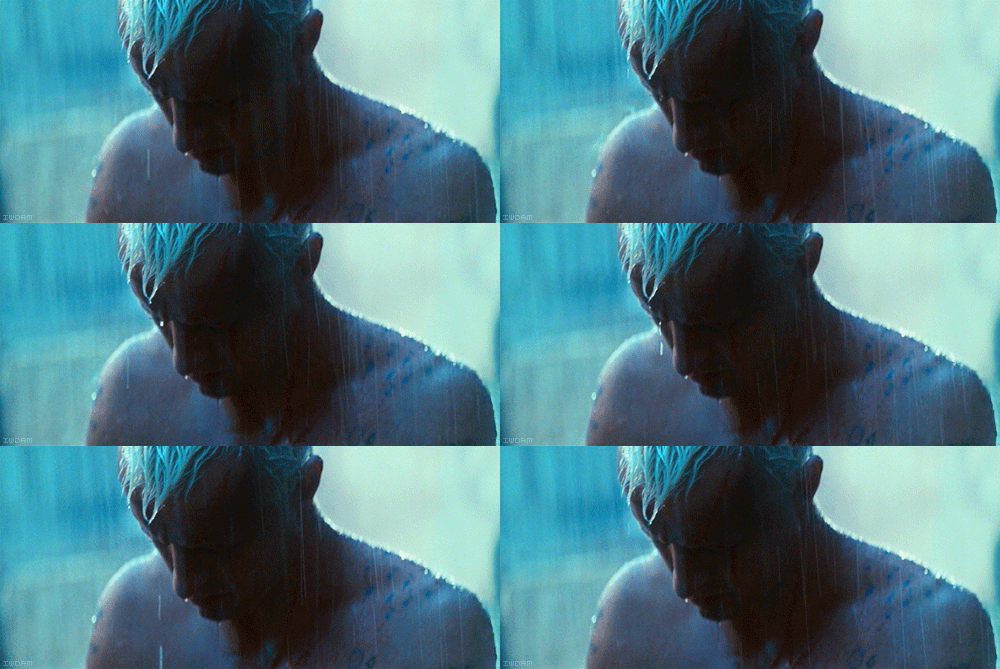
The most prominent examples of cyberpunk in film are Ridley Scott’s Blade Runner (1982) (loosely based on Philip K. Dick’s Do Androids Dream of Electric Sheep?,1968) and the Wachowskis’ The Matrix (1999).

Ray Bradbury’s Fahrenheit 451 (1953) points to the approaching perils of a consumerist and post-literate society, where books are burned by so-called firemen.

Book_burning

The Space Merchants (sometimes also titled Gravy Planet) (1952), by Cyril Kornbluth and Frederik Pohl, presents a polluted planet of ostentatious, consumerist capitalism where, for example, oak wood is worth more than gold, the reason being that there are very few living trees left. An interesting aspect of this work is that the forces opposing this world exist in an underground organization called the World Conservationist Union. They are derided as “Consies” – a word that might equally suggest “Commies” or “conservatives”. In fact, the tendencies that stand in opposition to this world can easily be characterized as embracing both socio-cultural and pro-ecological conservatism, although the authors might not have explicitly intended this as the message of the book.

Cyberpunk would not appear at first glance to be a subgenre at all friendly to a traditionalist orientation. It is interesting to note that, although it portrays such a “gritty world”, many people who read this sort of fiction identify with the independent cyberjockeys and experience a kind of exhilaration in this literature. In point of fact, many readers who have a tedious and uninteresting life are captivated by the sense of adventure inherent in this subgenre, although more often than not it depicts a dystopian world. Perhaps the real reason for cyberpunk’s attractiveness is not so much the gadgets, but the fact that the reader can identify with a cyberjockey living a far more interesting life than that of the reader.

Cyberpunk may suggest ideas that could be termed neo-Romantic, a Romanticism based only on one’s own humanity rather than on the natural world. Nature in fact is virtually non-existent, but in this gritty, poisoned world where there are virtually no other living creatures except cockroaches, humans must somehow find meaning and sense in life through their own resources and devices.

The extrapolation of this idea to contemporary reality suggests a kind of solution to our latter-day “crisis of identity”. No longer labouring under the sense that roots are being “imposed on them”, in the end humans make a choice in full freedom to embrace their traditional roots, not excluding at the same time partial identifications with the various other collectivities of late modernity. It would be extremely difficult in today’s world to demand total immersion in tradition. Insofar as we live nowadays in a society that – apparently at least – places enormous stock in free choice, opting freely in such case to become re-invested in a cultural context marked by traditional roots constitutes a strong challenge and a not insubstantial ideological conundrum for today’s prevailing system.

A yet further subgenre is that of “the lonely, wounded hero” in opposition to a corrupt society. Examples of this are Andrew Lloyd-Webber’s theatrical-operatic reinterpretation of The Phantom of the Opera, the Beauty and the Beast television series (1987-1990) (which unfortunately ended in such a pessimistic way), the new Batman epics, and the movie Ladyhawke (1985), which showed a black-clad knight fighting on behalf of the Church of Rome against a heretical, white-clad bishop and sorcerer of seemingly limitless powers. It could be argued that, in today’s society, the “true masculine” has been forced into the underground or subconscious of society. The appeal of these various productions could be attributed to the attempt to allow the so-called whole man to re-emerge.

The V for Vendetta movie (2006), based on the 1980s comic-book series by Alan Moore and David Lloyd, combined the fascinating imagery of the dark-tinged Romantic hero fighting for his beloved and also against a corrupt society, but with a high degree of political correctness in the portrayal of that corrupt society as stereotypically fascist.

There are as well those classic works of dystopia that can be seen to imply a traditionalist critique of modernity, such as, most prominently, Aldous Huxley’s Brave New World (1932) and George Orwell’s Nineteen Eighty-Four (1949). While left-wing critics focus in on the genetic caste system of Brave New World as symptomatic of “corporate conservatism”, it seems that Huxley’s point is much different. The posited abolition of God, history, and the family in Huxley’s dystopia points to the work as a classic of conservative criticism of society. Also, the book has to be read very carefully for one to notice a lot of the very disgusting aspects of the dystopia that might not be apparent on a superficial read-through. It is possible to see the main characters of Brave New World, Bernard Marx, John the Savage, and Helmholtz Watson as pointing to different aspects of possible resistance to late modernity, embodying the following concepts, roughly speaking: alienation and social awkwardness, the passion of opposition, and (for the lucky few) superb accomplishment and success.

As for Orwell’s Nineteen Eighty-Four, it is at its most obvious level a critique of Stalinism – a courageous stance for a Western intellectual to take at that time. The work can also be seen to evince a yearning for the traditions of Britain and England. At the same time, Orwell makes highly astute observations about the nature of political and social control, a great many of which can fairly easily be applied to today’s political correctness. He makes the vital point that semantic control is probably the most important part of controlling people – or as he puts it, “Newspeak is Ingsoc, and Ingsoc is Newspeak”. Many traditionalists in Western societies today can certainly identify with various elements (though obviously not all) of Winston Smith’s dissident experience.

Jean Raspail’s The Camp of the Saints (1973) – which portrays the West overwhelmed by Third World immigration – may be added to the great literary dystopias.

Conclusion

These foci offer practical points of departure in terms of social and ideological re-alignment – as far as traditionalism is concerned. For its part, high-fantasy such as that of Tolkien certainly has the potential to inspire cultural and ecological resistance to the more negative aspects of late modernity. Sword-and-sorcery might in some cases increase the confidence of persons critical of late modernity, although it can also result in an escape into a fantasy world. Cyberpunk and some dystopias provide a warning about the future, pointing to future worlds that traditionalists don’t want to happen. However, boldly extrapolative science fiction such as that of Frank Herbert can be seen as having affinities with “prophecy”, suggesting some of the ways in which a traditional ethos might be able to persist in societies with a very highly advanced technology.
bladerunner-thumb-510x227-39115

Mark Wegierski is a Toronto-based science fiction and fantasy aficionado


Posted in Cultural Matters, QR Home | Tagged , , , , , , , , , , , , | Leave a comment

Rachel Dolezal: A Racially Abused Girl – Really?

Rachel Dolezal

Rachel Dolezal

Rachel Dolezal: A Racially Abused Girl – Really?

Ilana Mercer visits la la land

Not so fast, Rachel Dolezal. The country is not finished with you yet. It merely got distracted. We scampered in other directions: on to the “genocidal” Confederate flag and the depraved-heart murders of Freddy Gray (black) and Kathryn Steinle. More “Black Lives Matter” riots took place. Not one “White Lives Matter” march was held. (And as one wag tweeted, Ms. Steinle didn’t sufficiently resemble Barack Obama’s daughters for him to give a damn.)

Since Dolezal dropped-off the radar, a lot has happened. It’s safe to say, however, that everyone is still barking mad, forever poised to heap scorn on her fake Afro.

Dolezal, if you’re from Deep Space, is the lily white woman who dared to “identify” as a black woman. The “Racial Industrial Complex” (a Jack Kerwick coinage) is populated with frauds, shysters, imposters, phonies, morons; black, white and 50 shades of gray.

Ms. Dolezal had been posing as all of these, teaching mambo-jumbo studies at the Bush College of Eastern Washington University. Our American Idiocracy confers the respect and the authority of a pedagogue on many like her, allowing them to spread the disease to college kids and beyond.

Why not Rachel?

The Age of the Idiot sees killers exculpated, just because they kill. As the reasoning goes, if an individual has murdered, raped, or is a feckless jailhouse whore—then he or she must have been abused, neglected, racially oppressed (if black or brown); not wealthy enough, mentally ill, lacking in self-esteem. Anything but plain bad, slothful, sociopathic or parasitical. The more aberrant the crime; the more thrill-seeking, vulgar, immoral or wicked the conduct—the more elaborate, fanciful and scientifically baseless the excuse-making.

In fact, around this if B then A, backward, erroneous reasoning, an industry has arisen. It’s called psychiatry. The psychiatric endeavor—voodoo, really—is premised on the medicalization of misconduct. The reason Ms. Dolezal has been denied the benefits of this excuse-making industry is that she has encroached on black supremacy’s turf. This protected turf acts as a medieval guild or a modern trade union. In cahoots with the state, the “Racial-Industrial Complex” protects its members from competition, by limiting entry into the professionally aggrieved class.

To be black, you see, is more than a pigment; it’s an identity, a politics, an entitlement, one-upmanship, a lifetime IOY (I Own You).

Poor Rachel painted her face orange, gave herself a Sideshow Bob hairdo, and adopted the ideology of the eternally oppressed. Big deal. Most of America’s authentic poseurs are phonies who’ve never been oppressed.

Unlike most blacks, Dolezal—by the admission of the president of the National Association for the Advancement of Colored People’s Washington-State chapter—had done “quality work” to “elevate the issues of civil rights.”

“I just want to feel beautiful, and this is how I feel beautiful,” the woman said rather plaintively. Yes, Dolezal is the white face of parental and societal displacement. Why am I the only one to find her pitiful, even deserving of pity?

In America, black is beautiful.

To be black is to be more righteous, nobler; carry the heaviest historic baggage—heavier than the Holocaust—and be encouraged to perpetually and publicly pick at those suppurating sores.

To be black is to have an unwritten, implicit social contract with wider, whiter society.

To be black it to be born with an IOY, I Own You; it is to be owed apologies, obsequiousness, education, and auto-exculpation for any wrongdoing.

Why can’t Rachel have some of that?

Was not Ms. Dolezal displaced for real in her parents’ affections? Rachel’s story should begin with parents Larry and Ruthanne Dolezal, who adopted four children, “three of whom were African-American while the other was from Haiti.”

Does this not send a message to a vulnerable girl that she and her biological brother are too pale for their pious parents?

Spokesperson for the quasi-black Brady Bunch is Ezra Dolezal. Ezra grew up in the diversity worshiping, evangelical, Dolezal household. He now lectures his estranged sister about her shenanigans in black-face.

The Chutzpah!

The once anemic-looking, fair-skinned Rachel was raised with a real sense that she was not black enough for her parents. Why do I say “real”? Because, like Angelina Jolie, Larry and Ruthanne Dolezal kept acquiring kids more colorful than their own.

Kids are needy creatures. Parenting is a complex endeavor. However great their reservoirs of love, sense of fair play and goodwill—two parents do not have enough of the good stuff to spread among six kids. Mark my words: Brangelina’s beautiful, biological offspring will also one day display signs of childhood racial abuse.

Lest I be called on the carpet (or the mosaic floor, rather) for deploying the backward reasoning I previously deplored:

I am not here psychologizing Dolezal’s perplexing behavior. No need. By reality’s standards—not those unscientifically set by the Diagnostic and Statistical Manual of Mental Disorders (DSM–∞/eternity)—Rachel was displaced. Dolezal has thus recreated the primal scene of her childhood by becoming in adulthood—experientially, at least—blacker than her adopted brothers and sisters.

She deserves a break.

Ilana Mercer is a paleolibertarian writer, based in the U.S.  She pens WND’s longest-standing, exclusive paleolibertarian column, “Return to Reason.” She is a fellow at the Jerusalem Institute for Market Studies. Her latest book is “Into the Cannibal’s Pot: Lessons For America From Post-Apartheid South Africa.” Her website is www.IlanaMercer.com.  She blogs at  www.barelyablog.com   Follow her on Twitter:  https://twitter.com/IlanaMercer “Friend” her on Facebook: https://www.facebook.com/ilanamercer.libertarian


Posted in Current Affairs and Comment, QR Home | Tagged , , , | Leave a comment

“Pre-Flight”

Moon and Clouds

“Pre-Flight”

By Marcus Bales

A tired, blood-shot moon was staring down
Half-closed with puffy clouds, as if the night
Before had been too hard, too late, too much.
The wind was building like a headache, brown
Around its sharpening edges. It blurred my sight,
And grit was all that I could taste or touch.

She ran her engine up and down to test,
Then shut it off, climbed out, and zipped her vest
Against the wind. She paid her bill in cash
And turned at last to me. And there we were.
I tried to say how much I wished she’d change
Her mind, in spite of everything, and stay.
We talked about the wind, her fuel and range,
And where she’d land, and how long she should rest.
I’d nearly nerved myself to reach for her
And try to say it somehow anyway
When over to the east a pinkish flash
Went off like an alarm to send her west.

We’d waited there together for the dawn
And it had come too soon. The sky was clear
The moon had set, the wind was just a breeze.
Could lifetimes really turn on things like these?
I called good-bye. By then she couldn’t hear.
I pulled the chocks away, and she was gone.

Marcus Bales lives and works in Cleveland, Ohio

Posted in Poetry, QR Home | Tagged | Leave a comment

ENDNOTES, July 17, 2015

ORFORD AT LOW TIDE. PICTURE BY S. MILLSON.

ENDNOTES, July 17, 2015

In this edition:

BBC Symphony Orchestra at the 2015 Aldeburgh Festival * New Nielsen symphony cycle from Chandos

Had the homesick Benjamin Britten, during his early wartime sojourn in North America, not discovered a volume of George Crabbe’s poetry, there is a chance that one of the greatest 20th-century operas would never have been composed. Crabbe (1754-1832), a Suffolk clergyman, born by the grey North Sea at Aldeburgh, distilled in his writings the character and essence of the East of England coast. For the self-exiled pacifist but profoundly English Benjamin Britten, the lure of his locality and homeland proved to be too strong – the echo of Crabbe’s Aldeburgh summoning the composer back across the Atlantic ocean, to the embattled England of 1942.

In a Country Alphabet published by Shell in the mid-1960s, the Cornish writer Geoffrey Grigson devoted a section to George Crabbe, observing how much of his verse “…derives from the coastal scenery at Aldeburgh, slow tides flowing out between banks of mud, jellyfish stranded on the shore, sandbanks where one might be caught and drowned by the tide, black storms sweeping in…” and how the poet liked “glitter and darkness, comets, phosphorescence, moon-glades across the sea, and the curious recesses of the human mind…” Anyone who tries to understand Britten’s music or who struggles to describe the setting and meaning of the Aldeburgh Festival would do well to recall Grigson’s words.

This year, the Festival welcomed the BBC Symphony Orchestra for a concert given at the 800-seat Snape Maltings concert hall, their 24th June programme consisting largely of sea music: by Sibelius (his Oceanides, of 1914), and a symphonic suite by Britten’s teacher, Frank Bridge, whose sea-moods may have been the foundation for the physical and psychological drama found in the famous four Interludes from his pupil’s 1945 Crabbe-inspired opera, Peter Grimes – the story of a strange, troubled fisherman living at the very margins of the local borough.

The BBC SO also included a relatively new work (Everyone Sang) by the young British composer with an appropriate name for Aldeburgh, Helen Grime; and the lonely ‘Songs of a Wayfarer’ (Lieder eines fahrenden Gesellen) by Gustav Mahler – a Central European figure who might seem somewhat distant from the heart of this Festival by the North Sea. However, Mahler was one of Britten’s favourite composers, and he championed the great Austrian symphonist at Aldeburgh, even bringing the LSO to nearby Orford Church in 1961 for a performance of the Fourth Symphony. (Fortunately, a recording of this occasion exists, on the BBC Music label, cat. no. BBCB 8004-2.)

Mezzo-Soprano Alice Coote,  conductor Martyn Brabbins

Mezzo-Soprano Alice Coote, conductor Martyn Brabbins, photo by Matt Jolly

There could not have been a finer day, though, for this year’s Snape outing by one of London’s distinguished orchestras – the BBC Symphony players, no doubt, enjoying breaks from their rehearsal by the riverbank and reeds of the slow, tidal Alde. In fact, where else in these islands, or in this world, could musicians or concertgoers enjoy an interval, after Sibelius and Mahler, with sea breezes from saltings and marshes, and the presence of wild birds – such as the marsh harrier – drifting by in the distance? This place is unique, and perfect for music.

And so to the performance itself: the BBC orchestra under the baton of the very persuasive and technically superb Martyn Brabbins, who replaced Chief Conductor Sakari Oramo at short notice, giving careful, slow-in-tempo readings of their well-chosen repertoire. Jean Sibelius’s The Oceanides, Op. 73, which began the concert unfolded gently in the Snape Maltings – the lonely woodwind calls, suggesting summer melancholy and trackless seas, echoing in this hall of polished wood and red brickwork. It was the American composer, teacher and music-advocate, Horatio Parker, who invited Sibelius to the United States in 1914, to conduct the premiere of his evocation of waves and the spirits of oceans. I wonder if, on his sea-crossing, Sibelius saw in the Atlantic swell, the Finnish sea-nymphs and other watery apparitions following in the wake? They certainly appeared in Martyn Brabbins’s interpretation of the work: the orchestra giving life to this ten-minute-long panorama of wave patterns, which gradually expanded in intensity – with cellos and violas suddenly catching a feeling of changing momentum, forming a huge, unsteady underswell, which led in turn to the intense, climactic high-tide of the work. From this moment, close to the end, The Oceanides subsides into the poetic longing of woodwind; as if the orchestra is lamenting the loss of that never-to-be-repeated scene of majestic waves and sky.

Helen Grime (b. 1981) set out in her work, Everyone Sang, to reconcile the ideas of public celebration and one’s private reservations about such jubilations, using as her starting point the poems and experiences of Siegfried Sassoon. Written in 2010 to celebrate the 75th anniversary of the BBC Scottish Symphony Orchestra, Helen’s music communicated itself well to the hall – an arresting, vital, rhythmic beginning, giving way to a softly-spoken section punctuated by (to my ears) Gamelan-like effects, and eventually a conclusion somewhat reminiscent of the ‘Sunday morning’ from Britten’s Four Sea Interludes – cold, percussive touches, suggesting glints of light on waves, perhaps?

The young Britten said that he was “knocked sideways” when he first heard the Bridge, Symphonic Suite, The Sea, in 1924 – although the piece actually dates from 1910. I share Britten’s feeling for this work, having first heard it on Morning Concert on Radio 3 in 1981. It may have been the nearest thing I had come to in “modern” music at that time (although Bridge is by no means a modernist in the sense in which we normally understand 20th-century music); and I remember feeling the sound of the work to be unusual, as if normal colours had been slightly altered or intensified – the sea-scene belonging to a new dimension.

Exactly the same emotions occurred to me during Martyn Brabbins’s recent performance: his (again) slow tempo, and desire to show the details of each mood, building a very visual sense of sunlight, with a chance of a disturbance in weather far out to sea. The ‘Moonlight’ movement brought George Crabbe’s phosphorescence into the nocturnal fantasy – and the foundations of Britten’s own interlude could clearly be seen. ‘Storm’, the final movement, is one of Bridge’s greatest creations – the piece ending with a re-statement of the much earlier seascape motif, a summing up made more dazzling by a sequence of cymbal clashes slicing through the emphatic, ringing orchestral tumult. One of the best, if not the best version of The Sea I have ever heard.

Britten in 1942 – like Sibelius in 1914 – looked out from the deck of a ship to a seemingly limitless, but always heaving Atlantic ocean. He was on his way home, and three years later his opera Peter Grimes would make musical history. For Martyn Brabbins, the orchestral interludes seem to be more than extracts from an opera, but a short sea-symphony in their own right: ‘Dawn’ gaining, under his baton and from the BBC SO, an overwhelming sense of tension – of the doom that awaits sailors or fishermen; and of the slate-grey of an East Anglian early morning, with the cry of sea birds never far away. Church bells, a general bustling energy, and thrilling, rushing estuary waters were brilliantly captured in ‘Sunday Morning’ (sounding much better for not being played too quickly, a fault of some interpretations); and ‘Moonlight’ and ‘Storm’ – and the lonely dread of the slow-treading Passacaglia – were all clearly evoked by the BBC Symphony Orchestra.

But for this performance, there was a twist in the tale: modern film-maker, Tal Rosner had composed a film accompaniment to the Britten – Rosner’s work being projected on a giant sail above the orchestra. The video sequence was initially composed for American performances of the Four Sea Interludes, and it was – at first – strange to see abstract shapes, and images of modern U.S. cities and harbours appearing above the stage of the Snape Maltings. The idea, though, began to work well, the director understanding the elemental drive and universal resonance in Britten’s music. Scenes of Los Angeles, and what looked like New York at night, gave a new slant to the ‘Moonlight’ interlude, but for the Passacaglia, the film-maker chose (like Britten in 1942) to come back to England. Tal commented in his programme note:

“Acting as a black mirror to the Interludes, the Passacaglia is my ‘B side’, a distant voice that is a newly-discovered core of the piece, where the grid has been broken and the harsh geometric shapes deteriorate around us. From the Barbican’s magnificent concrete reality to Blackfriars Bridge and along the Thames, the places I chose to deconstruct also embody personal experiences for me… In the process of dismembering familiar shapes, I find a freedom to create new life.”

Leaving the Snape Maltings that evening – daylight still lingering in the midsummer sky – I felt that Tal Rosner had achieved his aim; the BBC Symphony Orchestra, too, having given new life to well-known works.

**********

Elemental, inextinguishable, expansive: these words describe many parts of Danish composer, Carl Nielsen’s outlook and symphonic work. His symphonies even took the names – The Inextinguishable (the Fourth, written between 1914-16), No. 2 The Four Temperaments (1901-2) – confirming them with the true stamp of programmatic music. From Chandos Records comes a first-class cycle of the six symphonies, performed by conductor, John Storgards and the BBC Philharmonic at their state-of-the-art studio and hall at Media City, Salford.

If Sibelius’s Oceanides lapped the coast of East Anglia, Nielsen’s symphonies could also be the perfect choice for the Aldeburgh Festival: the outlook from Jutland and the dunes of Denmark offering a similar atmosphere. Beautifully recorded, the new Nielsen set is certainly definitive, both in the authoritative Storgards handling of this remarkable early 20th-century music, and in the astonishing attention to sound-detail. In the Third Symphony, for example, the 1910-11 Sinfonia Espansiva, two singers, a male and female (in this case, Gillian Keith, soprano, and Mark Stone, baritone) thread an enchanting vocalise over and through a summer haze of orchestral ripeness and warmth. Bathed in the red and orange glow of an evening landscape on a lonely northern shore, this sublime movement emerges on the Chandos recording, as if the listener were either there in the very front row, or wandering into the golden screen of a sky and shoreline – at somewhere approaching heaven.

An altogether more elusive and abstract world is conjured in the Symphony No. 6 of 1924-25, the first movement suggesting Shostakovich, or at least that the century is moving into new territories. Certainly, the side-drum passage in the Fifth Symphony (one of unusual ferocity) edges us closer to the war-torn world of Shostakovich’s Leningrad.

Austro-Hungarian soldier killed in the Great War

Austro-Hungarian soldier killed in the Great War

If Tal Rosner would like a subject for a new film, I recommend without hesitation the Chandos CDs of these six Nielsen symphonic masterpieces, which all cross and exist upon the very boundaries of late romanticism and the storms of the 20th century.

Stuart Millson is Classical Music Editor of QR

The Quarterly Review would like to thank Macbeth Media Relations and Aldeburgh Music for enabling us to visit this year’s Festival – and for their generous hospitality.

Performance details: BBC Symphony Orchestra conducted by Martyn Brabbins (with Alice Coote, mezzo-soprano in Mahler), live at the 2015 Aldeburgh Festival. Nielsen symphonies, BBC Philharmonic Orchestra, conducted by John Storgards. Chandos – CHAN10859(3).

Posted in ENDNOTES:Music, QR Home | Tagged , , , , , , , , | Leave a comment

The Return to the Great Tradition

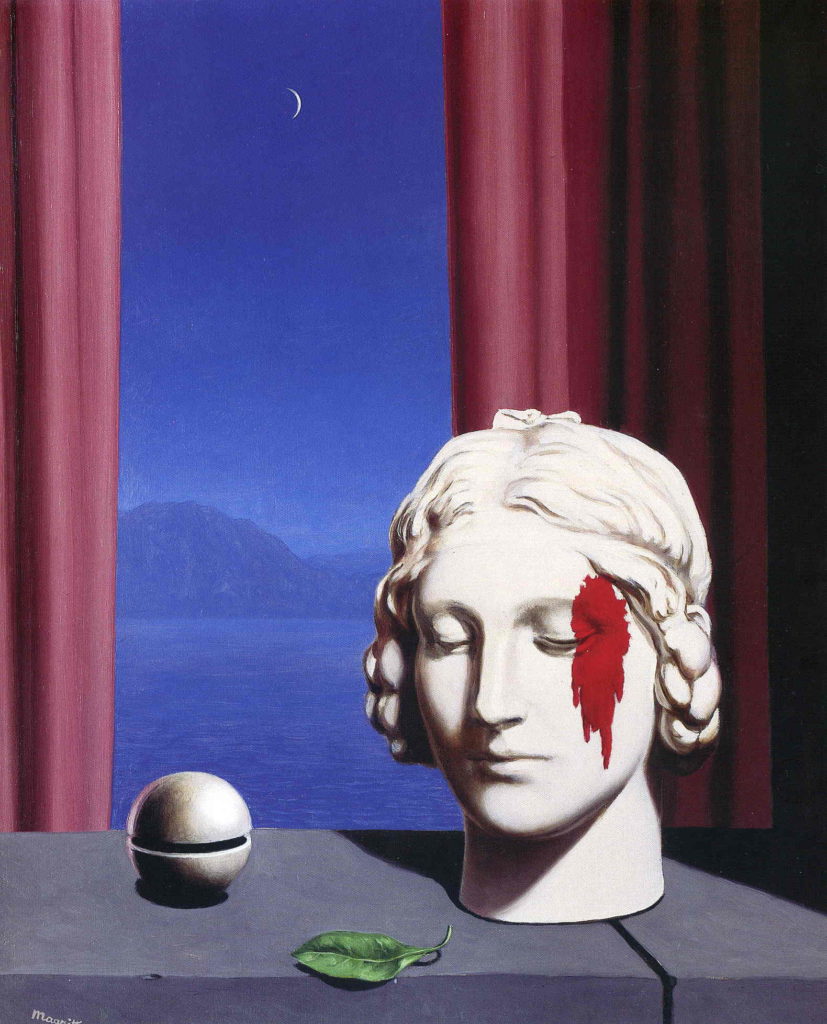
René Magritte, Memory, René Magritte Museum Brussels

The Return to the Great Tradition

Critic Michael Davis welcomes a classic collection

The Walled Garden by Andrew Thornton-Norris, the Leckhampton Press, 2011

In the short manifesto introducing his new collection of poems, The Walled Garden, Andrew Thornton-Norris writes, “The cancer [of abstraction] has grown back as cynicism and contempt for the general reader and what connected it with them. Poetry has become an hermetic gnosticism, a secret knowledge, no longer a universal truth.” So I’m sure the poet will understand—as many modern readers of poetry might not—that I mean only praise by saying The Walled Garden isn’t complicated stuff.

Our world has been somewhat simplified. Our economy is characterised by menial labour at the bottom end, and the manipulation and accumulation of capital at the upper. During our daily commute, we distract ourselves with hypersexual, ultra-violent, or patently insipid lyrics set to simple, repetitive tunes. In our leisure time, we occupy ourselves with television, drinking, shopping, gambling, and sex.

Those who find this existence tedious and desire to engage what Mill called their “higher nature” often find themselves encountering so much Sudoku in the arts: atonal music, postmodern literature and abstract art manage to engage nothing but our most cerebral faculties. We puzzle over them like encrypted letters, assuming (by and large correctly) that the media of artworks aren’t of any value in and of themselves—that they must have a “message.” We assume (again, by and large correctly) that this “message” is either political or idiosyncratic on the part of the author, i.e. a form of self-expression.

I’ll be the first to say that abstract forms of art have a value, if not to civilization, then to individuals. I’ve always been fond of the likes of Ashbery and Kandinsky. But that they’re sufficient as creative media is surely false. We’ve not yet quenched our thirst for beauty, order, divinity, affection, or any of the ancient muses that art once gave voice to.

So it needn’t be an all-or-nothing affair. Unfortunately, however, the abstractionists have decided that they’ll treat it as such. In the July-August 2015 issue of Quadrant magazine, the eminent art critic Giles Auty lamented Braque’s accusation “betraying modernism” levied against Picasso. Braque is a truly brilliant painter; why did he feel the need to censor Picasso? Modern, as Auty points out, has become an artistic virtue rather than a designation in time. What’s more, it’s become the chief artistic virtue, without which the artwork is rendered functionally valueless; any other virtues it may possess are simply ignored.

This is true of poetry as well as painting, and it’s an absurdity that the public at large is well aware of. No popular film set at a university is complete without a slam poetry reading: a single spotlight falling on a grungy teenager reciting meaningless lines, accompanied by a bongo drum. Though perhaps this image is a bit dated. On actual university campuses, we’re now more likely to find hipsters in well-lit bars shouting about capitalist oppression, or misogyny, or their genitals.

We can hardly say that this sort of poetry exhausts the universal poetic need or that those who enjoy poetry ought to be satisfied with the anarchic, “iconoclastic” stuff that dominates publishing and readings. There’s no denying that poetry is also a spiritual (or intellectual) and aesthetic pleasure, and that by pooh-poohing the poetry that provides that sublime pleasure the poetry industry has alienated itself from a general readership. A number of first- and second-rate poetry journals refuse to even consider poems written in strict rhyme and meter (called formalist), yet they can’t deny the fact that formalist poets like Shakespeare, Tennyson, Frost, and Auden dominate the poetry market.

There’s a terrible irony in realizing that a reincarnated Shakespeare, writing in modern parlance but committed to the same forms and themes as his Elizabethan incarnation, would be laughed at by so many preeminent poetry journals and critics. Yet I suspect, if he could breech the industry’s censors and reach a wider audience, he would be the most widely read living poet in the English-speaking world. “Laymen” possess none of the blinding postmodernist and abstractionist prejudices that dictate contemporary artistic fashion.

The highest praise I can offer Mr. Thornton-Norris, then, is that his poetry is a pleasure. It isn’t the Sudoku stuff that’s currently in vogue. It doesn’t mock the public for clinging to old-fashioned joys like grace, hope, and gratitude. It doesn’t revel in its own obscurantism.

“But this doesn’t mean it’s any good,” some sceptic must be saying. “It could be just as vapid as the fashionable stuff: a subfusc pastiche of Milton, for example.” Granted- there’s plenty of that going around too; and while these poets certainly deserve credit for their courageous efforts to reclaim the old forms and the old spirit of poetry, there’s no such thing as an A for effort.

I do, however, think any reader of Mr. Thornton-Norris who can agree with all that was said above will find that his work isn’t only traditional, but also modern in the best sense of the word.

There’s no use pretending that Elizabethan parlance and syntax is still viable, except perhaps in satirical poetry. Indeed, if you imagine a modern poet trying to emulate the Elizabethans, the serious and the satirical would be indistinguishable. (‘And, lo! I rock her slowly, she: my blust’ry-hearted queen;/ We two doth sway, and yet are still, like as washing machines.’) Mr. Thornton-Norris is indeed a master of modern English; his use of the vernacular is sophisticated, yet easy and graceful. We believe, to borrow again from Mr. Auty, that tradition contains Mr. Thornton-Norris, but doesn’t restrict him.

This is something of a pet obsession of mine as a (admittedly amateurish) reader and writer of poetry. There’s a wealth of talented poets who do attempt to speak the vernacular—I think of Simon Armitage and Billy Collins—yet their voice never seems to break, as it were. They strike one as native “high” English-speakers struggling to speak “low” English, or vice-versa. Armitage always seems to be talking down to us, and Collins up.

Two lines from Mr. Thornton-Norris’s work that particularly struck me are from “The Discernment of Spirits,”

The devil himself or one of them sat down
Beside me on the underground last night

He isn’t a professed grammatical heretic like Cummings and Cumming’s far less adept followers, but when Mr. Thornton-Norris violates convention, it’s to the greatest effect. The possible plethora of devils comes upon us as something of an afterthought, a half-thought. Whichever it is, we immediately come away with a sense of its unknowability, and yet also its immediate evidence: the demonic, whether its agents are one or many, is clearly all about us.

There’s a virtuously modern aspect to Mr. Thornton-Norris’s conventional love poem, “The Woman and the Well,” which ends

It is me, you have made me who I am,
Your love has made me who I am, in all
My vulnerability, you cared for me
And I can do nothing but respond in kind.

These lines, though expressing a sentiment universal in poetry, could only have been written by a 21st century poet. Particularly the last line, “And I can do nothing but respond in kind”: we may be tempted to call this prosaic, though lovely; but it seems to me this is an eminent expression of the colloquial poetic. We’re so un-used to modern parlance appearing unobtrusively in poetry—or, rather, so used to being jarred by the appearance of such a line of common English. Yet this is precisely what Yeats meant in “Adam’s Curse”

A line will take us hours maybe;
Yet if it does not seem a moment’s thought,
Our stitching and unstitching has been naught.

True poetry, like Mr. Thornton-Norris’s, is neither a separate dialect from the vernacular, nor is it rendering the vernacular in the context of poetry so as to “challenge our assumptions about poetry” or any of that Post Modernist nonsense. If we’re to be serious, the definition of poetry lies in the act of writing. There are effectively no parameters but its practice. And the moment we abuse the practice of poetry by “challenging our assumptions of it,” we break the mould, and are left only with a conspicuous non-poem. Mr. Thornton-Norris is one of few modern poets who see the poetic practice as a partner in creation, rather than a harsh master or a curious plaything. He does right by the poetic form, working with it rather than for or against it, and the poetic form rewards him in kind.

The Walled Garden – for details of availability, go to www.thornton-norris.com 

Michael Davis is the poetry editor of QR

Posted in Book Reviews, Poetry, QR Home | Tagged , , | 1 Comment

The Hispandering Effect

Picture from Aljazeera.com

Picture from Aljazeera.com

The Hispandering Effect

Ilana Mercer deplores the influx of criminal aliens

From her bright eyes and big smile to her sun-kissed, luscious locks, Kathryn Steinle was the consummate California girl. The 32-year-old was shot dead by a proxy of the American Immigration-Industrial-Complex.

ICE, the federal wing of The Complex, was quick to blame its local branch: the City of San Francisco. San Francisco is the sanctuary city that unleashed confessed killer Francisco Sanchez. As a matter of policy, sanctuary cities commit to protecting their illegal population as they would their endangered species.

Yes, San Francisco provided sanctuary not for Kathryn Steinle, but for the likes of Francisco Sanchez. Alas, this criminal alien had accessories to the crime. The murder of Ms. Steinle was a murder-by-proxy. For regularly unleashing predators on people they swore to protect, the Immigration and Customs Enforcement is just as culpable as the sanctuary cities. Last year, reports CNSNews, ICE alone loosed approximately 30,000 convicted criminal aliens, “including those convicted of sex crimes, homicide, drunk driving, kidnapping and robbery.” Recidivism among them is proving rife.

Francisco Sanchez is the face of successive American administrations—lawmakers and enforcers; city, state and federal—who’ve refused to uphold negative rights; who’ve rejected a duty that falls perfectly within the purview of the “night-watchman state of classical-liberal theory.” And well within the ambit of the U.S. Constitution, Article IV, Section 4:

“The United States shall guarantee to every State in this Union a Republican Form of Government, and shall protect each of them against Invasion; and on Application of the Legislature, or of the Executive (when the Legislature cannot be convened) against domestic Violence.”

Ms. Steinle joins a litany of lives lost. Criminal aliens commit crimes all the time. However, until the rise of The Donald and The Coulter duo, a few weeks back—those who determine the “conversation” du jour had been otherwise occupied in northern New York State. For three weeks, they followed a manhunt for local killers escaped.

Criminals of the Richard Matt and David Sweat caliber (or potential) cross the country’s Southwest, wide-open border almost daily. They go on to integrate into drug cartels, as drunk drivers and as petty and not-so-petty criminals. Nobody stops them. No one is allowed to so much as ask about their pedigree.

The same sort of offenders sprang into action the day after Ms. Steinle’s murder. On that Thursday, by Ann Coulter’s telling, “two people, Traci Lynn Lemley and Jeremy Carrico,” were killed by “members of the Mexican mafia.” Another couple, “Michael Careccia and his wife, Tina, were dug out of the Arizona desert,” having been placed there, allegedly, by one Jose Valenzuela. There was a child rape, courtesy of a Haitian voodoo priest. In my sanctuary state of Washington a hit-and-run took place. In response, Washingtonians took to the streets of Seattle in solidarity with … victims of the shooting at the First AME Church in Charleston.

Remember the 2007, execution-style shooting of four young black college students in Newark? That was the doing of a gang of illegal aliens.

Remember Josie Bluhm, age 4, killed in May of 2009? Behind the wheel on that fateful day was killer Eleazar Rangel-Ochoa.

Dearly departed too is Arizona Rancher Robert Krentz. A pillar of the Cochise County community, Krentz had for decades raised cattle along the Arizona-Mexico border. The cruel marauder who shot Krentz and his canine companion on his land, in 2010, beat a retreat to Mexico.

In 2012, a man named Ramon Hernandez took the tiniest of victims. Dimitri Smith was killed in-utero by this recipient of the Drunk-Driver Immigration Visa. You can see the deceased preemie, as he is cradled by young mother Aileen Smith, before being laid to rest.

Yet on TV, commentator Geraldo Rivera is fond of countering the carnage with this claim: the overall probability of being victimized by a Hispanic is negligibly low.

However low, that probability is still greater than the likelihood of one being killed by a soldier of ISIS. Yet some American crazies like Chucky Krauthammer are demanding that the U.S. occupy the Middle East so as to militate against those miniscule probabilities.

Besides, how would La Raza or Obama or Rivera know that Hispanic crime rates are likely comparable to white crime rates, given the obfuscating effects of the “Hispanic effect”? To wit, as criminologists have long complained, “FBI and Bureau of Justice crime statistics fail to distinguish between Hispanic and non-Hispanic white criminals.”

The upshot: White criminality is inflated; Latino lawlessness remains in the shadows.

More critically: what do Geraldo, La Raza and the rest of America’s Immigration-Industrial-Complex mean when they assert that the threat posed to natives by imported Latino criminals is significantly lower, or the same, as the danger to you and me from our own, local trailer trash?

Is the Latino Lobby implying that had they not been murdered by imported criminals—Steinle, Bluhm, baby Smith; Krentz, Jamiel Shaw, Jr. and Grant Ronnebeck would have, nevertheless, been killed by native criminals?

Ridiculous! I know not if this illogic—this inescapable deduction—is a case of a categorical confusion or a category mistake. All I know is that, logically, at least, propensities for crime are irrelevant in a discussion about the murder of Ms. Steinle and all other victims of criminals who should not be in the U.S.

For these deaths have nothing to do with aggregate crime rates; they’re about individuals who should be alive: a baby that should have been born, a girl who should be among the living, young men and women who should not be dead.

To justify the crime-probabilities line-of-inquiry in the context of Sanchez’ presence that day on the SF pier, you would need to show that had Sanchez been deported or jailed or turned back at the border—his victim, Ms. Steinle, would nevertheless have suffered the same fate at the hands of a native murderer. The same eventuality would need to be demonstrated with respect to each individual victim of a criminal alien. The implication is crushingly stupid, even by Geraldo Rivera’s standards.


Ilana Mercer is a paleolibertarian writer, based in the U.S.  She pens WND’s longest-standing, exclusive paleolibertarian column, “Return to Reason.” She is a fellow at the Jerusalem Institute for Market Studies. Her latest book is “Into the Cannibal’s Pot: Lessons For America From Post-Apartheid South Africa.” Her website is www.IlanaMercer.com.  She blogs at  www.barelyablog.com   Follow her on Twitter:  https://twitter.com/IlanaMercer “Friend” her on Facebook: https://www.facebook.com/ilanamercer.libertarian

Posted in Current Affairs and Comment, QR Home | Tagged , , , , , | 1 Comment

The Crack

Citizen Smith

Citizen Smith

The Crack

Bill Hartley discovers bias in the unlikeliest of places

Most towns and cities have access to a listings magazine and in the North East of England there is one called The Crack. Packed within its pages are details of just about every arts activity you can think of. The magazine (which is free) paints a picture of a vibrant scene, everything from the mainstream, Newcastle Theatre Royal to humbler events taking place upstairs in a pub. Additionally there are film, book and music reviews introducing the reader to bands and performers that might not otherwise be encountered. All told the magazine is an invaluable guide to what’s going on in a part of the country which covers everywhere from large conurbations to rural outposts in deepest Northumberland. Strangely though there seems to be an assumption on the part of those who produce it that readers share their political opinions. You might suppose that a listings magazine would be above taking an overtly political stance and simply showcase what is available in the region. However the current edition is fairly typical.

First there is a leading article alarmingly entitled ‘Is God Dead?’ sub headed: what’s the point of living? Just in case you believed that a philosophical essay had crept into the pages of a mere listings magazine, then reading a few sentences would make everything clear. Hoping but not entirely convinced that the writer is being ironic, these gloomy headlines were prompted by the editor contemplating the sight of David Cameron standing outside Number 10. Yes folks in the editorial office of this magazine they are still in a state of shock over the result of the general election. Life may go on as usual for the rest of us but at The Crack they appear to be in a state of deep depression, which may be something of a distraction for a reader wishing to see what’s on at the local art gallery. Further along in this piece the editor gives us his views on George Osborne and what appears to be a go at macroeconomics. Surprisingly the point being made is that in comparison Gordon Brown as chancellor was a model of parsimony. Fortunately for the purposes of research I troubled to read the whole thing, otherwise Brown as heir to Stafford Cripps would have passed me by.

In fairness The Crack reflects a certain attitude to be found in the North East. Once you’ve crossed the Tees it’s another country; resentful of The South (any government spending south of the river is ‘evidence of where the government’s true priorities lie’). Here I’m quoting Emma Lewell Buck the South Shields Labour MP, on a local television show last month.

Anyway back to The Crack and still in only as far as page six. Here there is an article illustrated by a line drawing of someone done up to resemble Che Guevara: beard, beret and red star cap badge. Again I’m not sure this is entirely ironic. There is no indication why what follows has a place in an arts listings magazine. Essentially the writer is attempting to analyse the causes of Labour’s defeat at the last general election but the dust settled on that a while back so it has the immediacy of the Suez Crisis. I wouldn’t have minded this further bit of self indulgence save for a sense that it seems to have been written on the basis that readers automatically share the dismay at Labour’s defeat.

Happily once over these hurdles then the magazine adopts an air of normality and concentrates on what it is meant to be doing: covering the arts. Unfortunately it doesn’t last because by page 14 another reviewer starts banging on about socialist values (inference: you can’t really appreciate the arts in the North East unless you share these). The warning signal is when the writer drags out that old cliché ‘community spirit’: the two terms being it seems interchangeable. No mention of the fact that in the North East Labour run councils have had a good go at destroying communities. Unfortunately even some of the artistes and promoters feel that this attitude is necessary in order to fit in.

For example how about an evening at The Stand Comedy Club? Who’s appearing? It doesn’t matter: the gig is called ‘Sod the Tories’.

All of this makes the magazine seem at times like something from an episode of The Young Ones edited by the late Rick Mayall as the voice of youth using ‘Thatcher’ and ‘Fascist’ interchangeably and yes, you can find an anti Thatcher T shirt for sale in The Crack.

Another performer publishes two opposing quotes: ‘more skilful and playful than ever’ and ‘is not funny and has nothing to say’. A brave thing to do you might suppose, however the first is from The Guardian and the second from The Daily Telegraph. Inference: relax folks we know who to believe here don’t we? It’s certainly not the critic writing in a ‘right wing newspaper’. All of this just tends to sustain the view of a part of the country where nothing much has happened since the miner’s strike.   

When you thought it couldn’t get any worse the critic for Lesbian/Gay theatre gets in on it too. In The Crack sexuality as well as politics shapes the critical faculty where art of a certain kind is being discussed and you need to be appropriately qualified to comment. Before getting down to business the critic first shares her shock and dismay at…. you’ve guessed it, the Tories winning a majority.

It is a pity that the producers of this magazine choose to infuse it with Citizen Smith style politics. This adds absolutely nothing of value and reveals a crude bias that makes one wonder how objective they might be about work which does not subscribe to their world view. The Crack is a very good listings magazine that needs to escape the North East culture of victim hood and grow up a bit.

Bill Hartley writes from Yorkshire


Posted in Cultural Matters, Current Affairs and Comment, QR Home | Tagged , , | Leave a comment

This Season’s Wine

Furleigh 1-3

This Season’s Wine

July 2015

This season’s featured beverages range from the finest English sparkling, through good quality wines at very reasonable prices (including two different Rieslings), to some slightly more unusual soft drinks – surprising and sometimes even startling options for drivers or non-drinkers. One theme represented here, and which is becoming increasingly common, is that of mixing fruit flavours with wines and ciders; perhaps an attempt to close the gap between hard and soft drinks; or to appeal to new markets by broadening out and making products seem more accessible.

The family-owned and award-winning vineyard of Furleigh Estate in Dorset uses traditional methods, and classic Chardonnay, pinot noir and pinot meunier grapes (with just a small quantity of Furleigh Estate’s Tyrannosaurus Red added at tirage) to produce their Sparkling Rosé. The 2010 Rosé is salmon pink and nicely effervescent, with a very strongly distinctive nose of strawberries. The taste combines said strawberries with more citrusy flavours – lime, lemon, and also fresh crab-apples. The wine is fairly dry, with little hint of sweetness despite the soft berry fruits, and makes a highly refreshing, and extremely elegant beverage, suitable for special occasions. Priced £28.50 from www.furleighestate.co.uk, or from good wine shops in London, Dorset and Oxfordshire.

Furleigh Estate

Furleigh Estate

The vineyard is marking its tenth anniversary by launching an exclusive English wine club. Benefits include the opportunity to buy new release wines at discounted prices, free bottles of wine, complimentary tours of the vineyard and private and free tastings, as well as invitations to wine and food events held at the vineyard, which provide an insight into the wine and wine-making in a relaxed and friendly atmosphere. All this is available for an annual membership fee of only £60 per person (or £75 per couple); more information can be found on their website www.furleighestate.co.uk, but it seems to me a rather fine way to show support for English wine, as well as to reap a generous number of benefits from one of our very best vineyards.

The next sparkling on my list is Hardy’s Stamp Sparkling Chardonnay Pinot Noir, which has a biscuity nose and an explosion of bubbles, which fill the mouth with a delightful riot of effervescence. Pleasantly, it’s neither too dry nor too citric – the lemony tones are tempered by that biscuit, but also by the sweeter flavours of apricot and peach. This is a worryingly moreish wine – I, for one, could happily sit drinking it all evening, with its perfect balance of sweet and dryness and of fruity, floral and mineral elements and energising finish. A delightful wine, especially for its very reasonable price of £8.99.

Hardy’s Stamp Sparkling Chardonnay Pinot Noir

Hardy’s Stamp Sparkling Chardonnay Pinot Noir

Moving on to reds, in which genre I have two recommendations: Bordiere Nord Syrah Grenache 2014 hails from the Pays D’Oc in the Languedoc-Rousillon region, surrounded by the Pyrenees and Cevennes mountain ranges. Bordiere refers to the hedgerows and rocky walls that form the boundaries of vineyards, and the wine is a deep, rich and dark colour with a purple tint. The nose is full of dark berry fruits – predominantly blackberries and blackcurrants, with some bilberries too. The taste is also rich and dark; a hint of sweetness from the bilberries and blackberries follows an initial burst of dark forests, black tar, ash and tart, glistening blackcurrants (Majestic £6.99).

Kumala brings us its 2013 Reserve Shiraz from South Africa’s Western Cape, with its modern, quirky but sophisticated lizard motif. The wine is a dark ruby red colour; with a nose of dark berry fruits and a black and rich flavour – full of spice with bites of chilli and pepper, and some higher tones of tannins and dark berry fruits – mainly blackcurrants. There are hints of darker tar and leather on the aftertaste, making this a lusciously dark and rich wine – perfect for steaks, red meats and stews. It is just a pity about the typo on the label, which speaks of “aroma’s”, with an unnecessary and grammatically incorrect apostrophe (£8.99 from Tesco.)

Kumala 2013 Reserve Shiraz from South Africa’s Western Cape

Kumala 2013 Reserve Shiraz from South Africa’s Western Cape

The first of two Rieslings that have recently impressed me is Domaine Schlumberger Alsace Riesling 2011 “Les Prince Abbes”; a rich and satisfying dry Riesling from grapes grown on steep mountain slope terraces. It pours into the glass in a luscious gloopy slosh – appearing quite thick and syrupy for a dry wine (in a good way), and with plenty of body. A pale straw colour, it has a nose predominantly of citrus fruits – oodles of grapefruit – but also the sweeter aroma of fresh apples. The taste is drier than the nose intimates; grapefruit flavours are very strong but it’s also quite a lemony wine, with hints of pineapple and dry hay along with a little spice – white pepper and ginger giving some bite, and also slight mineral elements – slate and even crumblier chalk (£13.99 Majestic.)

Secondly, but equally good, is the Trimbach Riesling 2012 from central Alsace. This has a pale straw colour and a nose of fresh apples; with intimations of minerals and hay. The predominant flavour is a tart lemon but this is preceded by gentler peach and apricot tones, while the lingering finish is of hay and more mineral elements; a very fine dry Riesling with plenty of body and character. (Available from the Wine Society priced £10.95.)

A hint of sunshine calls for a cooling glass of rosé, and winemaker Rodolfo Bastida has brought us a pale, dry ‘clarete’ style of rosé that is often to be found in the wine bars of the Rioja Alta, but seldom exported. Using only Garnacha grapes, Ramon Bilbao Rosado 2014 is a very dry, very fresh wine, salmon in colour, and with a floral rather than predominantly fruity nose (lots of glorious apple blossom in particular). The taste is sharp and rich – a fair amount of citrus fruits now showing their colours, but with some grass and straw also adding extra dryness. It has an immensely clear taste. This is a wine for those who think they don’t like rosé, to prove them wrong! Available priced £9.99 from Essentially Wine (essentiallywine.co.uk).

A completely different type of wine can be found in Echo Falls’s Fruit Fusion rosé wine with Summer Berries – a rosé of electric orangey-pink colour and startlingly intense nose of strawberries and cream. The flavour is equally startling and intense, with far more fruit drink in it than wine – it’s like an alcoholic berry juice, rich and extremely sweet, with a very creamy aftertaste – strawberries and cream to the fore again. Probably a very dangerous bottle to leave anywhere near children (I had to wrestle my glass out of the grip of my 15-month old son!). Not one for the purists, although you can well imagine it would have its fans (£5.75 from Tesco.)

Echo Falls’s Fruit Fusion rosé wine with Summer Berries

Echo Falls’s Fruit Fusion rosé wine with Summer Berries

Sheppy’s Cider has also been following the fashion for adding berry fruits to its drinks, hence the Cider with Raspberry – a slightly sparkling combination of Somerset cider and raspberry juice which delivers a bitter-sweet flavour. A pinky colour with orange tint and nose of raspberries, the initial taste is of sharp apples with a hint of citrus, which is followed by a long sweetness from the berries. The rather creamy taste and texture make it a little like liquid strawberries and cream. Refreshing, but I prefer the pure cider taste (6 for £15 from www.sheppyscider.com.)

Sheppy’s Vintage Reserve 2014, therefore, is more my cup of tea – a multi-award winner aged in traditional oak vats, with a warm golden colour – the essence of Autumn! It has a strong and rich nose of apples, and slight sparkle, which adds a very fresh and lively dimension. The flavour itself is pure apple – but only the very freshest and finest of fruits; luscious and rich. There is a good sweet-dry balance too, with a dusty dryness, yet also a fresh honeyed crunch from sweet, red apples making what is probably best described as a medium sweet cider. A truly lovely drink (6 for £12.60 from www.sheppyscider.com.)

There seems to have been an explosion of intriguingly inventive and yet health / environment-conscious soft drinks recently, such as Nix and Kix, whose opaque peach-coloured, fiery, cleansing and refreshing drinks contain cayenne pepper from a top British chilli farm, nothing artificial and under 70 calories a bottle. Their cucumber and lime flavour features both floral accents and warm tones from the pepper on the nose. The initial taste is a delicate one of distinctive cucumber, which is followed by a fiery kick and long lingering bite of hot pepper which tingles on the tongue. The ingredient list is short and natural – just water, grape juice concentrate, lime juice, cucumber extract and cayenne pepper. The lemon and lime flavour has a very strongly citrus nose yet with strong pepper tones, too. The flavour is very powerful and refreshing, with unmistakable lemon and lime followed by that hot kick of the cayenne pepper, whilst Blood orange and ginger has an immediate sharp acidic citric burst of blood orange and some warm ginger. The cayenne pepper hit is far more gentle in this one – more of a warm glow afterwards than the fiery blaze of the cucumber and lime and the lemon and lime flavours. Currently available from a range of outlets, cafes and restaurants in East London.

If Nix and Kix drinks are the cool, brash young kids on the block, Luscombe drinks are the refined, cultured attendees of elegant summer garden parties. The Passionate Ginger wasn’t as hot as I was expecting, yet is delicious nevertheless: full of natural sediment (lemon and ginger), it combines a traditional recipe of fresh root ginger and Sicilian lemons with a twist of passion fruit, which lends an intriguing and modern element. The drink itself is deeply refreshing – full of citrus flavours and floral aromas, and with gentle and warming heat from the ginger. A hint of sweetness tempers the citrus, making for a fully rounded drink.

The Madagascan Vanilla Soda is made with organic grape juice, Madagascan vanilla extract and lemon oil. This gently effervescing drink has a strong vanilla aroma with a hint of lemon and a pale straw colour; the flavour is sophisticated and graceful, with its citrus tang and strong pure vanilla taste. My final Luscombe is even more special – Damascene Rose Bubbly is romantically entitled “a celebration of the Majestic rose of the Orient”, and contains organic Muscat grape, organic damascene rose water and organic orange blossom water. An effervescent, refreshing beverage with a delicate but unmistakable rose flavour and a wonderful floral and fruity aroma, it is extremely elegant and grown-up – a perfect non-alcoholic option for sophisticated garden parties and soirees. (Available as packs of four for £7.99 from www.shopsatdartington.com.)

Last, but not least, we come to the bold and inventive Cawston Press – to whose Apple and Ginger I freely admit myself addicted – a sweet apple juice from only the finest apples, with a spicy, piquant tang of ginger which adds a further dimension to the taste and a mature twist. Their apple and rhubarb is also rather lovely, with a gloriously earthy aroma and nose overwhelmingly redolent of rhubarb – more so than the taste, actually; as the flavour of the combination of apple and rhubarb is curiously similar to pineapple, yet with hints of grapefruit as well. Nothing else has gone in the making of the juice – just apple and rhubarb, making a drink that is fresh with a lovely balance of sweetness and tartness and a very rounded taste. In Terrific Tomato, we find another interesting twist on the traditional – over half tomato juice, with the rest apple juice, lemon juice, celery juice and some added chilli, making a tomato drink that is sweeter than usual tomato juice, yet has a pleasantly fiery kick at the aftertaste.

Cawston’s new vegetable and fruit blends, meanwhile, offer innovative olfactory and taste experiences: Radiant Roots features beetroot, carrot, apple and ginger; the beetroot inclusion utterly unmistakable from both the bold purple-red colour and the nose, while the taste takes ones through first the higher tones of the apple juice followed by the very healthy earthiness from the root vegetables. A very cleansing-feeling drink.

Sweet Greens contains Cawston’s trademark apple juice along with crisp salad elements: iceberg lettuce, cucumber and garden mint. At first glance it would appear to be normal apple juice but the nose betrays more mineral elements, and the taste reflects its ingredients perfectly; the strapline of “salad in a glass” describes it accurately. The vibrant orange Sunshine Blend, meanwhile, stars apple juice, carrots, orange, celery root juice and lemon. Health fanatics will love these drinks, bursting as they are with goodness and rough and rude health (£2.99 from Tesco and independent stores.)

Em Marshall-Luck is our Food and Wine Critic

Posted in Tippler | 1 Comment