A Sandal in Bohemia, by Bill Hartley
The Friends of Hebden Bridge Station have done a good job. Even the disused signal box has had a lick of paint. Along the platforms stand elongated tubs, each with a little notice informing the traveller that they have been planted with ‘wildlife friendly’ flowers. What constitutes their particular amity with wildlife isn’t explained. Presumably in Hebden Bridge a sign advertising their contribution to the planet is considered essential. After all, this is a place with a notice in a shop window announcing that, ‘if we are to save the world we have to start somewhere’. Incidentally the paint job at the station has left the ‘Liberate Palestine’ graffiti untouched.
Just below the station is a very attractive swathe of parkland. On a Sunday afternoon in the summer, people were enjoying the fine weather. A few yards down a footpath amidst fluttering rainbow flags, a thinly attended Pride event is taking place. This was aimed at the kiddies; a handful of bemused under tens were being entertained by a rather insipid drag queen. Hebden Bridge may be a small place tucked away high in the Calder Valley but they are determined to make their contribution to Pride. It may be non league in comparison with the premier league of Leeds Pride but some years ago an act of homophobia was detected and vigilance is seen as essential in this town, which nowadays likes to present itself as an outpost of Bohemia. Indoctrination begins at a young age here. Apart from the event in the park the Gays (or at least the ghastly drag queens) have got themselves onto the curriculum at the local primary school.
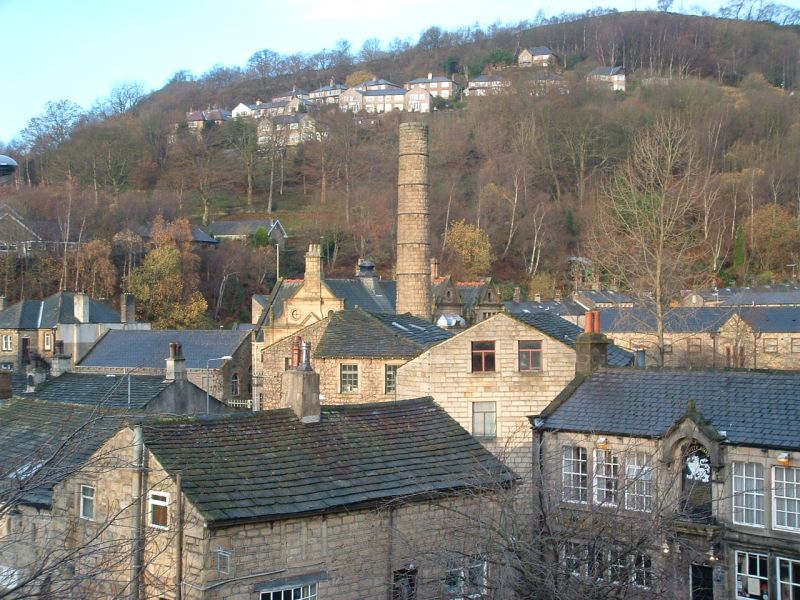
The Pennine towns and villages of what used to be called the West Riding of Yorkshire underwent rapid industrialisation in the nineteenth century. Small settlements which relied on sheep farming and hand loom weaving expanded as the mills arrived. There is a long history of non conformity here, ranging from the notorious Crag Vale coiners to the Luddites, who fought a losing battle against mechanisation.
As the mills began to disappear so they experienced a downturn. Curiously it wasn’t the kind of decline one sees today in so many of our towns, with boarded up shops, a drugs problem and other symbols of decay. Rather it was a gentler transition, as if they were simply reverting back to their pre industrial state.
The old mill towns used to be cheap places to live and at one time were well off the grid. As a consequence they attracted some interesting characters. For example, there was a maths lecturer with a dedication to real ale who bought the Rose and Crown in Holmfirth, reputedly for £4,500 and retained its draughty coal fired ambience. Stuart Christie (1946-2020) the anarchist also lived in these parts for a while. Not many people can have studied for their A levels in one of Franco’s jails. This was a world of pubs with peculiar names like the Slubber’s Arms; a place where they still grew teasles and hunted foxes on foot. Long before the growth of the Green movement hobby farmers could be found living in tumbledown houses with a byre attached, where they could rent a few fields and keep some cattle. It was a world which had adjusted to decline, without acquiring some of the unpleasant features associated with the term today.
These days Hebden Bridge is home to creative and media types who commute by rail to Leeds or Manchester. On weekdays the station car park has a good collection of expensive vehicles. Just beneath the surface, so to speak, the visitor can see what Hebden Bridge used to be like. These small Pennine towns were once fiercely independent and quite self contained. There are former bank and building society premises with fine sandstone facades, now fluttering with rainbow flags. Along from the old bank and next to a cocktail bar is the People’s Pizzeria, proving that even this kind of humble catering can also be radicalised in pursuit of sales.
Nearby is an estate agent and in its window the transformation of the place is boldly spelt out. One of the more curious architectural phenomena in the town is the under dwelling. The mill owners needed to house their workers and there wasn’t enough flat land to be had within easy walking distance of the workplace. The problem was solved by building one house on top of another. Access to the upper house was via a passage cut through the building. Once the cheapest and least desirable properties in town, things have changed. A merged over and under dwelling was advertised for sale at £475,000, a humble workman’s cottage at £280,000 and a 1970s semi, built out of ersatz sandstone, was offered at £400,000.
The Trades Club is a well known local venue (fully behind the Palestinian cause, naturally). It makes one wonder what the humble artisans who founded the place back in the 1920s might think of it, or indeed the Valley Organics Worker’s Cooperative. The club is advertising a Northern Soul event. This isn’t an amphetamine fuelled all nighter which veterans of the Wigan Casino might recall. Instead it runs between three and seven pm; more like the hours for a tea dance, which rather misses the point.
Near the Trades Club resides Thich Nhat Hahn, described as a ‘village traditional Zen master’. This is squeezed in near a rather exotic cheese shop which sells more than just a few wedges of Wensleydale. The shop is conveniently within easy reach of a wine merchant. Not far away is the Earth Spirit shop where among the array of crystals on sale is Aragonite ‘an earth healer’ which ‘combats anger and stress’. Yorkshire folk will be reassured to know that this crystal is attuned to the earth goddess. Clearly all essentials are catered for here.
The late John Morrison, a local writer, satirised Hebden Bridge as a place full of ‘cheery northern folk who are always popping next door for a cup of balsamic vinegar’. He also expressed his surprise that so many shops could survive selling worthless tat and thought the town had become as authentic as one of those old TV advertisements for Hovis bread.
The only time the working classes return in numbers is at weekends: predominantly couples of a certain age who wander about the place serenaded by street corner folk singers. They peer uncomprehendingly at exotic foodstuffs on market stalls, or fend off attempts by blue haired ladies to lure them into shops selling ethic garments. Otherwise the main working class presence is likely to be found waiting on tables in the many tea shops.
Outside its claim to be one big friendly place, a long time resident was quoted in Yorkshire Live magazine as saying that Hebden Bridge was ‘not a town any more’ and that seldom is the local accent heard on the streets. Some hold the view that it is now a place that serves tourists and holiday rentals. Alternative living is available here if you can afford it. The place is often described as quirky but in fact there is an overarching uniformity. Another Yorkshire based writer, Hazel Davies, refers to it as a place of like minded people with the same agenda and adds that whilst it is a good place to live if you fit in, that for all its free living all-embracing pretensions, it is a snob’s enclave.
William Hartley is a Social Historian


